Archive for February 2019

The opportunity of the century 

February 28, 2019

Source: The opportunity of the century – Israel Hayom

Doron Matza

The details of the Trump administration’s “deal of the century” are still under wraps, but the deal has become part of the election campaign and appears likely to keep the political system in turmoil throughout 2019.

The right wing is already responding negatively, both out of a sense of real danger and a desire to differentiate itself from the Likud and demonstrate uncompromising loyalty to the vision of the “complete land of Israel.” The New Right party has already expressed concern that the Trump plan could bring the ax down on its vision of annexing Judea and Samaria and shelve the hope of leveraging the Likud government to make a final decision on the future of parts of the country.

It looks like Prime Minister Benjamin Netanyahu, however, has a favorable attitude toward the deal. This might stem from tactical consideration but it is more likely that because of his position, he is more familiar with the details of the plan than the public at large. Throughout his time in office, Netanyahu has taken a realistic, practical approach on the Arab-Palestinian issue. While he is blocking the implementation of the two-state solution, and in recent years has even caused it to lose traction in international public opinion, he has also refrained from taking the opposite steps of applying Israeli sovereignty to Judea and Samaria or annexing those areas. As part of that approach, he has opted to foster the autonomic rule of the Palestinian Authority while promising Israeli security control without harming Jewish settlement.

That policy has proven itself effective: On the one hand, it has secured relative safety and quiet, while on the other, Israel hasn’t been forced to confront major questions about annexation and could maintain its Jewish, democratic character. At the same time, Netanyahu funneled resources into confronting the threat from Iran and strengthening Israel’s ties with Sunni Arab states.

The scraps of information being published about the “deal of the century” create the impression that it won’t oppose the deep reason for the past decade of Israeli policy under Netanyahu, and will even build on that policy and leverage it. According to various reports, the plan is based on changing Israel’s status in the region. The plan sees that change as leverage in creating a new geopolitical order based on economic growth as the key to securing the goal of all sane actors: bringing about stability and the eradication of flashpoints, like the Gaza Strip, by improving residents’ quality of life.

The deal of the century will apparently include the status of Judea and Samaria, as well as so-called concessions Israel will need to make, including some territorial ones. However, it is highly unlikely that the Palestine Liberation Organization and the PA leadership will be able to accept the general spirit of the plan, which will probably reflect the geopolitical and demographic reality developing on the ground, which means a significant step back from the Trilateral Statement U.S. President Bill Clinton issued after the Camp David talks between PLO leader Yasser Arafat and then-Prime Minister Ehud Barak blew up in 2000.

Palestinian opposition to the plan will allow Israel to deepen and expand the process of tightening relations with other Middle East countries. Moreover, it will give Israel a chance to promote a deal with the Palestinians that is not based on absolute, irreversible solutions – one that is already taking place, without any formal announcement, and is based on an autonomic Arab-Palestinian framework that would allow Israel to manage the tension between its desire to maintain security control and Jewish settlements and its aspiration to uphold the basic values of the Zionist movement in the form of a Jewish, democratic state.

Doron Matza is a researcher and lecturer on the Israeli-Arab conflict at Achva Academic College and a former member of the Shin Bet security agency.

Off Topic:  Trump, Kim open second nuclear summit with handshake, smiles 

February 27, 2019

Source: Trump, Kim open second nuclear summit with handshake, smiles | The Times of Israel

At initial greeting ahead of talks, both leaders make positive remarks without being specific on what they hope to achieve

HANOI, Vietnam (AP) — US President Donald Trump and North Korea’s Kim Jong Un opened their second summit Wednesday with hopeful words and a private chat before sitting down for dinner and further talks about North Korea’s pursuit of nuclear weapons.

The two exchanged smiles and a warm handshake in front of a phalanx of alternating American and North Korean flags.

They posed for cameras before disappearing for their private tete-a-tete, similar to one they had at their first historic meeting last year in Singapore.

“We made a lot of progress,” Trump said of their first summit. “I think the biggest progress was our relationship, is really a good one.”

Asked if this summit would yield a political declaration to end the Korean War, Trump said “We’ll see.”

Kim said he was “confident of achieving the great results that everyone will welcome.”

The venue, the colonial and neoclassical Sofitel Legend Metropole in the old part of Hanoi, came with a bit of irony.

Trump will be trying to convince Kim to give up his nuclear weapons at a hotel that has bomb shelter that protected the likes of actress Jane Fonda and singer Joan Baez from American air raids during the Vietnam War. According to the hotel’s website, the bunker was closed and sealed after the war ended in the mid-1970s. It was rediscovered by chance during a bar renovation project in 2011.

Trump was joined at dinner by Secretary of State Mike Pompeo and acting White House chief of staff Mick Mulvaney. Kim was accompanied by Kim Yong Chol, a former military spy chief and Kim’s point man in negotiations, and Ri Yong Ho, the foreign affairs minister. Interpreters for each side also attended.

Anticipation for what will be accomplished at the summit ran high in Hanoi. But the carnival-like atmosphere in the Vietnamese capital, with street artists painting likenesses of the leaders and vendors hawking T-shirts showing Kim waving and Trump giving a thumbs-up, contrasted with the serious items on their agenda.

Scoring a victory at the summit would offset Trump’s political troubles back in Washington, where Michael Cohen, his former personal attorney, was prepared to tell lawmakers that Trump is a “racist,” a “conman” and a “cheat.” Earlier in the day, after meeting with the president of Vietnam, Trump was unable to ignore the drama playing out thousands of miles away.


Bennett accuses Trump of ‘planning a Palestinian state right over our heads’ 

February 27, 2019

Source: Bennett accuses Trump of ‘planning a Palestinian state right over our heads’ | The Times of Israel

Escalating criticism of White House peace plan, New Right head calls on US president to ‘let my people know’ the details of his proposal

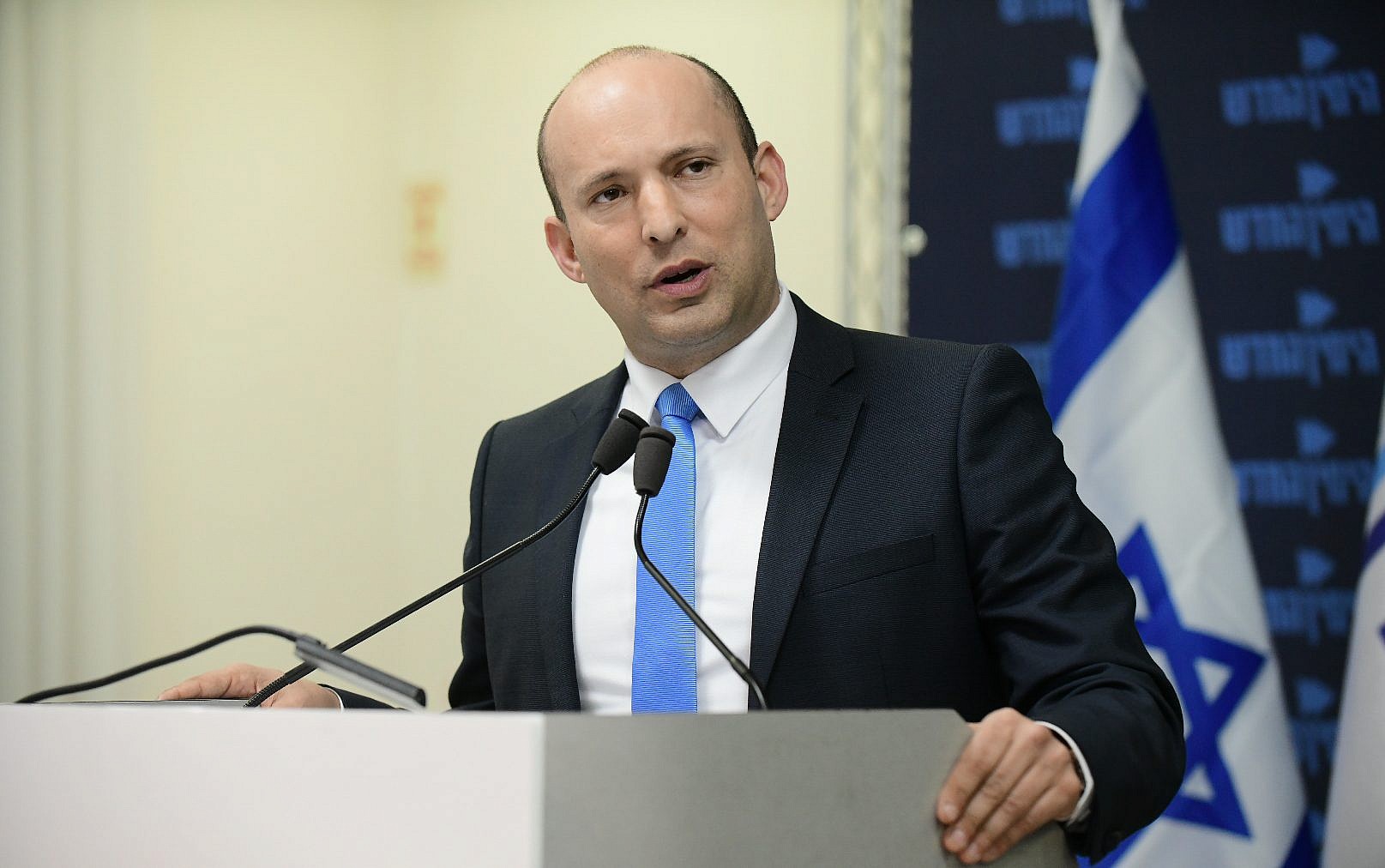
Education Minister Naftali Bennett speaking at a New Right party press conference in Tel Aviv on February 7, 2019. (Tomer Neuberg/Flash90)

Education Minister Naftali Bennett speaking at a New Right party press conference in Tel Aviv on February 7, 2019. (Tomer Neuberg/Flash90)

New Right chair Naftali Bennett launched a direct assault on Donald Trump Wednesday morning, accusing the US president of “planning a Palestinian state right over our heads,” and calling on him to release his closely guarded Middle East peace plan before Israel’s April elections.

‎‏”We all know the ‘deal of the century’ will be launched right after the Israeli elections, but we, the Israelis, are in the dark about the plan itself,” Bennett said in English-language comments during an address at a conference for local government in Tel Aviv.

While calling Trump “a true friend to Israel,” Bennett added that “friends do not keep secrets one from another.” The comment could be seen as a thinly veiled swipe at Prime Minister Benjamin Netanyahu, who has held talks with administration officials regarding Trump’s proposal, and whose Likud party is vying for the same voters Bennett’s New Right is aiming to win.

“It seems that everybody is in the loop, planning the Palestinian state right over our heads: the Americans, the Saudi prince, the Palestinians, the Jordanian king — even Erdogan of Turkey, blatant anti-Semite! Even he’s in the loop!” Bennett charged. “Everybody’s in the picture. Everybody but us, the people of Israel.”

In a wry parody of Moses’s biblical demand that Pharaoh release the Israelites from slavery, Bennett declared: “President Trump, let my people know.”

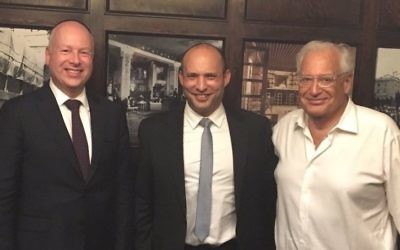
L-R: US President Donald Trump’s envoy to the Middle East Jason Greenblatt, Jewish Home chair Naftali Bennett and US Ambassador to Israel David Friedman after meeting in Jerusalem, July 12, 2017. (Jewish Home)


A spokesperson for the education minister said the remarks were a “direct request to President Trump” to reveal the plans immediately.

The Trump administration has closely guarded details of its peace proposal, which the president’s senior adviser and son-in-law Jared Kushner said last week would be released after Israeli elections on April 9.

Bennett, in comments aimed at the public as much as at Trump, said that due to the plan, the election was now “a referendum on the creation of a Palestinian terror state, which will threaten our very existence. This is not theory. This is about the lives of our children.”

“Let my people know what will happen to Jerusalem. It’s our land. It’s our lives. It’s our future. And it’s our right to decide our fate,” he added. “The Land of Israel has been our homeland for almost 4,000 years. Nobody can tear it apart. Nobody can divide Jerusalem again.”

The comments, the latest in a series of remarks by Bennett slamming both the as-yet-unrevealed peace proposal and Netanyahu for allegedly going along with it, came after Kushner gave an interview earlier this week on the administration’s plan, saying it will focus on “establishing borders and resolving final status issues.”

“The goal of resolving these borders is really to eliminate the borders. If you can eliminate borders and have peace and less fear of terror, you could have freer flow of goods, freer flow of people and that would create a lot more opportunities,” Kushner told Sky News Arabic on Monday.

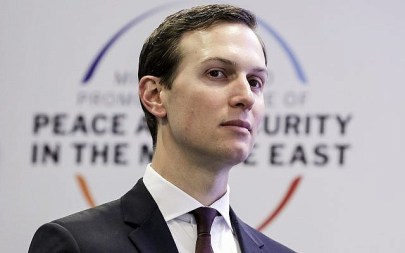
White House Senior Adviser Jared Kushner at a conference on Peace and Security in the Middle East in Warsaw, Poland, on February 14, 2019. (AP Photo/Michael Sohn)

Kushner said that since “very little has changed over the last 25 years,” the administration’s team had worked to “formulate realistic solutions for the issues of 2019, which will improve quality of life.

“We want to bring peace, not fear. We want to ensure there is free flow of people and of goods. We must create new opportunities,” he said.

Kushner also called for unified rule over the West Bank and the Gaza Strip, areas that are currently split between the internationally recognized Palestinian Authority and the Hamas terror group, respectively.

“We want to see the Palestinians united under one leadership; the Palestinians want a non-corrupt government that cares for their own interests,” he said.

Kushner said that the peace plan wants to help get the Palestinians “what’s been elusive to them for a long time.” But he did not explicitly mention a Palestinian state, nor did he even vaguely endorse a two-state solution.

Nonetheless, the statements set off a combative back-and-forth between New Right and Netanyahu’s Likud, with the two parties jostling to boost their right-wing credibility.

“There’s a clear and present danger in front of us: the establishment of a Palestinian state,” Bennett said Monday in response to the Kushner interview.

“What Kushner said proves what we already knew — the day after the elections the Americans will push the Netanyahu-Lapid-Gantz government to allow for the establishment of a Palestinian state… and for the division of Jerusalem,” Bennett said in a statement.

“There’s only one way to prevent this: a strong and powerful New Right party that will boost Netanyahu but put pressure on him against Palestine,” he said.

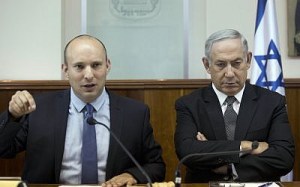
Prime Minister Benjamin Netanyahu, right, and Education Minister Naftali Bennett, left, attend the weekly cabinet meeting at the Prime Minister’s Office in Jerusalem, Tuesday, August 30, 2016. (Abir Sultan/Pool/via AP)

Likud responded to Bennett’s charges, saying on Monday: “When Bennett and [Ayelet] Shaked established the New Right they said they were doing it in order to pull votes from Lapid and Gantz to enlarge the right-wing bloc, and that they wouldn’t subject us to friendly fire. Now they are making false charges against Likud with the goal of pulling votes from Likud, which will bring about the rise of the left-wing government of Lapid and Gantz, whose party will be bigger than Likud.”

Likud further claimed that representatives of the New Right have “made contact with Lapid and Gantz to join them after the elections,” while Netanyahu “has made it unequivocally clear that he will form a right-wing government.

“Prime Minister Netanyahu has safeguarded the Land of Israel and the State of Israel against Obama’s hostile government and will continue to do so in the face of Trump’s sympathetic administration,” it said.

Responding to Likud’s claim that the New Right had held talks with Benny Gantz and Yair Lapid, heads of the centrist Blue and White party, Bennett’s party said: “The Likud announcement is pure fake news and utter nonsense. The pressure is clear… It’s the right or Palestine. Only the New Right will prevent the establishment of Palestine in the Land of Israel.”

Times of Israel staff contributed to this report.


British Labour party: Outlawing Hezbollah is unjustified 

February 27, 2019

Source: British Labour party: Outlawing Hezbollah is unjustified – Israel Hayom

Labour leader Jeremy Corbyn gives green light to party members to avoid voting in favor of the U.K.’s official designation of Hezbollah as a terrorist group • Home secretary must demonstrate that the decision was objective and impartial, Labour says.

News Agencies and Israel Hayom Staff // published on 27/02/2019
   
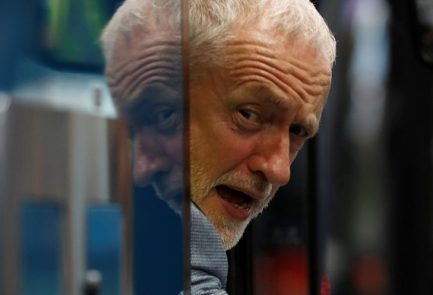
Head of Britain’s Labour Party Jeremy Corbyn 


U.K. Labour party leader Jeremy Corbyn on Tuesday gave the green light to party members to avoid voting in favor of the United Kingdom’s official designation of Hezbollah as a terrorist group.

On Monday, British Home Secretary Sajid Javid outlawed membership in Hezbollah or support for the terrorist group.

“Hezbollah is continuing in its attempts to destabilize the fragile situation in the Middle East and we are no longer able to distinguish between their already banned military wing and the political party,” Javid said. “Because of this, I have taken the decision to proscribe the group in its entirety.”

Labour said in a statement on Tuesday that Javid had to provide evidence to justify his decision to widen the ban on the terrorist group.

“The home secretary must therefore now demonstrate that this decision was taken in an objective and impartial way and driven by clear and new evidence, not by his leadership ambitions,” a Labour spokesman said.

Asked about the comments, Prime Minister Theresa May’s spokesman said it was for Labour to explain their decision.

“Hezbollah itself has publicly denied a distinction between its military and political wings. The group in its entirety is assessed to be concerned in terrorism,” he added.

“The links between the senior leaders of Hezbollah’s political and military wings as well as the group’s destabilizing role in the region mean that the distinction between the two wings is now untenable,” the spokesman added.

Corbyn has called members of Hezbollah his “friends.”


Iran’s president rejects resignation of Foreign Minister Zarif

February 27, 2019


Source: Iran’s president rejects resignation of Foreign Minister Zarif – Israel Hayom

Senior Revolutionary Guard commander: Zarif main person in charge of Iran’s foreign policy and has support of Supreme Leader Ayatollah Khamenei • Former official: Resignation could have domino effect Iran cannot tolerate under pressure of U.S. sanctions.

Reuters and Israel Hayom Staff // published on 27/02/2019
   
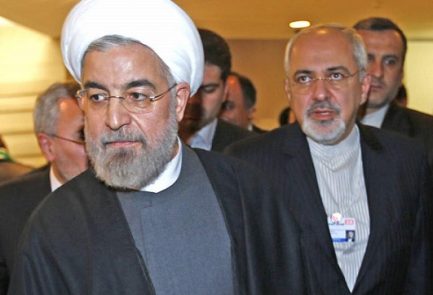
Iranian President Hassan Rouhani with Foreign Minister Mohammed Javad Zarif 


Iranian President Hassan Rouhani rejected on Wednesday the resignation of Foreign Minister Mohammad Javad Zarif, standing by an ally long targeted by hard-liners in internal factional struggles over a 2015 nuclear deal with the West.

Zarif – a U.S.-educated veteran diplomat who helped craft the pact that curbed Iran’s nuclear program in return for sanctions relief – announced his resignation on Instagram on Monday.

“As the supreme leader has described you as a ‘trustworthy, brave and religious’ person in the forefront of resistance against widespread U.S. pressures, I consider accepting your resignation against national interests and reject it,” Rouhani said in a letter published on state-run Islamic Republic News Agency.

In another show of confidence, senior Revolutionary Guard commander Qassem Soleimani said Zarif was the main person in charge of Iranian foreign policy and he was supported by the supreme leader, Ayatollah Ali Khamenei.

On Wednesday, Zarif thanked Iranians for their support.

“As a modest servant, I have never had any concern but elevating the foreign policy and the status of the foreign ministry,” he added in an Instagram post.

After Rouhani’s announcement, the semiofficial Iranian Students News Agency reported that Zarif had attended a ceremony to welcome Armenia’s prime minister to Tehran.

Zarif gave no specific reasons for his resignation.

But his move thrust the schism between Iran’s hard-liners and moderates into the open, effectively challenging Khamenei to pick a side.

The schism between hard-liners and moderates over the nuclear deal shows the tension in Iran between the two factions and between the elected government which runs the country on a day-to-day basis and a clerical establishment with ultimate power.

An ally of Zarif told Reuters his resignation was motivated by criticism of the nuclear accord, under increasingly intense fire in Iran since the United States abandoned it last year.

Since the United States walked out of the nuclear deal and reimposed sanctions, Rouhani has had to explain to critics why Iran has continued to abide by its restrictions while reaping virtually none of the foreseen economic benefits.

Uncertainty

The political uncertainty comes at a difficult time for Iran’s leaders as the reimposed U.S. sanctions have dashed hopes of an economic breakthrough. Rouhani has warned that the country is facing the worst economic crisis in 40 years.

Hardships have triggered waves of nation-wide protests, with calls for both Rouhani and clerical leaders to step down.

Some unconfirmed Iranian media reports indicated Zarif had resigned because he had not been informed about a visit by Syrian President Bashar Assad on Monday.

Zarif was quoted as condemning “factional fighting” in a newspaper interview published on Tuesday – suggesting political tensions may have played a part in his decision. The Fars news agency reported that the interview had taken place last week, before Zarif’s resignation.

A former pro-reform official warned of dire consequences of Zarif’s resignation is accepted.

“If accepted, it will have a domino effect … and others and even Rouhani might follow him, and this is not something that the country can tolerate when pressured by America and sanctions,” he said.

“Hard-liners will be strengthened and any kind of reform will be buried for at least 10 years.”


Dershowitz: Indicting PM would open Pandora’s box 

February 27, 2019

Source: Dershowitz: Indicting PM would open Pandora’s box – Israel Hayom

A decision to indict PM Netanyahu on corruption charges in Case 2,000 would “endanger democracy and freedom of the press,” Alan Dershowitz writes in an open letter to Attorney General Avichai Mendelblit, urging him to “consider the dangerous implications.”

Yehuda Shlezinger and Israel Hayom Staff // published on 27/02/2019
   
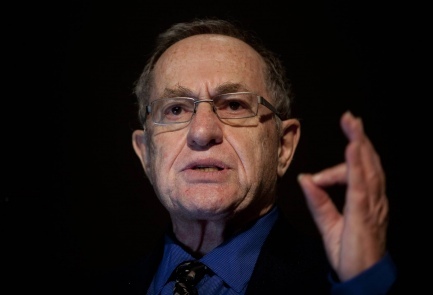
Professor Alan Dershowitz 


A decision to indict Prime Minister Benjamin Netanyahu on corruption charges in Case 2,000 would “endanger democracy and freedom of the press,” Professor Alan Dershowitz wrote in an open letter to Attorney General Avichai Mendelblit on Tuesday.

Dershowitz, one of the most prominent Jewish lawyers in the United States and in the world, posted the letter on his Twitter page.

“Such charges would open up a Pandora’s box out of which would flow a parade of horribles: Every government official – legislators, judges, prosecutors, police offices, administrators – who sought positive coverage in the media, and then did anything that helped the media, would have to be investigated,” Dershowitz wrote.

In Case 2,000, Netanyahu allegedly supported a law that would curtail Israel Hayom to gain fairer coverage from its competitor Yedioth Ahronoth in a deal struck with its publisher Arnon “Noni” Mozes. Netanyahu ultimately voted against the law, leaving prosecutors to deal with possible motives but no real evidence.

“In the Yedioth Ahronoth matter, more than 40 Knesset and cabinet members voted in favor of the newspaper, while [Netanyahu] effectively killed the bill and went to elections. Many of the Knesset members then received positive coverage in Yedioth Ahronoth. Yet they were not investigated. Only the prime minister, who killed the bill, is being prosecuted. This disparity illustrates the enormous discretion prosecutors have in selectively prosecuting alleged violators of this open-ended prosecutorial tool.

“There is no limiting principle to this open-ended intrusion of the criminal law into the delicate, and legally protected, relationship between government officials and the media.”

The letter continued: “Any such charge would give law enforcement far too much power to dictate to the media and to officials they cover how they relate to each other. In a democracy, criticism of the relationship between media and government should be left to voters, not prosecutors.

“I urge you, Mr. Attorney General, to consider the dangerous implications for democracy and freedom of the press if you go forward with these charges against the prime minister.”


America as sheriff, rather than cop 

February 27, 2019

Source: America as sheriff, rather than cop – Israel Hayom

Clifford D. May

Precipitously and with no plan in place, U.S. President Donald Trump late last year announced his intention to withdraw all U.S. troops from Syria.

Until then, roughly 2,000 special operators, backed by combat aircraft, had exemplified the concept of “economy of force.” Achieving a lot with a little, enabling local allies to fight much more effectively than they could have on their own, they decimated the Islamic State group and helped contain the Islamic Republic of Iran.

It seemed to me and others – Trump’s top military and national security advisers among them – that he had made a significant and unforced error, one that could only encourage America’s adversaries in the Middle East and beyond, e.g., Pyongyang, Moscow, Beijing and suburban Kandahar.

Then, last Friday, the president changed his mind, deciding to leave about 400 troops in Syria. Can a force of that size do the job that needs to be done? No. But some European allies who have been sharply critical of Trump’s decision to bug out are now considering committing more of their own troops to make up the difference. In other words, Trump may succeed in getting Europeans to do serious burden-sharing in this by-no-means-ended conflict.

If so, credit is due to Sen. Lindsey Graham who pushed hard for such a plan, both with the president in private, and publicly at the annual international security conference in Munich earlier this month.

Graham was quick to praise the commander-in-chief for deciding to “follow sound military advice,” thereby ensuring “that we will not repeat the mistakes of Iraq, in Syria. For a small fraction of the forces we have had in Syria, we can accomplish our national security objectives. Well done, Mr. President.”

This episode raises a broader strategic issue. Significant factions on both the Left and Right are adamant that America not be the world’s policeman. A question that should arise: If the U.S. won’t do that job, who will?

Not Denmark, Japan or Costa Rica. The U.N. isn’t up to the task and never will be. But if no one stands up to international thugs and gangsters we know what happens: They take over – country after country, region after region.

Isolationists on the Right say: “So what? Beyond our borders, it’s not our business.” They will appear to be correct until it becomes obvious they were disastrously wrong, as they were in the 1930s when they contended that the U.S. should do nothing to stop the Nazis and Japanese imperialists. (The most hardcore isolationists on the Right still believe that.)

Isolationists on the Left agree but for a different reason: They see America as oppressive and they are oddly unconcerned about what Chinese communists do to Uighurs and Tibetans, what Bolivarian socialists have done to Venezuela, and what theocrats in Tehran are doing to Syrians, Lebanese, Yemenis, and Iraqis. (The most hardcore isolationists on the Left still blame the U.S. for the Cold War.)

That said, I’m not going to make a case for America as global policeman. But is it not possible to steer a path between interventionism and isolationism? What if the U.S. were to see itself not as a policeman but as a sheriff instead?

Unlike the cop on the beat, the lawman in the Wild West isn’t expected to make arrests for every transgression. He doesn’t worry about the painted ladies and the gamblers in the saloon. But he will appoint deputies and raise a posse to stop the worst outlaws from riding roughshod throughout the territory.

This concept is not new. Back in 1997, a time when most people still believed Russia was democratizing and China moderating, a time when jihad was a word seldom heard, Dr. Richard Haass, a diplomat and scholar, now president of the Council on Foreign Relations, wrote a book titled “The Reluctant Sheriff: The United States After the Cold War.”

In it, he noted that the policeman has “a greater degree of authority, a greater capacity to act alone and a greater need to act consistently than is being advocated here. By contrast, a sheriff must understand his lack of clear authority in many instances, his need to work with others, and, above all, the need to be discriminating in when and how he engages.”

Haass likened posses to coalitions that “will vary from situation to situation, as will the purpose and even authority; what will be constant is the requirement for American leadership and participation from states and actors willing and able to contribute in some form.”

In an email exchange with me last week, Haass wrote: “The bottom line is that the U.S. as sheriff is essential because the world doesn’t order itself and there is no other candidate with the capacity, habits, etc.” He added: “What Trump seems to miss is that the benefits of our fulfilling that role far outweigh the costs, and the costs are high if we do not assume that role.”

Yes, but with prodding from Graham and other wise men, the president’s views appear to be evolving. No less consequential, Europeans may be recognizing that they sometimes have to load their six-shooters, saddle up and join the posse. The alternative is to be left alone watching the sheriff ride off into the sunset.

Clifford D. May is president of the Foundation for Defense of Democracies and a columnist for The ‎Washington Times.‎

Zarif defeated at home 

February 27, 2019

Source: Zarif defeated at home – Israel Hayom

Yossi Mansharof

The resignation of Iranian Foreign Minister Mohammad Javad Zarif didn’t come as a complete surprise. It reflects heated discourse within the regime over the Financial Action Task Force law.

While Iranian President Hassan Rouhani’s camp, of which Zarif is a senior member, worked with all its might to advance the law, the opposition camp – particularly the Iranian Revolutionary Guard Corps and its foreign arm, the Quds Force – has worked feverishly to shelve it. Ultimately the regime’s Assembly of Experts of the Leadership, whose job it is to ratify Iranian parliamentary legislation, quashed the law and ruled in favor of the IRGC.

The law was supposed to have forced Iran’s banking system – known for its money laundering services on behalf of the IRGC – to abide international obligations and would have put an end to the current situation whereby Iranians banks serve as an important conduit for the financing of terror. By pursuing financial ties with Iran, in the wake of the Trump administration’s withdrawal from the 2015 nuclear accord, European companies put themselves in jeopardy of heavy punitive measures by the United States. A commitment of this sort, suffice it to say, is unacceptable to the IRGC and those in Ayatollah Ali Khamenei’s close circle.

The latter are afraid that ratifying the law would bar Iran from continuing to fund its transnational network of militias, primarily Shiite, and the regime of Syrian President Bashar Assad. This financial support, estimated at billions of dollars, is a central component of Iranian foreign policy and its strategic efforts to export the Islamic revolution across the region.

In recent months, Zarif, for whom the nuclear deal was the crown jewel of his political career, has tried signaling his camp’s desire to implement a more pragmatic approach. Consequently, disagreement on this issue led him to butt heads with the Khamenei camp.

In his first comments following his resignation, Zarif explained that being kept out of the loop regarding Assad’s surprise visit to Tehran hindered his ability to continue serving as foreign minister. It appears this was simply a catalyst expediting his desire to step down that the real reason for his resignation was the denial of the FATF proposal to outlaw money laundering. The built-in tension between the foreign minister and the IRGC, specifically the Quds Force, was a thorn in Zarif’s side from his first day in office in 2013. It is known, for example, that the appointment of foreign envoys is dependent on the IRGC’s approval. Additionally, in light of the IRGC’s dominance in Syria and in Iran’s Supreme National Security Council, Zarif played a relatively minor role in determining the country’s policy.

As of the writing of these lines, certain political circles in Iran were trying to keep Zarif in office. His resignation, if approved by Rouhani, will mark a watershed moment – along with other developments in the Iranian political sphere – indicating the IRGC’s utter supremacy in Iranian politics.

In line with its growing status in the Iranian regime, it’s safe to infer that the IRGC will also hold considerable sway on another important matter in the near future: determining Khamenei’s successor.

Israel has no choice but to turn the spotlight, with an emphasis on the political and public discourse in key Western countries, on the IRGC and its positions on this and others matter, including the IRGC’s proclivity for terrorist activity on European soil.

Off Topic:  Major clashes bring India and Pakistan to brink of third war over Kashmir – DEBKAfile

February 27, 2019

Source: Major clashes bring India and Pakistan to brink of third war over Kashmir – DEBKAfile

According to conflicting reports on Tuesday, Feb. 26, Pakistan says it shot down two Indian jets over Kashmir, while India claims to have shot down a Pakistani fighter jet. Pakistan said it had “taken strikes at [a] non-military target, avoiding human loss and collateral damage” Indian authorities said the Pakistani jets had been pushed back.

Two weeks ago, tensions between the two nuclear-armed powers flared after a Pakistani Jaish-e-Muhammed terrorist carried out a suicide attack on a bus carrying Indian Border Guard police officers and killed 44, the deadliest terrorist attack since Kashmir was partitioned between India and Pakistan in 1947.

On Feb. 26, the Indian air force retaliated for the attack with strikes against targets in Pakistan, which responded with cross-border artillery shelling of Indian sites in Kashmir. Pakistan then claimed to have shot down two Indian Air force jets over the Pakistani side of Kashmir and taken two pilots captive, one injured. India confirmed the loss of an MIG21 fighter and said that a pilot was missing. During this air fight, Pakistan closed its air space to commercial flights, while India followed suit, although limiting the closure to areas close to embattled Kashmir.

In the wars between the two powers over Kashmir, India has lost more than 70,000 dead. Indian Kashmir has a population of 7 million, both Hindu and Muslim. The Pakistan side has 6 million inhabitants, almost all Muslim.

DEBKAfile notes that, while Kashmir is a long-rankling issue between New Delhi and Islamabad, both tend to scale up military tensions over the disputed territory when security concerns arise on the Indian subcontinent in other fields. This time, it was sparked by the Afghan peace talks in progress between the US and Taliban leaders.

Pakistan, which has strained relations with the Trump administration, suspects that the Americans aim to oust its positions of influence in Kabul and open the door for the Indians to step in. Last week Saudi Crown Prince Muhammad bin Salman visited both capitals and tried his hand at mediation. But tensions were so high, that the prince could not cross the border and was forced to return to Riyadh before flying back to India. Since then, Pakistan and India began trading serious air and ground warfare.


Israel seeks Russia’s approval to operate against Iran in Syria – TV7 Israel News 25.02.19 

February 26, 2019