Archive for February 2019

US troops to leave Syria by end of April — report

February 9, 2019

Source: US troops to leave Syria by end of April — report | The Times of Israel

Military officials tell Wall Street Journal that a significant portion of the American military presence will be withdrawn from war-torn country by mid-March
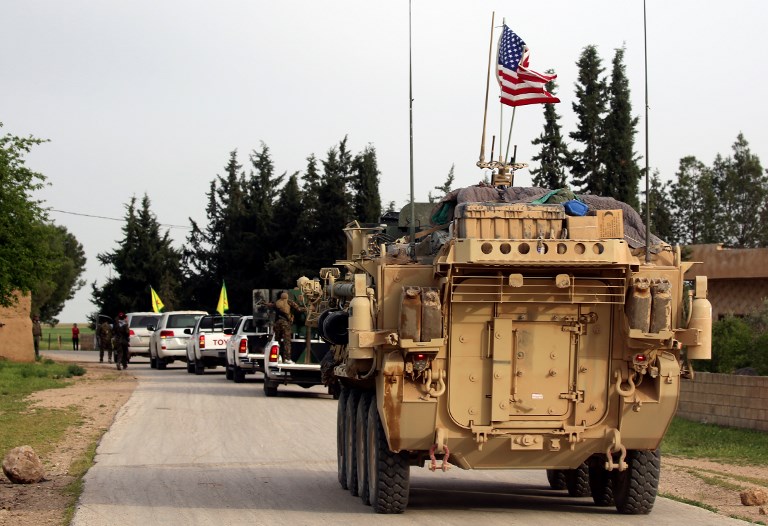
In this photo from April 28, 2017, US forces, accompanied by Kurdish People's Protection Units (YPG) fighters, drive their armored vehicles near the northern Syrian village of Darbasiyah, on the border with Turkey. (Delil Souleiman/AFP)

In this photo from April 28, 2017, US forces, accompanied by Kurdish People’s Protection Units (YPG) fighters, drive their armored vehicles near the northern Syrian village of Darbasiyah, on the border with Turkey. (Delil Souleiman/AFP)

The US military is preparing to pull all American forces out of Syria by the end of April, current and former US officials said Thursday.

According to the Wall Street Journal, which cited the unnamed officials, the US will pull a significant portion of the 2,000 troops currently serving in the war-torn country out by mid-March, and continue its evacuation of the country over the following month.

The Pentagon declined to comment to the newspaper on the plans.

US President Donald Trump abruptly tweeted plans for a US pullout from Syria in December, arguing that the Islamic State group had been defeated even though his intelligence chiefs have said it remains a threat. The move was welcomed by Russian President Vladimir Putin, but met with concern from Israel.
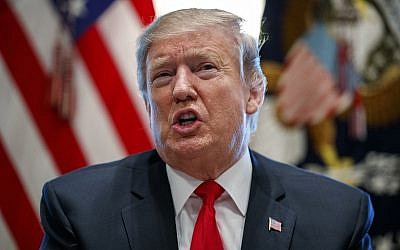
In this February 1, 2019, photo, US President Donald Trump speaks in the Cabinet Room of the White House in Washington. (AP Photo/ Evan Vucci)

The US leader had long questioned America’s multiple and seemingly interminable wars, but his withdrawal order came as a shock to Washington, upending years of doctrine in Syria.

Trump made his decision after a phone call with Turkish President Recep Tayyip Erdogan, who had said Istanbul would lead the fight against IS remnants in Syria.

IS jihadists have lost territory since Trump’s surprise announcement, but military officials warn the fighters could regroup within six months to a year after the Americans leave.

Gen. Joseph Votel, the commander of US forces in the Middle East, told a Senate committee Tuesday that battlefield gains can only be secured by “maintaining a vigilant offensive,” saying IS still has “leaders, fighters, facilitators, resources and the profane ideology that fuels their efforts.”

He estimated there are between 1,000 and 1,500 IS fighters in the small area they still control, but said others have “dispersed” and “gone to ground.”
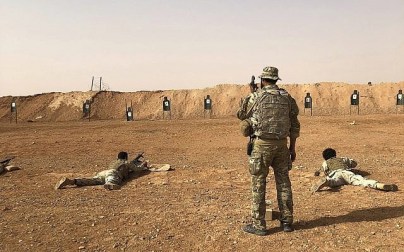
Members of the Maghawir al-Thawra Syrian opposition group receive firearms training from US Army Special Forces soldiers at the al-Tanf military outpost in southern Syria on October 22, 2018. (AP/Lolita Baldor)

The extremists have a long history of exploiting security vacuums, and may find another one in the coming months as US troops leave Syria.

Israeli officials have expressed worries that the pullout could give Iran greater leeway to entrench itself militarily in Syria. Recent reports have indicated the US is considering leaving some troops in place at the al-Tanf base in southern Syria, which is seen as a key bulwark against Iran.
 

Russia says Israel must limit attacks on targets in Syria 

February 9, 2019

Source: Russia says Israel must limit attacks on targets in Syria | The Times of Israel

Moscow’s deputy foreign minister warns strikes across border ‘destabilize the situation even more,’ but notes military hotline is working

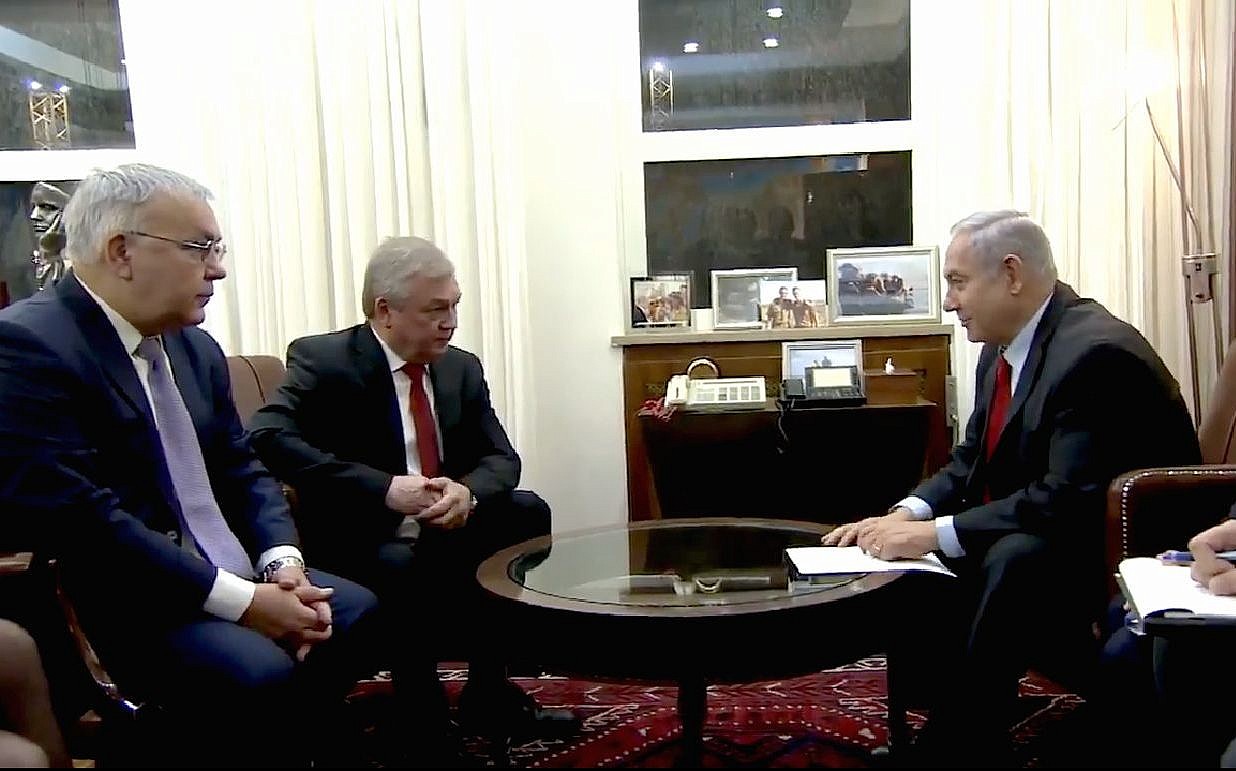
Prime Minister Benjamin Netanyahu holds talks on Iran and Syria with Russian President Vladimir Putin’s special envoy for Syrian affairs, Alexander Lavrentiev and Russian Deputy Foreign Minister Sergey Vershinin in Jerusalem, January 29, 2019.

Russian Deputy Foreign Minister Sergey Vershinin on Friday called on Israel to limit strikes on Syrian territory, saying that each strike raised the prospect of further conflict in the region.

“With regard to the latest Israeli attacks, we said that such arbitrary attacks on sovereign Syrian territory should be stopped and excluded,” Vershinin said, according to Russian news agency Sputnik. “Any strikes destabilize the situation even more. No one should conduct actions in Syria that go beyond the scope of anti-terrorist objectives.”

However, Vershinin added that military coordination between Russia and Israel was working in the wake of last year’s incident, where Syria shot down a Russian aircraft during an Israeli raid. Russia blamed Israel, which rejected the charge.

“We obviously want a more efficient deconfliction mechanism. We want to avoid incidents similar to what happened to our aircraft,” Vershinin said. “The military line of deconfliction is steadily working, the line has been operational for over a year and we are improving it.”

On Wednesday, Iranian Foreign Minister Mohammad Javad Zarif said that a trilateral summit later this month between representatives of the Islamic Republic, Russia, and Turkey will touch on Israel’s airstrikes in Syria.

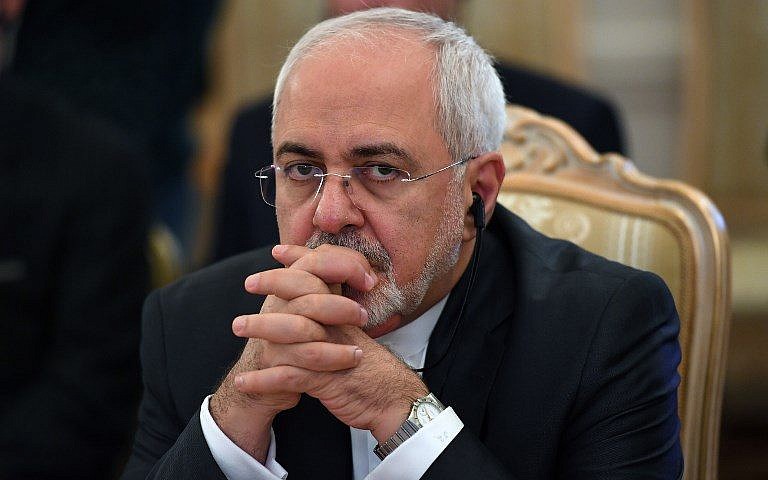
Iran’s Foreign Minister Mohammad Javad Zarif attends a meeting of foreign ministers of the Caspian Sea littoral states in Moscow on December 5, 2017. (AFP PHOTO / Kirill KUDRYAVTSEV)

Zarif told Russia’s RT news network that nations at the February 14 Sochi Summit will also review the planned withdrawal of US forces from Syria.

His comments regarding a response to the airstrikes followed a series of reciprocal taunts by Israeli and Iranian leaders amid rising tensions on the Israeli-Syrian border between Israeli and Iranian forces.

Israel says it has carried out hundreds of airstrikes on Iranian-linked targets as part of a campaign to prevent Tehran from establishing a military presence in Syria.

On Tuesday, Prime Minister Benjamin Netanyahu announced that he will travel to Moscow for a meeting with Russian President Vladimir Putin, their first formal meeting since Russia blamed Israel for the downing of a military aircraft by Syrian anti-aircraft fire over Syria.

Russian President Vladimir Putin, Iranian President Hassan Rouhani and Turkish President Recep Tayyip Erdogan, attend a press conference after meeting in Tehran on September 7, 2018.(Mikhail KLIMENTYEV/AFP/SPUTNIK )

Netanyahu said he will fly to Russia on February 21 for talks focused on Iranian efforts to establish a military presence in Syria. His office said the Israeli and Russian leaders would also discuss regional issues and improving security coordination between the countries’ militaries in Syria. There was no immediate confirmation from the Kremlin.

Their meeting will also be their first since US President Donald Trump announced in December he would pull out all American soldiers from Syria in a move welcomed by Putin, but which has been met with concern in Israel.


Iran opposition group calls for regime change in Paris march

February 9, 2019

Source: Iran opposition group calls for rime change in Paris march | The Times of Israel

Thousands attend annual rally held by People’s Mujahedeen, months after European authorities thwarted alleged Tehran-backed plot to bomb event

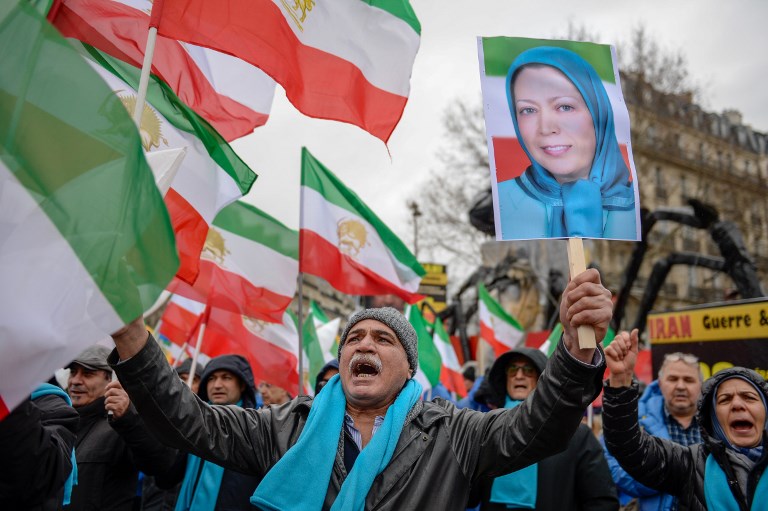
People wave former Iranian flags and a picture of Maryam Rajavi, leader of the People's Mujahedin of Iran, during a demonstration of the exiled Iranian opposition to protest against the Iranian government on February 8, 2019 in Paris. (AFP)

People wave former Iranian flags and a picture of Maryam Rajavi, leader of the People’s Mujahedin of Iran, during a demonstration of the exiled Iranian opposition to protest against the Iranian government on February 8, 2019 in Paris. (AFP)

PARIS — Several thousand supporters of an exiled Iranian opposition group marched through Paris on Friday, calling for an end to Iran’s clerical regime 40 years after the Islamic Revolution toppled Iran’s monarchy.

The People’s Mujahedeen (MEK) were joined at the rally by an array of speakers before the march, from former and current French politicians to a one-time Algerian prime minister and a Syrian opposition figure.

Crowds waved posters of group leader Maryam Rajavi and founder Massoud Rajavi — not seen since 2003 in Iraq, where the MEK once had a camp and waged war against Iran before being disarmed by invading US troops.

The group bases its headquarters outside Paris with several thousand members in Albania, extracted in a UN-brokered effort from Iraq. Supporters are scattered elsewhere in the West as part of the Iranian diaspora.

Security was tight during the rally and march through Paris’ Left Bank. The group’s annual rally last year was the target of an alleged Iranian government bomb plot, which was thwarted by arrests.

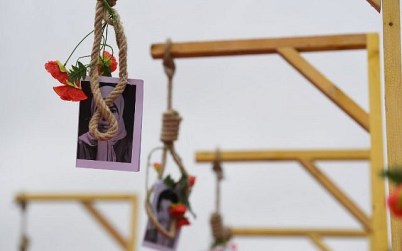
A picture shows a portrait of an Iranian and flowers placed on a gallows, during a demonstration of the exiled Iranian opposition to protest against the Iranian government on February 8, 2019 in Paris. (Alain JOCARD / AFP)

Belgium announced last July that it had arrested a couple of Iranian origin in a Brussels suburb who were suspected of preparing to drive a car packed with explosives to the French rally. But a total of six people, including an Iranian diplomat based in Vienna, were later detained in coordinated raids by European police.

Israel’s Hadashot news reported at the time that intelligence provided by the Mossad spy agency led to the arrests of the Iranian suspects.

French authorities accused Iran’s intelligence ministry of orchestrating the bombing, but Tehran firmly denied any involvement, and claimed the MEK orchestrated the plot to discredit Tehran as it sought to salvage the nuclear deal with European signatories.

“As long as we’re dealing with the main state sponsor of terrorism, there is a concern … But that will never stop us,” MEK spokesman Shahin Gobadi said. The MEK hones to US President Donald Trump’s hard line on Iran, and supports US sanctions on Iran.

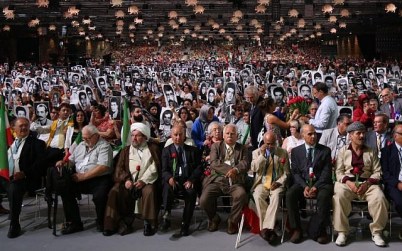
People hold pictures of relatives killed by the Iranian regime during the ‘Free Iran 2018 – the Alternative’ event on June 30, 2018, in Villepinte, north of Paris. Six people were arrested in Belgium, Germany and France for an alleged plot to attack the rally, including an Iranian diplomat and his wife. (AFP Photo/Zakaria Abdelkafi)

One of the speakers at Friday’s rally, former French senator Jean-Pierre Michel, said in an interview that “I’m not a fanatic of Mr. Trump … but I think the United States is right about Iran.” He chastised Europeans for what he views as their softer approach to Tehran.

Michel, 80, is a long-time supporter of the MEK, which has drawn around it numerous US and European parliamentarians and former officials who disagree with critics’ portrayal of the organization as cult-like.

He praised MEK for having a woman at its head who says she wants democracy and separation of church and state in a future Iran, and he hopes one day to visit Tehran with Rajavi, saying, “It keeps me alive.”


Hezbollah leader calls on Lebanon to accept arms from Iran to confront Israel

February 9, 2019

Source: Hezbollah leader calls on Lebanon to accept arms from Iran to confront Israel | The Times of Israel

Speaking at an event to mark 40 years since the Islamic Revolution, Hassan Nasrallah also vows that his terror group would fight alongside Iran in the event of a war with the US

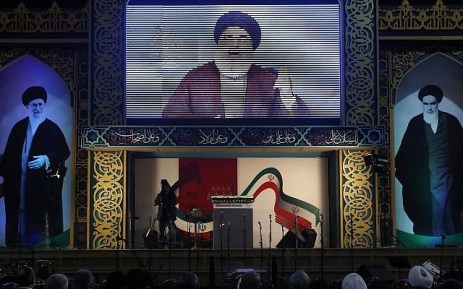
Hezbollah leader Hassan Nasrallah delivers a live broadcast speech, during a rally to commemorate the 40th anniversary of Iran's Islamic Revolution, in southern Beirut, Lebanon, Wednesday, Feb. 6, 2019. (AP Photo/Hussein Malla)

Hezbollah leader Hassan Nasrallah delivers a live broadcast speech, during a rally to commemorate the 40th anniversary of Iran’s Islamic Revolution, in southern Beirut, Lebanon, Wednesday, Feb. 6, 2019. (AP Photo/Hussein Malla)

The leader of Lebanese terrorist group Hezbollah said Wednesday that he is willing to ask Iran to supply the Lebanese military with weapons and aerial defense systems to confront Israeli warplanes and called on Beirut to accept the offer.

“Will the Lebanese government dare to accept the Iranian proposals? Why should Lebanon remain afraid to cooperate with Iran?” Nasrallah said in a televised address marking the 40th anniversary of the Iranian revolution and the overthrow of the Shah.

“I’m a friend of Iran and I’m willing to bring the Lebanese Army air defense systems from Iran to confront Israel,” Nasrallah said according to Lebanon’s Naharnet news site.

Nasrallah spent over an hour extolling Iran and the Islamic revolution’s political and economic accomplishments.

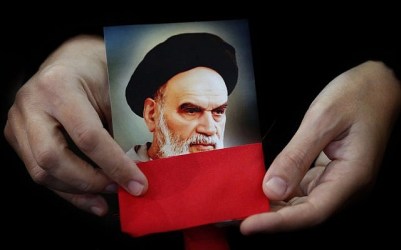
A Hezbollah supporter holds a portrait the late Iran revolutionary founder Ayatollah Khomeini, during a rally to commemorate the 40th anniversary of Iran’s Islamic Revolution, in southern Beirut, Lebanon, Wednesday, Feb. 6, 2019. (AP Photo/Hussein Malla)

The Shiite group was formed in 1982 under the guidance of Iran’s Revolutionary Guard to combat Israel. It has been Iran’s most successful investment abroad, serving as the Islamic Republic’s arm at Israel’s doorstep.

The group dominates the political and military landscape of Lebanon and possesses tens of thousands of trained fighters as well as an array of sophisticated armaments. Its intervention in Syria on the side of President Bashar Assad also expanded its influence and reach in the region.

At home, the group remains the unrivalled armed force, also making significant political gains along with allies in the last parliamentary elections. This positioned the group to secure three ministerial posts in the new government, sworn in last week, including the powerful Health Ministry, which has one of the country’s largest budgets.

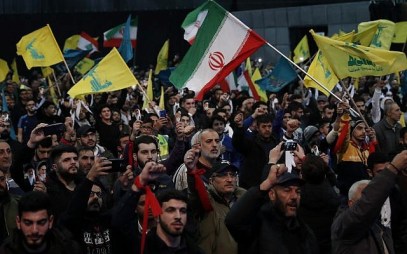
Hezbollah supporters shout slogans and wave Lebanese, Hezbollah and Iran flags, during a rally to commemorate the 40th anniversary of Iran’s Islamic Revolution, in southern Beirut, Lebanon, Wednesday, Feb. 6, 2019. (AP Photo/Hussein Malla)

Nasrallah also vowed that the organization would defend Iran in the event of war, saying the Islamic Republic would not be alone in a confrontation with America.

Nasrallah said the Islamic Republic is currently the strongest state in the region, and the so-called axis of resistance led by Iran is the strongest it has ever been. The axis groups Assad with Shiite militias in Iraq and Hezbollah.

“If America launches war on Iran, it will not be alone in the confrontation, because the fate of our region is tied to the Islamic Republic,” he said.

Speaking via a large screen, Nasrallah said America is set to retreat from the region and has no real option to squeeze Iran except with sanctions.

“We see the struggle in the region may escalate and may take different forms but in all cases, today the Islamic Republic is the strongest state in the region … and America is headed for more withdrawals and retreats from the region,” he said.

He admitted that Hezbollah was “affected” by the US sanctions on Iran, but vowed the terrorist group would “overcome the difficulties” through its “firmness, will and resolve.”


Praising Hezbollah, Russian envoy claims US could spark new Israel-Lebanon war

February 9, 2019

Source: Praising Hezbollah, Russian envoy claims US could spark new Israel-Lebanon war | The Times of Israel

Moscow’s ambassador in Beirut says US stance toward Iran is destabilizing region, hails terror group for fighting alongside Russia in Syria

Russian Ambassador in Lebanon Alexander Zasypkin in Beirut, Lebanon, May 16, 2016. (Hassan Ammar/AP)

Russian Ambassador in Lebanon Alexander Zasypkin in Beirut, Lebanon, May 16, 2016. (Hassan Ammar/AP)

Russia’s ambassador in Beirut said US policies toward Iran could set off a fresh war between Israel and Lebanon, while championing the country’s Iranian-backed Hezbollah terror group.

Though he said renewed fighting between the sides remained uncertain, Alexander Zasypkin accused the United States of inciting “new conflicts” that he said could draw in countries and actors throughout the Middle East.

“As for a conflict between Israel and Lebanon, nothing can be predicted with certainty because the region is at a crossroads. Peoples are demanding the settlement of existing crises, the return to a peaceful life, the development of cooperation,” Zasypkin told the state-owned Sputnik news agency in an interview published Saturday.

“A negative alternative to this is the incitement of new conflicts by the Americans, which could involve many countries as well as ethnic and religious forces,” he added.

Zaspykin also claimed the US stance toward Iran and Hezbollah was further destabilizing the region.

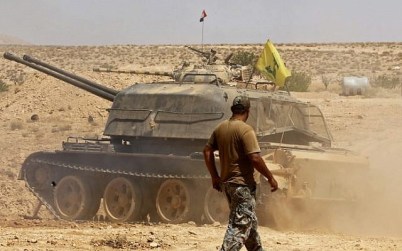
Illustrative image of a tank flying the Hezbollah terror group’s flag seen in the Qara area in Syria’s Qalamoun region on August 28, 2017 (AFP Photo/Louai Beshara)

The US has long accused Iran of sowing instability in the Middle East through its support of terrorist and militia groups, as well as its support for Syrian President Bashar Assad’s regime in the Syrian civil war.

The Syrian government has also received extensive military backing from Russia and Hezbollah.

“When events started unfolding in Syria, Hezbollah sided with its lawful authorities, seeing the fight against terrorists in the region as its duty,” said Zaspykin, echoing a claim from the Assad regime that all its opponents are terrorists.

“The party took a responsible approach to what was happening in Syria and the region as a whole and contributed significantly to terrorists’ defeat,” he added.

Zaspykin’s comments come a week after Lebanon announced the formation of a new government following a nine-month deadlock.

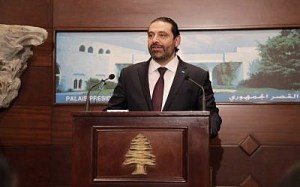
Lebanese Prime Minister Saad Hariri addresses the media after announcing the new cabinet during a press conference at the presidential palace in Baabda, east of the capital Beirut, on January 31, 2019. (Anwar Amro/AFP)

The new government is headed by Prime Minister Saad Hariri, the Western-backed Sunni politician who has held the job since 2016. But Hezbollah, the powerful Iran-backed Shiite group, made significant gains at the expense of the largest Sunni party and now controls three government ministries.

The Trump administration expressed concerns about Hezbollah holding three Cabinet posts and called on the new government to ensure that group is not supported by the ministries’ resources, while the United Nations said Friday that all Lebanese factions should stay out of foreign conflicts in a message clearly aimed at Hezbollah.

Zaspykin brushed aside concerns about Hezbollah’s inclusion in the new government and said the terror group’s leader was acting as a force of restraint.

“After the formation of a new government, the party’s secretary general, Hassan Nasrallah, notably urged political forces to refrain from fighting among themselves and to take on massive challenges the country faces,” he told Sputnik.

Prime Minister Benjamin Netanyahu has said Hezbollah’s role in the new government showed Iran was in control of Lebanon, leading Nasrallah to accuse the premier of “inciting” Western powers against Lebanon.

Days later, Nasrallah gave a speech extolling Iran and said he is willing to ask it to supply the Lebanese military with weapons and aerial defense systems to confront Israeli warplanes, while calling on Beirut to accept the offer.

Hezbollah leader Hassan Nasrallah delivers a live broadcast speech, during a rally to commemorate the 40th anniversary of Iran’s Islamic Revolution, in southern Beirut, Lebanon, on February 6, 2019. (AP Photo/Hussein Malla)

He also vowed that his organization would defend Iran in the event of war, saying the Islamic Republic would not be alone in a confrontation with America.

Tensions between Israel and Lebanon have been heightened in recent months after the Israeli military launched an operation to locate and destroy cross-border attack tunnels reaching into the country that it says were dug by Hezbollah.

The Israel Defense Forces has said the tunnels were to be used by Hezbollah to smuggle fighters into Israel as part of an opening salvo in a future war.

Nasrallah later dismissed the effectiveness of the Israeli operation, which it wrapped up in January, and said the terror group’s plan to invade northern Israel remained intact.

Agencies contributed to this report.

Israel and Iran: Are they heading for war? 

February 8, 2019

Israel and Iran are once again facing one another down. Blatant Israeli attacks on Iranian targets in Syria are leaving some to wonder what it would it take for them to declare war? In Syria, there are battles being fought, already fought and possibly about to be fought.

It’s the possibles that we look at today and whether an Iran/Israel confrontation could spread beyond Syrian borders. So what will happen when Israel’s ally America withdraws from Syria?

Joining us at the Roundtable was Mohammad Marandi, Iranian-American academic at Tehran University and in Tel Aviv, Neri Zilber, Fellow at the Washington Institute for Near East Policy; Chris Doyle, Director of the Council for Arab-British Understanding and Robert Fox, Defence Editor for the Evening Standard.


Iran ‘builds SECRET Syrian missile site and weapons WITHIN RANGE of US and Israeli bases’ 

February 8, 2019


Iran ‘builds SECRET Syrian missile site and weapons WITHIN RANGE of US and Israeli bases’ IRAN, Syria and Hezbollah are establishing a secret missile factory close to the town of Safita, Israeli media have reported, amid Iranian claims it has missiles within range of US and Israeli military bases. News of the alleged clandestine site came after Tehran said it had missiles with the range of up to 2,000 km (1242 miles), which puts Israel and US military bases in the region within reach.

Iran’s Revolutionary Guards inaugurated a surface-to-surface ballistic missile with a range of 1,000 km (621 miles), the semi-official Fars news agency reported on Thursday. The announcement ignored Western demands that Tehran halt its missile program.

Shabbat shalom…

February 8, 2019

Image may contain: sky, cloud, outdoor and water


Russia tells Turkey to do more to clear Syria’s Idlib of militants

February 8, 2019

Source: Russia tells Turkey to do more to clear Syria’s Idlib of militants – Israel Hayom


What happens after US withdrawal from Syria? 

February 8, 2019

Source: What happens after US withdrawal from Syria? – Middle East – Jerusalem Post

Anti-ISIS coalition meets in Washington amid shadow of uncertainty.

BY SETH J. FRANTZMAN
 FEBRUARY 7, 2019 16:56
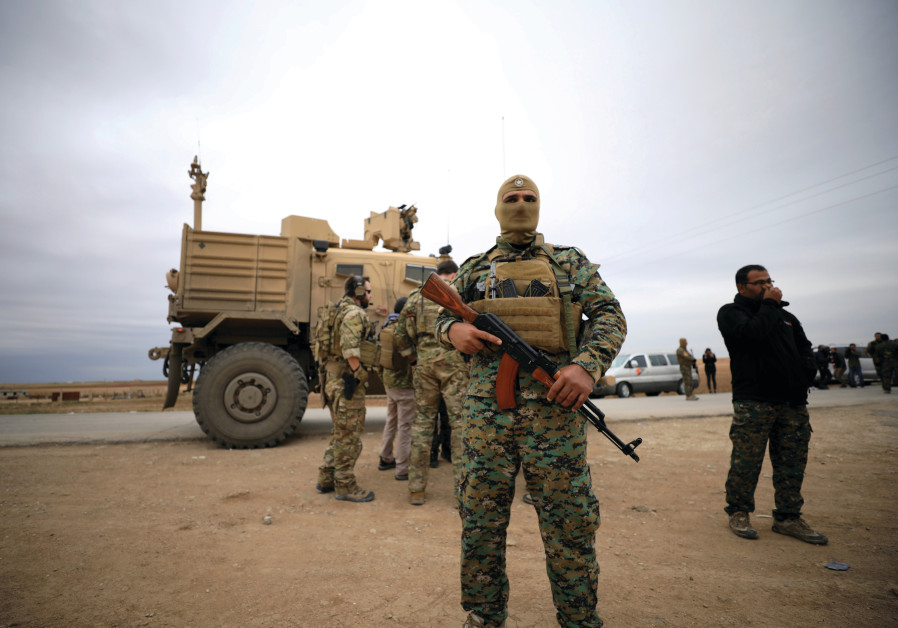
SYRIAN DEMOCRATIC FORCES and US troops are seen during a patrol near Turkish border in Hasakah.

WASHINGTON – Six weeks after US President Donald Trump announced the withdrawal of American troops from Syria, the US-led coalition of 79 partner countries and organizations gathered in Washington on Thursday to assess the fight against ISIS and the situation in eastern Syria.At the meeting, held the day after his State of the Union address, Trump praised the Coalition’s partners and the Syrian Democratic Forces for liberating “virtually all the territory previously held by ISIS.”The confab took place as ISIS is largely defeated, having lost 99.5% of its territory, according to recent Defense Department estimates. US Secretary of State Mike Pompeo said 110,000 sq. km. of territory had been liberated and seven million people freed from ISIS control in the last four and a half years. He laid out the coalition’s strategy going forward, saying the US is committed to Iraq’s security forces, and to preventing ISIS threats to the partner countries. He encouraged every one of the 79 members to “put our money where our mouth is.”This would include investing in “civilian stabilization assistance,” the programs that would return areas liberated from ISIS to functioning and safe parts of their respective countries. “Our final objective is to promote justice for victims.”Attendees included: Canadian Foreign Minister Chrystia Freeland, who posted a photo with Yazidi genocide survivor Nadia Murad; and Mevlut Cavusoglu, the Turkish foreign minister, who said that coordination was needed to prevent the resurgence of ISIS. “It takes addressing the root causes of this scourge effectively and avoidance of the repetition of past mistakes.”Hanging over the generalizations and self-congratulatory remarks was the US decision to quit Syria. The US, which stressed the need for stabilization, did not lay out its plans for the future in eastern Syria or how its withdrawal would be managed. Germany’s foreign office noted before the meeting that while ISIS had been “pushed back” in Iraq and large parts of Syria, the threat has “by no means been averted.” Turkey stressed that Trump’s decision to withdraw, announced in December 2018, was not the end of the conflict. “It simply represents a new stage in an old fight.”The US has not articulated how it will manage or coordinate its Syria withdrawal. This has led to constant rumors about how it may play out. Reports last month indicated the US might remain at its base in al-Tanf in eastern Syria’s desert.Turkey and the US have been discussing a “buffer” or “safe” zone that might extend up to 30 km. in Syria. Turkey wants this zone to be free of the People’s Protection Units (YPG), the Kurdish group that it asserts is part of the Kurdistan Workers Party (PKK), but which is also part of the SDF, the main partner of the coalition. This has raised fears of a new conflict in Syria once the US withdraws.The co-chair of the Syrian Democratic Council (SDC), Ilham Ahmad, has been in Washington for two weeks giving talks and holding discussions aimed at slowing a US withdrawal and shoring up support for the SDF, of which her SDC is the political wing. She has met with groups across the political spectrum, including Democrat Tulsi Gabbard, who is running for President in 2020. According to Al-Monitor, she received an invite to the State of the Union address from Gabbard. Gabbard has been critical of US Syria policy, especially regarding the Assad regime, asserting Assad is not an enemy of the US.This leaves many question marks about the withdrawal. The SDF fears a quick withdrawal might lead to escalation in tension with Turkey which would force them to seek out a deal in which the Syrian regime might return to the border in eastern Syria, or Russia might broker some kind of deal. But they prefer the US partners they have worked with for four years to defeat ISIS.After more than 10,000 casualties fighting ISIS, the SDF and its constituent groups want peace. But the US hasn’t provided clarity on what comes next, according to meetings held in Washington with individuals knowledgeable of the current discussions.At the same time, the US has hosted representatives of Egypt, France, Germany, Jordan, Saudi Arabia and the UK to discuss the situation in Syria. They emphasized the need for a political solution to end the conflict, but did not provide details.Turkey’s Deputy Minister of Foreign Affairs, Sedat Onal, also was in Washington on February 5 and met with US officials to launch several working groups on bilateral relations, including “bilateral cooperation on Syria.” As with the Coalition meeting and the other high level meetings held this week, no concrete plan for what comes next was made public.It appears that more than a month and a half after Trump made his  withdrawal from Syria announcement, much remains to be ironed out. There has been pushback and recognition of the sacrifices the SDF made fighting ISIS.But the US has not yet made the SDF part of the larger discussions about the withdrawal, and the meeting of the coalition did not provide clarity on that move.The coalition’s twitter account rarely seems to mention areas in eastern Syria which were liberated by the coalition. Instead, it mentions projects in Aleppo, Azaz, Souran in Hama province and UN programs directed to other areas of Syria.While the coalition said in December 2018 that “many stabilization projects had started in Iraq and Syria,” and that humanitarian efforts will continue in 2019, it is no longer spotlighting those efforts. The online withdrawal seems to have already begun, even if the physical withdrawal is at an impasse.