Archive for February 2019

Iran could get nuclear weapon within two years, intel assessments find 

February 14, 2019

Source: Iran could get nuclear weapon within two years, intel assessments find – Middle East – Jerusalem Post

Israeli intelligence assessment finds if Tehran leaves JCPOA it would have enough fissionable material within a year.

BY ANNA AHRONHEIM, TOVAH LAZAROFF

FEBRUARY 13, 2019 16:59

This handout photo provided by Iran's Revolutionary Guard Corps (IRGC) official website

This handout photo provided by Iran’s Revolutionary Guard Corps (IRGC) official website via SEPAH News on February 7, 2019 shows the new “Dezful” missile during its inauguration ceremony at an undisclosed location. (photo credit: SEPAH NEWS/IRAN’S REVOLUTIONARY GUARDS WEBSITE/AFP)

Iran is capable of producing a nuclear weapon within two years, if it steps up work on its nuclear program and violates the 2015 deal with the West, according to a recent Israeli intelligence assessment.

The assessment was released as the controversial US-led summit against Iran opened in Warsaw, where Israel is expected to pressure the European Union against trying to prop up the Joint Comprehensive Plan of Action following the American withdrawal last May.

In the Polish capital, Prime Minister Benjamin Netanyahu spoke openly about the possibility of war with Iran, and the possibility of a new alliance of Arab states with Israel, in the event of such hostilities.

“I am going to a meeting with 60 foreign ministers and envoys of countries from around the world against Iran,” Netanyahu said next to an outdoor skating rink in a short video clip his staff filmed for his Facebook page.

“What is important about this meeting – and this meeting is not in secret, because there are many of those – is that this is an open meeting with representatives of leading Arab countries, that are sitting down together with Israel in order to advance the common interest of war with Iran,” he said.

Israel has worked not just to block Iran’s accelerated nuclear activity, but has also attempted to stem its increased military activity along the North.

Before he boarded a plane to Warsaw Tuesday night, Netanyahu confirmed that Israel attacked Iranian targets in Syria on Monday. Prior to heading to the ministerial meeting, he said Israel is working to oust Iran from Syria.

“What we are doing is pushing and driving Iran from Syria. We are committed to doing this,” he said.

Israel considers Iran’s nuclear program as the nation’s No. 1 concern, and, according to the assessment, if the Islamic Republic does decide to renege on the agreement, it would take it one year to produce enough fissionable material to make a nuclear bomb and then another year to actually make the weapon device.

According to the assessment, Iran is contemplating how to deal with American sanctions in the hope that President Donald Trump will not be reelected in 2020 and a new and more pragmatic president would be elected, or to signal to the West that if the current status quo remains, it, too, will leave the agreement and return to enriching uranium.

Under the JCPOA, Tehran is prohibited from transferring any weapons to third countries, but Iran, which possesses more than 1,000 short- and medium-range ballistic missiles, is suspected of continuing to smuggle weapons to countries and non-state actors such as Lebanon’s Hezbollah and Hamas in the Gaza Strip.

Nevertheless, it is believed that Iran is continuing to develop the capabilities to produce a nuclear weapons arsenal as well as produce ballistic missiles capable of carrying nuclear warheads, despite new US sanctions placed on Iran meant to pressure Tehran over its military activity in the Middle East.

Iran has always denied seeking nuclear weapons, and agreed to curb its nuclear program in return for the lifting of sanctions as part of the JCPOA signed in 2015 between Iran and the US, Russia, China, the UK, France and Germany.

While US sanctions have largely succeeded in convincing Western businesses to cut ties with Iran, countries such as France, Germany and Britain have begun nondollar trade with Iran to avert US sanctions, to keep the deal with Iran alive.

Though Iran’s economy has improved since the signing of the deal, the average Iranian has not felt it, with high unemployment and growing inflation due to the sanctions, with a rise in the price of bananas over the past year by 165%, 50% in meat prices, 103% in tomato prices, and 15% for housing.

While the spark for the protests has been the economy, protesters have also taken to the street denouncing the Islamic Republic’s role in conflict zones such as Syria, Lebanon, Yemen and Gaza, burning pictures of the commander of the Islamic Revolutionary Guard Corps’ Quds Force, Maj.-Gen. Qassem Soleimani, who is in charge of Iran’s policy in those countries.

US envoy Jason Greenblatt, who is in Warsaw, tweeted in advance of the conference that “Iran is the primary threat to the future of regional peace/security.”

Netanyahu is also set to meet with US Vice President Mike Pence and US Secretary of State Mike Pompeo on the sidelines of the conference to discuss Iran.

Iranian Foreign Minister Mohammad Javad Zarif has dismissed the conference as a “desperate anti-Iran circus.”

Iran’s Supreme Leader Ayatollah Ali Khamenei warned Europe to distance itself from the US.

“Today, the Iranian people see some European countries as cunning and untrustworthy along with the criminal America. The government of the Islamic Republic must carefully preserve its boundaries with them,” he wrote. “Iran must not retreat a single step from national and revolutionary values.”

US President Donald Trump’s attorney and former mayor of New York, Rudy Giuliani, called for Iranian regime change on Wednesday ahead of a US-backed Middle East summit in Warsaw.

“Everyone knows that Iran is the No. 1 sponsor of terrorism in the world. There isn’t a single government there that disagrees with that,” he said.

“The reality is, Iran should be isolated until Iran changes. If they can do what our government, American government, other governments, believe and make policy change within, I would be satisfied with that, although skeptical. If it results in regime change, I think that would be a cleaner solution,” Giuliani said.

He spoke ahead of a rally to show support for the Paris-based National Council of Resistance of Iran (NCRI), a bloc of opposition groups in exile that seeks to end Shi’ite clerical rule in Iran.

Protesters banged drums, chanted and waved flags and placards outside the summit venue at the National Stadium. They were protesting the current regime and its human rights violations.

One Iranian protester, Mahmoud Masoudi of Germany, said they came to Warsaw to support NCRI head Maryam Rajavi.

She is “our leader and the only alternative to the dictatorship in Iran,” he said. “This is the basic reason that all of us are here today. And we think it is the time to support the NCRI… which includes the most democratic groups in Iran against the Khamenei regime, against dictatorship in Iran, the religious dictatorship.”

Reuters contributed to this report.
 

White House accelerates secret program to sabotage Iran missiles – report 

February 14, 2019

Source: White House accelerates secret program to sabotage Iran missiles – report – Middle East – Jerusalem Post

American military officials urged Congress to put more money into “left of launch” programs, meaning programs which rely on sabotaging launchers before they are fired.

BY TZVI JOFFRE
 FEBRUARY 13, 2019 21:23
Iran missile

The White House has pushed forward a secret program to sabotage Iranian missiles and rockets as part of a campaign to undercut Iran’s military, according to administration officials in a report by the New York Times.

No one can precisely measure the success of the program, which has never been publicly acknowledged, but the recent failure of Iran’s attempted satellite launches raised some suspicion.

The two failures are part of a pattern over the past 11 years. Sixty-seven percent of Iranian orbital launches have failed during this time, suspiciously high compared to the worldwide 5 percent failure rate for similar launches.
Iran insists that it will continue trying, with Iranian President Hassan Rouhani vowing to “continue our path and our military power.”
The Trump administration claims that Iran’s space program is a cover for its ballistic missile development program. Secretary of State Mike Pompeo claimed that Iran’s satellite launchers have technologies “virtually identical and interchangeable with those used in ballistic missiles.”
The Times found more than half-dozen current and former government officials who have worked on the American sabotage program over the past dozen years. They spoke on condition of anonymity since they’re not authorized to publicly discuss the secret program.
The officials said that the program was created under former president George W. Bush, which attempted to slip faulty parts and materials into Iran’s aerospace supply chains. The program continued early in the Obama administration, but eased by 2017 when Mr. Pompeo took over as the director of the CIA.
The head of Iran’s missile program, Brig. Gen. Amir Ali Hajizadeh, accused American and allied intelligence agencies of targeting Iran’s missile complex with campaigns of “infiltration and sabotage.”
“They want to repeat their nuclear sabotage in the missile area,” Hajizadeh told Iranian state television in 2016, promising that the program would never stop.
The CIA declined to comment on the sabotage program. Government officials requested that the New York Times withhold some of the details they had gathered, including the identities of specific suppliers to the Iranian program, since the sabotage program is ongoing.
Aerospace experts warned that Iran’s missile troubles could also just be the result of normal malfunctions. The recent rise in failures, though, suggests that the effort to sabotage Iran’s space launches and missile tests may have been intensified.
Last month, President Trump noted at the Pentagon that if the attempted space launch had succeeded, it would have given Tehran “critical information” it could use “to pursue intercontinental ballistic missile capability, and a capability, actually, of reaching the United States.”
Under President Bush, two covert programs against Iran were established: one focused on nuclear materials, the other on missiles.
The CIA and NSA searched for ways to subvert factories, supply chains, and launchers, according to the Times.
American military officials urged Congress to put more money into “left of launch” programs, meaning programs which rely on sabotaging launchers before they are fired.
With Iran that meant finding the network of supplies and subcontractors Iran uses, which became easier once United Nations sanctions forced Iran to rely on black markets and middlemen. The CIA found these relatively easy to penetrate, according to former officials who spoke to the Times.
Several participants said that the key insight was to sabotage test launches of new missiles, causing Iran to hesitate to embark on mass production.
Under the Obama administration, the program started targeting space launchers as well. Secretary of State Hillary Clinton believed that the development and testing of one class of launcher could advance the other.
Some rocket specialists claimed that the overlap between the two was insignificant. Iran claimed that the space launches had no military value.
When Mr. Pompeo arrived at the CIA, Iranian nuclear activity was no longer the focus. Iran had instead ramped up its missile and space program. Mr. Pompeo shifted focus to the supply chain for rockets and missiles, an area he knew well.
Seeding foreign aerospace programs with faulty parts and materials can take years, and it’s almost impossible to know if the faulty technology is ever installed in particular launchers.
There was one occasion when the USA had a chance to check their success, according to the Times. A short-range Iranian-made missile landed in Baghdad’s Green Zone, but failed to detonate. One of the American-sabotaged parts was found inside, according to a former senior official.
Iran’s size and isolation makes it difficult to monitor the success rate of the sabotage program, but the number of failures suggests that the program is effective.
According to the Times, Iran succeeded in putting a small satellite into orbit in 2009, 2011, 2012, and 2015. These were the only four clear successes out of a dozen attempts, according to Jonathan McDowell, a Harvard Astronomer who specializes in orbital monitoring.
On one occasion, an Iranian rocket exploded on the launchpad, leaving blast scars, burned wreckage, and a blackened rocket transporter which could be seen by satellites overhead. Iranian officials did not comment on the event.
Iran has so far failed to successfully test the newest generation of its satellite launcher, Phoenix, according to the Times. In the test launch on Jan. 15, Iranian officials claimed it suffered a third-stage failure.
Some experts attribute Iran’s poor performance to other factors, such as trade embargoes which block access to the best technology.
A similar sabotage program was directed at North Korea, which suffered through a series of missile failures in 2016.


At least 27 killed in suicide attack on Iran Revolutionary Guards’ bus

February 14, 2019

Source: At least 27 killed in suicide attack on Iran Revolutionary Guards’ bus | The Times of Israel

Vehicle filled with explosives said detonated next to bus; state media blames al-Qaeda-linked Sunni extremist group Jaish al-Adl for bombing

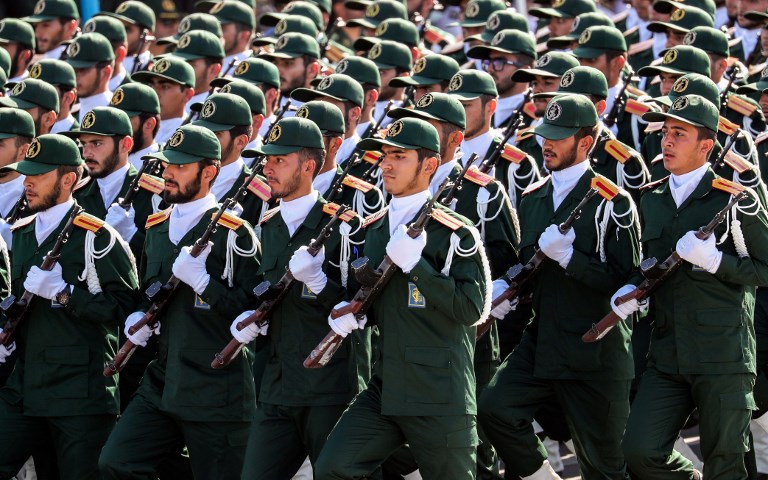
Members of Iran's Revolutionary Guard Corps (IRGC) march during the annual military parade marking the anniversary of the outbreak of the devastating 1980-1988 war with Saddam Hussein's Iraq, in the capital Tehran on September 22, 2018. (AFP/STR)

Members of Iran’s Revolutionary Guard Corps (IRGC) march during the annual military parade marking the anniversary of the outbreak of the devastating 1980-1988 war with Saddam Hussein’s Iraq, in the capital Tehran on September 22, 2018. (AFP/STR)

A suicide attack on Wednesday on a bus carrying members of the Revolutionary Guards in southeastern Iran killed at least 27 people.

“The suicide attack on an Islamic Revolutionary Guards Corps personnel bus happened on the Khash-Zahedan road,” IRNA said.

The road is located in the volatile southeastern province of Sistan-Baluchistan.

The Guards issued a statement confirming the attack. It said the troops were returning from the border.

“In this suicide attack a car filled with explosives blew up besides a bus carrying a unit of the Guards’ ground forces causing the martyrdom and wounding of a number of the protectors of our Islamic homeland’s border,” the statement read.

Iranian state media blamed the al-Qaeda-linked Sunni extremist group Jaish al-Adl for the bombing.

The semi-official Fars news agency reported 40 members of the IRGC were on board the bus at the time of the attack.

The attack took place in the volatile southeastern province of Sistan-Baluchistan which has a large, mainly Sunni Muslim ethnic Baluchi community that straddles the border with Pakistan.

On January 29 three members of an Iranian bomb squad sent to the scene of an explosion in Zahedan, the capital of Sistan-Baluchistan province, were wounded when a second device blew up as they were trying to defuse it, police said at the time.

And in early December last year two people were killed and around 40 others wounded in the port city of Chabahar, also in Sistan-Baluchistan, in an attack which Foreign Minister Mohammad Javad Zarif at the time blamed on “foreign-backed terrorists” — a reference to Sunni Muslim extremists.

Last September at least 29 people were killed and over 60 wounded in an attack on an IRGC parade in the southwestern city of Ahvaz. It was the deadliest such attack in Iran in nearly a decade.

Militants disguised as soldiers opened fire on the annual Iranian military parade in an attack claimed by the Islamic State terrorist group.

Iranian authorities blamed “jihadist separatists” for the assault claiming they were backed by Saudi Arabia, Israel and the United States.

The attack comes just days after Iran marked 40 years since the Islamic Revolution with numerous high-profile events.

Monday was the culmination of official celebrations called the “10 Day Dawn” that mark the period between February 1 and February 11, 1979, when Shiite cleric Khomeini returned from exile and ousted the shah’s last government.


IDF believes Iran pulling forces in Syria away from Israel border due to strikes

February 14, 2019

Source: IDF believes Iran pulling forces in Syria away from Israel border due to strikes | The Times of Israel

But Intel report says Tehran not giving up on plans to threaten Israel; army assesses Tehran abiding by 2015 nuclear deal, but could create atomic bomb within 2 years

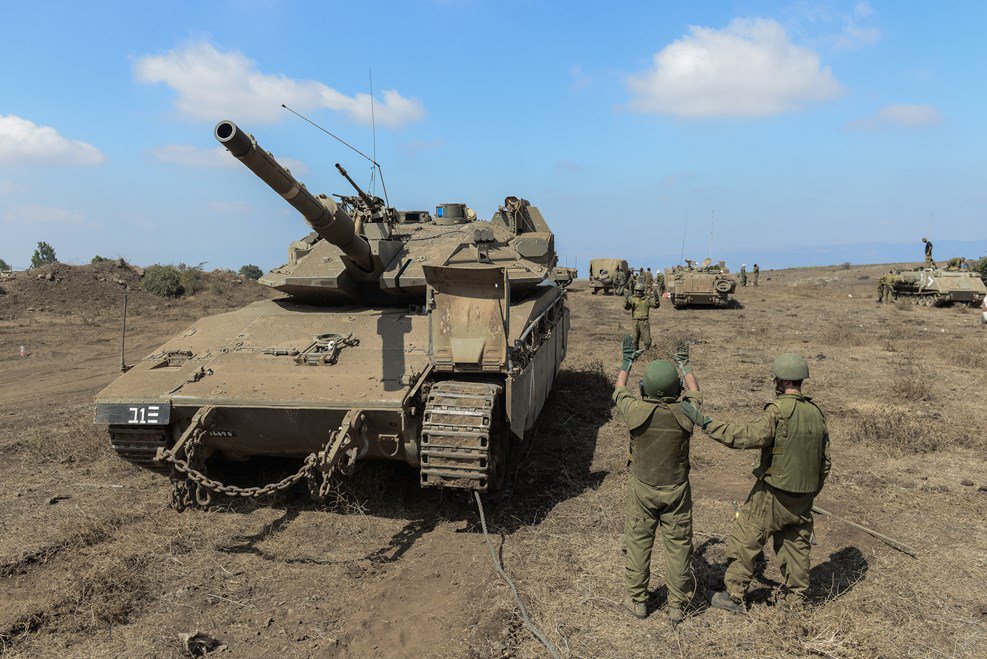
Israeli troops take part in an exercise on the Golan Heights in August 2018. (Israel Defense Forces)

Israel’s campaign of airstrikes in Syria has driven Iran to change tack in the country, moving the bulk of its troops and bases away from the Israeli border and toward what it sees as a safer location closer to Iraq, according to Military Intelligence assessments released Wednesday.

At the same time, the report said Iran appears to be adopting a more aggressive stance toward Israel, as evident by its launch of a missile into the northern Golan Heights last month, in response to a reported strike by the Israel Defense Forces. While most troops are being moved away, some pro-Iranian forces remain on the border with Israel and have established observation posts from which they can monitor Israeli military activities.

The intelligence report said Iran’s inclination to retaliate against Israeli airstrikes appears to be buoyed by the Syrian military’s recent acquisition of advanced Russian S-300 air defense batteries. The IDF does not believe Syrian troops have yet been fully trained to operate the powerful anti-aircraft system, but the military is prepared to destroy it the first time an S-300 battery fires at Israeli aircraft — despite the potential diplomatic blowback from Moscow, which gave Damascus the system.

In Gaza, the Israel Defense Forces believes the restive enclave may soon see another major conflict — the fourth in just over a decade — as its Hamas rulers may deliberately spark a destructive war as a way to gain both international sympathy and, afterwards, an influx of reconstruction funds to replenish its empty coffers.

The assessments were part of Military Intelligence’s forecast for 2019, portions of which were released to the media by the IDF on Wednesday.

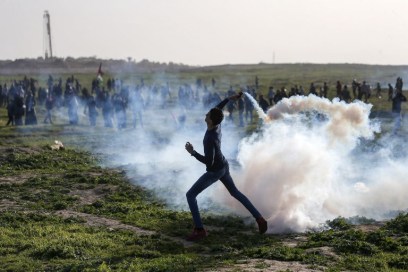
A Palestinian protester throws a tear gas canister towards Israeli forces during clashes following a demonstration along the border with Israel, east of Gaza City on January 25, 2019. (Mahmud Hams/AFP)

Military Intelligence also believes Iran is still adhering to the 2015 nuclear deal, under which Tehran agreed to limit its production of nuclear material and in exchange receive sanctions relief, despite the United States dropping out of the deal in 2017 — echoing similar findings released by American intelligence services earlier this month.

The military believes that were Iran to decide to break from the agreement, known formally as the Joint Comprehensive Plan of Action (JCPOA), it would take approximately one year for the country to produce fissile material and another year to turn that into a functioning bomb. No such decision has been made, though Israeli Military Intelligence believes Iranian officials are considering violating the nuclear deal by enriching uranium beyond the allowed limit — as a negotiation tactic.

Iran under pressure from sanctions

Israel sees a nuclear-armed Iran as an existential threat, and Israeli officials have vowed that the Jewish state would take all actions necessary to prevent such an occurrence.

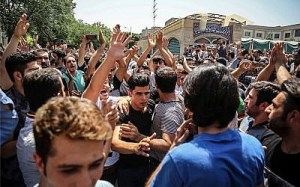
A group of protesters chant slogans at the main gate of old grand bazaar in Tehran, Iran, Monday, June 25, 2018. (Iranian Labor News Agency via AP)

The IDF believes the return of American sanctions against Iran are causing serious problems for the cash-strapped regime. As a result of the renewed sanctions, Tehran has scaled back its financial support for militias in Syria and Iraq, the Israeli military believes.

Domestically, the Iranian government is also facing significant criticism in light of the country’s deteriorating economy — the cost of food has more than doubled in some cases — casting a pall over the celebrations for the 40th anniversary of the 1979 revolution which brought the Islamic government to power.

However, a grassroots movement to overthrow the regime does not appear to be on the horizon, according to the IDF’s assessments.

Iran changing tactics in Syria

In addition to pulling its forces and weapons depots from areas close to Israel — including from the Damascus International Airport, which Israel has bombed on multiple occasions — Iran is also scaling back the number of troops in Syria, the Israel Defense Forces believes.

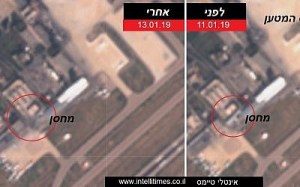
Satellite photos published on January 13, 2019 showing an alleged Iranian weapons depot at the Damascus International Airport in Syria (R) on January 11, and the same structure demolished on January 13 after an Israeli airstrike. (Intelli Times)

However, the Islamic Republic is not giving up on its plans to threaten and attack Israel, rather it is simply altering its methods to do so, the military believes.

This means moving its focus from the Golan and southern Syria and toward the Iraqi border. For instance, the weapons transports flown in to Damascus International Airport, which Israel has regularly targeted, would instead be sent to the T-4 air base near Palmyra.

Some parts of the Islamic Revolutionary Guard Corps’ expeditionary Quds Force and the Shiite militias it supports also appear to be moving out of Syria and into Iraq. From there they could still threaten Israel with powerful missiles and potentially return to Syria if war breaks out.

While Iran’s focus may be shifting away from southern Syria, it is not abandoning the territory entirely, and indeed its actions there will be more difficult for Israel to counter now that Syrian dictator Bashar Assad controls the area.

When the Syrian Golan was under the control of opposition forces, pro-regime and pro-Iranian forces were less able to operate there freely. Now that Assad is in control of the territory, Shiite militias and Iranian forces are more able to establish military posts along the border with northern Israel.

On Tuesday, Prime Minister Benjamin Netanyahu confirmed that the IDF had carried out a tank strike on an Iranian-affiliated position in the Quneitra region in the Syrian Golan.

According to Israeli and Syrian media reports, the shelling was aimed at observation posts that pro-Iranian militias had set up on the border in order to track Israeli military activities.


Saudi Prince Turki to Israeli TV: Netanyahu deceiving Israel about peace chances 

February 14, 2019

Source: Saudi Prince Turki to Israeli TV: Netanyahu deceiving Israel about peace chances | The Times of Israel

Veteran diplomat, in unprecedented interview, says Riyadh wants to ‘get our point across directly’ to Israelis: Solve the Palestinian issue and then ‘we can go far’

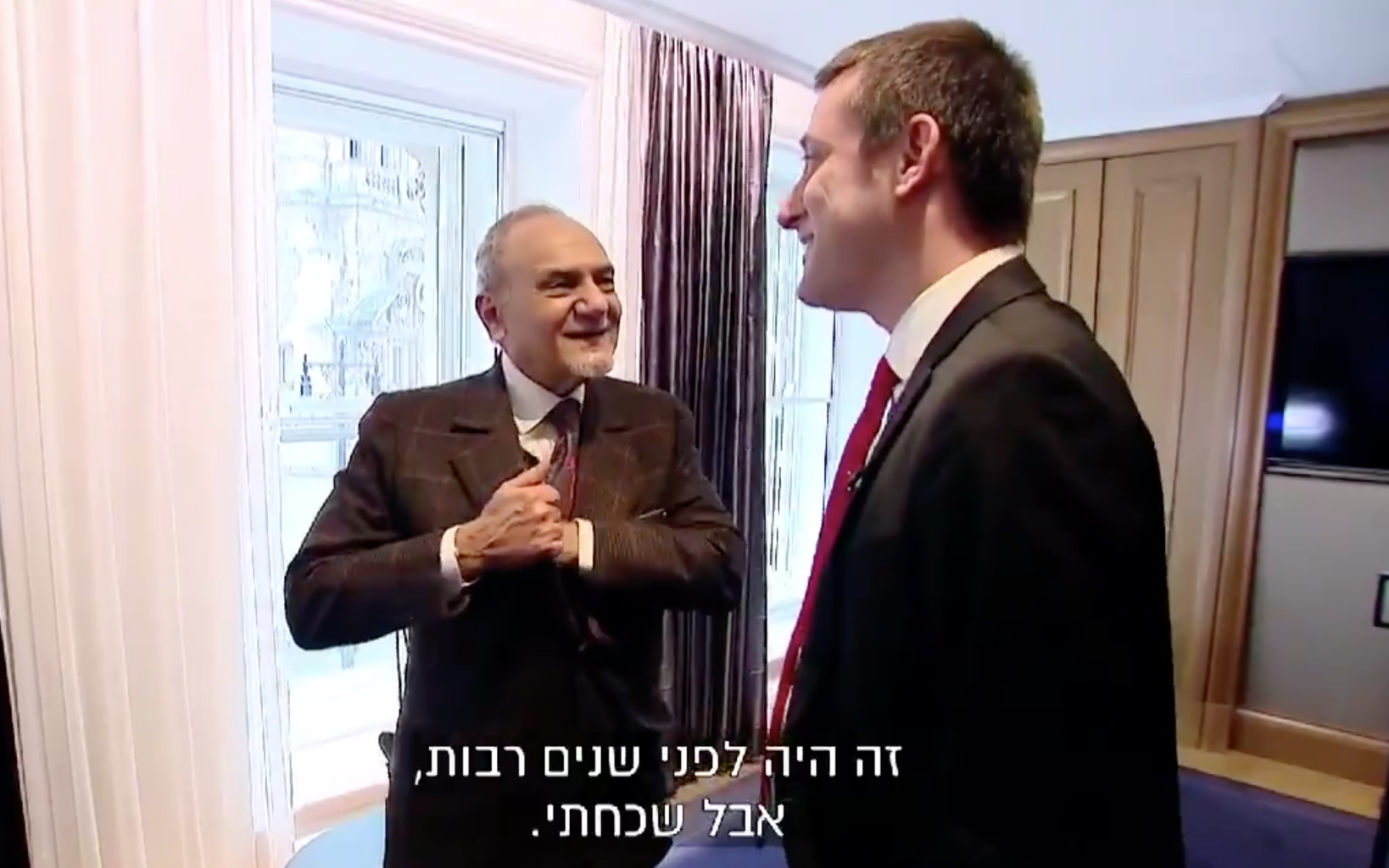
Saudi Prince Turki bin Faisal Al Saud with Channel 13’s Barak Ravid, February 2019 (Twitter screenshot)

In an unprecedented interview with an Israeli TV station broadcast Wednesday, the former Saudi intelligence chief and ex-ambassador to the US and UK accused Prime Minister Benjamin Netanyahu of deceiving the Israeli public by claiming that Israeli ties with the wider Arab world can be warmed without the Palestinian issue being solved.

“Israeli public opinion should not be deceived into believing that the Palestinian issue is a dead issue,” Prince Turki bin Faisal Al Saud told Israel’s Channel 13 news in a lengthy interview in London. “From the Israeli point of view, Mr. Netanyahu would like us to have a relationship, and then we can fix the Palestinian issue. From the Saudi point of view, it’s the other way around.”

Asked by interviewer Barak Ravid whether that meant Netanyahu was “deceiving the Israeli public” by claiming to be able to “promote relations with the Arab world regardless of the Palestinians,” Prince Turki replied: “Absolutely. Absolutely.”

Asked why Netanyahu would do that, the prince said: “For his own purposes.” Laughing, he continued: “He’s a man who runs for election on platforms of ‘look what I have done for you. I have brought you this. I have brought you that.’ Like all politicians.”

The prince said the Saudi public has “a very negative view of Mr. Netanyahu because of what is happening on the ground,” and because of what he termed Netanyahu’s “hubristic attitude… praising himself.”

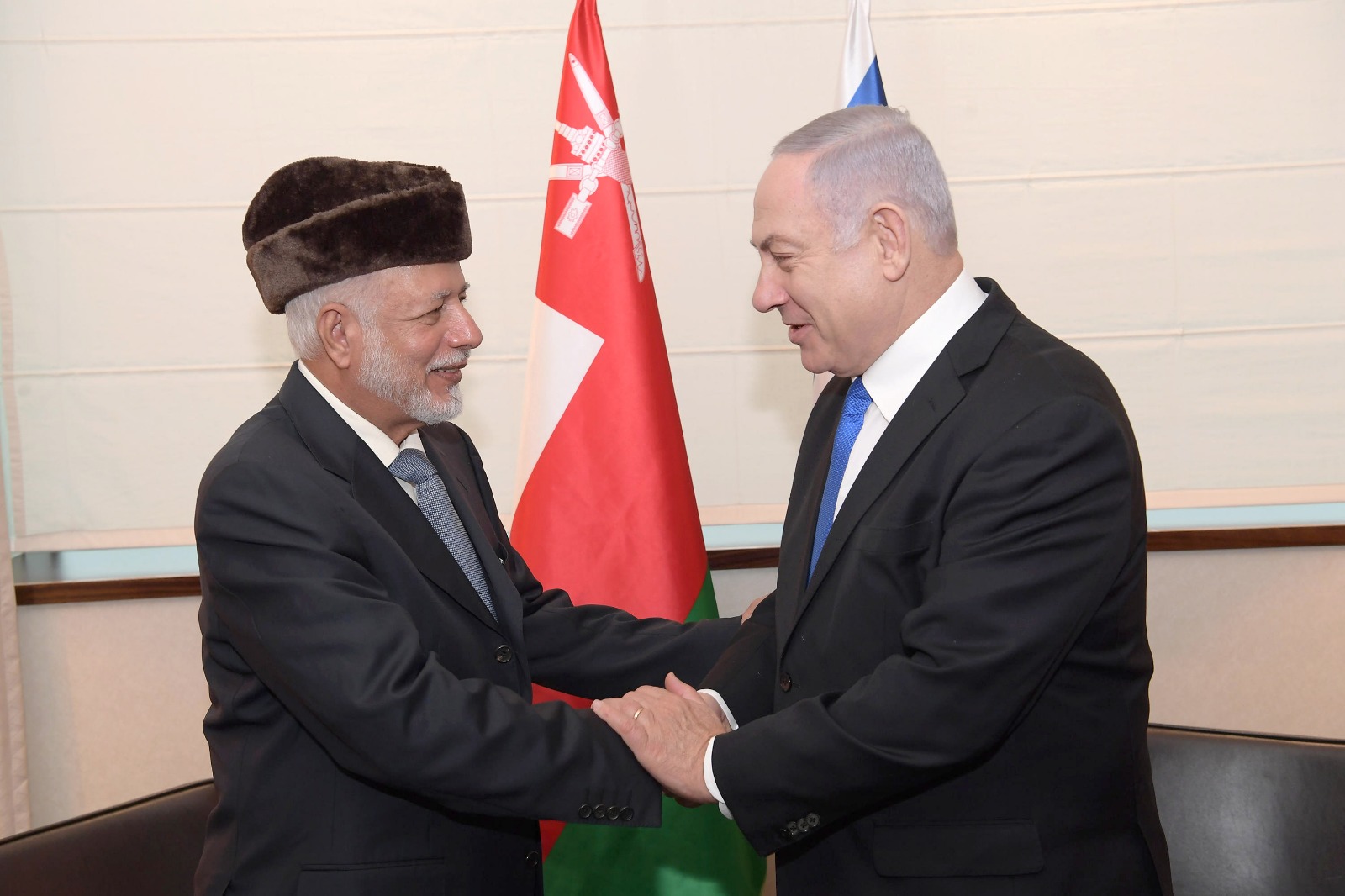
Ironically, the interview was broadcast only hours after Netanyahu, who is in Poland, met with the foreign minister of Oman, and the two men discussed a new era for the Middle East. Netanyahu has said often that shared concern about Iran is one of the factors helping to gradually warm Israeli ties with Gulf states and others in the region.

“We don’t need Mr. Netanyahu to tell us the dangers that Iran poses,” the Saudi prince stressed. “We see it on the ground. We see their activities in Lebanon. We see their activities in Syria, in Iraq, in Yemen, in Bahrain, even in Saudi Arabia. So why should we wait for Mr. Netanyahu to highlight these things? We don’t need that.”

Prime Minister Benjamin Netanyahu (right) greets Omani Foreign Minister Yusuf bin Alawi bin Abdullah at the sidelines of a regional conference on the Middle East in Warsaw, February 13, 2018 (Amos Ben Gershom/GPO)

Asked how he would advise the Trump administration as it prepares to present its peace plan, Prince Turki said simply: “The Arab Peace Initiative — take it on. Make it yours.”

He recalled that the late Saudi King Abdullah initiated the plan in 2002. “Basically it’s a quid pro quo: Israel withdraws from occupied Arab territories, in return for Arab recognition of Israel, end of hostilities and normal relations.”

However, he said, “from day one there has not been an Israeli response.” (In 2015, Netanyahu said he backed the “general idea” behind the initiative. Former prime minister Olmert indicated he saw it as a basis for discussion.)

“With Israeli money and Saudi brains, we can go far,” the prince said, but added: “Yes, if there is peace. Unfortunately,” he charged, “Israel chooses to ignore all the efforts of Saudi Arabia to make peace, and expects Saudi Arabia to put its hand in its [Israel’s] hand and go forward on technology, on water desalination, on issues like that. It’s not going to happen,” he exclaimed.

“Israel has not been very cooperative as far as achieving peace in our part of the world,” he also said.

Prince Turki insisted there was no difference between Saudi King Salman and Crown Prince Mohammed bin Salman when it came to Israel, rejecting the notion that the king had curbed the crown prince’s inclination to warmer ties.

The crown prince “is a stalwart representative of Saudi policy,” he said, and the idea that there was a warmer stance from him was likely “wishful thinking on the part of Israeli officials.” The crown prince “supports the Palestinian cause to the fullest” and had no differences with the king “on any issue. He does what the king tells him.”

The Saudi prince clarified that he was giving the interview in a personal capacity, and “I do not represent the government of Saudi Arabia in any capacity whatsoever.” Nonetheless, asked if it was known in Riyadh that he would be speaking to an Israeli TV station, he said it was normal “courtesy and good manners” to tell people what he was going to be doing.

Ravid said Prince Turki had met with the Saudi king in the days before the interview, and that the prince was plainly conveying a message that Riyadh wants heard in Israel.

President Shimon Peres shakes hands with former US President Bill Clinton, during a meeting at the World Economic Forum in Davos, Switzerland, in 2010 (Photo credit: Sergei Illin/Flash 90)

President Shimon Peres shakes hands with former US President Bill Clinton, during a meeting at the World Economic Forum in Davos, Switzerland, in 2010 (Sergei Illin/Flash 90)

During his years in government, the prince said he had never held official meetings with Israelis, except with president Shimon Peres, over dinner in Davos. Peres suggested they hold more substantive, private talks, but Prince Turki said he demurred: “I told him, Mr. President, nothing in Israel remains a secret.”

He said he was speaking to Israeli television now because “we have to get our point across directly to the Israeli people.”

The prince, who is 73, said he had never been to Jerusalem and looked forward “to the day when there is peace between Israel and the Arab world, and I can visit what I consider to be not only a holy place, but a place of my history as an Arab and as a Muslim. Abraham, our father, is not only the father of the Jews. He is the father of the Arabs. Jerusalem is something I want to see before I die. Unfortunately, I’m not too optimistic that I’m going to see that.”

Asked whether he expected to witness a meeting between an Israeli prime minister and a Saudi king or crown prince in his lifetime, Prince Turki said: “In my lifetime — and there’s very little of it left to come — I don’t think I’m going to see that. Not before the Palestinian issue is resolved. I am looking for an Israeli peace initiative. I haven’t seen one. What is it that Israel thinks will make peace?”


IDF warns Hamas likely to spark war in Gaza in bid for international support

February 14, 2019

Source: IDF warns Hamas likely to spark war in Gaza in bid for international support | The Times of Israel

Intelligence assesses terror group no longer opposes full-scale conflict, seeing it as a way to bring in reconstruction funds for beleaguered enclave; IDF developing war plans

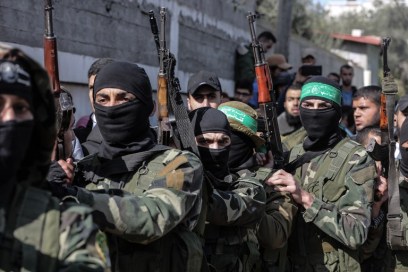
Masked gunmen of the al-Qassam brigades, the military wing of Hamas, raise their hands as they stand in front of a huge poster showing a mock attack on a bus, during a mass rally in Gaza, Sunday, Dec. 16, 2018. (AP/Khalil Hamra)

The Hamas terror group may seek to spark a war with Israel in the near future in an attempt to elicit international sympathy and an influx of international aid money to the Gaza Strip, which it controls, according to an Israeli Military Intelligence assessment released Wednesday.

The Israel Defense Forces believes Hamas or the Iran-backed Palestinian Islamic Jihad, the second largest terror group in Gaza, could attempt to draw Israel into a war by conducting an attack along the border — another anti-tank missile strike on a bus, an ambush from an as-yet-undiscovered tunnel or a similar low-level but significant attack.

According to the intelligence assessment, parts of which were distributed to reporters on Wednesday, while the Israeli military sees the northern arena — Lebanon and the Iranian entrenchment in Syria — as the larger challenges facing the Jewish state, the more immediate threats come from the Gaza Strip.

In light of this view, IDF chief Lt. Gen. Aviv Kohavi, whose tenure began last month, called for the military to update operational plans for fighting in the Gaza Strip.

IDF chief Aviv Kohavi visits Southern Command in undated photograph. (Israel Defense Forces)

“Gaza, as it is noted in the annual intelligence assessment, is the most volatile region, and there is a risk of terror group’s initiating action [against Israel]. The chief of staff identified an improvement of readiness in that region as a top priority,” the military said.

“The identification of targets will be increased — both for retaliatory strikes and to assist in ground forces maneuvering within the Strip,” the army said.

Kohavi also called for the military to purchase two more Iron Dome missile defense systems. Currently, the Israeli Air Force possesses eight batteries — six that are operated by conscripts and two by reservists. “By the end of 2019, 10 batteries are intended to be deployed across the country — eight staffed by conscripts and two by reservists,” the army said.

The IDF believes the terror group is not interested in entering a long conflict with Israel, but envisions a short period of intense fighting after which it would be able to negotiate a ceasefire agreement that would improve its overall economic and political standing.

An operator walks by an Iron Dome missile defense battery near the city of Sderot in southern Israel on May 29, 2018. (Yonatan Sindel/Flash90)

Adding to the potential for war in Gaza, the Palestinian Islamic Jihad in recent months has proven itself to be increasingly willing to clash with Israeli troops, despite Hamas’s opposition. Earlier this month, a sniper from the Iran-backed terror group opened fire at an IDF officer, hitting him in the helmet, causing light injuries.

This in part seems to come from the fact that Israel officially holds Hamas responsible for all violence coming from the Gaza Strip and thus directs its retaliatory strikes against Hamas targets and bases, meaning PIJ can carry out attacks without immediate consequences.

This represents a change from the IDF’s assessments in recent months, which had held that while Hamas wanted to maintain pressure on Israel with border violence, it was not interested in all-out conflict.

Masked Hamas gunmen attend the funeral of Mahmoud al-Nabaheen, 24, in the Bureij refugee camp, in the central Gaza Strip, on January 23, 2019. (MAHMUD HAMS / AFP)

Hamas, which has ruled Gaza since it overthrew the Palestinian Authority in a bloody coup in 2007, has faced increasing domestic pressure as the Strip’s economy has deteriorated during the interim 12 years in the face of a naval blockade by Israel and Egypt, which the countries say is necessary to prevent the terror group from importing large amounts of weaponry and war materiel into the coastal enclave.

International aid groups have warned in recent months that the Gaza Strip, which already has sweeping unemployment and limited access to electricity and water, is heading for a full humanitarian crisis.

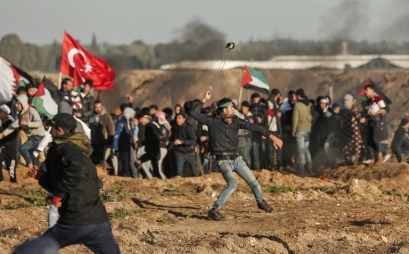
In response to these dire economic straits, over the past year, the terror group has led a series of regular riots and protests along the border, dubbed the “Great March of Return,” which included the launching of thousands of airborne arson devices into southern Israel that caused millions of shekels of damage to farmland and nature reserves, as well as sporadic flareups of rocket and mortar fire, including one in November in which over 500 projectiles were fired at Israel.

Illustrative: A Palestinian protester uses a slingshot to hurl stones at Israeli forces across the border fence, during clashes following a demonstration along the border with Israel east of Gaza City on January 11, 2019. (Mahmud Hams/AFP)

Over 200 Palestinians have been killed by Israeli troops in the clashes along the border and thousands more have been injured since the protests began on March 30. During the same period, two Israeli soldiers have been killed and several others injured. A Palestinian man living in the Israeli city of Ashkelon was also killed in a rocket attack from the Gaza Strip.

In a bid to end the weekly, sometimes daily, violence along the border, Israel reached a ceasefire agreement with Hamas — with Egypt and a United Nations envoy acting as mediators — that extended the permitting fishing zone around the Gaza Strip to 12 nautical miles and, more importantly, allowed the Islamist terror group to receive tens of millions of dollars from Qatar.

However, the IDF believes Hamas thinks it could negotiate better economic incentives from Israel in the midst of a small-scale war than it can now.

In light of the potential for a renewed outbreak of violence, Kohavi has instructed the military to prepare responses to a variety of potential scenarios in the Gaza Strip.

In addition, the newly minted IDF chief formed a General Staff-level task force to create a bank of targets that the military could strike quickly, not only in Gaza but for every regional command.

“In addition, he created a task force to identify high-quality targets in the Gaza Strip ahead of a potential operation there, which will be led by Col. Ronen Geiger,” the army said.

This appeared to be a response to criticisms heard within the military and outside it that the air force and artillery attacked empty or otherwise worthless targets during the 2014 Gaza war.


Israeli Intel Estimate: New Iranian threat from Iraq. Gaza escalates. Moscow jumps on Palestinian issue – DEBKAfile

February 14, 2019

Source: Israeli Intel Estimate: New Iranian threat from Iraq. Gaza escalates. Moscow jumps on Palestinian issue – DEBKAfile

Iranian forces are moving back from Israel’s border to northern and eastern Syria and arming Shiite proxies with surface missiles. This is reported in the Israeli Military Intelligence (AMAN) Estimate 2019, laid before the government two weeks ago and divided into two sections: pre- and post-election. The document foresees heightened tensions on the Gaza and northern fronts in the coming months.

After the April 9 general election, the next government will have to take a stand on President Donald Trump’s ”Deal of the Century” for resolving the Israeli-Palestinian conflict, a challenge which does not figure in any party campaign.
In the run-up to the election, AMAN predicts the following events:

  1. The Gaza Strip will heat up. Already this week, thousands of Palestinians are gathering night after night on the Gaza border to attack Israeli troops with explosive devices and hand grenades. The explosions cause alarm in neighboring Israeli communities.
  2. The northern front, including the Golan, will see escalating violence from across the Syrian border. The Iranian Al Qods Brigades and Hizballah will be choosing their moment to fire missiles into Israel, taking advantage of the Russian presence somewhat inhibiting Israeli payback.
  3. Palestinian terrorists will raise the stakes in Judea and Samaria so as to cast a pall on Israel’s election, encouraged by Moscow’s first supportive intervention in the Palestinian arena. The first Palestinian unity conference is taking place this week with Foreign Minister Sergei Lavrov in the chair. DEBKAfile’s intelligence sources report that the Palestinians reckon that Prime Minister Binyamin Netanyahu, when he arrives in the Russian capital on Feb. 21, will find in the Kremlin a newly friendly face for the Palestinian cause. Therefore, Iran and Syria won’t be the only items on the agenda of his talks with President Vladimir Putin.

The Intelligence Estimate points to changes in Iran’s Syrian deployment. Its forces are described as pulling away from proximity with Israel’s northern border and regrouping in northern and eastern Syria. This redeployment is cause for concern in Israel. Rather than being driven back under the pressure of Israel’s aerial and missile assaults, Tehran aims to take advantage of the coming withdrawal of US troops from Syria to extend its strategic depth into Iraq, from which Iranian missiles can reach Israel.

The Iranians are expected to leave their Shiite militias behind for dealing with the Israel front and arm them with ground-to-ground, short-range ballistic missiles. Israel’s northern front is therefore not moving farther away, it is expanding into Iraq and, in addition to the rockets piled up by Hizballah, Hamas and Islamic Jihad, Israel is now faced with ballistic missiles from Iraq and close by.


Abbas embarks on trip to wage battle over Trump’s ‘Deal of the Century’ 

February 13, 2019

Source: Abbas embarks on trip to wage battle over Trump’s ‘Deal of the Century’ – Arab-Israeli Conflict – Jerusalem Post

Abbas is traveling from one Arab country to another in an attempt to prevent Middle East countries from supporting Trump’s peace plan.

BY SARA RUBENSTEIN
 FEBRUARY 13, 2019 11:51Palestinian President Mahmoud Abbas

Palestinian Authority President Mahmoud Abbas has embarked on a trip to moderate Arab countries to wage a battle against US President Donald Trump’s “Deal of the Century,” according to a report published by Israel Hayom on Wednesday.

Abbas is traveling from one Arab country to another in an attempt to prevent Middle East countries from supporting Trump’s peace plan.

Palestinian news agency, Ma’an, carried pictures from Abbas’s trip to Saudi Arabia on Tuesday where he met with Saudi king Salman in Riyadh. Salman said that ” Saudi Arabia permanently stands by Palestine and its people’s right to an independent state with the occupied East Jerusalem as its capital,” according to Ma’an.

Abbas is also trying to convince Arab leaders to support Palestinian demands on core issues, including Israel’s withdrawal to the 1967 borders and recognition of east Jerusalem as the capital of an independent Palestinian state.

Senior Advisor Jared Kushner and Special Representative for International Negotiations, Jason Greenblatt, are expected to travel to the Middle East in the near future to present the plan to the relevant countries.

The assessment in Ramallah, Israel Hayom said, is that the Trump government will encourage Arab states to begin implementing the plan following Israeli elections and the formation of the new government in May.


German foreign ministry celebrates Iran’s Islamic revolution in Berlin

February 13, 2019

Source: German foreign ministry celebrates Iran’s Islamic revolution in Berlin – International news – Jerusalem Post

Foreign ministry state secretary Niels Annen, from the Social Democratic party, and an official from the Iran desk at the ministry attended the pro-mullah regime event.

BY BENJAMIN WEINTHAL
 FEBRUARY 13, 2019 14:14
A couple, with their faces painted in the colours of Iranian and German national flags

The German foreign affairs ministry sent representatives to Iran’s embassy in Berlin to celebrate the 40-year anniversary of the Islamic Republic of Iran—a regime in Tehran that frequently urges the destruction of the Jewish state and spreads Holocaust denial.

The German mass circulation daily Bild reported on Tuesday that foreign ministry state secretary Niels Annen, from the social democratic party, and an official from the Iran desk at the ministry attended the pro-mullah regime event.

Bild wrote the foreign ministry said it sent officials to the Iranian embassy to keep “dialogue channels” open. Germany has long been Iran’s most important trade partner within the EU.

The foreign policy spokesman of the Free Democratic Party in the Bundestag, Bijan Djir-Sarai told the Bild, “the fact that a representative of the Federal Government participates in celebrations of the 40th anniversary of the Islamic revolution of the Iranian embassy is embarrassing.” He added “A certain distance would have been helpful here. It is a mystery to me which message the Federal Government wanted to set with this performance. ”

The Jerusalem Post sent a media query to German foreign minister Heiko Maas regarding his ministry’s presence at the pro-Iran regime celebration. Maas, a member of the social democratic party, claims he went into politics “because of Auschwitz.”

German Jews accuse Maas of failing to internalize the lesson of the Holocaust with his robust support of Iran’s regime.

Iran’s regime is the leading international state-sponsor of terrorism, according to the US Department of State. Chancellor Angela Merkel’s administration, which has declared Israel’s security to be “non-negotiable,” refuses to join US sanctions against the Islamic Republic.

The timing of Annen’s visit coincides with Iranian Brig. Gen. Yadollah Javani saying to Iran’s state-controlled IRNA news agency regarding an American attack on Iran: “But if they attack us, we will raze Tel Aviv and Haifa to the ground.

According to the Bild article, Annen did criticize Iran’s genocidal antisemitic threats against Israel at the celebration. Annen has faced criticism in Germany and in the United States for his anti-Americanism. Maas opted not to attend the US-led conference in Warsaw today to blunt Iranian jingoism. He sent Annen instead, who is known as an energetic defender of the controversial Iran nuclear deal, to represent Germany. German foreign ministry officials have oft participated in events calling for the destruction of Israel. In 2017, former German foreign minister Sigmar Gabriel, a member of the social democratic party,welcomed an Iranian religious leader who called for the elimination of Israel at the annual al-Quds rally in Berlin.

In 2008, Gabriel’s Social Democratic Party colleague and current president of the Federal Republic, Frank-Walter Steinmeier (then-foreign minister), sponsored an event at the Foreign Ministry to address “common solutions” in the Middle East. Iran’s former deputy foreign minister, Muhammad Javad Ardashir Larijani, called at the event for the “Zionist project” to be “canceled” and said that Israel “has failed miserably and has only caused terrible damage to the region.”

The then-German Ambassador to Iran Herbert Honsowitz violated EU guidelines in 2008 by allowing a military attache to attend an anti-Israel military parade in Teheran, according to a spokeswoman for the German Foreign Ministry’s Iran section. “Israel must be wiped off the map” was one of the slogans painted on Shihab-3 missiles featured at the event in Teheran.


Israels covert war with Iran: Fact or fiction?

February 13, 2019

Source: Israels covert war with Iran: Fact or fiction?

Reports of Israeli special forces activity across the region do shed some light on the Jewish state’s effort to thwart Tehran’s expansionist and nuclear ambitions, but how much of it is actually true?

An Israeli defense expert quoted by Russia’s Sputnik news agency claims Jerusalem also is cooperating with central Asian countries such as Kazajistan, Turkmenistan and Uzbekistan to thwart Iran’s expansionism.

The revelation came a day after British media reported that the spy agencies of Israel, the US and Britain cooperated in the extraction of an Iranian nuclear scientist from Tehran that subsequently was granted asylum in America in exchange for details on Iran’s atomic program.

Benjamin Netanyahu reveals Israel has Iranian nuclear documents

Benjamin Netanyahu reveals Israel has Iranian nuclear documents

The unidentified man purportedly was initially smuggled to Turkey by Israel’s Mossad and then traveled by sea to London on a dingy alongside Iranian migrants earlier this year. Once there, the scientist provided information regarding the mullahs’ nuclear progress since the 2015 atomic deal was forged with world powers and was then flown to the US.

While it is well-known the Israel Defense Forces has conducted thousands of strikes against Iranian assets in Syria, the army also is active in other nations to prevent the Iranian regime from creating a land corridor stretching from Tehran to Beirut through which to smuggle arms and create forward-operating outposts. One of the primary reasons for training abroad is to simulate the rugged conditions that exist in southern Lebanon, for example, where Israeli soldiers likely are to deploy in the event of a future war with Hezbollah.

Illustrative: Israeli soldiers from the Givati Brigade on a training exercise  (Photo: GPO)

Illustrative: Israeli soldiers from the Givati Brigade on a training exercise (Photo: GPO)

“It is difficult to believe all the details in the reports about the Iranian scientist given that he was apparently taken to Britain by boat with other refugees when the CIA has more airplanes than many national carriers. Regarding Afghanistan, the story also seems embellished,” says former Mossad agent Gad Shimron. “That said, all things are possible but the benefit of being a journalist is that you can publish anything about Israeli spies and nobody will deny it.”

Indeed, some hold the reports are part of a disinformation campaign meant to harm or deter Israel, which, in Shimron’s estimation, is compounded by disproportionate media coverage on Jerusalem because it is “sexy” to attribute responsibility to the Jewish state.

Israel strikes Iranian targets in Syria (Photo: EPA)

Israel strikes Iranian targets in Syria (Photo: EPA)

“The whole civilized world is engaged in this underground war as there is widespread fear about the prospect of the ayatollah having his finger on the ‘red (nuclear) button.’ But compared to the CIA and MI6, Israel is doing little in Iran. Nevertheless,” he adds, “the Mossad often undertakes missions such as the one last year that recovered the treasure trove of Iranian atomic documents.”

Still others postulate that the latest reports contain valid elements, with some maintaining the stories may even have been leaked by Israel and its allies as a warning to the Islamic Republic.

“Usually the accounts have a factual basis but then diverge as each correspondent has only limited details and makes what they determine of them,” says Mishka Ben-David, another former Mossad agent. “There are pros and cons to this; on the one hand, there is the positive impact of demonstrating Israel’s abilities, however, at the same time putting this out in the open makes Israel’s enemies aware of them.

Mossad chief Yossi Cohen (Photo: Motti Kimchi)

Mossad chief Yossi Cohen (Photo: Motti Kimchi)

“According to most assessments,” he says, “the Mossad has been quite involved in sabotaging Iran and managed to postpone its nuclear project by up to ten years, although not to forestall it indefinitely.”

If the reports contain a modicum of truth, they provide a small window into the “war between wars” pitting the Islamic Republic against the Jewish state, the latter of which has been implicated in the assassinations of at least four Iranian nuclear scientists and, in conjunction with Washington, is believed to have developed the Stuxnet computer virus that significantly impeded Tehran’s atomic program at the beginning of the decade.

For its part, Iran’s proxies in the Gaza Strip (Hamas and Islamic Jihad) and Lebanon (Hezbollah) continue to pose a significant threat to Israel, as the Iranians attempt to establish a permanent military presence in Syria from which to open a third front in the next conflict.

Hamas leader Ismail Haniyeh in Gaza (Photo: AFP)

Hamas leader Ismail Haniyeh in Gaza (Photo: AFP)

All of this, meanwhile, comes on the backdrop of Jerusalem’s abandonment of its longstanding policy to neither confirm nor deny military operations abroad, in particular those directed at Iran in Syria.

It may be, then, that Israel’s political and defense establishments are taking incremental steps to come out of the closet, so to speak, in order to make crystal clear to Tehran the lengths to which the Jewish state will go to ensure its arch-nemesis can never threaten its existence.

Article written by Charles Bybelezer. Reprinted with permission from The Media Line