Archive for February 21, 2019

Off Topic:  Israels first moon mission set for liftoff from Florida on Thursday

February 21, 2019

Source: Israels first moon mission set for liftoff from Florida on Thursday

The unmanned robotic explorer named Beresheet (genesis) is due for liftoff from Cape Canaveral Air Force Station atop a Falcon 9 rocket launched by the California-based entrepreneur Elon Musk’s SpaceX company; if successful, the Jewish State will be the fourth country to have achieved controlled landing on the lunar surface.
Israel’s first spacecraft designed to land on the moon is set to blastoff from Florida on Thursday in the first privately-funded lunar mission, as the Jewish state seeks to become only the fourth nation to reach the surface of Earth’s natural satellite.
The unmanned robotic explorer named Beresheet—Hebrew for the word “genesis”—is due for liftoff from Cape Canaveral Air Force Station at 8:45pm EST (0145 GMT Friday) atop a Falcon 9 rocket launched by the California-based entrepreneur Elon Musk’s SpaceX company.

Unmanned robotic explorer Beresheet

Unmanned robotic explorer Beresheet

The 1,290-pound (585 kg), dishwasher-sized lander was built by Israeli nonprofit space venture SpaceIL and state-owned defense contractor Israel Aerospace Industries (IAI) with $100 million furnished almost entirely by private donors.

If the launch is successful, Beresheet is due to arrive on the near side of the moon in April following a two-month journey through 4 million miles (6.5 million km) of space.

SpaceIL said they hoped Beresheet will help inspire Israel’s defense-focused space program to pursue more science missions by way of an “Apollo effect,” referring to the manned lunar exploration program that became NASA’s chief purpose in the 1960s and early ’70s.

The United States, the former Soviet Union and China are the only three nations to date to have achieved controlled “soft” landings of spacecraft on the lunar surface.

The US Apollo program tallied six manned missions to the moon—the only ones yet achieved—between 1969 and 1972, with about a dozen more unmanned landings combined by the United States and Soviets. China made history in January with its Chang’e 4, the first to touch down on the dark side of the moon.

“This is the beginning of Israel’s story in deep space … whether this succeeds or fails,” SpaceIL president and billionaire high-tech developer Morris Kahn, who invested $44 million of his own money into the Beresheet project, told Reuters.

Morris Kahn at SpaceIL (Photo: Shaul Golan)

Morris Kahn at SpaceIL (Photo: Shaul Golan)
The Falcon 9 rocket will thrust Beresheet into a “long and complex” Earth orbit where it will spend roughly five weeks gradually widening its orbit until close enough to enter the moon’s gravitational field. From there, the spacecraft will execute a series of maneuvers to reach its destination between the landing sites of Apollo 15 and 17 by mid-April.During a mission slated to last just two to three days on the moon, Beresheet will use on-board instruments to photograph the landing site, measure the moon’s magnetic field and send all the data back to SpaceIL’s Israel-based ground station Yehud, via NASA’s Deep Space Network, SpaceIL vice president Yigal Harel told Reuters.

If successful, Beresheet will end up as the prototype for a series of future moon landing missions jointly planned by IAI and Germany’s OHB System on behalf of the European Space Agency.

SpaceIL has no plans for future explorations of its own beyond Beresheet and “will not continue after this mission,” Harel said.


Will Israel follow US Air Force and buy new advanced F-15 fighter jets? 

February 21, 2019

Source: Will Israel follow US Air Force and buy new advanced F-15 fighter jets? – Israel News – Jerusalem Post

Israel’s Air Force is set to decide in coming months on purchasing F-15IA fighter.

BY ANNA AHRONHEIM
 FEBRUARY 21, 2019 04:08
Will Israel follow US Air Force and buy new advanced F-15 fighter jets?

The United States Air Force is set to request funds to purchase new advanced F-15X fighter jets from defense giant Boeing along with Lockheed Martin’s stealth F-35 fighter jets, a similar make-up to what the Israeli Air Force is leaning towards.
According to a report by Bloomberg, the USAF is set to request funds to purchase eight F-15X in the fiscal 2020 budget, the first of a potential 80 jets to be purchased over the next five years to make a total of three squadrons of 24 planes each with eight spares.
The F-15X – which would be a variation of the jets Boeing has sold to Qatar – will come in two versions, a single seat F-15CX and a twin seat F-15EX and be able to carry heavier loads of air-to-ground and air-to-air missiles than the current F-15s.
The price of the F-15X, according to Bloomberg, has been offered by Boeing for $80 million per plane while the F-35 is estimated to cost $89m. each with a goal of $80m. per aircraft by 2020.
With a need to keep ahead of increased threats in the Middle East, the Israeli Air Force is set to decide within the coming months to place orders on several new aircraft to upgrade its aging squadrons.
The deal which the IAF and Defense Ministry are now considering is one of the largest defense deals in Israel’s history with Boeing and according to some reports is worth a combined $11 billion and include a fleet of F-15IA (an acronym for Israel Advanced) fighter jets, Chinook transport helicopters along with V-22 tiltrotor aircraft as well as the KC-46 aerial refueling tankers.
Israel’s Air Force has already received 14 F-35I “Adir” stealth fighter jets built by Lockheed Martin and is expected to receive a total of 50 to make two full squadrons by 2024. The IAF is also now considering whether to purchase an additional 25 F-35s to give The Jewish State a total of 75 stealth fighter jets.
While it is considered one of the world’s most advanced fighter jet, the stealth aircraft is limited in the weapons they are able to carry as they have to be stored in internal munition boxes in order to maintain a low radar signature.
And in parallel to the fifth-generation aircrafts, the IAF needs to retain its qualitative military edge and modernize an essential squadron of its fighter fleet. Most of the IAF’s F-15s are over 30 years old with the majority acquired in the second half of the 1970s and while a more advanced squadron of the F-15, the F-15I arrived in Israel in the 1990s.
The F-15IA model that the IAF is leaning towards purchasing is one of the most advanced and cost-effective fighter planes ever to be built, with various upgrades to the earlier models such as more efficient engines and fly-by-wire avionics-which is considered the biggest change to the jet in 20 years.
With the fly-by-wire avionics the jet has a 25% decrease in operating cost per flight hour compared to the F-15I and reduced maintenance costs. With advanced sensors and displays with high reliability, fewer aircraft would be also be required to accomplish most missions.
Boeing has designed its wings to be able to use two additional outboard stations to carry a payload of some 13,380 kilos such as 12 air-to-air as well as 15 air-to-ground or air-to-maritime strike weapons which are able to engage multiple targets simultaneously.
While the F-35I has advantages such as intelligence gathering, the F-15IA’s assets closely match most missions carried out by the IAF such as dealing with enemy missile launch sites or terror targets on its northern or southern borders.
Officials believe that a force mix of F-35I Adirs along with a squadron of F-15IA would allow Israel to carry out a number of complex operations, including any possible confrontation with Iran on its borders.


Multiple arson balloons launched from Gaza; IDF hits Hamas post in response

February 21, 2019

Source: Multiple arson balloons launched from Gaza; IDF hits Hamas post in response | The Times of Israel

Balloon attacks follow Tuesday’s incendiaries that sparked a fire, burning grasslands in Eshkol region; IDF says one of its aircraft hit launch area

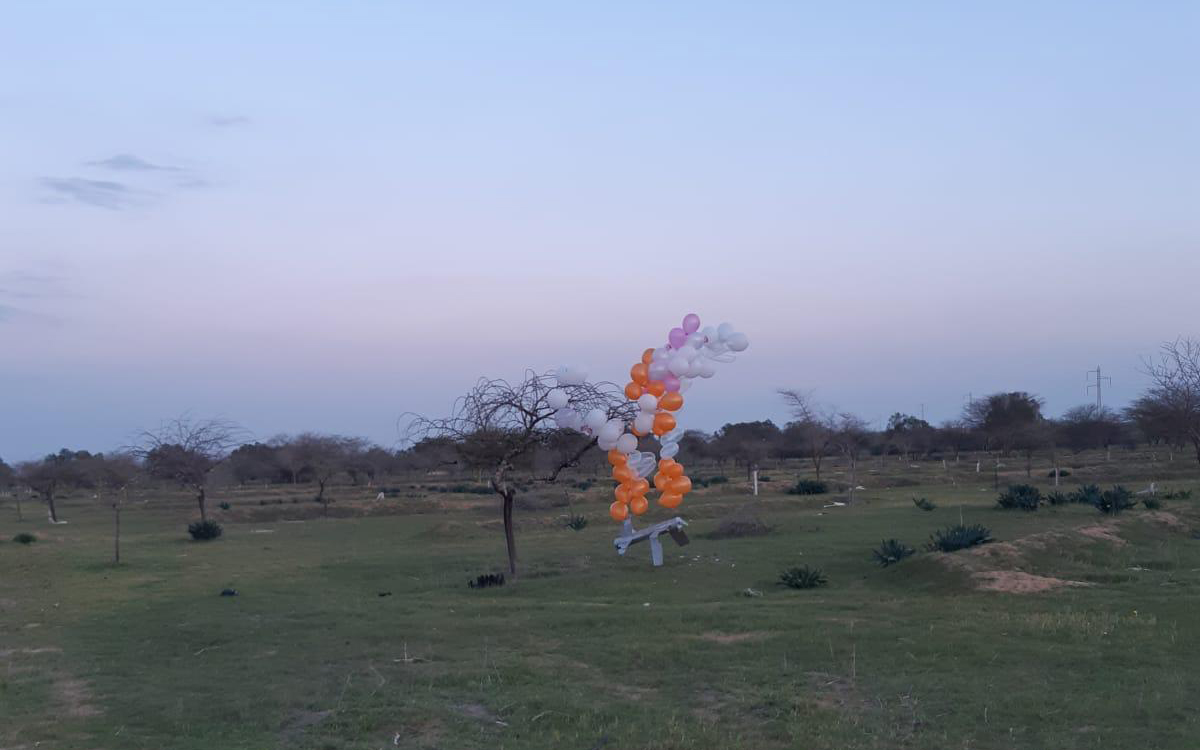
A cluster of balloons carrying what appears to be a cardboard model of a drone that was launched from the Gaza Strip touches down in southern Israel on February 20, 2019. (Eshkol Security)

A cluster of balloons carrying what appears to be a cardboard model of a drone that was launched from the Gaza Strip touches down in southern Israel on February 20, 2019. (Eshkol Security)

Arson balloon attacks continued for a second day on Wednesday, as at least three balloons launched from the Gaza Strip landed in Israel or exploded en route, according to one Gaza-bordering local council.

In response, IDF aircraft fired at a group of Palestinians launching the incendiary devices, the Israeli military said Wednesday evening, calling the target a Hamas post from which the airborne devices were launched.

No injuries were reported in the strikes east of the el-Bureij refugee camp in central Gaza.

A large bundled cluster of balloons carrying a cardboard model of a drone landed in a field in the Eshkol region on Wednesday afternoon, a spokesperson for the local council said. It was one of the largest airborne devices to reach Israel from the Palestinian territory in months.

Police sappers were called to remove the drone, the Eshkol spokesperson said.

A short time earlier, another balloon with a suspected explosive device was found in an agricultural field in the Eshkol region, which borders Gaza, the local government said.

Police sappers were called to the scene and removed the device.

Also Wednesday, a balloon from Gaza exploded in the air nearby. It is not clear what caused the airborne explosion, though it appears to have been something other than the balloon itself, as the sound was heard by fieldhands working nearby.

A balloon carrying a suspected explosive device from the Gaza Strip touches down in southern Israel on February 20, 2019. (Eshkol Security)

Earlier, a security guard outside a kindergarten in the village of Amikam shot several bullets at a balloon passing by the kindergarten in an attempt to bring it down before it reached the facility. Police units who reached the scene discovered it was an ordinary balloon and posed no danger to the surroundings.

The spate of arson balloon launches followed a Gazan balloon launch on Tuesday that sparked the first brush fire in southern Israel in months.

The blaze burned grasslands in a wooded area outside the community of Kibbutz Kissufim in the Eshkol region. It was quickly extinguished, according to the Israel Fire and Rescue Services.

Initially, the Eshkol Regional Council said the cause of the fire was not immediately known, but it was later confirmed to have been sparked by arson devices from Gaza, a fire department spokesperson said.

A second blaze that was sparked in the Eshkol region around the same time was found to have been an intentional controlled burn, and not the result of a Palestinian incendiary device, according to the fire department.

Grasslands burned in a fire sparked by a balloon carrying an incendiary device from the Gaza Strip in southern Israel on February 19, 2019. (Fire and Rescue Services)

In addition, a helium-filled condom with a suspected explosive device attached to it was found outside another community in the Eshkol region.

In response to the fire, Eshkol Mayor Gadi Yarkoni called on Israelis to question political candidates about how they planned to combat these airborne arson attacks.

“Currently candidates for the Knesset are making statements, tweeting, attending parlor meetings and conferences, and asking for your votes, I call on voters, all citizens of the State of Israel: Ask them — what are your proposals for Gaza and against the terror of balloons?” Yarkoni said in a statement.

The Tuesday balloon attacks came as dozens of Palestinians took part in riots along the northern border of the Gaza Strip, across from Kibbutz Zikim, the army said.

Demonstrators burned tires, threw rocks at soldiers and attacked the security fence. In one case, rioters attempted to throw an explosive device across the border, but it failed to clear the fence and landed inside Gaza, the military said.

Israeli troops responded with tear gas and, in some cases, live fire.

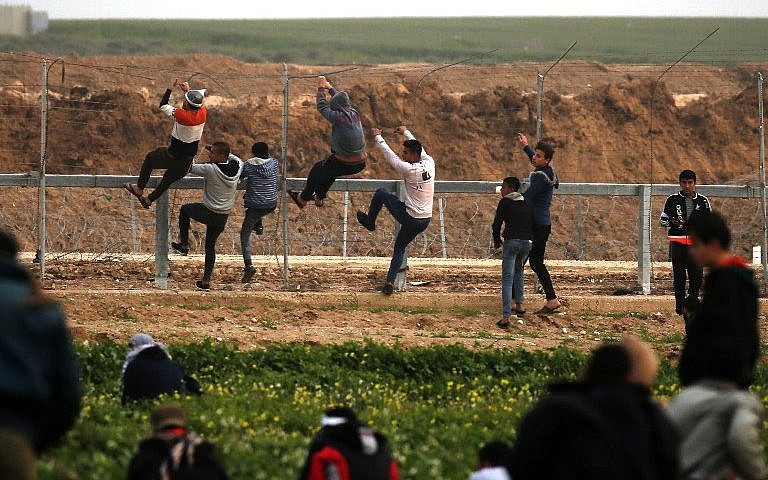
Palestinians climb the security fence along the border between Israel and the Gaza Strip, during clashes east of Gaza City, on February 15, 2019. (Said Khatib/AFP)

According to the Hamas-run Gaza health ministry, 20 people were injured in the clashes.

On Monday night, Palestinians in the Gaza Strip also rioted along the border with Israel, throwing dozens of explosive devices at the security fence and apparently sparking false reports of a mortar attack.

At least seven Palestinians were injured by Israeli gunfire in the Monday clashes, according to the Strip’s health ministry.

Monday’s nighttime clashes came a day after an IDF soldier was moderately injured in clashes along the northern Gaza border and two days after an attack lightly wounded a Border Police officer, the army said.

The IDF believes Hamas or the Iran-backed Palestinian Islamic Jihad, the second-largest terror group in Gaza, could attempt to draw Israel into a war by conducting an attack along the border — an anti-tank missile strike, an ambush from an undiscovered tunnel, or a similar psychologically significant attack.

IDF chief Lt. Gen. Aviv Kohavi, whose tenure began last month, ordered the military to update operational plans for fighting in the Gaza Strip.

Since last March, the Gaza border has seen large-scale weekly clashes on Fridays, smaller protests along the northern Gaza border on Tuesdays, and periodic flareups between the Israeli military and Palestinian terror organizations.

Times of Israel staff and AFP contributed to this report.


Trump bars US-born woman who joined IS from returning

February 21, 2019

Source: Trump bars US-born woman who joined IS from returning | The Times of Israel

Pompeo says 24-year-old Hoda Muthana is not an American citizen, even though she was born in the country and apparently traveled to Syria on a US passport

Hoda Muthana, a US-born former Islamic State propagandist, who is being barred from returning to the US (Screen capture/ABC News)

Hoda Muthana, a US-born former Islamic State propagandist, who is being barred from returning to the US (Screen capture/ABC News)

WASHINGTON (AFP) — US President Donald Trump said Wednesday he is barring a US-born former Islamic State propagandist from returning home, making the highly unusual case that she is not a US citizen.

Trump’s refusal to admit 24-year-old Hoda Muthana comes just as he is pressing Europeans to repatriate their own Islamic State fighters and will likely face legal challenges, with US citizenship extremely difficult to lose.

Trump said on Twitter he has “instructed” Secretary of State Mike Pompeo “not to allow Hoda Muthana back into the country” — a break with usual US protocol not to comment on individuals’ immigration issues.

“Ms. Hoda Muthana is not a US citizen and will not be admitted into the United States,” Pompeo said in a terse statement.

“She does not have any legal basis, no valid US passport, no right to a passport, nor any visa to travel to the United States,” he added.

The US generally grants citizenship to everyone born on its soil and the Alabama-raised Muthana is believed to have traveled to Syria on a US passport.

But a US official said a later investigation showed that she had not been entitled to her passport, adding: “Ms. Muthana’s citizenship has not been revoked because she was never a citizen.”

Officials declined further comment but in a loophole that could boost the government case, Muthana’s father had been a diplomat from Yemen — and children of diplomats are not automatically given citizenship.

Muthana’s lawyer, Hassan Shilby, showed a birth certificate that demonstrated she was born in New Jersey in 1994 and said her father had ceased being a diplomat “months and months” before her birth.

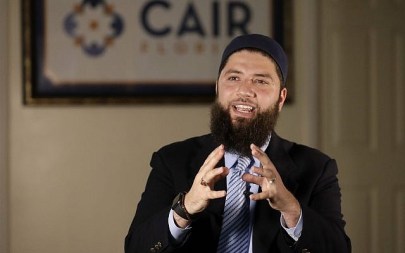
Hassan Shibly, attorney for Hoda Muthana, the Alabama woman who left home to join the Islamic State group in Syria, speaks during a news conference Wednesday, Feb. 20, 2019, in Tampa, Fla. (AP Photo/Chris O’Meara)

“She is a US citizen. She had a valid passport. She may have broken the law and, if she has, she’s willing to pay the price,” Shilby told AFP at his office in Tampa.

He said Muthana wanted due process and was willing to go to prison if convicted.

“We cannot get to a point where we simply strip citizenship from those who break the law. That’s not what America is about. We have one of the greatest legal systems in the world, and we have to abide by it.”

US-born and radicalized

Just this weekend, Trump took to Twitter to chastise European allies that have not taken back hundreds of Islamic State prisoners caught in Syria, where Trump plans to withdraw US troops.

Comparatively few Americans have embraced radical Islam, with the Counter Extremism Project at George Washington University identifying 64 who went to join the Islamic State group in Syria or Iraq.

Muthana, raised in a strict household in Hoover, Alabama, said she was brainwashed by social media messages and headed to Syria without her parents’ knowledge in 2014.

Shortly afterward, Muthana posted on Twitter a picture of herself and three other women who appeared to torch their Western passports, including an American one.

She went on to post vivid calls on social media to kill Americans, glorifying the ruthless extremist group notorious for its beheadings that for a time ruled vast swathes of Syria and Iraq.

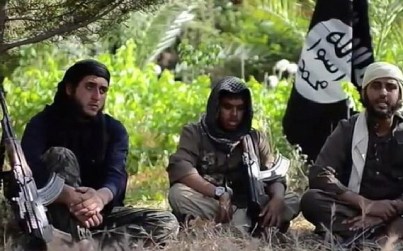
Screen capture from an Islamic State recruitment video directed at Western viewers. (YouTube)

But with the Islamic State group down to its last stretch of land, Muthana said she has renounced extremism and wants to return home with her toddler son, born to one of her three jihadist husbands.

“To say that I regret my past words, any pain that I caused my family and any concerns I would cause my country would be hard for me to really express properly,” she said in a handwritten note to her lawyer.

Tough to lose US citizenship

The US decision on Muthana comes amid rising debate in Europe on the nationality of extremists. Britain recently revoked the citizenship of Shamina Begum, who similarly traveled to Syria and wants to return to her country of birth.

Britain asserted that she was entitled to Bangladeshi citizenship due to her heritage, but the Dhaka government on Wednesday denied that she was eligible, leading her to become effectively stateless.

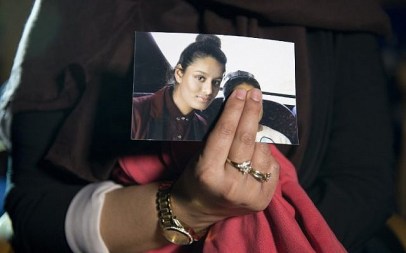
In this file photo taken on February 22, 2015, Renu Begum, eldest sister of British Islamic State member Shamima Begum, holds a picture of her sister while being interviewed by the media in central London. (Laura Lean/Pool/AFP)

US citizenship is significantly more difficult to lose. The 14th Amendment to the US Constitution, ratified in 1868 after the Civil War as slavery was abolished, establishes that anyone born in the country is a citizen with full rights.

The US Supreme Court in the landmark 1967 Afroyim decision rejected the government’s attempt to revoke the nationality of a Polish-born naturalized American after he voted in Israel.

And last year a federal judge rejected a bid to strip the nationality of a Pakistani-born naturalized American who was convicted in a plot to blow up the Brooklyn Bridge.

But Trump has campaigned on a hard line over immigration and raised the prospect of ending birthright citizenship ahead of last year’s congressional elections.

In 2011, President Barack Obama ordered drone strikes that killed two Americans in Yemen — prominent Al-Qaeda preacher Anwar al-Awlaki and his 16-year-old son — but did not believe it was possible to revoke citizenship.


Anti-Semitism worst since WWII, Macron tells French Jewish group 

February 21, 2019

Source: Anti-Semitism worst since WWII, Macron tells French Jewish group | The Times of Israel

President vows to ban racist groups and recognize anti-Zionism as a form of anti-Semitism after spate of recent incidents targeting Jews

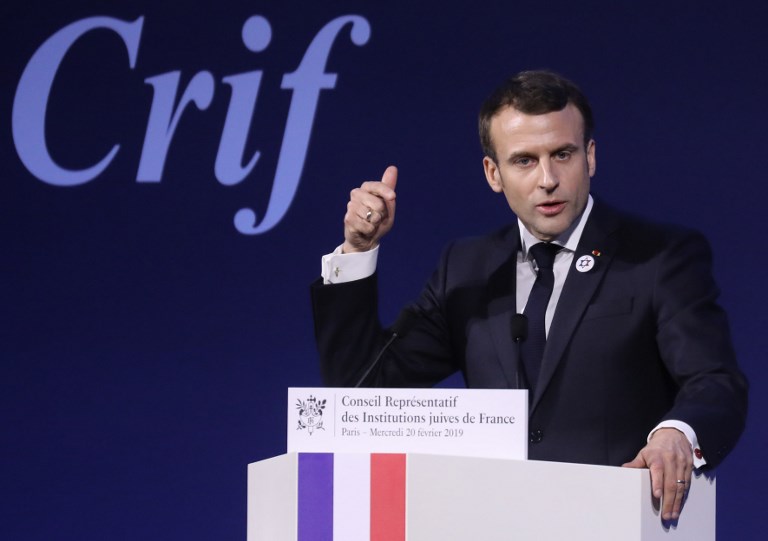
French President Emmanuel Macron speaks during the 34th annual dinner of the Representative Council of Jewish Institutions of France (CRIF – Conseil Representatif des Institutions juives de France) on February 20, 2019, at the Louvre Carrousel in Paris. LUDOVIC MARIN / POOL / AFP)

PARIS — Anti-Semitism appears to have reached its worst levels since World War II, French President Emmanuel Macron told Jewish community leaders on Wednesday, a day after thousands of people took to the streets to denounce hate crimes.

The scourge has grown in recent years “and the situation has got worse in recent weeks,” Macron told the annual dinner of the Representative Council of French Jewish Institutions (CRIF).

“Our country, and for that matter all of Europe and most Western democracies, seems to be facing a resurgence of anti-Semitism unseen since World War II,” he added.

Europe’s biggest Jewish community is reeling after a string of attacks that have made global headlines.

Macron announced measures including legislation to fight hate speech on the internet, to be introduced by May.
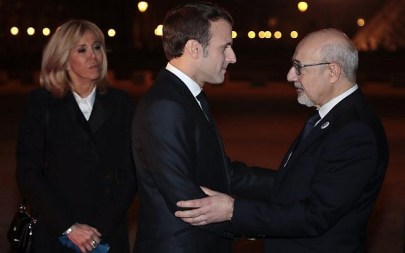
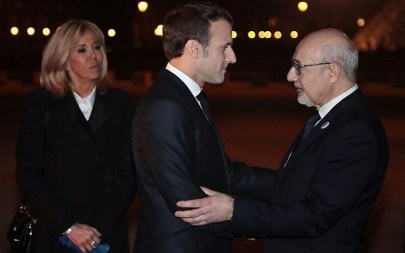
Conseil Representatif des Institutions Juives de France (CRIF) president Francis Kalifat (R) welcomes French President Emmanuel Macron (C), flanked by his wife Brigitte Macron (L) as they arrive at the Louvre Carrousel to attend the 34th annual dinner of the Representative Council of Jewish Institutions of France February 20, 2019, in Paris. (Photo by LUDOVIC MARIN / POOL / AFP)

He said he had asked his interior minister to take steps to ban racist or anti-Semitic groups, singling out “for a start” three far-right groups — Bastion Social, Blood and Honour Hexagone and Combat 18 — which he said “fuel hatred, promote discrimination or call for violence”.

He also vowed that France would recognize anti-Zionism as a form of anti-Semitism.

Macron earlier balked at a call by a lawmaker in his Republic on the Move party to criminalize anti-Zionist statements, which criticize the movement that established Israel as a home for Jews.

On a visit Tuesday to a cemetery in the Alsace region, near Germany, where 96 Jewish tombstones were daubed with swastikas, Macron promised: “We shall act, we shall pass laws, we shall punish.”

French President Emmanuel Macron looks at a grave vandalized with a swastika during a visit at the Jewish cemetery in Quatzenheim, on February 19, 2019, on the day of nationwide marches against a rise in anti-Semitic attacks. (Photo by Frederick FLORIN / POOL / AFP)

Also Tuesday, thousands of people, some carrying banners proclaiming “That’s enough”, held a rally in Paris to denounce anti-Semitism — one of around 70 protests staged nationwide.

Macron and his government have linked the appearance of swastikas and other anti-Semitic graffiti on artworks, shopfronts and headstones to far-right and far-left elements within the “yellow vest” protest movement.
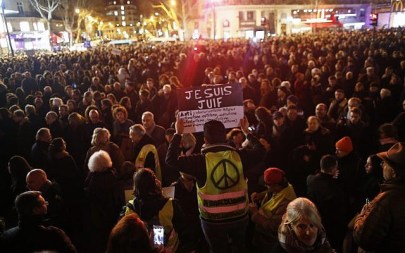
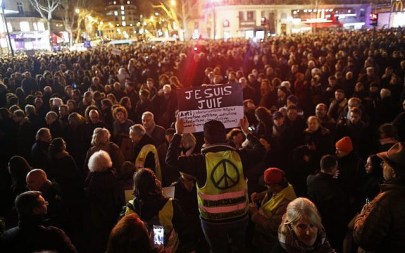
A man wearing a yellow vest holds a placard reading “I am jew”, during a gathering at the Republique square to protest against anti-Semitism, in Paris, France, Tuesday, Feb. 19, 2019. (AP Photo/Thibault Camus

France is ours

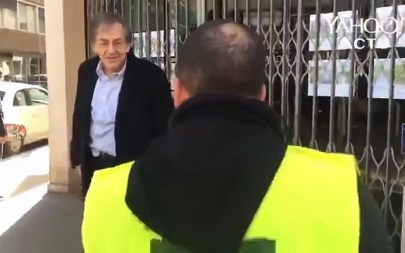
A protester caught on video hurling abuse at Jewish writer and philosopher Alain Finkielkraut during a “yellow vest” demonstration in Paris last weekend was taken into custody Tuesday in the eastern city of Mulhouse, authorities said.

Police confirmed the suspect, who has been named in French media as telephone salesman Benjamin W., was the bearded man seen on video calling 69-year-old Finkielkraut a “dirty Zionist” and telling him “France is ours” after the philosopher ran into demonstrators on the street.

Police sources described the 36-year-old suspect as a small-time delinquent with ties to ultra-conservative Muslim groups.

He was one of the most vocal members of a group that jeered Finkielkraut and called him a “racist”, apparently referring to his past warnings about what he sees as the failure of Muslim immigrants to integrate into French society.
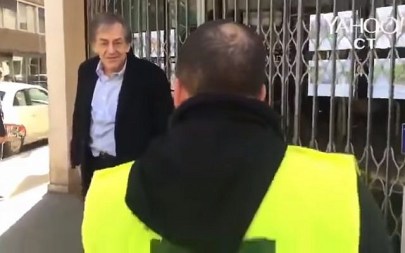
French Jewish philosopher Alain Finkielkraut is targeted by yellow vest protesters shouting anti-Semitic slogans, Paris, February 16, 2019 (Screen grab via Yahoo)

The incident caused outrage both in France and abroad, with Israel’s Immigration Minister Yoav Gallant urging French Jews to “come home” to Israel for their safety.

President Reuven Rivlin voiced support for Macron and Finkielkraut, calling the anti-Semitic incidents an “affront” to France.

Earlier Wednesday, Rivlin spoke with Finkielkraut to express his solidarity over the “wicked and hurtful attack.”

“I heard that the demonstrators told you to go back to Tel Aviv. I am sure you know that Tel Aviv is a wonderful place but be in no doubt that every Jew, and every person, has the right to choose wherever they live”, said Rivlin, who also wrote to Macron to thank him for visiting the Jewish cemetery.

Also on Wednesday, Prime Minister Benjamin Netanyahu spoke by telephone with Macron, the Israeli leader’s office said.

Focus on anti-Zionism

Several officials have accused radical “yellow vest” of fomenting a climate of hatred.

The anti-government protests began three months ago over fuel taxes but quickly grew into a broader anti-establishment, anti-capitalist rebellion, with some demonstrators using anti-Semitic slurs to denigrate Macron, a former Rothschild investment banker.

The number of anti-Jewish crimes rose 74 percent last year.

Anti-Semitism has a long history in France where society was deeply split at the end of the 19th century by the Alfred Dreyfus affair over a Jewish army captain wrongly convicted of treason.

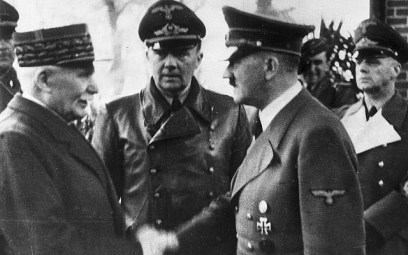
During World War II, the French Vichy government collaborated with Germany notably in the deportation of Jews to death camps.
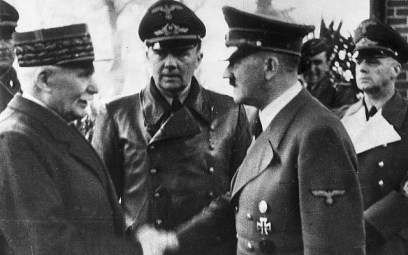
German Chancellor Adolf Hitler, right, shaking hands with Head of State of Vichy France Marshall Philippe Petain, in occupied France, October 24, 1940. (AP Photo)

Traditionally associated with the far right, anti-Semitism has become ingrained in the high-rise French housing estates that house many members of France’s Muslim community, Europe’s largest.

Jews have been targeted in several attacks by French jihadists in recent years.

But the proliferation of anti-Semitic graffiti is seen as a new trend.

In recent days, the word “Juden” was spray-painted on the window of a Paris bagel bakery and swastikas were daubed on postbox portraits of late French Holocaust survivor and women’s rights icon Simone Veil.


Off Topic:  Anti-Semitism worst since WWII, Macron tells French Jewish group

February 21, 2019

Source: Anti-Semitism worst since WWII, Macron tells French Jewish group | The Times of Israel

President vows to ban racist groups and recognize anti-Zionism as a form of anti-Semitism after spate of recent incidents targeting Jews

French President Emmanuel Macron speaks during the 34th annual dinner of the Representative Council of Jewish Institutions of France (CRIF – Conseil Representatif des Institutions juives de France) on February 20, 2019, at the Louvre Carrousel in Paris. LUDOVIC MARIN / POOL / AFP)

PARIS — Anti-Semitism appears to have reached its worst levels since World War II, French President Emmanuel Macron told Jewish community leaders on Wednesday, a day after thousands of people took to the streets to denounce hate crimes.

The scourge has grown in recent years “and the situation has got worse in recent weeks,” Macron told the annual dinner of the Representative Council of French Jewish Institutions (CRIF).

“Our country, and for that matter all of Europe and most Western democracies, seems to be facing a resurgence of anti-Semitism unseen since World War II,” he added.

Europe’s biggest Jewish community is reeling after a string of attacks that have made global headlines.

Macron announced measures including legislation to fight hate speech on the internet, to be introduced by May.

Conseil Representatif des Institutions Juives de France (CRIF) president Francis Kalifat (R) welcomes French President Emmanuel Macron (C), flanked by his wife Brigitte Macron (L) as they arrive at the Louvre Carrousel to attend the 34th annual dinner of the Representative Council of Jewish Institutions of France February 20, 2019, in Paris. (Photo by LUDOVIC MARIN / POOL / AFP)

He said he had asked his interior minister to take steps to ban racist or anti-Semitic groups, singling out “for a start” three far-right groups — Bastion Social, Blood and Honour Hexagone and Combat 18 — which he said “fuel hatred, promote discrimination or call for violence”.

He also vowed that France would recognize anti-Zionism as a form of anti-Semitism.

Macron earlier balked at a call by a lawmaker in his Republic on the Move party to criminalize anti-Zionist statements, which criticize the movement that established Israel as a home for Jews.

On a visit Tuesday to a cemetery in the Alsace region, near Germany, where 96 Jewish tombstones were daubed with swastikas, Macron promised: “We shall act, we shall pass laws, we shall punish.”

French President Emmanuel Macron looks at a grave vandalized with a swastika during a visit at the Jewish cemetery in Quatzenheim, on February 19, 2019, on the day of nationwide marches against a rise in anti-Semitic attacks. (Photo by Frederick FLORIN / POOL / AFP)

Also Tuesday, thousands of people, some carrying banners proclaiming “That’s enough”, held a rally in Paris to denounce anti-Semitism — one of around 70 protests staged nationwide.

Macron and his government have linked the appearance of swastikas and other anti-Semitic graffiti on artworks, shopfronts and headstones to far-right and far-left elements within the “yellow vest” protest movement.

A man wearing a yellow vest holds a placard reading “I am jew”, during a gathering at the Republique square to protest against anti-Semitism, in Paris, France, Tuesday, Feb. 19, 2019. (AP Photo/Thibault Camus

France is ours

A protester caught on video hurling abuse at Jewish writer and philosopher Alain Finkielkraut during a “yellow vest” demonstration in Paris last weekend was taken into custody Tuesday in the eastern city of Mulhouse, authorities said.

Police confirmed the suspect, who has been named in French media as telephone salesman Benjamin W., was the bearded man seen on video calling 69-year-old Finkielkraut a “dirty Zionist” and telling him “France is ours” after the philosopher ran into demonstrators on the street.

Police sources described the 36-year-old suspect as a small-time delinquent with ties to ultra-conservative Muslim groups.

He was one of the most vocal members of a group that jeered Finkielkraut and called him a “racist”, apparently referring to his past warnings about what he sees as the failure of Muslim immigrants to integrate into French society.

French Jewish philosopher Alain Finkielkraut is targeted by yellow vest protesters shouting anti-Semitic slogans, Paris, February 16, 2019 (Screen grab via Yahoo)

The incident caused outrage both in France and abroad, with Israel’s Immigration Minister Yoav Gallant urging French Jews to “come home” to Israel for their safety.

President Reuven Rivlin voiced support for Macron and Finkielkraut, calling the anti-Semitic incidents an “affront” to France.

Earlier Wednesday, Rivlin spoke with Finkielkraut to express his solidarity over the “wicked and hurtful attack.”

“I heard that the demonstrators told you to go back to Tel Aviv. I am sure you know that Tel Aviv is a wonderful place but be in no doubt that every Jew, and every person, has the right to choose wherever they live”, said Rivlin, who also wrote to Macron to thank him for visiting the Jewish cemetery.

Also on Wednesday, Prime Minister Benjamin Netanyahu spoke by telephone with Macron, the Israeli leader’s office said.

Focus on anti-Zionism

Several officials have accused radical “yellow vest” of fomenting a climate of hatred.

The anti-government protests began three months ago over fuel taxes but quickly grew into a broader anti-establishment, anti-capitalist rebellion, with some demonstrators using anti-Semitic slurs to denigrate Macron, a former Rothschild investment banker.

The number of anti-Jewish crimes rose 74 percent last year.

Anti-Semitism has a long history in France where society was deeply split at the end of the 19th century by the Alfred Dreyfus affair over a Jewish army captain wrongly convicted of treason.

During World War II, the French Vichy government collaborated with Germany notably in the deportation of Jews to death camps.

German Chancellor Adolf Hitler, right, shaking hands with Head of State of Vichy France Marshall Philippe Petain, in occupied France, October 24, 1940. (AP Photo)

Traditionally associated with the far right, anti-Semitism has become ingrained in the high-rise French housing estates that house many members of France’s Muslim community, Europe’s largest.

Jews have been targeted in several attacks by French jihadists in recent years.

But the proliferation of anti-Semitic graffiti is seen as a new trend.

In recent days, the word “Juden” was spray-painted on the window of a Paris bagel bakery and swastikas were daubed on postbox portraits of late French Holocaust survivor and women’s rights icon Simone Veil.

 

Rouhani calls US sanctions ‘a terrorist act’

February 21, 2019

Source: Rouhani calls US sanctions ‘a terrorist act’ | The Times of Israel

Iranian president tells cabinet ministers the ‘struggle between Iran and America is currently at a maximum’

Iranian President Hassan Rouhani speaks at a ceremony to mark the second anniversary of the death of former Iranian president Akbar Hashemi Rafsanjani, in Tehran, Iran, on January 10, 2019. (Iranian Presidency Office via AP)

Iranian President Hassan Rouhani speaks at a ceremony to mark the second anniversary of the death of former Iranian president Akbar Hashemi Rafsanjani, in Tehran, Iran, on January 10, 2019. (Iranian Presidency Office via AP)

Iranian President Hassan Rouhani lashed out at US-imposed sanctions as “a terrorist act” during a cabinet meeting in Tehran on Wednesday.

He said US-Iran relations were at a low point following the US withdrawal last May from the 2015 nuclear deal and reimposition of US sanctions, particularly targeting the country’s vital oil sector, according to comments from the meeting released by state media outlet IRIB and translated by Reuters.

“The struggle between Iran and America is currently at a maximum. America has employed all its power against us,” Rouhani told ministers. “The US pressures on firms and banks to halt business with Iran is 100 percent a terrorist act,” he was quoted as saying.

The Trump administration maintains that the 2015 nuclear deal, celebrated by European powers and the previous US administration of former president Barack Obama, was insufficient because it did not include measures to curb the Iranian regime’s ambitions in the region and its ballistic missile program.

US President Donald Trump last year pulled the US out of the deal and re-imposed sanctions on Iran, targeting its vital oil sector.

“Our ultimate aim is to compel Iran to permanently abandon its well-documented outlaw activities and behave as a normal country,” US Secretary of State Mike Pompeo said, when the sanctions were reimposed.

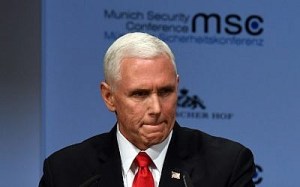
US Vice President Mike Pence speaks during the 55th Munich Security Conference in Munich, southern Germany, on February 16, 2019. (Christof STACHE / AFP)

Last week, US Vice President Mike Pence demanded that European Union allies follow Washington’s lead in withdrawing from the landmark Iran nuclear deal and cease efforts he said were designed to evade US sanctions.

Speaking at a Middle East conference in Poland, Pence accused Iran of being the world’s largest state sponsor of terrorism, adding that it was the “greatest threat to peace and security in the Middle East,” and accused the clerical regime of plotting a “new Holocaust” with its regional ambitions.

Rouhani’s comments were the latest in a string of statements by the Iranian president in recent weeks lambasting US sanctions policy.

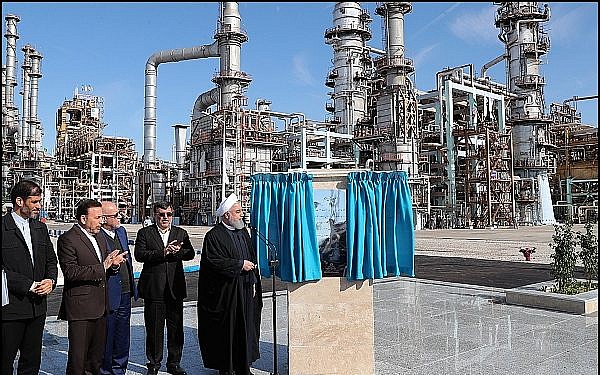
Iranian President Hassan Rouhani dedicates the final phase of a new oil refinery in the city of Bandar Abbas, Iran, February 18, 2019. (Official website photo)

On Monday, Rouhani called the sanctions an “economic war” against Iran, warning that “economic war is more difficult than military war.”

Rouhani spoke as he inaugurated the third and final phase of the sprawling Persian Gulf Star refinery built in the Persian Gulf port city of Bandar Abbas.

Construction of the refinery began in 2006 and it now has the capacity of 400,000 barrels a day, which amounts to about 20 percent of Iran’s 2.1 million barrels of daily refining capacity.

Rouhani praised the inauguration, saying in a televised speech that it comes despite America “imposing the harshest sanctions” on Iran.

“We have inaugurated huge national projects in this situation,” Rouhani said at the inauguration, adding that this comes despite efforts by the US, Israel, and their allies to increase pressure on Iran.

Times of Israel staff contributed to this report.


Democratic Party passes resolution calling for US to re-enter Iran nuke deal

February 21, 2019

Source: Democratic Party passes resolution calling for US to re-enter Iran nuke deal | The Times of Israel

‘The United States should return to its obligations under the JCPOA,’ DNC asserts in new document indicating party will reverse Trump’s withdrawal should it come to power in 2020

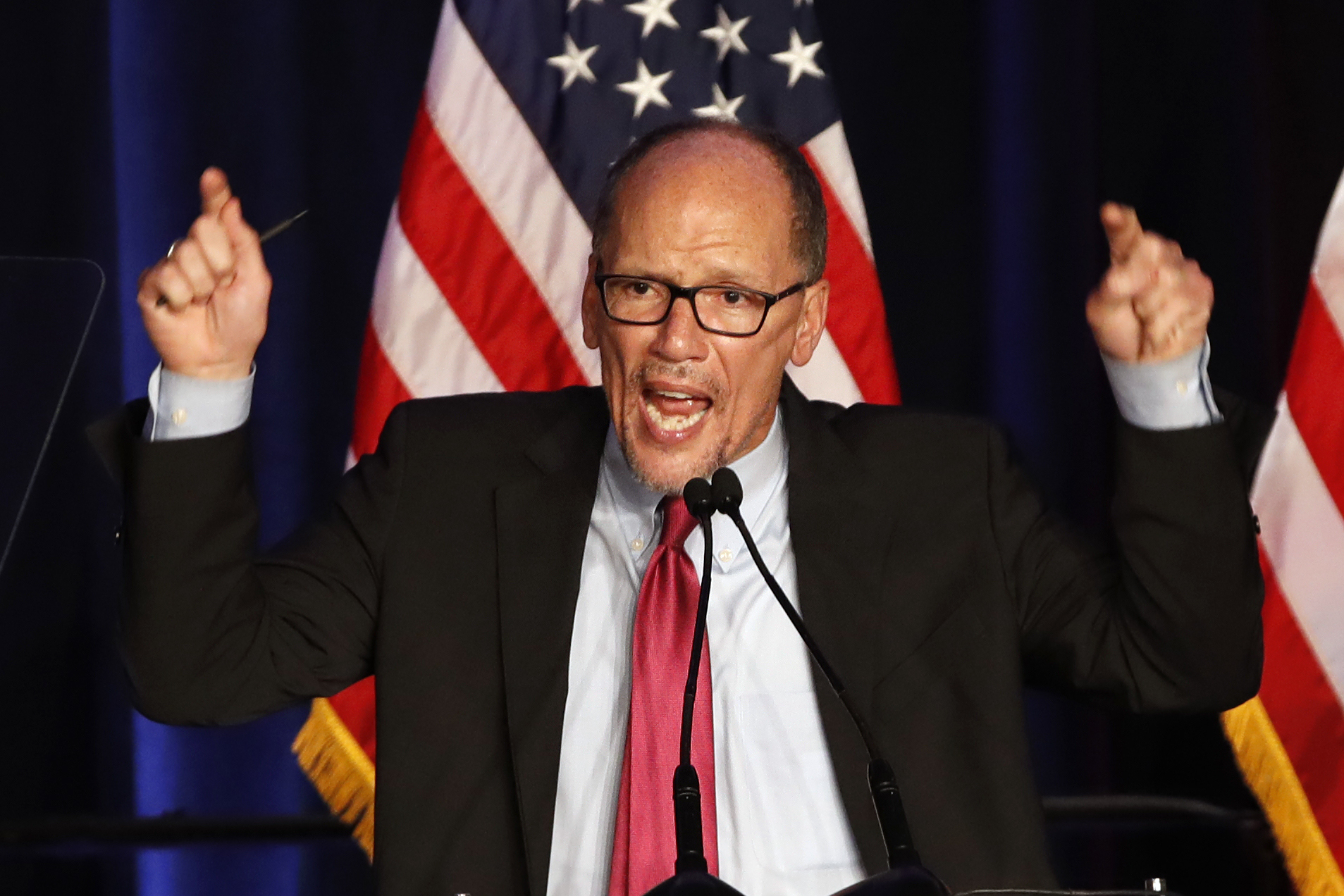
In this this Nov. 6, 2018, file photo, Tom Perez, Chairman of the Democratic National Committee, introduces Minority Leader Nancy Pelosi of Calif., as he speaks about Democratic wins in the House of Representatives to a crowd of Democratic supporters in Washington.(AP Photo/Jacquelyn Martin)

In this this Nov. 6, 2018, file photo, Tom Perez, Chairman of the Democratic National Committee, introduces Minority Leader Nancy Pelosi of Calif., as he speaks about Democratic wins in the House of Representatives to a crowd of Democratic supporters in Washington.(AP Photo/Jacquelyn Martin)

WASHINGTON, DC — The Democratic National Committee passed a resolution last week calling on the US to re-enter the Iran nuclear deal, a sign that the party’s 2020 presidential candidates will run on returning America to the landmark pact from which US President Donald Trump withdrew.

At the February 16 meeting in Washington, DC, the DNC adopted a motion solidifying the party’s position that US should rejoin the Joint Comprehensive Plan of Action, as the deal is formally known, according to a text of the resolution obtained by The Times of Israel.

“The United States should return to its obligations under the JCPOA and utilize multilateral and bilateral diplomacy to achieve political solutions to remaining challenges regarding Iran,” the document says.

Trump unilaterally pulled the United States out of the deal last May and renewed sanctions on the Islamic Republic, all with the intention, he said, to negotiate a new deal that would address three of his concerns: ending the sunset clauses that allow certain restrictions on Iran’s nuclear program to expire; banning Iran’s capacity to test ballistic missiles; and allowing international inspectors full access to Iran’s military sites.

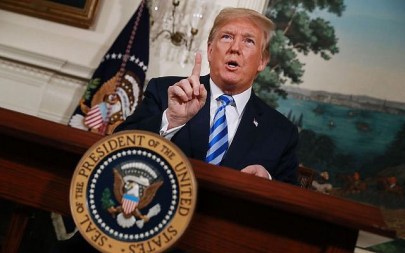
President Donald Trump announcing his decision to leave the Iran nuclear deal in the Diplomatic Reception Room at the White House, May 8, 2018. (Chip Somodevilla/Getty Images)

The other parties to the deal — England, France, Germany, Russia, China and Iran — have all maintained the agreement in spite of the United States walking out.

The agreement, forged under former US president Barack Obama, was struck in July 2015 and implemented in January 2016.

The DNC resolution is an early indication as the 2020 campaign ramps up, that if a Democrat were to win the White House, he or she may bring the United States back into the accord.

Virtually all of the Senate Democrats who have already declared their candidacy — Vermont Senator Bernie Sanders, California Senator Kamala Harris, New Jersey Senator Cory Booker, and Minnesota Senator Amy Klobuchar — opposed Trump’s decision to remove America from the deal.

The DNC resolution says that the Iran deal was working as intended to prevent Tehran from developing a nuclear weapon.

European Union High Representative for Foreign Affairs Federica Mogherini, left, and Iranian Minister of Foreign Affairs Mohammad Javad Zarif, center, take part in a Comprehensive Plan of Action (JCPOA) ministerial meeting on the Iran nuclear deal on July 6, 2018 in Vienna, Austria. (AFP/ APA/ Hans Punz)

“The JCPOA has delivered substantial nonproliferation benefits, including Iran slashing its enriched uranium stockpile by 97% to less than 300 kilograms and the IAEA instituting the world’s strongest nuclear verification regime in Iran,” the text says. 

It also quoted several world leaders — from French President Francois Macron  to EU Representative Federica Mogherini to Trump’s former secretary of state Jim Mattis — explaining the deal’s virtues.

The Iran deal “remains the best means of preventing Iran from developing a nuclear weapon,” British Prime Minister Theresa May is quoted saying.

“The JCPOA is a key nonproliferation achievement that guards against Iran developing nuclear weapons and is of central importance to American security,” the resolution states. “Returning to the JCPOA will restore America’s commitment to an agreement made with allies and prevent a renewed nuclear crisis in the Middle East.”

Iran says it cannot rule out possibility of war with Israel

February 21, 2019

Source: Iran says it cannot rule out possibility of war with Israel | The Times of Israel

Mohammad Javad Zarif accuses Jerusalem of ‘adventurism,’ with its campaign of airstrikes against Iranian targets in Syria and cautions situation could deteriorate

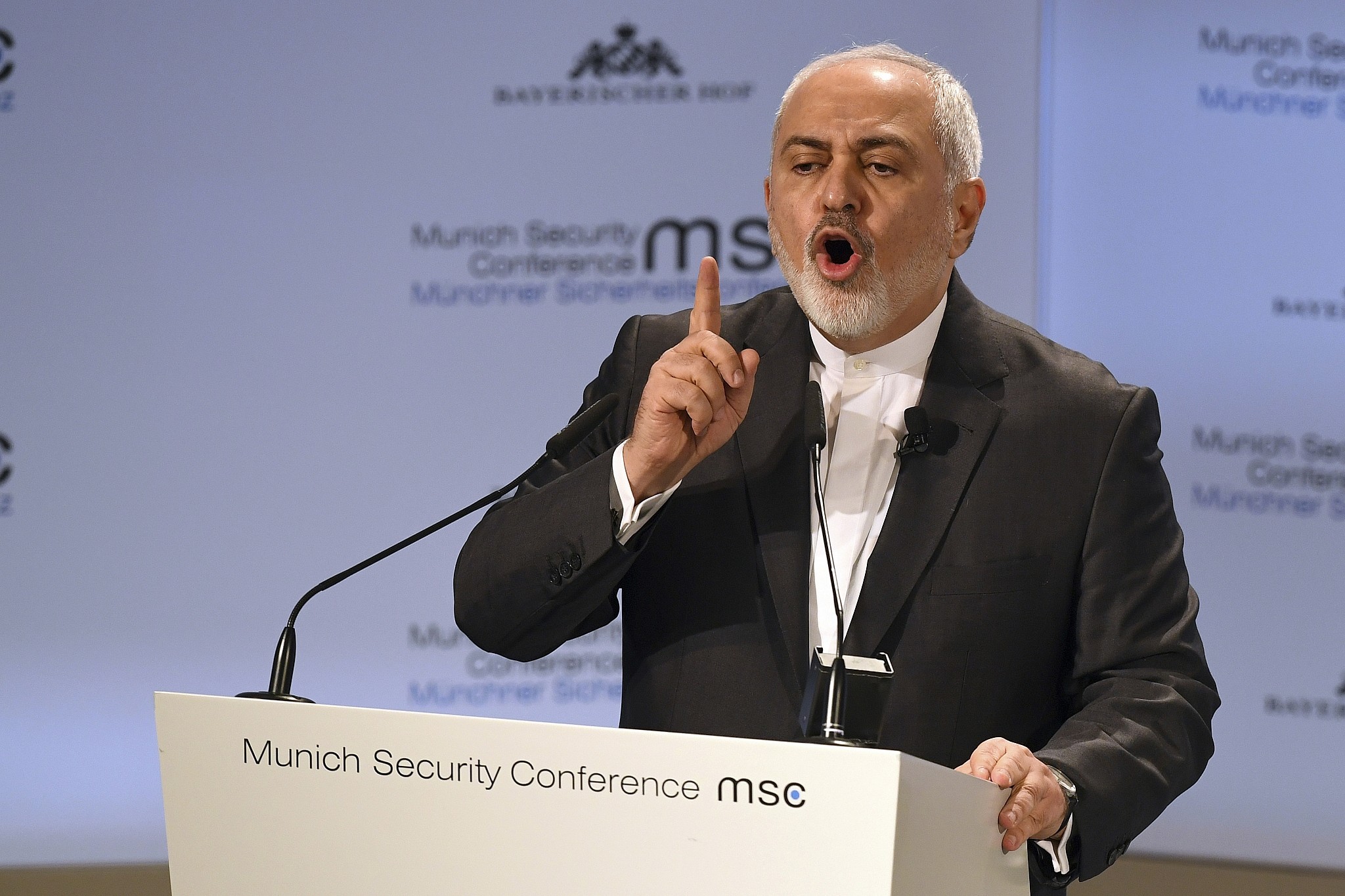
Iranian Foreign Minister Mohammad Javad Zarif speaks during the Munich Security Conference in Munich, Germany, Feb. 17, 2019. (AP Photo/Kerstin Joensson)

Iranian Foreign Minister Mohammad Javad Zarif speaks during the Munich Security Conference in Munich, Germany, Feb. 17, 2019. (AP Photo/Kerstin Joensson)

Iran’s foreign minister accused Israel of “adventurism,” with its campaign of airstrikes against Iranian targets in Syria and said he could not rule out the possibility  that they could lead to a war between the Mideast arch foes.

Speaking to the German Sueddeutsche Zeitung newspaper, Mohammad Javad Zarif said Israel constantly violated Syrian and Lebanese sovereignty, while Iran was in Syria at the invitation of the Assad government.

Israel has carried out dozens of airstrikes against Iranian targets in Syria in a bid to prevent Iran from entrenching itself in the country and transferring advanced weapons to the Hezbollah terror group in Lebanon.

Zarif said the Israeli strikes could lead to war.

“There is adventurism on Israel’s side, and adventurism is always dangerous,” Zarif told the newspaper in an interview to be published on Thursday, according to Reuters.

Asked if he saw an emerging military conflict between Iran and Israel, Zarif said, “I do not, but we cannot exclude the possibility.”

On Sunday, Zarif had warned that Jerusalem is “looking for war” and that the behavior of Israel and the United States was increasing the prospects of a conflict.

“Certainly, some people are looking for war… Israel,”  Zarif told participants at the Munich Security Conference, according to the Reuters news agency.

Zarif said that Israel was violating international law by carrying out bombing raids in Syria, and called on European powers and the US to hold Israel to account for its actions.

“The risk [of war] is great. The risk will be even greater if you continue to turn a blind eye to severe violations of international law.

“Israeli behavior is putting international law on the shelf, US behavior is putting international law on the shelf,” he said.

The Iranian regime views Israel and the US as its political and spiritual arch-enemies, and its leaders regularly vow to destroy the Jewish state.

Israel in recent years has carried out hundreds of airstrikes in Syria against targets linked to Iran, which alongside its proxies and Russia is fighting on behalf of the regime of Syrian President Bashar Assad.

Until recently, Israel typically refrained from commenting on its military activities against Iran in Syria, neither confirming nor denying strikes.

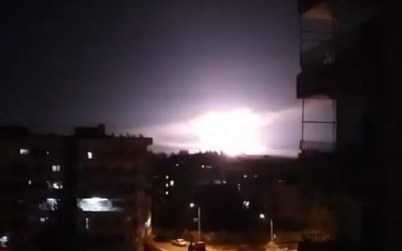
An explosion, reportedly during Israeli airstrikes near Damascus, Syria, on January 21, 2019. (screen capture: YouTube)

Over the past two months, however, that policy of ambiguity has been largely abandoned by Israeli military and political officials, who have begun more openly discussing the Israel Defense Forces’ operations in Syria.

Prime Minister Benjamin Netanyahu has come under fire for breaking Israel’s ambiguity policy regarding attacks in Syria, with critics accusing him of putting Israel’s security at risk to gain points among voters.

Zarif’s words regarding the increasing likelihood of all-out military conflict with Israel comes days after Netanyahu spoke of a joint interest in “war” in the context of the struggle against the Islamic Republic.

In a Hebrew-language video message recorded before he headed last Wednesday to the opening of a Middle East conference in Warsaw, the prime minister hailed the fact that an Israeli leader was about to sit down with senior officials from “leading Arab countries” in order to “advance the common interest of war against Iran.”

An official translation of the statement, provided by the Government Press Office, translated Hebrew phrase milhama b’Iran as “war with Iran,” when it was not clear that Netanyahu had meant literal military action.

The prime minister’s social media accounts published the statement, leading numerous people, including Zarif, to point out its ostensible belligerency.