Archive for February 14, 2019

Saudi Prince Turki to Israeli TV: Netanyahu deceiving Israel about peace chances 

February 14, 2019

Source: Saudi Prince Turki to Israeli TV: Netanyahu deceiving Israel about peace chances | The Times of Israel

Veteran diplomat, in unprecedented interview, says Riyadh wants to ‘get our point across directly’ to Israelis: Solve the Palestinian issue and then ‘we can go far’
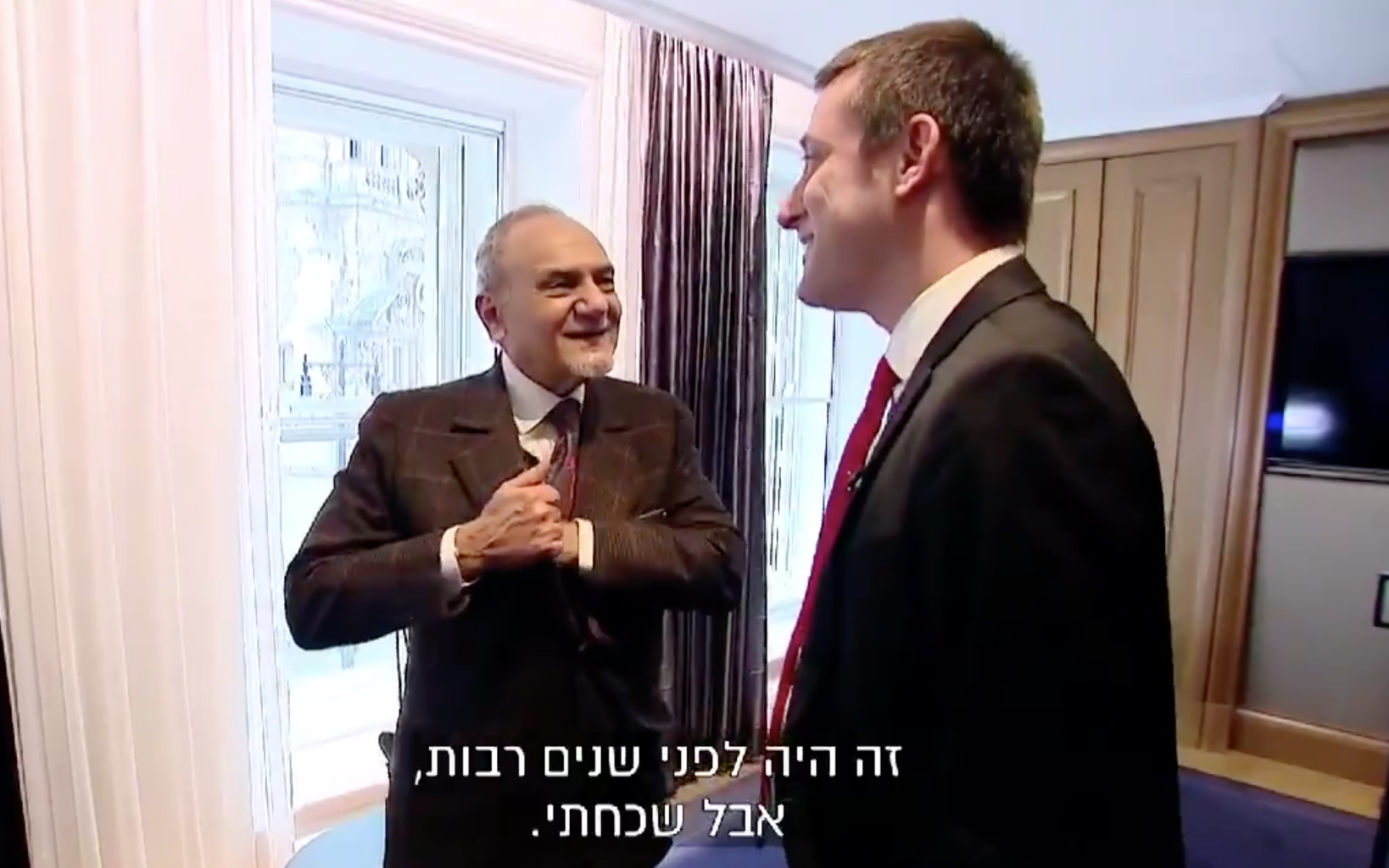
Saudi Prince Turki bin Faisal Al Saud with Channel 13’s Barak Ravid, February 2019 (Twitter screenshot)

In an unprecedented interview with an Israeli TV station broadcast Wednesday, the former Saudi intelligence chief and ex-ambassador to the US and UK accused Prime Minister Benjamin Netanyahu of deceiving the Israeli public by claiming that Israeli ties with the wider Arab world can be warmed without the Palestinian issue being solved.

“Israeli public opinion should not be deceived into believing that the Palestinian issue is a dead issue,” Prince Turki bin Faisal Al Saud told Israel’s Channel 13 news in a lengthy interview in London. “From the Israeli point of view, Mr. Netanyahu would like us to have a relationship, and then we can fix the Palestinian issue. From the Saudi point of view, it’s the other way around.”

Asked by interviewer Barak Ravid whether that meant Netanyahu was “deceiving the Israeli public” by claiming to be able to “promote relations with the Arab world regardless of the Palestinians,” Prince Turki replied: “Absolutely. Absolutely.”

Asked why Netanyahu would do that, the prince said: “For his own purposes.” Laughing, he continued: “He’s a man who runs for election on platforms of ‘look what I have done for you. I have brought you this. I have brought you that.’ Like all politicians.”

The prince said the Saudi public has “a very negative view of Mr. Netanyahu because of what is happening on the ground,” and because of what he termed Netanyahu’s “hubristic attitude… praising himself.”

Ironically, the interview was broadcast only hours after Netanyahu, who is in Poland, met with the foreign minister of Oman, and the two men discussed a new era for the Middle East. Netanyahu has said often that shared concern about Iran is one of the factors helping to gradually warm Israeli ties with Gulf states and others in the region.

“We don’t need Mr. Netanyahu to tell us the dangers that Iran poses,” the Saudi prince stressed. “We see it on the ground. We see their activities in Lebanon. We see their activities in Syria, in Iraq, in Yemen, in Bahrain, even in Saudi Arabia. So why should we wait for Mr. Netanyahu to highlight these things? We don’t need that.”
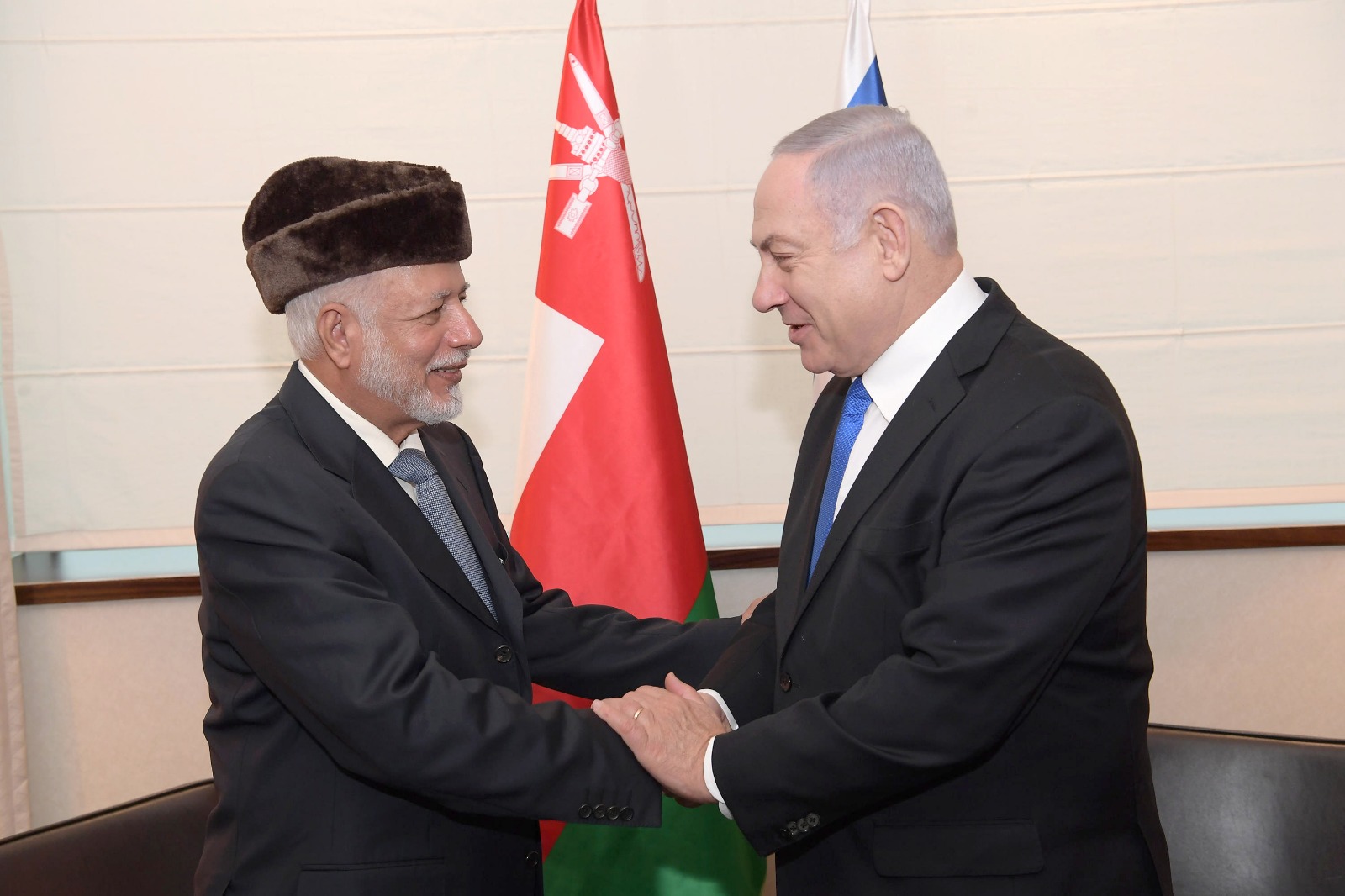
Prime Minister Benjamin Netanyahu (right) greets Omani Foreign Minister Yusuf bin Alawi bin Abdullah at the sidelines of a regional conference on the Middle East in Warsaw, February 13, 2018 (Amos Ben Gershom/GPO)

Asked how he would advise the Trump administration as it prepares to present its peace plan, Prince Turki said simply: “The Arab Peace Initiative — take it on. Make it yours.”

He recalled that the late Saudi King Abdullah initiated the plan in 2002. “Basically it’s a quid pro quo: Israel withdraws from occupied Arab territories, in return for Arab recognition of Israel, end of hostilities and normal relations.”

However, he said, “from day one there has not been an Israeli response.” (In 2015, Netanyahu said he backed the “general idea” behind the initiative. Former prime minister Olmert indicated he saw it as a basis for discussion.)

“With Israeli money and Saudi brains, we can go far,” the prince said, but added: “Yes, if there is peace. Unfortunately,” he charged, “Israel chooses to ignore all the efforts of Saudi Arabia to make peace, and expects Saudi Arabia to put its hand in its [Israel’s] hand and go forward on technology, on water desalination, on issues like that. It’s not going to happen,” he exclaimed.

“Israel has not been very cooperative as far as achieving peace in our part of the world,” he also said.

Prince Turki insisted there was no difference between Saudi King Salman and Crown Prince Mohammed bin Salman when it came to Israel, rejecting the notion that the king had curbed the crown prince’s inclination to warmer ties.

The crown prince “is a stalwart representative of Saudi policy,” he said, and the idea that there was a warmer stance from him was likely “wishful thinking on the part of Israeli officials.” The crown prince “supports the Palestinian cause to the fullest” and had no differences with the king “on any issue. He does what the king tells him.”

The Saudi prince clarified that he was giving the interview in a personal capacity, and “I do not represent the government of Saudi Arabia in any capacity whatsoever.” Nonetheless, asked if it was known in Riyadh that he would be speaking to an Israeli TV station, he said it was normal “courtesy and good manners” to tell people what he was going to be doing.

Ravid said Prince Turki had met with the Saudi king in the days before the interview, and that the prince was plainly conveying a message that Riyadh wants heard in Israel.

President Shimon Peres shakes hands with former US President Bill Clinton, during a meeting at the World Economic Forum in Davos, Switzerland, in 2010 (Photo credit: Sergei Illin/Flash 90)

President Shimon Peres shakes hands with former US President Bill Clinton, during a meeting at the World Economic Forum in Davos, Switzerland, in 2010 (Sergei Illin/Flash 90)

During his years in government, the prince said he had never held official meetings with Israelis, except with president Shimon Peres, over dinner in Davos. Peres suggested they hold more substantive, private talks, but Prince Turki said he demurred: “I told him, Mr. President, nothing in Israel remains a secret.”

He said he was speaking to Israeli television now because “we have to get our point across directly to the Israeli people.”

The prince, who is 73, said he had never been to Jerusalem and looked forward “to the day when there is peace between Israel and the Arab world, and I can visit what I consider to be not only a holy place, but a place of my history as an Arab and as a Muslim. Abraham, our father, is not only the father of the Jews. He is the father of the Arabs. Jerusalem is something I want to see before I die. Unfortunately, I’m not too optimistic that I’m going to see that.”

Asked whether he expected to witness a meeting between an Israeli prime minister and a Saudi king or crown prince in his lifetime, Prince Turki said: “In my lifetime — and there’s very little of it left to come — I don’t think I’m going to see that. Not before the Palestinian issue is resolved. I am looking for an Israeli peace initiative. I haven’t seen one. What is it that Israel thinks will make peace?”

 

IDF warns Hamas likely to spark war in Gaza in bid for international support

February 14, 2019

Source: IDF warns Hamas likely to spark war in Gaza in bid for international support | The Times of Israel

Intelligence assesses terror group no longer opposes full-scale conflict, seeing it as a way to bring in reconstruction funds for beleaguered enclave; IDF developing war plans

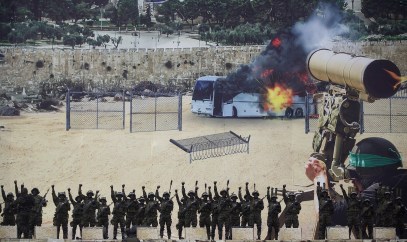
Masked gunmen of the al-Qassam brigades, the military wing of Hamas, raise their hands as they stand in front of a huge poster showing a mock attack on a bus, during a mass rally in Gaza, Sunday, Dec. 16, 2018. (AP/Khalil Hamra)

The Hamas terror group may seek to spark a war with Israel in the near future in an attempt to elicit international sympathy and an influx of international aid money to the Gaza Strip, which it controls, according to an Israeli Military Intelligence assessment released Wednesday.

The Israel Defense Forces believes Hamas or the Iran-backed Palestinian Islamic Jihad, the second largest terror group in Gaza, could attempt to draw Israel into a war by conducting an attack along the border — another anti-tank missile strike on a bus, an ambush from an as-yet-undiscovered tunnel or a similar low-level but significant attack.

According to the intelligence assessment, parts of which were distributed to reporters on Wednesday, while the Israeli military sees the northern arena — Lebanon and the Iranian entrenchment in Syria — as the larger challenges facing the Jewish state, the more immediate threats come from the Gaza Strip.

In light of this view, IDF chief Lt. Gen. Aviv Kohavi, whose tenure began last month, called for the military to update operational plans for fighting in the Gaza Strip.

IDF chief Aviv Kohavi visits Southern Command in undated photograph. (Israel Defense Forces)

“Gaza, as it is noted in the annual intelligence assessment, is the most volatile region, and there is a risk of terror group’s initiating action [against Israel]. The chief of staff identified an improvement of readiness in that region as a top priority,” the military said.

“The identification of targets will be increased — both for retaliatory strikes and to assist in ground forces maneuvering within the Strip,” the army said.

Kohavi also called for the military to purchase two more Iron Dome missile defense systems. Currently, the Israeli Air Force possesses eight batteries — six that are operated by conscripts and two by reservists. “By the end of 2019, 10 batteries are intended to be deployed across the country — eight staffed by conscripts and two by reservists,” the army said.

The IDF believes the terror group is not interested in entering a long conflict with Israel, but envisions a short period of intense fighting after which it would be able to negotiate a ceasefire agreement that would improve its overall economic and political standing.

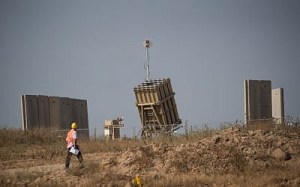
An operator walks by an Iron Dome missile defense battery near the city of Sderot in southern Israel on May 29, 2018. (Yonatan Sindel/Flash90)

Adding to the potential for war in Gaza, the Palestinian Islamic Jihad in recent months has proven itself to be increasingly willing to clash with Israeli troops, despite Hamas’s opposition. Earlier this month, a sniper from the Iran-backed terror group opened fire at an IDF officer, hitting him in the helmet, causing light injuries.

This in part seems to come from the fact that Israel officially holds Hamas responsible for all violence coming from the Gaza Strip and thus directs its retaliatory strikes against Hamas targets and bases, meaning PIJ can carry out attacks without immediate consequences.

This represents a change from the IDF’s assessments in recent months, which had held that while Hamas wanted to maintain pressure on Israel with border violence, it was not interested in all-out conflict.

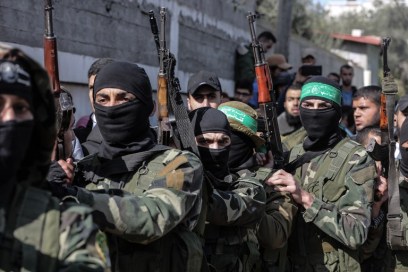
Masked Hamas gunmen attend the funeral of Mahmoud al-Nabaheen, 24, in the Bureij refugee camp, in the central Gaza Strip, on January 23, 2019. (MAHMUD HAMS / AFP)

Hamas, which has ruled Gaza since it overthrew the Palestinian Authority in a bloody coup in 2007, has faced increasing domestic pressure as the Strip’s economy has deteriorated during the interim 12 years in the face of a naval blockade by Israel and Egypt, which the countries say is necessary to prevent the terror group from importing large amounts of weaponry and war materiel into the coastal enclave.

International aid groups have warned in recent months that the Gaza Strip, which already has sweeping unemployment and limited access to electricity and water, is heading for a full humanitarian crisis.

In response to these dire economic straits, over the past year, the terror group has led a series of regular riots and protests along the border, dubbed the “Great March of Return,” which included the launching of thousands of airborne arson devices into southern Israel that caused millions of shekels of damage to farmland and nature reserves, as well as sporadic flareups of rocket and mortar fire, including one in November in which over 500 projectiles were fired at Israel.

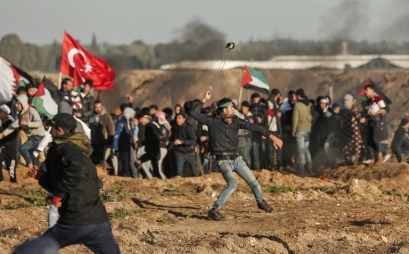
Illustrative: A Palestinian protester uses a slingshot to hurl stones at Israeli forces across the border fence, during clashes following a demonstration along the border with Israel east of Gaza City on January 11, 2019. (Mahmud Hams/AFP)

Over 200 Palestinians have been killed by Israeli troops in the clashes along the border and thousands more have been injured since the protests began on March 30. During the same period, two Israeli soldiers have been killed and several others injured. A Palestinian man living in the Israeli city of Ashkelon was also killed in a rocket attack from the Gaza Strip.

In a bid to end the weekly, sometimes daily, violence along the border, Israel reached a ceasefire agreement with Hamas — with Egypt and a United Nations envoy acting as mediators — that extended the permitting fishing zone around the Gaza Strip to 12 nautical miles and, more importantly, allowed the Islamist terror group to receive tens of millions of dollars from Qatar.

However, the IDF believes Hamas thinks it could negotiate better economic incentives from Israel in the midst of a small-scale war than it can now.

In light of the potential for a renewed outbreak of violence, Kohavi has instructed the military to prepare responses to a variety of potential scenarios in the Gaza Strip.

In addition, the newly minted IDF chief formed a General Staff-level task force to create a bank of targets that the military could strike quickly, not only in Gaza but for every regional command.

“In addition, he created a task force to identify high-quality targets in the Gaza Strip ahead of a potential operation there, which will be led by Col. Ronen Geiger,” the army said.

This appeared to be a response to criticisms heard within the military and outside it that the air force and artillery attacked empty or otherwise worthless targets during the 2014 Gaza war.


Israeli Intel Estimate: New Iranian threat from Iraq. Gaza escalates. Moscow jumps on Palestinian issue – DEBKAfile

February 14, 2019

Source: Israeli Intel Estimate: New Iranian threat from Iraq. Gaza escalates. Moscow jumps on Palestinian issue – DEBKAfile

Iranian forces are moving back from Israel’s border to northern and eastern Syria and arming Shiite proxies with surface missiles. This is reported in the Israeli Military Intelligence (AMAN) Estimate 2019, laid before the government two weeks ago and divided into two sections: pre- and post-election. The document foresees heightened tensions on the Gaza and northern fronts in the coming months.

After the April 9 general election, the next government will have to take a stand on President Donald Trump’s ”Deal of the Century” for resolving the Israeli-Palestinian conflict, a challenge which does not figure in any party campaign.
In the run-up to the election, AMAN predicts the following events:

  1. The Gaza Strip will heat up. Already this week, thousands of Palestinians are gathering night after night on the Gaza border to attack Israeli troops with explosive devices and hand grenades. The explosions cause alarm in neighboring Israeli communities.
  2. The northern front, including the Golan, will see escalating violence from across the Syrian border. The Iranian Al Qods Brigades and Hizballah will be choosing their moment to fire missiles into Israel, taking advantage of the Russian presence somewhat inhibiting Israeli payback.
  3. Palestinian terrorists will raise the stakes in Judea and Samaria so as to cast a pall on Israel’s election, encouraged by Moscow’s first supportive intervention in the Palestinian arena. The first Palestinian unity conference is taking place this week with Foreign Minister Sergei Lavrov in the chair. DEBKAfile’s intelligence sources report that the Palestinians reckon that Prime Minister Binyamin Netanyahu, when he arrives in the Russian capital on Feb. 21, will find in the Kremlin a newly friendly face for the Palestinian cause. Therefore, Iran and Syria won’t be the only items on the agenda of his talks with President Vladimir Putin.

The Intelligence Estimate points to changes in Iran’s Syrian deployment. Its forces are described as pulling away from proximity with Israel’s northern border and regrouping in northern and eastern Syria. This redeployment is cause for concern in Israel. Rather than being driven back under the pressure of Israel’s aerial and missile assaults, Tehran aims to take advantage of the coming withdrawal of US troops from Syria to extend its strategic depth into Iraq, from which Iranian missiles can reach Israel.

The Iranians are expected to leave their Shiite militias behind for dealing with the Israel front and arm them with ground-to-ground, short-range ballistic missiles. Israel’s northern front is therefore not moving farther away, it is expanding into Iraq and, in addition to the rockets piled up by Hizballah, Hamas and Islamic Jihad, Israel is now faced with ballistic missiles from Iraq and close by.