Archive for February 8, 2019

Israel said to find new Iranian precision missile factory in northwest Syria 

February 8, 2019

Source: Israel said to find new Iranian precision missile factory in northwest Syria | The Times of Israel

Tehran reportedly rebuilds facility previously bombed by IAF in different location, bypassing international sanctions with help from Syrian government and terror group Hezbollah
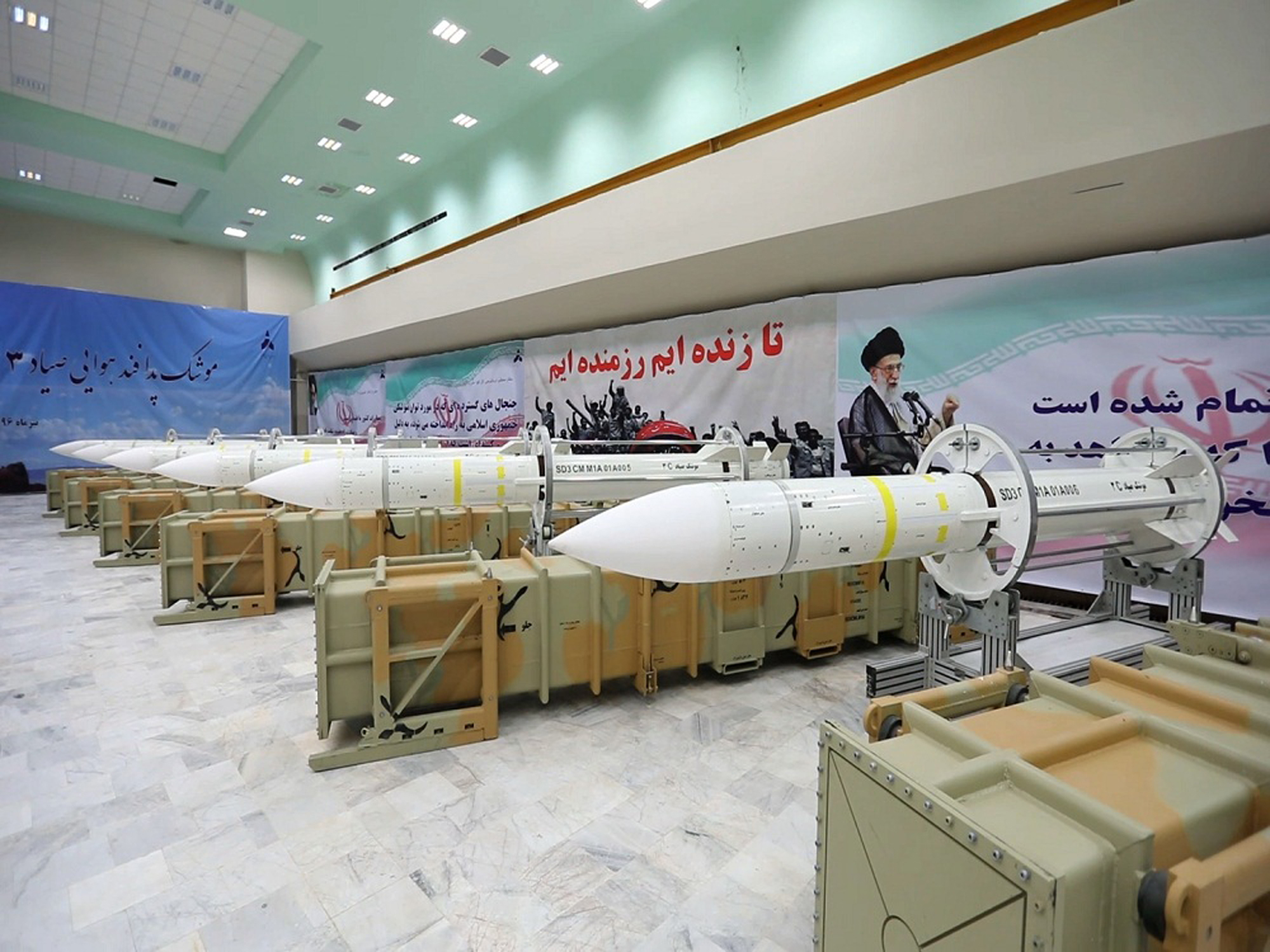
Illustrative. Sayyad-3 air defense missiles during inauguration of its production line at an undisclosed location, Iran, according to official information released, July 22, 2017. (Official website of the Iranian Defense Ministry via AP)

Illustrative. Sayyad-3 air defense missiles during inauguration of its production line at an undisclosed location, Iran, according to official information released, July 22, 2017. (Official website of the Iranian Defense Ministry via AP)

Israel has discovered a new ambitious precision missile factory being constructed by Iran in Syria together with the Syrian government and Lebanese terror group Hezbollah, after Israel bombed and destroyed a previous one, an Israeli TV network reported Thursday evening.

The report on Channel 12 said the new factory was recently built near the northwestern city of Safita in hopes that Israel wouldn’t discover it in the location, which is far from previous Iranian sites struck by Israel elsewhere in Syria. The factory is intended to focus on producing precision missiles, dramatically upgrading the threat to Israel from the vast arsenal of rockets and missiles deployed against it in southern Lebanon by Iran’s proxy, Hezbollah.

To build it, Channel 12 reported, Iran had to bypass international sanctions on its missile program via a series of straw companies established by Syria’s Scientific Studies and Research Center (SSRC), a government agency that manufactures weaponry and whose facilities have repeatedly been targeted by Israel in the past.

Those companies — established specifically for that purpose — ordered missile parts from Italy, China and other countries in eastern Asia, the report said. The companies are named the Organization of Technological Industries (OTI) and ANAS Group, according to the report.

Israel has nevertheless discovered, tracked and uncovered the facility, the network said, as part of its effort to thwart Iran’s military entrenchment in Syria.

An explosion, reportedly during Israeli airstrikes near Damascus, Syria, on January 21, 2019. (screen capture: YouTube)

Israel says it has carried out hundreds of airstrikes on Iranian-linked targets as part of a campaign to prevent Tehran from establishing a military presence in Syria.

The previous Israeli airstrike on a precision missile factory in Syria occurred in September, when Syrian air defenses shot down a Russian military aircraft, killing all 15 servicemen aboard.

Russia, which is allied with Damascus, blamed the Israeli military for the incident, a charge rejected by Jerusalem, and later transferred advanced air defense systems to Syria in a move condemned by Israel.

Meanwhile, an Iranian news outlet said Thursday that the elite Revolutionary Guard has inaugurated a surface-to-surface ballistic missile it claims has a 1,000-kilometer (620-mile) range.
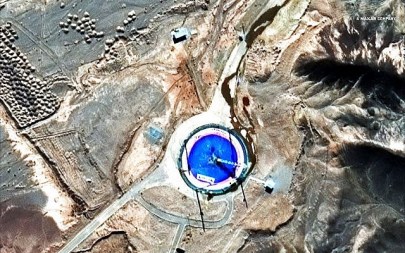
This February 6, 2019, satellite image provided by DigitalGlobe shows an empty launch pad and a burn mark on it at the Imam Khomeini Space Center in Iran’s Semnan province. (DigitalGlobe, a Maxar company via AP)

The report by the semi-official Fars news agency, close to the Guard, said a ceremony marking the inauguration was held in an underground missile factory described as an “underground city.”

The ceremony coincided with the 40th anniversary of the 1979 Islamic Revolution.

The report said the missile, dubbed Dezful, is a version of the Zolfaghar missile that has a 700-kilometer (430-mile) range and a 450-kilogram (992-pound) warhead.

Iran has missile capability of up to 2,000 kilometers (1,250 miles), far enough to reach archenemy Israel and US military bases in the region.

Occasionally, Iran announces military achievements that cannot be independently verified.

AP contributed to this report.
 

Iran unveils new ballistic missile in secret ‘underground city’ facility 

February 8, 2019

Source: Iran unveils new ballistic missile in secret ‘underground city’ facility | The Times of Israel

Officials say hidden facility proves Western powers can’t stop Tehran’s program; move is latest show of military might marking 40th anniversary of the Islamic Revolution

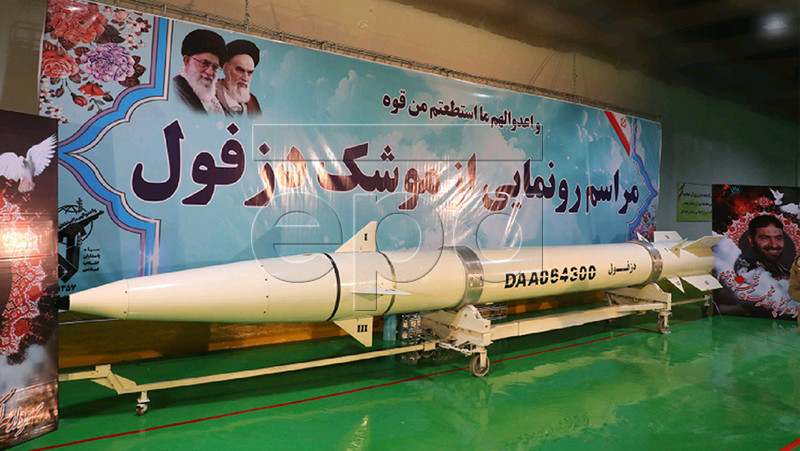
A handout photo from the Iranian Revolutionary Guard Office shows the new Iranian missile Dezful, in an undisclosed location, Iran, 07 February 2019. (Courtesy)

TEHRAN, Iran — Iran’s Revolutionary Guards on Thursday unveiled a new ballistic missile with a range of 1,000 kilometers (620 miles), their official news agency Sepah News reported.

The move was the latest show of military might by the country as it celebrates the 40th anniversary of the Islamic Revolution at a time of heightened tensions with the United States.

The surface-to-surface missile — called Dezful — is an upgrade on the older Zolfaghar model that had a range of 700 kilometers (435 miles), aerospace commander Brigadier General Amirali Hajizadeh said.

The new weapon was revealed after Iran on Saturday said it had successfully tested a new cruise missile named Hoveizeh with a range of 1,350 kilometer.

The unveiling ceremony Thursday was carried out by Revolutionary Commander Major General Mohammad Ali Jafari and Hajizadeh at an “underground ballistic missile production facility,” the report said.

The semi-official Fars news agency, close to the Guard, described the location  an “underground city.”

The facility’s location was not specified and pictures published by Sepah News showed only the two commanders in a room examining the missile.

“Displaying this missile production facility deep underground is an answer to Westerners … who think they can stop us from reaching our goals through sanctions and threats,” Jafari was reported as saying.

“Europeans talk of limiting our defensive capability while they have the audacity (to allow) their offensive power be used to attack innocent people all over the world,” he added.

Hajizadeh said the new missile had a “destructive power” twice that of the Zolfaghar version, which Iran used for the first time in October to strike a jihadist base in Syria.

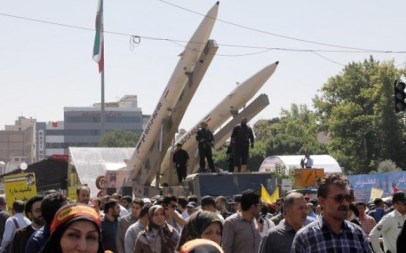
Zolfaghar missiles, right, are displayed during a rally marking al-Quds (Jerusalem) Day in Tehran on June 23, 2017. (AFP/Stringer)

Iran says it has voluntarily limited the range of its missiles to 2,000 kilometers (1,250 miles), but that is still enough to hit its arch-enemy Israel and US bases in the Middle East.

Although there are no restrictions in place on the range of Iranian missiles, US President Donald Trump had insisted that limitations be placed on Tehran’s missile program, as a prerequisite for Washington remaining in the landmark 2015 nuclear deal with Iran. He ultimately pulled out of it on May 12.

The US and its allies have been demanding that Iran curb its production of ballistic missiles, which can reach parts of Europe and could soon reach the US as well. Western officials have maintained that the only reason Tehran could have for manufacturing such missiles would be to fit them with non-conventional, including atomic, warheads.

UN Security Council Resolution 2231 — adopted just after the nuclear deal — calls on Iran “not to undertake any activity related to ballistic missiles designed to be capable of delivering nuclear weapons”.

Tehran, which calls for the destruction of Israel, insists that it sees the missile program as crucial to its defensive posture, and says its existence is non-negotiable. It has also maintained that it never intended to develop nuclear weapons and therefore its missile development does not violate the agreement.

However, Prime Minister Benjamin Netanyahu has presented evidence which he says details Iranian efforts and research programs specifically aimed at producing atomic weapons. In a Mossad operation, Israel earlier this year spirited out a trove of Iranian documentation from Tehran’s nuclear weapons archive, which Netanyahu said proved conclusively that Iran is lying when it says it has not been working toward a nuclear weapons arsenal.


Two Iranian flops: Putting a satellite into orbit and fitting guided warhead on long-range ballistic missile – DEBKAfile

February 8, 2019

Source: Two Iranian flops: Putting a satellite into orbit and fitting guided warhead on long-range ballistic missile – DEBKAfile

Two of the hi-tech military achievements Iran had prepared for the Islamic Revolution’s 40th anniversary did not come up to scratch.
Tehran failed in its second attempt on Wednesday, Feb. 6, to launch a satellite into orbit from the Imam Khomeini Space center in central Iran. US sources released images showing the rocket firing after some days of preparation, but since Tehran was silent on the outcome, it is assumed that the space shot was a flop. Since the first attempt on Jan. 15, using a long-range Simorgh. also failed, the Iranians decided to use the smaller a Safir rocket for their second attempt.

DEBKAfile’s military sources also met with a skeptical response to the Iranian claim on Feb. 4 to have armed its long-range Khorramshahr missiles (2,000km range) with 2-ton “home-made guided warheads.” Tehran said the upgraded version had been renamed Khorramshahr 2.

Tehran is undoubtedly working hard to develop guidance warheads, but intelligence surveillance has discovered no evidence of its efforts leading to success.

Not all the weapons Iran has recently showcased are flops. The test launch on Feb. 2 of its new cruise missile, the Hoveizeh (1,250km range) of the Soumar family, was successful, although the images reaching the West since then indicate some trouble with its engine.

The Hoveizeh, is in fact, a replica of the Russian-Ukrainian Kh-55, a missile capable of carrying a nuclear warhead, which was smuggled into Iran eighteen years ago. The original was designed to be fired from warplanes. This would explain technical glitches arising when the Iranians try to use it as a ground-to-ground missile.