Archive for February 8, 2019

Israel and Iran: Are they heading for war? 

February 8, 2019

Israel and Iran are once again facing one another down. Blatant Israeli attacks on Iranian targets in Syria are leaving some to wonder what it would it take for them to declare war? In Syria, there are battles being fought, already fought and possibly about to be fought.

It’s the possibles that we look at today and whether an Iran/Israel confrontation could spread beyond Syrian borders. So what will happen when Israel’s ally America withdraws from Syria?

Joining us at the Roundtable was Mohammad Marandi, Iranian-American academic at Tehran University and in Tel Aviv, Neri Zilber, Fellow at the Washington Institute for Near East Policy; Chris Doyle, Director of the Council for Arab-British Understanding and Robert Fox, Defence Editor for the Evening Standard.


Iran ‘builds SECRET Syrian missile site and weapons WITHIN RANGE of US and Israeli bases’ 

February 8, 2019


Iran ‘builds SECRET Syrian missile site and weapons WITHIN RANGE of US and Israeli bases’ IRAN, Syria and Hezbollah are establishing a secret missile factory close to the town of Safita, Israeli media have reported, amid Iranian claims it has missiles within range of US and Israeli military bases. News of the alleged clandestine site came after Tehran said it had missiles with the range of up to 2,000 km (1242 miles), which puts Israel and US military bases in the region within reach.

Iran’s Revolutionary Guards inaugurated a surface-to-surface ballistic missile with a range of 1,000 km (621 miles), the semi-official Fars news agency reported on Thursday. The announcement ignored Western demands that Tehran halt its missile program.

Shabbat shalom…

February 8, 2019

Image may contain: sky, cloud, outdoor and water


Russia tells Turkey to do more to clear Syria’s Idlib of militants

February 8, 2019

Source: Russia tells Turkey to do more to clear Syria’s Idlib of militants – Israel Hayom


What happens after US withdrawal from Syria? 

February 8, 2019

Source: What happens after US withdrawal from Syria? – Middle East – Jerusalem Post

Anti-ISIS coalition meets in Washington amid shadow of uncertainty.

BY SETH J. FRANTZMAN
 FEBRUARY 7, 2019 16:56
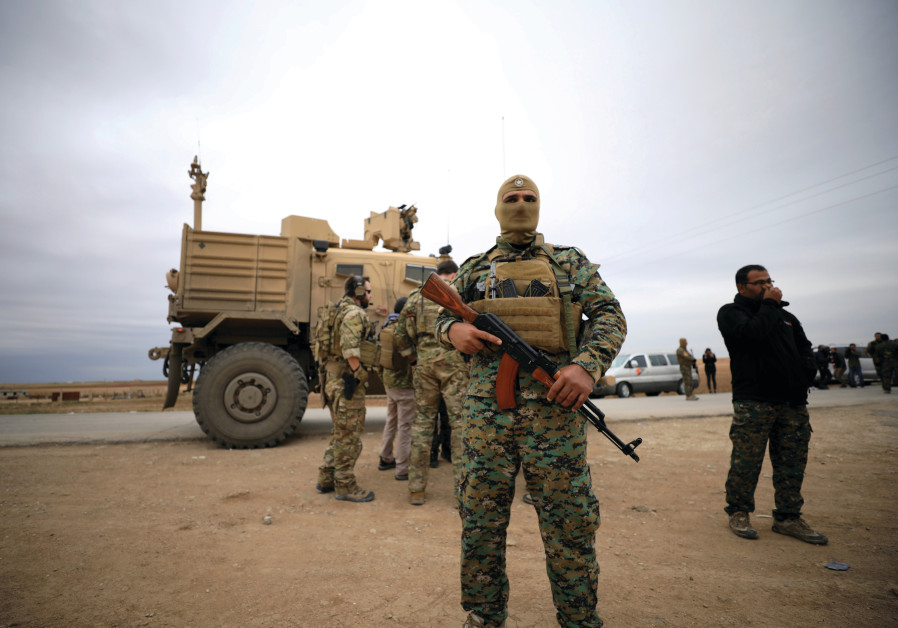
SYRIAN DEMOCRATIC FORCES and US troops are seen during a patrol near Turkish border in Hasakah.

WASHINGTON – Six weeks after US President Donald Trump announced the withdrawal of American troops from Syria, the US-led coalition of 79 partner countries and organizations gathered in Washington on Thursday to assess the fight against ISIS and the situation in eastern Syria.At the meeting, held the day after his State of the Union address, Trump praised the Coalition’s partners and the Syrian Democratic Forces for liberating “virtually all the territory previously held by ISIS.”The confab took place as ISIS is largely defeated, having lost 99.5% of its territory, according to recent Defense Department estimates. US Secretary of State Mike Pompeo said 110,000 sq. km. of territory had been liberated and seven million people freed from ISIS control in the last four and a half years. He laid out the coalition’s strategy going forward, saying the US is committed to Iraq’s security forces, and to preventing ISIS threats to the partner countries. He encouraged every one of the 79 members to “put our money where our mouth is.”This would include investing in “civilian stabilization assistance,” the programs that would return areas liberated from ISIS to functioning and safe parts of their respective countries. “Our final objective is to promote justice for victims.”Attendees included: Canadian Foreign Minister Chrystia Freeland, who posted a photo with Yazidi genocide survivor Nadia Murad; and Mevlut Cavusoglu, the Turkish foreign minister, who said that coordination was needed to prevent the resurgence of ISIS. “It takes addressing the root causes of this scourge effectively and avoidance of the repetition of past mistakes.”Hanging over the generalizations and self-congratulatory remarks was the US decision to quit Syria. The US, which stressed the need for stabilization, did not lay out its plans for the future in eastern Syria or how its withdrawal would be managed. Germany’s foreign office noted before the meeting that while ISIS had been “pushed back” in Iraq and large parts of Syria, the threat has “by no means been averted.” Turkey stressed that Trump’s decision to withdraw, announced in December 2018, was not the end of the conflict. “It simply represents a new stage in an old fight.”The US has not articulated how it will manage or coordinate its Syria withdrawal. This has led to constant rumors about how it may play out. Reports last month indicated the US might remain at its base in al-Tanf in eastern Syria’s desert.Turkey and the US have been discussing a “buffer” or “safe” zone that might extend up to 30 km. in Syria. Turkey wants this zone to be free of the People’s Protection Units (YPG), the Kurdish group that it asserts is part of the Kurdistan Workers Party (PKK), but which is also part of the SDF, the main partner of the coalition. This has raised fears of a new conflict in Syria once the US withdraws.The co-chair of the Syrian Democratic Council (SDC), Ilham Ahmad, has been in Washington for two weeks giving talks and holding discussions aimed at slowing a US withdrawal and shoring up support for the SDF, of which her SDC is the political wing. She has met with groups across the political spectrum, including Democrat Tulsi Gabbard, who is running for President in 2020. According to Al-Monitor, she received an invite to the State of the Union address from Gabbard. Gabbard has been critical of US Syria policy, especially regarding the Assad regime, asserting Assad is not an enemy of the US.This leaves many question marks about the withdrawal. The SDF fears a quick withdrawal might lead to escalation in tension with Turkey which would force them to seek out a deal in which the Syrian regime might return to the border in eastern Syria, or Russia might broker some kind of deal. But they prefer the US partners they have worked with for four years to defeat ISIS.After more than 10,000 casualties fighting ISIS, the SDF and its constituent groups want peace. But the US hasn’t provided clarity on what comes next, according to meetings held in Washington with individuals knowledgeable of the current discussions.At the same time, the US has hosted representatives of Egypt, France, Germany, Jordan, Saudi Arabia and the UK to discuss the situation in Syria. They emphasized the need for a political solution to end the conflict, but did not provide details.Turkey’s Deputy Minister of Foreign Affairs, Sedat Onal, also was in Washington on February 5 and met with US officials to launch several working groups on bilateral relations, including “bilateral cooperation on Syria.” As with the Coalition meeting and the other high level meetings held this week, no concrete plan for what comes next was made public.It appears that more than a month and a half after Trump made his  withdrawal from Syria announcement, much remains to be ironed out. There has been pushback and recognition of the sacrifices the SDF made fighting ISIS.But the US has not yet made the SDF part of the larger discussions about the withdrawal, and the meeting of the coalition did not provide clarity on that move.The coalition’s twitter account rarely seems to mention areas in eastern Syria which were liberated by the coalition. Instead, it mentions projects in Aleppo, Azaz, Souran in Hama province and UN programs directed to other areas of Syria.While the coalition said in December 2018 that “many stabilization projects had started in Iraq and Syria,” and that humanitarian efforts will continue in 2019, it is no longer spotlighting those efforts. The online withdrawal seems to have already begun, even if the physical withdrawal is at an impasse.


Analysis: The Middle East’s tectonic shifts

February 8, 2019

Source: Analysis: The Middle East’s tectonic shifts – Middle East – Jerusalem Post

The region is now at a crossroads no less important than during the decline and fall of the Ottoman Empire 100 years ago.

BY SETH J. FRANTZMAN
 FEBRUARY 8, 2019 02:07
Analysis: The Middle East’s tectonic shifts

There is a tendency to view the Middle East as largely unchanging, now that the chaos unleashed after the Arab Spring appears to have dissipated. It’s the status quo – again. Gaza is still Gaza. Iraq is Iraq. Egypt is Egypt. But that analysis ignores the tectonic shifts which have taken place in the last few decades.

Regimes may appear the same, but in fact, the instability of recent years has had major effects. The region is now at a crossroads no less important than during the decline and fall of the Ottoman Empire 100 years ago.

From old leaders to a younger generation

For starters, to understand the changes let us look back 20 years. Who was in charge in 1999?

In Iraq it was Saddam Hussein, born in Tikrit in 1937 and president since 1979. In Saudi Arabia it was King Fahd, born in 1921 and reigning since 1982, as he would do until 2005. In Libya it was Muammar Gaddafi, who was born 1942 and came to power in 1961. In Egypt it was Hosni Mubarak, born in 1928 and in power since 1981.

In Syria it was Hafez Assad, born in 1930 and ruling since 1971. In Yemen, the long-serving Ali Abdullah Saleh, born in 1947, had come to power in 1958. Mohammed Khatami, the supposed reformer, was in Tehran. He had been born in 1943 and had been in charge since 1997, where he would stay until 2005.

In Turkey, Mesut Yilmaz was prime minister, about to be succeeded by Bulent Ecevit. In Lebanon around this time, Rafic Hariri, born in 1944, had been prime minister, taking a hiatus from 1998 to 2000. King Hussein was the monarch of Jordan. Born in 1935, he began his reign in 1952. Let’s not forget Tunisia’s Zine El Abidine Ben Ali, who was born 1936 and rose to power in 1989.

In neighboring Algeria it was Abdelaziz Bouteflika, who was born in 1937 and came to power in April 1999. Among regional monarchies, Mohammed VI of Morocco, born in 1929, came to power in 1999, after Hassan II, who served since 1961, died. Lest we forget, the emir of Qatar, Hamad bin Khalifa Al-Thani, who was born in 1952, had been in power since 1995, and would remain until his death 2013. And Yasser Arafat was president of the Palestinian National Authority, a post he held since 1994. He was born in 1929.

Listing all these leaders who dominated in the late 1990s, one gets a sense of who they were, and the worldviews they held. They were products primarily of the 1930s and 1940s. Most were born in the region’s colonial era. Their worldview was shaped by the rise of Arab nationalism and the Cold War. Some had played a formative role in putting down the first Islamist rebellions in the region, such as the battles in Egypt and Syria in the 1980s.

With the exception of Turkey or Iran, which are different than the rest of the Arab Middle East in history and politics, these regimes fit several clear patterns. They were aging dictators who were past their peak, in monarchies and a few hybrid regimes, such as Lebanon. This was an era of big politics and big men. Israel was an outsider in the region in many ways.

Then things began to change. Saddam was overthrown by the 2003 US invasion. Arafat, Fahd, Assad and King Hussein died. Hariri was assassinated. Eventually, Saddam would be hanged, Gaddafi raped to death, and Saleh assassinated and his body chucked onto a truck. Mubarak and Ali would abdicate, as would Hamad al-Thani. Today, leaders in the region are younger, even if some of them take after their parents or the systems that produced them.

Many of these men were born in the 1950s and 1960s. Some of them are much younger, such as Emir Tamim in Qatar, who was born in 1980. Mohammed Bin Salman, the crown prince of Saudi Arabia, was born in 1985. Saad Hariri, Lebanon’s long-serving prime minister, was born in 1970. The leaders of the Kurdistan Regional Government are also of a younger generation, as is the king of Morocco. There are a few exceptions, such the President Hassan Rouhani in Iran and Sultan Qaboos in Oman.

Generally, this generation of leaders grew up in the shadow of American hegemony. The Cold War was ending or had already ended. They also dealt with the ramifications of the Gulf War, when many Arab regimes joined the Americans to oust Saddam from Kuwait. They have also had to look askance at an American hegemony led by US leaders who appear to change policies every four or eight years. That means they watched as George H.W. Bush preached a “New World Order” and as Clinton pushed for humanitarian intervention. They wondered about George W. Bush’s calls for democratization, and then were skeptical when calls for elections led to the rise of Hamas in the Palestinian Authority.

From US New World Order to withdrawal

As the Bush years turned to the Obama years, the region wondered whether Obama’s Cairo speech represented a new era. Others were concerned about the US push for the Iran deal and how that would play out. The US shifted its focus from opposing Assad to opposing ISIS. Disillusionment in Egypt led to claims that the US was supporting the Muslim Brotherhood. Libya became a chaos. Yemen, too. Syria fueled extremism across the region. And some 50,000 or more foreign extremists flooded in to support ISIS. This was unprecedented.

Through it all, old alliances were shattered and friendships tested. Qatar was isolated by its former Gulf friends and enjoyed warmer relations with Turkey. Iranian-supported militias rose in Iraq, Syria and Lebanon. These groups gained from the war on ISIS and emerged with unprecedented strength and armaments. The Houthis even came close to taking the Bab al-Mandab Strait.

From the chaos, new alliance systems emerged. The bedrock southern Middle Eastern states, led by Saudi Arabia, the UAE and Egypt, form one system; Qatar and Turkey form, another; and Iran and its allies, a third. The US is at a historic crossroads in its attempt to withdraw – again – from the region.

In a way this would be the third major withdrawal since the 1990s. Bush Sr. had reduced the US footprint. Obama also did. And so has Trump. A resurgent Russia has filled some of those gaps, but not all of them. Regional frameworks, such as the Arab League, have proven weak in addressing the region’s needs. And there is no longer consensus in the region regarding opposition to Israel, or even the workability of any peace plan. Old initiatives, such as the Saudi plan of the early 2000s, appear moribund.

Strong states defeat independent political groups 

The last several years since 2011 have seen the rise of a plethora of political groups seeking to carve out spaces in various weak or unstable states. This has included some of the Kurdish movements that sought independence and autonomy. It has also included a long list of Sunni groups, many of them trending toward extremism. The remains of this can be found in Idlib where Hayat Tahrir al-Sham dominates, and Eastern Syria where the Syrian Democratic Forces are strongest. Other groups like the Houthis in Yemen, or Khalifa Haftar’s Libyan National Army, shape the politics of their countries.

Is the Sunni-Shia conflict over?

An unprecedented rancor of Sunni-Shia infighting has dominated politics in some countries. Ethnic struggles have emerged in others. But much of that is now being shoehorned back into the state structure. The fantasies of rewriting the Sykes-Picot European borders of the region that were drawn 100 years ago are no more. Now state structures have returned. But they have returned in a different way.

Arab Gulf states have taken a lead in foreign policy, launching a war in Yemen that began in 2015 to confront the Houthis. Egypt is playing a role in Libya. Regional security frameworks are emerging. This was evident at a meeting at the Dead Sea in late January, when representatives of Egypt, Bahrain, the UAE, Saudi Arabia, Kuwait and Jordan gathered. Proxies and militias still exist. Turkey has an unprecedented role in Iraq and Syria, and appears set to keep its soldiers in its two southern neighbors. The question now is whether the sectarian conflicts are being reduced and returning to power politics. The Gulf states are patching things up with Syria, for instance.

Defeating ISIS and the new alliance systems

As the last stronghold of ISIS is liberated in the Euphrates valley the Middle East finds itself transformed and at a turning point. The last decade, dominated by the Syrian civil war, has presented a struggle between extremist forces that have sought to exploit weak states and ungoverned spaces, and existing regional and global powers whose agenda is to come out of the recent conflicts positioned to dominate the region.

This is a unique time in the Middle East that presents complex challenges for policy-makers. The region is now increasingly influenced by two rising alliance systems. Iran and its proxies and clients in Iraq, Syria, Lebanon and Yemen represent one system, while Turkey and Qatar, as well as their partners in northern Syria, Libya, Sudan and elsewhere, represent another.

The traditional US allies, such as Saudi Arabia, Israel, the UAE, Egypt, and the Kurdistan Regional Government in northern Iraq, now face this changed environment and are seeking out policies that will best prepare them for the next phase.

Examples include the reopening of embassies in Syria, the Iran-Israel tensions in Syria, and the complexity of managing the US withdrawal from Syria.

Despite US fatigue in dealing with Syria and Iraq, what comes next in the Middle East is of importance, because the Syrian civil war and the chaos it fed across the region has had major implications for Western powers. It has fueled a growing connection between Iran, Russia and Turkey as they have sought to agree to a post-conflict Syria absent a US role. The way in which countries have responded to the destabilizing extremism that led to the rise of ISIS is also important, because the region may be turning a corner in confronting the jihadist networks that flourished from the 1980s to 2014 and underpinned ISIS.

New totalitarianism

One of the responses among US allies and adversaries has been to increase crackdowns on dissent. Another response has been that some polities, such as the Palestinian Authority, appear to prefer the status quo over any experiments with new elections that might open the door to groups such as Hamas. This also appears to be the case in Iraq and Lebanon where, to governing elites, the status quo appears preferable to the chaos of Yemen and Libya.

The region is also witnessing the decline in any experiments to create new state structures, such as the decline of the independence of the Syrian rebels in northern Syria, and the likely decline of the autonomy of the Syrian Democratic Forces and groups linked to it in eastern Syria. This decline dovetails with the new authoritarianism. States fear chaos, instability and irredentist or extremist movements. Strong governments are seen as the best remedy to weak states where extremism has thrived. Controlling religious messages is seen as preferable to a free-for-all.

Is this a ‘New Middle East’? 

Is this a “New Middle East” on par with the changes that took place 100 years ago with those wrought by the fall of the Ottoman Empire? Or is this merely a return to the ancient regime that dominated before 2010, and which was destabilized by democratization attempts and the wars sparked by Saddam Hussein in the 1990s? Are we seeing the eclipse of the ability of jihadist extremist groups to destabilize countries? Will Turkey, Russia and Iran be the main beneficiaries at the expense of Western powers and their allies?

All of these questions will be answered in coming years. The tensions between Israel and Iran will continue, and Israel will likely continue to make inroads among some Gulf states, where recent official visits have broken decades of silence. A complex series of challenges exist. And many of them will be addressed without US leadership in the region. This is a major change from the last decades, in which US policy was at the center of the decisions being made locally. Even if the US decides to increase its role, its reputation has been forever changed by zigzagging policies. It would be difficult to change that perception.

At the same time, the region must invest in recovering from the wars of the last decade and the harm done to infrastructure. Whereas the Gulf States have made major strides, many of the largest Arab states, such as Iraq, Syria and Egypt face uphill challenges. Meanwhile, countries on the periphery, such as Iran and Turkey, appear to have emerged much stronger from the last decades of instability. They will seek to dominate the region alongside the rising Russian influence.

Follow the author @Sfrantzman.


Israel, U.S. to begin massive air force drill amid northern tension 

February 8, 2019

Source: Israel, U.S. to begin massive air force drill amid northern tension – Israel News – Jerusalem Post

The goal of the drill is the strengthening of cooperation, mutual learning, and coordination between the armies.

BY JERUSALEM POST STAFF
 FEBRUARY 7, 2019 18:48
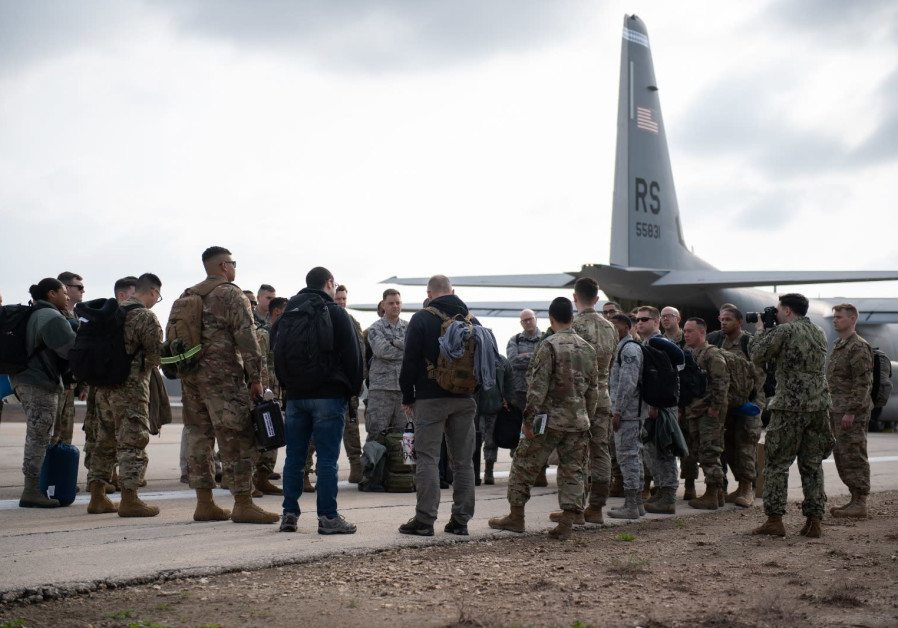
US Army soldiers arrive at Israel for preparations of the 2019 Juniper Falcon annual drill

Amid growing tension along the northern border, the IDF and the United States military will hold their annual joint exercise next week to test the level of coordination between the two countries in the event of future conflicts.

The exercise is part of a long standing agreement between the US and Israel to hold bilateral training exercises on a regular basis and the IDF Spokesman’s Office stressed that it was not associated with a particular threat or world event.

The goal of the drill – known as Juniper Falcon – is to strengthen cooperation, mutual learning, and coordination between the armies. In 2017, 12 American F-15E Strike Eagles and approximately 80 Airmen attached to the 494th Fighter Squadron flew missions with the Israeli Air Force.

The drill is expected to include over 300 US Army soldiers and 400 IDF soldiers from different units.

The last Juniper drill, which occurred in March 2018, was labeled as the largest IDF and US European Command joint exercise in 2018, with more than 2,500 US troops deployed in Europe participating alongside 2,000 Israeli Aerial Defense troops, logistics units, medical forces, and additional IDF units.

On Wednesday, the United States purchased the Iron Dome missile defense system from Israel for an immediate need of the United States Army. “This is yet another expression of the strengthening of our strong alliance with the US,” Prime Minister Benjamin Netanyahu said.


Kushner, Greenblatt to visit Mideast to seek backing for peace plan

February 8, 2019

Source: Kushner, Greenblatt to visit Mideast to seek backing for peace plan | The Times of Israel

The envoys will visit Oman, Bahrain, Saudi Arabia, United Arab Emirates and Qatar to brief them on economic aspects of the plan and possibly ask them to bankroll parts of it

White House adviser Jared Kushner attends a meeting with President Donald Trump and Hispanic pastors in the Roosevelt Room of the White House in Washington, Friday, Jan. 25, 2019. (AP Photo/Susan Walsh)

White House adviser Jared Kushner attends a meeting with President Donald Trump and Hispanic pastors in the Roosevelt Room of the White House in Washington, Friday, Jan. 25, 2019. (AP Photo/Susan Walsh)

WASHINGTON — White House senior adviser Jared Kushner and other administration officials are headed to the Middle East later this month to brief diplomats in at least five countries on the economic section of a US proposal for peace between Israel and the Palestinians.

Kushner, who is US President Donald Trump’s son-in-law, will be joined by US Mideast envoy Jason Greenblatt, US envoy on Iran Brian Hook and other administration officials who have worked on the economic part of the plan.

Stops are confirmed in Oman, Bahrain, Saudi Arabia, United Arab Emirates and Qatar. Other stops could be added to the trip, according to a White House official.

The plan includes an economic development proposal for Palestinians that foresees major infrastructure and industrial work, particularly in Gaza. For the plan to succeed or even pass the starting gate, it will need at least initial buy-in from both Israel and the Palestinians as well as from the Gulf Arab states, which officials say will be asked to substantially bankroll the economic portion.

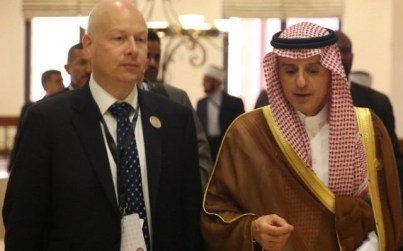
Saudi Arabia’s Foreign Minister Adel al-Jubeir (R) speaks with Jason Greenblatt, the US president’s assistant and special representative for international negotiations, during the Arab Summit in the Jordanian Dead Sea resort of Sweimeh on March 29, 2017. (AFP Photo/Khalil Mazraawi)

Also, Kushner is to participate next Thursday in Warsaw in a discussion to end the Israeli-Palestinian conflict, according to a senior White House official.

During the discussion with Borge Brende, president of the World Economic Forum, he is expected to give an update on the peace effort and what the administration hopes to accomplish in coming weeks and months.

In Warsaw, Kushner will be attending a gathering that Secretary of State Mike Pompeo has said will focus on Middle East stability and efforts to keep Iran from being a destabilizing influence in the region.

The officials were not authorized to publicly disclose details of the trip and spoke only on condition of anonymity.

Trump has long promised to try and reach the so-called “deal of the century” to end the long-simmering Israeli-Palestinian conflict, but his efforts have derailed since his decision to transfer the US embassy to Jerusalem.

The Palestinian Authority has castigated the move, declared the US no longer an honest broker in negotiations, and rejected any plan the White House may come out with, with PA President Mahmoud Abbas calling it the “slap of the century.”

The Palestinians have refused to meet with the US to discuss peace overtures since December 2017, when Trump announced the move and declared he would recognize Jerusalem as the capital of Israel.

The US has ended millions in aid to the UN’s refugee agency for the Palestinians, and has cut funding for the PA over Abbas’s refusal to enter negotiations and Ramallah’s payments to terror convicts and their families.

The launch of the plan has also reportedly been delayed by Israel’s elections, which will be held on April 9.


US vows to remain ‘relentless’ to deter Iran missile program

February 8, 2019

Source: US vows to remain ‘relentless’ to deter Iran missile program | The Times of Israel

Washington says launch again proves the Iran deal is doing nothing to stop missile program and that Tehran’s ‘blatant disregard for international norms’ must be addressed

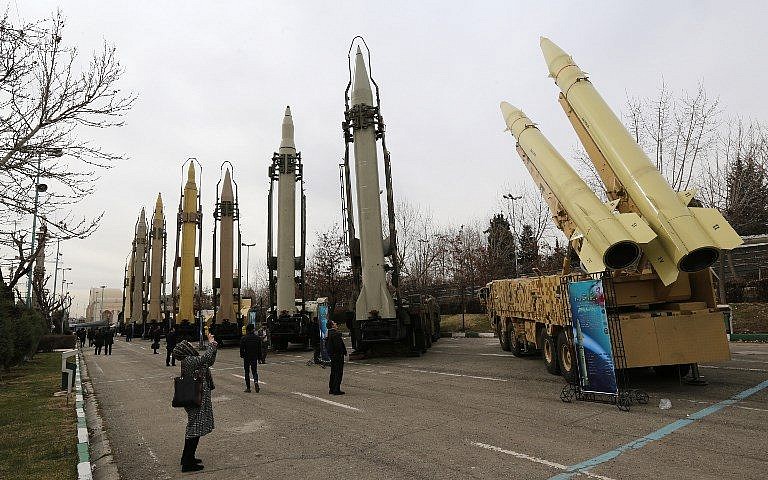
Iranians visit a weaponry and military equipment exhibition in the capital Tehran on February 2, 2019, organized on the occasion of the 40th anniversary of the Iranian revolution. Iran announced the successful test of a new cruise missile with a range of over 1,350 km. (some 840 miles). (ATTA KENARE / AFP)

Iranians visit a weaponry and military equipment exhibition in the capital Tehran on February 2, 2019, organized on the occasion of the 40th anniversary of the Iranian revolution. Iran announced the successful test of a new cruise missile with a range of over 1,350 km. (some 840 miles). (ATTA KENARE / AFP)

The United States on Thursday vowed to remain “relentless” in pressuring Iran to deter its missile program after the Islamic Republic unveiled a new ballistic weapon days after testing a cruise missile.

Iran’s Revolutionary Guards last week unveiled a new ballistic missile with a range of 1,000 kilometers (620 miles), their official news agency Sepah News reported.

The move was the latest show of military might by the country as it celebrates the 40th anniversary of the Islamic Revolution at a time of heightened tensions with the United States.

“Iran’s blatant disregard for international norms must be addressed,” State Department deputy spokesman Robert Palladino said in a statement.

“We must bring back tougher international restrictions to deter Iran’s missile program,” he added.

“The United States will continue to be relentless in building support around the world to confront the Iranian regime’s reckless ballistic missile activity, and we will continue to impose sufficient pressure on the regime so that it changes its malign behavior – including by fully implementing all of our sanctions.”

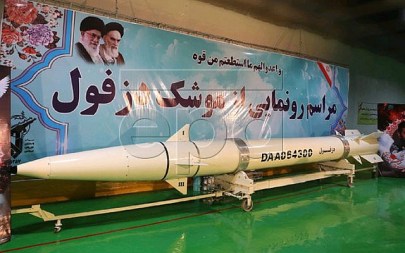
A handout photo from the Iranian Revolutionary Guard Office shows the new Iranian missile Dezful, in an undisclosed location, Iran, 07 February 2019. (Courtesy)

Tehran reined in most of its nuclear program under a landmark 2015 deal with major powers but has kept up development of its ballistic missile technology.

President Donald Trump pulled the US out of the nuclear accord in May and reimposed sanctions on Iran, citing the program among its reasons.

“Iran’s latest missile launch again proves the Iran deal is doing nothing to stop Iran’s missile program,” Secretary of State Mike Pompeo tweeted late Thursday.

Iran and the other signatories have stuck by the 2015 agreement, although some European governments have demanded an addition to address Tehran’s ballistic missile program and its intervention in regional conflicts.

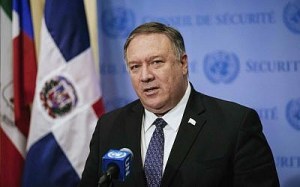
US Secretary of State Mike Pompeo speaks to the press after attending the U.N. Security Council at United Nations Headquarters, Jan. 26, 2019 (AP Photo/Kevin Hagen)

Meanwhile, UN Security Council Resolution 2231 — adopted just after the nuclear deal — calls on Iran “not to undertake any activity related to ballistic missiles designed to be capable of delivering nuclear weapons”.

Tehran, which calls for the destruction of Israel, insists that it sees the missile program as crucial to its defensive posture, and says its existence is non-negotiable. It has also maintained that it never intended to develop nuclear weapons and therefore its missile development does not violate the agreement.

However, Prime Minister Benjamin Netanyahu has presented evidence which he says details Iranian efforts and research programs specifically aimed at producing atomic weapons. In a Mossad operation, Israel earlier this year spirited out a trove of Iranian documentation from Tehran’s nuclear weapons archive, which Netanyahu said proved conclusively that Iran is lying when it says it has not been working toward a nuclear weapons arsenal.


Israel said to find new Iranian precision missile factory in northwest Syria

February 8, 2019

Source: Israel said to find new Iranian precision missile factory in northwest Syria | The Times of Israel

Tehran reportedly rebuilds facility previously bombed by IAF in different location, bypassing international sanctions with help from Syrian government and terror group Hezbollah

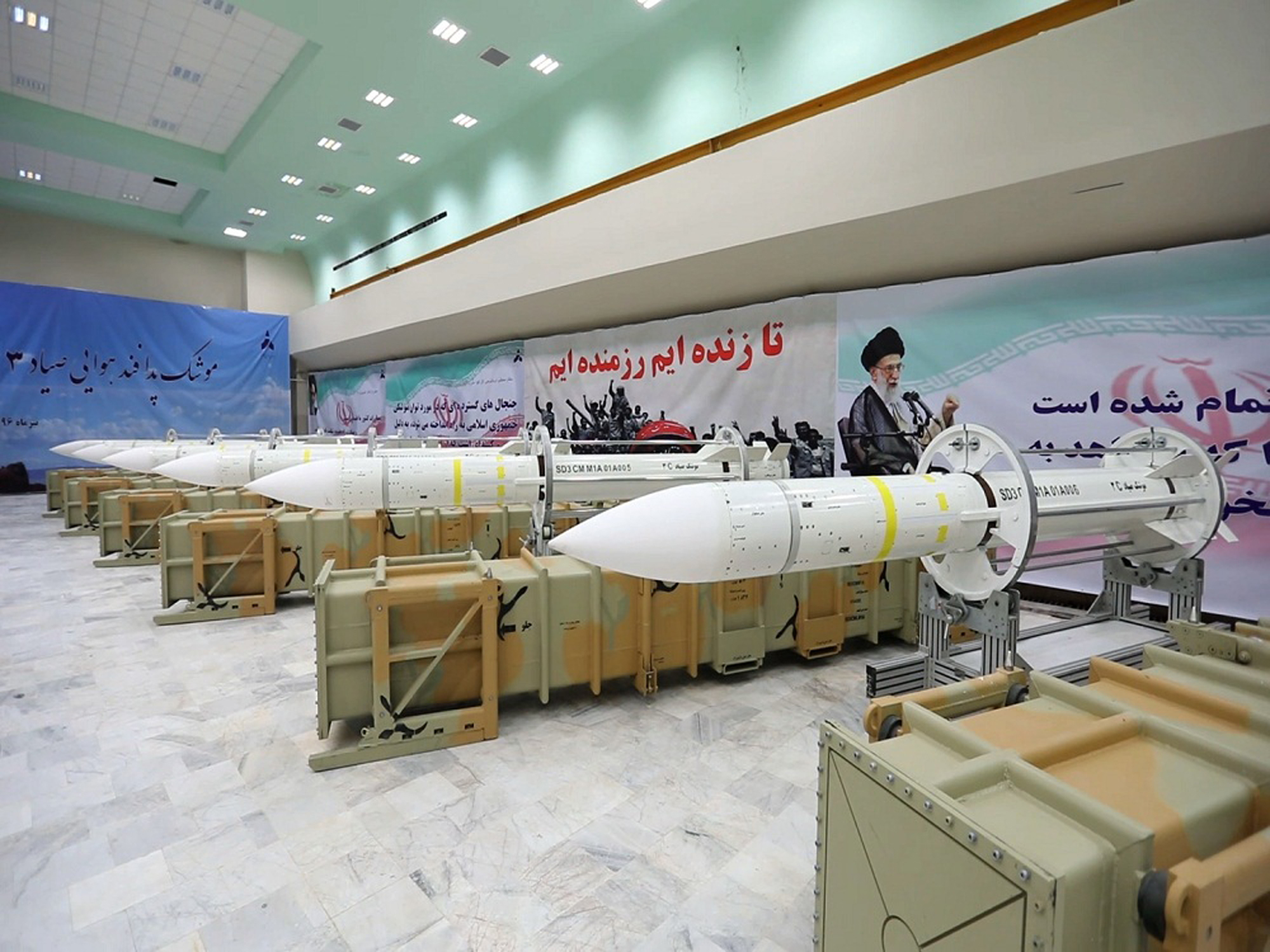
Illustrative. Sayyad-3 air defense missiles during inauguration of its production line at an undisclosed location, Iran, according to official information released, July 22, 2017. (Official website of the Iranian Defense Ministry via AP)

Illustrative. Sayyad-3 air defense missiles during inauguration of its production line at an undisclosed location, Iran, according to official information released, July 22, 2017. (Official website of the Iranian Defense Ministry via AP)

Israel has discovered a new ambitious precision missile factory being constructed by Iran in Syria together with the Syrian government and Lebanese terror group Hezbollah, after Israel bombed and destroyed a previous one, an Israeli TV network reported Thursday evening.

The report on Channel 12 said the new factory was recently built near the northwestern city of Safita in hopes that Israel wouldn’t discover it in the location, which is far from previous Iranian sites struck by Israel elsewhere in Syria. The factory is intended to focus on producing precision missiles, dramatically upgrading the threat to Israel from the vast arsenal of rockets and missiles deployed against it in southern Lebanon by Iran’s proxy, Hezbollah.

To build it, Channel 12 reported, Iran had to bypass international sanctions on its missile program via a series of straw companies established by Syria’s Scientific Studies and Research Center (SSRC), a government agency that manufactures weaponry and whose facilities have repeatedly been targeted by Israel in the past.

Those companies — established specifically for that purpose — ordered missile parts from Italy, China and other countries in eastern Asia, the report said. The companies are named the Organization of Technological Industries (OTI) and ANAS Group, according to the report.

Israel has nevertheless discovered, tracked and uncovered the facility, the network said, as part of its effort to thwart Iran’s military entrenchment in Syria.

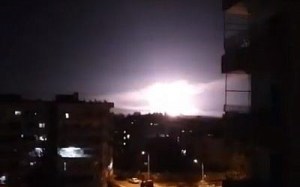
An explosion, reportedly during Israeli airstrikes near Damascus, Syria, on January 21, 2019. (screen capture: YouTube)

Israel says it has carried out hundreds of airstrikes on Iranian-linked targets as part of a campaign to prevent Tehran from establishing a military presence in Syria.

The previous Israeli airstrike on a precision missile factory in Syria occurred in September, when Syrian air defenses shot down a Russian military aircraft, killing all 15 servicemen aboard.

Russia, which is allied with Damascus, blamed the Israeli military for the incident, a charge rejected by Jerusalem, and later transferred advanced air defense systems to Syria in a move condemned by Israel.

Meanwhile, an Iranian news outlet said Thursday that the elite Revolutionary Guard has inaugurated a surface-to-surface ballistic missile it claims has a 1,000-kilometer (620-mile) range.

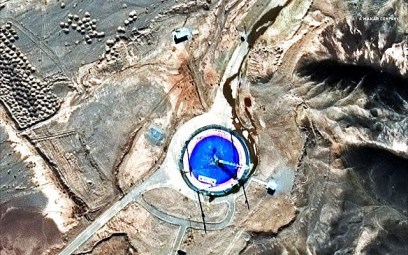
This February 6, 2019, satellite image provided by DigitalGlobe shows an empty launch pad and a burn mark on it at the Imam Khomeini Space Center in Iran’s Semnan province. (DigitalGlobe, a Maxar company via AP)

The report by the semi-official Fars news agency, close to the Guard, said a ceremony marking the inauguration was held in an underground missile factory described as an “underground city.”

The ceremony coincided with the 40th anniversary of the 1979 Islamic Revolution.

The report said the missile, dubbed Dezful, is a version of the Zolfaghar missile that has a 700-kilometer (430-mile) range and a 450-kilogram (992-pound) warhead.

Iran has missile capability of up to 2,000 kilometers (1,250 miles), far enough to reach archenemy Israel and US military bases in the region.

Occasionally, Iran announces military achievements that cannot be independently verified.

AP contributed to this report.