Archive for February 6, 2019

Netanyahu to meet Putin in Moscow this month

February 6, 2019

Source: Netanyahu to meet Putin in Moscow this month – Israel Hayom


Russian-made S-300 missile defense system active in Syria

February 6, 2019

Source: Russian-made S-300 missile defense system active in Syria – Arab-Israeli Conflict – Jerusalem Post

Russia delivered the defense system to Bashar Assad’s regime in Syria in October, after Syria mistakenly downed a Russian plane during an Israeli strike on Iranian targets.

BY ANNA AHRONHEIM
 FEBRUARY 5, 2019 18:33
The self-launching component of the S300 surface-to-air missile

The launchers of Russian-made S-300 missile defense systems deployed to Syria have been erected, new satellite images released on Tuesday showed.

“Due to the current regional tension and the detected erection of the launchers it is possible that the mentioned activity indicates an increase of the operational level and alertness,” ImageSat said in their assessment of the images.
The camouflaging of the fourth launcher “is rare and raises question marks about the operational level of the whole battery and specifically of the covered and folded launcher,” they added.

Russia delivered the launcher, radar and command and control vehicle of the advanced surface-to-air missile system to the regime of Syrian President Bashar Assad in early October as a response to the downing of a Russian reconnaissance plane by Syrian air defenses during an Israeli airstrike on Iranian targets the previous month.

Moscow said it would also impose electronic countermeasures over Syria’s coastline to suppress satellite navigation, onboard radar systems and communications of warplanes attacking targets on Syrian territory.

The incident has led to one of the lowest points in the relationship between Jerusalem and Moscow in years. Earlier on Tuesday, Prime Minister Benjamin Netanyahu announced that he would be heading to Moscow later in the month to meet with Russian President Vladimir Putin, their first-such official meeting since the crisis.

With the help of the Russians, Iranians and Hezbollah, Assad has regained control over the majority of Syria and is rebuilding his army, focusing first on intelligence and air defense divisions which could pose a threat to Israeli aircraft.

Syrian air defenses are largely antiquated Soviet-era systems, with SA-2s, SA-5s and SA-6s, as well as the more sophisticated tactical surface-to-air missiles, such as the SA-17s and SA-22 systems. Moscow has also supplied the short-range Pantsir S-1 to the Assad regime.

The advanced S-300 would be a major upgrade to the Syrian air defenses and would pose a threat to Israeli jets on missions as the long-range missile defense system can track objects, such as aircraft and ballistic missiles, over a range of 300 kilometers.
A full battalion includes six launcher vehicles, with each vehicle carrying four missile containers for a total of 24 missiles, as well as command-and-control and long-range radar detection vehicles.

The system’s engagement radar, which can guide up to 12 missiles simultaneously, helps guide the missiles toward the target. With two missiles per target, each launcher vehicle can engage up to six targets at once.

Israel has been carrying out airstrikes in the war-torn country against Hezbollah and Iranian targets. While the number of airstrikes in Syria attributed to the Jewish state has dropped since the downing of the Russian plane, Israel has stressed that it will continue to operate when necessary.

“We are operating both against Iran and against the Syrian forces that are abetting the Iranian aggression,” Netanyahu said at the end of January. “We will strike at anyone who tried to harm us. Whoever threatens to eliminate us, bears full responsibility.”


Iran vows to ‘teach Israel a lesson’ as response to strikes in Syria

February 6, 2019

Source: Iran vows to ‘teach Israel a lesson’ as response to strikes in Syria – Arab-Israeli Conflict – Jerusalem Post

“If these actions continue… as a firm and appropriate response to teach a lesson to the criminal and lying rulers of Israel,” a senior official said.

BY REUTERS
 FEBRUARY 5, 2019 17:13
AN IRANIAN ballistic missile on display in Tehran.

Israel, which views Iran as its biggest security threat, has repeatedly attacked Iranian targets and those of allied militia in Syria. With an election looming in April, Israel has been increasingly open about carrying out its air strikes.

In a meeting with Syria’s Foreign Minister Walid al-Moalem in Tehran, the secretary of Iran’s National Security Council Ali Shamkhani said the Israeli attacks violated Syria’s territorial integrity and were “unacceptable”.

“If these actions continue, we will activate some calculated measures as a deterrent and as a firm and appropriate response to teach a lesson to the criminal and lying rulers of Israel,” Shamkhani was quoted as saying by Fars news agency.

Israeli Prime Minister Benjamin Netanyahu said last month that Israeli forces would continue to attack Iranians in Syria and warned them to “get out of there” fast.

In January, Israeli warplanes carried out an attack on what they called an Iranian arms cache in Syria.

Syria’s Moalem was quoted on Tuesday by a Hezbollah-run media unit as saying: “The Syrian government considers it to be its duty to keep Iranian security forces in Syrian territory.”

Iran has also repeatedly said it will keep military forces in Syria.


As it readies peace plan, US says it sees no need to balance pro-Israel slant 

February 6, 2019

Source: As it readies peace plan, US says it sees no need to balance pro-Israel slant | The Times of Israel

White House is proudly supportive of Israel, senior official says, dismissing need for equivalency as a ‘vestige of talking points from decades ago’

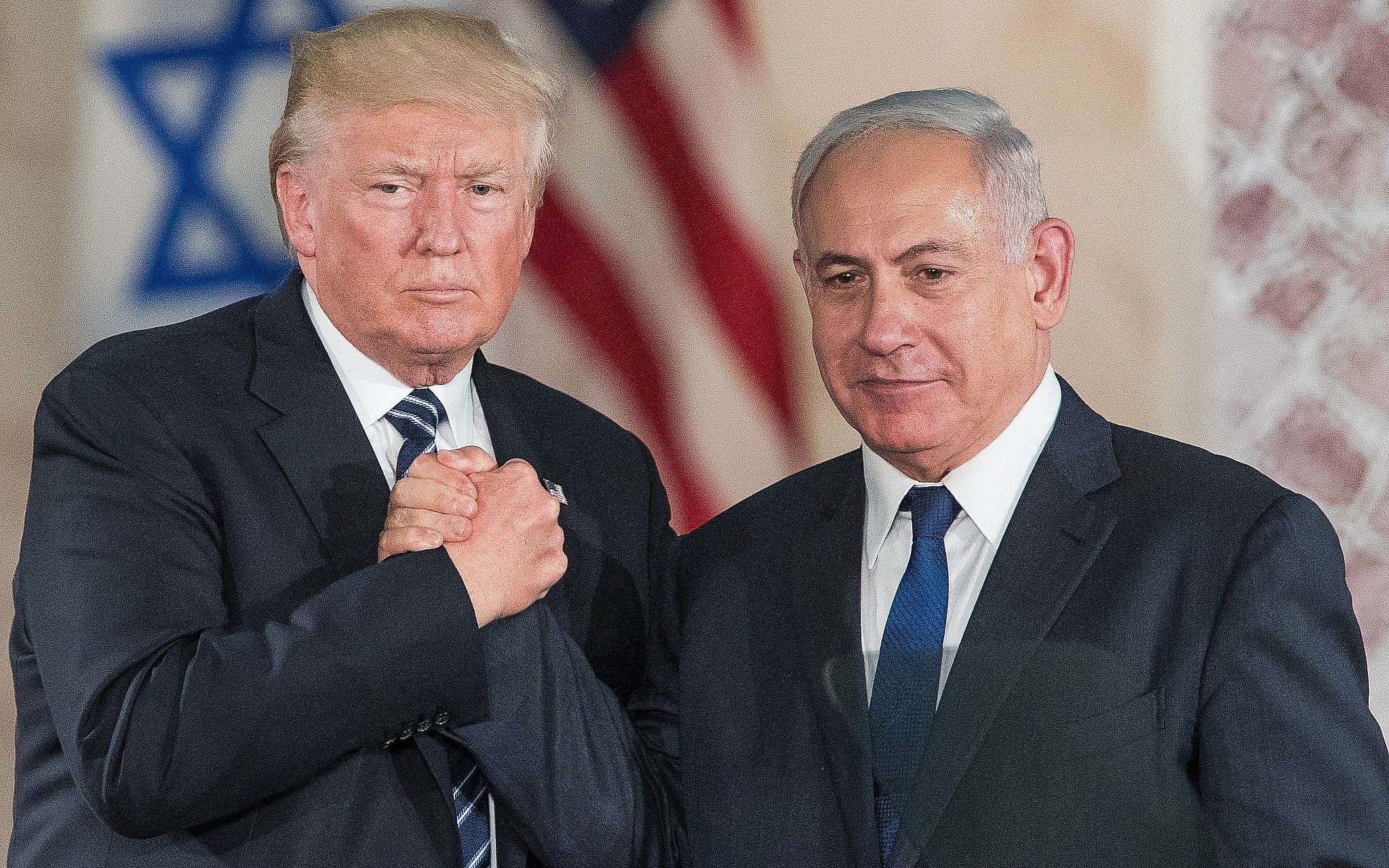
US President Donald Trump and Prime Minister Benjamin Netanyahu shake hands after speaking at the Israel Museum in Jerusalem on May 23, 2017. (Yonatan Sindel/Flash90)

The White House is not interested in being considered an “honest broker” in the Israeli-Palestinian conflict, a senior US official said this week, rejecting the notion that some sort of “equivalency” between the two sides was required to successfully mediate a peace deal.

Rather, the administration is proudly supportive of Israel and does not feel the need to try to counterbalance any pro-Israel statement with some carrots for the Palestinians, or to add a line about Palestinian grievances every time it laments Israeli victims of terror attacks, according to the senior official.

“The US is a strong ally of Israel. The administration, from the president on down, is not embarrassed to defend Israel where Israel needs to be defended, whether it’s on the Gaza border, on the Hezbollah tunnels, the Syrian border, wherever it is,” the senior official told The Times of Israel, speaking on condition of anonymity.

Asked about the widespread perception that the US is no longer an “honest broker,” the senior official dismissed that concept as “a vestige of talking points from decades ago.”

“We don’t believe that in order for us to work on a peace effort we need to have an equivalency, where we can only say certain things about Israel if at the same time we also say something about the Palestinians,” he said.

“Not only does that not work; we don’t think it’s right. We say what’s on our mind; we speak the truth. The truth may be uncomfortable for some people. But we cannot solve the conflict without being open and honest. Ultimately, it’s all about the plan: either it’s a good plan that’s workable for the two sides, or it isn’t.”

The official was referring to the administration’s much-expected proposal for an comprehensive Israeli-Palestinian peace agreement, which Washington is expected to release in the weeks after the April 9 Knesset elections.

In recent weeks, Trump’s special envoy to the peace process, Jason Greenblatt, has conducted some contentious Twitter exchanges with senior PA officials over US-Palestinian relations and so-called Twitter diplomacy.

Greenblatt, who has been working on the peace plan together with Trump’s son-in-law and senior adviser Jared Kushner and US Ambassador to Israel, David Friedman, responded to the attacks by saying that his door remains open to Palestinian officials, who would like to discuss the administration’s policies vis-a-vis the Middle East.

The official reiterated that meetings with “ordinary Palestinians” were taking place on a regular basis.

“They express deep frustration with their leadership. They believe that their leadership has eroded their standing in the world, not just in the US, but around the world. They want to engage with us and they want to see what is in the plan. They want a better future, and they know the key to that involves the US,” the official said.

People are seen outside the Palestinian Liberation Organization Delegation office in Washington DC on September 10, 2018. (AFP/Andrew Caballero-Reynolds)

Since US President Donald Trump unilaterally recognized Jerusalem as Israel’s capital in December 2017, and subsequently moved the US embassy to the city, the Palestinian Authority has refused to engage with administration officials, arguing that Washington was no longer qualified to play a leading role in the peace process.

Relations between Ramallah and Washington further soured after the administration surprisingly cut financial aid to agencies supportive of Palestinians, and closed the Palestine Liberation Organization’s representative office in the US capital.

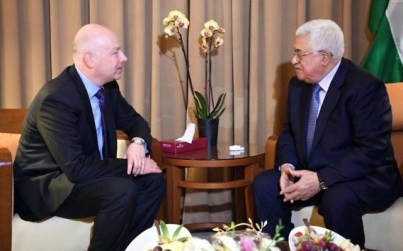
US Middle East envoy Jason Greenblatt meets Palestinian Authority President Mahmoud Abbas on the sidelines of the Arab League Summit in Amman, March 28, 2017 (Wafa/Thair Ghnaim)

The US administration remains hopeful that once the plan is released, Palestinian leaders “will realize how much the Palestinians can gain from the plan,” the senior official added.

The US will not try to force either side to accept the peace proposal, he said, adding “but we believe we can put forth a credible, realistic and fair plan that could bring this conflict to an end; to dramatically improve Palestinian lives, maintain Israel’s security and allow Israel to integrate into the region in a way that even two years ago no one would have imagined it could.”

When the plan will see the day of light has not yet been decided, according to the official, acknowledging that there are “numerous considerations” that may play a role and push the date back to mid-May at the earliest. These include the Israeli elections (April 9) and subsequent coalition building process, the Passover holiday (April 19-26), Ramadan (May 5-June 4), and Israeli Memorial and Independence Days (May 7-9).

“Our goal is to release the plan at a time when it has the best chance of success. There are a lot of factors that go into making that decision,” he said.


Vowing to confront Iran, Trump scolds ‘the vile poison of anti-Semitism’ 

February 6, 2019

Source: Vowing to confront Iran, Trump scolds ‘the vile poison of anti-Semitism’ | The Times of Israel

In key address to joint session of Congress, president brings Pittsburgh survivor as guest, says Jerusalem embassy move fueled by ‘pragmatic realism’

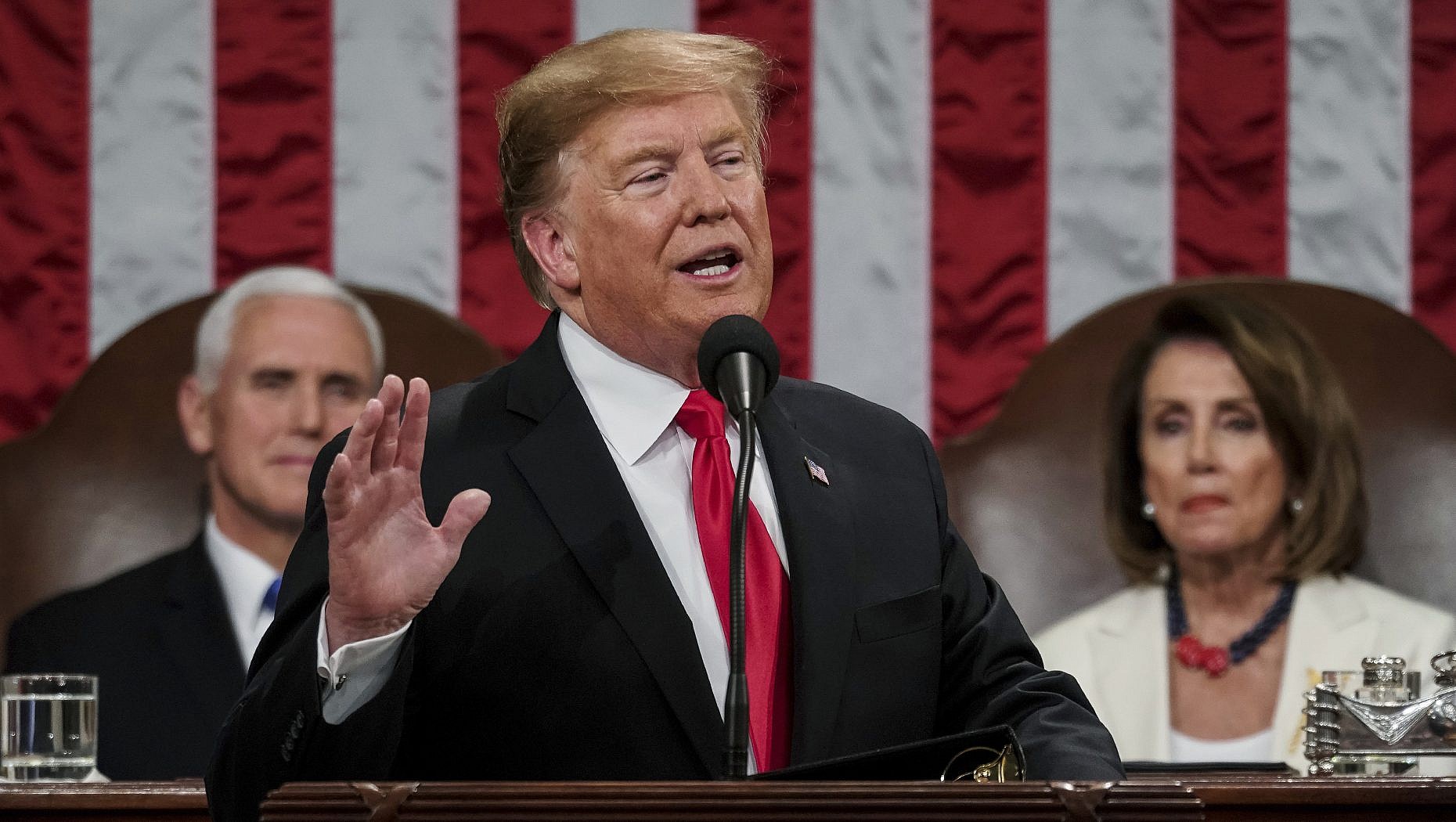
President Donald Trump gives his State of the Union address to a joint session of Congress, Tuesday, Feb. 5, 2019 at the Capitol in Washington, as Vice President Mike Pence, left, and House Speaker Nancy Pelosi look on. (Doug Mills/The New York Times via AP, Pool)

President Donald Trump gives his State of the Union address to a joint session of Congress, Tuesday, Feb. 5, 2019 at the Capitol in Washington, as Vice President Mike Pence, left, and House Speaker Nancy Pelosi look on. (Doug Mills/The New York Times via AP, Pool)

WASHINGTON — US President Donald Trump strongly condemned anti-Semitism Tuesday night as he vowed to confront Iran and learn the lessons of the Pittsburgh synagogue shooting, during his 2019 State of the Union address.

In the speech before a joint session of Congress, in which the president laid out his policy agenda for the next year and lambasted the special counsel’s investigation, Trump spent a fair portion of time on the subject of Jew-hatred.

He contextualized his Iran policy by castigating the regime’s rapacious anti-Semitism.

“We will not avert our eyes from a regime that chants, ‘Death to America,’ and threatens genocide against the Jewish people,” Trump said. “We must never ignore the vile poison of anti-Semitism, or those who spread its venomous creed. With one voice, we must confront this hatred anywhere and everywhere it occurs.”

The need to take a strong stance against Tehran, the president implied, was evident in the attack at the Tree of Life Synagogue — believed to be deadliest act of anti-Semitic violence in American history.

“Just months ago, 11 Jewish Americans were viciously murdered in an anti-Semitic attack on the Tree of Life Synagogue in Pittsburgh,” Trump said, as he introduced SWAT officer Timothy Matson, who responded to the scene, and Judah Samet, a Holocaust survivor who also survived the attack.

A makeshift memorial stands outside the Tree of Life synagogue in the aftermath of a deadly shooting in Pittsburgh, on October 29, 2018 in which eleven Jews were killed while at Shabbat services. (AP/Matt Rourke)

“He arrived at the synagogue as the massacre began,” Trump said of Samet, who was also celebrating his 81st birthday. “But not only did Judah narrowly escape death last fall — more than seven decades ago, he narrowly survived the Nazi concentration camps.”

Trump visited the synagogue shortly after the attack with his Jewish daughter Ivanka and son-in-law Jared Kushner, who is also his senior adviser.

Earlier this year, the president withdrew the United States from the Iran nuclear deal and renewed sanctions on the Islamic Republic, actions that he said in his speech were intended to “ensure this corrupt dictatorship never acquires nuclear weapons.”

Trump made one mention of Israel in his speech, which lasted over an hour. During an extended segment on his Middle East policy, the president suggested he would diverge from the way previous White Houses had tried to resolve the Israeli-Palestinian conflict.

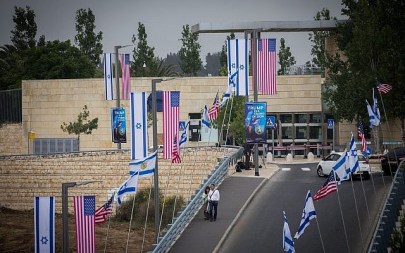
“Our approach is based on principled realism — not discredited theories that have failed for decades to yield progress,” he said. “For this reason, my administration recognized the true capital of Israel — and proudly opened the American embassy in Jerusalem.”

View of the US embassy in Jerusalem’s Arnona neighborhood, May 13, 2018. (Yonatan Sindel/Flash90)

Trump only briefly mentioned his decision to pull US troops out of Syria, a policy decision to which Jerusalem was deeply opposed. Israel has repeatedly warned in recent years that Iran is seeking to establish a military presence in Syria, where it is fighting alongside its Lebanese proxy Hezbollah and Russia to shore up the regime of Syrian President Bashar Assad.

Israeli officials have also warned that America’s absence would open the door for Tehran to create a so-called “land bridge” from Iran, through Iraq and Syria, into Lebanon and to the Mediterranean Sea.

“As a candidate for president, I pledged a new approach.” Trump said. “Great nations do not fight endless war. When I took office, ISIS controlled more than 20,000 square miles in Iraq and Syria. Today, we have liberated virtually all of that territory from the grip of these bloodthirsty killers.”

He continued: “Now, as we work with our allies to destroy the remnants of ISIS, it is time to give our brave warriors in Syria a warm welcome home.”


Iran airs animation showing its submarine sinking US aircraft carrier

February 6, 2019

Source: Iran airs animation showing its submarine sinking US aircraft carrier | The Times of Israel

Video release part of country’s celebrations marking 40 years since the Islamic Revolution

Iranian state media has released an animated video showing one of the country’s Ghadir-class submarines sinking an American aircraft carrier.

The IRINN news channel aired the clip on February 1, according to a transcription provided by the Middle East Media Research Institute (MEMRI).

The video opens with the aircraft carrier cruising on an open sea escorted by four smaller ships and carrying two planes on its deck. A green periscope bearing an Iranian flag then appears, sinister music begins playing, and one by one, the American ships disappear beneath the surface.

The clip ends with the submarine towing the American ships underwater past a logo reading “40 years,” a reference to the 40th anniversary of the country’s 1979 Islamic Revolution, and a voiceover saying, “Our Iran has the technology to manufacture very advanced Ghadir-class submarines.”

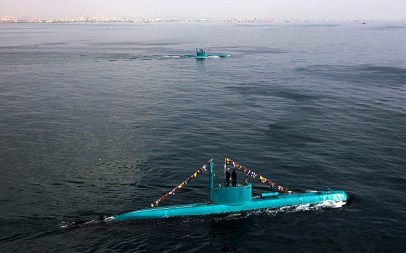
Iran’s newly launched Ghadir submarines move in the southern port of Bandar Abbas in Persian Gulf, Iran, Wednesday, Nov. 28, 2012. Ghadir class submarines can fire missiles and torpedoes at the same time, and can operate in the Persian Gulf’s shallow waters. (AP Photo/Fars News Agency, Ebrahim Norouzi)

Last week, Iran started celebrating the 40th anniversary of the country’s 1979 Islamic Revolution that toppled the US-backed shah, overturned 2,500 years of monarchical rule and brought hard-line Shiite clerics to power.

The Ghadir class submarines are mini, or midget, submarines that can operate in the shallow waters of the gulf.

The subs have sonar-evading technology and can launch missiles from under water, as well as fire torpedoes and drop marine mines, according to an Iranian state TV report released last year.

Iran began manufacturing Ghadir subs in 2005. The first was unveiled in 2007 and by 2012, five such submarines were incorporated into Iran’s navy.

Iran does not disclose the total number of submarines in its fleet.

In December, the US carrier USS John C. Stennis entered the Persian Gulf, ending a long absence of American carriers in the volatile region.

In past years, Iranian naval forces have harassed US ships in the area, and Iran has threatened to close the Strait of Hormuz, the narrow entrance to the Persian Gulf that is crucial to the international oil trade.