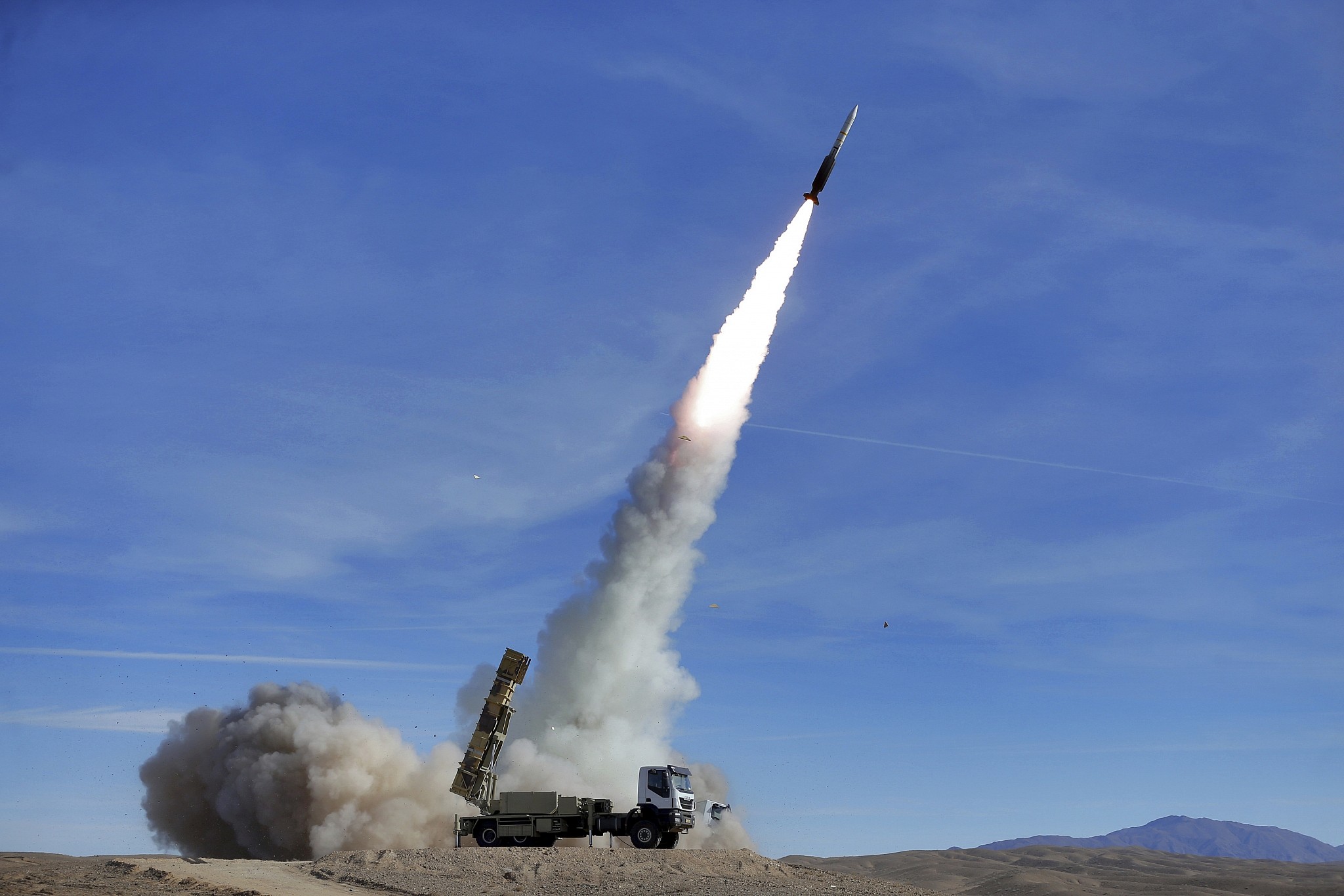
In this photo provided on November 5, 2018, by the Iranian Army, a Sayyad 2 missile is fired by the Talash air defense system during drills in an undisclosed location in Iran. (Iranian Army/AP)
The deputy chief of Iran’s Islamic Revolutionary Guard Corps has warned Europe against forcing the Islamic Republic into boosting the range of its missiles by trying to halt their development.
“If the Europeans, or anyone else, want to conspire to disarm Iran of missiles, we will be forced to make a strategic leap,” the guards’ deputy commander Brigadier-General Hossein Salami said on state TV on Saturday.
“All that hear me today, come to terms with the new reality of Iran’s missile might: There are no obstacles or technical limitations to us increasing (their) range,” he added.
The Islamic Republic develops its missile technology according to a “defensive strategy” that changes according to need, he said.
Last week, Salami told a reporter in Tehran that Iran’s strategy was to eventually wipe Israel off the “global political map.” Days later, he warned that Iran is capable of destroying Israel “in three days.”
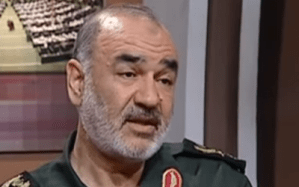
Brig. Gen. Hossein Salami, the second-in-command of the Islamic Revolutionary Guard Corps. (YouTube screen capture)
Earlier Saturday, Iran announced the “successful test” of a new cruise missile with a range of over 1,350 kilometers (840 miles), coinciding with the anniversary of the country’s 1979 Islamic Revolution.
Defense Minister Amir Hatami said the Hoveizeh cruise missile had successfully hit its targets, calling it the “long arm of the Islamic Republic of Iran.”
Iran reined in most of its nuclear program under a landmark 2015 deal with major powers, but has kept up development of its ballistic missile technology.
Washington withdrew from the accord in May and reimposed sanctions against Iran, citing the missile program among its reasons. European governments have stuck by the agreement, although some have demanded a new section to address Iran’s ballistic missile program and its intervention in regional conflicts including Yemen.
Iran has voluntarily limited the range of its missiles to 2,000 kilometers (1,250 miles), but that is still enough to hit Israel and US bases in the Middle East.
Washington and its allies have accused Tehran of pursuing enhanced missile capabilities that also threaten Europe.
Tehran denies this, insisting its missile program is “purely defensive.”
The weapon tested Saturday takes its name from a city in the southwestern province of Khuzestan that was devastated in the 1980-1988 war against Saddam Hussein’s Iraq.
Salami on Saturday warned world powers “not to seek (new) negotiations or make recommendations or requests on Iran’s missile power.”
“Our enemies only understand the language of force,” he said. “If you cannot talk to them in that language, they will use it to talk to you.”
The new Hoveizeh cruise missile with a range of 1,350km was tested on Saturday, Feb. 2, as Iran’s answer to the successful Israeli-US Arrow-3 missile test on Jan. 22, DEBKAfile’s military sources report.
Iran has made rapid strides towards developing a medium-range missile for attacking Israel in three tests launches in recent weeks. In the first, on Dec. 29, a Fajr 5 was aimed at central Israel; three weeks later, on Jan. 21, a Fatteh 100 was fired towards the Golan (and was intercepted); and in the last one, marking the 40th anniversary of the 1979 Islamic Revolution, a cruise missile was hailed by Iranian Defense Minister Amir Hatami as accurately hitting its intended target at 1,200 km. This is the distance from Iran to Israel.
By test number three, the Hoveizeh, which belongs to the Soumar family of cruise missiles, Iran demonstrated that, while the Israel’s Defense Ministry Research Administration and the US Missile Defense Agency were intent on developing missiles capable of striking targets outside earth’s atmosphere, the Islamic Republic had succeeded in producing low-flying cruise missiles that fly to target under their radar. Iran is confident that neither the United States nor Israel has the answer to this threat. And indeed, say our military experts, no military force in the world has so far found an effective means of intercepting cruise missiles before they strike, unless they are of short range.
Cruise missiles can hug mountains and hills and dip into valleys, thereby evading the radars of counter-missile systems. Because of these assets, the US has used Tomahawk cruise missiles for attacks in Syria and other parts of the world; the Russians use Kalibr-NKs and Israel, the Delilah, which has a range of 250km, and which the Syrian army and the Russian forces based in Syria have not been able to intercept. Israel also has cruise missiles of other types.
The closest answer to cruise missiles may be provided by US nuclear aircraft carrier strike groups, due to the blanket of concentrated radar, sensors and data processing systems thrown up over a vast area by this heavy concentrations of warships, surveillance planes and fighter-bombers. Even this capacity is limited to wide stretches of sea while ineffective against cruise missiles over land.
Therefore, the successful test of the Hoveizeh cruise missile is highly significant despite western attempts to play it down. When Brig, Gen. Hatami was appointed Defense Minister in September 2017, DEBKAfile characterized him as an enthusiast of ballistic and cruise missile development and an ardent admirer of the Al Qods chief Brig. Gen. Qassem Soleimani. The Hoveizeh provides Soleimani, supreme commander of Iran’s Middle East war fronts, with a powerful new weapon.
On the morning of January 20, 2019, a six-by-six Mercedes-Benz truck in al-Kiswah, Syria crewed by the Iranian Revolutionary Guard Corps began elevating a missile mounted on its back into firing position. Once the nearly nine-meter long missile attained a roughly seventy-degree angle, it solid-fuel rocket blasted it on an arcing trajectory towards Mount Hermon, twenty-miles to the west on the Israeli-controlled portion of the Golan Height.
Skiers vacationing at the ski-resort there could see the contrails of the Fateh-110 (“Conqueror”) missile streaking towards them at three times the speed of sound (video here.)
However, the missile was also detected by Israeli radars. As Israel’s David’s Sling anti-ballistic missile system was not yet operational, the IDF made do with the Iron Dome, a system designed for swatting slower, unguided artillery shells and rockets. Two Tamir interceptor missiles rocketed over snowboarders towards the Fateh missile at Mach 2, switched to electro-optical sensors for terminal guidance and destroyed it.
Israeli website Debka claims the attack was ordered by the head of the Iranian Quds force, General Qassam Suleimani, as a means to test Israeli defenses. Later that day, the IDF retaliated with an intense series of strikes in Syria detailed in this earlier article .
The domestically-developed Fateh-110 is not Iran’s longest-range missile, but it has nonetheless spearheaded a succession of missile strikes targeting Tehran’s foes since 2017.
During the Iran-Iraq War, Iran relied upon Soviet Scud-B missile purchased from Libya (20), North Korea (120, plus 150 more post-war) and Syria (12) to retaliate against Iraq’s larger ballistic missile force. Afterwards, North Korea assisted Iran in setting up production of a domestic Scud-variant called the Shahib-1. However, the Shahib and its successors are liquid-fuel rockets which required days to gas up, limiting their reactivity and leaving them vulnerable to preemptive strikes.
Starting in 1995, Iranian engineers began developing the first Fateh missile by adapting an unguided Zelzal-2 610-millimeter long-range artillery rocket, itself a reverse-engineered Soviet Luna-M “FROG” rocket. Chinese experts assisted with installing an inertial guidance system and maneuvering fins to allow the rocket to make course corrections.
The initial Fateh missile tested in 2001 had a range of only 130 miles. In the following decade, Iran built and tested three additional generations of improved Fateh-110A, Fateh-110B (or Mod 3) and 110D1 models, eventually boosting range to 180 miles and improving accuracy using GPS-guidance. The Fateh’s payload ranges in size from a 990 to 1,433-pound warhead. Its accuracy remains debated, with claims that a Fateh will land on average within either 100 or 250 meters of its designated target.
A 2017 report assessed a total of one hundred Iranian Fateh launchers in service with the IRGC Aerospace Force. Like the Scud tactical missiles which Iraq used to bombard Israel and Saudi Arabi during the 1991 Gulf War, the truck-mounted Fateh can be moved and fired on short notice, making it survivable versus preemptive attacks.
However, the missile’s limited range meant that the Fateh could only be used against countries bordering Iran. However, Tehran has also sold the Fateh-110A design for domestic manufacture in Syria under the name M-600 Tisheree. Syria began using M-600s to attack anti-Assad rebels starting in 2012.
Since 2007, Damascus and Iran have also transferred Fateh-110s and M-600s to Hezbollah, leading Israel to repeatedly bomb missile transfers because it views solid-fuel ballistic missiles as potential game-changers.
Iran’s Carrier-Killing Missiles?
The Fateh has spawned a bewildering variety of successors. In 2015 Tehran unveiled the lighter steel/titanium composite Fateh-313 with 310 mile range. Then in August 2018 it announced the Fateh-Mobin (“Bright Conqueror”), which has an infrared-seeker for terminal guidance, and claimed radar-evasive features—though such features were not discernible in the image shown to the public.
In 2011, Iran also unveiled an anti-ship version of the Fateh-110 called the Khalij Fars (“Persian Gulf”), ostensibly equipped an electro-optical seeker to allow it hit to home in on a moving naval target, though photographic evidence is unclear on that. An Iranianarticle claims that in a 2013 test, the missile struck a moving naval target with eight-meters of accuracy (recording here ).
Anti-ship ballistic missiles (ASBM) are rare and difficult to defend against. China’s development of DF-21D and DF-26 ASBMs has raised concerns about the survivability of aircraft carriers. The Khalij Fars, however, has one-quarter the DF-21’s range at 190 to 220 miles, and relatedly a lower maximum speed of Mach 3 compared to the DF-21’s Mach 10, making it easier to intercept. Like the Chinese missiles, the Khalij Fars would also require external reconnaissance assets to provide initial target-cueing for its inertial guidance system. However, the Khalij Far’s limitations are significantly mitigated by the fact that the Persian Gulf is quite confined, with only between 25 to 250 miles separating the western and eastern shores.
Iran also claims to have developed a Mach 4 anti-radiation variant called the Hormuz-1 and Hormuz-2 which are designed to home-in on land- and sea-based radars respectively. If real, these would be the world’s first anti-radiation ballistic missiles.
Revenge-by-Missile
In 2016, Iran also showed off a modernized “Zolfaghar” variant of the Fateh capable of carrying thirty thirty-seven-pound submunitions, and with a purported range of 434 miles—enough to strike Riyadh from Iranian soil. Later photos suggested the Zolfaghar was made of up filament-wound fiber to reduce weight, thereby increasing range.
Skepticism of the Zolfaghar’s reach was largely quashed on June 18–19, 2017 when in retaliation for a terrorist attack on the Iranian parliament that killed eighteen, the IRGC fired six Zolfaghars targeting ISIS-held Mayadin, Syria. The missiles were launched 370 miles away in Kermanshah, Iran—the first missile strike launched from Iranian territory since 2001.
Despite Tehran’s claims that all six missiles landed on target, however, the strike’s accuracy was questionable. An assessment by Jane’s suggests only one or two missiles landed in Mayadeen—hitting an open field, causing no casualties. The IDF reported that three missiles landed in Iraq (the border is over forty miles away.) An Iranian general later claimed the Iraqi explosions were casings jettisoned by the missiles prior to impact.
Then on September 8, 2018, two months after the IRGC lost ten soldiers in a border skirmish with Kurdish separatists, Iran launched seven Fateh-110B missiles on another cross-border strike targeting the headquarters of the Kurdistan Democratic Party-Iran, located in Koya, Iraq. This far deadlier attack killed eighteen Kurds and injured at least fifty. Footage of the strike released by Iranian media depicts two missiles striking a compound, suggesting greater precision.
Finally, on October 1, 2018—a week after gunmen massacred twenty-five in an Iranian military parade—the IRGC launched a third cross-border salvo: six Fateh-110 and medium-range Qiam missiles targeting the ISIS-held town of al-Bukamal, Syria. However, two of the Qiam missiles may have crashed during launch (the IRGC claims otherwise). Iran claims the strike killed twenty-five ISIS fighters, but locals and the U.S. military reported the strike inflicted no damage.
The succession of Fateh strikes in the last nineteen months signal a new willingness by Tehran to use its ballistic missiles—both those on home soil and deployed to Syria—to pressure adversaries across the Middle East.
Sébastien Roblin holds a master’s degree in conflict resolution from Georgetown University and served as a university instructor for the Peace Corps in China. He has also worked in education, editing, and refugee resettlement in France and the United States. He currently writes on security and military history for War Is Boring.
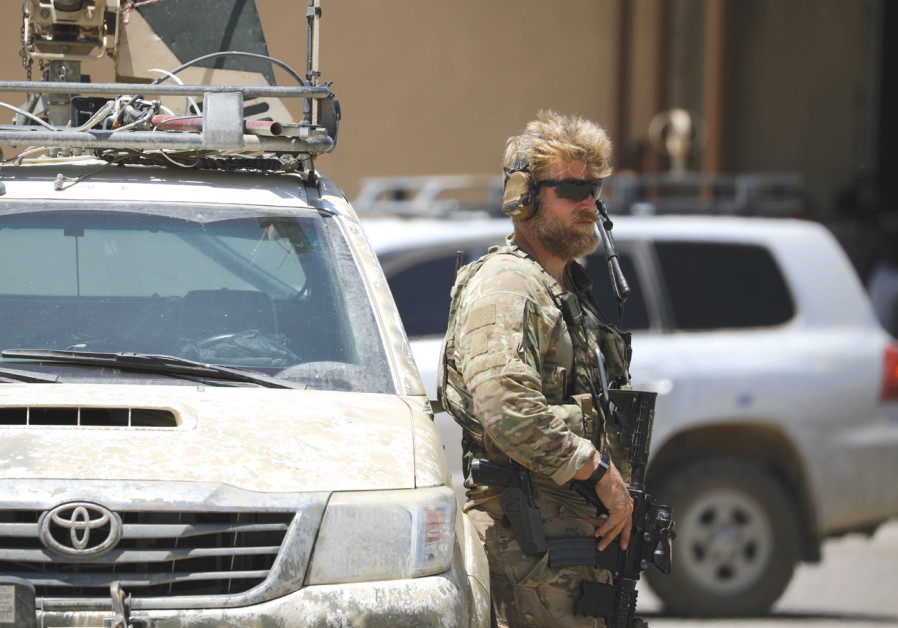
A US soldier guards a convoy with anti-ISIS envoy Brett McGurk in it last year.. (photo credit: REUTERS)
Members of the Hashd al-Shaabi, the Iranian-backed Shi’ite militias in Iraq, warned US troops against “provocations” near Mosul in a video posted over the weekend. US troops on patrol in eastern Mosul were confronted by gunmen who monitored their movements and put an armored jeep across their path on a road.
Iran’s Press TV boasted on Saturday that “Hashd al-Shaabi stop US military patrol in Iraq’s Mosul.” The Hashd are also called the Popular Mobilization Units and are a group of militias that have grown in the last several years in response to the ISIS attack on Iraq in 2014. Some of the militias, such as Badr, have deep roots in Iraq and leaders who fought alongside the Iranians during the Iran-Iraq war. Others, such as Qais Khazali’s Asaib Ahl al-Haq, were once considered terrorist gangs that targeted US troops and Sunnis in Iraq after the US invasion of 2003. Khazali was once held at Camp Cropper and went to Lebanon in December 2017 where he threatened Israel. The PMU in Iraq increasingly play a similar role to Hezbollah in Lebanon, with armed militias and members of parliament. The Fatah Alliance, led by Badr’s Hadi al-Amiri, came in second in the May 2018 Iraq elections.
US forces in Iraq, deployed as part of the Coalition’s anti-ISIS war, have not worked with the PMU during the war on ISIS. This has prevented a complex challenge because ostensibly the US is allied with the PMU in the anti-ISIS war, even as the US administration of Donald Trump has ended the Iran deal and sought to confront and sanction Tehran.
In the last two years the militias have increasingly threatened the US. In January 2018 Harakat Hezbollah al-Nujaba often called for the US to leave Iraq and threatened the US. In June 2018 Kata’ib Hezbollah also threatened to attack US forces after an airstrike hit their fighters in Syria. They had also said they were ready to fight the US in September 2017. Khazali said the US should leave Iraq last week in a interview.
These tensions have now boiled over in Mosul. US soldiers on patrol near the once-swank Nineveh International Hotel, found a street blocked by PMU vehicles. PMU members holding their rifles pointed skyward looked at the Americans. A helicopter circled in the background, landing at an Iraqi base nearby. The Americans share the base with the Iraqis, according to locals. It was only their first or second patrol in this particular area, sources told the Middle East Center for Reporting and Analysis (MECRA), which published reports of the confrontation. Kurdistan24 reported that the US forces had air support during their patrol.
After the confrontation the PMU produced a video threatening the US. Rezvan Al-Anzi, a PMU commander said on Saturday that the US was making “deliberate provocations.” The PMU claim the US is creating insecurity in the area. Locals in Mosul also are divided on what is happening. Most Mosul residents are Sunnis and they fear the role of the Shi’ite militias. But they also have been recovering from years of war. The city is hosting cultural events and rebuilding. They don’t want to be in the middle of an Iran-US struggle played out with Iranian proxies. They don’t want tensions some wrote online. In other parts of Iraq the PMU are also increasing rhetoric and confrontations with the US. In Anbar in mid-January a unit of the PMU also blocked an American patrol. Some members of the PMU have indicated that they expect to confront the Americans one day. An inquiry to the US Central Command about the incident was not answered as of press time.
The US is withdrawing from Syria but Trump told troops at Al-Asad base in Iraq in December 2018 that the US would stay in Iraq and continue to monitor ISIS threats. ISIS has been carrying out attacks in Iraq. But the PMU say they want to fight ISIS without US help. The Iraqi government is more circumspect. The Prime Minister Adel Abudl Mahdi was non-plussed that Trump came to Iraq and met US forces but didn’t come to Baghdad. Former Iraqi Prime Minister Haider al-Abadi had scolded then Secretary of State Rex Tillerson in October 2017, claiming the PMU were the hope for the future of Iraq. But Iraq wants support from the US for reconstruction and also continued US training of key security forces, such as pilots or Iraq’s Counter-Terrorism Service. The US is therefore in a difficult relationship with Baghdad and the PMU, amid tensions with Iran. The message in Mosul to US forces was that this part of Iraq belongs not only to Iraqis, but to the PMU, and US forces should be aware. Coinciding with the 40th anniversary of the Islamic Revolution in Iran, the confrontation is part of pro-Iranian groups and their attempt to test the US.





 anneinpt
 artaxes
 danmillerinpanama
 davidking1530
 Peter Hofman
 Joseph Wouk
 Peter
Peter Louisiana Steve
 WarSclerotic
Recent Comments