Archive for January 2019

Israel intel chief sees possible threat from Iraq as Irans clout grows

January 1, 2019

Source: Israel intel chief sees possible threat from Iraq as Irans clout grows

Maj. Gen. Tamir Hayman says Iraq ‘under growing influence’ of Iranian foreign operatives, compares it to Tehran intervention in Syria, which gave Islamic Republic a foothold close to Israeli border.
Iran could use its growing clout in Iraq to turn the Arab country into a springboard for attacks against Israel, the top Israeli intelligence official said on Monday.
Israel sees the spread of Tehran’s influence in the region as a growing threat, and has carried out scores of air strikes in civil war-torn Syria against suspected military deployments and arms deliveries by Iranian forces supporting Damascus.

Iraq, which does not share a border with Israel, is technically its enemy but was last an open threat in the 1991 Gulf War. After a U.S.-led invasion in 2003 toppled Iraqi dictator Saddam Hussein, a Sunni Muslim, Israel has worried that the country’s Shi’ite majority could tilt to Tehran.
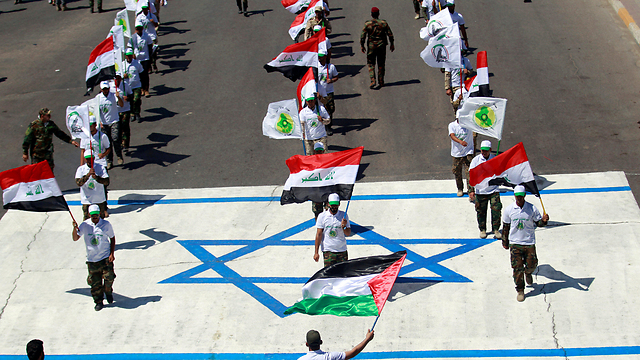
Anti-Israel demonstration in Baghdad, Iraq (Photo: Reuters)

Anti-Israel demonstration in Baghdad, Iraq (Photo: Reuters)

“Iraq is under growing influence of the (covert Iranian foreign operations unit) Qods Force and Iran,” Major-General Tamir Hayman, the chief of Israeli military intelligence, told a conference in Tel Aviv.

With U.S. President Donald Trump signalling he sought to disengage from the region, Hayman said, the Iranians may “see Iraq as a convenient theatre for entrenchment, similar to what they did in Syria, and to use it as a platform for a force build-up that could also threaten the State of Israel.”

Citing Iranian, Iraqi and Western sources, Reuters reported in August that Iran had transferred short-range ballistic missils to Shi’ite allies in Iraq. Baghdad denied the findings.

The following week, Israel said it might attack such sites in Iraq, effectively expanding a campaign now focussed in Syria.

Hayman predicted 2019 would bring “significant change” to Syria, whose President Bashar Assad has beaten back rebels with the help of Russia, Iran and Lebanese Hezbollah reinforcements, and where Trump this month ordered a pullout of U.S. troops.

“This presence of Iran, with Syria’s return to stabilisation under a Russian umbrella, is something we are watching closely,” he said.

Israel has also been monitoring Iranian conduct since Trump quit the 2015 nuclear deal with Tehran in May and reimposed U.S. sanctions. The deal placed caps on nuclear projects with bomb-making potential, though Iran denied having such designs. Trump, with Israeli support, deemed the caps insufficient.

“We assess that Iran will strive to stay within the deal but will do everything in order to find ways of circumventing the American sanctions,” Hayman said.
 

Islamic Jihad Leader: We Will Attack Israel from the North and South

January 1, 2019

Source: Islamic Jihad Leader: We Will Attack Israel from the North and South

Shamkhani-Nakhala

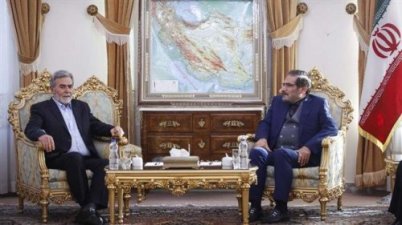
Secretary of Iran’s Supreme National Security Council Ali Shamkhani (R) met Ziyad al-Nakhala, Secretary General of the Palestinian Islamic Jihad movement, in Tehran on December 30, 2018. (Photos from Iranian press)

During a visit to Tehran on December 29, 2018, Ziyad Nakhalah, leader of the Palestinian Islamic Jihad (PIJ), met with the top echelons of Iran’s leadership, including the Supreme Leader Ayatollah Ali Khamenei. Iran’s head of the Supreme Security Council, Rear Admiral Ali Shamkhani told Nakhalah, “Iran has always been supportive to the resistant and oppressed Palestinian people since the very start of the Islamic Republic of Iran’s establishment, which was inspired by our religious and humane beliefs and will continue until the complete victory of the resistance process.”

Khamenei-Nakhalah

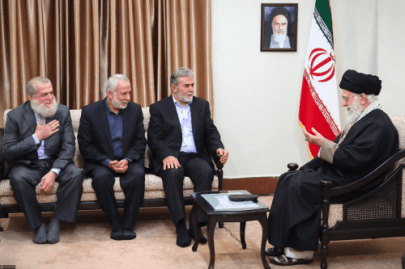
Iranian Supreme Leader Khamenei receiving Nakhalah and his colleagues (Iranian press)

Nakhalah gave an interview to the Iranian TV channel Al-Alam, in which he revealed the “Axis of Resistance” plan, led by Iran, to attack Israel from the north and the south. PIJ serves as Iran’s proxy in Gaza. Nakhalah’s statements were issued several days after his public meeting in Beirut with the leader of Hizbullah, Sheikh Hassan Nasrallah.

Nakhalah-Zarif

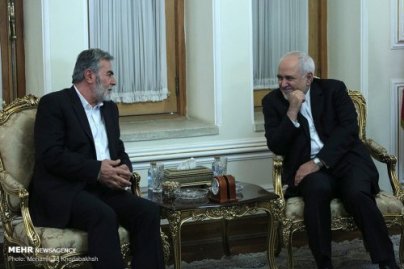
Ziyad Nakhalah of PIJ met with Iranian Foreign Minister Javad Zarif in Tehran.

“In the next confrontation with the occupation,” Nakhalah declared, “the axis of resistance will operate from the north [Lebanon] to the south [Gaza]. There will be open channels of collaboration, without any limitation or red lines. Each Israeli attack will be answered with a reaction from the entire axis of resistance. All forces will participate in it, as they will form a single axis. Iran supports the Palestinian resistance and the Hizbullah organization. The resistance is in its best situation. There have been qualitative developments in the capabilities of the Palestinian resistance. Next year, we will see big changes in favor of the resistance.”

“The entire ‘axis of resistance’ will work together in every confrontation that will arise. The resistance forces and their axis have a plan to struggle against the occupation. There is strategic coordination between the factions of the resistance in the Gaza Strip [Hamas and Islamic Jihad], and we will strengthen the joint operations room of the resistance factions,” Nakhalah emphasized.

He added: “We will emerge from beneath the ground and from above the ground. The occupation needs to expect us everywhere. I’m sure we will defeat the Zionist project, and this entity will disappear. We will continue with the resistance, and we will not withdraw from it. There will be victims, come what may.”

In the interview, Nakhalah dealt with several other issues:

  1. He claimed that during Israel’s most recent clashes with various factions in the Gaza Strip, Israel asked, for the first time, for a cease-fire through an Egyptian mediator. “If the clashes had continued, we would have hit cities (in Israel),” Nakhalah asserted.
  2. A call to the Palestinian Authority to sit down with the resistance factions. If this does not happen, the Palestinian Authority “will become obsolete.”
  3. The plan of Islamic Jihad and the Palestinian people is to fight against the occupation in the West Bank through popular and military means, including one-person terror attacks.
  4. Efforts are currently being concentrated on torpedoing Trump’s “Deal of the Century,” which is a new conspiracy to impose terror on the region. It is composed of old U.S. theories in a new disguise.
  5. The Arab countries failed in their response to the existence of Israel. Their normalization with Israel has recently become revealed.
  6. The declaration of Jerusalem as the capital of Israel was an erroneous move by the U.S. government, and the resistance has made some real achievements in the struggle against this declaration.
  7. The resistance in Lebanon and Palestine is gaining strength, while the Arab line has collapsed. All of the peace plans have failed.
  8. Nothing remains from the Oslo Accords, apart from security cooperation and a few sources of finance for the Palestinian Authority.

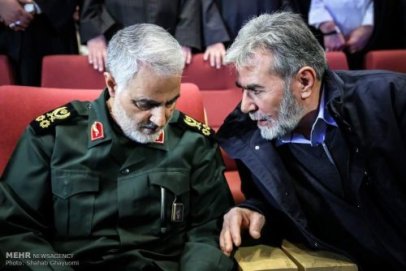
Ziyad Nakhala and Iran’s Gen. Qassem Soleimani, commander of the Iranian Revolutionary Guards’ Al Quds brigade, during an earlier visit.

During the last week of December 2018, a delegation from Hamas also visited Iran, led by Mahmoud al-Zahar, a senior member of the organization’s political bureau.

During the second half of January 2019, Hamas leader Ismail Haniyeh is expected to pay a visit to Iran.

Iran is publicly strengthening its ties with Hamas and Islamic Jihad, while it acts to reinforce its military grip on Syria in order to open a new Golan Heights front against Israel with fighters from Hizbullah and pro-Shiite militias.


Iran plays its “Palestinian Islamic Jihad” card in Tehran meetings 

January 1, 2019

Source: Iran plays its “Palestinian Islamic Jihad” card in Tehran meetings – Arab-Israeli Conflict – Jerusalem Post

Tehran considers Nakhala and a visit with his group an important event, even though PIJ is a relatively minor player on the Palestinian scene.

By Seth J. Frantzman
January 1, 2019 04:24
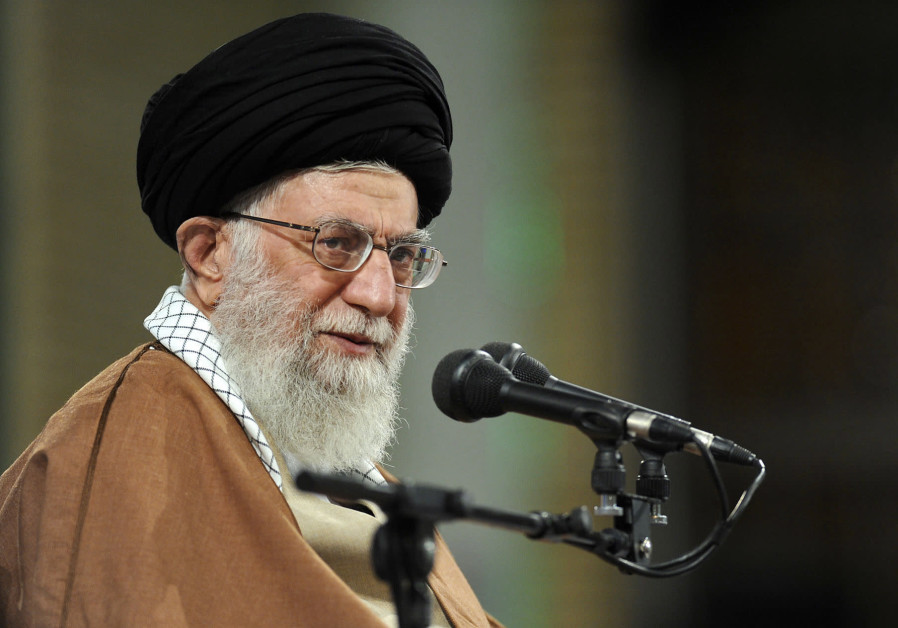
Iran's supreme leader Ayatollah Ali Khamenei

Iran’s Supreme leader Ayatollah Khamenei met with Ziad Nakhala, the head of Palestinian Islamic Jihad, in Iran on Monday. The meeting is the latest attempt by the Iranian regime to involve itself in Palestinian politics. Khamenei said that a Palestinian state would eventually be established in Tel Aviv and sought to highlight Palestinian “resistance” while contrasting it with the “defeat” of Arab countries in the region.

The important meeting is with one of  the smaller Palestinian terrorist groups, but buttresses the long-term support and connection between the Iranian regime and Palestinian Islamic Jihad (PIJ). Ziad Nakhala was chosen to lead PIJ in September 2018. He was celebrated by Turkey’s Anadolu as living a “lifetime of resistance” when he was chosen. According to the Turkish media biography he was born in 1953 in Khan Yunis and served time in Israeli prison. Released in a 1985 prisoner deal, his house was damaged in the 2014 war in Gaza. Al-Nakhala replaced Ramadan Shallah, who had run the group since 1995. When he was chosen, he was appointed along with a group of other unnamed men to PIJ’s “politburo,” according to Al-Manar, Hezbollah’s media channel.

Nakhala has been central to the group’s policy for decades and shows up on US State Department cables in 2008 and 2011 in relation to two attempts at ceasefires in the Gaza Strip, in which Hamas sought Egyptian mediation to relieve the siege of Gaza imposed by Israel after Hamas came to power. Some sources believe that PIJ is controlled by Iran. In October PIJ fired dozens of rockets from the Gaza Strip, allegedly after orders from Tehran.

Tehran considers Nakhala and a visit with his group an important event, even though PIJ is a relatively minor player on the Palestinian scene. It is the one real frontline group Iran has in Gaza that Tehran thinks can pressure Israel at its behest. Khamenei stressed that the Palestinian people would eventually achieve victory through “resistance,” in his discussion. He claimed that in the last conflicts “the Zionists regime begged for ceasefires.” PIJ reported to Iran about its activities and preparations, claiming that in any subsequent war with Israel it could fire “thousands of missiles” that would reach Tel Aviv and other areas. Khamenei was happy, saying that eventually a Palestinian government would arise in Tel Aviv.

In an interview with Al-Alam media in Tehran, the PIJ leader went further in his claims, arguing that in any new war with Israel that “all the axes of resistances will participate.” He claimed the Palestinian Authority had stalled in its march towards statehood and that the “resistance,” by which he meant Hamas and PIJ, were in very good condition today. He also said that in the next conflict Iran and Hezbollah will support the Palestinians. This was an important assertion, because it appears to represent a threat to launch a multi-front war against Israel. The comments were reported in Tasnim news agency. The meeting was also highlighted in English on Iran’s PressTV and also Khamenei’s Twitter, where he claimed that “as along as resistance exists, the decline and perishing process of the Zionist regime will continue,” paraphrasing what he told the PIJ leader.

The meeting in Iran included at least eight men, at least several of whom appeared to be PIJ senior leadership. It was not entirely clear how they had arrived in Iran or where they would continue on to after the meeting.
Join Jerusalem Post Premium Plus now for just $5 and upgrade your experience with an ads-free website and exclusive content. Click here>>


IDF raises ‘Gates of Fire’ battalion to protect North from Hezbollah 

January 1, 2019

Source: IDF raises ‘Gates of Fire’ battalion to protect North from Hezbollah – Arab-Israeli Conflict – Jerusalem Post

The battalion held a training program during the past month in which it practiced a wide range of scenarios it may encounter during a war.

BY JERUSALEM POST STAFF
 JANUARY 1, 2019 10:23
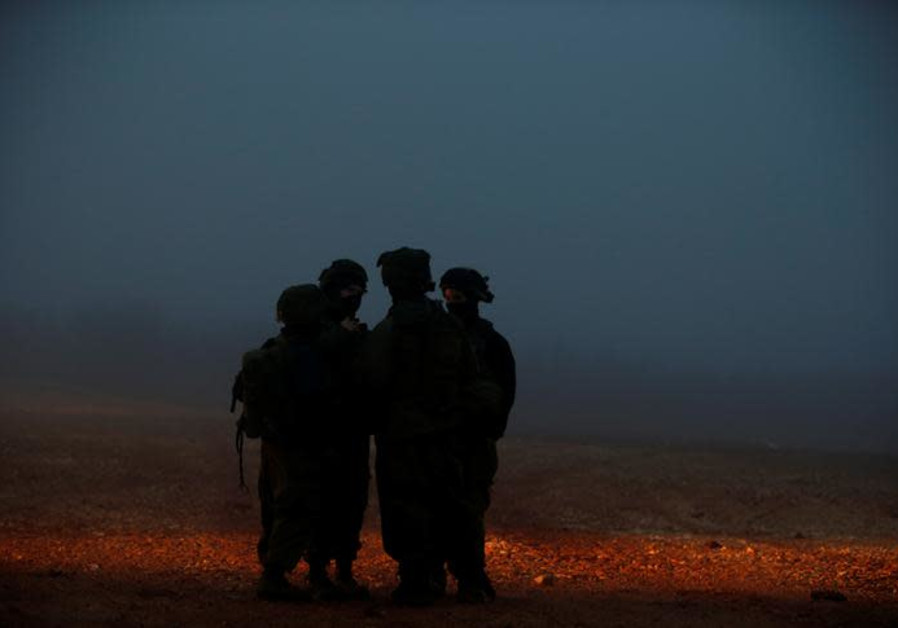
Israeli soldiers

Prime Minister Benjamin Netanyahu said Monday at a press conference Israel’s efforts exposing the tunnels in the North has destroyed Hezbollah’s surprise plan for the next war. However, the IDF is already preparing for the next confrontation with the Shiite organization and is not merely satisfying itself with defensive tactics.

According to the report on the IDF website, the battalion, which was named “Gates of Fire” and given the number 9300, held a training program during the past month in which it practiced a wide range of scenarios it may encounter during a war.

“The establishment of the battalion “Baram” constitutes an important milestone in the defense of the northern border of the state of Israel, and another significant step for us to ensure that “good will overcome evil,'” Col. Roy Levy, commander of the Baram brigade, said on the IDF’s website.

According to Levy, the battalion was established to meet two main goals.

“The first is defensive – we’re engaged in a ‘war with time.’ In recent years, Hezbollah has intensified its battles in Syria, has acquired more sophisticated weapons, and has openly said that it plans to invade our territory,” Levy elaborated. “We have to be prepared for the time it will choose to attack and be prepared to defend ourselves and attack them in return.”

“We are  facing an enemy that intends to attack  settlements and outposts,” Levy added. “The soldiers will have to act quickly, drive them out from Israeli territory and prepare for the second mission – attacking key areas and severely damaging Hizbullah’s first line of defense in Lebanon.”

This report was translated from Maariv Online.


NYT: Trump will give U.S. troops 4 months to pull out of Syria 

January 1, 2019

Source: NYT: Trump will give U.S. troops 4 months to pull out of Syria – Middle East – Jerusalem Post

The New York Times report quoted anonymous administration officials who said that Trump had backtracked from his sudden order two weeks ago.

BY SARA RUBENSTEIN
 JANUARY 1, 2019 06:39
NYT: Trump will give U.S. troops 4 months to pull out of Syria

US President Donald Trump is allowing the US military four months to gradually pull out of Syria, the New York Times reported Monday night.

The announcement is a significant shift from Trump’s previous remarks saying he wanted the troops to pull out within 30 days. There are currently 2,000 United States troops in Syria.

The New York Times report quoted anonymous administration officials who said that Trump had backtracked from his sudden order two weeks ago.

Trump hinted to the widespread criticism he has received for his decision, which was against the advice of his top advisors and army commanders on Twitter on Monday, saying that “if anybody but Donald Trump did what I did in Syria, which was an ISIS loaded mess when I became President, they would be a national hero. ISIS is mostly gone, we’re slowly sending our troops back home to be with their families, while at the same time fighting ISIS remnants.”

Defense Secretary James Mattis resigned the day after Trump announced his decision. Both Republicans and Democrats, as well as international allies, condemned his decision to pull US troops out of Syria, saying that the US would lose influence in the region, where the Syrian civil war, in its eighth year, is still raging.

Prime Minister Benjamin Netanyahu had responded to Trump’s December 19 announcement by warning that Israel could escalate its fight against Iran in Syria.

He addressed the issue at a weekly government meeting in Jerusalem shortly after the annnouncement,

“The decision to remove the 2,000 US troops from Syria will not change our consistent policy,” Netanyahu said. “We will continue to act against Iran’s attempt to establish military bases in Syria, and if necessary we will even expand our operations there.”

“I want to reassure the concerned – our cooperation with the United States continues in full force and is carried out in many areas: in the operational, intelligence and other security fields,” Netanyahu added.

Israeli officials have worked to calm fears that the move emboldens Iran and thus endangers Israel since Trump’s surprise announcement about Syria.

Resignation announcements in the wake of the decision by US Secretary of Defense James Mattis and the US top envoy leading the global coalition fighting ISIS, Brett McGurk, only served to underscore Israeli fears.

Mattis, who had been scheduled to visit Israel that week to discuss Iran, canceled his trip.

In Israel, top members of the Bayit Yehudi party, its leader Education Minister Naftali Bennett and Justice Minister Ayelet Shaked told Army Radio the move was bad for Israel but did not impact its security. Trump, they explained, was still seen as a strong ally of the Jewish statute.

Bennett said that the impact of the crippling sanctions the US imposed on Iran were more effective in crippling Tehran’s aggressive behavior than the continued presence of US troops in Syria.

“We know how to protect ourselves,” Shaked said. The US withdrawal could lead to the transfer of more weapons to Lebanese Shi’ite terrorist group Hezbollah from Iran, Shaked said, but “we will do everything we need to prevent Iran from gaining foothold in Syria.”

The withdrawal will also have a negative impact on the Kurdish militias in Syria, which have been leading the fight against the Islamic State, Shaked said. On Friday, Erdogan pledged to “eliminate” these Kurdish militias along with remaining ISIS fighters.

“The Kurds are great heroes,” she said, “and because of them, the West succeeded in its fight against ISIS. They are allies, and I hope that they will win in their battle against the Turks. I hope that the international community will prevent Erdogan from massacring the Kurds.”

Tovah Lazaroff contributed to this report.


Naval barrier reducing risk of Hamas infiltration nears completion 

January 1, 2019

Source: Naval barrier reducing risk of Hamas infiltration nears completion – Israel News – Jerusalem Post

The decision to build an upgraded naval barrier was decided upon after five Hamas frogmen (naval commandos) tried to infiltrate Kibbutz Zikim during Operation Protective Edge in 2014 armed with automatic weapons, fragmentation grenades and several types of explosives devices.

BY ANNA AHRONHEIM
 JANUARY 1, 2019 12:14
A before (R) and after (L) of the sea barrier built by Israel, released August 5, 2018

A naval barrier meant to starve off Hamas infiltrations from the sea is nearing completion, seven months after Israel began the work.

The 200 meter sea barrier is made up of three layers including one below the sea level which is lined with seismic detectors and other tools, a layer of armored stone and a third layer in the form of a mound. In addition to the three layers, a six meter (20 foot) smart fence surrounds the breakwater in order to provide a final security measure.

The decision to build an upgraded naval barrier was decided upon after five Hamas frogmen (naval commandos) tried to infiltrate Kibbutz Zikim during Operation Protective Edge in 2014 armed with automatic weapons, fragmentation grenades and several types of explosives devices. They were engaged and killed by the IDF in a combined attack from the sea, ground and air.

Hamas has significantly expanded their naval commando unit in the four years since the last conflict, with hundreds of frogmen. The new barrier, which has been designed to withstand severe sea conditions and serve the defense establishment for many years, is aimed at preventing similar incidents.

The border with Gaza is Israel’s most explosive, hundreds of rockets fired towards southern Israel and nine months of violent protests along the Gaza-Israel security fence with Palestinians launching incendiary aerial devices and throwing explosive devices towards troops.

Thousands of Palestinians have taken part in the protests known as “Great Return March” which began on March 30 which has also seen naval flotillas from Gaza try to cross into Israeli waters. Over 220 have been killed and thousands more wounded by IDF fire.

Last February a senior Naval officer warned that Hamas was increasingly turning to the sea to carry out attacks against IDF troops and Israeli civilians, saying that “Hamas sees potential in the sea like they saw potential in their tunnels.”

In August the IDF destroyed a naval terror tunnel belonging to Hamas which would have enabled militants who would enter from a Hamas military post in the northern Gaza Strip to exit into the sea unnoticed, making it possible to carry out out terrorist acts against the State of Israel from the sea.

The route of the tunnel, which was operational but did not actually extend into Israeli waters, reached a depth of 2-3 meters and was 3 kilometers from the border with Israel, was identified by the IDF as part of a campaign against Hamas’s naval force in the past year.

The tunnel was destroyed on June 3rd by an air strike which was part of the IDF’s retaliation to the barrage of mortars and rockets from the Gaza Strip by Hamas and Islamic Jihad.

Also on Tuesday, the IDF and Defense Ministry decided to expand the Gaza fishing zone. The move was reported by Ynet news to be in response to the relative calm on the border.


Iran and Palestinian Jihad decide to add Iraqi Shiite militias and Hizballah to the combined Gaza terrorist command – DEBKAfile

January 1, 2019

Source: Iran and Palestinian Jihad decide to add Iraqi Shiite militias and Hizballah to the combined Gaza terrorist command – DEBKAfile

Iran has empowered the Palestinian Islamic Jihad delegation visiting Tehran to attach Iraqi Shiite militias under Al Qods command and Hizballah to the common terrorist operations command in the Gaza Strip, DEBKAfile’s exclusive military and intelligence sources report.
It was further decided to activate the expanded operations room only in the event of a full-scale Palestinian-Israeli war centering on the Gaza Strip. It would then act as a supportive “second front.”

The Palestinian Jihad delegation holding talks with top Iranian officials, including supreme leader Ayatollah Ali Khamenei, is headed by its overall leader Ziyad Rashid al-Nakhalah and the director of the Gaza sector, Muhammed Al-Hindi.

Their decisions prompted Israel’s Military Intelligence (AMAN) chief, Maj Gen. Tamir Hayman, to warn on Monday, Dec. 31, that Iran had acquired the capacity to mount attacks on Israel from Iraq. Also on Monday, Nakhalah referred to the Iran-backed terrorist movement’s expanded capacity in an interview on Iranian State TV. He said:  “Iran and Hizballah are no longer bound by red lines. Henceforth there are no limits to the scope and depth of the cooperation between Islamic Jihad, Iran and Hizballah.”

The Palestinian Jihad leader went on to boast of the improved precision of the group’s new rockets, 530 of which were fired against Israel during the massive barrage Jihad and Hamas staged from the Gaza Strip on Nov. 12- 13.
He was talking about the Asklon, which carries a warhead of an estimated 200-500kg.with a range of up to 10km. DEBKAfile’s military sources identify this weapon as an improved Grad fitted with a target-marking system.

Ayatollah Khamenei told his Palestinian visitors that the two-day barrage last November and the subsequent clash had proved that Israel’s Defense Forces were no longer capable of withstanding Palestinian “forces of resistance.” During the previous two wars, he noted, “the Zionist regime called for a truce after 22 days on one occasion and 8 days on another. But in the latest confrontation it requested a ceasefire after only 48 hours.”

The Palestinian delegation also met with Iran’s National Security Adviser Ali Shamkhani and held secret conferences with senior Iranian Revolutionary Guards commanders.