Archive for January 2019

Israel, US test-fire Arrow 3 missile, declare trial a success

January 22, 2019

Source: Israel, US test-fire Arrow 3 missile, declare trial a success | The Times of Israel

Calling test a ‘milestone’ in development of Israel’s self-defense, ministry says interceptor locked onto incoming dummy missile, fully destroyed it
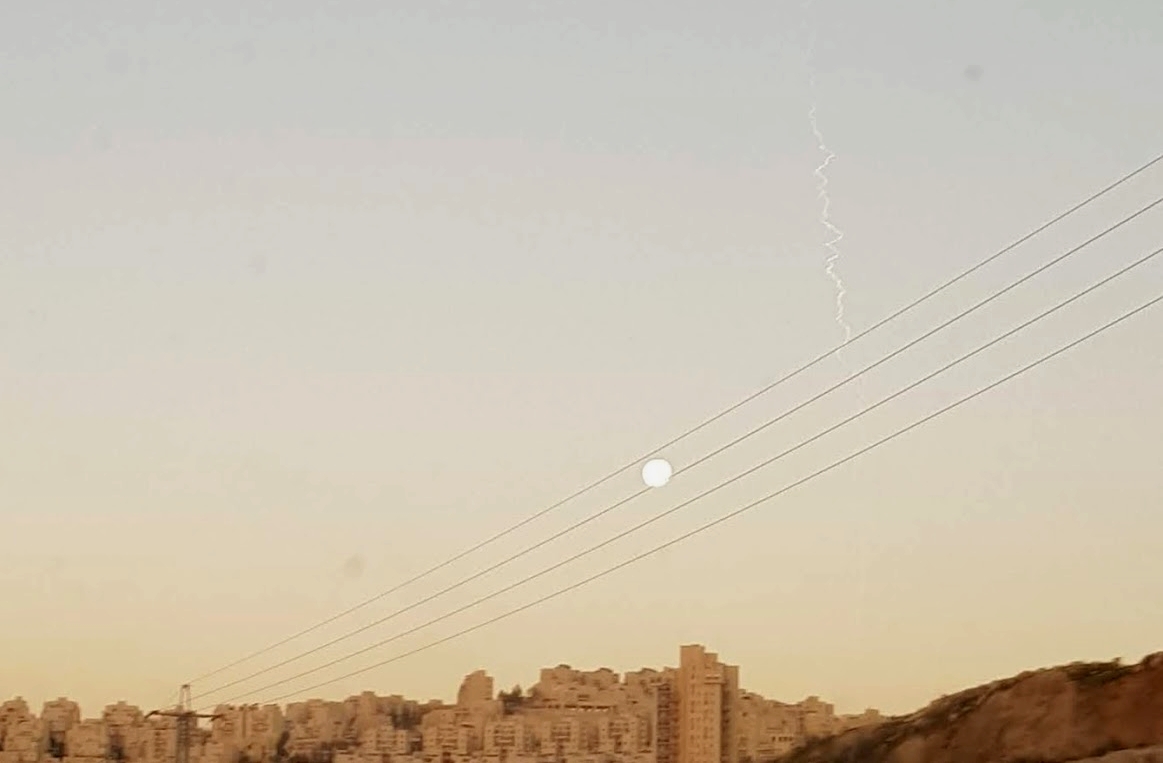
An Israeli-American Arrow 3 test as seen from Jerusalem on the morning of January 22, 2019 (Elie Leshem/Times of Israel)

Israel and the United States carried out a successful test of their advanced Arrow 3 missile defense system early Tuesday morning, the Defense Ministry said.

Shortly before 6:45 a.m., a dummy missile was launched off the coast of Israel that was meant to simulate the type of long-range ballistic missile the Arrow 3 system is designed to intercept.

“Following the launch, the Arrow’s radar spotted the target on its radar array and transferred the data to its fire management center, which analyzed it and fully planned the interception. Once the planning was completed, an Arrow 3 interceptor was fired at the target, which completed its mission with complete success,” the ministry said in a statement.

The test was conducted by the Defense Ministry’s Missile Defense Organization and the US Missile Defense Agency, with assistance from the Israeli Air Force and Israeli Aerospace Industries, which manufactures the Arrow 3.

“This successful test provides confidence in Israel’s capability to protect itself from existing threats in the region.” said MDA director Lt. Gen. Samuel Greaves. “My congratulations to the Israel Missile Defense Organization, the Israeli Air Force, our MDA team, and our industry partners. We are committed to assisting the government of Israel in upgrading its national missile defense capability against emerging threats.”

The Arrow 3 system, a more advanced model of the Arrow and Arrow 2 models, was declared operational in January 2017. The air defense system, developed as a joint project with the US, is designed to shoot down ballistic missiles — like those Israel fears Iran may one day launch at it — while the incoming projectile is still outside the earth’s atmosphere.

“The success of this test presents an important milestone in the operational capabilities of the State of Israel in defending itself against current and future existential threats,” the Defense Ministry said.

The Arrow was launched from the Palmachim air base in central Israel and the trail it left behind was visible from as far away as Jerusalem, owing to the clear morning.

Complemented by a number of other missile defense systems designed to protect Israel from short-, medium- and long-range attacks, the Arrow 3 system represents the highest level of Israel’s multi-tiered missile defense network.

The Arrow 3 was last tested, successfully, in July as part of a broad missile defense exercise that also checked the abilities of the short-range Iron Dome and medium-range David’s Sling.

Before that, the system was successfully tested in February 2018, after months of delays and technical problems. In January, an exercise was called off because of a data transfer problem and in December a test was canceled over safety concerns.

Tuesday’s trial came two days after Israel’s air defense systems were put the test in shooting down a missile fired from Syria at the Israeli Golan Heights. An Iron Dome battery intercepted the incoming projectile, which the Israeli military said was launched by Iranian forces in Syria, apparently in retaliation for a rare daytime strike attributed to Israel on weapons depots in and around Damascus.

Israel responded to the missile attack on the Golan by pounding both Iranian military targets in Syria and the Syrian air defense systems that fired on the attacking Israeli jets on Monday.

Israel has accused Iran of seeking to establish a military presence in Syria that could threaten Israeli security and attempting to transfer advanced weaponry to the Hezbollah terror group in Lebanon.
 

Iranian security official: We’ll remain in Syria as long as we’re asked to

January 22, 2019

Source: Iranian security official: We’ll remain in Syria as long as we’re asked to | The Times of Israel

Member of Tehran’s Supreme National Security Council says his country’s involvement comes at request of Damascus, is aimed at saving innocent lives

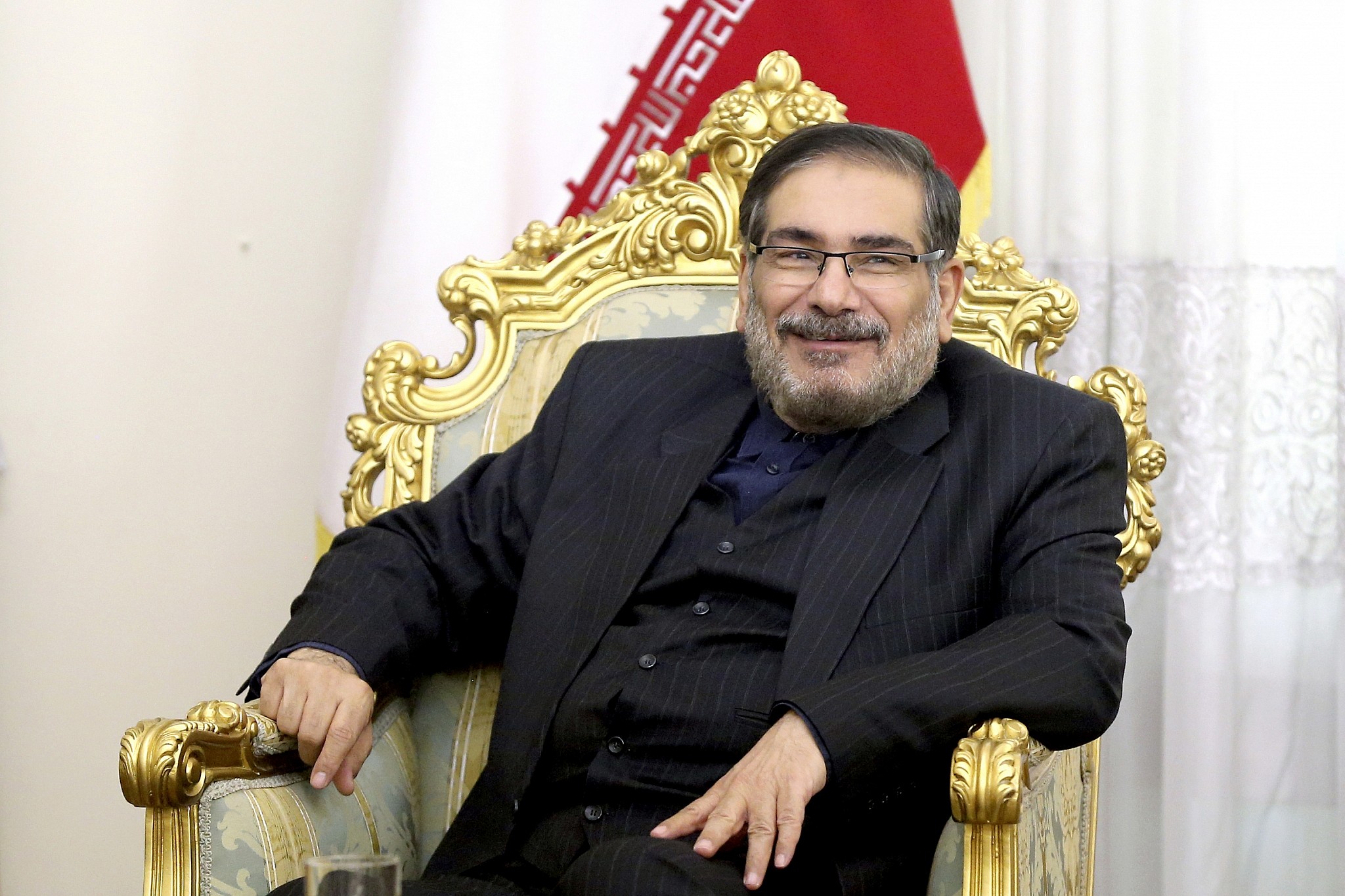
Secretary of Iran's Supreme National Security Council Ali Shamkhani in Tehran, Iran, January 17, 2017.  (Ebrahim Noroozi/AP)

Secretary of Iran’s Supreme National Security Council Ali Shamkhani in Tehran, Iran, January 17, 2017. (Ebrahim Noroozi/AP)

A senior Iranian official said that his country’s military will continue to be involved in Syria as long as the Damascus regime wants its help, the Mehr news agency reported Tuesday.

Ali Shamkhani, a member of Iran’s Supreme National Security Council, made the remarks in an interview published a day earlier by a Tehran-based international relations magazine.

His comments came the same day Israel carried out a series of airstrikes on Iranian military sites in Syria, as well as Syrian air defense units, in response to a rocket fired from Syria at the Israeli Golan Heights, allegedly by Iranian forces. The clash followed a rare daytime strike attributed to Israel on weapons depots in and around Damascus on Sunday.

Israel has accused Iran of seeking to establish a military presence in Syria that could threaten Israeli security and attempting to transfer advanced weaponry to the Hezbollah terror group in Lebanon. Jerusalem has vowed to prevent Iran’s military entrenchment in Syria and has sought help from the US and Russia in getting the Iranians to pull their military out of the country. Russia, along with Iran and its military proxies, are fighting on behalf of the Damascus regime in the country’s civil war, now in its eighth year.
Shamkhani said that as long as the Syrian and Iraqi governments continue to ask for Iran’s help in defeating “terror,” it will provide assistance. The Syrian regime and its allies refer to opposition forces as terrorists.

Instead of “exporting terrorism to Syria” and imposing their own ideas, Western countries should let the Syrian people speak for themselves, he said.

He also criticized US hostility toward Iran’s involvement in the two countries, saying that Tehran was there to defeat the Islamic State terror group and prevent the killing of innocent people.

Shamkhani lamented that while the US condemns Iranian involvement in Syria, it remains silent about Yemen, where airstrikes by a Saudi Arabian-led coalition have reportedly killed thousands of civilians during attacks on Iran-backed Houthi rebels.

Israel responded to Monday’s missile attack on the Golan by pounding both Iranian military targets in Syria and the Syrian air defense systems that fired on its jets.

Amid fears of escalation, Iran’s air force chief said in the hours that followed that his country was “impatient” to eliminate Israel in a war.

In the weeks since US President Donald Trump’s abrupt announcement in December that he will pull US ground forces out of Syria, Israel has become more open in admitting that it carries out raids on Iranian assets in the country, which, it says, destroyed thousands of targets in the last few years.


Monitor: 21 died in Israeli strikes in Syria Monday, 12 of them Iranian fighters 

January 22, 2019

Source: Monitor: 21 died in Israeli strikes in Syria Monday, 12 of them Iranian fighters | The Times of Israel

Syrian Observatory for Human Rights says 6 Syrian soldiers, 3 more foreign nationals among those killed in retaliatory raids after missile attack from Syria on Golan Heights

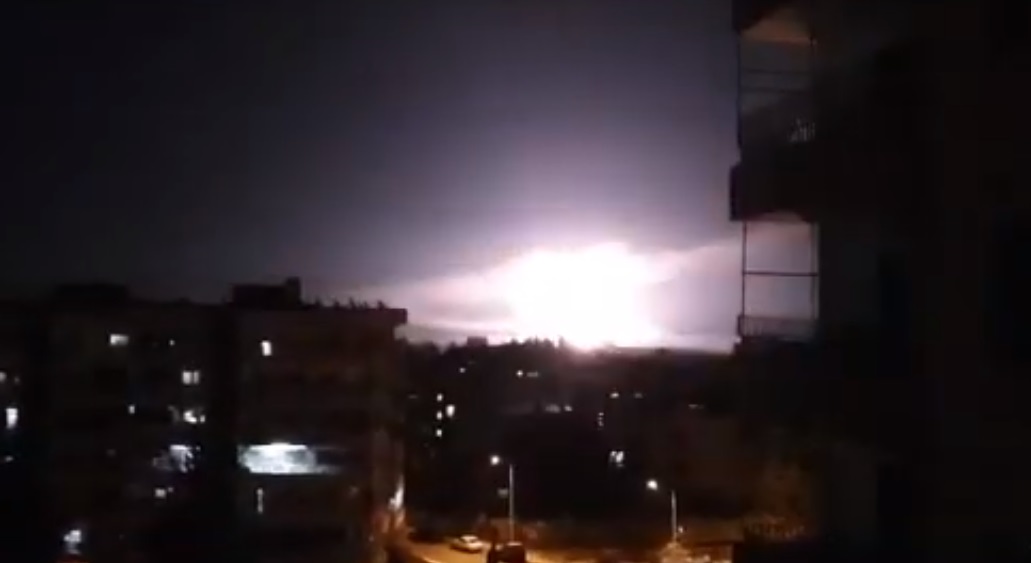
An explosion, reportedly during Israeli airstrikes near Damascus, Syria, on January 21, 2019. (screen capture: YouTube)

An explosion, reportedly during Israeli airstrikes near Damascus, Syria, on January 21, 2019. (screen capture: YouTube)

Twenty-one people were killed in Israeli retaliatory airstrikes in Syria early on Monday, 12 of them members of the Iran’s Revolutionary Guard Corps, a Britain-based Syrian war monitor said Tuesday.

On Sunday, Israel reportedly conducted a rare daylight missile attack on Iranian targets in Syria. In response, Iran fired a surface-to-surface missile at the northern Golan Heights, which was intercepted by the Iron Dome missile defense system over the Hermon ski resort, according to the Israel Defense Forces.

Hours later, in the predawn hours of Monday morning, the Israeli Air Force launched retaliatory strikes on Iranian targets near Damascus and on the Syrian air defense batteries that fired upon the attacking Israeli fighter jets, the army said.

The UK-based Syrian Observatory for Human Rights initially reported the death toll from the Israeli strikes to be 11. But on Tuesday, the war monitor said the number had risen to 21, making it one of the deadliest attacks by Israel in Syria.

According to SOHR, 12 of those killed were members of Iran’s Islamic Revolutionary Guard Corps; six were Syrian military fighters; and the other three were other non-Syrian nationals.

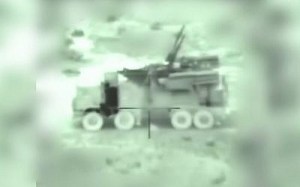
A Syrian mobile anti-aircraft battery vehicle as seen through the targeting camera of an incoming Israeli missile, in footage released by the IDF of its early morning strikes in Syria on January 21, 2019. (IDF)

In July 2018, 22 people, nine of them Iranians, were said to have been killed in an airstrike attributed to Israel on an Iranian-controlled base in northern Syria.

In May 2018, in an air battle sparked by Iran launching dozens of rockets at the Golan, at least 23 fighters were killed in Syria. Eighteen of them were said to be foreigners, though it was not immediately clear how many were Iranians and how many were non-Syrian nationals from elsewhere in the Muslim world fighting in Shiite militias.

Escalating attacks

The IDF said Monday that Iranian troops in Syria launched their missile at the Golan in a “premeditated” attack aimed at deterring Israel from conducting airstrikes against the Islamic Republic’s troops and proxies in Syria.

Israeli troops on Monday were put on high alert in the north.

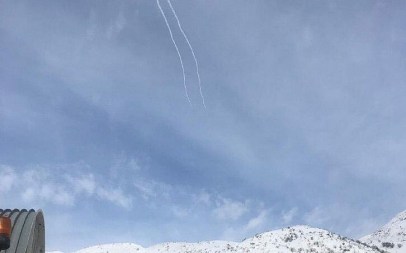
Trails left by the Iron Dome air defense system intercepting a Syrian projectile over Mount Hermon in the Golan Heights, on January 20, 2019. (Israel Defense Forces)

Military spokesperson Jonathan Conricus said the three response sorties destroyed a number of Iranian intelligence sites, training bases and weapons caches connected to the Quds Force, the expeditionary arm of Iran’s Islamic Revolutionary Guard Corps.

According to Conricus, one of the targets of the raids was “the main storage hub for Quds Force.”

On Monday morning, the IDF also released video footage of its airstrikes on Syrian air defenses, including on social media.

Embedded video

צבא ההגנה לישראל

@idfonline

תיעוד מתוך תקיפת חלק מסוללות ההגנה האווירית הסוריות לאחר שביצעו ירי הלילה:

According to Conricus, the Iranian retaliatory strike aimed at the northern Golan was “not a spur-of-the-moment” response, but had been planned months in advance, based on intelligence collected by the IDF.

“We understand that the Iranians are trying to change the context and deter us from our policy and our strategy of fighting Iranian troops in Syria,” Conricus said. “They thought they could change the rules of engagement. Our response was a rather clear one, with a message to Iran and Syria that our policies have not changed.”

He acknowledged that while the military believed it was planned in advance, the trigger for Sunday’s attack was likely the airstrikes reported moments before.

The spokesman said Iran was directly responsible for the launch, and disputed reports that the projectile had been fired by pro-Iranian militias or by the Syrian regime.

Conricus said the location from which the missile was fired was “an area that we have been promised that the Iranians would not be in.”

That assurance appeared to have been made by Russia — Syrian dictator Bashar Assad’s prime ally in the civil war — but Conricus said he “won’t go into who made the promise.”

Israel has reached a number of understandings with Russia about the permitted location of Iranian troops in Syria, mostly about their deployment along the Golan border with Syria.

The IDF spokesperson said the military ultimately holds Syria responsible for the attack and warned that the country would “pay the price” for allowing Iran to establish a permanent military presence in its territory. Iran officially denies having troops in Syria beyond a small number of advisers — a claim that is widely disregarded among Western intelligence officials.

IDF: Iran’s Al Qods aimed the Fateh-110 missile at Golan, which Iron Dome intercepted – DEBKAfile

January 22, 2019

Source: IDF: Iran’s Al Qods aimed the Fateh-110 missile at Golan, which Iron Dome intercepted – DEBKAfile

The ground-to-ground missile aimed at the Golan on Sunday, Jan. 20 was fired by Al Qods and made in Iran, the IDF spokesman said Monday. DEBKAfile: It was a Fateh-110 missile that was launched from a point in the Damascus region which Russia had promised would be kept out of bounds to the Iranians.

The missile was intercepted by Israel’s Iron Dome air defense system. It may be recalled that last year, Russian officials, including Foreign Minister Sergei Lavrov, affirmed that the Iranians had withdrawn deep inside Syrian territory, more than 80km from the Israeli border.

IDF army spokesman Brig. Gen. Manelis said in a statement on Monday, Jan. 21 that Sunday’s missile attack on the Golan was aimed at civilians and carried out by the Iranian command – not local militias.  For the first time, an Israeli military spokesman named the Al Qods Brigades (of the Iranian Revolutionary Guards under the command of Gen. Qassem Soleimani) as being present in the Damascus region. He said the Iranians “had planned the attack in advance for the purpose of deterring Israel from continuing its operations against them,” stressing: “This was an Iranian attempt to attack Israel.” Manolis said that, early Monday, Jan. 21, Israel, in its most extensive offensive hitherto against Iranian sites in Syria, had struck 10 targets, including “an important weapons warehouse” near the civilian section of Damascus International Airport” and, in other locations, an Iranian intelligence site and an Iranian training camp in Syria’s south. Some Iranian military facilities were embedded in Syrian military compounds. A series of secondary explosions was set off.

Manelis said: “We warned the Syrians not to fire anti-aircraft missiles at our planes during the strike and they chose to fire anyway.” The IDF had responded with three waves of air strikes against the Syrian batteries.
DEBKAfile: The IDF spokesman made no mention of Russian involvement in Syria’s air defense operations against Israel. On Monday morning, the Russian army issued the following statement: Syrian air defenses destroyed over 30 cruise missiles and guided bombs when repelling the Israeli air strike. The statement added that 4 Syrian soldiers had been killed in the Israeli attack and 6 injured.


(2) Israel conducts massive bombardment of Iranian targets in Syria – TV7 Israel News 21.01.19 

January 21, 2019


Islamic State targets US convoy in northeast Syria

January 21, 2019

Source: Islamic State targets US convoy in northeast Syria | The Times of Israel

American military official says there are no casualties among US-led coalition forces, but Britain-based monitoring group claims 5 were killed

Screen capture from video provided by Hawar News, ANHA, shows Kurdish fighters standing guard at the site of a suicide attack near the town of Shaddadeh, in Syria's northeastern province of Hassakeh, Syria, January 21, 2019. (ANHA via AP)

Screen capture from video provided by Hawar News, ANHA, shows Kurdish fighters standing guard at the site of a suicide attack near the town of Shaddadeh, in Syria’s northeastern province of Hassakeh, Syria, January 21, 2019. (ANHA via AP)

BEIRUT — An Islamic State suicide bomber targeted a joint convoy of US and allied Kurdish forces in northern Syria on Monday, the second attack against US troops in less than a week.

US military Col. Sean Ryan said there were no casualties among the US-led coalition members. He added: “We can confirm a combined US and Syrian partner force convoy was involved” in the suicide bomb attack.

“We will continue to review the situation and provide updates as appropriate,” he added.

The Kurdish Hawar news agency, based in northern Syria, said Monday’s blast targeted a Syrian Kurdish checkpoint as a coalition convoy was passing near the town of Shaddadeh. It said two Kurdish fighters were lightly wounded in the blast.

The Britain-based Syrian Observatory for Human Rights said the blast killed five people and wounded others.

Monday’s attack came days after a suicide attack killed 16 people, including two US service members and two American civilians, in the northern Syrian town of Manbij. It also came a month after US President Donald Trump announced his intention to withdraw troops from the war-torn country, declaring that IS had been defeated.

Islamic State claimed both attacks in statements carried by its Aamaq news agency.


Iran fires rockets over Mount Hermon. 

January 21, 2019


Israel strikes in Syria in more open assault on Iran

January 21, 2019

Source: Israel strikes in Syria in more open assault on Iran

BEIRUT/JERUSALEM (Reuters) – Israel struck in Syria early on Monday, the latest salvo in its increasingly open assault on Iran’s presence there, shaking the night sky over Damascus with an hour of loud explosions in a second consecutive night of military action.

Damascus did not say what damage or casualties resulted from the strikes. The Syrian Observatory for Human Rights war monitor said 11 people were killed. Syria’s ally Russia said four Syrian soldiers had died and six were wounded.

Israeli Prime Minister Benjamin Netanyahu said the air raid had mostly targeted Iranian forces, but also hit Syrians helping them. “We will strike at anyone who tries to harm us,” he said.

The threat of direct confrontation between arch-enemies Israel and Iran has long simmered in Syria, where the Iranian military built a presence early in the nearly eight year civil war to help President Bashar al-Assad’s government.

Israel, regarding Iran as its biggest threat, has repeatedly attacked Iranian targets in Syria and those of allied militia, including Lebanon’s Hezbollah.

With an election approaching, Israel’s government has begun discussing its strikes more openly, and has also taken a tougher stance towards Hezbollah on the border with Lebanon. It said a rocket attack on Sunday was Iran’s work.

What is believed to be guided missiles are seen in the sky during what is reported to be an attack in Damascus, Syria, January 21, 2019, in this still image taken from a video obtained from social media. Facebook Diary of a Mortar Shell in Damascus/Youmiyat Qadifat Hawun fi Damashq/via REUTERS

The Israeli shift comes a month after U.S. President Donald Trump unexpectedly announced a sudden plan to pull the 2,000 U.S. troops from Syria, a move long sought by Assad and his Russian and Iranian allies. Trump’s decision shocked American allies in the region and was opposed by top U.S. officials including Defense Secretary Jim Mattis who quit in response.

The Israeli military said its fighter jets had attacked Iranian “Quds Force” targets early on Monday, including munition stores, a position in the Damascus International Airport, an intelligence site and a military training camp. Its jets then targeted Syrian defence batteries after coming under fire.

It followed a previous night of cross-border fire, which Israel said began when Iranian troops fired an Iranian-made surface-to-surface missile from an area near Damascus at a ski resort in the Israeli-occupied Golan Heights.

Syria said it was Israel that had attacked and its air defences had repelled the assault. Syria had endured “intense attack through consecutive waves of guided missiles”, but had destroyed most “hostile targets”, state media quoted a military source as saying.

The Russian defence ministry said Syrian air defences, supplied by Russia, had destroyed more than 30 cruise missiles and guided bombs, according to RIA news agency.

In Tehran, airforce chief Brigadier General Aziz Nasirzadeh said Iran was “fully ready and impatient to confront the Zionist regime and eliminate it from the earth”, according to the Young Journalist Club, a website supervised by state television.

Assad has said Iranian forces are welcome to stay in Syria after years of military victories that have brought most of the country back under his control. Just two big enclaves are still outside Assad’s grip, including the area Trump plans to exit.

Netanyahu, who is hoping to win a fifth term in the April 9 election, last week told his cabinet Israel has carried out “hundreds” of attacks over recent years.

“We have a permanent policy, to strike at the Iranian entrenchment in Syria and hurt whoever tries to hurt us,” he said on Sunday.

“EVERY LAST BOOT”

The Israeli military distributed footage of what it said were missiles hitting the Syrian defence batteries, as well as satellite images showing the location of the alleged Iranian targets. Syrian state media showed footage of explosions.

In a highly publicised operation last month, the Israeli military uncovered and destroyed cross-border tunnels from Lebanon it said were dug by Hezbollah to launch future attacks.

Israel last fought a war with Hezbollah, on Lebanese soil, in 2006. It fears Hezbollah has used its own role fighting alongside Iran and Assad in Syria to bolster its military capabilities, including an arsenal of rockets aimed at Israel.

Tensions have also risen with Israel’s construction of a frontier barrier that Lebanon says passes through its territory.

Washington has sought to reassure allies it still aims to eject Iran from Syria despite pulling its own troops out. U.S. Secretary of State Mike Pompeo, who visited the region this month, has vowed to expel “every last Iranian boot” from Syria.

Israel has sought reassurances from Moscow that Iranian forces in Syria would not be a threat. Israeli military spokesman Lieutenant Colonel Jonathan Conricus said the missile fired at the ski resort was launched from “an area we were promised the Iranians would not be present in”.

(The refiled story fixes ‘tried’ to ‘tries’ in paragraph three.)

Reporting by Ellen Francis in Beirut, Ari Rabinovitch and Dan Williams in Jerusalem and Maria Kiselyova in Moscow; writing by Angus McDowall; Editing by Nick Macfie and Raissa Kasolowsky

Off Topic: New Norwegian government calls for closer ties with Israel, condemns BDS

January 21, 2019

Source: New Norwegian government calls for closer ties with Israel, condemns BDS – Arab-Israeli Conflict – Jerusalem Post

“The Norwegian government does not see boycott of Israel as a contribution to dialogue, understanding and a peaceful development in the Middle East.”

BY HERB KEINON
 JANUARY 21, 2019 15:27
Norwegian Prime Minister Erna Solberg

Israel’s relations with Norway, which improved significantly in 2013 with the election of a center-right government, are likely to improve even more following a reshuffling on Thursday, said Conrad Myrland, head of a pro-Israel group in the country.

The coalition government of Erna Solberg was expanded on Thursday with the addition of the small Christian-Democratic Party. Solberg was quoted as calling the formation of the government a “historic day,” since it marks the first time since 1985 that Norway would be ruled by a non-socialist majority government.

Reelected in 2017, Solberg has governed with minority governments since 2013, meaning she has needed the opposition parties to pass legislation. This will no longer be the case.

Though foreign policy was not the reason for bringing in the new party, Myrland – whose organization With Israel for Peace (Med Israel for Fred), the largest non-religious, pro-Israel organization in Norway – said the Christian Democrats now headed by a pro-Israel leader named Kjell Ingolf Ropstad have inserted some pro-Israel paragraphs in the new government guidelines.

The government guidelines calls for Norway to have “a balanced attitude to the Middle East-conflict, actively support the goal of Israel and Palestine as two states within secure and international recognized borders, and support democratic development in the Middle East.”

Myrland said the paragraph is not new, and that something similar appeared in the previous government guidelines. What is new, he said, is a clause calling for the government to “lay the ground for strengthened research and development cooperation, trade, tourism and cultural exchange with Israel. The government does not see boycott of Israel as a contribution to dialogue, understanding and a peaceful development in the Middle East.”

Furthermore, the guidelines call for the government to “mark a clear critical stand against all form of antisemitism and actively work against economic contributions to terrorism, including reward of prisoners.”

In the chapter about international aid, the platform said the “government will not support organizations that encourages violence or promote hateful expressions, racism or antisemitism, specifically in the Palestinian areas.”

Myrland called these additions to the government guidelines a “further step in the right direction” toward Israel that began with Solberg’s election in 2013.

Norway has for years been a major donor to the Palestinians, and chairs the Ad Hoc Liaison Committee that is the main coordination mechanism for development assistance to them.


Defense site: Iran has a stronger military than Israel 

January 21, 2019

Source: Defense site: Iran has a stronger military than Israel – Arab-Israeli Conflict – Jerusalem Post

GlobalFirePower ranks Iran as 13th strongest military and placed Israel as 16th, below Brazil and Indonesia.

BY ANNA AHRONHEIM
 JANUARY 21, 2019 15:26
Defense site: Iran has a stronger military than Israel

Israel’s military has slipped below its arch-nemesis Iran in the ranking of military powers, ranking 16 out of 137 countries, according to the international defense site Global Firepower (GFP).

It was the third year in a row that Israel fell in the site’s ranking, falling one spot from the previous year and down five spots when it ranked 11th in 2016. Iran, meanwhile, climbed to 13th in 2018 from 20th in 2017.

According to the defense site, it only takes conventional military capabilities into account when compiling and factors in another 55 criteria, such as the range of weapons in its arsenal, amount of available manpower, abilities of the local defense industries, as well as natural resources, geographical size and economic strength.

“The unique, in-house formula allows for smaller, more technologically-advanced nations to compete with larger, though lesser-developed ones,” the site said, adding that “a perfect PwrIndex (Power Index) score is 0.0000 which is realistically unattainable in the scope of the GFP formula.”

The site also allows for one to compare two specific countries against each other, showing military data such as total manpower available, active personnel, total amount of reservists, and total military personnel. The site also shows the total amount of arms such as aircraft, tanks, naval assets as well as artillery strength.

A comparison between Iran and Israel shows that while Iran has significantly more naval assets than Israel (398 versus 65), Iran has a total coastline of 2,440 km. compared to Israel’s 273 km.

Israel has far greater tank strength (2,760 assets versus 1,650) and has some 10,575 armored fighting vehicles, compared to Iran’s 2,215. The total amount of aircraft between the two countries are close, with Israel having 596 aircraft versus Iran’s 505.

According to the site, Israel’s total military personnel stands at 615,000, compared to Iran’s 934,000. But Iran’s total population is significantly larger than Israel, with 82 million people versus Israel’s 8.3 million people. Jerusalem meanwhile has a defense budget of $20 billion versus Tehran’s budget of $6.3 billion. The United States topped the defense site’s list as the strongest military force, followed by Russia and China in second and third places, respectively. India placed fourth, followed by France and the United Kingdom.

In the Middle East, while Israel was outranked by Iran, Egypt (12) and Turkey (9), it continued to outrank other countries in the region, including Saudi Arabia (26), Syria (49), Jordan (76) and Lebanon (106).

While the Jewish state placed higher than other Western countries, like Canada (25) and Poland (22), it nevertheless ranked below Germany (10), Italy (11) Brazil (14) and Indonesia (15).