Archive for January 29, 2019

Tikun olam. Repairing the world in spite of it all.

January 29, 2019

A cure for cancer? Israeli scientists say they think they found one

“We believe we will offer in a year’s time a complete cure for cancer.”

By Maayan Jaffe-Hoffman
January 28, 2019 23:14

A small team of Israeli scientists think they might have found the first complete cure for cancer.

“We believe we will offer in a year’s time a complete cure for cancer,” said Dan Aridor, of a new treatment being developed by his company, Accelerated Evolution Biotechnologies Ltd. (AEBi), which was founded in 2000 in the ITEK incubator in the Weizmann Science Park. AEBi developed the SoAP platform, which provides functional leads to very difficult targets.

“Our cancer cure will be effective from day one, will last a duration of a few weeks and will have no or minimal side-effects at a much lower cost than most other treatments on the market,” Aridor said. “Our solution will be both generic and personal.”
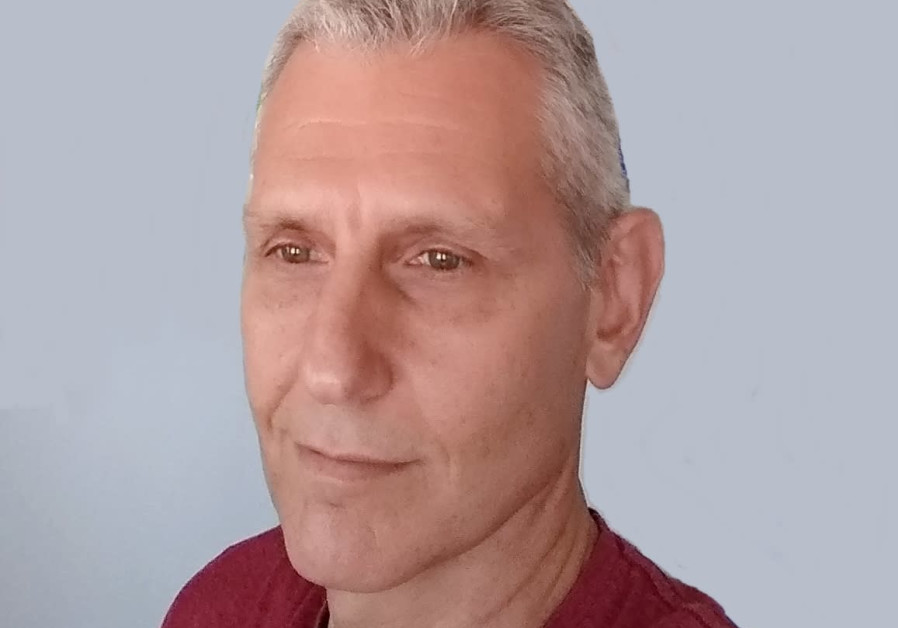
Dr. Ilan Moran (Courtesy)Dr. Ilan Moran (Courtesy)

It sounds fantastical, especially considering that an estimated 18.1 million new cancer cases are diagnosed worldwide each year, according to reports by the International Agency for Research on Cancer. Further, every sixth death in the world is due to cancer, making it the second leading cause of death (second only to cardiovascular disease).

Aridor, chairman of the board of AEBi and CEO Dr. Ilan Morad, say their treatment, which they call MuTaTo (multi-target toxin) is essentially on the scale of a cancer antibiotic – a disruption technology of the highest order.

The potentially game-changing anti-cancer drug is based on SoAP technology, which belongs to the phage display group of technologies. It involves the introduction of DNA coding for a protein, such as an antibody, into a bacteriophage – a virus that infects bacteria. That protein is then displayed on the surface of the phage. Researchers can use these protein-displaying phages to screen for interactions with other proteins, DNA sequences and small molecules.

In 2018, a team of scientists won the Nobel Prize for their work on phage display in the directed evolution of new proteins – in particular, for the production of antibody therapeutics.

AEBi is doing something similar but with peptides, compounds of two or more amino acids linked in a chain. According to Morad, peptides have several advantages over antibodies, including that they are smaller, cheaper, and easier to produce and regulate.

When the company first started, Morad said, “We were doing what everyone else was doing, trying to discover individual novel peptides for specific cancers.” But shortly thereafter, Morad and his colleague, Dr. Hanan Itzhaki, decided they wanted to do something bigger.

To get started, Morad said they had to identify why other cancer-killing drugs and treatments don’t work or eventually fail. Then, they found a way to counter that effect.

For starters, most anti-cancer drugs attack a specific target on or in the cancer cell, he explained. Inhibiting the target usually affects a physiological pathway that promotes cancer. Mutations in the targets – or downstream in their physiological pathways – could make the targets not relevant to the cancer nature of the cell, and hence the drug attacking it is rendered ineffective.

In contrast, MuTaTo is using a combination of several cancer-targeting peptides for each cancer cell at the same time, combined with a strong peptide toxin that would kill cancer cells specifically. By using at least three targeting peptides on the same structure with a strong toxin, Morad said, “we made sure that the treatment will not be affected by mutations; cancer cells can mutate in such a way that targeted receptors are dropped by the cancer.”

“The probability of having multiple mutations that would modify all targeted receptors simultaneously decreases dramatically with the number of targets used,” Morad continued. “Instead of attacking receptors one at a time, we attack receptors three at a time – not even cancer can mutate three receptors at the same time.”

Furthermore, many cancer cells activate detoxification mechanisms when in stress from drugs. The cells pump out the drugs or modify them to be non-functional. But Morad said detoxification takes time. When the toxin is strong, it has a high probability of killing the cancer cell before detoxification occurs, which is what he is banking on.

Many cytotoxic anticancer treatments aim at fast-growing cells. But cancer stem cells are not fast growing, and they can escape these treatments. Then, when the treatment is over, they can generate cancer again.

“If it does not completely annihilate the cancer, the remaining cells can start to get mutations again, and then the cancer comes back, but this time it is drug resistant,” Morad said.

He explained that because cancer cells are born out of mutations that occur in cancer stem cells, most of the overexpressed proteins which are targeted on the cancer cell exist in the cancer stem cells. MuTaTo’s multiple-target attack ensures that they will be destroyed as well.

Finally, some cancer tumors erect shields which create access problems to large molecules, such as antibodies. MuTaTo acts like an octopus or a piece of spaghetti and can sneak into places where other large molecules cannot reach. Morad said the peptide parts of MuTaTo are very small (12 amino acids long) and lack a rigid structure.

“This should make the whole molecule non-immunogenic in most cases and would enable repeated administration of the drug,” he said.

Morad said their discovery could also reduce the sickening side-effects of most cancer treatments, which stem from drug treatments interacting with the wrong or additional targets, or the correct targets but on non-cancerous cells. He said MuTaTo’s having a combination of several highly specific cancer-targeting peptides on one scaffold for each type of cancer cell would increase the specificity to the cancer cell due to the avidity effect. In addition, in most cases, the non-cancer cells that have a protein in common with the cancer cells do not overexpress it.

“This makes a great difference between the two kinds of cells and should decrease the side effects dramatically,” Morad said.

He equated the concept of MuTaTo to the triple drug cocktail that has helped change AIDS from being an automatic death sentence to a chronic – but often manageable – disease.

Today, AIDS patients take protease inhibitors in combination with two other drugs called reverse transcriptase inhibitors. The drug combination disrupts HIV at different stages in its replication, restrains an enzyme crucial to an early stage of HIV duplication and holds back another enzyme that functions near the end of the HIV replication process.

“We used to give AIDS patients several drugs, but we would administer them one at a time,” Morad explained. “During the course of treatment, the virus mutated, and the AIDS started attacking again. Only when patients started using a cocktail, were they able to stop the disease.”

Now, he said, people with AIDS are HIV carriers, but they are not sick anymore.

The MuTaTo cancer treatment will eventually be personalized. Each patient will provide a piece of his biopsy to the lab, which would then analyze it to know which receptors are overexpressed. The individual would then be administered exactly the molecule cocktail needed to cure his disease.
However, unlike in the case of AIDS, where patients must take the cocktail throughout their lives, in the case of MuTaTo, the cells would be killed, and the patient could likely stop treatment after only a few weeks.

The company is now writing patents on specific peptides, which will be a large bank of targeting toxin peptides wholly owned and hard to break, said Aridor.

Morad said that so far, the company has concluded its first exploratory mice experiment, which inhibited human cancer cell growth and had no effect at all on healthy mice cells, in addition to several in-vitro trials. AEBi is on the cusp of beginning a round of clinical trials which could be completed within a few years and would make the treatment available in specific cases.
Aridor added: “Our results are consistent and repeatable.”

H/T PG

Netanyahu: Bible is the ‘foundation for Israel’s eternity’ – TV7 Israel News 29.01.19

January 29, 2019


Iran: Proxies in Lebanon, Gaza will respond with hellfire to Israeli attacks

January 29, 2019

Source: Iran: Proxies in Lebanon, Gaza will respond with hellfire to Israeli attacks

Close aide of Khamenei claims country will continue supplying ancilliaries with high-precision weapons to counter Israel’s ‘acts of stupidity’; says slow discovery of Hezbollah terror tunnels brings ‘shame to the Zionist entity’s intelligence capabilities.’
Iran will continue supplying high-precision missiles to its proxies in Lebanon and Gaza so they would be able to respond to Israel’s “acts of stupidity with hellfire” said the country’s Supreme National Security Council Secretary Ali Shamkhani on Tuesday.The remarks come in the wake of a massive aerial bombardment launched by Israel Air Force on Iranian targets in Syria last Monday, which came in response to the surface-to-surface rocket launched at Israeli territory by Iranian Quds Force and intercepted by the Iron Dome a day earlier.

Shamkhani, a close aide to Iran’s Supreme Leader Ayatollah Ali Khamenei, also dismissed the success of Israeli military operation meant to expose and destroy the Hezbollah terror tunnels dug along the Israel-Lebanon border.

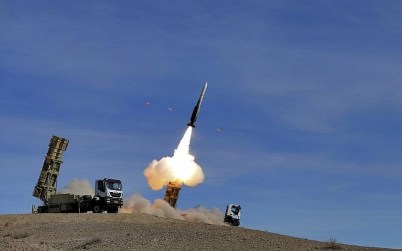
Iran's Fateh-110 missiles

Iran’s Fateh-110 missiles

“There is no greater shame to the Zionist entity, which claims to have superior intelligence capabilities, than the fact that tunnels—hundreds of kilometers long—had been dug under this entity’s nose, and the fact that one of their ministers turned an Iranian spy,” he said referring to former minister Gonen Segev, who was found guilty of spying on Israel for Iran and will serve 11 years in prison.

Speaking at the National Conference on Space Technologies, Shamkhani added that Iran would keep working to improve the accuracy of its missiles arsenal despite the international pressure, but has no plans to increase their range.

“Iran has no scientific or operational restriction for increasing the range of its military missiles, but based on its defensive doctrine, it is continuously working on increasing the precision of the missiles,” Shamkhani said.

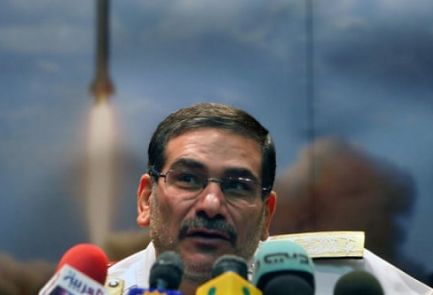
Supreme National Security Council Secretary Ali Shamkhani  (Photo: Reuters)

Supreme National Security Council Secretary Ali Shamkhani (Photo: Reuters)

A UN Security Council resolution that accompanied the 2015 nuclear deal called upon Tehran to refrain for up to eight years from work on ballistic missiles designed to deliver nuclear weapons. But Iran said that call did not amount to a binding order and has denied that its missiles are capable of carrying nuclear warheads.

Washington has also told Tehran to stop developing its satellite-launching technology, saying it was concerned that the same techniques could also be used to launch warheads.

Hassan Nasrallah

Hassan Nasrallah

Last week, Hassan Nasrallah, the leader of the Iran-backed Hezbollah, warnedthat the “resistance axis” — as the group refers to itself, Iran and Syria — might change their reaction to Israeli strikes in Syria, including with a bombardment of Tel Aviv.

Nasrallah added that it’s in the interest of Israeli citizens for the terror group to continue developing precision-guided missiles capabilities. “I want to say something to the people of Israel: It’s in your interest to tell Netanyahu to allow Hezbollah to develop accurate missiles. If the missile is accurate, it will hit the military bases in the heart of Tel Aviv, and not your home,” the 58-year-old leader said.


Off Topic:  Anti-Israel protest again sparks controversy at LGBTQ conference 

January 29, 2019

Source: Anti-Israel protest again sparks controversy at LGBTQ conference – American Politics – Jerusalem Post

JTA obtained video of the event, at which speakers led chants of “From the river to the sea, Palestine will be free” and “From Palestine to Mexico, all the walls have got to go.”

BY BEN SALES/JTA
 JANUARY 29, 2019 05:07
LGBT

 An anti-Israel protest has again led to controversy at Creating Change, an LGBTQ conference that was the site of a raucous anti-Israel protest in 2016.
At the opening of this year’s conference, organized by the National LGBTQ Task Force, a group of activists holding Palestinian flags took the stage unannounced and led a 13-minute protest for Palestinian liberation and against Zionism. The speakers were not interrupted or asked to leave by the event organizers.
JTA obtained video of the event, at which speakers led chants of “From the river to the sea, Palestine will be free” and “From Palestine to Mexico, all the walls have got to go.”
The conference took place from Jan. 23 to 27 in Detroit.
The first speaker of the protest, who did not give their name, said the conference did not include pro-Palestinian programming because it could upset donors. The speaker invoked Rep. Rashida Tlaib, the Michigan Democrat who is the first Palestinian-American woman elected to Congress.
“In a state that elected the first Palestinian woman to the US Congress, there is still a ban on Palestine at Creating Change, because the Task Force is afraid that people are going to come here to seek their full liberation, and donors might get mad,” the speaker said. “Right now, our content is being censored, our liberation is being silenced and our voices are being shut down because the Task Force is too cowardly to have a conversation on one of the leading social justice issues of our time: Palestinian freedom.”
The second speaker of the protest, Mina Aria, called on the Task Force to fight “pinkwashing, Zionism, Islamophobia and colonial violence.” Pinkwashing is a term that connotes what critics see as Israel’s covering up of human rights abuses by trumpeting its LGBTQ-friendly policies.
JTA has called and emailed the Task Force for comment. On Sunday, the group wrote in a Facebook post that it “firmly condemns anti-Semitism. We firmly condemn Islamophobia. We firmly condemn attacks on each other’s humanity. The perpetuation of white supremacy is harmful to all. There are a number of misunderstandings and misinformation being thrown around.”
Tye Gregory, executive director of A Wider Bridge, a pro-Israel LGBTQ group that also advocates for LGBTQ rights within Israel, said the Task Force’s staff “either don’t have the core competence to fix this problem or don’t care what we have to say.”
“When you say Israel and Zionism are the problem, you’re directly implicating other attendees at the conference and stirring up hate,” Gregory told JTA. “I want to make sure those in the Jewish community and those who care about Israel outside the Jewish community have a welcoming space.”
The protest this year recalled a similar one at the same conference in 2016, when pro-Palestinian activists tried to disrupt a Shabbat service hosted by A Wider Bridge. The protesters chanted “Hey hey, ho ho, pinkwashing has got to go.”
The first speaker at the protest this year also criticized the Anti-Defamation League, saying it has “committed acts of severe violence against the queer and trans liberation movement.” The speaker also claimed that the ADL spied on gay rights groups in the 1980s.
The ADL did not comment by publication time.


Netanyahu: Israel thwarts Iranian cyber attacks ‘daily’

January 29, 2019

Source: Netanyahu: Israel thwarts Iranian cyber attacks ‘daily’ – Israel Elections – Jerusalem Post

Netanyahu also touched on the vulnerability of airlines, saying they can be attacked in “one hundred [different] ways.”

BY YONAH JEREMY BOB
 JANUARY 29, 2019 11:52
  Benjamin Netanyahu at the CyberTech conference in Tel Aviv

Prime Minister Benjamin Netanyahu said Iran attempts cyber attacks on Israeli infrastructure “daily” only to be thwarted by the Jewish state.

“Iran attacks Israel on a daily basis,” he said at the Cybertech conference in Tel Aviv on Tuesday. “We monitor these attacks, see the attacks and thwart the attacks. In the last 24 hours, Iran has said it will destroy us and target our cities with missiles. They don’t impress us because we know our power in defense and offense.”

Netanyahu also touched on the vulnerability of airlines, saying they can be attacked in “one hundred [different] ways.”

Cyber attacks on aircraft can come via “ground control, interference, systems within the plane and communications. It is the most vulnerable system we have – dramatically vulnerable. But everything today is vulnerable and under attack.”

The prime minister also listed a range of statistics highlighting Israeli achievements in the cyber arena.

He said that all top global technology companies have major offices now in Israel, with some of those offices exceeding the size of their original headquarters in their home countries.

Netanyahu said that Israel’s strength comes from “leveraging our defense industry into the civilian cyber security sector.”

With 20% of the world’s investments in cyber security, Israel is now number two in the number of cyber security companies it hosts, Netanyahu added.

Another detail that Netanyahu added was that despite the fact that the US is 42 times larger than Israel, the US’s National Security Agency is less than 10 times bigger than Israel’s.

Finally, Netanyahu said that a key to rapid Israeli cyber growth is limiting regulation in order to avoid limits on creativity and international cooperation.


Iran: ‘Our missiles in Gaza, Lebanon ready to retaliate’ against Israel 

January 29, 2019

Source: Iran: ‘Our missiles in Gaza, Lebanon ready to retaliate’ against Israel – Israel Hayom


Netanyahu said set to deliver speech at Warsaw conference on Iran

January 29, 2019

Source: Netanyahu said set to deliver speech at Warsaw conference on Iran | The Times of Israel

The PM will speak out strongly against Tehran at the US-organized summit next month, report says

Prime Minister Benjamin Netanyahu speaks during a handover ceremony for the new IDF chief of staff, on January 15, 2019, in Tel Aviv. (Jack Guez/AFP)

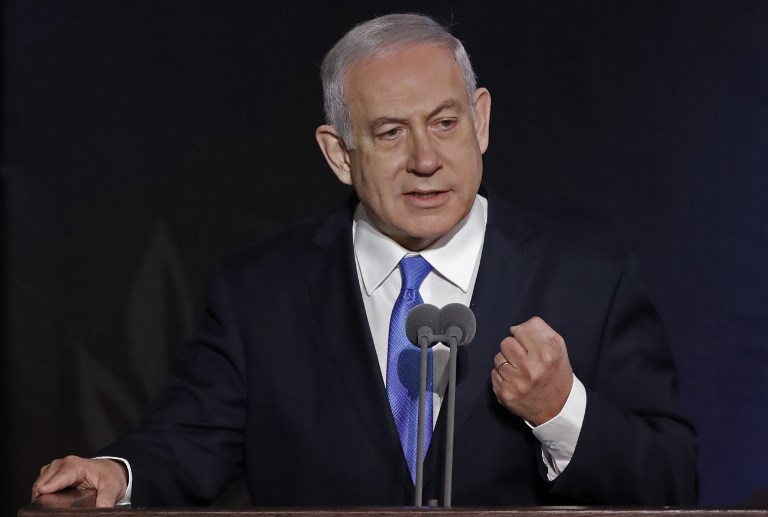
Prime Minister Benjamin Netanyahu speaks during a handover ceremony for the new IDF chief of staff, on January 15, 2019, in Tel Aviv. (Jack Guez/AFP)

Prime Minister Benjamin Netanyahu is set to give a speech at a US-Polish conference on the Middle East and Iran, in Warsaw next month, where he will speak out strongly against Iran, Channel 13 news reported Monday.

Netanyahu is expected to be a main speaker at the event organized by US Secretary of State Mike Pompeo, the report said. Also attending will be representatives of Gulf nations including Saudi Arabi, the United Arab Emirates, Kuwait and Oman.

Iran and the Palestinian Authority have not been invited.

The summit was originally billed as focused on the Iranian threat. However, with Russia and China subsequently vowing to skip the event and many European nations wary of sending senior representatives, US officials are now saying it will focus on Middle East challenges in general, “Iran’s destructive policies in the region” among them.

The conference, which Pompeo said will draw ministers from around the world, comes almost exactly as Iran marks 40 years since its Islamic Revolution and after the United States reimposed sweeping sanctions on the country.

Iran summoned a Polish diplomat to protest the conference, which it called a hostile act.

A Polish official said that, despite serving as co-host, Poland still supports the international agreement on Iran’s nuclear program from which US President Donald Trump withdrew last year.


Iran and Syria agree to boost cooperation, in ‘message to world’ 

January 29, 2019

Source: Iran and Syria agree to boost cooperation, in ‘message to world’ | The Times of Israel

Defying push against Iranian entrenchment, Damascus agrees to give Tehran benefits to help rebuild war-torn country, rehabilitate ports, develop oil sector and more

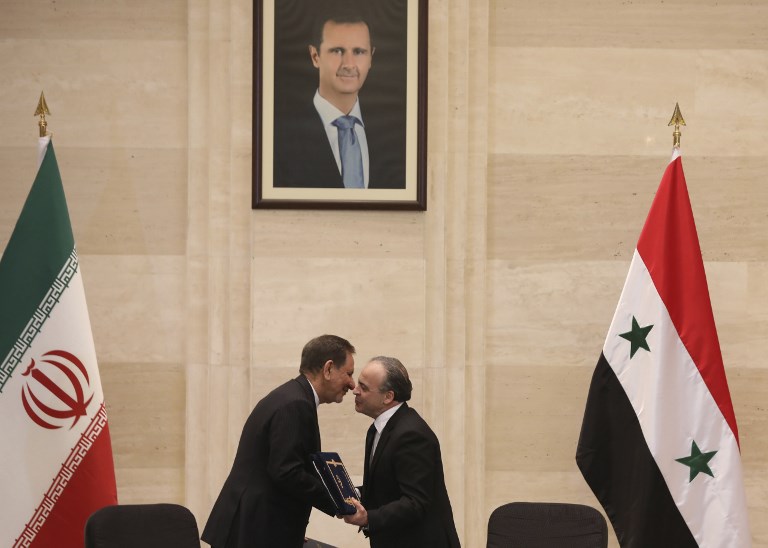
Syrian Prime Minister Imad Khamis, right, and Iranian Vice President Eshaq Jahangiri shake hands after the signing of an agreement in the capital Damascus on January 28, 2019. (LOUAI BESHARA / AFP)

Syrian Prime Minister Imad Khamis, right, and Iranian Vice President Eshaq Jahangiri shake hands after the signing of an agreement in the capital Damascus on January 28, 2019. (LOUAI BESHARA / AFP)

DAMASCUS, Syria — Syria and Iran signed 11 agreements and memoranda of understanding late Monday, including a “long-term strategic economic cooperation” deal aimed at strengthening cooperation between Damascus and one of its key allies in the civil war that has torn the country apart.

The agreements covered a range of fields including economy, culture, education, infrastructure, investment and housing, the official SANA news agency reported.

They were signed during a visit to Damascus by Iran’s First Vice President Eshaq Jahangiri.

Syrian Prime Minister Imad Khamis said it was “a message to the world on the reality of Syrian-Iranian cooperation”, citing “legal and administrative facilities” to benefit Iranian companies wishing to invest in Syria and contribute “effectively to reconstruction.”

The agreements included two memos of understanding between the railway authorities of the two countries as well as between their respective investment promotion authorities.

In relation to infrastructure, there was also rehabilitation of the ports of Tartus and Latakia as well as construction of a 540 megawatt energy plant, according to Khamis.

In addition there were “dozens of projects in the oil sector and agriculture,” he added.

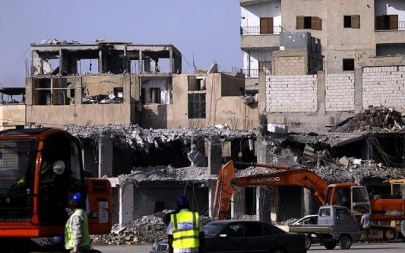
The civil war has taken an enormous toll on the Syrian economy and infrastructure, with the cost of war-related destruction estimated by the UN at about $400 billion.

Bulldozers clears debris in the Syrian city of Raqqa on October 18, 2018. (Delil Souleiman/AFP)

Iran will stand “alongside Syria during the next phase that will be marked by reconstruction,” Jahangiri promised.

Iran and Syria had already signed a military cooperation agreement in August while Tehran has supported Damascus economically during the conflict through oil deliveries and several lines of credit.

The new agreements come against the backdrop of fresh US sanctions against Iran, while Syrian President Bashar Assad’s regime and several Syrian businesspeople and companies are already on US and European blacklists.

They also come as Israel has repeatedly pledged to keep arch-foe Iran from entrenching itself militarily in Syria, where the war has already claimed more than 360,000 lives and displaced several million people.


US charges Huawei with stealing trade secrets, violating Iran sanctions

January 29, 2019

Source: US charges Huawei with stealing trade secrets, violating Iran sanctions | The Times of Israel

Justice Dept. alleges Chinese corporate giant tried to steal tech from T-Mobile; US seeks to extradite CFO from Canada for allegedly doing business with Tehran via Hong Kong

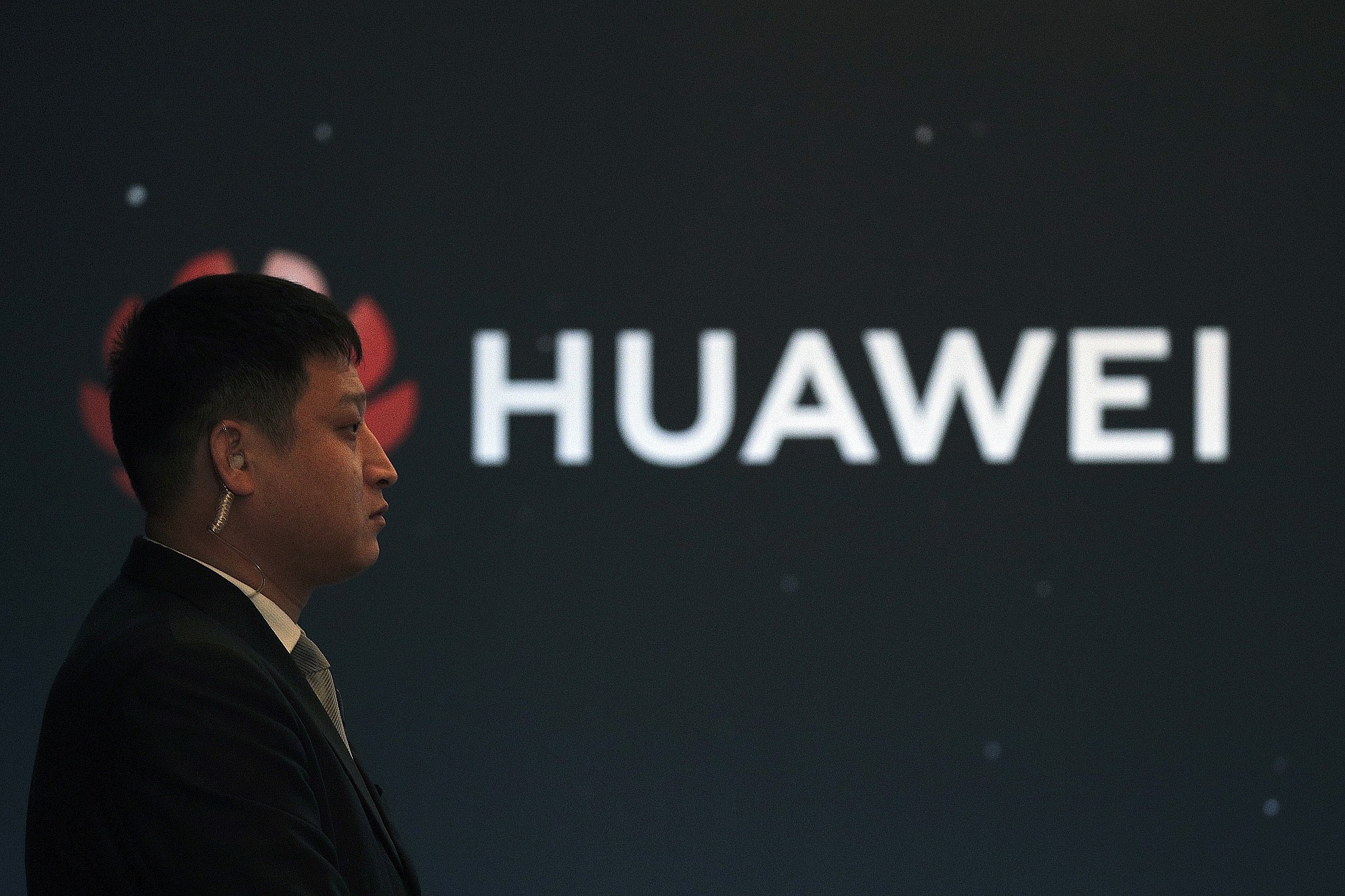
In this Jan. 9, 2019, photo, a security guard stands near the Huawei company logo during a new product launching event in Beijing (AP Photo/Andy Wong)

In this Jan. 9, 2019, photo, a security guard stands near the Huawei company logo during a new product launching event in Beijing (AP Photo/Andy Wong)

WASHINGTON (AP) — The Justice Department unsealed criminal charges Monday against Chinese tech giant Huawei, a top company executive and several subsidiaries, alleging the company stole trade secrets, misled banks about its business and violated US sanctions.

In a statement, Huawei denied committing any of the violations cited in the indictment.

The charges were announced just before a crucial two-day round of trade talks between the United States and China are scheduled to begin in Washington. Trade analysts say they could dim prospects for a breakthrough.

The sweeping indictments accuse the company of using extreme efforts to steal trade secrets from American businesses — including trying to take a piece of a robot from a T-Mobile lab.

The executive charged is Huawei’s chief financial officer, Meng Wanzhou, who was arrested in Canada last month. The US is seeking to extradite her, alleging she committed fraud by misleading banks about Huawei’s business dealings in Iran.

David Martin, Meng’s lawyer in Canada, didn’t immediately respond to messages seeking comment. Meng is out on bail in Vancouver and her case is due back in court Tuesday as she awaits extradition proceedings to begin.

Huawei is the world’s biggest supplier of network gear used by phone and internet companies and has long been seen as a front for spying by the Chinese military or security services.

“The company denies that it or its subsidiary or affiliate have committed any of the asserted violations of US law set forth in each of the indictments,” the company statement said. Huawei is “not aware of any wrongdoing by Ms. Meng,” it added, “and believes the US courts will ultimately reach the same conclusion.”

Prosecutors say Huawei did business in Iran through a Hong Kong company called Skycom and Meng misled US banks into believing the two companies were separate.

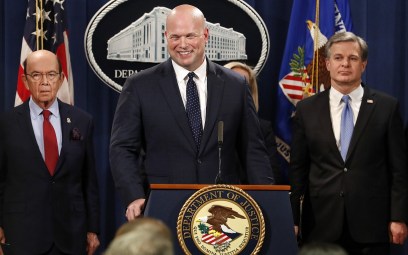
Acting Attorney General Matthew Whitaker, center, smiles at a question from a reporter after an announcement of an indictment of Chinese telecommunications companies including Huawei, on violations including bank and wire fraud, Jan. 28, 2019, at the Justice Department in Washington (AP Photo/Jacquelyn Martin)

“As I told high-level Chinese law enforcement officials in August, we need more law enforcement cooperation with China,” acting Attorney General Matt Whitaker said at a news conference with other Cabinet officials, including Commerce Secretary Wilbur Ross and Homeland Security Secretary Kirstjen Nielsen. “China should be concerned about criminal activities by Chinese companies — and China should take action.”

The officials provided details from a 10-count grand jury indictment in Seattle, and a separate 13-count case from prosecutors in the Eastern District of New York.

Among the accusations, prosecutors say Huawei stole trade secrets, including the technology behind a robotic device that T-Mobile used to test smartphones.

Beginning in 2012, Huawei hatched a plan to steal information about T-Mobile’s robot, named “Tappy,” and Huawei engineers secretly took photos of the robot, measured it and tried to steal a piece of it from T-Mobile’s lab in Washington state, according to prosecutors. T-Mobile declined to comment.

The Huawei case has set off diplomatic spats among the United States, China and Canada. President Donald Trump said he would get involved in the Huawei case if it would help produce a trade agreement with China. But Ross said Monday that the indictments are “wholly separate from our trade negotiations with China.”

The two countries agreed Dec. 1 to negotiate for 90 days in an effort to defuse worsening trade tensions. Trump has postponed a scheduled increase in US tariffs on $200 billion of Chinese goods from 10 percent to 25 percent during the talks. A breakdown in negotiations would likely lead to higher tariffs, a prospect that has rattled financial markets for months.

Monday’s announcement of criminal charges “is certainly not a propitious sign for US-China trade tensions and could hamper prospects for even a partial deal in the coming weeks,” said Eswar Prasad, an economics professor and China expert at Cornell University.

There is no allegation Huawei was working at the direction of the Chinese government. In past instances, the US government has singled out Beijing in corporate or digital espionage and has recently charged several Chinese hackers and intelligence officials.

The arrest of Meng, the daughter of Huawei’s founder at Vancouver’s airport, has led to the worst relations between Canada and China since the Tiananmen Square massacre in 1989. China detained two Canadians shortly after Meng’s arrest in an apparent attempt to pressure Canada to release her. A Chinese court also sentenced a third Canadian to death in a sudden retrial of a drug case, overturning a 15-year prison term handed down earlier.


Iran threatens Israel with ‘inferno,’ vows to improve missile accuracy

January 29, 2019

Source: Iran threatens Israel with ‘inferno,’ vows to improve missile accuracy | The Times of Israel

Top security official says Tehran won’t increase missile range due to its ‘defensive doctrine’; boasts that Hezbollah tunnels were an ‘absolute disgrace’ to Jewish state

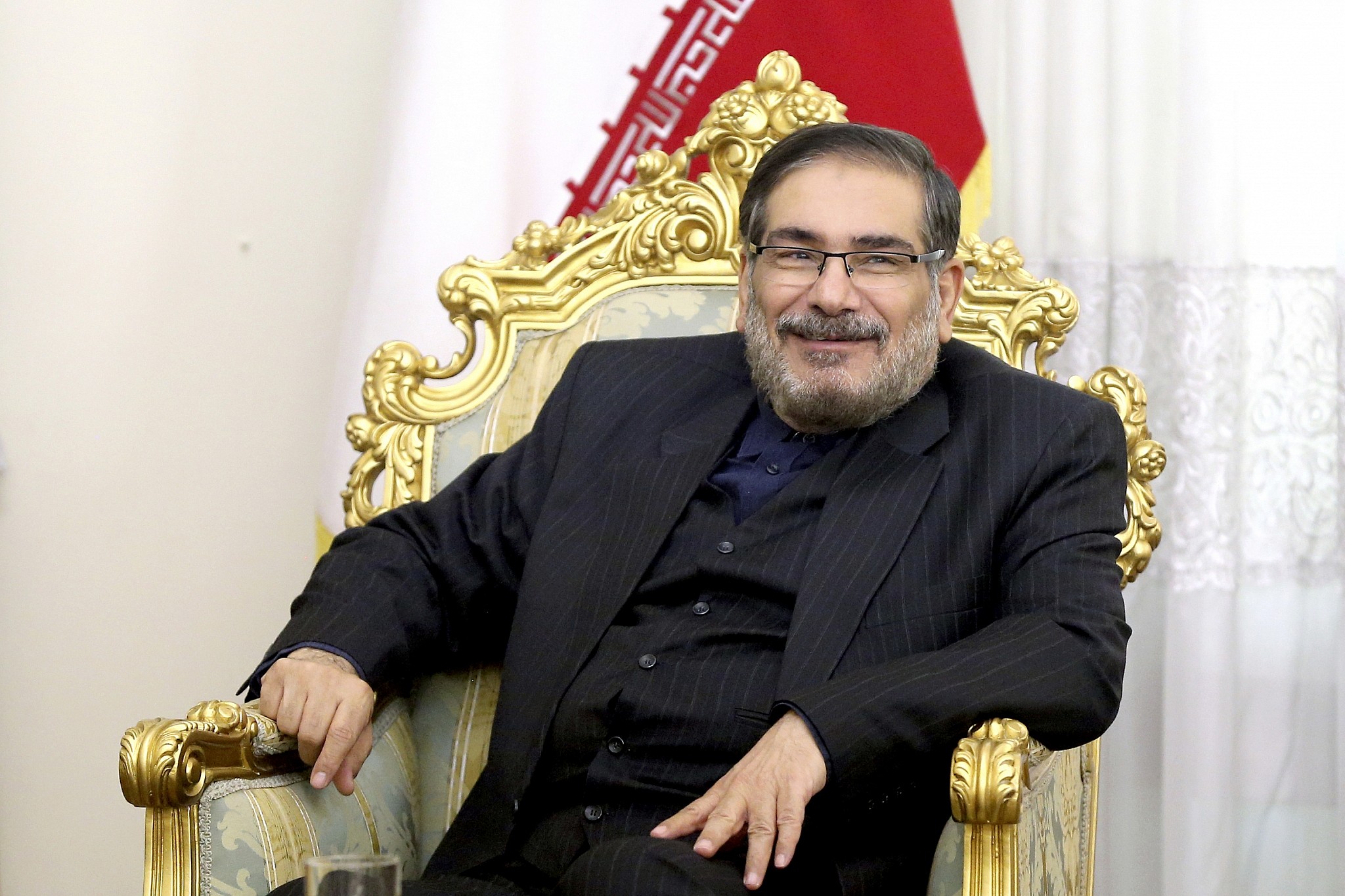
Secretary of Iran's Supreme National Security Council Ali Shamkhani in Tehran, Iran, January 17, 2017.  (Ebrahim Noroozi/AP)

Secretary of Iran’s Supreme National Security Council Ali Shamkhani in Tehran, Iran, January 17, 2017. (Ebrahim Noroozi/AP)

Iranian officials continued their anti-Israel rhetoric on Tuesday, threatening to improve the accuracy of their country’s missiles and warning that terror groups Hamas and Hezbollah were prepared to unleash an “inferno” on the Jewish state.

Speaking at a conference on space technology, the secretary of Iran’s National Security Council, Ali Shamkhani, was quoted by the Tasnim news agency as saying that “it has been an absolute disgrace for the Zionists when an Israeli minister was proved to be a spy, when there are hundreds of kilometers of tunnels dug underneath their feet, and when the resistance forces in Gaza and Lebanon have missiles with pinpoint accuracy and are ready to respond to any foolish Israeli behavior with an inferno.”

He was referring to the conviction of former minister Gonen Segev of spying for Tehran, and to a recent operation in which the Israel Defense Forces uncovered and destroyed six subterranean passages penetrating into Israel from Lebanon. Israel says they are attack tunnels dug by Lebanese terror group Hezbollah — a close Iranian ally.

Shamkhani also said Tehran has the capabilities to extend its missile range, but won’t do so due to its “defensive doctrine.”

“Iran has no scientific or operational restriction for increasing the range of its military missiles, but based on its defensive doctrine, it is continuously working on increasing the precision of the missiles and has no intention to increase their range,” he said, according to the Reuters news agency.

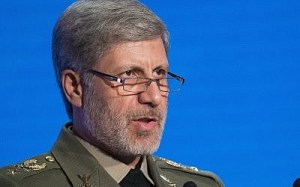
Iranian Defense Minister Amir Hatami speaks at the Conference on International Security in Moscow, Russia, April 4, 2018. (AP Photo/Alexander Zemlianichenko)

Meanwhile, Iran’s Defense Minister Amir Hatami railed at Prime Minister Benjamin Netanyahu’s campaign against Iran’s missile program, which was among the reasons cited by US President Donald Trump in leaving the landmark 2015 nuclear deal and reimposing crippling sanctions.

“The enemies say Iran’s missile power should be eliminated, but we have repeatedly said our missile capabilities are not negotiable,” Hatami said, according to Reuters.

Shamkhani also hit back at Washington’s demand that Iran halt its satellite-launching project, vowing to continue it “to improve the quality of people’s lives and increase the country’s technological prowess.”

The comments followed a series of reciprocal taunts by Israeli and Iranian leaders in recent weeks as tensions have risen on the Israeli-Syrian border between IDF and Iranian forces.

Last week, Israel reportedly conducted a rare daylight missile attack on Iranian targets in Syria. In response, Iran fired a surface-to-surface missile from Syria at the northern Golan Heights, which was intercepted by the Iron Dome missile defense system over the Mount Hermon ski resort, according to the Israel Defense Forces.

Hours later, in the predawn hours of January 21, the Israeli Air Force launched retaliatory strikes on Iranian targets near Damascus and on the Syrian air defense batteries that fired upon the attacking Israeli fighter jets, the army said.

Twenty-one people were killed in the Israeli raids in Syria, 12 of them Iranian fighters, a Britain-based Syrian war monitor said the following day. Iran has denied that its citizens were among the dead.

In this photo provided November 5, 2018, by the Iranian Army, a Sayyad 2 missile is fired by the Talash air defense system during drills in an undisclosed location in Iran. (Iranian Army via AP)

On Monday, the deputy head of Iran’s Islamic Revolutionary Guard Corps said Tehran’s strategy was to eventually wipe Israel off the “global political map.”

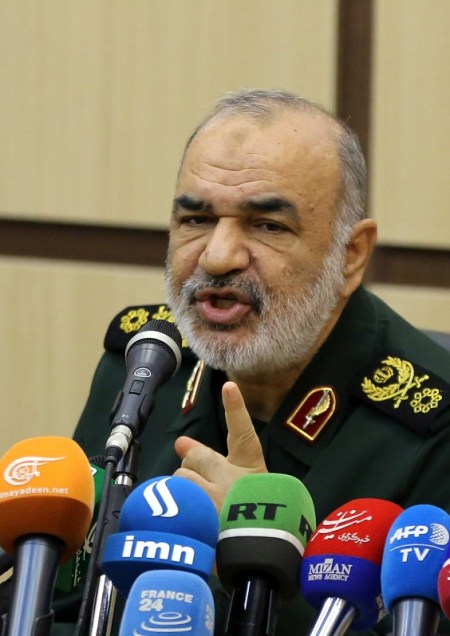
Asked by a reporter in Tehran about Israeli threats to strike Iranian forces deployed in Syria, Brig. Gen. Hossein Salami was quoted by Iranian news outlets as saying, “Our strategy is to erase Israel from the global political map. And it seems that, considering the evil that Israel is doing, it is bringing itself closer to that.”

He added: “We announce that if Israel does anything to start a new war, it will obviously be the war that will end with its elimination, and the occupied territories will be returned. The Israelis will not have even a cemetery in Palestine to bury their own corpses.”

Israel sees Iranian entrenchment in Syria as a major threat and in recent years has carried out hundreds of airstrikes in Syria against targets linked to Iran, which alongside its proxies and Russia is fighting on behalf of the regime of Syrian President Bashar Assad.

Times of Israel staff contributed to this report.