Source: Israeli jets strike northern Gaza targets following border flare-ups | The Times of Israel
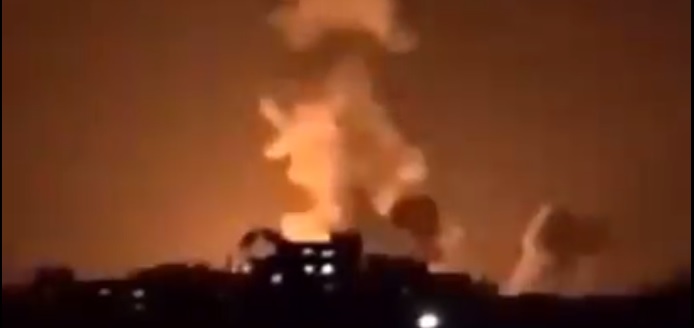
Raids hit Hamas sites after two shooting attacks on Israeli troops earlier in the day, including one in which bullet struck officer’s helmet
Source: Israeli jets strike northern Gaza targets following border flare-ups | The Times of Israel
Raids hit Hamas sites after two shooting attacks on Israeli troops earlier in the day, including one in which bullet struck officer’s helmet
Earlier in the day, shots were fired at Israeli troops stationed along the security fence across from the northern Strip. In response, an IDF tank destroyed a nearby observation post belonging to the Gaza-ruling Hamas terror group.
On Tuesday afternoon, during a small riot next to the border, another sniper opened fire at a group of soldiers positioned along the border, hitting a Paratroopers Brigade company commander in his helmet, causing light injuries.
Then an IDF tank fired on a Hamas observation post. In that case, however, three Hamas members who had just left the structure were hit by the blast, killing one of them and wounding the other two.
The injured IDF officer was taken to Beerhsheba’s Soroka Medical Center for treatment. A cut on his head was bandaged, and he was released hours later, the hospital said.
In addition to the airstrikes, Israel also halted a previously approved $15 million transfer to the Gaza-ruling Hamas terrorist group from Qatar because of the violence.
“Following the recent incidents in the Gaza Strip, and with consultation with security officials, Prime Minister Benjamin Netanyahu decided not to allow the transfer of Qatari money to the Gaza Strip tomorrow,” an Israeli diplomatic official said, speaking on condition of anonymity.
A Hamas official told The Times of Israel that “Netanyahu’s decision to prevent their entry is a crime that will push Gaza toward an explosion.”
Qatar had been preparing to transfer $15 million in payouts to Hamas civil servants in the Gaza Strip. This was the third such installment for the terror group to be approved by the Israeli government, in what officials see as a pressure-release valve intended to calm unrest and ease a potential humanitarian crisis in the beleaguered Strip.
The transfer of the funds to Hamas, which calls for the destruction of the Jewish state, is widely unpopular in Israel. The announcement by the diplomatic official was a rare admission by the government that it had indeed approved the payments.
The funds were expected to be transferred on Wednesday, after they were initially stalled by Israel last week in response to another flare up in cross-border violence, Qatar’s envoy to the Hamas-ruled Gaza Strip, Mohammed al-Emadi, told the Reuters news service.
Since March, Palestinians have been holding regular protests on the border. Israel has accused Gaza’s Hamas rulers of using the demonstrations as a cover for attacks on troops and attempts to breach the security fence.
Israel has demanded an end to the violent demonstrations along the border in any ceasefire agreement.
Adam Rasgon contributed to this report.
Source: Syria’s UN envoy threatens retaliatory attack on Ben Gurion Airport | The Times of Israel
Threats come after Israeli air force strikes on storehouses and radar systems at Damascus airport, which reportedly killed 21, including 12 Iranians
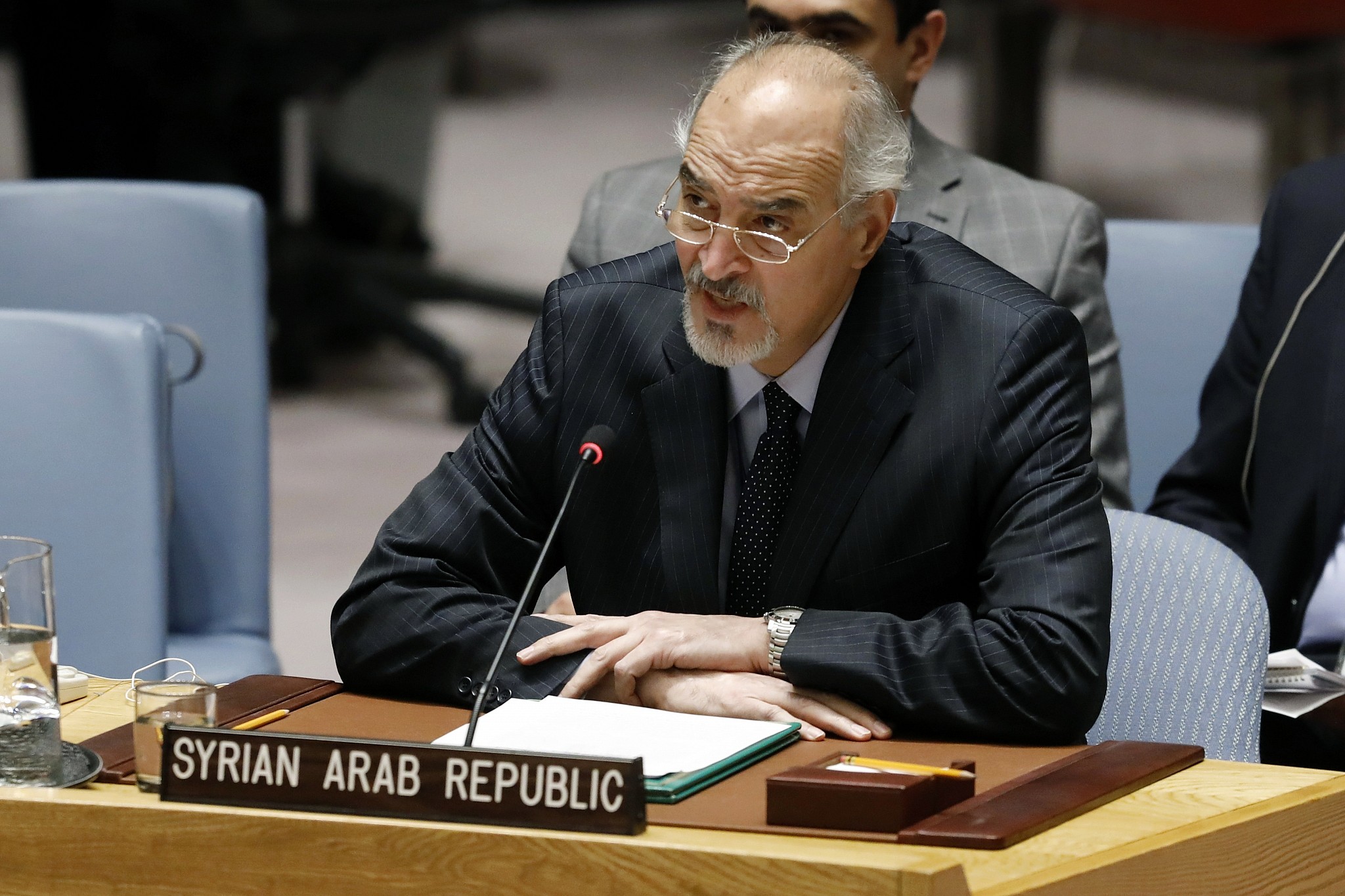
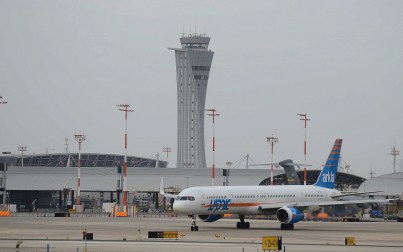
Syria’s envoy to the United Nations warned Tuesday that if the world body did not halt Israeli strikes on his country, Syria would retaliate with an attack on Ben Gurion International Airport outside Tel Aviv.
Speaking at the UN Security Council after a series of IAF airstrikes on Sunday and Monday — most of them launched after an Iranian missile fired from Syria was intercepted over the Israeli Golan Heights on Sunday afternoon — Bashar Jaafari said Israel was only able to act freely in Syria because it had the backing of the US, UK and France in the Security Council.
Syrian state media Sana quoted Jaafari as saying that if the UN Security Council didn’t adopt measures stop Israel, “Syria would practice its legitimate right of self-defense and respond to the Israeli aggression on Damascus International Airport in the same way on Tel Aviv airport.”
“Isn’t it time now for the UN Security Council to stop the Israeli repeated aggressions on the Syrian Arab republic territories?” Jaafari said.
While Israel has repeatedly hit targets inside Syria in recent years to try to stop the transfer of arms to Hezbollah and the entrenchment of Iranian forces, Syria has rarely responded.
It’s unclear if Syria has the ability to strike at Ben Gurion Airport; any attempt to do so would be viewed by Israel as a major escalation.
On Sunday, Israel reportedly conducted a rare daylight missile attack on Iranian targets in Syria. In response, Iran fired a surface-to-surface missile at the northern Golan Heights, which was intercepted by the Iron Dome missile defense system over the Mount Hermon ski resort, according to the Israel Defense Forces.
Hours later, in the predawn hours of Monday morning, the Israel Air Force launched retaliatory strikes on Iranian targets near Damascus and on the Syrian air defense batteries that fired upon the attacking Israeli fighter jets, the army said.
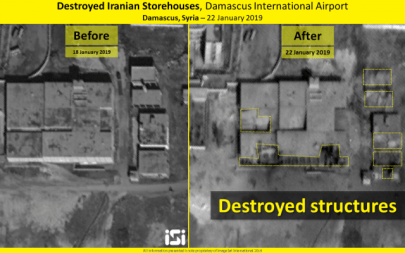
Satellite images released by an Israeli firm on Tuesday appeared to show extensive damage at Damascus International Airport.
The photographs published by ImageSat indicated storehouses and radar systems at the Syrian airport were destroyed in the strikes.
Twenty-one people were killed in the Israeli raids in Syria early on Monday, 12 of them Iranian fighters, a Britain-based Syrian war monitor said earlier on Tuesday.
The Syrian Observatory for Human Rights initially reported the death toll from the Israeli strikes to be 11. But on Tuesday, the war monitor said the number had risen to 21, making it one of the deadliest attacks by Israel in Syria.
According to SOHR, 12 of those killed were members of Iran’s Islamic Revolutionary Guard Corps; six were Syrian military fighters; and the other three were other non-Syrian nationals.
The IDF said Monday that Iranian troops in Syria launched their missile at the Golan in a “premeditated” attack aimed at deterring Israel from conducting airstrikes against the Islamic Republic’s troops and proxies in Syria.
Israeli troops on Monday were put on high alert in the north.
Military spokesperson Jonathan Conricus said the three response sorties destroyed a number of Iranian intelligence sites, training bases and weapons caches connected to the Quds Force, the expeditionary arm of Iran’s Islamic Revolutionary Guard Corps.
According to Conricus, one of the targets of the raids was “the main storage hub for Quds Force.”
On Monday morning, the IDF also released video footage of its airstrikes on Syrian air defenses, including on social media.
“We understand that the Iranians are trying to change the context and deter us from our policy and our strategy of fighting Iranian troops in Syria,” Conricus said. “They thought they could change the rules of engagement. Our response was a rather clear one, with a message to Iran and Syria that our policies have not changed.”
Source: Between exoatmospheric Arrow 3 and two perilous warfronts down below – DEBKAfile
The Israeli-US Arrow 3’s successful interception of a mock ballistic missile flying outside the earth’s atmosphere coincided on Tuesday, Jan. 22, with a sniper bullet from Gaza denting an IDF’s officer’s helmet.
Tension shot up on Israel’s combustible southern border at the same moment as Dome anti-rocket batteries were being rushed north, the day after an Iranian Fatteh-110 missile was aimed from Syria at the Hermon ski slopes north of the Golan.
Nonetheless, the Arrow 3 test was the cause for celebration. Harel Locker, Chairman of Israel’s Aerospace Industries, commented: “We are capable of defending ourselves against many bad things that our enemies are throwing at the state of Israel and preparing our next ground-breaking, border-breaking and atmosphere-breaking products.” Prime Minister Binyamin Netanyahu was more prosaic: “We have extremely powerful defensive and offensive capabilities, among the most advanced in the world, for reaching our enemies and settling accounts with them.”
That morning, in the south, gunfire from the northern Gaza Strip was directed at an IDF engineering truck. Israeli tanks shelled a Hamas position. In the afternoon, a Hamas sniper shot an IDF officer. He was injured but saved from worse by his helmet. The IDF spokesman, whose communiques are often less than accurate, claimed he was struck by a rock. Meanwhile, five Palestinians broke through the Gaza fence to infiltrate Israel, and, once again, the tanks went into action against another Hamas position in central Gaza.This time, the Palestinians suffered casualties, one dead and several injured.
This time, too, the prime minister reacted to Hamas’ violation of the ceasefire deal it undertook in return for Qatari funding, by holding back the third $15m installment of Qatari cash due in January. Information was received that the outbreak of Gaza violence was instigated this time by Hamas’ partner-in-error, Iran’s Palestinian pawn, the Islamic Jihad, on orders from Tehran that were relayed through Hizballah in Beirut.
Iran had put another of its proxies in play. Instead of directly retaliating for the massive Israeli air and cruise missile strikes against Al Qods targets in Syria early Monday morning Jan. 21, Tehran decided to use its pawn in Gaza to punish Israel.
This concatenation of events highlights the complexity of Israel’s military quandary. Iran has managed to pull a tight noose around Israel’s neck from three directions, Syria, Lebanon and Gaza and is building a fourth in Iraq. All of these fronts are bristling with ground-to-ground missiles, a small number of which are precision-guided, although most are not outfitted with exact targeting devices. By now, some of those precise missiles have reached the Gaza Strip, as well as Syria and Lebanon.
Israel’s arsenal of air defense weapons is formidable. But they can’t seal Israel’s air space and territory hermetically or nullify the strategic advantage Iran has achieved by the power to inflame three of its borders.
On the one hand, Iran’s military capabilities in Syria are diluted by their distance from home base, but, on the other, they are near Israel, on its very doorstep. The missile aimed at the Golan on Monday laid bare the presence of mobile surface missiles manned by Iranian officers and teams and deployed south of Al-Kiswah, opposite the IDF’s Golan positions. It was indeed shot down in time by Israel’s Iron Dome air defense system. However, those Al Qods launchers are not positioned outside the atmosphere, but just 25km from the Israeli border.
Recent Comments