Archive for January 21, 2019

A different kind of attack on Syria

January 21, 2019

Source: A different kind of attack on Syria

Analysis: It appears that the target of the strike was an Iranian plane with unknown cargo due to land at Damascus airport; the timing of the incident, and the Syrian response, are unlike the usual sequence of events we have grown accustomed to.

The Russian army in Syria said it was Israeli planes that launched air-to-surface missiles over the Mediterranean Sea, towards targets in the area of Damascus International Airport. Contrary to most of the attacks previously attributed to Israel, for which Prime Minister Benjamin Netanyahu took partial responsibility, Sunday’s attack took place in the afternoon, during daylight hours. At the time of the strike, an Iranian passenger/cargo plane was coming in for landing at Damascus International Airport. The plane belonged to the Iranian aviation company Mahan Airlines.

Mahan’s headquarters are in Tehran; the company operates from Imam Khomeini Intenrational Airport and has a large fleet of aircraft, some 60 in total, most made in Europe. In 2009, the company was found to have unlawfully taken three Boeing 747s from the European company Blue Sky Airlines, using forged bills of sale. The company refused to return the planes, hardly surprising, given the American boycott on the sale of US-made aircraft of any kind to Iran since the 1979 Islamic Revolution.

The flightpath of the Mahan airliner that turned back from Damascus

The flightpath of the Mahan airliner that turned back from Damascus

Mahan flies both domestic and international flights, which is interesting given that in December 2011, the US Treasury declared it an embargoed company on the grounds that it supports terrorism and serves the Iranian Revolutionary Guards. In announcing its embargo on the company, the US Treasury said it primarily serves the Revolutionary Guards’ elite Quds Force, which operates in the international and Middle Eastern arenas, is assisting Hezbollah and the Syrian army, operating against Israel and trying to establish itself in Syria.

Last month, Germany officially announced that it planned to ban Mahan Airlines from landing in its territory, after receiving evidence that the company’s planes, including Boeing 747s, had transferred Quds Force weapons and operatives to Syria.

With this in mind, it is fair to assume that the action attributed to Israel was intended to deter the Mahan plane, which took off in Tehran, from landing in Damascus. This assumption can be reinforced by the fact that this was the only plane due to land at Damascus airport.

The plane was close to touch down when the strike took place, and it is reasonable to believe that Israel alerted the Russians to the attack and the Russians directed the craft back to Tehran. The suspicion that the entire operation was to stop the plane landing is strengthened by the fact that the usual Syrian sources, such as the London-based Syrian Observatory for Human Rights, or other Syrian and Lebanese sources did not report the strike nor distribute photographs of Israeli missiles hitting their targets.

Israel's Iron Dome missile defense system fells rockets over the Golan Heights (Photo: Yossi Amar)

Israel’s Iron Dome missile defense system fells rockets over the Golan Heights (Photo: Yossi Amar)

Syrian television even boasted that 100 percent of the Israeli missiles were intercepted by the Syria’s anti-aircraft system, which while not necessarily the truth, could indicate not that the missiles failed to hit significant targets, but rather this purely solely a warning or deterrent about the plane itself.There is no way of knowing who or what was in the belly of the plane, but one could sensibly assume that whoever attacked it was interested in sending it back from whence it came – with a warning for whoever sent it. All of this was apparently done in order not to irritate the Russians, and to bring them onboard with the operation.

The Syrian response is also interesting. The reaction was surface-to-surface rocket fire, apparently under cover of a barrage from an anti-aircraft missile battery launched in order to mislead Israel. AMid the anti-aircraft fire was a surface-to-surface rocket aimed at Mount Hermon. The anti-aircraft missile fire only came after the attacking planes were out of range, or even when they had already returned to their base in Israel. Assuming, of course, that it was Israel who carried out the attack.

The Syrians have previously fired anti-aircraft missiles into Israeli territory, even though they had no target they could realistically hit. To Israel, Sunday’s was a reprisal attack aimed at harassing and wearing down its population, creating panic and possibly harming tourism on the Golan. This was the case a few weeks ago, when Israel attacked and Syrian surface-to-air missiles were fired at the Jewish state, even though they did not hit. And this was the case Sunday, when the rockets brought down by Iron Dome could be clearly seen in the skies over Mount Hermon, while thousands enjoyed the snow below.

Tourists at the Mt. Hermon ski resort (Photo: Mt. Hermon management)

Tourists at the Mt. Hermon ski resort

This method of retaliation shows that the Assad regime is apparently looking for ways to respond to the attacks attributed to Israel, especially after Israel lifted much of the veil of ambiguity over these strikes.

This removal of the veil of ambiguity by then-IDF chief of staff Gadi Eisenkot and Prime Minister Netanyahu is intended to make the Russians deter the Iranians themselves, and make it clear to Tehran that Quds Force commander Qassem Suleimani is dragging them into a perilous escapade. He is trying to avenge the damage to the prestige of his regime, apparently without pushing Israel too hard, and the Russians are pressuring him not to do anything that could lead to a broad confrontation.


Ch. 6 – Messiahs, Time Machines & Sitting Ducks

January 21, 2019

Source: Scuds, Duds & Tyre – Joseph Wouk – Google Books

( Apropos of the previous article, I decided to share the chapter from my book dealing with what people were thinking about what Israel’s responxe would be to Sadam’s Scuds. – JW ) 

 

By the time dinner arrives two hours later, the whole plane has heard about “the Yossi’s” in the back.  The passengers sitting near us who had wanted to rest were totally out of luck.  Jokes, howls, leers, and roars, in a never-ending stream, pierce through a billowing cloud of cigarette smoke reminiscent of Mount Saint Helen.  I am having the time of my life.  What a great buncha guys!

The harassed stewardesses, who are trying to satisfy the “infinite en­titlement” complexes of five hundred Israelis at once, have a some­what different opinion of the “Yossi’s.”  I found this out the hard way when I tried to ask one of them if they might possibly sell the duty frees before dinner rather than after… You see, I had finished the Winstons and “The Organized’s” pack of Marlboros was nearly ex­hausted as well…

“Don’t YOU start up now,” she shrieked, “You’ll be sorry, you hear!  ALL of you are an ‘ASONE TEVA’!!!” (Natural catastrophe).  She wagged her forefinger at me, eyes flashing an unmistakable warn­ing.  This woman was pissed!  At the moment she seemed to hate me more than fifty Saddams…

“Wha’d I say?  Hey, Yossi, did I say something wrong?”  I looked around for support.  That poor girl.  The jeers, curses, catcalls, and epi­thets that chased her up the aisle were among the worst I had ever heard.  As she fled the deluge, other passengers joined in the deri­sion…

“Who the hell do you think you are, anyway?…” “This is the worst service I’ve ever encountered!…” “Don’t you shout at the American!…” “Leave those Yossi’s alone!  They cheer everyone up; all you do is kvetch!…” “Where’s my drink, you?!  It’s been half an hour!…” Etc.

It was a great victory, but I still had the problem of the cigarettes to deal with.  One pack was all it had taken to rekindle the bitterest cravings of a confirmed nicotine addict.  “The Organized” insisted that I take his last Marlboro.

“But what will you do?”  I exclaimed.  “What will I do?  What good is one butt?  We’ve got almost nine hours left on this horrible flight!”


“God will provide a lamb for the sacrifice, my son…”  He an­swered with Biblical conviction.

And damned if he wasn’t right!  “The Curly” was up and rummag­ing through the overhead compartment.  He pulled out a carton of Kents, and, like Jesus before the starving multitude, began tossing packs one-by-one to the eager, outstretched hands of the nic-crazed Yossi’s.  “I bought these for my brother in law.  To hell with him, he’s an asshole anyway…”  Dollar bills began flapping in all directions as we tried to pay him for his largess.  “Te’heyu Bri’im, Azov T’akesef…”  (Be healthy, forget the money).

As happy fresh clouds of poison smoke refilled the cabin, it was mo­tioned, seconded, and passed by a voice vote that “The Curly” would hereinafter be known among us only as Yossi HaMashiach (The Messiah)…

*        *        *

The vile rubbish that masquerades as “dinner” in economy class is gagged down in good humor.  We all have two or three mini-bottles of wine under our belts before beginning to discuss the “Matzav” (situation).

I kick off the discussion by challenging the row to prove to me that any of them are any less crazy than I am to be flying into this shit-pit of a war.  It turns out only one of them actually lives in Israel at the moment.  The rest are Yordim, like me.  Some still have family in Israel that they are worried about, others don’t.  No one has a really good reason to be going.  I rest my case.

The fact of the matter is, the majority of the people on this plane are returning home because of the same irresistible force that I felt on the night of the Midori.  An ephemeral but powerful need to be a part of what is happening.  My mind wanders, as I recall the movie version of H.G. Wells’ The Time Machine.  That eerie, mesmerizing wail of the Morlocks’ air raid sirens…  Drawing spellbound people to their deaths below….

RRRRHHhhhhhhhhh…..RRRRRRHHHHHHhhhhhhhh….RRRR…

This is the Captain speaking.  The military spokesman in Israel has just announced that the four Patriot Batteries sent by the Americans to Israel are now fully operational.  B’sha’a tova.”  (Lit. in a good hour, just in time).

I join in the subdued cheering and handclapping that erupts through­out the plane.   I look around at the faces of the passengers…  Pain, de­termination and sadness is written all over them.  No real happiness or re­lief.  Nobody actually believes that these American-manned machines are going to make a difference.  But we all clap anyway.  Davka! (Nevertheless…In Spite of it all…Because of it all)

It was time for business.  We pour ourselves some new mini’s, light up and begin to argue.  There’s an old joke that if you want to hear five different opinions on a particular subject, ask two Israelis…

Everybody agrees that the Patriots are little more than a public re­la­tions stunt designed to calm the population and give the government po­litical breathing space to decide what to really do about the threat.

There is a division of opinion though, as to whether it is good or bad to have American troops stationed in Israel.  On the one hand, it more firmly commits the U.S. to the defense of Israel.  If Saddam drops gas on Israel he might very well gas Americans at the same time.  It’s a whole different ball of wax when G.I.s get killed than when Jews do.  Especially in the American press.  If that happens, Katie-bar-the-door, as far as Israel’s political ability to justify any re­sponse it chose to make.  On the other hand, Israel is now responsi­ble for the G.I.’s safety.  That hinders our ability to take preemptive action that might provoke a gas counter-at­tack.

Besides, Israel doesn’t want or need to become an American lackey… Look what happened to South Vietnam.  Why are the Americans so eager to send troops to Israel all of a sudden, anyway?  Clearly they want Israel to sit this one out and not endanger the Arab coalition that they built up with such painstaking care over the last six months.  This is part of their plan.  Hamstring Israel.  The Shamir Government now owes Bush for providing them with this po­litical cover.

This argument ends with a Teyku.  (Lit. The Talmudic expression for an unresolved controversy that must wait for the Messiah to answer it, A draw.)

But what is Israel going to do?  How and when will we strike back?

“The Bearded” is sure that we will have to mount a large com­mando raid into Western Iraq.  If massive American air strikes can’t do the job, what could our relatively small Air Force accomplish?  We could helicop­ter or parachute in enough troops to seize either H-2 or H-3 airfields.  Then bring in a much larger force using C-130 Hercules trans­ports.  Kind of an Entebbe operation on a massive scale.  These forces would search and destroy all the mobile missiles in the area before be­ing pulled out.  This analysis sounds eminently reasonable to me, until “The Young” interjects: “‘The Bearded’ has no idea what he is talking about when he says our air-force can’t do the job…”

“The Young”, it develops, is an authority on the subject since one of his brothers is an F-16 pilot.  There could be no comparing the American and Israeli Air Forces as far as precision bombing was con­cerned.  The Americans were not allowed to fly any lower than 500 feet in their at­tacks.  The Israelis routinely practiced bomb runs as low as 50 feet.  His brother had told him that they could locate a cockroach in the Negev de­sert and blow its head off while leaving the carapace intact.  That’s how good they were.  The mobile launchers would be no problem to find and destroy….

All Right!  Good to hear!  Sounds pretty convincing to me….

“Both ‘The Young’ and ‘The Bearded’ are forgetting one simple fact,” announces “The Large.”  “Whether we go in with jet fighters or commandos we’re gonna have to cross Jordan to get there…”  King Hussein has said that he will confront any violation of his air space with military force.  He will do it, too.  If he doesn’t, he’ll be hanged from the nearest sour-apple tree his people can find.  Of course, Israel can take care of the Jordanian forces in short order, but it will require an overland invasion across the Jordan river.  A combined operation of air, armour and infantry.  In other words, all out war.  If we want to stop the Missiles, it’s our only choice…  Very depressing thought, but I have to admit he’s right…

“The Small” has been listening silently to this whole exchange.  A wizened man in his seventies, he has sharp, bright, weasel-like eyes that gleam with cunning intelligence.  He holds up a shrunken claw for silence.  “What none of you seem to understand is that we have no choice.  We must and will use atomic bombs on this Bastard…”  Can Israel afford to absorb even one missile attack that uses ABACH?  (Military acronym… Atomic-Biological-Chemical).  Why do we have our own nuclear arsenal, anyway?  For precisely such an occurrence as this… A whirling Dervish of an Arab leader gets hold of non-conven­tional weapons and then backs himself into a political corner of having to use them on Israel.  Didn’t he say he would “incinerate half of Israel”?


“The Small,” it turns out, had actually grown up in Iraq and un­der­stood their values.  They didn’t give a hoot about human lives.  Not of their enemies, not of their friends, not even their own.  Deterrence simply doesn’t work against this sort of mentality.  They would use that ABACH of theirs even if they knew Israel would retaliate with Atomic bombs…

That being the case, it made no sense to abandon our population as sitting ducks, waiting for the gas, or even worse, the germs that Saddam was planning to drop on them.  Sure, there will be some hard political fallout.  But the Russians are in the middle of a civil war, and the Americans will be spared the necessity of a ground attack.  No more Americans killed by Saddam.  That might not go down too badly with the American public.  The end result would justify the means.  Besides, the alternative was unthinkable….

I am reminded of how I had howled as much to Lou Dobbs on the big-screen.  But that was back when I thought there had been gas.  If “The Small” is right in his assessment of the Iraqi mentality, though, he has a real point….

My neighbor, “The Organized” has been wearing a knowing smirk on his face, occasionally interrupting the speakers with puns and other pointless inanities.  “Friends, what no one here has even dealt with is the fact that none of us will be making this decision.  Consider who it is we’re talking about.  Yizhak Shamir… That man hasn’t been able to make a hard decision since his days in Lechi.  (a pre-State underground Zionist faction).  Let me tell you what I think Israel is going to do.  Nothing, that’s what…  We’ll let the Americans do the fighting for us.  If Saddam had gas war-heads for his ridiculous Scuds he would have used them by now.  The fact is, all he’s got are the conventional type… And he couldn’t hit a barn at 50 meters with their accuracy.  The Americans will eventu­ally manage to take out all of his launchers.  In the meantime, we can ab­sorb the one or two casualties a day that he’s managed to inflict upon us so far.

Consider how many soldiers we would lose if we followed either “The Bearded’s” or the “The Large’s” plan of action…. Ten, twenty, two hun­dred?  Why should we throw away that many lives for one or two civil­ians?  It makes no sense.  We’ll make lots of threatening noises to keep the domestic political pressure at bay, but in the end we’ll do nothing.  Even if I’m wrong about the Iraqis, I know I’m right about Shamir.  We will do nothing because that is the only thing Shamir knows how to do.  And he does it very well.”

The row of Yossi’s grows silent in contemplation of this descrip­tion of Shamir that they all know to be the gospel truth.  “The Organized” has actually won the argument.  None of us can really say that we know what the Americans, the Iraqis, or the Jordanians will do.  But we all know Shamir.  What a horrible thought!  We might all be slaughtered without even trying to protect ourselves.  And there was nothing Yossi One through Yossi Eight could do about it….

“I’m going to get some Vodka… Any takers?”  I try to dispel the gloom that has settled around us like a cold, dark blanket.  Only “The Organized” is game.  But he doesn’t count.  After all, he won the ar­gu­ment.  Of course he’d drink…

*        *        *

The hours fly by as does our Jet to the “Holy Land.”  The Yossi’s never recover their former jubilance.  An hour before landing I find myself making mental preparations for survival on the ground.  What if there is an attack while we’re landing?  Or even worse, while we’re disembarking?  None of us have gas masks yet.  Supposedly they are being distributed at the airport, but I assume we’ll have to make it to the terminal first…  The advance warning is only about 90 seconds.  Sitting Ducks…  I look around and see the others clearly absorbed in similar thoughts.  We are all men­tally grooming our feathers for the event.

“Hey!  Come see!”  “The Young” blurts from his window seat.

We all climb over one another to get a look through a window.  I lie across the laps of “The Small,” “The Bearded” and “The Young,” but I get to see it…

The sun is already sinking low off the Western horizon behind us.  The clouds are lit with pink, yellow and orange pastels.  And there, glass canopies glinting with reflected gold, a pair of camouflage painted Kfir warplanes fly in tight formation, no more than 500 yards from us… The blue Magen David is clearly visible on each tail.

Chail Avir (The Israeli Air Force) is escorting us home.

As I watch, the giant wing-flaps of the 747 come out and down.  With the sounds of servos whining, the plane shudders and pitches forward.

We are starting our descent….

When Israel prepared to conquer Baghdad

January 21, 2019

Source: When Israel prepared to conquer Baghdad

During the First Gulf War, Israeli political and military leaders found themselves on a steep learning curve as the country was pounded by Saddam Hussein’s Scuds; the lessons from that experience — and the demands of the Americans —still resonate, in particular regarding a devious Iranian plan to strike the Jewish state from Iraq.
The picture painted by the intelligence gathered by Israel and by the United States Central Command is very worrying. The Iranians, it transpired, have started sending surface-to-surface missiles to Shiite militias in Iraq. The missiles are meant to be aimed, among other things, at Israel, to deter it from further attacks on Iranian facilities in Syria.
It is a cunning Iranian move: missile fire from Iraq would not give Israel just cause to attack Syria or Lebanon, and it would put the Jewish state in a dilemma. Furthermore, an attack on Iraq requires coordination with the US, who has already informed Israel that any military action it takes in Iraq would endanger the lives of Americans protecting the Baghdad regime. It would also require coordination with neighboring countries such as Jordan and Saudi Arabia to allow the Israel Air Force warplanes to fly in their airspace. It’s obvious these countries will not openly cooperate with Israel in attacking a neighboring Arab nation.

This has happened over the past year, and caused the IDF to raise its level of alert. The Iranians didn’t send the missiles as a mere threat, they also intend to use them for a strike in retaliation or for deterrence.

On February 10, 2018, the IAF attacked the T-4 Air Base in northern Syria, destroying a command and control trailer for an Iranian drone after it infiltrated Israel. During that same incident, an IAF F-16 fighter jet was downed over Israeli territory by a Syrian anti-aircraft missile. Iranian military personnel were killed in the Israeli strike, and Tehran prepared to retaliate through the Shiite militias it has at its beck and call. It seems that it was only due to heavy diplomatic pressure that the missile threat from Iraq was lifted. Instead, the Iranians on May 10 launched more than 20 rockets towards the Israeli Golan Heights, which didn’t cause any damage or create a new balance of deterrence. On the contrary, they only gave Israel cause to strike the Iranians again where it’s convenient for the IDF — in Syria.

An Israeli strike on Iranian targets in Syria (Photo: IDF Spokesperson's Unit)

An Israeli strike on Iranian targets in Syria (Photo: IDF Spokesperson’s Unit)

Gadi Eisenkot’s General Staff didn’t have to deal with long-range missile fire—from Lebanon, Syria, Iraq or Iran—to a large extent thanks to a smart policy of ambiguity that allowed Israel “plausible deniability,” and didn’t force the enemy to respond to strikes for which Israel had not claimed responsibility.

The recent decision to tear down the veil of ambiguity surrounding Israel’s military operations in Syria leaves the General Staff, now under the command of new IDF Chief of Staff Aviv Kochavi, with the need to preserve and enhance Israeli deterrence in other ways. Beyond the creativity and daring that have characterized Kochavi’s military career so far, this will require him for the first time to display political capabilities. To allow the IDF the freedom of operations in Syria, with a window of opportunity that is closing as the civil war in the country draws to an end, he will have to win support from the prime minister and every single member of the security cabinet.
The Iranian attempt at entrenchment in Syria has been halted for now, but the final word has not yet been uttered. An Iranian attack against Israel from Iraqi soil is still a realistic scenario. Is the IDF prepared to deal with a new front from Iraq? Will the government withstand American pressure to leave the work of ridding Iraq of the Iranians to someone else? Will Israel’s Arab friends cooperate with it? Will Israel choose not to respond to missiles from Iraq or Iran into its territory, despite the blow it would deliver to its deterrence? Or alternatively, will the Israeli government allow the military to take heavy punitive action, including damaging civilian infrastructure, to make it clear to the entire Middle East that Israeli citizens are not free play?A different General Staff, no less talented, had to contend with the same questions in the 1990s, and couldn’t deliver answers.

The sites in western Iraq where the Iranians might deploy missiles, are in almost the same area from which the long-range “Al Hussein” Scud missiles were launched at Israel during the First Gulf War. On January 18, 1991, almost precisely 28 years ago to the day, eight Al Hussein missiles were launched for the first time from western Iraq toward population centers in central Israel and the Haifa area. Israel didn’t respond that day, and remained diplomatically paralyzed, with undeveloped military plans, until the end of the US-led coalition’s Operation Desert Storm on February 28.

A Ramat Gan home destroyed by an Iraqi Scud, January 1991 (Photo: GPO)

A Ramat Gan home destroyed by an Iraqi Scud, January 1991 (Photo: GPO)
In total, some 40 missiles were fired from Iraq, most of them at Dan region. Israel didn’t respond, and it is paying the price in psychological deterrence price to this very day. The enemy learned Israel’s Achilles’ heel. Even Hamas dares to launch rockets at Tel Aviv and still remains standing. The Gulf War created the “ethos of restraint,” which in the years that have passed has become a doctrine at which Israel. The historical memory is that Israel held back and didn’t attack due to heavy American pressure. But this is only half the truth.

The fear: Attack on Dimona

The beginning was actually promising. As early as April 1990, four months before the Iraqi invasion of Kuwait and nine months before the first missile was fired at Israel, Israeli intelligence uncovered seven stationary launchers stationed in western Iraq. In July, initial preparations began for an operation to strike this apparatus, and then a series of discussions and preparations began for special ops—both aerial and ground—of different scales. But this saga was filled with zig-zagging. There wasn’t a clear worldview, no plan reached a point at which it had reasonable odds of success, and the diplomatic conditions had not yet ripened. Israel was running on the spot.

Patriot missiles intercepting Iraqi Scuds over Tel Aviv during the 1991 Gulf War (Photo: GPO)

Patriot missiles intercepting Iraqi Scuds over Tel Aviv during the 1991 Gulf War (Photo: GPO)

Three weeks after the Iraqi invasion, on August 21, 1990, the IDF General Staff held war games to examine the different ways to deal with the threats from Iraq. By this point, the IDF was already on high alert in light of assessments that an all-out regional conflict would include Israel as well. At the conclusion of the war games, there was talk of possible missile fire or a potential Iraqi airstrike on strategic targets, such as the Dimona nculear reactor and major population centers. There was also the assessment that the Iraqis had the ability to use chemical weapons against one of those strategic targets, like Dimona.

Most of the speakers at the meeting—head by then-IDF chief Dan Shomron, his deputy Ehud Barak, the head of the Military Intelligence Directorate Amnon Lipkin-Shahak, and Air Force Commander Avihu Ben-Nun—believed that Iraq would try to provoke Israel in order to draw it into war and dismantle the American coalition with the Arab world. Therefore, they predicted there would be American pressure on Israel not to take action. Most of those present agreed that there was room for Israeli restraint regarding the timing, scope and nature of a potential response, and they all agreed any move should be coordinated with the Americans.

Iraqi dictator Saddam Hussein in 1991 (Photo: AP)

Iraqi dictator Saddam Hussein in 1991 (Photo: AP)
Shomron’s General Staff—just like Gabi Ashkenazi’s General Staff, which dealt with the possibility of a strike on Iran’s nuclear project 20 years later—preferred to have the Americans solve the problem for Israel. But they weren’t confident the Americans would do the job in a satisfactory manner, so they all agreed that if Iraq launched missiles at major Israeli population centers, Israel would have no choice but to respond.Then GOC Northern Command, Maj. Gen. Yossi Peled argued that Israel had to respond either way, even if missiles were only launched at military targets, otherwise it would undermine Israel’s deterrence against the threat of indirect fire in the future. Lipkin-Shahak addressed the possibility of friction with Jordan in the case of Israeli airstrikes on Baghdad, and recommended Israel “examine other painful responses, such as hitting Iraqi shipping.”

The IDF chief assessed that the Israeli military did not have the ability to destroy the Iraqi Air Force, and it also did not have the ability to completely prevent or stop missile fire at Israel. Therefore, he said, the top priority for the military would be how to restore Israeli deterrence, and not how to remove the threat. In other words, deter Iraq from further missile fire.

“If Israeli population centers are hit,” the IDF chief said at the conclusion of the war games, “Israel will pound government and strategic sites in Baghdad and military targets in western Iraq, to send the Iraqis an unequivocal message: if the missile fire doesn’t stop, we will hit population centers in Baghdad.”

The war games exposed the fact the IDF did not have a concrete view on when to use force or indeed have an operational plan in the face of the threat of missile fire toward Israel from western Iraq. At the time, the IDF was prepared to fight off two Iraqi units that were supposed to join an eastern front against Israel—one from the direction of Syria and the other from the direction of Jordan. But it didn’t have an effective plan to deal with missiles or long-range rockets. The only plan the military had when the crisis erupted was meant to deal with Syrian chemical weapons, and the IDF top brass were now trying to adjust it for the existing conditions in western Iraq.

But that plan was not ready either. From the moment it was presented in late 1989 and until the end of the First Gulf War, it remained unclear who would command this operation, which combined the Israel Air Force, the Ground Forces and the Intelligence Directorate. A bitter argument was waged between the Air Force and special ops HQ (which at the time was under the command Maj. Gen. Doron Rubin). The decisions made by the IDF chief, his deputy, and the head of the Operations Division didn’t help settle the dispute. Conversely, a similar dispute is currently ongoing between the Depth Corps, which inherited the headquarters for special operations, and the Air Force.

But these operations combining Special Forces and the Air Force, which were planned for western Iraq, were secondary in their importance. The preferable option was reinforcing deterrence through painful punishment of the Iraqi government and its citizens should missiles actually be launched at Israeli population centers. Clues for this can be seen in General Staff and government discussions from those days.

The first missile landed in Tel Aviv on January 18, 1991, at 2am. Four hours later, then-defense minister Moshe Arens held consultations in his office. IDF chief Shomron recommended attacking Baghdad. The Air Force commander also spoke of a significant strike; otherwise there was no point in bothering. The deputy IDF chief recommended action on two fronts — the rocket fire and punitive measures — but stressed that Israel was entirely dependent on the Americans to get real-time intelligence from Baghdad. The Air Force commander also stressed the need to coordinate with the Americans, asked permission to carry out a sortie over western Iraq to take photos and gather intelligence, and proposed that Israel carry out both the punitive measures and the attack on the launchers.

Deputy IDF Chief of Staff Ehud Barak and Defense Minister Moshe Arens during the 1991 Gulf War (Photo: Israeli Ministry of Defense)

Deputy IDF Chief of Staff Ehud Barak and Defense Minister Moshe Arens during the 1991 Gulf War (Photo: Israeli Ministry of Defense)

At 7:45am, the defense minister convened another meeting. The Air Force commander presented the plans for the intelligence sortie that very afternoon. He also presented three plans for special operations in western Iraq. “It turns out the Americans were unable in their first strike to destroy the entire Iraqi defense apparatus,” said Ben-Nun. “Therefore I recommend taking a neighborhood in the city of Ramadi, which is west of Baghdad, and wiping it out with 80 tons of bombs.” The Navy commander, Maj. Gen. Micha Ram, had another suggestion: “Let’s sink four Iraqi merchant ships.” The head of the IAF’s Air Group, Brig. Gen. Amir Nachumi, said that “if Israel doesn’t respond, the Iraqis will try to hit us with chemical warfare.”

That day, at 3pm, it appeared that the coordination with the Americans was unsuccessful, and the intelligence sortie was postponed to the following day. That evening, the Americans informed Israel they were willing to immediately provide it with two Patriot batteries to brign down the Iraqi missiles. Major General Thomas R. Olsen, a representative of the United States Central Command (Centcom) landed in Israel the next day with satellite images of western Iraq, which was supposed to give the Israelis a sense of cooperation. But the photos were taken a month prior and not in real time. During Olsen’s stay in Israel, four missiles were launched at the Dan region—further proof the American activity in western Iraq was ineffective.

Soon after the second missile launch, at 9am on January 19, the defense minister convened a meeting. He gave an update about his conversation with his American counterpart, then-defense secretary Dick Cheney, during which Arens raised Israel’s request to take intelligence photos during the day and act in the evening. The Air Force commander once again presented a plan for an intelligence sortie in the afternoon, and again the Americans didn’t cooperate, claiming they had no control over the Arab nations that the Israel Air Force would have to fly over on its way to Iraq. Arens, Shomron and Barak agreed that action must be taken so the Americans would have no choice but to agree—even if it entailed shooting down Arab planes on the way. Arens concluded the discussion, saying: “First western Iraq, then we’ll go for Baghdad.”

At 10am, the Air Force commander presented the IDF chief with his plans of action in western Iraq. Dan Shomron argued Israel had to “get a foot in the door.” Meaning: Israel had to do something—be it an intelligence sortie or an attack, even a symbolic one—to try and deter the enemy.

At 10:45am, the IDF chief gave the Air Force commander the green light “to prepare for a violent intelligence sortie in western Iraq. If the planes identify a relevant target, like a Scud missile launcher, they are authorized to attack.” At 11am, the defense minister approved the plan. At 2pm, the sortie was supposed to get underway.

Israeli PM Yitzhak Shamir and US President George HW Bush meeting in Madrid in 1991, after the Gulf War (Photo: David Rubinger)

Israeli PM Yitzhak Shamir and US President George HW Bush meeting in Madrid in 1991, after the Gulf War (Photo: David Rubinger)

But then, at the very same forum that approved the plan, the defense officials started faltering. Arens received an update that then-prime minister Yitzhak Shamir had spoken to US President George H.W. Bush, who told him he had been unsuccessful in reaching understandings with Saudi Arabia and Jordan about Israeli operations in Iraq. At 12pm, the defense minister asked the IDF chief to change the flight path of the sortie. In light of the change, the IDF chief reached the conclusion the sortie could take place that day.

At 12:30pm, Arens convened another meeting. The Air Force commander informed the forum that the intelligence sortie would not be carried out that day. By this point, the enthusiasm among the senior ranks of the IDF for any kind of operation in Iraq had dropped. Everyone was talking about the possibility of an entanglement with Jordan, leading it to join the war.

At 4:30pm, Shamir ended the charade and gave the order: “Israel will not respond. We will discuss this again near the end of the war.”

This dynamic of zig-zagging and quickly switching from enthusiasm to weariness, which in reality stemmed from a lack of preparedness, was present until the very end of the crisis. The military itself didn’t understand what it wanted; it began with plans for small commando operations, moved on to extensive preparations to conquer western Iraq using hundreds of troops who would remain in the field for days on end, and ended with nothing.

The plan to hit Iraq’s dams

The issue of punitive measures came up again in a situation assessment by the General Staff on January 21. All of the speakers pointed to the inability—both by Israel and the US—to eliminate the surface-to-surface missile threat on Israel, and recommended patiently monitoring further developments. Maj. Gen. Yoram “Yaya” Yair, who was the commander of the 91st “Galilee” Division, spoke about retaliatory and deterrence operations to stop the missile fire, and proposed a plan to destroy two dams on the Tigris River, which must have been a contingency plan. Destroying the dams would lead to extensive flooding and grave damages to populated areas in Iraq. But the Air Force commander had reservations due to operational limitations, and the proposal was scrapped.

As far as we know, this plan was first brought up in discussions held at the Defense Ministry even before the fighting began. On October 19, 1990, Arens requested an examination of the option of attacking dams on the Euphrates and Tigris rivers in Iraq. The Intelligence Directorate examined the ramifications of destroying two of the three dams: Haditha, Saddam (now known as the Mosul Dam), and Samarra. At the same time, the head of the IDF’s history department, Col. (res.) Benny Michelson, was required to prepare a report on the ramifications of the British attack on the Ruhr valley dams in Germany in 1943.

The attack of the dams on the Tigris, which was rejected on January 21, 1991, was brought up again for discussion on February 10 by the head of the Operations Division. By that point, the Americans had already destroyed most of the relevant targets, and Israel had no choice but to settle for the dams as almost the last realistic option it had left to restore its deterrence. At the end of the discussion, it was decided that the MID would gather information about seven dams in Iraq, and the Air Force would present the head of the Operations Division with operational plans of attack by February 19—nine days later. These decisions were made despite the fact two and a half weeks earlier, the Air Force commander stated he did not have the ability to carry out these attacks.

The situation assessment was that despite the immense damage to both lives and property in Iraq, world opinion would have an easier time stomaching such an operation than a brutal bombardment of a city. But, as was the fate of all of the IDF’s plans during the First Gulf War, the plans to attack the dams were not ready before the end of the conflict.

700 sorties a day

There was just one point at which Arens managed to seize the opportunity with his American counterpart. On January 22, at 8:30pm, a rocket landed on Abba Hillel Street in Ramat Gan, causing heavy damage and leading to the deaths of three elderly people through heart attacks. The defense minister and the IDF chief of staff visited the site, and left with a strong sense that the Americans’ Patriot systems were incapable of properly intercepting the Iraqi Scuds. Israel had reached the limits of its patience – and of its restraint.

Israelis wearing gas masks during the 1991 Gulf War (Photo: GPO)

Israelis wearing gas masks during the 1991 Gulf War (Photo: GPO)

At 10:30pm, Arens convened a debate on how Israel should respond. “If the rocket launches do not stop,” the defense minister told the generals, “our civilians will flee the urban areas.” This grim prediction was to come true.

Arens spoke with Cheney during this debate, and for the first and only time, the Americans agreed to allow Israel to take action in western Iraq, west of a line that would be set between the two sides. However, the Americans repeatedly stressed that they were unable to arrange any Israeli coordination with the Jordanians and the Saudis, and that this was already Israel’s business.

However, the Air Force meteorologists warned that bad weather was expected over Iraq for the coming two days, and there was also a dispute over the size and intensity of the operation. The head of the Israel Air Force was talking about 700 sorties a day, otherwise it would be impossible to complete the mission. Others proposed making do with targeted actions by IDF special forces. And again they went back to arguing who would be responsible for the operation – the commanders on the ground or the Air Force?

At a cabinet meeting held on January 23 at 9am, the prime minister realized what he was dealing with. In order to avoid offending the chief of staff and not back himself into a corner, the prime minister authorized ongoing preparations for a wide-ranging operation in western Iraq, but, in a hint to the army of his true plans, Shamir ordered additional plans to be drawn up. “Until then,” he said, “there is no authorization for anything.”

Israel never struck Iraq during the Gulf War, although it came close.

The Gulf War is a poor precedent. Today, as Aviv Kochavi prepares the army for the post-civil war era in Syria, he must take into account the fact that Israel will always be subject to political pressure from a power that would deny it freedom of action – whether it is the Americans in Iran or the Russians in Syria.

IDF Chief of Satff Aviv Kochavi at the Western Wall in Jerusalem (Photo: AFP)

IDF Chief of Satff Aviv Kochavi at the Western Wall in Jerusalem (Photo: AFP)

Another lesson from the Gulf War is that the IDF was unprepared for shifting regional threats. The plans were drafted during wartime, and even the army itself was not convinced that they could hold up. In order to withstand pressure the political echelon had to be sure that it had an army with true ability, or the diplomatic battle would also be lost.

The third lesson was one intended mainly for Israel’s neighbors: In the Gulf War, Israel prepared especially harsh punitive measures. It did not implement them because it was not ready from a political, operational or intelligence standpoint. But its willingness to harm civilian populations in order to cause enormous damage to an enemy state, still exists today. The long-range intelligence and operational capabilities also exist. The enemy must know that the only thing that prevents Israel from striking major cities in response to attacks on its own civilians is the willingness of the political echelon to actually do it.


If IDF hit Syria, are daytime strikes army chief Kochavi’s new strategy? 

January 21, 2019

Source: If IDF hit Syria, are daytime strikes army chief Kochavi’s new strategy? – Arab-Israeli Conflict – Jerusalem Post

IAF jets are believed to have carried out dozens of attacks in al-Kiswah and Damascus International Airport as part of its effort to prevent Iranian entrenchment in the war-torn country.

BY ANNA AHRONHEIM
 JANUARY 20, 2019 17:01
If IDF hit Syria, are daytime strikes army chief Kochavi's new strategy?

IDF Chief of Staff Lt.-Gen. Aviv Kochavi may be a vegetarian, but if reports are correct his first act against Iranian targets in Syria show he’s just as hungry as his predecessor Gadi Eisenkot who first interrupted Tehran’s dream to build a large military power in Syria.

As reported, the strikes on Sunday morning struck familiar targets, sites at Damascus International Airport and a Hezbollah/Iranian Revolutionary Guard Corps (IRGC) base in the Al-Kiswah area.

IAF jets are believed to have carried out dozens of attacks in al-Kiswah and Damascus International Airport as part of its effort to prevent Iranian entrenchment in the war-torn country.

But the Jewish State, which recently come out in the open about its activity against Iran in the war-torn country, rarely strikes during the day, preferring to wait until the late hours of the night to attack Iranian targets.

While it could be that the Israeli jets were ordered to strike targets which posed an immediate threat to Israel, Kochavi – who took the reins as top officer just last week – is known for changing the rules of the game to the IDF’s advantage.

In an interview given to the New York Times before his retirement, Eisenkot was crowned “as the man who humbled” the IRGC’s Qassem Soleimani. But Solemani is still alive and kicking, sending planes full of men and arms to Syria, the latest one having had to turn around mid-flight back to Tehran after the missiles left their pods.

Could it be that Kochavi, who was reported by Saudi Arabi’s Elaph newspaper as once advocating for removing Syrian President Bashar al-Assad over his support for Hezbollah even by assassinating him, sending a message to Soleimani?

When he took over from Eisenkot on Wednesday he vowed to make the IDF “deadly and efficient” while Prime Minister Benjamin Netanyahu warned Iran to leave Syria “quickly.”

“I advise them to leave [Syria] quickly, because we will continue with our assertive policy, as promised, without fear and without a break,” Netanyahu said, adding that while Israel was not looking for embarking on a full-blown military campaign against Iran “if it is necessary – the Israeli army will rise to the challenge.”

Netanyahu was out of the country on Sunday when the jets reportedly struck their targets, but Kochavi knows the northern arena very well, serving as the Head of the Northern Command until 2017 during which he instituted a series of reforms throughout the command – responsible for both the Lebanese and Syrian fronts – to make it more lethal and responsive to intelligence gathered in the military.

But nothing stays static in the Middle East for very long.

And while Eisenkot had to contend with a Syria which was devouring itself during his term, Assad has conquered his country with the help of Iran, Hezbollah and the Russians. Eisenkot was able to greatly expand the IDF’s “war between wars” campaign, carrying out thousands of strikes against enemy targets across the region.

Kochavi came in at a time where the IDF knew it’s window of opportunities to act against Iranian entrenchment was closing. He knew he would have to bring a different attitude to the table, and Sunday’s strikes may just be the beginning to that new IDF strategy.


IDF destroys weapons cache, military sites in overnight attack on Syria 

January 21, 2019

Source: IDF destroys weapons cache, military sites in overnight attack on Syria – Israel News – Jerusalem Post

The IDF announced, “We are warning the Syrian Armed Forces from trying to harm Israeli territory or its forces.”

BY ANNA AHRONHEIM, SETH J. FRANTZMAN, MAAYAN JAFFE-HOFFMAN
 JANUARY 21, 2019 01:46
Missile fire is seen from Damascus, Syria May 10, 2018

IDF fighter planes attacked Syrian military targets and Syrian air defense batteries in the Syrian region of Quds overnight Sunday and early Monday morning, according to a statement by the IDF spokesperson.
The attack was carried out in response to the launching of a missile by Iranian forces from Syria into Israeli territory, with intention of hitting the northern Golan Heights. The missile was intercepted by the Iron Dome.
The IDF attack targeted military targets belonging to the Quds Force in Syria, including weapons storage sites, mainly a site at Damascus International Airport, an Iranian intelligence site, and an Iranian training camp.
During the attack, dozens of Syrian surface-to-air missiles were fired. As such, several Syrian air defense batteries were attacked.
“The Iranian attack on Israeli territory yesterday is yet another clear proof of the intention behind the attempts to establish Iran in Syria and the danger they pose to the State of Israel and regional stability,” said the IDF spokesperson. “The IDF will continue to act decisively and firmly against the Iranian establishment in Syria.”
The spokesperson said the Syrian regime is responsible for what is happening in its territory and warns it not to act or to allow action against Israel.
“The IDF is ready and alert for any variety of scenarios and will continue to act as necessary for the safety of Israeli citizens,” said the IDF statement.

Following the attack, the IDF Spokesperson’s Unit announced that the Hermon skiing site would be closed to visitors on Monday.

The IDF Spokespersn’s Unit added that the residents of the Golan should continue their routine as usual unless further instructions from the Home Front Command are issued.

The IDF air strike took place hours after a projectile was identified over the Golan Heights. The Iron Dome successfully intercepted the projectile.

The projectile was launched from Syria after Damascus accused Jerusalem of carrying out a rare daytime attack on the south of the country on Sunday.

Pictures from Israel’s popular Mount Hermon ski resort, which was full of tourists enjoying the snow-filled hill, showed two trails from Iron Dome missiles while screams from children were heard in a video from the scene. The interception came shortly after the Syrian regime accused Israel of carrying out airstrikes in the south of the country, triggering air defenses that intercepted several of them.

“A military source said that our air defenses had successfully engaged an Israeli aerial attack targeting the southern region and prevented it from achieving any of its objectives,” read a report by the official Syrian news agency SANA.

Al-Manar, Hezbollah’s media network, reported the attack near Damascus but gave no further details. Syrian regime supporters said that a total of nine Israeli missiles were intercepted by regime air defenses. Russia’s Ministry of Defense, according to RIA news agency, said four Israeli jets fired seven missiles at the international airport, causing no injuries to Syrian nationals.

The Syrian regime used the Buk and Pantisr systems to intercept the missiles, according to Sputnik, the Russian news agency.

The Syrian air defenses were alerted on Sunday afternoon as a Mahan Air flight from Tehran to Damascus was about to make its approach to Damascus. At 1:30 p.m. the flight turned around and headed away from the city. A Syrian L-76 cargo lifter from Tehran was also en route to Damascus on Sunday morning. These kinds of flights have been seen as suspicious over the last year amid allegations that Iran delivers weapons to Syria and Hezbollah using different airlines as cover.

There was no comment on the strikes by Israel, which rarely comments on alleged Israel Air Force operations on the northern front, but Israeli officials have repeatedly voiced concerns over Iran’s presence in Syria and the smuggling of sophisticated weaponry to Hezbollah in Lebanon from Tehran via Syria, stressing that both are red-lines for the Jewish State.

With the presence of Iranian and Hezbollah forces, Israel’s northern front has become the IDF’s number one priority with former IDF Chief of Staff Lt.-Gen. (res.) Gadi Eisenkot admitting that Israel has carried out hundreds of strikes against Iranian targets in Syria.

Israel “operated under a certain threshold until two-and-a-half years ago,” when he got “unanimous consent” from the government to change the rules of the game and dropped some 2,000 missiles against Iranian and Hezbollah targets in 2018 alone, he said.

Prime Minister Benjamin Netanyahu said last week that Israel conducted airstrikes on Iranian weapons near Damascus airport on January 13 and Russia warned Israel against further strikes near the airport. Syria is therefore on high alert for any potential airstrikes.

Nevertheless, daytime strikes by Israel against targets in the war-torn country are extremely rare with the IAF operating during the night.

Earlier on Sunday SANA reported that a bomb exploded near a highway at the southern edge of Syria’s capital Damascus. According to the report, an attacker was arrested and no one was injured.


Nasrallah to give TV interview after long public absence and ill health rumor

January 21, 2019

Source: Nasrallah to give TV interview after long public absence and ill health rumor | The Times of Israel

Hezbollah chief on Saturday expected to address Israeli operation to destroy cross-border tunnels from Lebanon, in first appearance in months

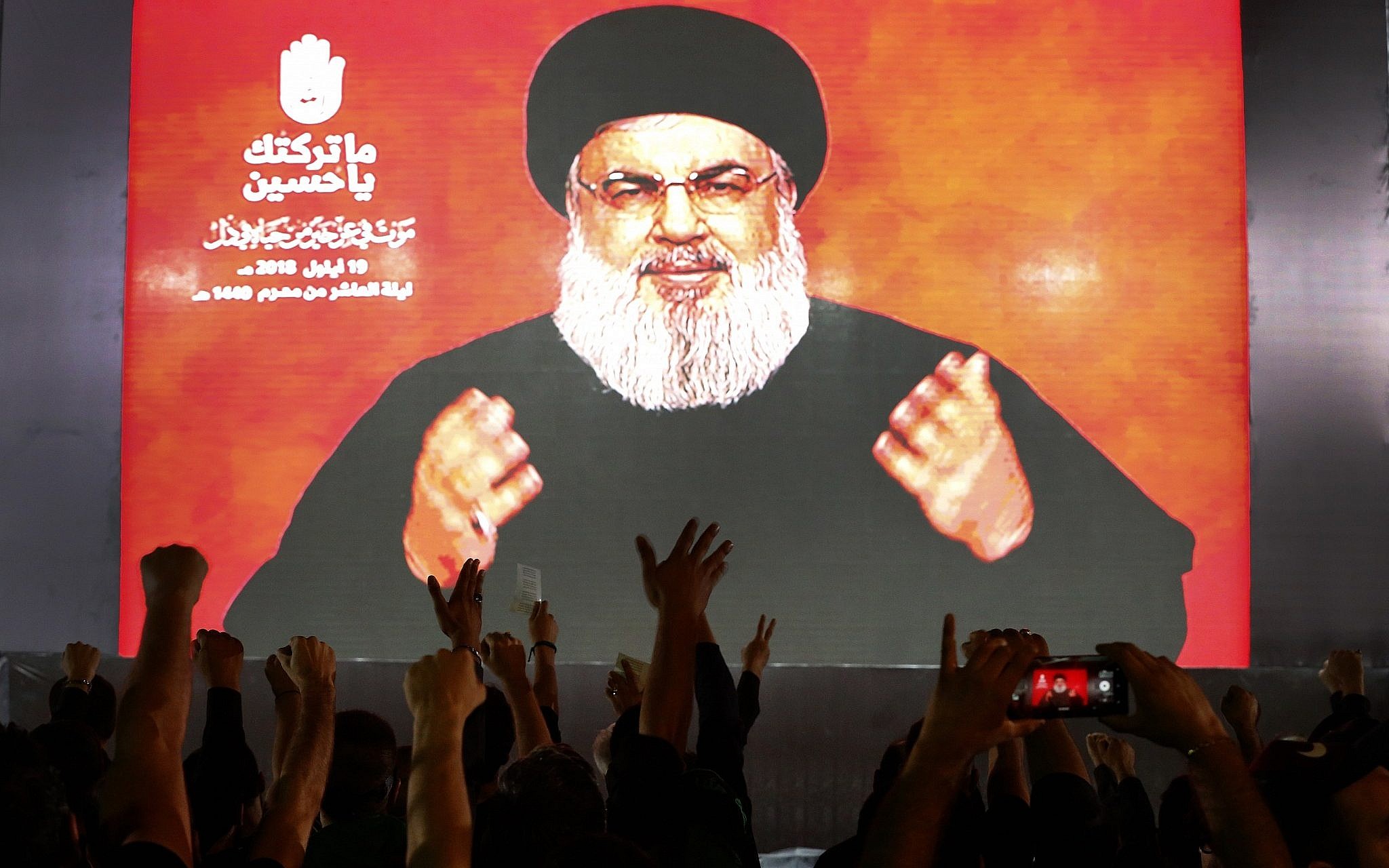
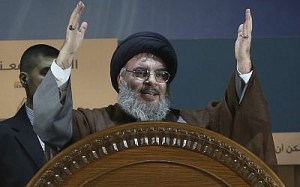
Hezbollah leader Sheik Hassan Nasrallah speaks via a video link, as his supporters raise their hands, during activities to mark the ninth of Ashura, a 10-day ritual commemorating the death of Imam Hussein, in a southern suburb of Beirut, Lebanon, on September 19, 2018. (AP Photo/Hussein Malla)

Hezbollah leader Sheik Hassan Nasrallah speaks via a video link, as his supporters raise their hands, during activities to mark the ninth of Ashura, a 10-day ritual commemorating the death of Imam Hussein, in a southern suburb of Beirut, Lebanon, on September 19, 2018. (AP Photo/Hussein Malla)

Amid reports of his failing health and a long absence from the public eye, Hezbollah leader Hassan Nasrallah will give an interview later this week to a television channel associated with the Lebanese terror group.

In a short promotional clip released Sunday, al-Mayadeen said Nasrallah would appear on the network Saturday evening. Nasrallah typically grants an interview to the satellite channel around this time each year.

“Hezbollah’s secretary-general breaks his silence that frightens the occupation,” the video said.

In the interview, Nasrallah is expected to address for the first time an operation launched by the Israeli military last month to locate and destroy cross-border tunnels dug by Hezbollah. The Israel Defense Forces have said the underground passages were meant to bring fighters into Israeli territory as part of an opening salvo in a future war.

The IDF announced the end of the Operation Northern Shield last week.

“In occupied Palestine, Israel’s leadership is boasting about its Northern Shield, taking pride in its battles against Hezbollah and Syria and threatening Iran. In this way, Hezbollah’s leader responds,” al-Mayadeen said.

Israeli troops search for attack tunnels dug into Israel from southern Lebanon that the Israeli military believes Hezbollah planned to use in future wars, in January 2019. (Israel Defense Forces)

Nasrallah has not made a public appearance in months, leading to unconfirmed reports he was in critical condition following a heart attack brought on by cancer.

An official from Iran, Hezbollah’s main backer, dismissed the rumors as a “Zionist lie.”

Earlier this month, Europe-based Lebanese journalist Jerry Maher tweeted that unnamed intelligence sources had confirmed Nasrallah was taken to the hospital in Beirut in critical condition, and that he has been battling cancer for years.

Maher posted Twitter updates including claims that Hezbollah rejected a suggestion for Nasrallah to be moved to the Syrian capital Damascus for treatment by Russian and Iranian doctors.

Some Hebrew media reports said that Nasrallah had suffered a heart attack.

Maher noted that the Hezbollah leader has not been seen for weeks.

Hezbollah leader Hassan Nasrallah gestures during a rally to mark Jerusalem Day or Al-Quds Day, in a southern suburb of Beirut, Lebanon, August 2, 2013. (AP Photo/Hussein Malla, File)

In the past, claims of Nasrallah’s death or severe illness have been countered by the publication of videos in which he was shown commenting on current affairs.

Nasrallah, 58, took over the Iran-backed Hezbollah group after its previous leader was killed in a 1992 targeted assassination by Israeli helicopters on his convoy.

As a precaution against a repeat of the incident, Nasrallah’s movements are shrouded in mystery with few public appearances. The Hezbollah leader frequently releases videos or live television broadcasts.

In his speeches, Nasrallah often makes threats to attack Israel. Hezbollah has accumulated an arsenal of hundreds of thousands of ground attack rockets, and is considered to be a more powerful military force than the Lebanese army.

Hezbollah is designated a terror organization, either entirely or partly, by Israel, the United States, the European Union and other countries.

Adam Rasgon contributed to this report.


Jihadists in Mali kill 10 peacekeepers over Netanyahu visit to Chad 

January 21, 2019

Source: Jihadists in Mali kill 10 peacekeepers over Netanyahu visit to Chad | The Times of Israel

Al-Qaeda in the Islamic Maghreb claims responsibility for attack on UN camp hours after Israeli PM visits Africa to re-establish ties with N’Djamena

In this July 28, 2013 photo, United Nations peacekeepers stand guard at a polling station, during presidential elections in Kidal, Mali. (AP/Rebecca Blackwell)

In this July 28, 2013 photo, United Nations peacekeepers stand guard at a polling station, during presidential elections in Kidal, Mali. (AP/Rebecca Blackwell)

BAMAKO, Mali — Jihadist gunmen angered by Chad forging ties with Israel killed 10 Chadian peacekeepers and injured at least 25 others in an attack on a UN camp in northern Mali on Sunday, one of the deadliest strikes against the UN mission in the West African country.

Al-Qaeda in the Islamic Maghreb (AQIM) claimed responsibility for the attack, saying it was “in reaction” to the visit to Chad by Israeli Prime Minister Benjamin Netanyahu, according to the Mauritanian Al-Akhbar news agency, which regularly receives statements from this jihadist group.

Netanyahu flew to Chad for a single-day visit Sunday, re-establishing ties with the Muslim-majority country after 47 years.

Netanyahu called the move ” a breakthrough into the heart of the Muslim world,” and lauded the fact that there was no opposition.

Prime Minister Benjamin Netanyahu, left, and Chad’s President Idriss Déby speak at a press conference at the presidential palace in N’Djamena, Chad on January 20, 2018. (Kobi Gideon/GPO)

Israel has in recent years established or upgraded ties with a number of African countries, including with Guinea, which neighbors Mali.

UN Secretary-General Antonio Guterres strongly condemned what he described as a “complex attack” on the peacekeepers camp in Aguelhok, in Kidal region and called for the perpetrators to be brought to justice.

“Ten peacekeepers from Chad were killed and at least 25 injured,” said a statement from UN spokesman Stephane Dujarric.

The gunmen struck early Sunday at the Aguelhok base 200 kilometers (125 miles) north of Kidal and towards the border with Algeria, according to a source close to the MINUSMA mission.

“MINUSMA forces responded robustly and a number of assailants were killed,” Dujarric said, without specifying the toll.

Mahamat Saleh Annadif, the UN envoy for Mali, condemned what he called a “vile and criminal” attack.

“Peacekeepers of the MINUSMA force at Aguelhok fought off a sophisticated attack by assailants who arrived on several armed vehicles,” he said in a statement.

The attack “illustrates the determination of the terrorists to sow chaos.

“It demands a robust, immediate and concerted response from all forces to destroy the peril of terrorism in the Sahel.”

Mali Islamist violence

On Sunday, France’s Defense Minister Florence Parly told French radio that the G5 Sahel anti-jihadist force in the region was resuming its operations.

They were suspended after an attack on their headquarters in mid-2018. The G5 force comprises contingents from Mali, Mauritania, Niger, Burkina Faso and Chad.

An attack at the same base last April killed two peacekeepers and left several others wounded.

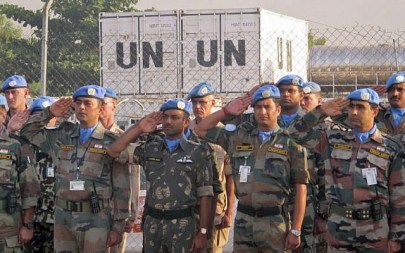
UN peacekeepers salute during a memorial service for two colleagues who were killed in an attack on the UN compound in Juba, South Sudan, Saturday, Dec. 21, 2013. (AP/United Nations Mission in South Sudan)

In October 2014, nine troops of a Nigerian contingent were killed in the northeast.

Some 13,000 peacekeepers are deployed in Mali as part of a UN mission.

It was established after Islamist militias seized the north of the country in 2012. They were pushed back by French troops in 2013.

A peace agreement signed in 2015 by the Bamako government and armed groups was aimed at restoring stability to Mali.

But the accord has failed to stop violence by Islamist militants, who have also staged attacks in neighboring Burkina Faso and Niger.

Earlier this month, both France and the United States criticized the authorities in Mali for their failure to stem the worsening violence.

On January 16, France threatened to push for more targeted sanctions to be imposed on Mali after hearing a UN official report on worsening violence in the West African country.

Washington renewed its warning that it would push for changes to the peacekeeping mission in Mali, possibly a major drawdown, if there was no progress.

In August, a panel of experts said in a report to the UN Security Council that inter-communal conflicts in the region were exacerbating existing tensions from clashes between jihadist groups and international and Malian forces.

Times of Israel staff contributed to this report.


Khartoum lets Netanyahu’s plane fly over South Sudan, in first for Israel

January 21, 2019

Source: Khartoum lets Netanyahu’s plane fly over South Sudan, in first for Israel | The Times of Israel

Flight back from Chad shortened by an hour as Sudan gives permission for PM’s jet to cross over airspace of southern neighbor, amid reports of diplomatic opening

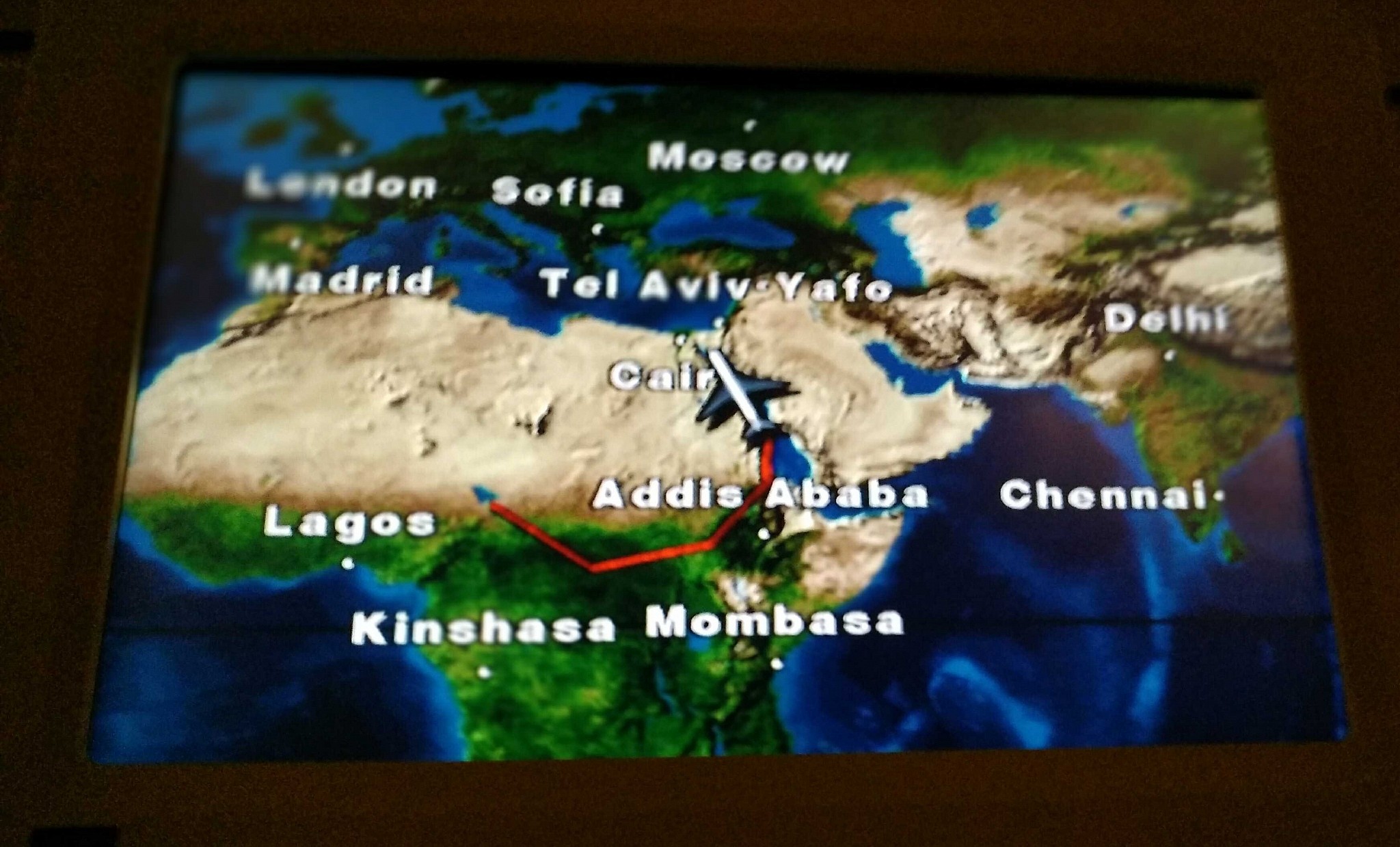
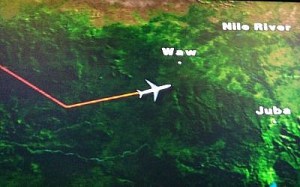
The flight path of Benjamin Netanyahu's plane over South Sudan, as seen on a screen inside Netanyahu's plane, January 20, 2019. (Rraphael Ahren)

The flight path of Benjamin Netanyahu’s plane over South Sudan, as seen on a screen inside Netanyahu’s plane, January 20, 2019. (Rraphael Ahren)

ABOVE SOUTH SUDAN — In an unprecedented move, Sudan on Sunday allowed an Israeli plane to cross over the air space it controls.

The flight, carrying Prime Minister Benjamin Netanyahu back to Israel from a lightning visit to Chad, jetted over South Sudan, whose skies are under the control of the civil aviation authorities in Khartoum.

The flight came hours after Netanyahu lauded Israeli “inroads” with the Islamic world as he and Chadian President Idriss Deby resumed ties, and amid a reported diplomatic push to reach an understanding with Khartoum to allow Israeli overflights above Sudan to shave hours off flights to western Africa and Latin America.

Israel has friendly relations with South Sudan, but the country’s airspace is controlled by its northern neighbor, which does not have diplomatic ties with the Jewish state.

Sunday’s flight was the first time an Israeli aircraft was allowed to fly over South Sudan, officials in the prime minister’s entourage said.

South Sudan, which is predominantly Christian, gained independence from Muslim Sudan several years ago, and the two countries are still hostile to each other. However, South Sudan’s civil aviation remains under Khartoum’s control.

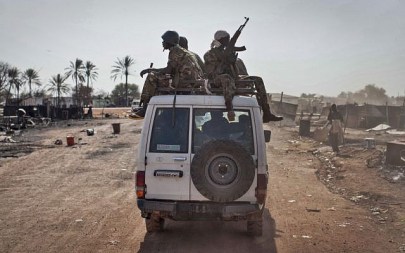
South Sudanese government forces ride on a vehicle, January 12, 2014. (AP/Mackenzie Knowles-Coursin, File)

The Prime Minister’s Office asked reporters who accompanied Netanyahu to Chad not to publish the flight over South Sudan before his plane landed at Tel Aviv’s Ben-Gurion Airport, presumably for security reasons and to prevent last-minute efforts to change the mind of the Sudanese authorities.

Shortly after takeoff, the captain announced that this was a “historic flight,” and that thanks to the shortcut the return flight would be about one hour shorter than the trip’s first leg.

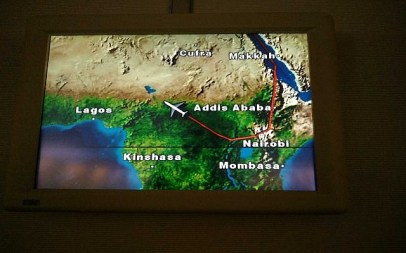
Earlier on Sunday, the prime minister’s plane took a long detour en route to Chad, flying south over the Red Sea and then across Eritrea, Ethiopia, Kenya, Uganda, the Democratic Republic of the Congo and the Central African Republic before entering Chadian airspace.

The flight path of Benjamin Netanyahu’s plane to Chad skirting Sudan, as seen on a screen inside Netanyahu’s plane, January 20, 2019. (Rraphael Ahren)

On the return flight, the El Al air craft flew from N’Djamena south to the Central African Republic but then turned eastward to cross over central South Sudan, from which it continued to Ethiopia and Eritrea to the Red Sea.

The flight path of Benjamin Netanyahu’s plane over South Sudan, as seen on a screen inside Netanyahu’s plane, January 20, 2019. (Rraphael Ahren)

Netanyahu had flown to Chad on Sunday to declare the resumption of diplomatic ties with the Muslim-majority country, together with Déby.

It was unclear whether Sudan’s decision to let Netanyahu’s jet fly over South Sudan was connected to Chad’s move Sunday. In November, Deby said during a visit to Israel in November that he would be willing to help Israel and Sudan negotiate forging ties.

Khartoum has said recently it was not changing its policy of forbidding Israeli planes from entering its airspace. Earlier this month, a Sudanese television station reported that Sudanese leader Omar al-Bashir had refused an request by a Kenyan airline to use its airspace for a flight to Tel Aviv.

However, Sunday’s unprecedented flight may indicate that Khartoum is willing to show flexibility regarding flyovers of third states under the control of civil aviation authority.

Netanyahu, who also serves as foreign minister, has in recent years pushed to open more flight paths to the Jewish state, including a direct route to India over Saudi Arabia and Oman.

Israeli and South American officials recently agreed to open a direct flight between Santiago and Israel, though the plane would still have to skirt Sudan, adding several hours to the time in the air.

Sudan has in recent years moved away from the geopolitical influence of Iran, which officials in the West have seen as an opportunity for a diplomatic breakthrough.

In the past, Sudan allegedly served as a way-station for the transfer of Iranian weapons to the Hamas terrorist group in Gaza. Israel has reportedly intercepted and destroyed transfers of weapons from Sudan bound for Gaza.

However, since it broke ties with Iran, Sudan is no longer perceived by Israel as a threat, but rather as a potential ally, amid a campaign by Netanyahu to forge open ties with more countries.

On Sunday, Israel added a record 160th country to the list of nations it has a relationship with, signing an agreement to resume bilateral ties with Chad.

Chad, a country of 15 million people, had severed ties in 1972 at the behest of Libyan dictator Muammar Gaddafi.

“We are making inroads into the Islamic world,” Netanyahu declared Sunday at N’Djamena’s presidential palace, minutes before he signed the formal document sealing the resumption of diplomatic relations.

Prime Minister Benjamin Netanyahu (R) and Chadian President Idriss Deby meet at the presidential palace in N’Djamena, Chad, on January 20, 2019. (Kobi Gideon/GPO)

“We are making history and we are turning Israel into a rising global power.”

A few moments later, at a briefing for the traveling press, Netanyahu said that Jerusalem’s increasingly robust ties with the Arab world helps Israel break the ice with Muslim-majority states in Africa that do not have formal diplomatic relations with Israel.

“This visit first and foremost teaches us about our standing in the Arab world,” Netanyahu said. “Not only that there wasn’t any opposition, but also, I say this unofficially, there was some support.”

He declined to say which countries expressed support for Chad’s decision to establish ties with Israel nearly 50 years after they were severed.


Israel bombs Iranian targets near Damascus as border tensions rocket

January 21, 2019

Source: Israel bombs Iranian targets near Damascus as border tensions rocket | The Times of Israel

IDF warns Syria not to intervene, hours after regime fires missile at Israel in apparent retaliation for daylight attack near capital; army shutters Mount Hermon ski resort

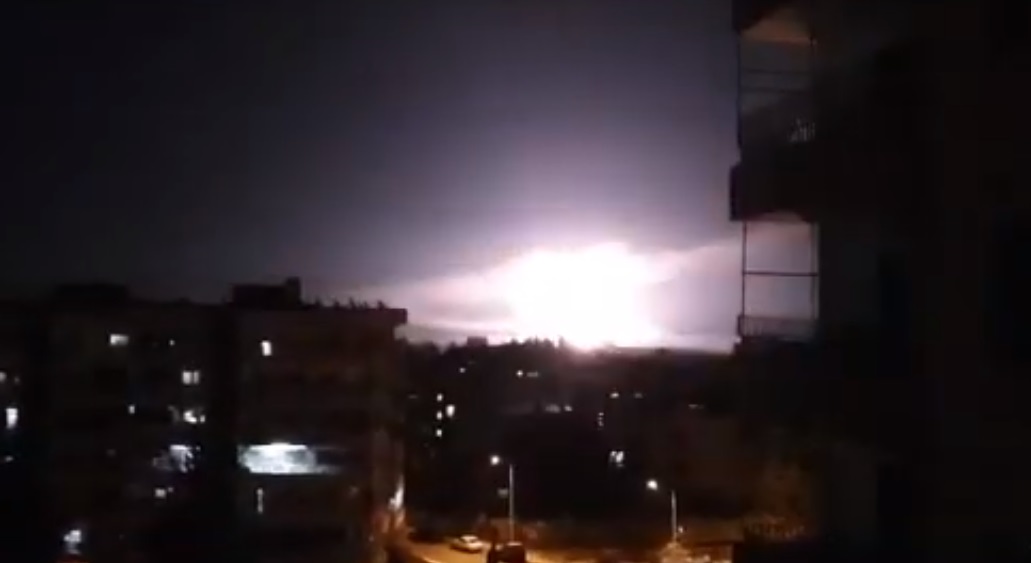
An explosion, reportedly  during Israeli airstrikes near Damascus, on January 21, 2019. (screen capture: YouTube)

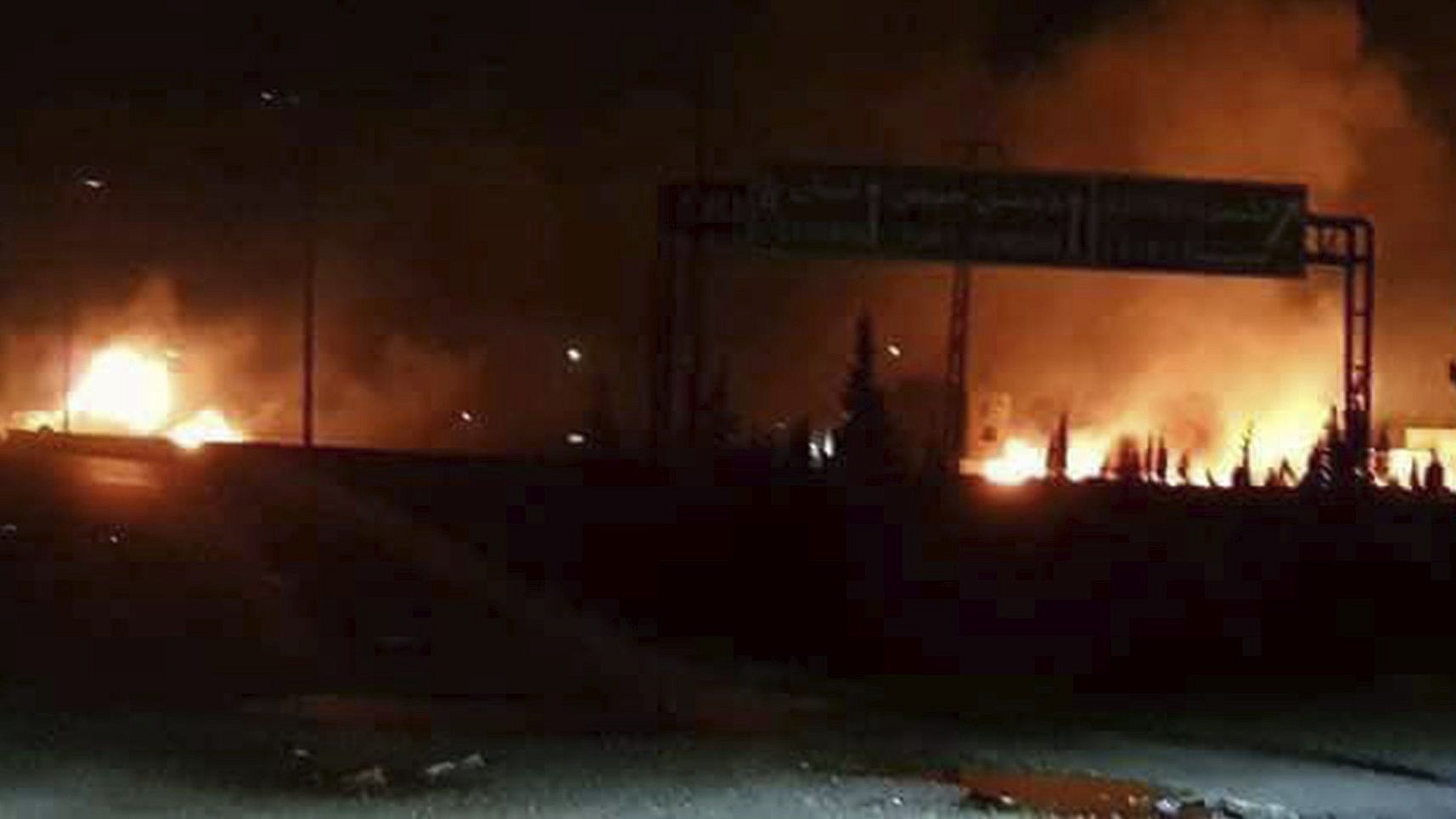
An explosion, reportedly during Israeli airstrikes near Damascus, on January 21, 2019. (screen capture: YouTube)

Israeli forces bombed targets belonging to Iran inside Syria early Monday morning, the Israel Defense Forces said in a statement, as tensions on the northern border continued to skyrocket.

The IDF said at 1:30 a.m. it was “striking Iranian Quds targets in Syrian territory,” and warned Syrian forces not to intervene.

“The IDF warns the Syrian Armed Forces against attempting to harm Israeli territory or forces,” the army said in an exceedingly rare statement.

The attack came less than a day after Israel reportedly carried out a rare daylight strike on targets near Damascus, sparking Syria to fire a retaliatory missile at Israel, and ratcheting up concerns of a wider confrontation between Israel and Iran in Syria.

Syria’s state-run SANA news outlet claimed Monday morning that its air defenses had shot down a number of “hostile targets.”

Videos posted online appeared to show Syrian air defense missiles being launched.

SANA claimed the strikes had come from the direction of Lebanese airspace and said explosion were heard near Damascus.

According to the Britain-based Syrian Observatory for Human Rights war monitor, the airstrikes tageted Iranian and Hezbollah warehouses at Damascus airport and other locations in the south and west of the capital.

The Quds Force is Iran’s expeditionary unit inside the powerful Islamic Revolutionary Guards Corps, which Israel and others accuse of trying to gain a military foothold in Syria.

On Sunday, Syria shot a missile at Israeli territory, in apparent response to a rare daylight attack on targets in and around Damascus widely attributed to Israel.

Israel’s air defenses managed to down the surface to surface missile before it reached Israeli airspace over the Golan Heights, according to the military.

Signaling fears of a fresh attack on Israel, the army announced it would shutter the Mount Hermon ski resort on Monday. On Sunday, the popular site had remained open despite the missile attack nearby.

Embedded video

The cross-border fire comes less than a week after IDF Chief of Staff Aviv Kohavi took office.

The IDF announcement regarding the strike Monday morning attack was nearly unprecedented, after years of maintaining a policy of strategic ambiguity regarding its air campaign against Iran gaining a military foothold in Syria.

Israeli prime minister Benjamin Netanyahu and other officials have seemingly become more open about Israel’s military efforts in Syria, even as the installation of more advanced Russian air defense systems and tensions with Moscow have complicated the campaign.

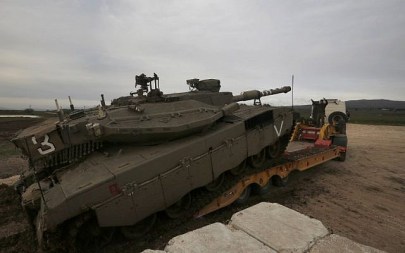
An Israeli army Merkava tank is loaded into a truck in the Golan Heights, on January 20, 2019. ( JALAA MAREY / AFP)

On Sunday Netanyahu appeared to confirm that Israel was behind the daylight strike while speaking to reporters in Chad.

“We have a permanent policy to hurt the Iranian entrenchment in Syria, and everyone who is trying to hurt us,” Netanyahu said. “This policy doesn’t change, whether I am in Israel or on a historic visit in Chad. It’s permanent.”

Local Syrian media said the targets of strike were in Damascus International Airport and in the town of al-Kiswah, south of the capital, both of which have been hit by Israeli attacks in the past. Last year, the Israeli military said bases near al-Kiswah were used by pro-Iranian militias. An Iranian weapons depot at the airport was targeted in an airstrike a week and a half ago, Israel said.

Israel typically refrains from commenting on individual airstrikes in Syria, but does generally acknowledge that it carries out raids against Iranian- and Hezbollah-linked targets in the country.

Israel in recent years has carried out hundreds of airstrikes in Syria against targets linked to Iran, which alongside its proxies and Russia is fighting on behalf of the regime of Syrian President Bashar Assad.

Israel has accused Iran of seeking to establish a military presence in Syria that could threaten Israeli security and attempting to transfer advanced weaponry to the Hezbollah terror group in Lebanon.


Israeli strikes said to destroy Iranian, Hezbollah sites near Damascus

January 21, 2019

Source: Israeli strikes said to destroy Iranian, Hezbollah sites near Damascus | The Times of Israel

Bombings inflict heavy damage on weapons warehouses and military positions near airport and other areas, with casualties reported; Syria calls attack ‘heavy’

Illustrative: Flames rising after an attack in an area known to have numerous Syrian army military bases, in Kisweh, south of Damascus, released by Syria's official news agency on May 9, 2018. (SANA, via AP)

Illustrative: Flames rising after an attack in an area known to have numerous Syrian army military bases, in Kisweh, south of Damascus, released by Syria’s official news agency on May 9, 2018. (SANA, via AP)

Massive Israeli airstrikes on Syria destroyed weapons stores and military positions belonging to Iran and the Lebanese Hezbollah terror group, a war monitor said Monday.

The Israeli military said early Monday it was carrying out strikes against Iran’s Qud’s Forces, in a rare statement on its military activities in Syria.

“The Israeli missiles managed to destroy weapons depots and military posts of the Iranians and the Lebanese Hezbollah in the vicinity of Damascus International Airport and the area of Al-Kiswah and Jamraya,” the Britain-based Observatory for Human Rights said.

The monitor said there had been casualties and extensive damage, without providing details. A news site in the southern Syrian city of Suweida reported that eight soldiers had been brought to a local hospital with injuries sustained during the Israeli strikes, including two who died.

There was no immediate confirmation of casualties from Damascus. Syria’s state-run media described the attack as “heavy” and said Israel had launched “consecutive waves of guided missiles.” However, it claimed the majority of the missiles were shot down.

“Our air defenses responded effectively to an Israeli air attack targeting the southern region and prevented it from achieving any of its objectives,”SANA quoted a military source saying.

The airstrike was the second attack on the airport and al-Kiswah in as many days, after a rare daytime attack attributed to Israel on Sunday morning. Both locations have been attacked by Israel in the past and are thought to house Iranian or Hezbollah assets.

“Warehouses containing weapons for Syrian regime ally Hezbollah and Iranian fighters are located in that area,” Rami Abdel Rahman, head of the Syrian Observatory for Human Rights war monitor, said Sunday.

Israel has accused Iran of seeking to establish a military presence in Syria that could threaten Israeli security and attempting to transfer advanced weaponry to the Hezbollah terror group in Lebanon.

Last year, the Israeli military said bases near al-Kiswah were used by pro-Iranian militias. An Iranian weapons depot at the airport was targeted in an airstrike a week and a half ago, Israel said.

Jamraya, which has also allegedly been attacked by Israel in the ast, is thought to house a military facility and scientific research center.

A Google Earth view of a Syrian scientific facility in Jamraya, near Damascus, before it was allegedly struck by Israeli warplanes in late January. (photo credit: image capture from Google Earth)

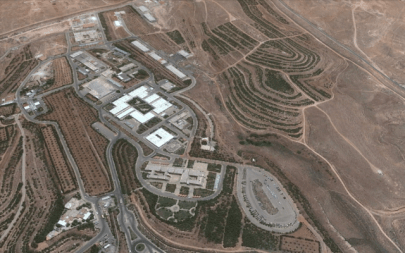
A Google Earth view of a Syrian scientific facility in Jamraya, near Damascus, before it was allegedly struck by Israeli warplanes in late January 2013. (photo credit: image capture from Google Earth)

The Israeli attack Monday morning was widely seen as a response to a surface to surface missile fired at Israel Sunday, apparently in retaliation for the earlier airstrikes.

Israel intercepted the missile near the Mount Hermon ski resort, but on Monday said it would shut the site, apparently signaling fears violence could continue to escalate.

For years, Israel has conducted airstrikes against Iranian and Hezbollah targets in Syria, which it considers threats to national security. However, those attacks typically take place under the cover of darkness.

The strike appeared to be the first major attacks carried out by the Israel Defense Forces since Aviv Kohavi took over as chief of staff last week.

The alleged strike Sunday came hours after a Syrian cargo plane touched down in the Damascus International Airport from Tehran, according to publicly available flight data. Israel and American defense officials have said these types of ostensibly civilian cargo planes are often used to transport advanced weaponry from Tehran to pro-Iranian militias, fighting in Syria, including the Hezbollah terror group.

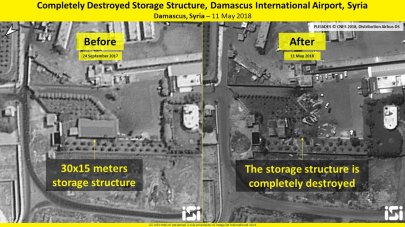
Satellite image allegedly showing damage to buildings at Damascus International Airport caused by a May 11 Israeli airstrike, released by ImageSat International, on May 13, 2018. (ImageSat International)

Another flight from Iran, flown by Tehran’s Mahan Air carrier, was en route to Syria on Sunday afternoon, but turned back following the reported Israeli strikes, according to flight data. Mahan Air has been identified by defense officials as one of the cargo carriers suspected of ferrying war materiel from Iran to Syria. As a result, it is subject to sanctions by the US Treasury Department.