Archive for January 19, 2019

Off Topic:  Wiesenthal Center slams Muslim lawmakers for anti-Semitic, anti-Israel remarks

January 19, 2019

Source: Wiesenthal Center slams Muslim lawmakers for anti-Semitic, anti-Israel remarks | The Times of Israel

The Jewish human rights group writes to Nancy Pelosi to complain about ‘extreme’ comments from newly elected Democrats Rashida Tlaib and Ilhan Omar

This combination of 2018 photos shows Reps.-elect Ilhan Omar, D-Minn., left, and Rashida Tlaib, D-Mich., in Washington. On Friday, Dec. 21, 2018 The two became the first and only Muslim women elected to Congress in 2018. (AP Photo/Carolyn Kaster,)

This combination of 2018 photos shows Reps.-elect Ilhan Omar, D-Minn., left, and Rashida Tlaib, D-Mich., in Washington. On Friday, Dec. 21, 2018 The two became the first and only Muslim women elected to Congress in 2018. (AP Photo/Carolyn Kaster,)

The Simon Wiesenthal Center wrote to House speaker Nancy Pelosi on Friday to complain about comments made by two freshman Muslim Congresswomen, labeling them “extreme anti-Israel and anti-Semitic statements.”

The Jewish human rights group singled out Michigan Congresswoman Rashida Tlaib for comments she made earlier in the month questioning the loyalty of lawmakers who were pushing a bill that would protect states that penalize Israel boycotters.

Tlaib, in a January 6 tweet, attacked a Senate bill initiated by Senator Marco Rubio and Senator James Risch, an Idaho Republican, that incorporates four Middle East-related bills that languished in the last Congress.

One of the measures protects states that pass anti-BDS bills, including those that ban work with contractors who boycott Israel, from lawsuits. Civil libertarians have decried the state laws as impinging on speech freedoms.

“They forgot what country they represent,” tweeted Tlaib, the first Palestinian-American women in Congress.  “This is the US where boycotting is a right & part of our historical fight for freedom & equality.”

Rashida Tlaib

@RashidaTlaib

Bernie Sanders

@SenSanders

It’s absurd that the first bill during the shutdown is legislation which punishes Americans who exercise their constitutional right to engage in political activity. Democrats must block consideration of any bills that don’t reopen the government. Let’s get our priorities right. https://twitter.com/theintercept/status/1081664403622252544 

The Simon Wiesenthal Center decried the tweet, saying it was a “cynically alleged ‘dual loyalty’ screed, historically a dog whistle for anti-Semites.”

And it pointed out that “Tlaib also now endorses a ‘One-State Solution’ in the Holy Land.”

“Congressperson Tlaib has every right to be proud that she came to this country as a refugee and has every right to advocate for the rights of Palestinians,” said the letter signed by the center’s Rabbi Marvin Hier, and Rabbi Abraham Cooper.

Rashida Tlaib (in red thobe and glasses), accompanied by her family, being sworn in with Speaker of the House Nancy Pelosi (in pink dress), at the US Capitol in Washington, DC, January 3, 2019. (Chip Somodevilla/Getty Images/AFP)

“But Speaker Pelosi, as the leader of the Democratic Party, you should make clear that a one-state solution is a code word for the destruction of the state of Israel – home to the world’s largest Jewish population — and violates everything you and your father have spent your lives defending,” the Rabbis concluded.

The letter also complained about remarks by Minnesota Congresswoman Ilhan Omar, who earlier this week defended a previous tweet calling Israel “evil” and said she couldn’t understand why American Jews would be upset.

“Those unfortunate words were the only words I could think about expressing at that moment,” Omar, a Minnesota Democrat, told CNN’s Christiane Amanpour in an interview aired Wednesday night.

The tweet, which said that “Israel has hypnotized the world, may Allah awaken the people and help them see the evil doings of Israel,” came in reaction to Israel’s November 2012 operation against Hamas in Gaza.

“What is really important to me is that people recognize that there is a difference between criticizing a military action by a government that has exercised really oppressive policies and being offensive or attacking to particular people of faith,” said Omar.

Amanpour asked Omar if Jewish Americans “should be worried” about her views because of her support of the Boycott, Divestment and Sanctions movement against Israel or tweets such as the one from 2012.

“In that tweet and in any other conversation I’ve had, I only talk about the State of Israel,” Omar said. “And I think it is really important for us to make sure that we are not associating the people with the country and its government.”

Prior to her election to Congress in November, Omar called BDS “counteractive” and said it prevents dialogue, but a week after her victory she told the Muslim Girl website that she “believes in and supports the BDS movement.”


 

Russia tells Israel to stop airstrikes near Damascus Airport — report 

January 19, 2019

Source: Russia tells Israel to stop airstrikes near Damascus Airport — report | The Times of Israel

( F_ck ’em… – JW )

According to pan-Arab daily, Moscow preparing to renovate airport damaged in 8 years of fighting, says IDF raids deterring airlines from resuming operations

Illustrative: Missiles rise into the sky as Israel hits an air defense position and other military bases, in Damascus, Syria, May 10, 2018. (Syrian Central Military Media, via AP)

Illustrative: Missiles rise into the sky as Israel hits an air defense position and other military bases, in Damascus, Syria, May 10, 2018. (Syrian Central Military Media, via AP)

The Russian government has reportedly asked Israel to halt its airstrikes against Iranian targets near the Damascus airport, the pan-Arab al-Quds al-Araby reported on Friday.

According to the report, Russian military officials said Moscow was preparing to renovate the airport that has been damaged in the eight years of fighting in the Syrian civil war. The unnamed officials said the Israeli strikes on Iranian and Hezbollah targets in the vicinity of the airport were causing foreign airlines to reconsider resuming flights to the Syrian capital.

Israel in recent years has carried out hundreds of airstrikes in Syria against targets linked to Iran, which alongside its proxies and Russia is fighting on behalf of the regime of Syrian President Bashar Assad. A number of the strikes have targeted the Damascus airport in a bid to halt weapons transfers from Iran to its militias in Syria and Lebanon.

Israel has accused Iran of seeking to establish a military presence in Syria that could threaten Israeli security and attempting to transfer advanced weaponry to the Hezbollah terror group in Lebanon.

The reported Russian request comes less than a week after Prime Minister Benjamin Netanyahu broke with longstanding Israeli policy and publicly acknowledged the IDF was behind a raid in Syria days earlier. The strike destroyed a number of weapons caches in the Damascus airport, Netanyahu said.

Satellite image allegedly showing damage to buildings at Damascus International Airport caused by a May 11 Israeli airstrike, released by ImageSat International, on May 13, 2018. (ImageSat International)

The number of airstrikes in Syria attributed to Israel has dropped in recent months, after a Russian military plane was downed by Syrian air defenses during an Israeli attack on Latakia, killing all 15 servicemen aboard.

Russia blamed the Israeli military for that incident — a charge rejected by Jerusalem — and has supplied Syria with the advanced S-300 air defense system. The systems were delivered to Syria late last year, but they are not yet believed to be in use, as the Syrian air defense teams still need to be trained to operate them.

At a farewell ceremony for outgoing IDF chief of staff Gadi Eisenkot this week, Netanyahu said Israel’s intention to strike only the Iranian and Iranian-linked targets in Syria was “understood by all,” including Russian President Vladimir Putin and his military chief.

The prime minister’s remark appeared to be an effort to assuage concerns that Israel’s ability to operate in Syria was being curbed by Russia at a time when the US is withdrawing its military presence from the country.

Trump’s abrupt decision to pull America’s 2,000 troops from Syria stunned regional players, US politicians, and military leaders, who expressed surprise that such a major decision would be announced after apparently so little advance consultation, and against the advice of his national security advisers. Trump’s secretary of defense, James Mattis, resigned over the withdrawal.

A blast caused by an Israeli airstrike on Iranian targets in the Damascus International Airport on January 11, 2019. (Screen capture: Twitter)

US soldiers have been leading the coalition against the Islamic State terror group, while also helping to thwart the establishment of permanent Iranian military infrastructure in Syria.

Israeli officials have warned that America’s absence would open the door for Tehran to create a so-called “land bridge” from Iran, through Iraq and Syria, into Lebanon and to the Mediterranean Sea.

Trump’s announcement also was the first significant point of contention between Washington and Jerusalem since he took office — Netanyahu reportedly pleaded with him to rethink the decision — and has fortified the perception that he views the US relationship with Israel as transactional.

Last month, US Secretary of State Mike Pompeo told Netanyahu the planned withdrawal of ground forces from Syria would not alter America’s commitment to countering Iranian aggression and maintaining Israel’s security.

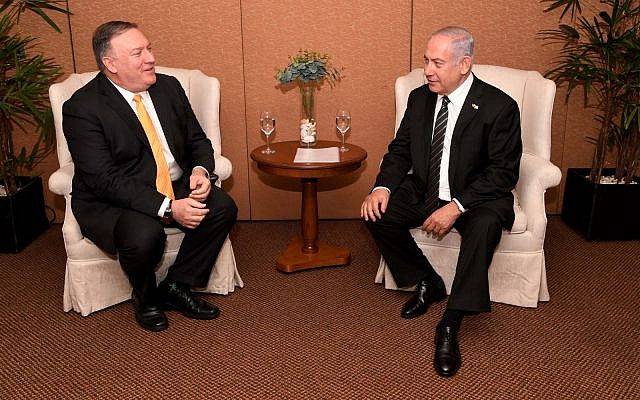
US Secretary of State Mike Pompeo (L) meets with Prime Minister Benjamin Netanyahu in Brasilia on January 1, 2019 (Avi Ohayon/GPO)

The pullout announced before Christmas was initially expected to be completed within weeks, but the timetable has slowed as the president acceded to requests from aides, allies and members of Congress for a more orderly drawdown.

Last week, a US official said Washington would be “very supportive” of Israeli strikes against Iranian targets in Syria. Speaking ahead of a visit to Israel by National Security Adviser John Bolton, the source said the White House had sent Bolton to Israel to ally its fears regarding the growing Iranian activity in the region.


Europe versus Iran, sanctions and agreements – Jerusalem Studio 389 

January 19, 2019