Archive for January 9, 2019

Netanyahu seeking to meet with Trump two weeks before elections – report

January 9, 2019

Source: Netanyahu seeking to meet with Trump two weeks before elections – report | The Times of Israel

Sources tell newspaper that arrangements are being made for sit-down while PM is in Washington for annual AIPAC conference

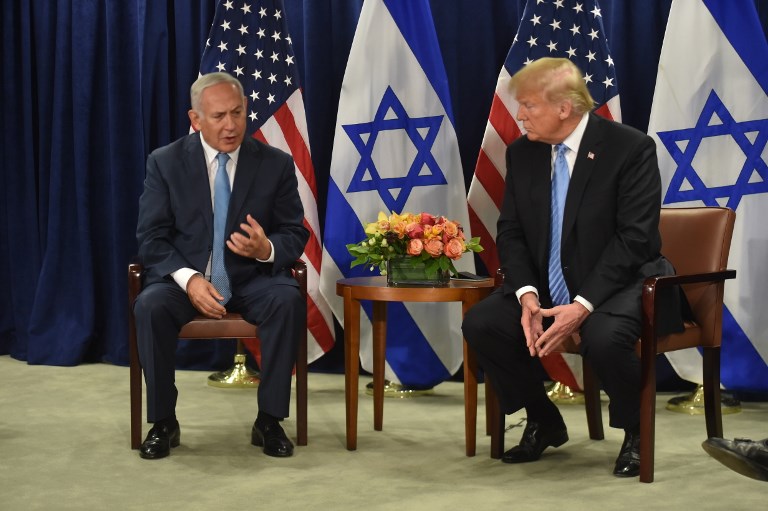
US President Donald Trump meets with Israeli Prime Minister Benjamin Netanyahu on September 26, 2018 in New York on the sidelines of the UN General Assembly. (AFP PHOTO / Nicholas Kamm)

US President Donald Trump meets with Israeli Prime Minister Benjamin Netanyahu on September 26, 2018 in New York on the sidelines of the UN General Assembly. (AFP PHOTO / Nicholas Kamm)

Prime Minister Benjamin Netanyahu is hoping to meet with US President Donald Trump in Washington just two weeks before April’s national elections, the Israel Hayom daily newspaper reported on Wednesday.

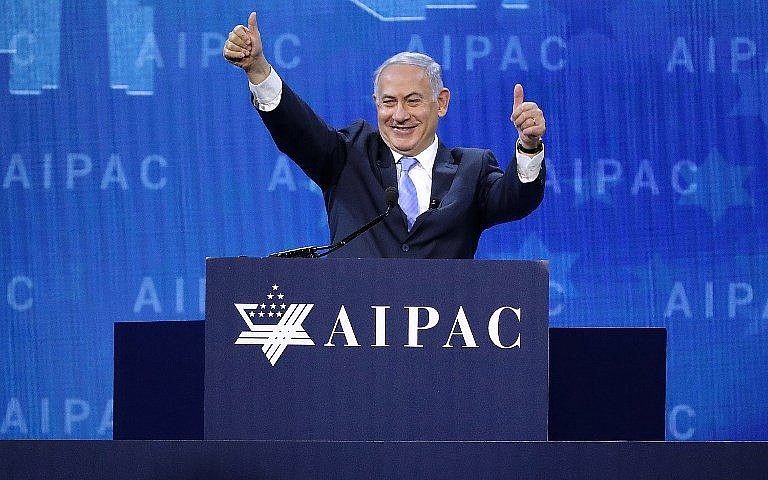
Sources told the pro-Netanyahu paper that arrangements for the meeting have yet to be finalized, but that it would be held at the White House while Netanyahu is in Washington for the American Israel Public Affairs Committee’s policy conference in March.

“The prime minister regularly speaks at the annual AIPAC conference and the plan is that he will travel to Washington this year too, despite the proximity to the elections,” a source close to Netanyahu source told the paper.

The two men last met on the sidelines of the UN General Assembly in September 2018.

This year’s AIPAC conference is scheduled for March 24-26, two weeks before the elections on April 9.

Prime Minister Benjamin Netanyahu addresses the American Israel Public Affairs Committee’s annual policy conference at the Washington Convention Center March 6, 2018 in Washington, DC. (Chip Somodevilla/Getty Images/AFP)

Netanyahu and Trump may meet even earlier, at the World Economic Forum in Davos, Switzerland at the end of the month.

The form runs January 22-25; however, it is not yet clear if Trump will make it to the annual gathering of world leaders, in light of to the US federal government shutdown.

A White House source told Israel Hayom, “At the moment we don’t have anything to announce.”

Along with the prime minister, the AIPAC conference also invites other senior figures in Israeli politics, including the leaders of political parties from both the coalition and the opposition. The roster of speakers for this year’s conference has not yet been published.

Agencies and Times of Israel staff contributed to this report.


US puzzles over fate of Islamic State fighters captured in Syria

January 9, 2019

Source: US puzzles over fate of Islamic State fighters captured in Syria | The Times of Israel

As groundwork is laid for planned withdrawal of troops, Trump administration works to find solution for imprisoned terrorists whose release is ‘unacceptable’

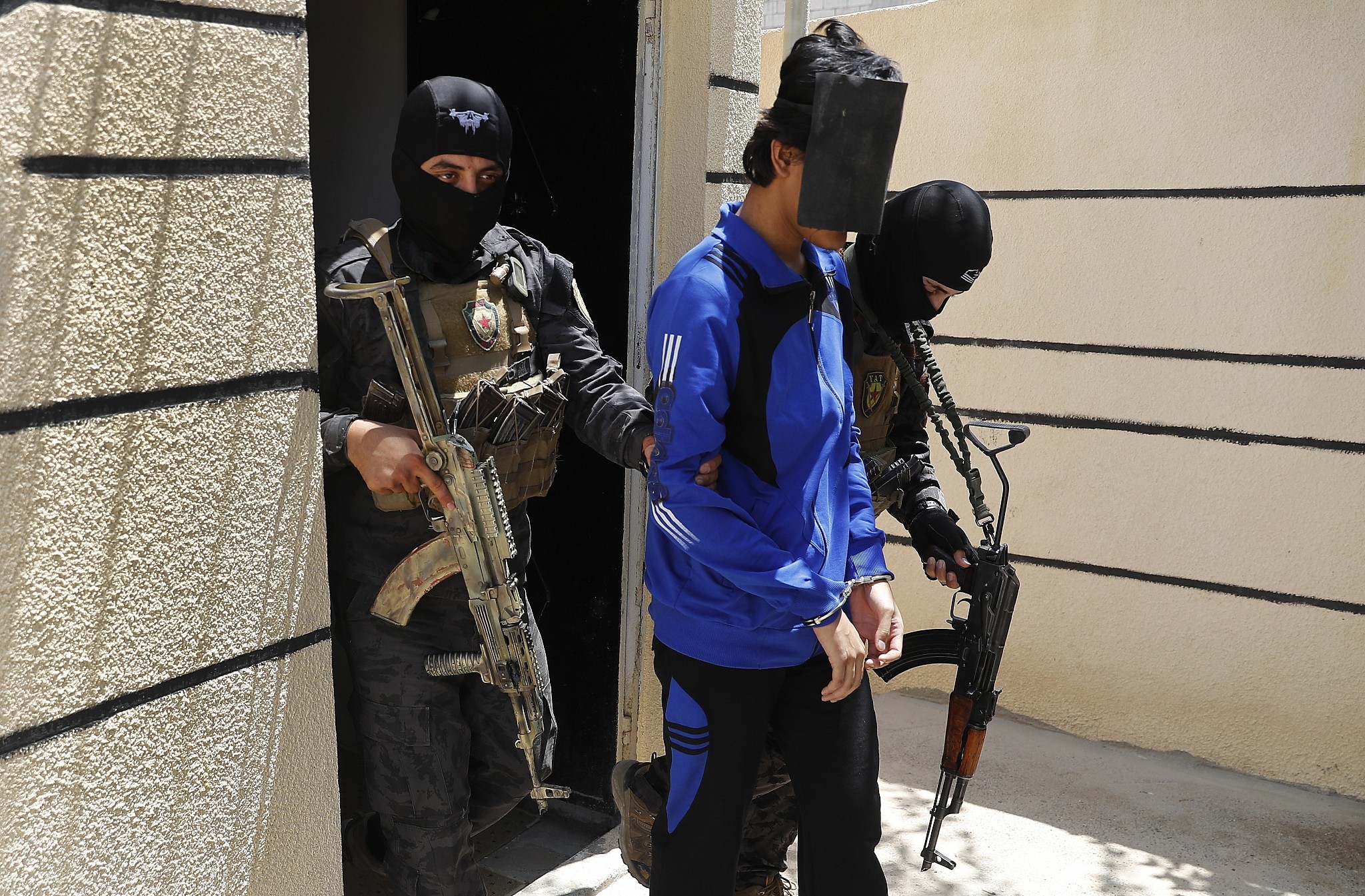
In this July 21, 2017, file photo, Kurdish soldiers from the Anti-Terrorism Units, carry a blindfolded an Indonesian man suspected of Islamic State membership, at a security center, in Kobani, Syria (AP Photo/Hussein Malla, File)

In this July 21, 2017, file photo, Kurdish soldiers from the Anti-Terrorism Units, carry a blindfolded an Indonesian man suspected of Islamic State membership, at a security center, in Kobani, Syria (AP Photo/Hussein Malla, File)

WASHINGTON (AP) — What to do with hundreds of foreign Islamic State fighters captured in Syria has become a critical and growing problem for the Trump administration as it prepares to pull troops out of the country.

A senior administration official said Tuesday that resolving the fate of these prisoners is a top priority as the government lays the groundwork with allies to comply with US President Donald Trump’s December 19 order to withdraw the 2,000 American troops from Syria, where they have been working alongside the US-backed Syrian Defense Forces to fight the Islamic State group since 2015.

But there are no easy answers. The official, speaking on condition of anonymity, said releasing the fighters, among them Europeans and some US citizens, would be “unacceptable” since they could simply rejoin the remnants of Islamic State fighters in Syria or elsewhere.

“This matters because SDF holds hundreds of IS fighters, including many European citizens, and they might go free if no solution is found,” said Bobby Chesney, a national security law expert at the University of Texas.

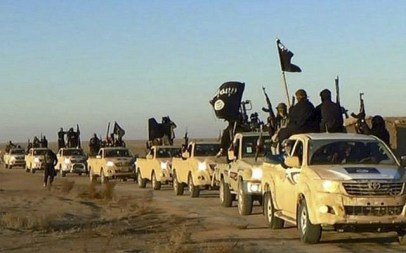
In this undated file photo, militants of the Islamic State group hold up their weapons and wave its flags on their vehicles in a convoy to Iraq, in Raqqa, Syria. (Militant website via AP, file)

European nations have been reluctant to take back citizens with ties to the Islamic State, not wanting the legal challenge of prosecuting them or the potential security risk if they are released.

And moving former fighters to the United States poses some of the same challenges the US has faced with men detained at the military base at Guantanamo Bay, Cuba, including whether it’s feasible to prosecute militants captured on the battlefields of northern Syria, according to experts.

“It’s one thing for the government to be very confident that an individual joined or tried to join ISIS. And sometimes it’s still another thing for the government to be able to mount confidently a criminal prosecution against that individual,” said Joshua Geltzer, a senior counterterrorism official under President Barack Obama.

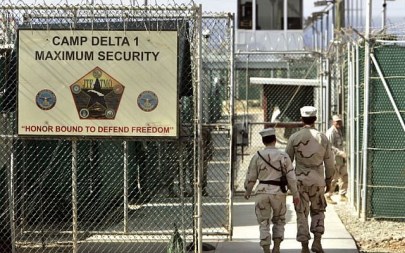
US military guards walk within Camp Delta military-run prison, at the Guantanamo Bay US Naval Base, Cuba, June 27, 2006. (AP Photo/Brennan Linsley, file)

Meanwhile, the prisoner problem is only growing worse.

On Sunday, the Syrian Defense Forces announced the capture of five fighters, including two US citizens, one of whom has been identified as a former school teacher from Houston.

US Secretary of State Mike Pompeo just began a tour of eight Middle Eastern nations to discuss the withdrawal of the American troops. National security adviser John Bolton returned Tuesday from a meeting in Turkey, where he was seeking a guarantee of safety for the Kurdish fighters who have fought alongside US troops against the Islamic State.

US Secretary of State Mike Pompeo speaks to reporters on December 12, 2018, at United Nations headquarters. (AP Photo/Mary Altaffer)

There are fears that the US withdrawal will leave a door open for Turkey to assault the US-allied SDF fighters. Turkey views them as part of a terrorist group linked to an insurgency within its own borders. SDF commanders have warned that they will be unable to hold the 700 prisoners if Turkish forces invade Syria following a US withdrawal.

Administration officials so far do not have a plan for what to do with the prisoners, according to a separate US official, who said that few countries have been willing to accept any of their captured citizens. Both officials spoke on condition of anonymity because they weren’t authorized to disclose the information publicly.

In a recent case of an American suspected of IS membership, US officials wrestled for more than a year, never charged him and then ultimately released him in Bahrain.

The problem has been further complicated by conflicting reports of Trump’s timeline for recalling the 2,000 US troops from Syria. When he made his surprise announcement of the withdrawal three weeks ago, Trump said he wanted to complete it quickly. His abrupt decision led to the resignations of Defense Secretary Jim Mattis and Brett McGurk, special presidential envoy for the global coalition to defeat IS.

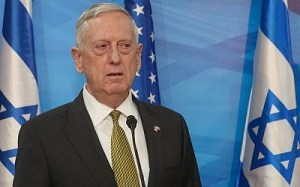
US Secretary of Defense Jim Mattis at a press conference with Prime Minister Benjamin Netanyahu (unseen) at the latter’s office in Jerusalem on April 21, 2017. (Marc Israel Sellem/Pool/Flash90)

More recently, Trump and other administration officials have insisted they favor an orderly pullout. The senior administration official said the US will defeat remaining IS fighters on the way out to prevent a resurgence and that the U.S. will oppose any mistreatment of opposition forces, such as the SDF, that fought with the United States against IS.

“These questions are hard enough, if you know the timeline on which you’re making them — if you know what the US involvement will or won’t be over that timeline,” Geltzer said.

One of the foreign fighters recently captured is Warren Christopher Clark, a former substitute schoolteacher from Houston, Texas, who was first identified by George Washington University’s Program on Extremism. Researchers spent months investigating to confirm his identity through multiple sources. The program has identified more than 73 Americans, by their legal names, who are known to have joined jihadist groups.

“Clark is one of several dozen Americans to join the Islamic State out of the around 295 whom intelligence officials claim have traveled or attempted to travel to Syria and Iraq to join the terrorist group,” according to Seamus Hughes, deputy director of the Program on Extremism.

Clark was captured along with four other foreign jihadists — two from Pakistan, one from Ireland and a fourth man, Zaid Abed al-Hamid, who also is believed to be from the United States, although that has not been confirmed.

In a letter to IS that was obtained by the researchers, Clark submitted a resume noting that he had a bachelor’s degree from the University of Houston, had worked as a substitute teacher at the Fort Bend Independent School District in Sugar Land, Texas, and had done teaching stints in Saudi Arabia and Turkey.

“Dear Director, I am looking to get a position teaching English to students in the Islamic State,” he wrote to the group in an accompanying cover letter. “Teaching has given me the opportunity to work with people from diverse cultural backgrounds and learning capabilities.”


When Hamas and Fatah fight, the ricochets are likely to end up hitting Israel

January 9, 2019

Source: When Hamas and Fatah fight, the ricochets are likely to end up hitting Israel | The Times of Israel

Relations between Palestinian factions are again threatening to explode, after the PA abandoned the Rafah crossing, leading to its closure

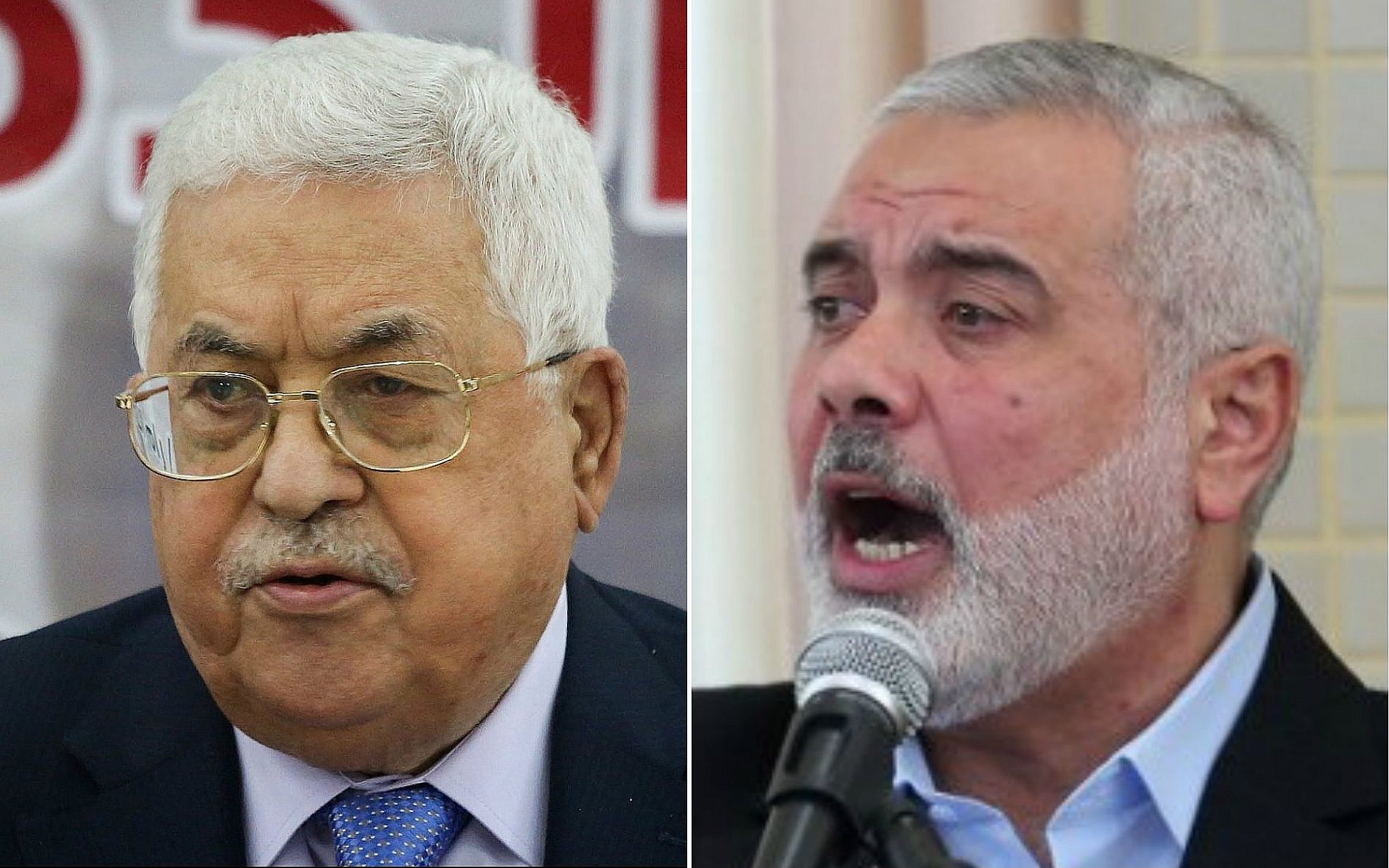
Palestinian Authority President Mahmoud Abbas (left) and Hamas leader Ismail Haniyeh (Flash90, SAID KHATIB/AFP)

Palestinian Authority President Mahmoud Abbas (left) and Hamas leader Ismail Haniyeh (Flash90, SAID KHATIB/AFP)

It’s hard to tell who started the latest dispute between Palestinian factions Fatah and Hamas. Was it an arrest campaign by the Palestinian Authority in the West Bank, or a major wave of arrests of Fatah operatives by Hamas in the Gaza Strip?

Either way, one thing is clear: The fallout from the current tussle between the rival groups will surely be felt by Israel, including in the form of an escalation in violence.

The latest headline coming from intra-Palestinian politics has been PA staff abandoning the Rafah crossing, a step that has caused the closure of the only passage for Gazans to travel overseas.

The crossing had been operating for many months with Egypt’s blessing, manned by PA staff, significantly easing the feeling of being besieged in Gaza. Though exit was by no means free, and not many people had been permitted to pass through, the crossing’s continued operation gave the population some feeling of change.

That ended when the PA announced in recent days that it was evacuating the officials who had been operating the crossing and supervising the entries and exits from Gaza. The Egyptians, who refuse to cooperate with the Hamas terror group as a government authority, reacted by closing their side of the crossing.

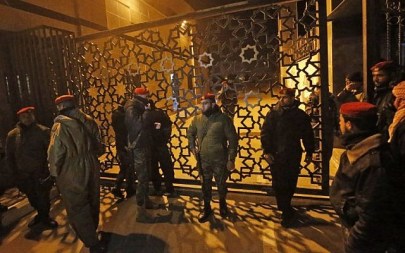
Palestinian security forces loyal to Hamas (R) stand guard outside the Rafah border crossing with Egypt just minutes before the Palestinian Authority withdraws its staff (L) from the Rafah border crossing with Egypt on January 7, 2019. (SAID KHATIB / AFP)

Hamas, true to form, accused Ramallah of “declaring war” on Gaza, but conveniently ignored what led the PA to take such a step.

Fatah had been preparing to hold a mass rally in Gaza commemorating the movement’s anniversary on January 1, but Hamas prevented that by various means, including an exceptionally widespread arrest campaign. Some 500 Fatah operative were arrested or taken in for questioning in the days leading up to that planned anniversary, according to Fatah; explanatory material was confiscated; and unknown assailants broke into the PA’s TV and radio offices in Gaza and caused extensive damage to the property and equipment.

Those steps apparently crossed a few red lines in the sensitive status quo between the organizations in the PA’s eyes, leading to the closure of the Rafah crossing.

That is when the war of words and threats began. Senior Fatah officials such as Azzam al-Ahmad have threatened that the removal of officials from the Rafah crossing was just the first step out of many that will topple Hamas, which openly seeks Israel’s destruction and wrested control of Gaza from the PA in a violent coup in 2007.

The PA’s approach to Gaza, according to those senior Fatah officials, is “all or nothing” — meaning, either Hamas surrenders all aspects of leadership in Gaza to the PA, or the PA cuts itself off completely from the Strip.

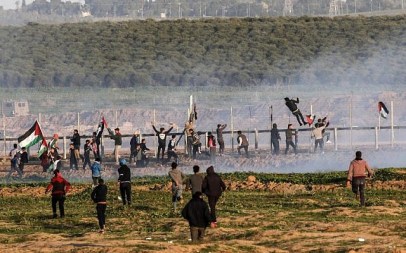
Palestinian protesters try to climb the border fence with Israel during clashes following a demonstration along the border east of Gaza City on January 4, 2019. (Said Khatib/AFP)

That could just be a move intended to pressure Hamas or signal to the Egyptian that there’s an emergency, but it seems that the fragile situation in Gaza is destabilizing again.

According to a report in the London-based Arabic-language daily Asharq Al-Awsat, PA President Mahmoud Abbas conveyed a clear message to the Egyptians during his recent visit to Cairo that he intends to take stronger measures against Gaza, including in the fields of health and education. That is essentially a threat to cut PA funds to the Strip, which could drag the already impoverished population there into an unprecedented crisis.

Crises and instances of deterioration in Hamas-Fatah relations have frequently led to an increase in tensions with Israel: more border protests, rocket fire and other incidents, such as the explosive device attached to balloons that was launched into Israel on Sunday and prompted the IDF to strike in Gaza in retaliation.

All that is added to the current delay in the transfer of Qatari aid money to the Strip — $15 million to pay Hamas staff’s salaries — resulting in a general feeling in Gaza that another round of violence is brewing.

The famous rule in the Palestinian arena hasn’t changed: When Fatah and Hamas have a brawl, Israel gets hit.


Hamas renews funding for incendiary kite units ahead of expected escalation

January 9, 2019

Source: Hamas renews funding for incendiary kite units ahead of expected escalation | The Times of Israel

Terror group set to renew violence amid rising criticism from Gazans, who see recent cash injections from Qatar as easing living conditions only of Hamas members rather than public

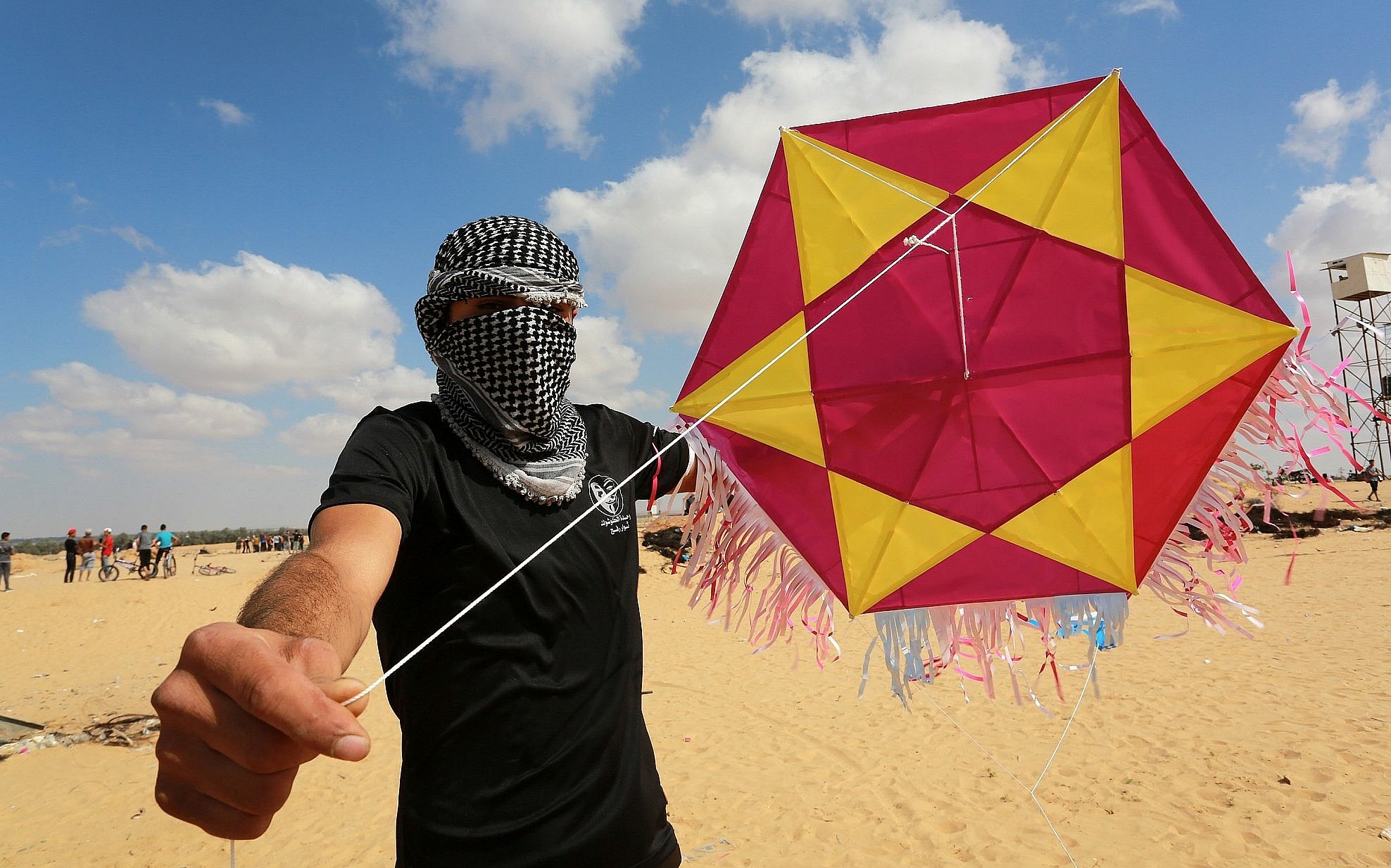
A Palestinian protester displays a kite loaded with an incendiary device before launching it towards Israel, east of Rafah in the southern Gaza Strip, on June 29, 2018 (Abed Rahim Khatib/Flash90)

An Egyptian security delegation is expected to arrive in Gaza in the coming days in an attempt to prevent a deterioration in the security situation along the border with Israel this weekend.

On Tuesday, the “Supreme National Authority for the March of Return and Breaking of the Siege,” the body officially behind the weekly border protests that the Hamas terror group has been encouraging saince last March, called on the Palestinian public to participate extensively in marches near the fence on Friday.

Over the past two weeks, after a months-long lull, there has been an increase in the number of demonstrations close to the fence, and last Friday also saw a rise in the number of violent incidents at those protests.

There have also been attempts by Palestinians to break through the fence at several locations, and an explosives-laden drone attached to balloons was launched toward Israel on Sunday, followed by a rocket attack.

A drone-shaped device from the Gaza Strip, borne by dozens of helium balloons, lands in a carrot field in southern Israel on January 6 ,2019. (Courtesy)

These moves have been interpreted by Israel as an attempt by Hamas to renew hostilities in light of its ongoing failure to change the reality of life in Gaza.

Monthly cash injections of $15 million from Qatar via Israel over the past two months have been perceived by some in Gaza as designed to ease the living conditions only of Hamas members rather than the public at large. The result has been an increase in criticism of the terror group among Gazans. This is exacerbated by the fact that electricity supply to the coastal enclave has again decreased to only five hours of power followed by 12-hour outages.

Palestinian sources in Gaza report that Hamas is planning to renew incendiary balloon attacks, along with the offensive tactics implemented in the weeks preceding the Qatari cash injection.

A week ago, Hamas officials met with the heads of the “kite unit,” as well as the leaders of the groups the so-called “tire unit” and a unit that carries out a variety of operations close to the border under the cover of darkness, such as demonstrations and attempts to damage the fence.

At that meeting, the unit heads received a new budget to prepare for the next round of violence.

Earlier this week, those units were expected to hold a press conference in Gaza at which they were to announce the relaunch of their activities. However, the event was canceled for reasons that were not immediately clear.

Hamas’s recent attempts to escalate the situation along the border have been linked to the ongoing failure of mediators, chief among them Egypt, to secure a reconciliation agreement between the Islamist terror group and the Palestinian Authority.

Earlier this week, Israel reportedly asked Qatar to delay its monthly delivery of $15 million to the Gaza Strip, after a rocket was fired from the coastal enclave at a southern Israeli city.

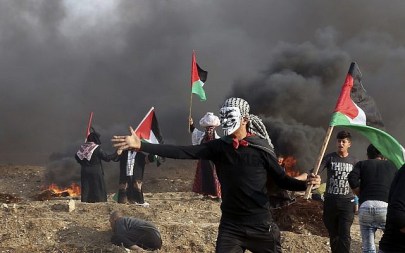
Palestinians wave their national flags while others burn tires near the fence of Gaza Strip border with Israel during clashes east of Gaza City, on November 9, 2018. (AP Photo/Adel Hana)

The Qatari cash injection is part of an unofficial truce between Hamas and Israel that was supposed to see an end to months of violent protests along the Gaza-Israel border in exchange for an easing of Israel’s blockade of the coastal enclave.

Israel says it maintains the blockade to prevent weapons smuggling by Hamas and other terror groups sworn to Israel’s destruction.

Gaza protesters have launched hundreds of incendiary kites and balloons into Israel over the past nine months, sparking fires that have destroyed forests, burned crops, and killed livestock. Thousands of acres of land have been burned, causing millions of shekels in damages, according to Israeli officials. Some balloons have also carried improvised explosive devices.

Israel holds Hamas responsible for all attacks coming from Gaza, where the terror group, which seeks to destroy Israel, has held sway since seizing control in 2007 by ousting the West Bank-based PA.

Times of Israel staff contributed to this report.


The Palestinians’ Uncivil War

January 9, 2019
  • The biggest losers from this internal bloodletting are the Palestinians living under these leaders in the Palestinian Authority (PA) and Hamas-ruled Gaza.
  • The dispute between Hamas and Fatah is not over who will bring democracy and a better economy to the Palestinians. They are not fighting over who will improve the living conditions of the Palestinians in the West Bank and Gaza Strip by building new schools and hospitals. They are not fighting over who will introduce major reforms to the Palestinian government and end financial and administrative corruption. They are not fighting over the need for freedom of expression and a free media.
  • Mahmoud Abbas, the Hamas leaders correctly argue, is not a rightful or legitimate president. If Abbas were to sign a deal with Israel, people could come along later and say that he lacked the legal authority to do so; they would be right.
  • In order for any peace process to move forward, the Palestinians first need to stop attacking each other. [Never going to happen] Then, they need to come up with new leaders who actually give a damn about their people. [Even less likely to happen]

https://www.gatestoneinstitute.org/13502/palestinians-hamas-fatah-conflict
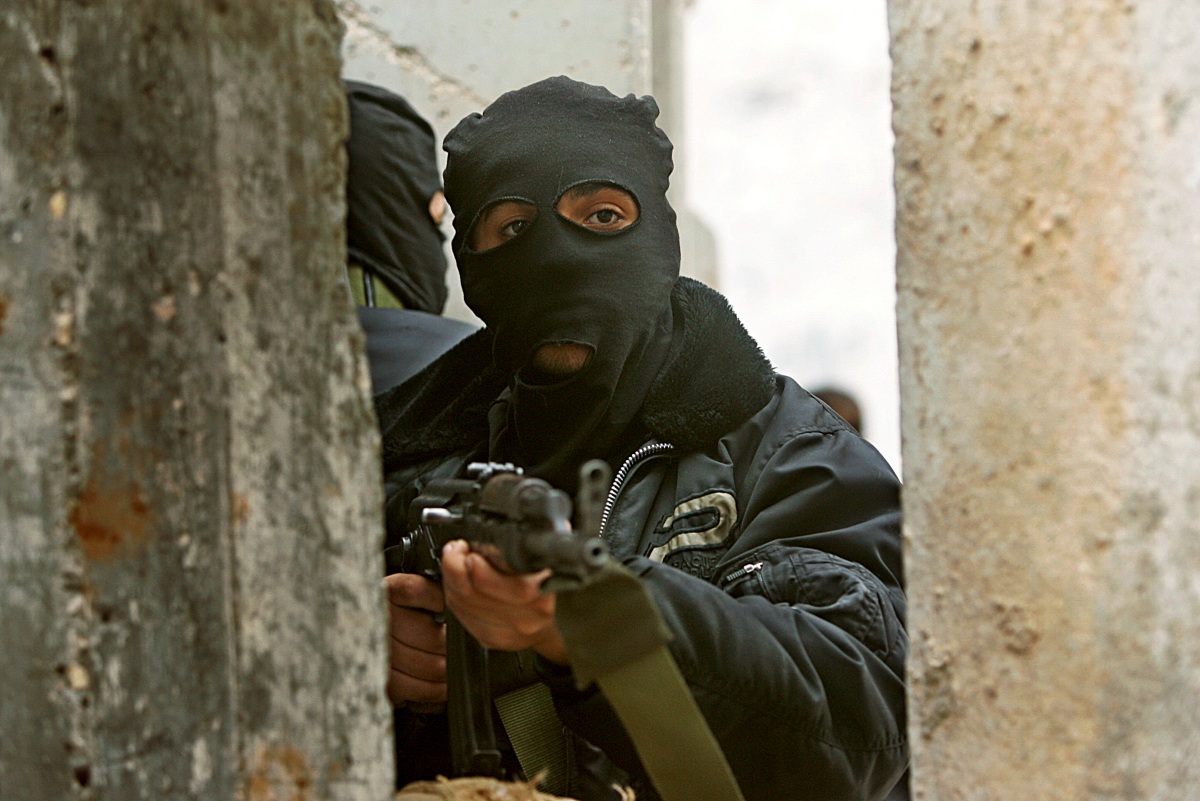
Pictured: Fatah gunmen guard the home of a senior Fatah official in the Gaza Strip on January 30, 2007, during the violent Hamas takeover of the Gaza Strip.

The Palestinians’ major ruling groups, Fatah and Hamas, are now saying they are done with each other: that the divorce is final.

Recent days and weeks have witnessed the two groups maligning each other beyond anything previously seen. Fatah and Hamas have reached a new level of mutual loathing. At times, it even seems as if Fatah and Hamas hate each other more than they hate Israel [Crikey, that bad, eh?]

Many in the West say they would like to see Israel and the Palestinians return to the negotiating table. They want Israelis and Palestinians to resume the so-called peace process. They are hoping that Israel and the Palestinians will manage to reach a historic agreement that would end the Israeli-Arab conflict and bring real peace to the Middle East.

The region, however, does not need a “peace process” between Israel and the Palestinians. It needs one of a different type. The “peace process” that the Middle East is crying out for is one between Palestinians and Palestinians, one that would end their bloody, internecine war.

Before pushing “peace” upon Israel and the Palestinians, it would be helpful if the international community first tried to help the Palestinians stop torturing each other. The Palestinians cannot make peace with Israel while they are busy killing their own people. The Palestinians cannot make peace with Israel when their leaders lead only themselves — to money and power.

The political struggle between Fatah and Hamas is not a normal dispute between two rival parties in parliament. Rather, it is a rivalry between two large groups and governments that have tens of thousands of armed men at their disposal and massive arsenals of weapons.

The biggest losers from this internal bloodletting are the Palestinians living under these leaders in the Palestinian Authority (PA) and Hamas-ruled Gaza.

Fatah, the largest faction of the Palestine Liberation Organization (PLO), is the dominant party that controls the PA. The PA has tens of thousands of policemen and security officers (in the West Bank) who are funded and trained by various Western countries, including the US and UK.

Similarly, Hamas has thousands of security officers and militiamen who help it maintain a tight grip on the Gaza Strip.

In 2007, two years after the Israeli withdrawal from the Gaza Strip, Hamas overthrew the PA regime in Gaza. Since then, Hamas has been the unchallenged ruler of the Gaza Strip, home to nearly two million Palestinians. It took Hamas less than a week to remove Abbas’s government from power and seize control of the entire coastal territory.

The dispute between Hamas and Fatah is not over who will bring democracy and a better economy to the Palestinians. Let us make this clear: they are not fighting over who will improve the living conditions of the Palestinians in the West Bank and Gaza Strip by building new schools and hospitals. They are not fighting over who will introduce major reforms to the Palestinian government and end financial and administrative corruption. They are not fighting over the need for freedom of expression and a free media.

Instead, this is a struggle over money, power and ego.

The Palestinian Authority and its president, Mahmoud Abbas, are furious with Hamas because it forced them out of the Gaza Strip 11 years ago. Abbas and his senior aides and advisers have yet to overcome the deep humiliation they suffered when Hamas militiamen overthrew their regime in the Gaza Strip and killed several PA and Fatah men. Abbas seeks to shame his rivals in Hamas. He seems to want Hamas to pay a steep price for expelling him and his regime from the Gaza Strip.

Abbas is also apparently disturbed because Hamas defeated his Fatah loyalists in the 2006 Palestinian parliamentary elections. The result of that vote, too, was humiliating for Abbas and his regime.

Last year, in the context of his hitherto unsuccessful effort to undermine Hamas and end its rule over the Gaza Strip, Abbas imposed a series of sanctions that included the suspension of salaries to thousands of civil servants living there. Abbas also stopped paying Israel for the fuel and electricity it had been supplying to the residents of the Gaza Strip.

These punitive measures, however, have backfired, further undermining Abbas’s credibility among his people. He is now being accused by many Palestinians of being fully responsible for the suffering and misery of his people in the Gaza Strip. He is being accused of imposing a blockade on his own people and of being an Israeli “collaborator” for conducting security coordination with the Israeli security forces in the West Bank.

Hamas leaders have also called for bringing Abbas to trial on charges of “high treason” — a crime, according to Palestinian laws and traditions, punishable by death.

Hamas says that Abbas is a dictator and traitor because of his refusal to share power with anyone and his “close relations” with Israel. Hamas leaders never fail to broadcast that Abbas’s four-year term in office expired in January 2009. Abbas, the Hamas leaders correctly argue, is not a rightful or legitimate president. If Abbas were to sign a deal with Israel, people could come along later and say that he lacked the legal authority to do so; they would be right.

Recently, Hamas has been condemning Abbas for his decision to dissolve the Palestinian parliament, which, in any event, has been inoperative since Hamas’s violent takeover of the Gaza Strip. This decision, according to Hamas, proves that Abbas is an autocrat and dictator, who presides over an authoritarian regime.

Hamas also claims that Abbas is a traitor because his security forces conduct security coordination with Israel and continue to arrest scores of Hamas supporters in the West Bank.

Abbas, for his part, has made similar charges against Hamas. He recently hinted that Hamas was working for Israel. Abbas, in a speech, referred to Hamas as “spies” (he used the Arabic word jasous) — the word Palestinians use to label Palestinians accused or suspected of collaborating with Israel.

Hamas officials have responded by likening Abbas to Hamid Karzai, the former president of Afghanistan who came to power with the help of the US and Western countries. What they are saying is that Abbas is a puppet in the hands of Israel and the US.

Abbas was expressing outrage over the recent detention of some 500 of his loyalists in the Gaza Strip at the hands of Hamas. The men were reportedly rounded up by Hamas because they were planning to hold a big rally to celebrate the 54th anniversary of the launching of Fatah’s first armed attack against Israel.

Abbas and his advisers have, in turn, repeatedly accused Hamas of being in collusion with the US and Israel to create a separate Palestinian state in the Gaza Strip. According to Abbas and his representatives, US President Donald Trump’s administration and Israel are working to establish a small and isolated Palestinian state there, thus permanently detaching it from the West Bank.

Fatah leaders are now saying that they have cut off contact with Hamas — permanently. Hamas leaders, similarly, are saying that as long as Abbas remains in power, the dispute with Fatah will continue.

The leaders of Hamas and Fatah are making their mutual distrust unmistakably clear. They probably have good reason to believe that their suspicions are not misplaced; after all, they know each other better than anyone else does. If they are right, what is the point of presenting any peace plan between Israel and the Palestinians? Who is Israel supposed to make peace with? With the discredited 83-year-old Abbas, who will never be able to win the backing of a majority of his people for any peace agreement with Israel? Or with Hamas, which forever informs the world that it will never make peace with Israel because it cannot accept the presence of non-Muslims on what it perceives to be Muslim-owned land?

In order for any peace process to move forward, the Palestinians first need to stop attacking each other. Then, they need to come up with new leaders who actually give a damn about their people. As these two conditions seem rather unrealistic at this point, any talk about the resumption of an Israeli-Palestinian “peace process” sounds like nothing so much as a big joke.