USA-IRAN/ (URGENT):U.S. warns Iran against space launches, ballistic missiles
WASHINGTON, Jan 3 (Reuters) – The United States issued a pre-emptive warning to Iran on Thursday against pursuing three planned space rocket launches that it said would violate a U.N. Security Council resolution because they use ballistic missile technology.
Secretary of State Mike Pompeo said Iran had announced plans to launch in the coming months three rockets, called Space Launch Vehicles (SLV), which he said incorporate technology that is “virtually identical” to that used in intercontinental ballistic missiles.
“The United States will not stand by and watch the Iranian regime’s destructive policies place international stability and security at risk,” Pompeo said in a statement.
“We advise the regime to reconsider these provocative launches and cease all activities related to ballistic missiles in order to avoid deeper economic and diplomatic isolation.”
Iranian Deputy Defense Minister General Qassem Taqizadeh in late November was quoted by Iranian media as saying that Iran was planning to launch three satellites into space soon.
“The satellites have been made by domestic experts and will be put on various orbits,” Taqizadeh said.
Pompeo said such rocket launches would violate United Nations Security Council Resolution 2231, which endorsed a 2015 nuclear deal between Iran and world powers. It calls upon Iran not to undertake activities related to ballistic missiles capable of delivering nuclear weapons, including launches using such technology. It stops short of explicitly barring such activity.
U.S. President Donald Trump decided in May to pull out of the Iran nuclear deal.
Pompeo said Iran has launched ballistic missiles numerous times since the U.N. resolution was adopted. He said it test-fired a medium-range ballistic missile capable of carrying multiple warheads on Dec. 1.
“The United States has continuously cautioned that ballistic missile and SLV launches by the Iranian regime have a destabilizing effect on the region and beyond,” Pompeo said. “France, Germany, the United Kingdom, and many nations from around the world have also expressed deep concern.”
In July 2017, Iran launched a rocket it said could deliver a satellite into space, an act the U.S. State Department called provocative. Earlier that month, the United States slapped new economic sanctions on Iran over its ballistic missile program.
Iran says its space program is peaceful, but Western experts suspect it may be a cover for developing military missile technologies. (Reporting by Doina Chiacu and Lesley Wroughton; Additional reporting by Dubai newsroom; Editing by Jeffrey Benkoe)
Amir Peretz says he’s ‘deeply concerned’ Trump would allow a ‘Syrian-Iranian-Russian axis’ to shape the region; Erdan dismisses worries as ‘recycled drama’
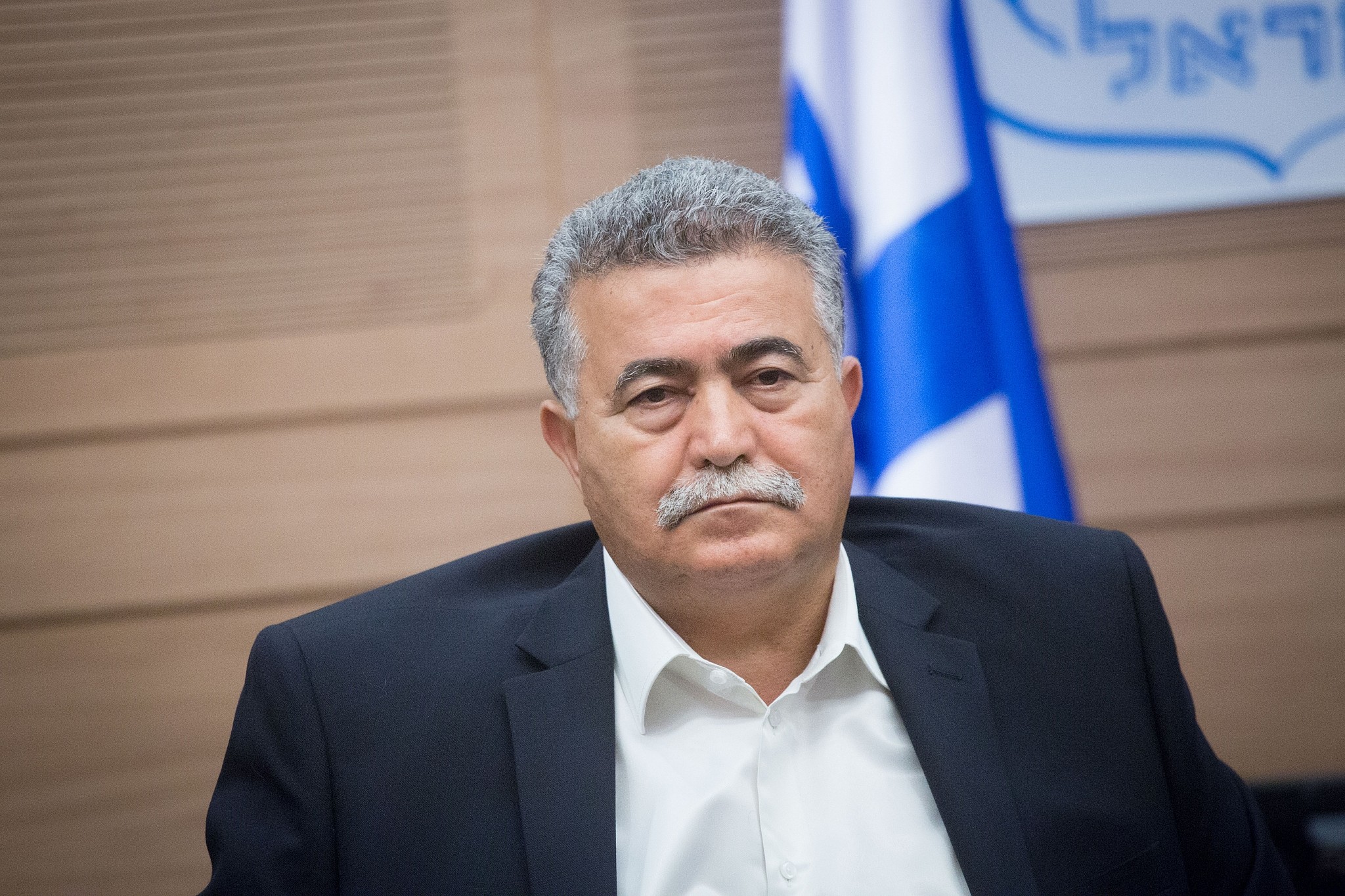
MK Amir Peretz attends a Defense and Foreign Affairs Committee meeting at the Knesset, October 22, 2018. (Miriam Alster/Flash90)
Former defense minister MK Amir Peretz on Thursday expressed disappointment and “great concern” about US President Donald Trump’s statement the day before on Iranians being able to “what they want” in Syria.
In a letter to US Secretary of State Mike Pompeo and US Ambassador to Israel David Friedman, Peretz (Labor) said he would appreciate “any clarification and explanation” of Trump’s remarks.
“The words of the president are bound to raise grave concerns among many Israeli citizens, who well understand the hegemonic ambitions of the Islamic Republic of Iran and know all too well the murderous methods it deploys to achieve these ambitions,” Peretz’s letter states.
Peretz, who is a member of the Knesset’s Foreign Affairs and Defense Committee and chairs the Subcommittee for the Readiness of the Home Front, went on to say that the US president’s decision to withdraw American troops from Syria would allow a “Syrian-Iranian-Russian axis to shape the future of our region.”
Trump’s statement Wednesday “only adds to the weakening of moderate forces in the region,” added Peretz, who served as Israel’s defense minister from May 2006 to June 2007.
“The conservative philosopher Edmund Burke said that all it takes for evil to triumph is for good men to do nothing,” the letter went on. “For Israel, the US has always been on the side of the good. We cannot accept a reality in which it chooses to stand by idly.”
On Wednesday, Trump said of Iranian forces in Syria: “They can do what they want there, frankly,” while suggesting Tehran was removing its troops from the country.
His statement came two weeks after he rattled Jerusalem by announcing that he would pull all 2,000 US troops out of Syria. US soldiers have been leading the coalition against the Islamic State terror group, while also helping to thwart the establishment of permanent Iranian military infrastructure in Syria.
Israeli officials have also warned that America’s absence would open the door for Tehran to create a so-called “land bridge” from Iran, through Iraq and Syria, into Lebanon and to the Mediterranean Sea.
‘We never relied on US troops in Syria’
Public Security Minister Gilad Erdan, a member of the security cabinet, on Thursday tried to downplay Trump’s statement.
“I don’t understand why they’re trying to recycle this drama time and again,” he told Army Radio.
While Israel may have preferred that US troops remain in Syria, it was the president’s prerogative to withdraw them whenever he sees fit “even if we don’t always see eye to eye,” Erdan, a member of Prime Minister Benjamin Netanyahu’s ruling Likud party, said.
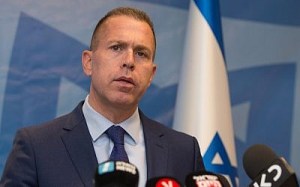
Public Security Minister Gilad Erdan at a press conference in Tel Aviv, September 13, 2018. (Roy Alima/Flash90)
Trump’s decision on Syria does not alter his commitment to Israel’s security, the senior minister noted. “We never relied on US troops in Syria. All together we’re talking about 2,000 troops and our policy to prevent Iran’s entrancement in Syria is based exclusively on the IDF and the government’s policy and not on the US presence,” he said.
“There is no substantive change in the way Israel plans to confront Iran’s entrenchment in Syria,” Erdan concluded.
Speaking anonymously, a senior Israeli official on Thursday, however, reportedly criticized Trump for appearing to give Iran free rein to further entrench militarily in Syria.
“It is sad that he is not attentive to intelligence materials,” the unnamed Israeli official told the Ynet news website.
“I am quite simply in shock,” the source continued. “Trump simply does not know what is happening in Syria and the Iranian entrenchment there.”
Israel has repeatedly warned in recent years that Iran is seeking to establish a military presence in Syria, where it is fighting alongside its Lebanese proxy Hezbollah and Russia to restore the regime of Syrian President Bashar Assad.
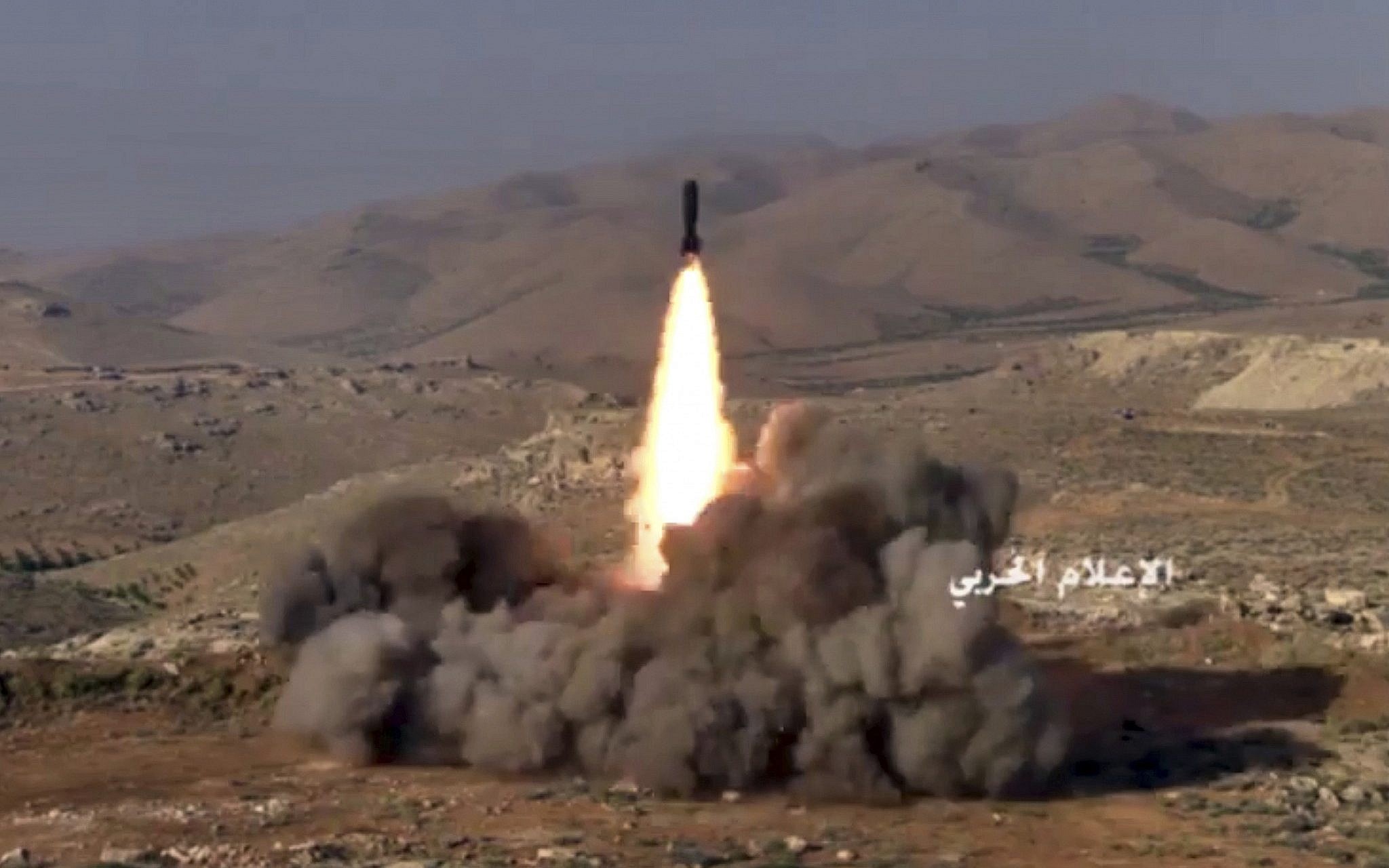
This frame grab from video released on July 22, 2017, and provided by the government-controlled Syrian Central Military Media, shows Hezbollah fighters firing a missile at positions of al-Qaeda-linked militants in an area on the Lebanon-Syria border. (Syrian Central Military Media, via AP)
Over the last several years, Israel has carried out hundreds of airstrikes in Syria against targets linked to Iran.
Yet Trump, on Wednesday, said at a cabinet meeting that Tehran, like the US, was withdrawing its forces from Syria.
The American president went on to say that in pulling out of the nuclear deal with Iran last year, Washington had changed Tehran’s calculus and stymied its efforts to destabilize the region.
“Iran is no longer the same country,” he said. “Iran is pulling people out of Syria. They can do what they want there, frankly, but they’re pulling people out. They’re pulling people out of Yemen. Iran wants to survive now.”
Trump’s decision to pull America’s 2,000 troops out from Syria caused a major shakeup within his own administration; his secretary of defense, James Mattis, resigned over the withdrawal.
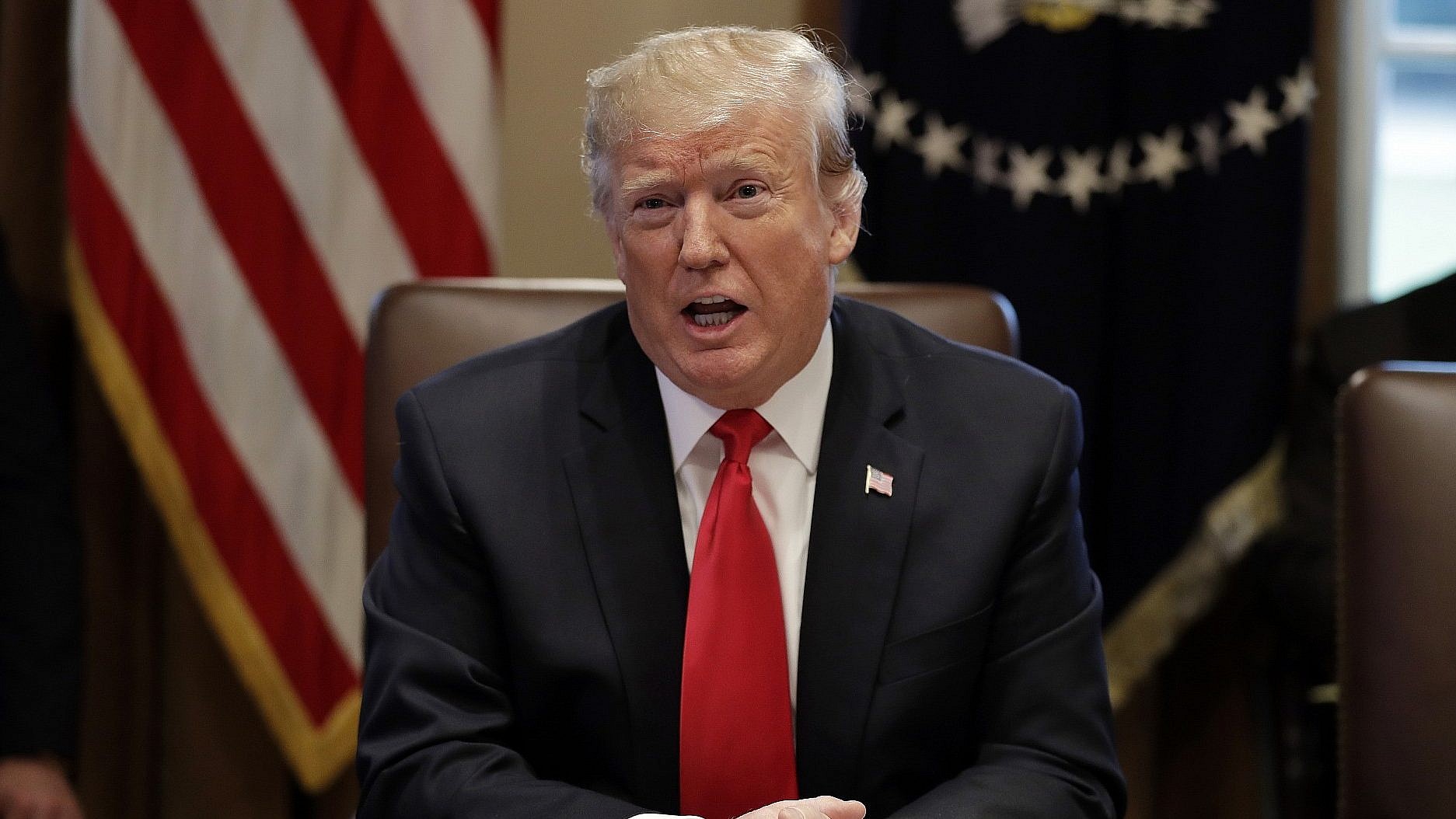
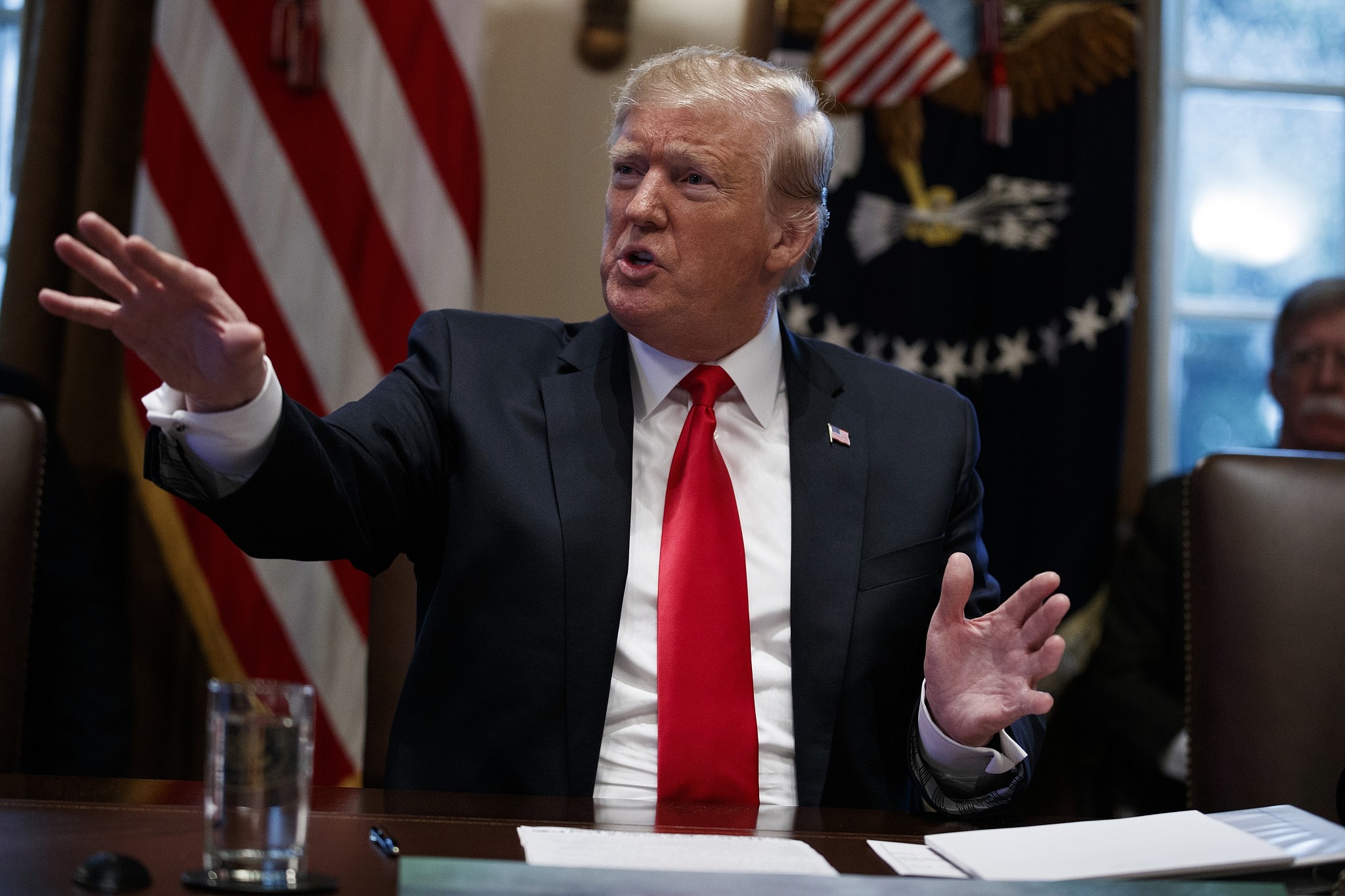
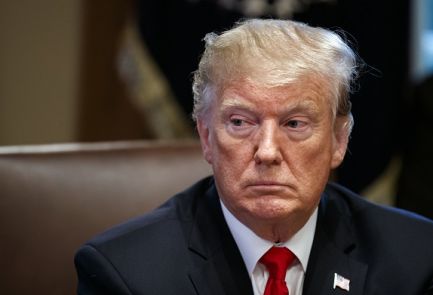
US President Donald Trump speaks during a cabinet meeting at the White House, Wednesday, January 2, 2019, in Washington. (AP Photo/Evan Vucci)
Trump offered a stark take on the situation in Syria Wednesday, summing it up in two words — “sand and death” — while remaining vague about the timing of the US troop withdrawal.
“So Syria was lost long ago. It was lost long ago. And besides that, I don’t want — we’re talking about sand and death. That’s what we’re talking about,” Trump said during a cabinet meeting. “We’re not talking about vast wealth. We’re talking about sand and death.”
On when US forces would leave Syria, Trump said: “I don’t want to be in Syria forever.”
He added: “I never said we are getting out overnight… We’re withdrawing… over a period of time.”
The US president’s announcement of the Syrian withdrawal was the first significant point of contention between Washington and Jerusalem since he took office — Netanyahu reportedly pleaded with him to rethink the decision — and has fortified the perception that he views the US relationship with Israel as transactional.
On Tuesday, Pompeo told Netanyahu that the planned withdrawal of US ground forces from Syria will not alter America’s commitment to countering Iranian aggression and maintaining Israel’s security.
“The decision by the president on Syria in no way changes anything that this administration is working on alongside Israel,” Pompeo said at a joint press conference with Netanyahu before they held talks in Brazil.
Trump said last week that he did not think America’s removing its troops from Syria would endanger Israel.
Agencies and Times of Israel staff contributed to this report.
US President Donald Trump speaks during a cabinet meeting at the White House, January 2, 2019, in Washington. (Evan Vucci/AP)
A senior Israeli official on Thursday reportedly criticized US President Donald Trump for appearing to give Iran free rein to further entrench militarily in Syria.
The US president, on Wednesday, said of Iranian forces in Syria: “They can do what they want there, frankly,” while suggesting Tehran was removing its troops from the country.
“It is sad that he is not attentive to intelligence materials,” the unnamed Israeli source said, according to a Thursday report by the Ynet news website.
“I am quite simply in shock,” the source continued. “Trump simply does not know what is happening in Syria and the Iranian entrenchment there.”
Trump’s comments came two weeks after he rattled Jerusalem by announcing that he would pull all American troops out of Syria. US soldiers had been leading the coalition against the Islamic State terror group, while also helping to thwart the establishment of permanent Iranian military infrastructure in Syria.
Israel has repeatedly warned in recent years that Iran is seeking to establish a military presence in Syria, where it is fighting alongside its Lebanese proxy Hezbollah and Russia to restore the regime of Syrian President Bashar Assad.
This frame grab from video released on July 22, 2017, and provided by the government-controlled Syrian Central Military Media, shows Hezbollah fighters firing a missile at positions of al-Qaeda-linked militants in an area on the Lebanon-Syria border. (Syrian Central Military Media, via AP)
Israeli officials have also warned that America’s absence would open the door for Tehran to create a so-called “land bridge” from Iran, through Iraq and Syria, into Lebanon and to the Mediterranean Sea.
Over the last several years, Israel has carried out hundreds of airstrikes in Syria against targets linked to Iran.
Yet Trump, on Wednesday, said at a cabinet meeting that Tehran, like the US, was withdrawing its forces from Syria.
The American president went on to say that in pulling out of the nuclear deal with Iran last year, Washington had changed Tehran’s calculus and stymied its efforts to destabilize the region.
“Iran is no longer the same country,” he said. “Iran is pulling people out of Syria. They can do what they want there, frankly, but they’re pulling people out. They’re pulling people out of Yemen. Iran wants to survive now.”
Trump’s decision to pull America’s 2,000 troops out from Syria caused a major shakeup within his own administration; his secretary of defense, James Mattis, resigned over the withdrawal.
US President Donald Trump speaks during a cabinet meeting at the White House, Wednesday, January 2, 2019, in Washington. (AP Photo/Evan Vucci)
Trump offered a stark take on the situation in Syria Wednesday, summing it up in two words — “sand and death” — while remaining vague about the timing of the US troop withdrawal.
“So Syria was lost long ago. It was lost long ago. And besides that, I don’t want — we’re talking about sand and death. That’s what we’re talking about,” Trump said during a cabinet meeting. “We’re not talking about vast wealth. We’re talking about sand and death.”
On when US forces would leave Syria, Trump said: “I don’t want to be in Syria forever.”
He added: “I never said we are getting out overnight… We’re withdrawing… over a period of time.”
The US president’s announcement of the Syrian withdrawal was the first significant point of contention between Washington and Jerusalem since he took office — Prime Minister Benjamin Netanyahu reportedly pleaded with him to rethink the decision — and has fortified the perception that he views the US relationship with Israel as transactional.
On Tuesday, US Secretary of State Mike Pompeo told Netanyahu that the planned withdrawal of US ground forces from Syria will not alter America’s commitment to countering Iranian aggression and maintaining Israel’s security.
“The decision by the president on Syria in no way changes anything that this administration is working on alongside Israel,” Pompeo said at a joint press conference with Netanyahu before they held talks in Brazil.
Trump said last week that he did not think America’s removing its troops from Syria would endanger Israel.
Lebanese politicians have been wrangling over a new government since elections in May further unsettling the country’s fragile economy • Hezbollah politician: Government formation would be beneficial “particularly in light of the Israeli dangers.”
Reuters and Israel Hayom Staff
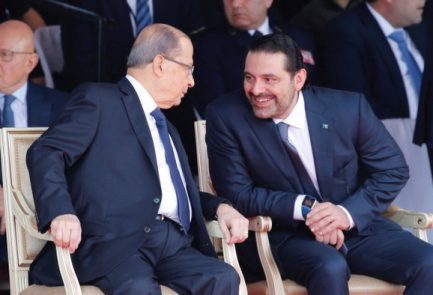
Lebanese President Michel Aoun and PM-designate Saad Hariri in Beirut in November
|Archives: Reuters
The powerful Lebanese Shiite terrorist group Hezbollah believes a solution to be “very close” for the country’s impasse over forming a new government, one of its senior officials said on Wednesday, following nearly eight months of political wrangling.
Lebanese politicians have been unable to agree on a new government since a general election in May as rival parties have competed over the allocation of cabinet positions, further unsettling the country’s fragile economy.
Iran-backed Hezbollah started taking part in electoral politics in the 1990s and is the most powerful group in the country.
“We believe the solution is very close,” said Mahmoud Qamati, deputy head of the terrorist group’s political council, and suggested it could happen in time to be considered “a holiday gift.”
“The intentions held by everybody are positive and for the benefit of the country,” he added.
On Tuesday, Lebanese Prime Minister-designate Saad al-Hariri said he and President Michel Aoun had met and were “determined to form a government,” state news agency NNA reported.
A breakthrough to create a national unity government in line with Lebanon’s sectarian power-sharing system seemed close last month, but it did not work out and the deadlock resumed. However, Hariri said on Sunday he still believed the government would form early in the new year.
The lack of a government has caused particular concern because Lebanon faces both structural economic problems and regional instability.
Lebanon has the world’s third-highest level of debt to GDP and Finance Minister Ali Hassan Khalil said on Sunday the country was facing an economic crisis.
Hariri has pledged to carry out economic reforms that could unlock billions of dollars of international investment in Lebanese power, transport and data infrastructure, aimed at boosting the economy after years of weak growth.
The International Monetary Fund has stressed the importance of Lebanon putting its debt on a sustainable footing, while bond yields and the cost of insuring against Lebanese sovereign debt have shown signs of stress in recent months.
Last month, Israel uncovered several tunnels it said Hezbollah had dug under the border, adding to tensions between the countries some 12 years after the Second Lebanon War.
Qamati said the government formation was beneficial “particularly in light of the Israeli dangers.”
American president admits that Iranian forces have been emboldened in Syria, but says Tehran no longer seeks to bolster its presence there • Syria “was lost long ago, we’re talking about sand and death,” he says, Iranians “can do what they want there.”
News Agencies and Israel Hayom Staff
|Photo: AP
U.S. President Donald Trump on Wednesday acknowledged that Iran was seeking to bolster its presence in the war-torn country but that “Iran is no longer the same country” since he exited the 2015 nuclear deal and reimposed financial sanctions on the Islamic republic.
Trump claimed Iran was suffering under the sanctions but admitted it remains a powerful presence in Syria. Blaming the balance of power in Syria on his predecessor, Barack Obama, Trump said that Syria was “lost long ago,” adding, “We’re talking about sand and death. We’re not talking about vast wealth.”
Iran “is pulling people out of Syria,” he told a press briefing at the end of a cabinet meeting in the White House. “They can do what they want there, frankly, but they’re pulling people out,” he said, referring to Iranian forces in the war-torn country.
Trump, who recently announced he would be pulling American troops from Syria, said he did not want the U.S. military fighting there forever. Still, he gave no timetable for the planned military exit from Syria.
He further denied a report according to which he had set a four-month timetable for the withdrawal of 2,000 American troops stationed in Syria amid a battle against Islamic State militants.
“We’re getting out and we’re getting out smart. I never said I’m getting out tomorrow,” he said.
In recent days, Trump appeared to back off from any hasty pullout and stressed that the operation would be slow.
“We’re slowly sending our troops back home to be with their families, while at the same time fighting ISIS,” he said.
U.S. officials said that Trump was committed to making sure Turkey did not clash with the Kurdish YPG forces once U.S. troops leave Syria, and was assuring the NATO ally that it would have a buffer zone in the region to help protect its own interests.
Turkey views the YPG as a branch of its own Kurdish separatist movement and is threatening to launch an offensive against the group, igniting fears of significant civilian casualties.
U.S. commanders planning the U.S. withdrawal are recommending that YPG fighters battling Islamic State be allowed to keep U.S.-supplied weapons, according to U.S. officials.
That proposal would likely anger Turkey, where Trump’s national security adviser, John Bolton, is expected to hold talks in the coming days.
Trump said he was not happy that the Kurds were selling oil to Iran, but that he wanted to protect them either way.
“I didn’t like the fact that they’re selling the small [amount of] oil that they have to Iran, and we asked them not to sell it to Iran. We’re not thrilled about that. OK? I’m not happy about it at all,” he said.
“We want to protect the Kurds, nevertheless. We want to protect the Kurds, but I don’t want to be in Syria forever. It’s sand. And it’s death.”
Also on Wednesday, Syria’s Defense Ministry said a convoy of Syrian Kurdish fighters has pulled out of the flashpoint area of Manbij in northern Syria, close to territory controlled by Turkey.
The town, some 20 miles from the Turkish border, is a critical spot on the map of the Syrian conflict, near the junction of three separate blocks of territory that form spheres of Russian, Turkish and – for now – U.S. influence.
“According to information, approximately 400 Kurdish fighters have left Manbij so far,” the ministry said. “Their departure was in line with an agreement “for the return of normal life to the area of northern Syria.
EXCLUSIVE: David Makovsky and Dennis Ross say that while no politician will want to acknowledge the reality of a diminished U.S. role in the Mideast, they should at least address Moscow’s regional prominence and new criticism of Israeli actions in Syria and Lebanon.
It is a truism in politics that elections are about the future, and not just about the past. In Israel’s upcoming election, given the potential of looming indictments, many in Israel will want to consider whether a sitting prime minister can fulfill the responsibilities of the office while also devoting major time and attention to his legal difficulties. Regardless of how that question is answered, there will be other fundamental questions about national security challenges that must be addressed. And, those questions, which have understandably gone to the heart of the Israeli public’s concerns historically, should be asked of both Prime Minister Benjamin Netanyahu and his challengers Avi Gabbay, Benny Gantz, Yair Lapid, and others on the center-left.To begin with, while the Trump’s administration support for Israel has been important diplomatically and symbolically, it has largely left Israel on its own when it comes to dealing with the challenges of Iran in Syria and Lebanon and managing the Russians. But with the Russians now adopting a tougher policy toward Israel’s freedom of action in Syria and Lebanon, how do Netanyahu and other candidates propose to deal with them?
The challenge is especially acute because the Trump administration with its withdrawal from Syria is signaling to everyone, including the Russians, that it sees no interests in Syria regardless of whether Israel and Jordan are likely to face Iranian-backed threats from there. Historically, there was an understanding between the United States and Israel: Israel handles the threats it faces in the region, the U.S. deals with threats from external powers. That apparently no longer applies with the Trump administration, so Israel’s leaders have to contend with a new reality in the region in which the U.S. intends to play a diminished role even as Russia becomes more assertive in filling the vacuum.
Benjamin Netanyahu and Vladimir Putin meeting in Moscow
True, neither the prime minister nor his challengers are likely to want to acknowledge publicly the reality of a diminished U.S. role, and its implications for Israel. But they can address what Israel may need to be doing on its own, given Russia’s increased prominence in the region and its new criticism of Israeli actions in Syria and Lebanon.
The prime minister may have been the honored guest of Russian President Vladimir Putin last May in Moscow celebrating the victory over the Nazis, but now the Russians are calling the most recent Israeli strike in Syria a provocation and Israeli overflights in Lebanon a violation of UNSC Resolution 1701—this even as Israel uncovers the fifth Hezbollah tunnel dug into its territory. So the relationship with Putin looks more problematic and the Russian impulse to exert its leverage is now greater, particularly with it not having to worry about the United States.
To be sure, Syria is not the only Iran-related challenge near Israel’s borders. Amid understandable concerns about Hezbollah’s 130,000 rockets, Israel has refrained from attacking its precision-guided facilities in Lebanon that could convert these rockets into missiles with sharp accuracy. And, yet, Israel truly cannot live with Hezbollah having rockets with high accuracy and capable of launching saturation attacks on Israel’s high-value strategic economic and military targets. So what should Israel do?
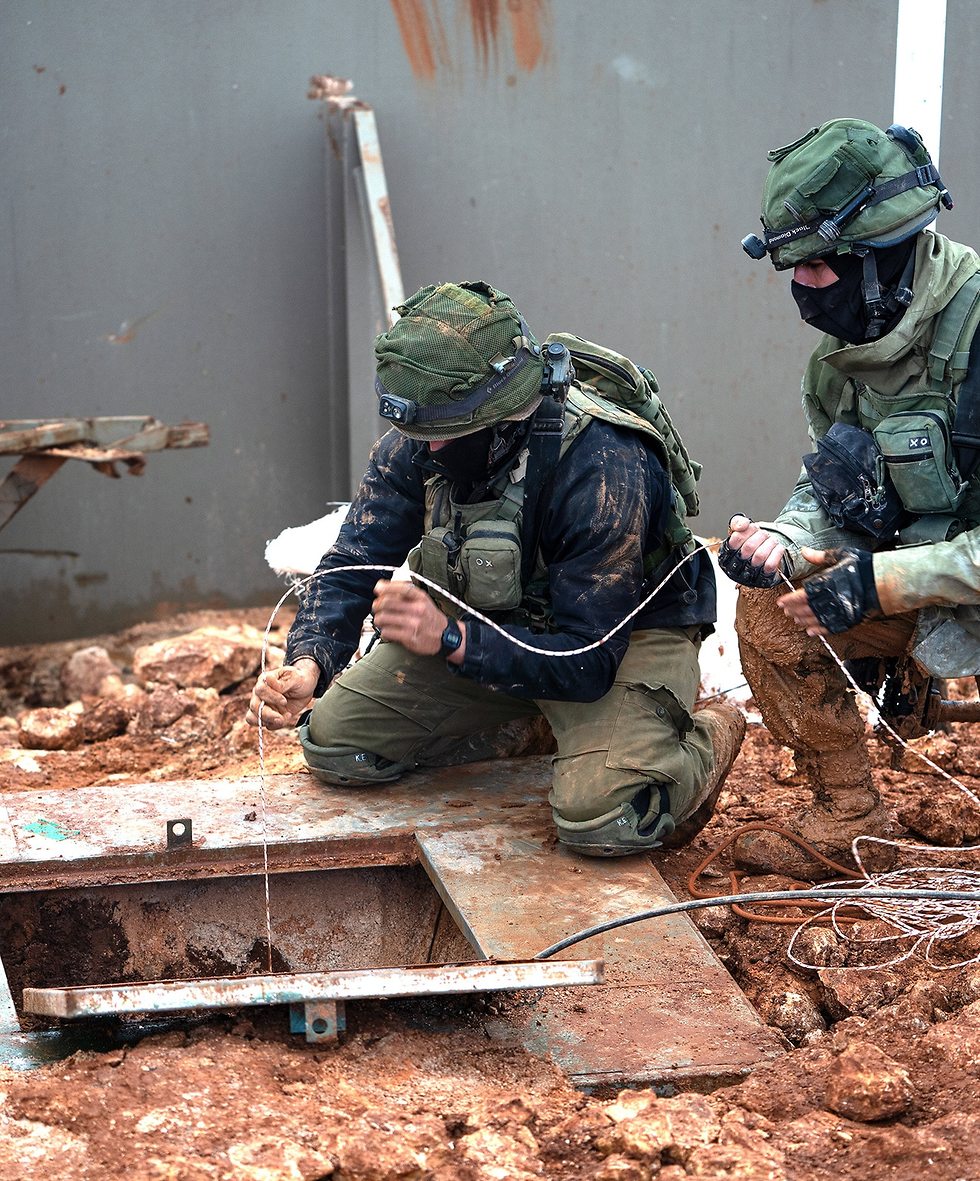
IDF troops uncovering a Hezbollah tunnel dug from Lebanon into Israel
Of course, the main Iran-related issue is the question of whether Tehran will renew its nuclear program. The Trump administration has withdrawn from the nuclear deal of 2015 and its approach of re-imposing sanctions is creating real economic pressures on Iran. But it has not altered any Iranian behaviors as they remain aggressive in the region—so Israel must focus on countering that where it can. But what happens if the Iranians withdraw from the nuclear deal and resume their uranium enrichment, reducing their break-out time to weeks? The Trump approach seems built essentially on sanctions and economic pressure but little more. How will each candidate approach an Iranian withdrawal from the nuclear deal and the possibility that the Trump administration will maintain its current approach?
What about Gaza? Does either the prime minister or his challengers have an alternative to the current approach? No one wants to go back into Gaza, but is the reality of periodic flare-ups over the last decade, often driving a million Israelis in the south into shelters, the new normal? Can there be a more durable ceasefire with Hamas without reconstruction of infrastructure in Gaza? It is clear that the Israeli security establishment is looking for stabilizing components like infrastructure that could avert future deterioration. What is the alternative to this approach? If there is not one, why hasn’t it gone forward?
As for the Palestinian issue, there is no ultimate deal any time soon. While President Trump may be intent on reducing the U.S. role in the Middle East, he still appears to want to present a peace plan. Even if key Arab leaders may be less inclined to be responsive to Trump if they judge him withdrawing from the region, the Administration wants these leaders to acknowledge the seriousness of the plan. And, this is especially true at a time when the Administration has no contact with Mahmoud Abbas and the Palestinian Authority.
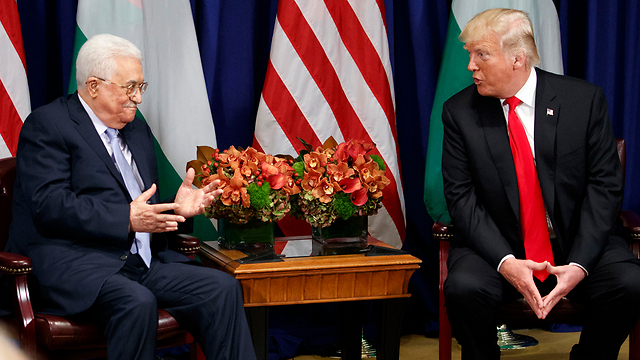
Donald Trump and Mahmoud Abbas meeting in New York in 2017
There is, however, little chance of gaining Arab public recognition of the seriousness of the plan without it addressing Palestinian statehood and key Arab neighborhoods in East Jerusalem. Both Prime Minister Netanyahu, who has said he would like a new coalition much like the current one, and those on the center-left should be asked whether it is possible to respond favorably to the Trump plan without a government capable of making tough decisions? Indeed, if as Nikki Haley said in her farewell address as UN envoy that Israelis and Palestinians are going to like parts of the plan and dislike other parts, is it conceivable that a narrow-based right-wing Israeli government will be able to accept it, even with reservations? Is there more to an Israeli strategy than merely planning on Abbas to say no, so Israel is off the hook?
If the Trump plan is presented and goes nowhere, a clear possibility, what is the policy of the prime minister and his challengers toward the Palestinians? If there is no early prospect of a deal, there is the danger of Israel simply drifting toward becoming a binational state. Each candidate should be asked what will they do to ensure that this does not happen.
Lastly, what is the policy of each candidate toward preserving not only bipartisan ties with the United States, recognizing that President Trump might be gone in two years, but also with American Jewry. Clearly, the ties of the current coalition are strained both with the Democrats and with key non-Orthodox segments of American Jewry. Both are essential to preserving the relationship with America—with one factor generally overlooked in Israel. The American Jewish community has played an essential role in ensuring a strong U.S.-Israel relations, including the American commitment of $38 billion in military assistance over the next 10 years. This is a commitment that Trump inherited from his predecessor Barack Obama. So, does each candidate recognize a problem with American Jews and, if so, what will they do about it?
Quite apart from domestic issues, these issues deserve an airing and a debate in advance of the election. We hope it takes place.
David Makovsky and Dennis Ross are both distinguished fellows at the Washington Institute for Near East Policy. Makovsky served as a senior policy advisor in the Office of the Secretary of State during 2013-2014 and Dennis Ross has served as US Middle East peace envoy 1993-2001, as well as senior Middle East advisor in the White House during 2009-2011.
First-ever visit by an Israeli prime minister marks an abrupt shift in relations between Jerusalem and Brasilia following 16 years of tension under Brazil’s left-wing regimes
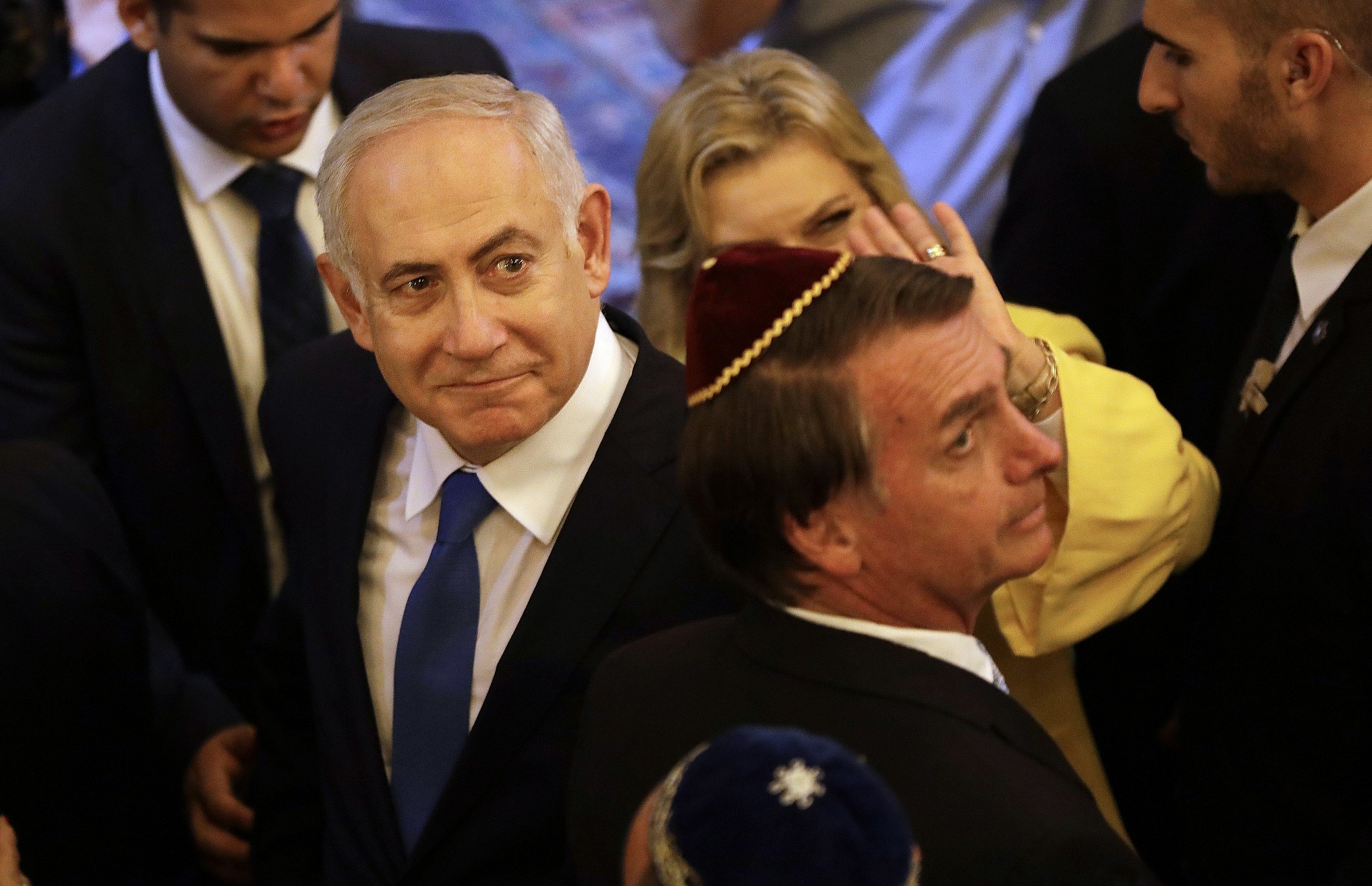
Benjamin Netanyahu (left) and Brazil’s President-elect Jair Bolsonaro, exit after a visit to the Kehilat Yaacov synagogue, in Rio de Janeiro, Brazil, December 28, 2018. (Leo Correa/Pool Photo via AP)
RIO DE JANEIRO (JTA) – Israeli Prime Minister Benjamin Netanyahu gained pop star status among Brazilians during a five-day visit to their country to attend the inauguration of the new president, Jair Bolsonaro.
Brazil’s most influential primetime newscasts, Jornal Nacional and Fantastico, dedicated several minutes to coverage of the first sitting Israeli prime minister to visit Brazil.
The warm feelings between Israel’s right-wing prime minister and Brazil’s most right-wing president in three decades played out in public events and on social media. They contrasted with the previous 16 years of tension between the two countries’ under Brazil’s left-wing regimes.
“This visit is unique, historical, a turnover in the relationship between Israel and Brazil. It’s a great start of year 2019,” Israel’s ambassador to Brazil, Yossi Shelley, told JTA.
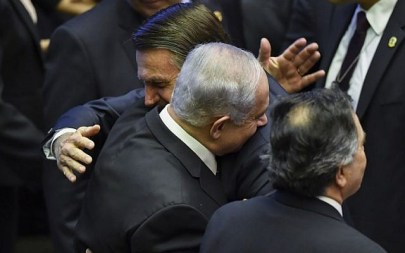
Brazil’s newly sworn-in President Jair Bolsonaro (C) greets Prime Minister Benjamin Netanyahu (L), during his inauguration ceremony, at the National Congress in Brasilia on January 1, 2019. (Nelson Almeida/AFP)
This city was the starting point for Netanyahu along with his wife, Sara, and their son, Yair. After landing, the prime minister headed straight to the Copacabana fort, where he was surprised to be awarded the National Order of the Southern Cross, Brazil’s highest national honor for high-ranking guests, by Bolsonaro.
“We will be starting a difficult government from January. In order to overcome the obstacles, we’ll need good allies, good friends, good brothers. Like Benjamin Netanyahu,” Bolsonaro said about the only foreign leader he met prior to being sworn in.
Bolsonaro also joined Netanyahu at a Dec. 28 ceremony at the Kehilat Yaacov synagogue in the heart of Copacabana, Rio’s most heavily Jewish neighborhood. Some 500 members of the 30,000-strong Jewish community there attended the ceremony at the Orthodox synagogue, shouting “mito” (Portuguese for myth or legend) at Bolsonaro, and Netanyahu’s nickname, “Bibi.”
“We can’t understand that we had to wait over 70 years for an Israeli prime minister to visit Brazil,” Netanyahu said in Hebrew, calling Bolsonaro “yedidi,” my friend, and “mitos.” “It’s not just friendship, not a pact of interest, it’s also a pact of brothers.”
Bolsonaro said: “It is with great honor that today I meet the man that is to me an example of patriotism, austerity and work for his people. I have always mentioned Israel as an example. Look what they don’t have and see what they are. Look at Brazil, look what we have and see what we don’t have. We’ll be more than just good partners, we’ll be brothers.”
Back at their hotel, the Netanyahus held a private Friday evening Shabbat ceremony, where Freddy Glatt, the 90-year-old president of the Brazilian Association of Holocaust Survivors in Rio, offered the kiddush blessing over the wine.
“His visit is very positive to show Brazilians the good things about Israel,” Glatt told JTA. “Despite the leftist people who are usually harsh on him, he is very nice and surprisingly behaved with simplicity.”
Like most Cariocas, or Rio natives, the Netanyahus chose the beach to enjoy the 95-degree weather on Saturday morning. While Yair, 27, took a helicopter and went on a yacht ride at a pristine island off Rio, the prime minister and his wife took a stroll that drew the attention of locals and tourists. A scene of the pair eating at a seafront restaurant fueled a media spectacle. When someone in the crowd of onlookers yelled “Free Palestine,” Netanyahu immediately added “from Hamas.”
On Sunday, the couple was escorted by Rio state governor Wilson Witzel and his wife for a visit to Sugarloaf Mountain, a city landmark. They headed for the iconic Christ the Redeemer statue, but the prime minister could not leave the car for security reasons. At night, the statue was lit up with the blue-and-white colors of the Israeli flag.
The Israeli prime minister met with Jewish officials from several Brazilian states, including those concerned about the impact of Netanyahu and Bolsonaro’s right-wing politics.
“The Jewish community is quite diverse and we will work so that political differences do not affect our unity,” Fernando Lottenberg, president of the Brazilian Israelite Confederation, told JTA the day after Bolsonaro was elected in October.
At a news conference, Netanyahu highlighted Israel’s innovation and high technology contributions to the world. He also spoke of Bolsonaro’s plans for the Israeli Embassy.
Prime Minister Benjamin Netanyahu and his wife Sara in Rio de Janeiro attend an event with Brazilian Jewish community leaders, December 30, 2018 (Avi Ohayun/GPO)
“President Bolsonaro said he’ll move the embassy to Jerusalem. It’s not a matter of if, but when,” Netanyahu told the audience about the Brazilian leader’s promise during the campaign. “President Trump said the same thing, he moved the embassy. And President Bolsonaro will move the embassy as well.”
Israel also offered assistance to Brazil in domestic security — a key part of the Bolsonaro campaign in the crime-ridden country — including the sale of drones with facial recognition technology.
Bolsonaro’s pro-Israel stance during his campaign and Netanyahu’s eagerness to embrace the new leader have earned mixed reactions at home. Reporters at a briefing with an unnamed “senior Israeli political officer” noted that Bolsonaro has denigrated women, the LGBTQ community and minorities.
“Netanyahu has his own positions and no one can diminish them, both regarding women and regarding gays,” the official replied, according to Haaretz. “He is liberal in these matters, and it’s not just political correctness. … But our relations with countries like Brazil are important. We do not have the privilege of hunkering down in our fortress of purity.”
Netanyahu was joined later by Witzel and Rio’s mayor, Marcelo Crivella, at a meeting with several evangelical Christian leaders who, fiercely pro-Israel, played a pivotal role in supporting Bolsonaro’s election. Brazil has the world’s second-largest Christian population and the largest Catholic population.
“We have no better friends in the world than the evangelical community, and the evangelical community has no better friend in the world than Israel,” Netanyahu said. “You are our brothers and sisters, and we protect the rights of Christians.”
“President Bolsonaro’s first name in Hebrew is Yair, which is also the name of our son. It means he who brings light. And I think that we have now an opportunity together to bring a lot of light to the people of Brazil and the people of Israel. This is an alliance of brothers.”
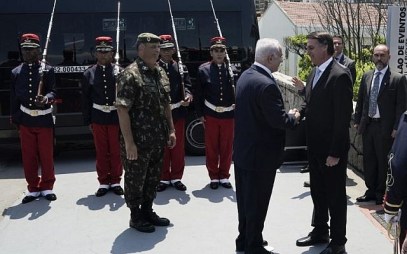
Prime Minister Benjamin Netanyahu (L) is welcomed by Brazil’s President-elect Jair Bolsonaro at the Copacabana fort in Rio de Janeiro, Brazil, on December 28, 2018. (Photo by Leo CORREA / POOL / AFP)
During the event, the Brazilian state of Amazonas launched a commemorative stamp featuring a picture of Netanyahu and also honoring Israel’s 70th birthday.
Tuesday, New Year’s Eve, was a day to meet businesspeople who flew to Rio from all corners of Brazil. The following morning they flew to Brasilia for Bolsonaro’s inauguration.
“Let’s unite the people, value the family, respect the religions and our Jewish-Christian tradition,” Brazil’s president said during his speech in the Brazilian congress on Jan. 1 after being greeted by the Netanyahus.
In the capital city, Netanyahu held separate meetings with the US secretary of state, Mike Pompeo; Chile’s president, Sebastian Pinera; and the president of Honduras, Juan Orlando Hernandez, who recently expressed his willingness to move its embassy to Jerusalem from Tel Aviv.
Netanyahu said Bolsonaro has accepted his invitation to visit Israel in March, weeks before Israel is slated to hold national elections.
“Until a few months ago Brazil was the unattainable goal of Israeli diplomacy. Overnight it has turned from hostile to sympathetic,” Netanyahu said. “This is a partnership that has been meaning to happen, meant to happen, and we’re going to make it happen very fast.”
The administration of President Donald Trump imposed a new round of sanctions on the Iranian regime on Nov. 4, 2018, following the president’s announcement the United States would cease participation in the Joint Comprehensive Plan of Action (JCPOA), better known as the Iran Deal. These sanctions are said to be some of the harshest ever imposed on the Islamic Republic of Iran. The U.S. Department of State also announced that the United States is committed to “maximum financial pressure” on the Iranian regime, and that the sanctions are mostly targeting the financial and energy sectors.
The sanctions are designed, among other things, to convey a sense of shock to the populace in Iran so that they rise against the regime and put it under domestic pressure. The goal is to force the regime, in addressing the nation’s problems, to concede to American demands, if not be completely toppled by a revolution. However, the regime has developed a set of “shock-absorbing” techniques to counter the sanctions. Here we enumerate them:
The Iranian regime created artificial hyperinflation in the months leading up to Nov. 4. By quadrupling the price of foreign currencies, the price of domestic staples such as meat and grocery increased and made simple items scarce or unavailable on the market. That was before any strong sanctions had gone into effect. By that, the regime used the “frog in the boiling water” technique to acclimate the population to scarcity in order to absorb the shock of the coming sanctions.
Utilizing currency and gold reserves, the regime artificially flooded and relieved the market after the sanctions went into effect. The regime’s media outlets have repeatedly reported that foreign currencies were declining in price after Nov. 4. As is common knowledge, the IRGC and the supreme leader have full control over a large swath of Iran’s economy. It is easily understood that the regime can decrease, stop, or increase the trickle into the market, and thereby create artificial economic conditions to mislead people.
Regarding the general strikes, the regime has been capable of suppressing them through sophisticated techniques. A series of protests have been taking place across Iran against the economic situation since April 14, 2018. Although it all started by retail shop owners, it soon reached the truckers, who stopped work in 160 cities in May for 10 days. This was followed in June 2018, almost a month later, by the Bazaar of Tehran and a few other major cities, with the crowds chanting “Death to the dictator” and “Death to Palestine.”
September and October 2018 were marked with the truckers’ strike across several Iranian cities. The Free Truckers Union announced the strike had spread to 31 provinces and the judiciary stated that those arrested could face the death penalty. By Oct. 8, the number of truckers arrested reached 256 after 17 days of strikes. The strikes were taken up by the teachers, two of whom were arrested.
In November, the truckers went on strike for the fourth time this year in protest of the arrest of hundreds of truckers in October. The workers at the Haft-Tappeh Sugar Cane Co. also started their own strikes at this point. On the same day, hundreds of workers of the Steel Company in Ahvaz protested by chanting, “Let go of Khashoggi, think of us!” and “Inflation, increasing prices, be responsible Rouhani!”
Protesters were arrested and threatened with charges of “acting against the state,” which is punishable by death. The supreme leader called on the judiciary to punish those who disrupted economic security.
The regime basically allowed workers to go on strike for a few weeks, then outlawed the strike and announced it on judiciary, police, and state-run media outlets. It blamed the strikers for the general populace’s suffering due to scarcity, and pushed a section of workers to break strike.
As long as the regime maintains the ability to control the economy and suppress strikes and other kinds of popular movements, the sanctions are not likely to produce shock effects that spur the populace to move and push the regime to comply with U.S. demands. As such, it will become a war of attrition. The mullahs have all the time in the world. On the other hand, the Trump administration, as a government in a democratic system, has limited time to implement its measures against the greatest state sponsor of terrorism. As such, it must act quickly and utilize more effective methods that are likely to produce tangible results.
US President Donald Trump speaks during a cabinet meeting at the White House, Wednesday, January 2, 2019, in Washington. (AP Photo/Evan Vucci)
WASHINGTON — US President Donald Trump on Wednesday gave Iran free rein to further entrench itself in Syria, but claimed that Tehran was no longer seeking to bolster its presence in the beleaguered country.
“They can do what they want there, frankly,” he told reporters, referring to Iranian forces.
Trump’s comments came two weeks after he rattled Jerusalem by announcing that he would pull all American troops out of Syria. US soldiers had been leading the coalition against the Islamic State terror group, while also helping to thwart a permanent Iranian infrastructure in the war-torn country.
Israel has repeatedly warned in recent years that Iran is seeking to establish a military presence in Syria, where it is fighting alongside its Lebanese proxy Hezbollah and Russia to restore the regime of Syrian President Bashar Assad.
Israeli officials have also warned that America’s absence would open the door for Tehran to create a so-called “land bridge” from Iran, through Iraq and Syria, into Lebanon and to the Mediterranean Sea.
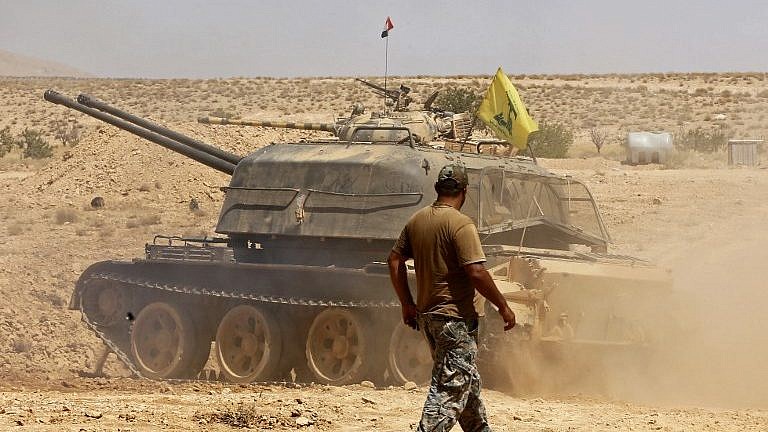
Illustrative image of a tank flying the Hezbollah terror group’s flag seen in the Qara area in Syria’s Qalamoun region on August 28, 2017 (AFP Photo/Louai Beshara)
Over the last several years, Israel has carried out hundreds of airstrikes in Syria against targets linked to Iran.
Yet Trump, on Wednesday, said that Tehran, like the US, was withdrawing its forces from Syria.
“Iran is no longer the same country,” he said. “Iran is pulling people out of Syria. They can do what they want there, frankly, but they’re pulling people out. They’re pulling people out of Yemen. Iran wants to survive now.”
The president went on to say that in pulling out of the nuclear deal with Iran last year, Washington had changed Tehran’s calculus and stymied its efforts to destabilize, and spread its influence throughout, the region.
“Iran was going to take over everything and destroy Israel while they’re at it. Iran is a much different country right now,” he said, in comments that were at times incoherent. “They’re having riots every week in every country. I’d love to negotiate with Iran… but Iran is a much different country right now.”
Trump’s decision to pull America’s 2,000 troops out from Syria caused a major shakeup within his own administration; his secretary of defense, James Mattis, resigned over the withdrawal.
Trump offered a stark take on the situation in Syria Wednesday, summing it up in two words — “sand and death” — while remaining vague about the timing of the US troop withdrawal.
“So Syria was lost long ago. It was lost long ago. And besides that, I don’t want — we’re talking about sand and death. That’s what we’re talking about,” Trump said during a cabinet meeting. “We’re not talking about vast wealth. We’re talking about sand and death.”
On when US forces would leave Syria, Trump said: “I don’t want to be in Syria forever.”
He added: “I never said we are getting out overnight… We’re withdrawing… over a period of time.”
The president’s announcement of the Syrian withdrawal was the first significant point of contention between Washington and Jerusalem since he took office — Prime Minister Benjamin Netanyahu reportedly pleaded with him to rethink the decision — and has fortified the perception that he views the US relationship with Israel as transactional.
On Tuesday, US Secretary of State Mike Pompeo told Netanyahu that the planned withdrawal of US ground forces from Syria will not alter America’s commitment to countering Iranian aggression and maintaining Israel’s security.
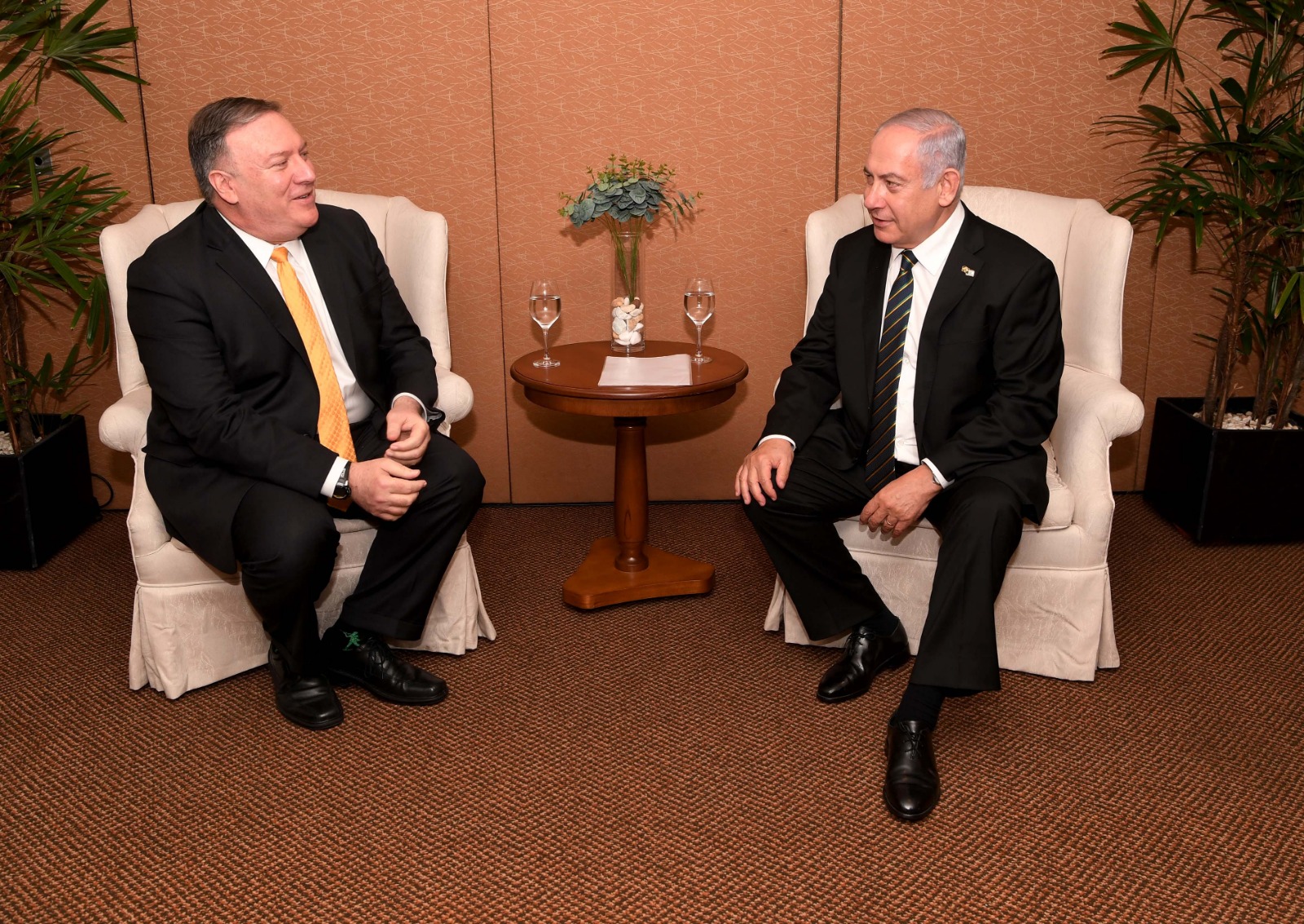
US Secretary of State Mike Pompeo (L) meets with Prime Minister Benjamin Netanyahu in Brasilia on January 1, 2019 (Avi Ohayon/GPO)
“The decision by the president on Syria in no way changes anything that this administration is working on alongside Israel,” Pompeo said at a joint press conference with Netanyahu before they held talks in Brazil.
Trump said last week that he did not think America’s removing its troops from Syria would endanger Israel by strengthening Tehran’s hand in one of the Jewish state’s immediate neighbors to the north.
“Well, I don’t see it. I spoke with Bibi,” he said. “I told Bibi. And, you know, we give Israel $4.5 billion a year. And they’re doing very well defending themselves, if you take a look… So that’s the way it is.”
Trump blamed Syria’s instability on the policies of his predecessor, Barack Obama, who didn’t attack Assad after he crossed the former US president’s “red line” of using chemical weapons on his own people.
“You can’t make a threat and then do nothing. So Syria was lost long ago,” Trump said. “Beside that, we’re talking about sand and death. We’re not talking about vast wealth.”
Times of Israel staff and Agencies contributed to this report.
President Donald Trump is asking Prime Minister Binyamin Netanyahu to build his campaign around the “Deal of the Century” for an Israeli-Palestinian peace, DEBKAfile reports exclusively.
This insistent request keeps on coming up in contacts with Washington, including Netanyahu’s conversation with Secretary of State Mike Pompeo in Brazil on Tuesday, Jan. 1. The peace plan’s authors, the president’s advisers Jared Kushner and Jason Greenblatt, have been placed on standby for finally going public on their product in the near future.
In recent consultations at the White House, in which US ambassador to Israel David Friedman also participated, the president was advised that publication of the peace plan would not be good for the prime minister and his Likud’s chances and it would be better to wait until after the April 9 election. Trump, however, stood by his demand and put forward the following arguments for an early date of publication:
Making it a central feature of Netanyahu’s campaign would reuse the general election as a kind of referendum for its popular endorsement.
Building a new coalition cabinet after the vote could be a drawn-out process consuming several months.
As a focal of the prime minister’s bid for re-election, the plan would fit in well with his plans for visits in the critical months of February and March of a string of world leaders, including Arab heads of government, to showcase his successes as minister of foreign affairs and defense. Trump believes that knowing the peace plan for the Palestinians was imminent would provide Arab leaders, especially in the Gulf, with an added incentive to make state visits to Israel or invite Netanyahu to visit their capitals.
Some of Trump’s advisers suggested as a compromise that just sections of the peace plan be released at this stage, not the entire opus. They hoped that Trump would be deterred from losing patience and turning to Twitter to unveil his plan, with the same abruptness as the US troop pullback from Syria last month. He could do this in a series of tweets.
On Tuesday, Jan. 1, Israel’s party strategists were engrossed in calculating how the Trump peace plan landing in the middle of the election campaign would affect their prospects. This scenario appeared more pressing even than Labor leader Avi Gabbay’s sudden dumping of Tzipi Livni which was making waves. They also treated as a flash in the pan the media reports, soon to be denied, claiming that Attorney General Avichai Mendelblit had conferred with a flock of ex-prosecutors and legal whizzes on how to handle the cases against Netanyahu.







 anneinpt
 artaxes
 danmillerinpanama
 davidking1530
 Peter Hofman
 Joseph Wouk
 Peter
Peter Louisiana Steve
 WarSclerotic
Recent Comments