Archive for October 2018

Avigdor Liberman: US sanctions will reduce Iran’s terror financing

October 22, 2018

Source: Avigdor Liberman: US sanctions will reduce Iran’s terror financing – Israel News – Jerusalem Post

Former National Security Council Chief Yaakov Amidror says Russia will be embarrassed when IDF overcomes S-300 in Syria.

BY YONAH JEREMY BOB
 OCTOBER 21, 2018 22:40
Liberman: US sanctions will reduce Iran’s terror financing

The US sanctions enacted on November 4 will not stop Iran from getting a nuclear bomb, but they willpressure the regime and significantly reduce its ability to finance regional terror, Defense Minister Avigdor Liberman said on Sunday night.

Speaking at the Jerusalem Institute for Strategic Studies, Liberman explained that “the first round of US sanctions had a big impact on Iran” causing “inflation [and] reducing foreign investments.”

“So the second round of sanctions will obviously have an even bigger impact. The fact that Iran will not be able to fund terror” is crucial and will negatively impact “Hezbollah, Hamas, proxies in Yemen and proxies in Iraq,” he said.

Still, he believes that Iran has made a political decision to eventually obtain a nuclear weapon and that sanctions alone could not force it to change its mind, although he hoped they would pressure the regime internally.

The defense minister also holds that the current regime of the ayatollahs will fall like many former communist regimes connected with the USSR, but implied this could take time. In that light, he said “we need to deter Iran” from trying to get a nuclear bomb “and be ready for all scenarios.”

Liberman reiterated his position that Israel must “strike a great blow” against Hamas to achieve quiet in Gaza and insisted on evacuating the Bedouin village of Khan al-Ahmar, while leaving room to negotiate the evacuation.

Earlier at the conference, former National Security Council Chief Yaakov Amidror and a JISS fellow proclaimed that the IDF would overcome the challenge of the S-300 antiaircraft missile system that Russia recently provided to Syria.

Amidror was certain when he said Russian President Vladimir Putin had made an uncharacteristic blunder by presenting the S-300 as Russia’s unbeatable answer to the IDF’s air power. He noted this would lead to embarrassment for Russia when the IDF succeeds at striking Syria despite the presence of the S-300.

Amidror continued by saying that in several decades, “there is not a single Russian-made weapon that we have not figured out a technical-tactical solution for confronting. There is no reason to think Israel will not find a solution to the S-300.” Regarding overcoming the S-300, he said “there are different S-300 models. It is a tactical [item] which has never been in the Middle East. We are not familiar with it. We need a deep intelligence process to know exactly which S-300 model was provided” to the Syrians.

He also asked, ”Who is operating the S-300? The Russians? The Syrians? The Iranians?…We will act differently depending on…who pulls the trigger,” implying that the IDF could act more aggressively if those manning the S-300 were not Russians.
Another thing that assured Amidror was that “Israeli intelligence has been doing incredible work with both long-range surveillance and [covert] forces going in and out [of Syria,]…to make sure the IDF hits targets exactly…and without hitting any of the Russian” advisers stationed near Syrian troops.

At the same conference, Strategic Affairs Minister Gilad Erdan advocated Israel widen its targets in Syria to include Iranian communication units and not just weapons transfers to Hezbollah and Syria.

Erdan called on the US to publicly announce it will back any Israeli operations against Iran in Syria.

Finally, he expressed hope that from recent talks with England’s new interior minister, once the UK leaves the EU, it will become the first Western European country to declare both Hezbollah’s political and military wings to be terroristic in nature (currently only the EU declares the military wing to be so.)

Speaking at the conference, former national security council official and JISS fellow Micky Ahronson asserted that the Russia-Iran team could be broken with the right set of incentives, like appeasing Russia in other geopolitical areas it remains concerned about, such as Ukraine.

JISS Vice President, former national security council officer and IDF Col. (ret.) Dr. Eran Lerman said that it appears that the Trump administration would keep some troops in Syria, which would help Israel hold back Iran.

However, the US defense establishment would be unlikely to support an attack on Iran if it tried to attain a nuclear weapon in light of the difficult situations in Iraq and Afghanistan. This would leave Israel to attack in a worst case scenario, Lerman said.
 

Russia supports Syria, Iran ramps up support to Hezbollah 

October 22, 2018

Source: Russia supports Syria, Iran ramps up support to Hezbollah – Middle East – Jerusalem Post

“If Hezbollah succeeds in converting these missiles, the new situation would represent a significant risk to Israeli airports, power stations, the Dimona nuclear reactor, and more.”

BY VICTOR CABRERA/THE MEDIA LINE
 OCTOBER 22, 2018 04:50
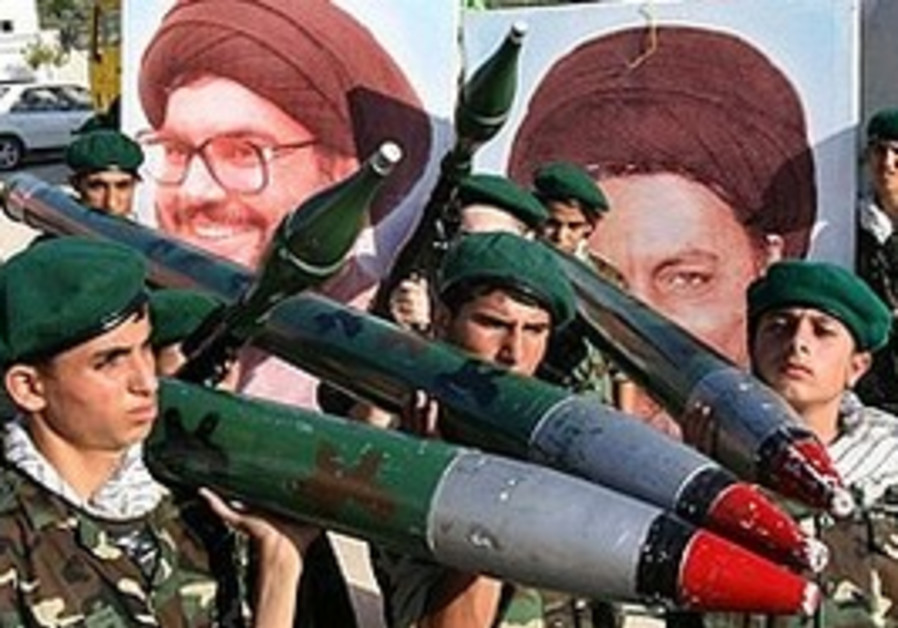
Hizbullah rockets

The Israel Defense Forces has over the past two years conducted hundreds of attacks in Syria to prevent such arms deliveries.

Meanwhile, Russia last week upped its military support to the Assad regime with the transfer of three S-300PM-2 missile batteries whose radar and communication technologies are more sophisticated than those of the model deployed to Syria at the beginning of the month.

That move, in turn, followed the downing of a Russian reconnaissance plane by Syrian forces, an incident the Kremlin blamed on Israel which minutes before had conducted an aerial operation against an Iranian military installation in Latakia.

“Russia’s delivery of advanced air defense systems to Syria has emboldened Iran to ramp up its shipments of weaponry to Hezbollah,” Meir Litvak, Director of the Alliance Center for Iranian Studies at Tel Aviv University, contended to The Media Line.

“While Israel can deal with the military threat posed by the S-300PM-2,” he elaborated, “the problem is that the government does not yet know how the Russians will operate. Will they tell Syrians when an Israeli jet takes off and will they intercept the planes? Until the reaction becomes clear, Israel is limited.”

Nevertheless, Jerusalem repeatedly has vowed to continue conducting cross-border missions, both to prevent Tehran from establishing a permanent military presence in Syria and to inhibit the Iranians from supplying Hezbollah with arms.

“Most [of Hezbollah’s rockets] are not precise enough, making their potential threat tolerable to Israel,” Dr. Litvak continued. “If Hezbollah succeeds in converting these missiles, the new situation would represent a significant risk to Israeli airports, power stations, the Dimona nuclear reactor, and more.”

During his speech last month to the United Nations General Assembly, Prime Minister Binyamin Netanyahu revealed satellite imagery of three sites in the Lebanese capital where Hezbollah, at the behest of its Iranian masters, allegedly has built underground missile manufacturing facilities. According to analysts, the weapons produced are capable of hitting within a few meters their intended target and can reach almost anywhere in Israel.

Hezbollah has an arsenal of more than 100,000 rockets and missiles, many of them housed in residential areas to protect them from attack.

“The increased Russian presence in Syria and the mounting threats from Lebanon indicate a significant level of danger from a diplomatic point of view,” Jonathan Spyer, a Fellow at the Jerusalem Institute for Strategic Studies, conveyed to The Media Line. “The consolidation of Iranian power in Syria is becoming Israel’s number one priority in the region.”

To this end, Prime Minister Netanyahu is slated to meet with Russian President Vladimir Putin in the near future to discuss the latest developments.


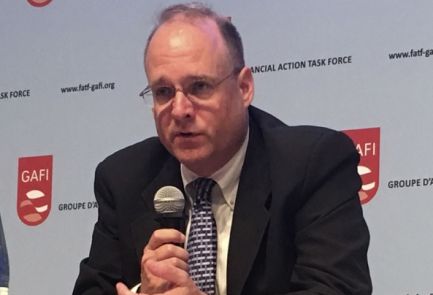
Global financial watchdog warns Iran over sponsoring terrorism 

October 21, 2018

Source: Global financial watchdog warns Iran over sponsoring terrorism – Israel Hayom


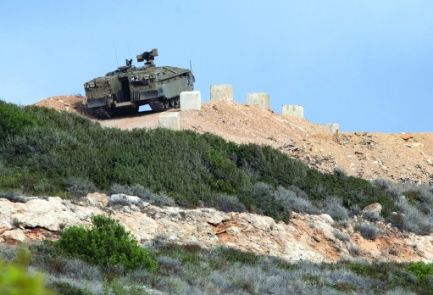
Anticipating Hezbollah clash, Israel builds barriers, deploys tanks on Lebanon border 

October 21, 2018

Source: Anticipating Hezbollah clash, Israel builds barriers, deploys tanks on Lebanon border – Israel Hayom


Off Topic: Russia blasts US withdrawal from nuclear arms deal as ‘dangerous step’ 

October 21, 2018

Source: Russia blasts US withdrawal from nuclear arms deal as ‘dangerous step’ | The Times of Israel

Accusing Moscow of violating the agreement, Trump announced plans to leave the Intermediate-Range Nuclear Forces Treaty

Russian President Vladimir Putin looks over toward US President Donald Trump, as Trump speaks during their joint news conference at the Presidential Palace in Helsinki, Finland, July 16, 2018. (AP Photo/Pablo Martinez Monsivais)

Russian President Vladimir Putin looks over toward US President Donald Trump, as Trump speaks during their joint news conference at the Presidential Palace in Helsinki, Finland, July 16, 2018. (AP Photo/Pablo Martinez Monsivais)

MOSCOW, Russia — Withdrawing from a Cold War-era nuclear weapons treaty with Russia, as US President Donald Trump has announced he plans to do, is a dangerous step, Russia’s deputy foreign minister warned on Sunday.

“This would be a very dangerous step that, I’m sure, not only will not be comprehended by the international community but will provoke serious condemnation,” deputy foreign minister Sergei Ryabkov told TASS state news agency.

The treaty is “significant for international security and security in the sphere of nuclear arms, for the maintenance of strategic stability,” he stressed.

Russia condemned what he called attempts by the US to gain concessions “through a method of blackmail,” he added.

If the US continues to act “clumsily and crudely” and unilaterally back out of international agreements “then we will have no choice but to undertake retaliatory measures including involving military technology,” Ryabkov told RIA Novosti news agency.

“But we would not want to get to this stage,” he added.

Russian Deputy Foreign Minister Sergei Ryabkov at the State Department in Washington, July 17, 2017 (AP Photo/Carolyn Kaster)

On Saturday, Trump announced US plans to leave the three-decade-old Intermediate-Range Nuclear Forces Treaty, known as the INF, signed in 1987 by then-US president Ronald Reagan.

“We’re the ones who have stayed in the agreement and we’ve honored the agreement, but Russia has not unfortunately honored the agreement, so we’re going to terminate the agreement and we’re going to pull out,” said Trump.

But Ryabkov on Sunday denied Trump’s accusations, throwing the accusation back at Washington.

“We don’t just not violate (the treaty), we observe it in the strictest way,” he insisted.

“And we have shown patience while pointing out over the course of many years the flagrant violations of this treaty by the US itself.”

US National Security Adviser John Bolton is set to arrive in Moscow on Sunday.

“We hope that we will hear from him during meetings, tomorrow and the day after, more substantively and clearly what the American side intends to undertake,” said Ryabkov.

Earlier a foreign ministry source told Russian news agencies that the US move was connected to its “dream of a unipolar world,” an argument that Ryabkov also advanced.

“Apparently the existence of the Intermediate-Range Nuclear Forces Treaty creates problems for establishing a line of total US domination and supremacy in the military sphere,” he said.


Off Topic: Trump: US to exit nuclear treaty, citing Russian violations

October 21, 2018

Source: Trump: US to exit nuclear treaty, citing Russian violations

( Gee, the NPC’s of the left  told us Trump was “SOFT” on Russia… – JW )

American president says country will pull out of Cold-War era INF treaty, designed to eliminate short- and intermediate-range nuclear and conventional missiles, due to Moscow’s deployment of ground-launched system in breach of 1988 agreement
President Donald Trump said on Saturday the United States will exit the Cold-War era Intermediate-Range Nuclear Forces Treaty that eliminated a class of nuclear weapons, in a move that is likely to upset Russia.
The INF treaty, negotiated by then-President Ronald Reagan and Soviet leader Mikhail Gorbachev and ratified by the US Senate in 1988, required elimination of short-range and intermediate-range nuclear and conventional missiles by both countries.”Russia has not, unfortunately, honored the agreement so we’re going to terminate the agreement and we’re going to pull out,” Trum told reporters after a rally in Nevada.

President Trump (Photo: AP)

President Trump (Photo: AP)

Washington believes Moscow is developing and has deployed a ground-launched system in breach of the INF treaty that could allow Moscow to launch a nuclear strike on Europe at short notice. Russia has consistently denied any such violation.

Trump said the United States will develop the weapons unless Russia and China agree to a halt on development.

China is not a party to the treaty and has invested heavily in conventional missiles as part of an anti-access/area denial strategy, while the INF has banned US possession of ground-launched ballistic missiles or cruise missiles of ranges between 500 and 5,500 km (311 and 3,418 miles).

Trump’s national security adviser, John Bolton, will visit Moscow next week.


The unusual route of the Iranian cargo jets

October 21, 2018

Source: The unusual route of the Iranian cargo jets

Western intelligence sources believe that a Fars Air Qeshm Boeing 747, very active on the Tehran-Damascus route, made an unusual flight to Beirut to deliver advanced weapons systems to Hezbollah, including GPS for precision missiles.
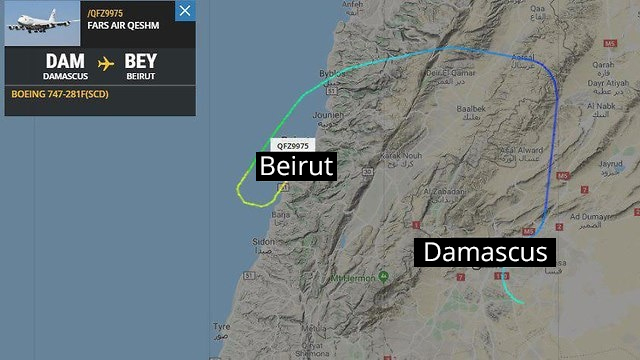
Flight QFZ9975 set off alarm bells for Western intelligence agencies. The Boeing 747 aircraft of the Iranian cargo airline Fars Air Qeshm has been operating for months in the service of arms shipments from Tehran to Syria, but this time it made an unusual stop in Beirut. Fox news reported on Friday that the aircraft delivered GPS components to Hezbollah that would make their unguided rockets into precision-guided missiles.
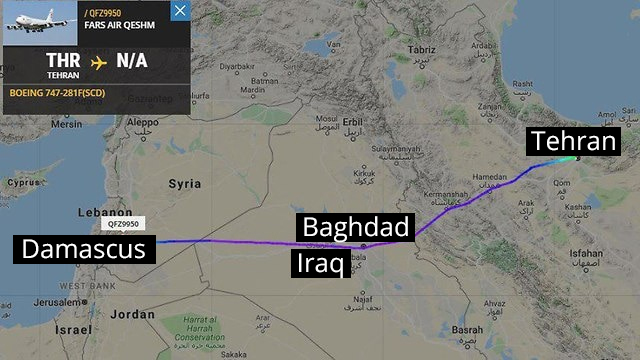
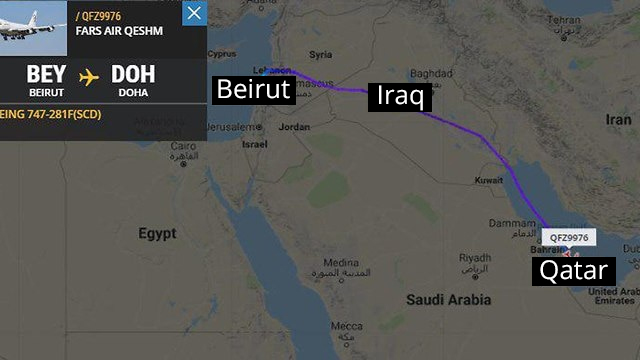
The 27-year-old plane, under the registration EP-FAB, took off Tuesday morning from Tehran to Damascus as flight QFZ9950 and landed in Syria just before 11am. About two hours later, in a rather unusual change, the plane took off as flight QFZ9975 directly to Beirut airport, where it landed shortly after 2pm.The following day, the plane took off at night from Lebanon to Doha, the capital of Qatar, as flight QFZ9976, where it landed after midnight. On Thursday it made its final journey last week when it flew back as flight QFZ9977 to Tehran.

The plane has worked extensively in the past to transport equipment and weapons from the Revolutionary Guards under civilian guise, mainly to Assad’s army. It entered the Iranian fleet in September 2017 after an extensive service life with companies from Japan, Georgia, Afghanistan, Armenia and Russia.Last month, suspicions surfaced that Iran used the Boeing 747 to deliver advanced weapons to Syria. The reports came in the aftermath of the assault on the Damascus airport, attributed to Israel. This plane was documented at the time when it landed at Damascus International Airport.

Last month, it was also reported that two aircraft belonging to the Iranian airline “carried out unconventional flight routes.” The first flight was by a Boeing 747, which took off on July 9 from a military base in Tehran, made a brief interlude at the Damascus International Airport, and then continued to Beirut International Airport.The second flight took off on August 2 from Tehran and landed in Beirut about two hours before the scheduled landing, in what appeared to be “an unusual route through northern Syria.”

“The Iranians are trying to find new ways to smuggle weapons to their allies in the Middle East,” said an unnamed Middle Eastern intelligence source, adding that “they are exploring the West’s ability to locate and define smuggling.”

According to Fox News, the Iranian airline stopped operations in 2013 due to administrative failures, but became active once more last March. The company’s board of directors includes three representatives from the Iranian Revolutionary Guards.

Last month. Prime Minister Benjamin Netanyahu revealed in his speech at the UN General Assembly that “in Lebanon, Iran is directing Hezbollah to build secret sites to convert inaccurate projectiles into precision-guided missiles. Missiles that can target deep inside Israel within an accuracy of ten meters.”

 (Photo: IDF Spokesman's Office)

(Photo: IDF Spokesman’s Office)
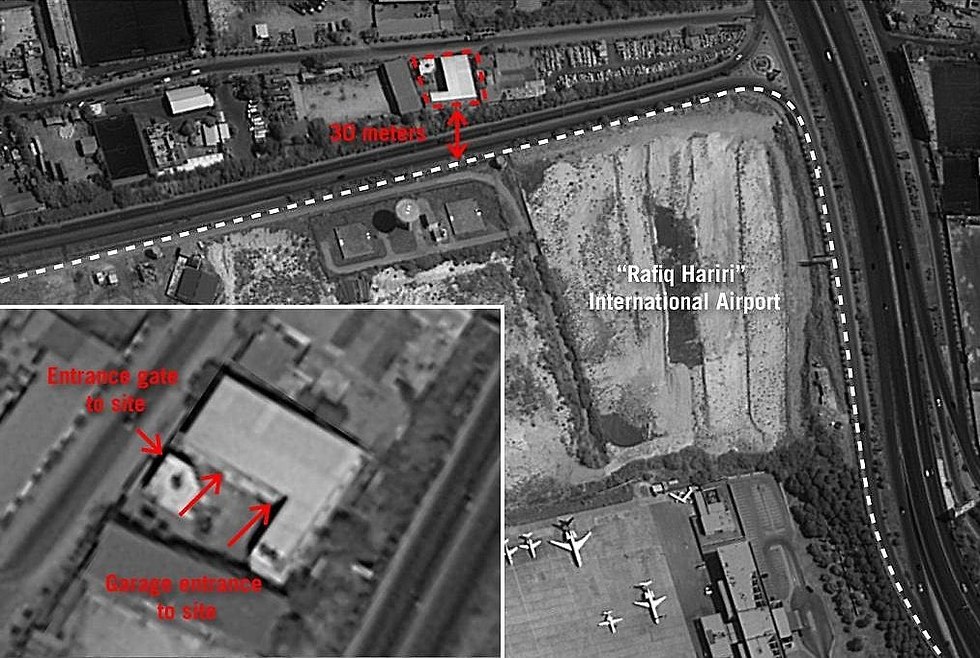
Netanyahu addressed the Shiite terror organization and said: “Hezbollah is deliberately using the innocent people of Beirut as human shields. They’ve placed three of these missile conversion sites along Beirut’s international airport.”

 (Photo: IDF Spokesman's Office)

(Photo: IDF Spokesman’s Office)

Netanyahu presented world leaders with a picture of the airport and said: “Here’s Beirut’s international airport. Here’s the first missile site. It’s in the Uzai neighborhood, on the water’s edge, a few blocks away from the runway. Here’s the second site. It’s underneath a soccer stadium, two blocks away. And here’s the third site. It’s adjacent to the airport itself, right next to it. So I have a message for Hezbollah today: Israel knows, Israel also knows what you’re doing. Israel knows where you’re doing it. And Israel will not let you get away with it.”

The IDF published a record of the Hezbollah sites in the Lebanese capital.


Netanyahu calls on Mnuchin to stop Iranian aggression

October 21, 2018

Source: Netanyahu calls on Mnuchin to stop Iranian aggression – International news – Jerusalem Post

“Instead of blocking their path to a nuclear bomb, it actually paved their way to a nuclear arsenal,” Netanyahu said of JCPOA.

BY YVETTE J. DEANE
 OCTOBER 21, 2018 11:14
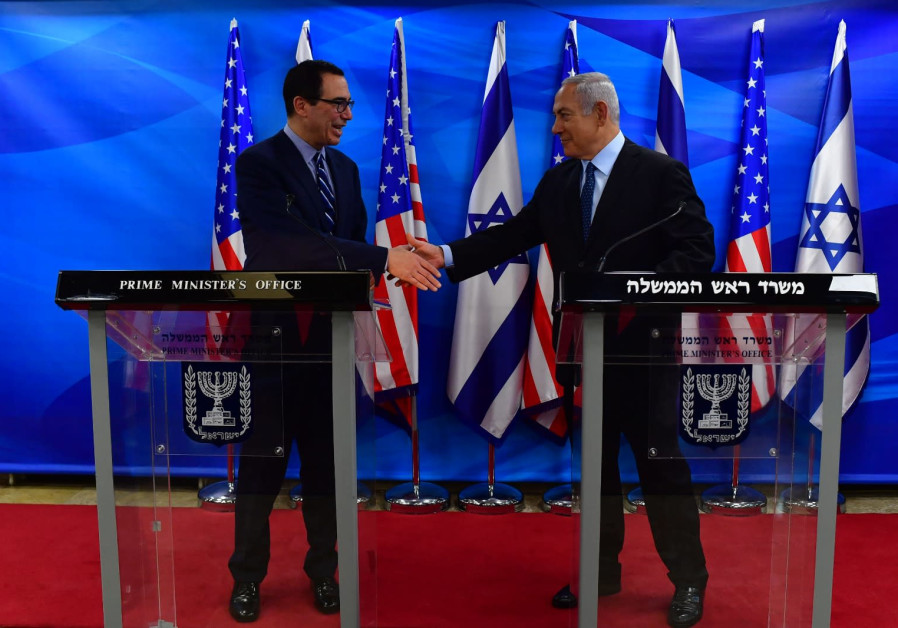
Prime Minister Benjamin Netanyahu meets Treasury Secretary Steven Mnuchin, October 21, 2018

Prime Minister Benjamin Netanyahu discussed ways to continue to challenge Iranian power in the region with US Treasury Secretary Steven Mnuchin on Sunday.

Netnyahu said the two discussed, “How to stop Iran’s two-pronged aggression: its pursuit of a nuclear arsenal and its pursuit of a conventional arsenal and its plans to takeover the Middle East.”

He also congratulated President Trump’s “courageous step out of the JCPOA,” and hope for increased “pressure on the world’s main terrorist regime, the aggressive regime in Tehran.”

“Instead of blocking their path to a nuclear bomb, it actually paved their way to a nuclear arsenal,” Netanyahu said of JCPOA. “In addition, it gave them hundreds of billions of dollars in cash, credit and investment, enabling them to finance their growing aggression in the region.”

Netanyahu also touted the US and Israeli relationship, saying “The alliance between the United States and Israel under President Trump has never been stronger.”

The two also discussed the local economy in Israel  and American economy, the cooperation between the two.

In response to the a journalist’s question about Khan al-Ahmar, Netanyahu said, “Khan al-Ahmar will be evacuated, this is a decision of the court, this is our policy, and it will also be implemented … I have no intention of postponing this.”


Saudi admission of Khashoggi death leaves turmoil in Riyadh, fallout on Saudi-US relations – DEBKAfile

October 21, 2018

Source: Saudi admission of Khashoggi death leaves turmoil in Riyadh, fallout on Saudi-US relations – DEBKAfile

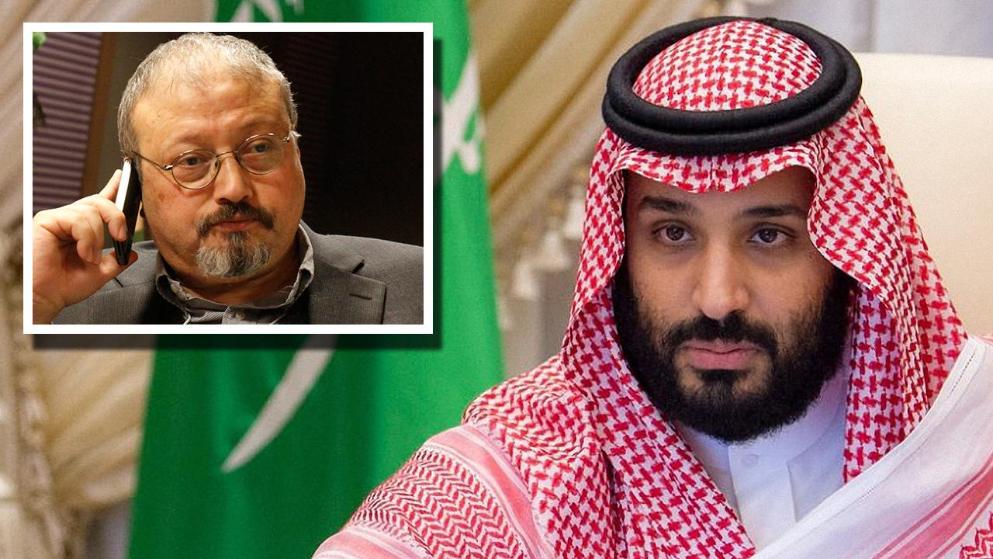
The Saudis cannot hope to lay to rest the upsets in the royal house and commotion in Washington by their disclosure on Saturday, Oct. 20 that the journalist Jamal Khashoggi died after a fistfight with intelligence agents sent to abduct him. 
Neither will the vibes subside after royal decrees  were issued to sack the crown prince’s associate, Deputy intelligence chief Ahmed Al-Asiri, court adviser Saud Al-Qahtani and three other intelligence officers, or 18 arrests in the ongoing investigation.

President Donald Trump saw this when he said: “Saudi Arabia has been a great ally, but what happened is unacceptable. It’s a big first step, only a first step.” He also announced he would work with Congress on the response.

There are too many fingers in the pie and open questions for the scandal to die down any time soon. For one, what happened to the body of the dead journalist? The Saudis now report that it was handed to an unnamed “local collaborator.” This mysterious person either got away, was smuggled out of Turkey by Saudi agents or is no longer alive. This may explain the sweep Turkish police have been conducting in the woods near the consulate and other parts of Istanbul.

King Salman’s appointment of a ministerial committee, headed by Saudi Crown Prince Mohammed bin Salman to restructure the country’s General Intelligence agency and issue the results of its work within a month, was intended as a vote of confidence in Prince Mohammed (MbS) who has taken most of the international flak over the Khashoggi mystery. The monarch was clearly trying to put the running of the kingdom back to normal.

Abductions and assassinations by clandestine agencies of traitors, enemies, double agents or regime opponents  are not uncommon in the shady underworld of many nations. But even when they are botched and lead to unplanned deaths of the objects or even their assailants, such cases are rarely admitted by officialdom or reach the public domain. Yet the Khashoggi case hit world headlines, fed day after day by vividly morbid details, from the moment he failed to come out of the Saudi consulate in Istanbul on Oct. 2, because three parties had an immediate interest in fanning the flames of outrage.

  1. The crown prince’s rivals at home, who saw their chance to topple him. The official announcement on Saturday will not end the infighting in Riyadh, but rather intensify the struggle waged against him for some months by high-ranking princes, army commanders, intelligence agents and rich Saudis.
  2. Turkish President Tayyip Erdogan seized the affair with both hands as a vehicle for climbing up to the top of the international and Muslim power ladder in the guise of a seeker after justice and truth.
  3. Donald Trump’s political foes at home, who saw an opening for getting at him through the friendship between his son-in-law Jared Kushner and the Saudi crown prince. In this respect, the president’s decision to send Secretary of State Mike Pompeo to Riyadh and Ankara to get to the bottom of the affair and take the heat off the White House did more harm than good. Trump would have been better served by standing aloof from the scandal. Now he hopes to get rid of the hot potato by his decision to work with Congress on Washington’s response to the embarrassing Saudi crisis.


PM Netanyahu Meets with U.S. Treasury Secretary Steven Mnuchin 

October 21, 2018