Archive for October 2018

Report: Egypt brokers ‘understandings’ between Israel and Hamas 

October 26, 2018

source: Report: Egypt brokers ‘understandings’ between Israel and Hamas – Israel Hayom


IAF strikes Hamas targets in response to rocket attack

October 25, 2018

Source: IAF strikes Hamas targets in response to rocket attack

A military compound, a training camp and a weapons storage facility, belonging to Gaza’s rulers, are among the areas targeted by the IDF in extensive overnight strikes after a rocket fired from the strip landed in the Eshkol Regional Council on Wednesday night; no damage or injuries reported.
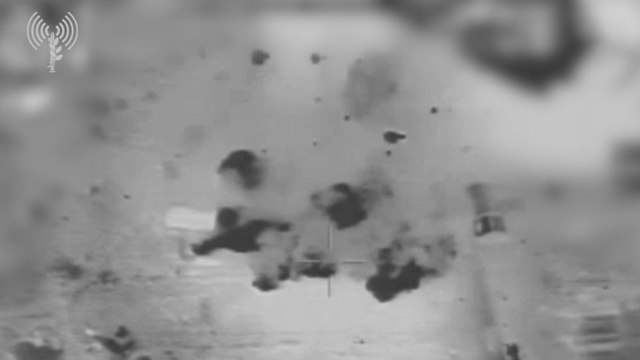
Israeli Air Force (IAF) aircrafts attacked overnight Thursday eight Hamas sites in Gaza in response to a rocket fired from the strip, which landed in the Eshkol Regional Council.

The IDF Spokesperson’s Unit issued an official statement following the strikes, clarifying that among the areas targeted were a military compound, a training camp and a weapons storage facility belonging to the terror group.

IAF strikes in Gaza (Photo: IDF Spokesperson's Unit)

IAF strikes in Gaza (Photo: IDF Spokesperson’s Unit)

The rocket alert siren went off at 23:17 on Wednesday in the Eshkol Regional Council, and according to the IDF, an Iron Dome interceptor missile attempted to down the rocket but failed.

The rocket exploded in an open area and no damage or casualties had been reported.

A Code Red siren also blared in Merhavim Regional Council, but no missiles are reported to have hit the area.

Hamas did not officially claim responsibility for the rocket attack. However, the IDF blamed Gaza’s rulers for the incident.

“The Hamas terror organization is responsible for everything that is happening in the Gaza Strip, and it will bear the consequences for the terror activity aimed against Israeli citizens.

“The IDF is prepared for a variety of scenarios and is determined to continue its mission to protect the citizens of Israel,” the statement concluded.

On Wednesday afternoon, an IAF plane attacked a Hamas observation post east of Rafah in the Gaza Strip, in response to incendiary balloons being launched into Israeli territory in the outpost’s proximity.

In addition, two Palestinians breached the border with Israel. They retreated back to the strip shortly after.

IDF forces searched the area, and ruled out infiltrations into Israel.

Nine fires sparked throughout the day across the Gaza border communities as a result of incendiary balloons flown from Gaza.

Associated Press contributed to this report.


Russia fears US surveillance flights portend fresh Israeli air strikes over Syria – DEBKAfile

October 25, 2018

Source: Russia fears US surveillance flights portend fresh Israeli air strikes over Syria – DEBKAfile

Moscow charged Thursday, Oct. 25, that US surveillance aircraft had piloted a massive UAV attack on Russia’s Syrian air base. DEBKAfile: This charge aimed at stopping US-UK reconnaissance flights which are assessing the new Russian air defense and electronic warfare deployments in Syria.

It was leveled by Russian Deputy Defense Minister Alexander Fomin, who claimed that that Russia’s Khmeimim Air Base in Syria had come under a massive drone attack by unmanned aerial vehicles piloted by a US Poseidon 8 surveillance aircraft. “This is very alarming data, of course,” Kremlin Spokesman Dmitry Peskov told journalists. ”No one has doubts about the conclusions, an appropriate analysis will be carried out by our military.”  Asked whether the subject would be raised at the Trump-summit expected to take place on Nov. 11 in Paris, Peskov did not rule this out.

It also came up, DEBKAfile’s sources report, in the talks US National Security Adviser John Bolton held in Moscow on Monday and Tuesday.
The Russian accusation is indeed grave. The radical Islamist rebel Hay’at Tahrir al-Sham has mounted repeated drone attacks on the Khmeimim airbase from Idlib and northern Latakia, but Moscow has never before charged the US with direct military involvement in attacks by the Islamist terrorists.

The accusation also directly affects Israel, or rather its air force. According to our sources, the Russian accusation is aimed at halting the US and British reconnaissance flights taking place for some days along the Syrian Mediterranean coast and the Israeli and Jordanian borders with Syria. Our military sources report that these missions aim primarily to gauge the effectiveness of the Russian S-300 air defense missiles and electronic warfare systems newly-deployed in various parts of Syria, and how far they endanger any US and Israeli warplanes operating in Syrian airspace.

The coming issue of DEBKA Weekly (for subscribers) out on Friday, Oct. 26, provides details of those missions. Click here to subscribe.

It is five weeks since Israel discontinued its air strikes against Iranian targets in Syria out of reluctance to risk its aircraft being shot down by the Russians out of eagerness to even the score over the downing of their IL-20 spy plane on Sept. 17, albeit by Syrian missiles. Russian eavesdroppers this week picked up chatter in Israel about possible plans to resume the air strikes. And so, Moscow came up with the charge of an American Poseidon piloting a rebel drone attack on its air base in Syria, mainly to deter Israel and its air force from returning to Syrian skies – certainly before Presidents Vladimir Putin and Donald Trump meet next month.

Why is the Kremlin so anxious to connect the two cases? The Russians have long memories. In December 1987, i.e. 31 years ago, shortly before President Ronald Reagan and President Mikhail Gorbachev were to meet in Geneva, the US and Israel decided to ignore Russian threats in Syria and allow aerial duel to take place between Syrian fighters secretly piloted by Russian air crews and Israeli warplanes. The engagement was to test their respective electronic warfare systems in action and find out which was superior, Israeli-Western or Russian capabilities. However, Gorbachev’s hopes of reaching the summit with Reagan with the upper hand, after proving Russian superiority, were dashed after Russian-piloted aircraft were downed by the Israeli air crews.

With another summit coming up shortly, the Russians are waiting in suspense for Israel to decide whether to brave their cutting-edge hardware or avoid the risk.


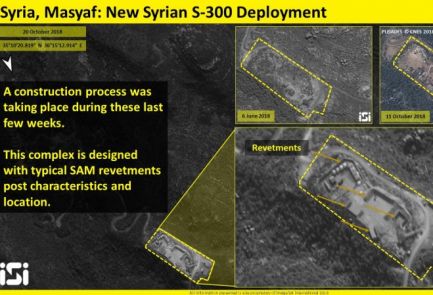
Satellite images reveal deployment of Russian S-300 missiles in Syria 

October 25, 2018

Source: Satellite images reveal deployment of Russian S-300 missiles in Syria – Israel Hayom


Revealed: Hezbollah establishes terror infrastructure in Druze Golan 

October 25, 2018

Source: Revealed: Hezbollah establishes terror infrastructure in Druze Golan – Israel Hayom


Avoiding detection: The team tracking Iran’s attempt to cloak its oil exports

October 25, 2018

Source: Avoiding detection: The team tracking Iran’s attempt to cloak its oil exports – Middle East – Jerusalem Post

Samir Madani and Lisa Ward run an online service that shows how tankers seek to hide their movements. On the eve of Iran sanctions, the tracking takes on great importance.

BY SETH J. FRANTZMAN
 OCTOBER 25, 2018 01:22
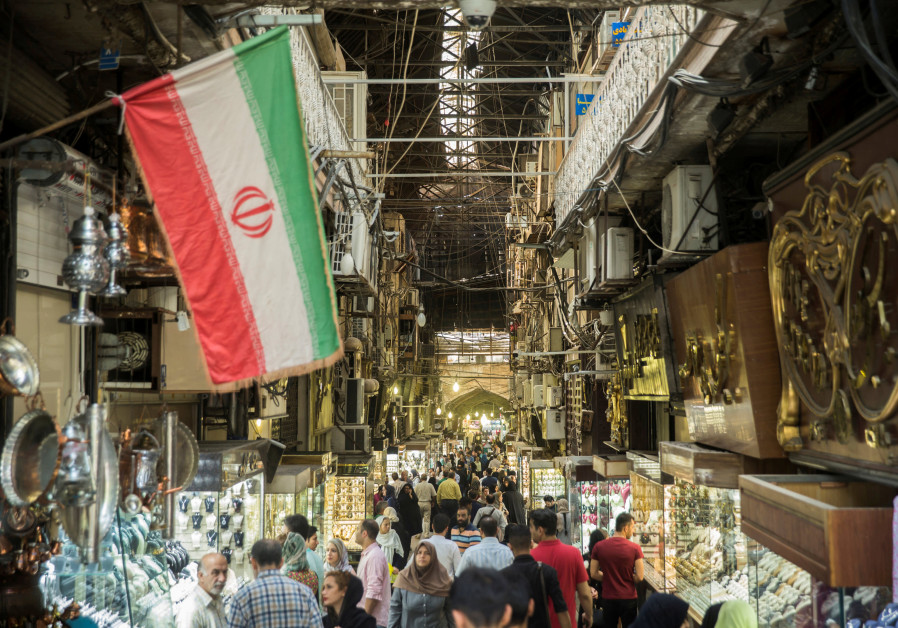
People shop at the Grand Bazaar in the center of Tehran, Iran, August 2, 2017

Iran may benefit from assumptions that it is shipping less oil on the eve of US sanctions that begin on November 4. According to a team that tracks crude oil tankers, ships departing from Iran have been “cloaking” their movements by turning off their AIS transponders that publicly geolocate vessels.

“Just two months ago we would spot, at most, 2-3 tankers cloak either the departure out of Iran or the arrival into, for example Syria. Fast forward to October [2018]and less than a handful of departures are publicly visible,” says Samir Madani who co-founded TankerTackers.com with Lisa Ward. Their techniques for tracking oil exports on tankers is increasingly important because they use satellite imagery to find tankers that have turned off their transponders. “During the first half of October, we were able to verify 2.2 million barrels per day over a 13 day period [leaving Iran], but some others only got slightly more than half that amount as they do not use tools such as satellite imagery.”

The US is seeking to push Iranian oil exports to near zero, according to US Secretary of State Mike Pompeo’s statements in July. In September Pompeo said that the US would consider some waivers, but “our expectation that the purchases of Iranian crude oil will go to zero from every country or sanctions will be imposed.” Iran’s oil exports had reached 2.7 million barrels per day (bpd) in May, the highest since the Iran deal in 2015. May was also the month that US President Donald Trump announced the US was leaving the Iran deal. At the time around 1.8 million bpd was heading to Asian state customers. Washington has now threatened those importers, such as China, with sanctions. In August in September the US also sought to work with India, which imports oil from Iran.

In the leadup to the sanctions a complicated dance is taking place between Iran and its customers. For instance it is thought that Iran’s exports are declining below the 2.06 million bpd it was doing in August. China switched to using Iranian tankers as a way to sidestep sanctions, Reuters reported. The National Iranian Oil Co was also slashing prices.  The exports are supposed to slip even more to 700,000 bpd.

But Madani says that Iran is now one of the most complex countries to track shipments from. “We could track in a matter of minutes a day, but now it takes up the most part of the day on account of the vessels that cloak their movements by switching off their AIS transponders.” These devices locate the vessels and are used by sites that track ships. He says that these cloaking activities are increasing as the Brent price for crude oil reached $80 a barrel. That has now slipped to $76 a barrel this week. But Madani says the higher price “benefits Iran if the world thinks they’re shipping less than they are. The price goes up on account of a fear of fewer barrels out on the market, while their shipments remain steady.” The founders of Tanker Trackers used to do their work as a hobby, now with the stakes so high because of countries like Iran, it has become a career, Madani says.

As the tankers cloak their movements you’ll notice a tanker go in to port but not come out, the tracker says. Most of these are connected to the National Iranian Tanker Company, which is state owned and many fly a Panamanian flag. “So you wait another and still nothing. Then you look at the export terminal with a satellite and see the tanker’s no longer there.” But then it will pop up somewhere lese, such as off the east coast of the UAE. “Today, nearly  the entire fleet [trading with Iran] is working in this manner in order to throw off the trackers,” he notes. Madani gets data from a network of satellites that can provide daily data. He says that a lot has changed since the last time Iran was under sanctions. New technology can make it easier to track the tankers, but “they left quite an impression on us given the high level of care they place in avoiding detection.”

It is not clear at what level the cloaking of the ships is coordinated. “NITC coordinates all the directives of what vessels need to do. It is then the experience of each vessel captain to decide where and when to manipulate the AIS.” This can pose a safety risk in waters with many ships. Iran isn’t the only place where tankers are doing this. Madani notes that “as an exporter, they’re now hiding pretty much as many departures as Israel is hiding arrivals/imports from various countries.” He points to Russia, Angola, and others origins of oil that ends up in Israel in which some vessels carrying the oil cloak their movements.

As for Iran, the main recipients of oil tend to be China and India. Turkey also receives Iranian oil. The European Union, particularly Italy, Spain, Greece and Croatia imported 311,000 bpd recently. In addition data shows that the UAE imports “gas condensates while re-exporting crude oil.” Madani cautions against calling this an illicit trade in oil. “Our focus is on profiling the NITC tanker fleet as we track them visually by satellite when AIS is not available.”


Rouhani claims Saudis couldn’t kill Khashoggi without American protection 

October 24, 2018

Source: Rouhani claims Saudis couldn’t kill Khashoggi without American protection – Middle East – Jerusalem Post

A day after US President Donald Trump decried the Saudis for their cover-up, Iranian President Hassan Rouhani criticizes the US and Saudi Arabia.

BY REUTERS
 OCTOBER 24, 2018 13:07
GENEVA — Iranian President Hassan Rouhani said on Wednesday that Saudi Arabia would not have murdered prominent journalist Jamal Khashoggi without American protection, according to the Islamic Republic News Agency (IRNA).
President Donald Trump said on Tuesday Saudi authorities staged the “worst cover-up ever” in the killing of Khashoggi in Turkey this month, as the United States vowed to revoke the visas of some of those believed to be responsible.
“No one would imagine that in today’s world and a new century that we would witness such an organized murder and a system would plan out such a heinous murder,” Rouhani said, according to IRNA.
“I don’t think that a country would dare commit such a crime without the protection of America.”
Iran and Saudi Arabia are regional rivals and have supported opposing sides in the conflicts in Syria and Yemen and different political factions in Iraq and Lebanon.
U.S. protection has allowed Saudi Arabia to carry out bombings against civilians in Yemen’s war, Rouhani said, according to IRNA.
“If there was no American protection, would the people of Yemen still have faced the same brutal bombing?” Rouhani said.
Rouhani also called on Turkey’s government to conduct an impartial investigation into Khashoggi’s “unprecedented” murder.


Off Topic: ‘Witnesses in uniform’: Israeli Police on Holocaust memorial visit in Poland 

October 23, 2018

Source: ‘Witnesses in uniform’: Israeli Police on Holocaust memorial visit in Poland – Israel News – Jerusalem Post

( NEVER AGAIN…! – JW )

The delegation is visiting several concentration camps and memorial sites and are accompanied by Holocaust survivor Shela Altaraz and her granddaughter.

BY TAMARA ZIEVE
 OCTOBER 23, 2018 15:32

Israel Police Poland

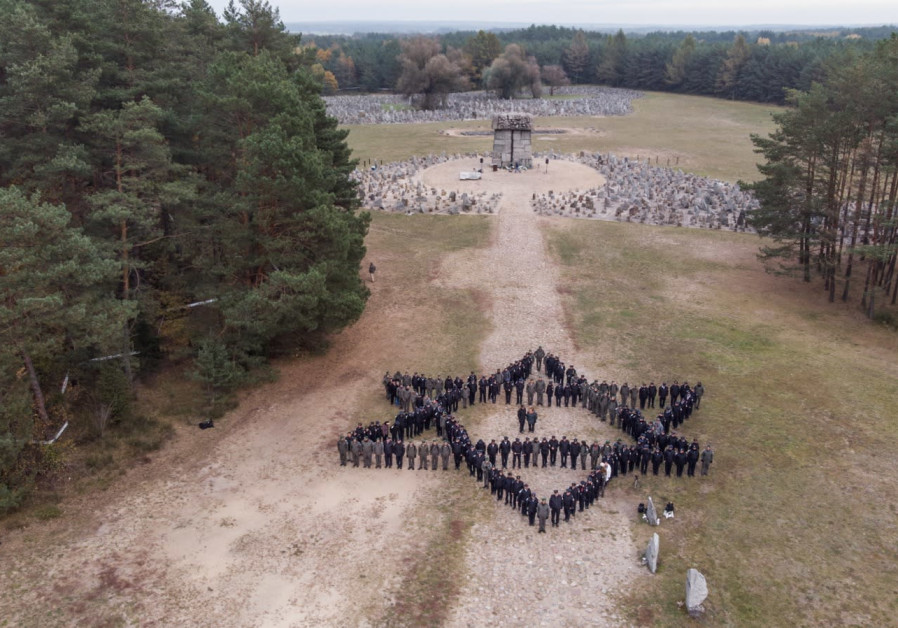
On Monday, on the second day of their visit, the officers visited the Treblinka death camp, where the Jewish community of Štip, Macedonia, formerly Yugoslavia, where Altaraz was born, was murdered. According to Yad Vashem, Altaraz is the sole survivor of that Jewish community.

The police officer formed a human Star of David to honor the memory of the victims, and standing in the middle of them, Altaraz shared her testimony.

The delegation includes officers, commanders, non-commissioned officers, representatives of bereaved families, and police officers who were wounded in the line of duty from various districts, divisions and ranks.


Off Topic: Erdogan’s “Khashoggi speech” is meant to boost his Muslim credentials (and Turkish lira) – DEBKAfile

October 23, 2018

Source: Erdogan’s “Khashoggi speech” is meant to boost his Muslim credentials (and Turkish lira) – DEBKAfile

Turkish President Tayyip Erdogan withheld the promised “naked truth” about the Saudi role in the murder of Jamal Khashoggi at the Saudi embassy in Istanbul on Oct. 2 in his speech to parliament on Tuesday, Oct.23.
He failed to produce any of the audio or video evidence of the crime, which Turkish authorities claimed to possess during weeks of disseminating sensational leaks to the world media. His references to Saudi King Salman were deferential: “His denial of prior knowledge of the crime is sincere.” And he made no mention at all of the beleaguered Crown Prince Mohammed bin Salman.

The Turkish president noted that the 18 people arrested in Riyadh were those named by Turkey as the assassins, saying they should be tried in Istanbul. He also referred to a team of three people, without identifying them, who he said, arrived in Riyadh the day before Khashoggi’s disappearance and scouted a forest near Istanbul. This suggested that the Saudis had prepared a hiding place for the murdered journalist’s remains and therefore knew where the body was. Erdogan called for an independent inquiry into the affair, asserting: “This was a political killing!”

DEBKAfile’s analysts make certain inferences from the mildness of the Turkish president’s accusations. One is that he and the Saudi royal house have come to a deal to defuse the affair, to which President Donald Trump is a party. Alternatively, Erdogan himself was short of smoking-gun evidence to support those accusation. It is also possible that he has learned from his own record of making political opponents disappear, whether from the Turkish army, police or intelligence service, that holding back information increases his bargaining power.
He has already milked international outrage over the assassination of the Saudi journalist for great personal benefits and can afford to allow it to die down.

In all 15 years at the helm of Turkish government (11 as prime minister and four as president), he has never felt stronger or closer to his imperial ambitions. In the weeks after the Khashoggi episode erupted, he bounced his fortunes from rock bottom to the pinnacle of world affairs. Before, he was grappling with a sinking currency, a bitter hate contest with fellow Muslim rulers, excepting only Qatar, over his support for the Muslim Brotherhood, one foot out of NATO, and nearly half a million Turks deprived of their livelihood by his massive purges after the 2016 that nearly toppled him.
After the Khashoggi affair broke, Erdogan is sought after by world leaders, whether in Washington or hostile Riyadh, and entertains high hopes of achieving goals that were once out of his reach:

  • Stabilizing the Turkish lira with US and Saudi financial assistance. Riyadh may fork out generous sums for removing the Khashoggi affair from international headlines and agenda.
  • From being treated like a pariah by mainstream Muslim nations like Egypt, Saudi Arabia and the United Arab Emirates, Erdogan’s Turkey may win acceptance as an ally.
  • His standing in the Muslim world will be much enhanced, one of his most coveted ambitions.
  • This enhancement will pave the way for his appointment as mediator in the Saudi-UAE feud with Qatar.
  • Erdogan gains more say in determining Syria’s post-war future.
  • His clout is seriously strengthened in dealings with Moscow and Tehran.
  • He has opened the door to alliances with parties which are hostile to Israel, so gaining clout over the Jewish state.


Making it that much harder for Iran 

October 23, 2018

Source: Making it that much harder for Iran – Israel Hayom

Yoav Limor

The recent disclosure of Hezbollah’s covert activity along the Lebanese border with Israel is part of the wide-scale campaign Israel is waging against the terrorist organization and its Iranian patron.

Disguised to appear as though they belong to an environmental advocacy group, the observation posts are themselves of tactical significance: They allow Hezbollah to maintain a presence on the border, in violation of U.N. Security Council Resolution 1701, which brought an end to the Second Lebanon War, and regularly collect intelligence it can use direct operational activity inside Israeli territory in real time.

But the disclosure is in fact of even greater significance. By exposing Hezbollah’s efforts on the border, Israel is in fact demanding the international community enforce its decisions and put an end to Hezbollah’s illicit activity. The move also serves as a warning to the Lebanese government as well as the Lebanese people from Israel that this activity could drag Lebanon into a war, and that it is Hezbollah that would be responsible for such a development.

This disclosure is part of Israel’s so-called “campaign between the ‎wars,” a strategic concept that encompasses a host of covert and low-‎intensity military and intelligence efforts to prevent enemy states and ‎terrorist organizations from becoming stronger and thwart their ‎offensive activity.‎  While this campaign is known to make headlines when it involves an airstrike on an Iranian weapons convoy or facility in Syria, there are also other dimensions to Israel’s efforts, and they can involve diplomatic or economic efforts and even the media.

This is not the first time Israel is behind this type of report, which has appeared in both the local and foreign press. In some instances, the report is aimed at deterring an imminent attack, other times it is aimed at deterring the continuation of the illegal activity. When Israel exposed Hezbollah’s activities along the border in the past, it resulted in the organization lowering its profile. One can assume that officials in Israel hope that this most recent report will spur Hezbollah to pull back from these front-line observation posts.

Israel’s efforts to counter the observation posts is just one small piece in a much more complex puzzle, aimed at making Hezbollah’s and Iran’s operations more difficult. Israel also recently exposed the organization’s efforts to establish weapons factories inside Lebanon to convert previously unguided rockets into highly accurate missiles.  Despite the media reports, it seems those efforts are ongoing. Several reports in recent days have even tied Israel to an attack on a weapons convoy in Lebanon, the first since the downing of a Russian plane last month. This has also been hinted at in speeches delivered by Prime Minister Benjamin Netanyahu and Defense Minister Avigdor Lieberman, in which they said Israeli activity against Iran was ongoing, despite Russia’s decision to provide Syria with the S-300 anti-aircraft missile system following the Syrian army’s downing of a Russian plane last month.

Nevertheless, it seems Israel is now trying to keep this activity out of the public eye in the past, in order to avoid a new confrontation with the Kremlin. This concerted effort to not draw attention to its activities may also be the result of a certain slowdown in Iranian activity in Syria and Lebanon, which stems in part from Tehran’s desire to understand the repercussions of Russia’s new policy as well as the difficulties it now faces as a result of U.S. President Donald Trump’s withdrawal from the nuclear deal and sanctions implemented by his administration.

These challenges are expected to exacerbate on Nov. 4, when an additional wave of U.S. sanctions on Iran take effect. Israeli officials believe it will be difficult for Iran to circumvent these sanctions, which are set to deliver another serious blow to its economy. As a result, the ayatollah regime will need to decide whether to continue to invest billions of dollars every year in wars in places like Yemen, Iraq, Syria, Lebanon and the Gaza Strip, and risk further angering its citizens by squandering state funds to this end instead of investing them in the Iranian people. Iran could also decide to decrease funding overseas, a move that would be detrimental to its efforts to the export of the Islamic Revolution and Tehran’s customers, among them Hezbollah.

These measures will have a direct impact on the security situation in the north, and to a lesser extent in Gaza. As it stands, the southern front is still much more volatile than the north, which poses a more dangerous threat due to the might of Hezbollah. Nonetheless, the Shiite organization is being very cautious, and despite this new-old activity on the border, is taking care to avoid an escalation with Israel, which for the time being, is the last thing it wants.