Air strikes against terror targets in Gaza, intensifying IDF’s response to breaching attempts and launching of incendiary balloons while showing containment are presented as operational plans at Cabinet meeting; DM Lieberman’s suggestion to take more aggressive approach is rejected.
After concluding a five-hour meeting, the Security Cabinet decided Thursday to change its handling of the rampant violence on the Gaza border fence and the kite terrorism, implying that the rules of the game have changed.Nevertheless, the political echelon still views reaching a ceasefire agreement with the mediation of Egypt and UN envoy to the Middle East Nickolay Mladenov as an option.
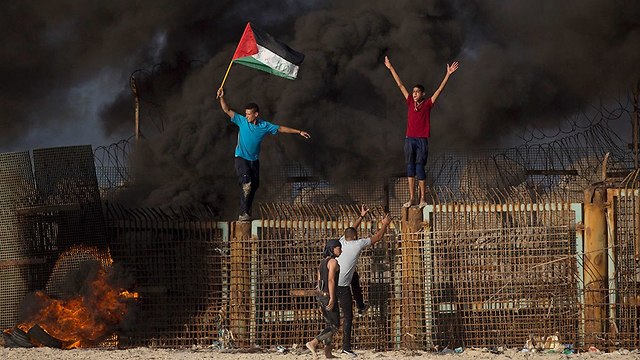
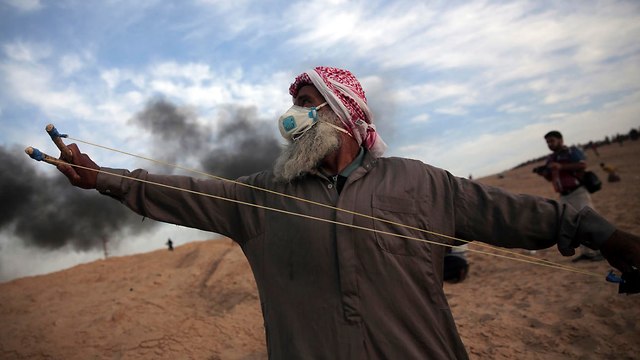
Gaza border violence (Photo: AP)
The Cabinet—which convened following a rocket attack launched from Gaza on a Be’er Sheva home and in the sea off the shores of a city in central Israel—instructed the IDF to gradually exacerbate its retaliatory actions to violence along the security fence and to demonstrate a zero-tolerance approach.
The new policy will come into effect on Friday, during which Hamas-led mass riots are expected on the border.
During the overnight meeting, the military brass presented two operational plans to tackle the violent border clashes and to handle the incendiary balloons launched from the strip into Israel, with the first being air strikes against terror targets in the strip, while the second is containment of the violence while gradually Intensifying the army’s response to breaching attempts and launching of incendiary balloons.
House in Be’er Sheva hit
Nevertheless, Defense Minister Avigdor Lieberman suggested implementing a more aggressive approach against Hamas, as could have been expected in light of his remarks over the past few days.
Lieberman’s plan was rejected.
Prime Minister Benjamin Netanyahu instructed the Cabinet ministers no to speak with the media about the decisions taken at the meeting.
(Photo: AP)
Construction Mnister Yoav Galant addressed the recent escalation Gaza, saying, “I’m not going to talk about decision taken by the Cabinet. However, I can explicitly say that the rules of the game are about to change.
“We won’t accept violence on the Gaza border fence and the continuation of the kite terrorism,” Galant concluded.
“U.S. outlaw regime’s hostility toward Iranians is heightened by an addiction to sanctions” that is “out of control,” Iranian Foreign Minister Mohammad Javad Zarif says • Foreign Ministry spokesman rails against “cruel and unfair” new sanctions.
News Agencies and Israel Hayom Staff
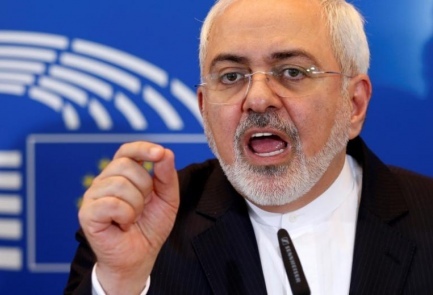
Iranian Foreign Minister Mohammad Javad Zarif
|Photo: Reuters
Iran said Wednesday that the latest round of U.S. sanctions is an “insult” to the international order that stems from “blind hostility.”
The U.S. has steadily restored sanctions on Iran following President Donald Trump’s withdrawal from the 2015 nuclear accord in May. Next month the U.S. plans to impose sanctions on Iran’s oil and gas industry.
Iran is already in the grip of an economic crisis and has seen sporadic protests in recent months.
Foreign Minister Mohammad Javad Zarif said Wednesday that the United States’ latest economic sanctions against Iran display a disregard for the human rights of all Iranians.
“Latest U.S. sanctions violate two ICJ [International Court of Justice] orders: to not impede humanitarian trade and to not aggravate the dispute. Utter disregard for rule of law and human rights of an entire people. U.S. outlaw regime’s hostility toward Iranians is heightened by an addiction to sanctions,” Zarif tweeted.
“U.S. addiction to sanctions is out of control,” Zarif also wrote on Twitter.
He said in the tweet that one of the banks was vital for food and medicine imports and seemed to suggest it was not close to the Basij force, without it directly.
“Iranian private bank key to food/medicine import is designated because of alleged EIGHT degrees of separation with another arbitrary target. In comparison, all humans on the planet are connected by SIX degrees of separation. You do the math,” Zarif said on Twitter.
Earlier, Foreign Ministry spokesman Bahram Qassemi railed against the “spitefulness” of the U.S. government in imposing the sanctions, calling the new sanctions “cruel and unfair.”
Rocket attacks on Israel during Egyptian mediators’ visit to Gaza was a “personal affront, and worse, put their lives in danger,” Palestinian official says • Egyptian intelligence chief cancels planned visit to Gaza, officially citing scheduling conflict.
Daniel Siryoti
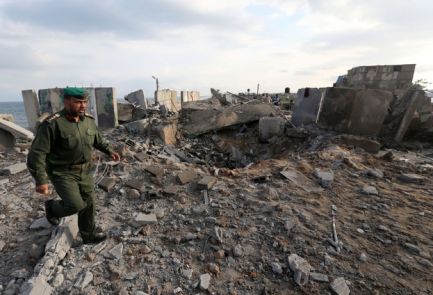
A Palestinian security official loyal to Hamas at the scene of an Israeli airstrike in south Gaza, Wednesday
|Photo: Reuters
Egyptian intelligence chief Abbas Kamel has called off a planned visit to the Gaza Strip, Ramallah and Israel, officially citing a scheduling conflict, but commentators surmised that the cancellation may be a response to rocket attacks launched from Gaza into Israel on Wednesday.
Kamel’s visit was meant to advance Egyptian efforts to mediate a cease-fire agreement between Israel and Hamas, whose clashes along the Israel-Gaza border have intensified in recent weeks, culminating with Wednesday’s Grad rocket strike on a Beersheba home.
An Egyptian intelligence and diplomatic delegation that had arrived in Gaza to prepare the groundwork for Kamel’s intended visit, initially planned for Thursday, left the Strip on Wednesday before setting a new date for Kamel’s shuttle diplomacy mission.
A member of the Egyptian delegation told Israel Hayom that the official reason for postponing Kamel’s mission was the fact that he was accompanying Egyptian President Abdel-Fattah el-Sissi on his trip to Russia, which was taking longer than planned.
But a senior Palestinian official told Israel Hayom that the Egyptians were surprised by the rocket fire and didn’t mince words in admonishing the leaders of Hamas and other armed Palestinian factions in Gaza, with whom they met Wednesday morning, shortly after the rockets were launched at Israel.
No Palestinian group has claimed responsibility for the rocket fire and several hours after it occurred, Hamas, Palestinian Islamic Jihad and the Popular Resistance Committees issued a joint statement saying: “We appreciate the Egyptian efforts to secure the demands of our people, and oppose any attempts to sabotage these efforts – including the rocket fire at Israel.”
According to another Palestinian official, the statement was issued at Egypt’s demand. “They viewed the rocket launch at Israel during their visit in Gaza as a personal affront, and worse, as putting their lives in danger,” the official said.
After the rocket fire, Israel carried out airstrikes across Gaza, and members of the Egyptian delegation in Gaza City at the time heard and also felt the shockwaves caused by the Israeli bombs.
Palestinian media outlets reported that Palestinian Authority President Mahmoud Abbas was expected to depart for Jordan this weekend, where he will meet Jordanian King Abdullah and other senior Jordanian officials.
A senior Jordanian official told Israel Hayom this week that Abbas would likely hear a message similar to the one he heard from the Egyptians, namely that he should lift the economic sanctions he is imposing on the population in Gaza.
“Abbas needs to understand he cannot use the population in Gaza as a bargaining chip against Hamas, Israel or Egypt. He has to allow all the proceedings to be exhausted, to facilitate an arrangement and improve the lives in Gaza, which is collapsing under a dire humanitarian crisis,” he said.
Who would benefit from a wide-scale military conflict in the Gaza Strip? And who would lose? What does weighing interests in the balance mean for Israel?
The smaller terrorist organizations in Gaza – Islamic Jihad, which operates as a satellite of Iran, and radical Sunni groups inspired by the Islamic State group – are the primary ones who want to ratchet up the violence into a full-scale war. For them, a major war in Gaza could be an opportunity to build themselves up on the ruins of Hamas. It also looks like Iran has an interest in escalating the situation in Gaza and pulling Israel into a war that will take away from its ability to focus on its main defense activity right now: keeping Iran from digging down in Syria.
The third player that is consistently working to worsen the situation in Gaza and torpedo Egypt’s efforts to broker a cease-fire is Palestinian Authority President Mahmoud Abbas, for whom – as he once said in Jenin – “the worse things are, the better.” Some in Israel see value in assisting the PA’s attempts to regain control of Gaza, but even if that were the right thing to do in principle (and that’s doubtful), it is not feasible without a full-blown war that would end with the IDF occupying Gaza for many years to come. What a war would not do would be to create a moderate, effective Palestinian leadership there.
All these considerations are counter-balanced, paradoxically, by Hamas’ interest in continuing to dictate the terms of any cease-fire with Israel while refraining from a war, which the Hamas leadership knows would be self-destructive. Its moves to escalate the conflict – arson balloons, breaches of the border fence – have been intentionally selected as ways of taking things to the brink without toppling over into the abyss.
Egypt also seems to have an interest in avoiding a war, despite the deep-seated mutual hatred between Hamas, who are the flesh and blood descendants of the Muslim Brotherhood, and the government of Egyptian President Abdel-Fattah el-Sissi. Slowly, Cairo has come to realize that it is better to contain and deter an organization like Hamas while gradually delegitimizing it than to take it on directly.
And Israel? A harsh, well-defined blow is vital for it to maintain its mechanism of deterrence. A missile hitting Beersheba is not a trivial occurrence.
However, as far as possible, given the broader considerations of the regional balance of power as well as Israel’s fundamental interest in avoiding a ground war, it would be best to make the most of Egypt’s mediation.
Col. (ret.) Dr. Eran Lerman, former deputy director of the National Security Council, is the vice president of the Jerusalem Institute for Strategic Studies.
Hamas and Islamic Jihad have denied any involvement in Wednesday’s Grad rocket attack on Israel, leading security experts to argue that Iran is behind the attack • Israel would be making a very big mistake if it falls into the Iranian trap, expert warns.
Assaf Golan
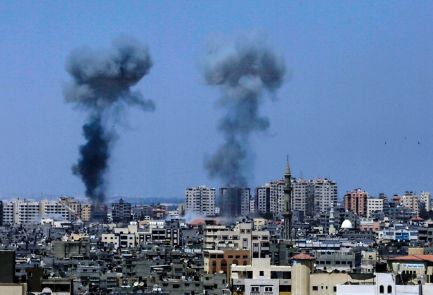
Smoke billowing over Gaza following an Israeli airstrike on terror targets
|Illustration: AFP
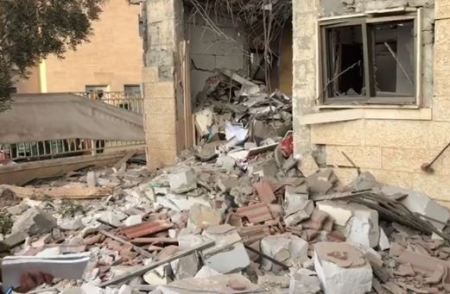
Hamas, the rulers of the Gaza Strip, and Palestinian terrorist group Islamic Jihad both were quick to deny launching rockets from Gaza Wednesday, after a Grad rocket fired on Israel scored a direct hit on a Beersheba home and another landed in the sea, off the coast of a major central Israeli city
Six people, including a woman and her three children, managed to survive the Beersheba rocket attack with only minor injuries. In response, Israeli fighter jets struck 20 Hamas positions in Gaza, and the flare-up sparked concerns that a rapid escalation may be inevitable.
”There is only one element that wants to see a war in the Gaza Strip right now, and that is Iran,” former National Security Adviser Maj. Gen. (ret.) Yaakov Amidror noted. “So we have to ask ourselves which of their proxies in Gaza have long-range rockets, then counter them.”
It would be a “very big mistake,” he warned, if Israel were to “fall into the Iranian trap and launch a military operation in Gaza. That would play directly into the Iranians’ hands.”
Yoni Ben-Menachem, a research fellow at the Jerusalem Center for Public Affairs, disagrees. Ben-Menachem argues that Wednesday’s rocket fire was Hamas’ handiwork, as Gaza’s rulers sought to set facts on the ground vis-à-vis Israel and Egypt.
”No other group in Gaza would dare fire two long-range rockets at Israel like this. The attack didn’t target the Gaza-vicinity communities – this was aimed at Beersheba and central Israel,” he said.
Channel 10
The damage caused to a Beersheba home by rocket fire, Wednesday
Had both projectiles resulted in Israeli fatalities, it would surely lead to war, he explained, adding that “no rogue group in Gaza would do something like that without getting the green light from Hamas. This is why, as the sovereign entity in Gaza, Hamas is responsible.”
”Hamas continues to claim that a rogue group was behind the attack only so it can deflect the claims brought against it, but it’s a lie. Unfortunately, the Israeli defense establishment seems to be willing to believe this lie,” Ben-Menachem said.
”Be very careful in romanticizing the relations between Hamas and Egypt, because Hamas is very displeased with the way Egyptian intelligence is handling the truce talks,” he said.
”Hamas is actually sending mixed signals: its message to Egypt is that it is dissatisfied with the way the negotiations are being handled, while at the same time, it signals to Israel that any forceful strike in Gaza would risk massive retaliation targeting the Israeli homefront,” he explained.
”Hamas maintains an iron grip on Gaza. It controls everything, down to the last firebomb balloon, so even if they say, ’We didn’t do it’ – they did,” he said. “I can only assume that Israeli intelligence misjudged the situation and was unprepared for long-range rocket fire on Israel. That’s a failure on their part. We can’t trust Hamas, so we have to be prepared for any scenario.”
Bar-Ilan University Middle Eastern Studies Department’s Dr. Yehuda Balanga, an expert on Syria and Egypt, believes there are other parties in Gaza who wish to capitalize on Israel and Egypt’s obvious interest in a Gaza truce.
”Hamas may be the sovereign in Gaza, but there are more radical forces on the ground, and while Hamas tries to rein them in, these organizations have their own agenda and they see every attack on Israel as a great victory,” he said.
These groups, he explained, “understand that given the tensions in [Israel’s] northern sector and the fact that this is an election year, Israel won’t strike back.”
”For these groups, any rocket fired from Gaza is an achievement because it does not endanger them. They know Israel will not pursue the end of Hamas’ regime, nor will it pursue their elimination so as far as these groups are concerned, they are the winners here.”
These groups, Balanga explained, “Have their own agenda and part of it is to embarrass Hamas. The fact that the head of Egyptian intelligence was headed to the Strip to try and advance the truce efforts made it the perfect time for them to act.”
”Everyone knows that despite the attempts to postpone the inevitable, Israel will eventually launch another military campaign in Gaza. This means that these radicals have nothing to lose. Whatever the scenario – they will survive and will most likely be hailed as heroes by the Gazans. That’s why they fire rockets,” he concluded.
Arabic-language paper Al-Hayat reports that Egyptian delegation pressured terrorist groups in Gaza to scale back clashes with Israeli forces to diminish number of Palestinian casualties • Decision was made before rockets were launched at Israel from Gaza.
Israel Hayom Staff and Daniel Siryoti
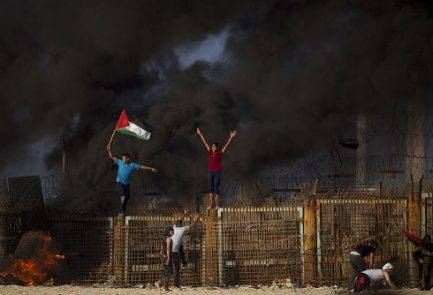
Palestinian protesters climb over the border fence between Gaza and Israel, Monday
|Photo: AP
Hamas has decided to scale back the violent weekly protests along Gaza’s border with Israel in an effort to bring down the number of casualties among the protesters, the London-based Arabic-language newspaper Al-Hayat reported Thursday.
A Palestinian source in the Gaza Strip told Al-Hayat that the organization had made its decision after being pressured by a delegation of senior Egyptian intelligence officials that arrived in Gaza on Tuesday to mediate a cease-fire agreement between Israel and the Gaza rulers. The decision was made before two long-range rockets were fired from Gaza into Israel Wednesday, one of which demolished a family home in Beersheba.
Hamas has denied any responsibility for the rocket attacks.
The newspaper reported that the Egyptian officials had persuaded Hamas to de-escalate the tensions with Israel after a Hamas operative was killed in a retaliatory Israeli missile strike on Wednesday.
Meanwhile, reports Wednesday that suggested that Egypt had brokered a cease-fire between Israel and Hamas were not corroborated by Egyptian or Israeli officials.
The Palestinian Maan news agency reported that Egyptian officials who are visiting Gaza in efforts to mediate a long-term truce teamed with U.N. Middle East envoy Nickolay Mladenov and held urgent meetings with the Palestinian factions in Gaza.
Egyptian intelligence official Ahmed Abdel Khalek, who heads the delegation, was able to convince the Gazan groups to halt their fire, the report said.
It did not take long for Hamas and Islamic Jihad to deny any involvement in Wednesday’s rocket fire on Israel, and the two Gaza Strip-based groups rushed to express their commitment to Egypt’s efforts to broker a cease-fire between Israel and Gaza.
Hamas could be lying – it wouldn’t be the first time – and its operatives may have been the one to fire two Grad rockets at Beersheba and central Israel. At the very least, Hamas probably encourage the rogue groups in Gaza to fire on Israel.
One must remember that while Hamas has no real interest in provoking a full-fledged war with Israel, it has every interest in improving its position in the Egyptian-led mediation and maybe even forcing Israel to accept a reality in which sporadic rocket fire is a part of any future deal in Gaza.
What is particularly troubling, however, is the possibility that Hamas had nothing to do with Wednesday’s rocket fire and that the attack was mounted contrary to its direct orders.
This would mean that Hamas has lost its notorious iron grip on the situation on the ground in Gaza. Moreover, it would mean that any deal Israel signs with it may not be worth the paper it is written on, as it will not guarantee any calm on the border.
Achieving some form of quiet on the border is a prominent Israeli interest, as it wants to focus its attention on the northern sector, where efforts to curtail Iran’s attempts to cement its presence in Syria and curb Hezbollah are paramount.
Iran, we must remember, is the only one that stands to gain from a conflagration in Gaza, as it would divert everyone’s attention from what it is doing in Syria and what it is trying to do in the region.
Reaching a cease-fire is also in Hamas’ interest, as it would grant it legitimization and all but guarantee that it will rule Gaza for many years to come. This is why Israel must ensure that in return to any concessions offered Hamas, it would be guaranteed absolute calm on the border.
Israel will most likely choose to contain Wednesday’s incident both because it did not result in fatalities and over Hamas’ denouncing it. But this does not bode well for the efforts to achieve a cease-fire, as one cannot survive if one of the parties involved has no intention of meeting it. It is important that Israel not lose sight of this when it comes to the Gaza Strip, but also when it comes to Judea and Samaria.
The Trump administration is gearing up to present the “deal of the century,” for the Israeli-Palestinian conflict, which would undoubtedly require not only Israeli concessions but also a demand to contain and tolerate the Palestinian Authority’s incompetent counterterrorism efforts.
Experience, however, has taught us that any deal that does not guarantee security will not last.
Eyal Zisser is a lecturer in the Middle East History Department at Tel Aviv University.
The rocket that struck the house in Beersheba was a game-changing event, which obligates Israel and Hamas to decide which way we go from here.
The fact that the people living in the house managed to escape the attack unscathed, due to the mother’s resourcefulness, is either a miracle or a model for proper behavior or both. On a practical level, none of this should matter. The air force uses the stark term “near miss” to describe mishaps that didn’t end in a crash or tragedy; it’s the only way to understand, inquire and learn the lessons to help avoid similar events in the future.
This is how the rocket strike in Beersheba should be viewed: as if it were lethal. This is the only way Israel can prevent the next rocket, which could kill. Let’s for a moment put aside the matter of intelligence (which needs checking), and why no one thought rockets would be fired into the heart of Israel.
But the troubling question is a different one. Two rocket launchers were deployed in advance, pointed at Israel – one at Beersheba and the other at a city in central Israel. Hamas is supposed to properly protect its rockets, certainly those with strategic impact. If it isn’t doing so (which seems to be the case), then there’s one of two options: Either it looked the other way with a wink, which apparently didn’t happen, or it isn’t in control of its people.
This situation is disconcerting because the basic assumption pertaining to events in Gaza in recent months has been that Hamas is the sole power; that it can fan or lower the flames if it so chooses. The latest incident could reveal that Hamas is losing control; which if true could simplify Israel’s dilemma because it won’t have anyone on the other side to trust when it comes to implementing and preserving future agreements – if they are reached.
The way to determine this is to watch the ground level. Israel had three response options on Wednesday: The first, as bad as it sounds, is to do nothing; maintain the current course and hope for the best.
The second, problematic but gaining increasing support (mainly from Defense Minister Avigdor Lieberman, but also other ministers and high-ranking IDF officers), is to launch a comprehensive operation to alter the reality with Gaza. The third option, which looks to be preferred by Prime Minister Benjamin Netanyahu, is to try changing the situation via other means – primarily diplomatic.
Hamas, it appears, is prepared for the second option but would prefer the third. It was taken off guard by the Egyptian intelligence chief canceling his visit to Gaza (at Israel’s request) and passed on multiple messages that it will work to calm tensions. Israel needs to give Hamas the only and most important test: the results test. It must demand a complete cessation of border terror, including incendiary kites and balloons. If Hamas upholds its end of the bargain for a sufficient period of time, it will be possible to discuss moving forward – humanitarian gestures, opening border crossings, etc.
Such a move will transfer the dilemma to Gaza. If Hamas chooses war, it will be accused of starting it, in contravention of all understandings that have been reached, and it will immediately lose the support of Egypt and Arab countries. The alternative, from its perspective, is to swallow the bitter pill and bow its head – so it doesn’t get lopped off. This is the line currently being advocated by the leader of Hamas’ military wing, Yahya Sinwar, with an asterisk: Numerous casualties in Gaza will obligate him to respond, which could spark a chain reaction ending in a conflagration.
In the past, Israel preferred to start operations with a surprise opening move, one that would give it an advantage from the very beginning. Due to the already high alert levels in Gaza it will be hard to fashion a surprising opening salvo, which means that an operation – if Israel decides to launch one – could sputter, be protracted, drag on into the winter, and of course also result in considerable casualties, on the front lines and on the home front, and draw criticism due to the public’s natural tendency to lose patience.
This is a tough dilemma for the political echelon in an election year. Casualties in Beersheba would necessitate a very clear decision; even if the soldier tracking the rockets from the home front command center had sounded the sirens in Gush Dan (she didn’t because the radar calculated it would land in the sea), we would probably have woken up Wednesday morning to a different reality. The lesson is that decisions shouldn’t be made out of necessity, but out of choice. It’s still possible, but the sand in the hourglass looks to be running out quickly.
Morsi’s younger son has been detained because of his alleged support for the banned Muslim Brotherhood movement in Egypt
BY DIMA ABUMARIA/ THE MEDIA LINE
OCTOBER 18, 2018 05:59
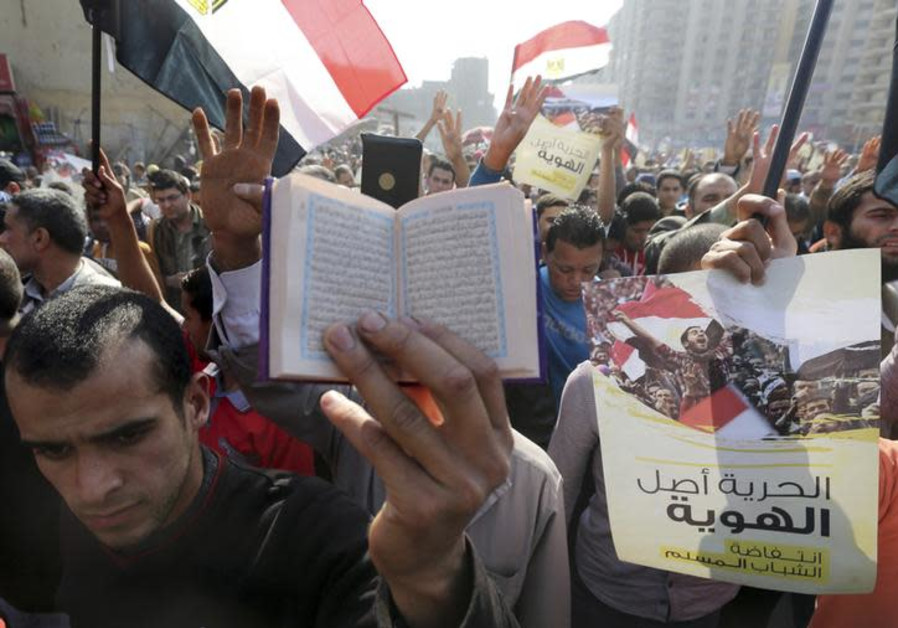
A supporter of the Muslim Brotherhood and ousted Egyptian President Mohamed Mursi holds a copy of the Koran as others shout slogans against the military and the interior ministry during a protest in the Cairo suburb of Matariya November 28, 2014.. (photo credit: MOHAMED ABD EL GHANY/REUTERS)
Egyptian police released the 25-year-old son of former president Mohammed Morsi Wednesday after he spent less than 24 hours in detention on charges of joining an outlawed organization and publishing “fake news.”
Abdullah Morsi Mohammed Morsi, a graduate business student, posted a bail of 5,000 Egyptian pounds [about $280] according to a statement by Attorney General Nabil Sadek.
“The Attorney General decided to release Abdullah until further investigations take place into the charges against him,” said Abdel-Moneim Abdel-Maqsoud, a member of Morsi’s defense team.
Abdullah frequently posts updates on social media about his father’s condition at the Tora maximum security prison, about eight miles south of downtown Cairo, as the family seeks more visitation rights and better health care for the jailed Brotherhood leader.
The London-based Arabi21 website published an interview with Abdullah just days before his arrest detailing the conditions of the family’s September visit at the prison.
Morsi is challenging a death sentence and 48 years in jail for five separate cases including espionage for Hamas, Hezbollah and Qatar as well as insulting Egypt’s judiciary.
The charge of joining a terrorist group refers to the Muslim Brotherhood, which was outlawed in 2013. Abdel Fattah al-Sisi, an Egyptian general who then became president, led a coalition to remove the elder Morsi from the presidential palace.
Egypt has been plagued by a violent insurgency since Sisi replaced Morsi. Egyptian officials have viewed the terrorist wave as part of a revenge campaign for the Brotherhood’s ousting.
Since 2013, the Egyptian army has also waged a fierce counter-terrorism operation against a Sinai-based Islamic State-affiliated group. It has seen an upsurge in attacks on the Coptic Christian community, as well as security personnel and senior officials in the Nile Valley. Last month, Sisi emphasized the need for a “global war” against terrorism during his address at the United Nations General Assembly in New York.
“There is no doubt that the Arab region is one of the most vulnerable to the dangers of nation-state disintegration, and the ensuing creation of a fertile environment for terrorism and exacerbation of sectarian conflicts,” Sisi declared at the UN.
Cairo has been working to contain Islamists throughout Egypt, making no distinction between their political and armed wings.
“Anyone who has anything to do with the Islamic movement can expect to be questioned and other times detained based on their activity within the movement,” an Egyptian political observer close to the Sisi administration told The Media Line.
“Mohammed Morsi supported and promoted the Muslim Brotherhood in Egypt and beyond—especially in Syria by urging Muslims join a jihad against the government of Syrian President Bashar Assad. Sisi ended that and is cleaning up the mess caused by Islamist political groups in Egypt,” the analyst added.
Ibrahim Haj Ibrahim, who heads the Political Science department at Birzeit University in Ramallah, believes the anti-terror rhetoric in Cairo is a core component of a Saudi-led effort, which includes Egypt and the UAE, to gain support for the ongoing boycott of Qatar, the Muslim Brotherhood’s chief state backer in the region.
“Saudi Arabia doesn’t want any other regional power, but itself,” Ibrahim told The Media Line. “Riyadh is doing the best it can to put the Muslim Brotherhood in the category of terrorism.”
During 2017, Iran was Turkey’s top crude oil source, accounting for 11.5 million tonnes of its total purchases nearing 26 million tonnes, followed by Iraq and Russia.
BY REUTERS
OCTOBER 18, 2018 09:40
A Turkish special forces police officer guards the entrance of the Presidential Palace in Ankara, Turkey, August 5, 2016. (photo credit: REUTERS)
WASHINGTON – Turkey’s top refiner, Tupras, is in talks with US officials to obtain a waiver allowing it to keep buying Iranian oil after Washington reinstates sanctions on the Islamic Republic’s energy sector in November, industry sources said.
The United States is preparing to impose the new sanctions on Iran’s oil industry after Washington withdrew from a nuclear deal between Tehran and other global powers earlier this year, but is also considering offering waivers to some allies that rely on Iranian supplies.
NATO member Turkey depends heavily on imports to meet its energy needs and neighboring Iran has been one of its main sources of oil because of its proximity, the quality of its crude, and favorable price differentials.
Turkey has already made efforts to cut its purchases ahead of the US sanctions, but would prefer to keep up some level of Iranian oil imports past November, an industry source familiar with the matter said.
“They would like to be able to continue importing 3-4 cargoes a month, like they did during the previous sanctions round. But if the US would tell them to stop, they will oblige and work towards achieving that,” the source said.
A Tupras spokeswoman was not available for comment. Turkey’s Energy Ministry was not immediately available for comment.
Turkey imported around 97,000 barrels per day of Iranian oil in August and 133,000 bpd in September, compared with just over 240,000 bpd in April, tanker tracking and shipping data showed.
And in the first two weeks of October, Turkey has purchased three 1 million barrel-cargoes of Iranian oil – a level that would equate to about 97,000 bpd if it made no other purchases this month.
CASE-BY-CASE
Asked if Washington was negotiating with Turkey for a waiver, a State Department official said the department was prepared to work with countries that are reducing their imports on a case-by-case basis.
On Monday, Brian Hook, the US special representative on Iran, did not comment directly about any talks on waivers with Turkey. But he told reporters countries seeking sanctions relief must “explain their specific and unique circumstances.”
Hook said those conversations were private, but he added the State Department was “trying to advance our national security goals and also taking into account the needs of our allies and partners around the world.”
Refiners around the world are under pressure to avoid Iranian oil purchases because they want to maintain their access to the US financial system – something they could lose if they flout the US sanctions.
Indian refiners also cut imports of Iranian oil purchases last month in a sign they are preparing for November.
Washington’s plan to impose sanctions on Iranian crude could strain already soured ties between the United States and Turkey – at odds over a host of issues from diverging interests in Syria to Ankara’s ambition of buying Russian defense systems.
The release of an American pastor last week who had been in custody in Turkey for two years could signal a thaw in relations between the two NATO allies as Trump said he welcomed an end to the “harsh relationship” the countries had over the summer.
But Turkey has been vocally opposed to the US sanctions on Iran, and has said it will not cut trade ties with Tehran at the behest of other countries.
During 2017, Iran was Turkey’s top crude oil source, accounting for 11.5 million tonnes of its total purchases nearing 26 million tonnes, followed by Iraq and Russia.





 anneinpt
 artaxes
 danmillerinpanama
 davidking1530
 Peter Hofman
 Joseph Wouk
 Peter
Peter Louisiana Steve
 WarSclerotic
Recent Comments