Archive for August 2018

Iran-based political influence operation: bigger, persistent, global

August 29, 2018

Source: Iran-based political influence operation: bigger, persistent, global

After Facebook and other companies found multiple social media accounts and websites were part of an Iranian project to covertly influence public opinion in other countries, Reuters identifies 10 more sites and dozens of social media accounts that are part of the same campaign.
LONDON/WASHINGTON – An apparent Iranian influence operation targeting internet users worldwide is significantly bigger than previously identified, Reuters has found, encompassing a sprawling network of anonymous websites and social media accounts in 11 different languages.
 Facebook and other companies said last week that multiple social media accounts and websites were part of an Iranian project to covertly influence public opinion in other countries. A Reuters analysis has identified 10 more sites and dozens of social media accounts across Facebook, Instagram, Twitter and YouTube.US-based cyber security firm FireEye Inc and Israeli firm ClearSky reviewed Reuters’ findings and said technical indicators showed the web of newly-identified sites and social media accounts—called the International Union of Virtual Media, or IUVM—was a piece of the same campaign, parts of which were taken down last week by Facebook Inc, Twitter Inc and Alphabet Inc.

File photo (Photo: Getty Images)

File photo (Photo: Getty Images)

IUVM pushes content from Iranian state media and other outlets aligned with the government in Tehran across the internet, often obscuring the original source of the information such as Iran’s PressTV, FARS news agency and al-Manar TV run by the Iran-backed Shi’ite Muslim group Hezbollah.

PressTV, FARS, al-Manar TV and representatives for the Iranian government did not respond to requests for comment. The Iranian mission to the United Nations last week dismissed accusations of an Iranian influence campaign as “ridiculous.”The extended network of disinformation highlights how multiple state-affiliated groups are exploiting social media to manipulate users and further their geopolitical agendas, and how difficult it is for tech companies to guard against political interference on their platforms.

In July, a US grand jury indicted 12 Russians whom prosecutors said were intelligence officers, on charges of hacking political groups in the 2016 US presidential election. US officials have said Russia, which has denied the allegations, could also attempt to disrupt congressional elections in November.

Ben Nimmo, a senior fellow at the Atlantic Council’s Digital Forensic Research Lab who has previously analyzed disinformation campaigns for Facebook, said the IUVM network displayed the extent and scale of the Iranian operation.

“It’s a large-scale amplifier for Iranian state messaging,” Nimmo said. “This shows how easy it is to run an influence operation online, even when the level of skill is low. The Iranian operation relied on quantity, not quality, but it stayed undetected for years.”

Further investigations

Facebook spokesman Jay Nancarrow said the company is still investigating accounts and pages linked to Iran and had taken more down on Tuesday.”This is an ongoing investigation and we will continue to find out more,” he said. “We’re also glad to see that the information we and others shared last week has prompted additional attention on this kind of inauthentic behavior.”

 (Photo: AP)

(Photo: AP)

Twitter referred to a statement it tweeted on Monday shortly after receiving a request for comment from Reuters. The statement said the company had removed a further 486 accounts for violating its terms of use since last week, bringing the total number of suspended accounts to 770.

“Fewer than 100 of the 770 suspended accounts claimed to be located in the US and many of these were sharing divisive social commentary,” Twitter said.

Google declined to comment but took down the IUVM TV YouTube account after Reuters contacted the company with questions about it. A message on the page on Tuesday said the account had been “terminated for a violation of YouTube’s Terms of Service.”

IUVM did not respond to multiple emails or social media messages requesting comment.

The organization does not conceal its aims, however. Documents on the main IUVM website https://iuvm.org said its headquarters are in Tehran and its objectives include “confronting with remarkable arrogance, western governments and Zionism front activities.”

App store and satirical cartoons

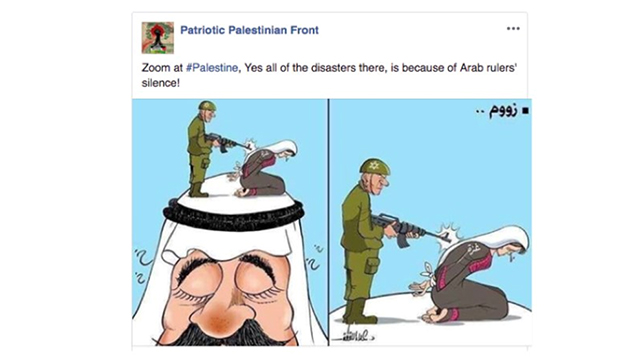
IUVM uses its network of websites—including a YouTube channel, breaking news service, mobile phone app store, and a hub for satirical cartoons mocking Israel and Iran’s regional rival Saudi Arabia—to distribute content taken from Iranian state media and other outlets which support Tehran’s position on geopolitical issues.Reuters recorded the IUVM network operating in English, French, Arabic, Farsi, Urdu, Pashto, Russian, Hindi, Azerbaijani, Turkish and Spanish.

Anti-Israel cartoon removed by Facebook

Anti-Israel cartoon removed by Facebook

Much of the content is then reproduced by a range of alternative media sites, including some of those identified by FireEye last week as being run by Iran while purporting to be domestic American or British news outlets.

For example, an article run by in January by Liberty Front Press—one of the pseudo-US news sites exposed by FireEye—reported on the battlefield gains made by the army of Iranian ally Syrian President Bashar Assad. That article was sourced to IUVM but actually lifted from two FARS news agency stories.

FireEye analyst Lee Foster said iuvmpress.com, one of the biggest IUVM websites, was registered in January 2015 with the same email address used to register two sites already identified as being run by Iran. ClearSky said multiple IUVM sites were hosted on the same server as another website used in the Iranian operation.

Moshe Kahlon and Mnuchin form joint U.S.-Israel team to enforce Iran sanctions 

August 29, 2018

Source: Moshe Kahlon and Mnuchin form joint U.S.-Israel team to enforce Iran sanctions – Middle East – Jerusalem Post

Kahlon said the economic sanctions led by the US on Iran are proving themselves effective: “We should be thankful to the US.”

BY CASSANDRA GOMES-HOCHBERG
 AUGUST 29, 2018 10:46
Finance Minister Moshe Kahlon and United States Treasury Secretary Steven Mnuchin

Kahlon said that “the sanctions on Iran contribute to removing a threat to Israel’s security and to the security of the entire free world.”

Most of the meeting focused on the issue of Iran, concluding with the decision which pertains in particular to sanctions in the high-tech sector. Responsibility for economical sanctions rests with the ministries of finance of both countries. The joint ream will count with staff from both Israeli and US ministries.

This is the fourth time the finance minister and the US secretary have met in the past year.

In May, the US pulled out of the nuclear deal with Tehran in which sanctions were lifted. They were then reimposed reimposed upon US withdrawal. In addition to cutting off Iran from dollars and gold, the US sanctions enforced earlier this month also restrict Iran’s access to industrial metals and target the country’s automotive sector, its exports of carpets and its sale of pistachios.

Washington’s harshest sanctions will come back into effect on November 4, by which date the Trump administration hopes to decimate Iran’s oil export market. Protests have erupted in several cities in Iran.

Iran’s president Hassan Rouhani was pressured on live TV on Tuesday for his promised economic gains, his government’s corruption scandals and surging inflation.

“The economic sanctions led by the US on Iran are proving themselves [effective],” Kahlon said Wednesday.

“They contribute to the removal of the threat to Israel’s security and to the security of the entire free world, and this is why we should be thankful to the US. My meeting with Finance Secretary Steven Mnuchin is intended to further our strategic economic ties with the US. The joint team that we have established will be of great importance in tightening sanctions on Iran.”

Kahlon also addressed the new development in a tweet Wednesday morning, saying “We are working with true friends in Washington, and together are looking after Israel’s security interests.”

Michael Wilner contributed to this report

Qatar and Turkey: Toxic Allies in the Gulf

August 29, 2018

The Great Middle Eastern War of 2019

August 29, 2018

A long article, but covers pretty much all the possibilities…

The Great Middle Eastern War of 2019

The next war on Israel’s north will not simply be a more destructive replay of the 2006 Lebanon War, but will likely involve many more actors on multiple fronts, unprecedented challenges for escalation management, warfighting, and conflict termination—and the possibility of a regional conflagration.

Growing tensions on Israel’s northern border have raised concerns about yet another Israel-Hezbollah confrontation or a war between Israel and Iran in Syria. Such a war may not be limited to the original participants, but could involve an array of Shi‘a militias and even the Assad regime, and could span the region—thereby affecting vital U.S. interests.

Two factors are driving these tensions: efforts by Hezbollah and Syria—with Iran’s help—to produce highly accurate missiles in Lebanon and Syria that could cripple Israel’s critical infrastructure and make life there intolerable; and Iran’s efforts to transform Syria into a springboard for military operations against Israel and a platform for projecting power in the Levant.

Iran, however, while pursuing an anti-status quo agenda that has often brought it into conflict with Israel and the United States, has shown that it seeks to avoid conventional wars and consequent heavy losses to its own forces. Instead, it relies on proxy operations, terrorism, and non-lethal shaping activities. Yet it has occasionally been willing to venture high-risk activities that entail a potential for escalation. (Example: Iranian forces in Syria launched an explosives-laden UAV into Israeli airspace in February; it was shot down, but the incident sparked a round of clashes.)

Israel also seems intent on avoiding war, though its actions show that it is willing to accept the risk of escalation to counter these emerging threats. Indeed, since 2013 it has carried out more than 130 strikes in Syria on arms shipments destined for Hezbollah, and since late 2017 it has expanded this “campaign between the wars” to target Iranian military facilities in Syria—without, thus far, sparking a wider confrontation.

Complacency is, however, unwarranted. The two major Arab-Israeli confrontations of the recent past (Lebanon 2006, Gaza 2014) resulted from unintended escalation. The emerging dynamic between Israel, Iran, and the “axis of resistance” is a formula for a third major “accident,” and so deserves careful analysis.

Multiple Actors, Fronts, and Domains

The potential for yet another war—one of unprecedented scope and complexity—is an outcome of the Syrian civil war, which has enabled Iran to build a military infrastructure in Syria and to deploy its Shi‘a “foreign legion” to Israel’s borders. War is now possible on multiple fronts and in far-flung theaters, fought on land, in the air, at sea, and in information and cyber domains by fighters from Hezbollah, Iran, Syria, Iraq, Afghanistan, Pakistan, and even Yemen. The widened scope of a possible war will create new military options for Iran and Hezbollah, and stretch Israeli capabilities to their limits.

Hezbollah Secretary General Hassan Nasrallah said as much, though perhaps with some exaggeration, when he warned in June 2017 that “if an Israeli war is launched against Syria or Lebanon it is not known that the fighting will remain Lebanese-Israeli, or Syrian-Israeli,” and “this could open the way for thousands, even hundreds of thousands of fighters from all over the Arab and Islamic world to participate.” Likewise, IRGC Commander Mohammad Ali Jafari stated in November 2017 that, “The fate of the resistance front is interwoven and they all stand united, and if Israel attacks a part of it, the other component of the front will help it.”

Such a war is most likely to occur as a result of unintended escalation, after another Iranian action against Israel from Syria, or after an Israeli strike in Lebanon or Syria (for example, against missile production facilities). It could start as a result of a U.S. and/or Israeli strike on Iran’s nuclear program. It might even come about as a result of a conflict that starts in the Gulf but that reaches Israel’s borders—perhaps as a result of Iranian diversionary moves (much as Saddam Hussein tried in 1991 to derail the U.S. military campaign to expel Iraqi forces from Kuwait by launching missiles at Israel).

A new northern war could resemble one of several scenarios:

Lebanon War Plus. A war between Israel and Hezbollah in Lebanon, in which Iranians, thousands of foreign Shi‘a fighters, and even Hamas (which has established a limited military presence in southern Lebanon) also participate. The Syrian front remains relatively quiet, with Israel acting there on a limited basis to interdict the movement of fighters and capabilities into Lebanon.

War in Syria. A war between Israeli and Iranian forces, Shi‘a militias (including Hezbollah fighters), and perhaps even elements of the Syrian military, fought on Syrian territory. The Lebanese front remains relatively quiet. Should Syrian ground forces get drawn into combat, however, Russia might intervene to protect its client.

A Two-Front War. A war in Lebanon and Syria between Israeli and Iranian troops, Hezbollah, Shi‘a militias, and perhaps even elements of the Syrian military, in which both sides treat Lebanon and Syria as a single, unified theater of operations.

All three of these scenarios entail a potential for escalation or spillover into secondary fronts or theaters, and the involvement of additional actors:

Additional Fronts/Theaters. A war in Lebanon and/or Syria might prompt: attacks on Israel from Gaza, unrest in the West Bank, or terrorist attacks in Israel; Houthi attacks on Israeli interests (such as Israeli maritime traffic in the Bab al-Mandeb Strait), or Israeli strikes on Houthi targets in Yemen; missile attacks on Israel by Shi‘a militias in Iraq, and Israeli counterstrikes. Some of these militias have already warned that the latter could trigger attacks on U.S. personnel in Iraq.

Israel vs. Iran. During fighting in Syria or Lebanon, Israel attacks Iran to strike a blow against the central pillar of the enemy coalition, and to thereby influence the course of the war. Alternatively, Iran augments attacks on Israel from Syria or Lebanon with attacks from its own territory, perhaps after suffering heavy losses in Syria. These could take the form of air or missile strikes and/or destructive cyberattacks on military targets and critical infrastructure.

A Regional War? A low-probability/high-impact scenario in which a conflict in the Levant morphs into a regional war involving Saudi Arabia and perhaps the United Arab Emirates, as well. Israel responds to attacks on its critical infrastructure with air strikes or cyberattacks on Iran’s oil industry or even its nuclear facilities—with the encouragement and perhaps logistical assistance of Gulf Arab states. Iran retaliates against Israel, but also conducts missile strikes, sabotage, or cyberattacks on Arab oil facilities across the Gulf, leading to escalation there, and perhaps even military intervention by the United States.

Campaign Design Considerations

For Israel, planning for and fighting the next northern war will entail unprecedented challenges, due to uncertainties regarding the number of actors involved, the potential for combat on multiple fronts, theaters, and domains (including cyber), and the role of the great powers. Moreover, because the military capabilities of both sides and the geopolitical environment are rapidly evolving, and because Iran began its entrenchment in Syria only recently, the character of a future war will be greatly influenced by its timing. A war in 2019 might be very different than a war in 2025.

Despite these uncertainties, recent experience and current trends permit several generalizations. Israel’s next northern war will be far more wide-ranging than prior conflicts. Israel may start with an intense air campaign to counter the threat of enemy rocket and missile forces and militias, but effectively dealing with this threat will require large-scale ground operations. Israel’s enemies will not be satisfied only with launching rockets and missiles at Israeli military facilities, population centers, and critical infrastructure, but they will try to use ground forces to infiltrate Israeli lines and to capture Israeli villages and small military outposts. They will also likely employ cyber warfare in support of conventional military operations (for instance, to disrupt Israeli missile defenses), and perhaps against critical infrastructure, to achieve strategic effects.

In past conflicts with Hezbollah, Israel focused on the organization’s military forces, its leadership, military specialists, and elements of the Lebanese infrastructure that facilitated its operations. In the next northern war, the dilemma of whether to prioritize action against immediate threats or enemy centers of gravity and critical enablers will be acute; substantial effort needs to be invested in identifying centers of gravity that can be targeted to hasten war termination on favorable terms.

Russia is a key actor in Syria and could be a key factor in a future war: Will Moscow stand aside, or will it constrain Israel’s ability to strike pro-regime forces in Syria, to prevent the unraveling of the Assad regime’s post-2015 civil war gains? And will Washington remain militarily uninvolved—beyond perhaps augmenting Israeli missile defenses—or will it play a more active role, seeing this as an opportunity to strike a blow against Iran, and thereby advance its goal of undermining the latter’s influence in the region? Depending on how events play out, Israel could face a disquieting possibility: Russian efforts to thwart its use of decisive force, U.S. reticence, and ineffectual great power diplomacy could prevent Israel from achieving its full military aims—not entirely unlike the denouement of the October 1973 war. That could ensure a protracted war, and perhaps a war that ends without Israel fulfilling its aims.

Challenges of Complexity

The next northern war will require new operational concepts and a rethinking of Israel’s “way of war,” especially its approach to attaining military decision via defeat mechanisms tailored to its adversaries. The challenge for planners is great because they are dealing with a complex emerging threat consisting of many actors, operating on multiple fronts, with no single, well-defined center of gravity. In addition, there will be many other factors that Israeli military planners will have to consider when grappling with this complex operational environment:

Ends, Ways, and Means. Israel’s war aims would likely be shaped by how a war begins and its geopolitical context. Would Israel aim to degrade enemy forces and to demoralize them? Disrupt the cohesion of the axis of resistance? Discredit the enemy’s “resistance doctrine”? Destabilize Syria and/or Iran? Or simply reestablish deterrence and bring about a prolonged period of quiet? How many of these goals are attainable? Should Israel focus on Hezbollah and Nasrallah? On Lebanese infrastructure that facilitates Hezbollah’s activities? On Iran and IRGC head Soleimani? On the Shi‘a militias? Or on the Assad regime? How much emphasis should be placed on targeting the enemy’s field forces, military infrastructure, leadership, and motivation/morale, and how should Israel prioritize and phase these efforts? Finally, how will Israel resolve the tension between the imperative to end its wars quickly in a way that restores deterrence—which will require it to inflict heavy damage on enemy forces that in many cases will be embedded among civilians—and its desire to avoid unnecessary escalation, as well as fulfill its obligations under the law of armed conflict?

Images of Victory. Israel has a much higher bar for success than its enemies. If the axis of resistance can disseminate images of its flags flying over captured Israeli military outposts or villages (even if subsequently retaken), land blows to Israel’s critical infrastructure, and continue to launch rockets against Israel on the final day of combat, they will claim victory. It may not be possible, however, for the axis of resistance to preserve the luster of these putative achievements in the face of significant combat losses and widespread devastation in Lebanon, Syria, and even Iran.

Scope of Operations. Israel has always tried to avoid multi-front wars that require it to split its forces. A key unknown is whether Hezbollah or Iran would try to limit or expand a conflict with Israel. Would Hezbollah eschew a fight in Lebanon to preserve its military assets there, avoid widespread destruction to the country’s infrastructure, and avert a political backlash? Would Syrian forces actively participate in such a war? Would Iran encourage the Houthis to attack Israeli shipping in the Red Sea, or would the Houthis do so without being asked? Would Hezbollah and Iran launch terrorist attacks against Israeli interests from the outset of a war, or might they try to de-escalate a potentially devastating conventional conflict in the Levant in order to launch a less risky, low-intensity terrorist “war in the shadows” against Israeli interests worldwide? And might Israel threaten to bring the war to Lebanon or Iran in order to prevent further escalation and bolster deterrence?

Hezbollah’s Dilemma. Hezbollah has more than 100,000 rockets and missiles in Lebanon—sufficient to overwhelm Israeli defenses—though most are not very accurate. Iran has thousands more—though most cannot reach Israel. After seven years of civil war, Syria has relatively few missiles left—though it is trying to rebuild this capability. Hezbollah’s Lebanon-based rocket and missile force is the key to achieving truly strategic effects against Israel, and a basic assumption over the past decade is that in the next war on Israel’s north, Hezbollah will be the main participant. But this may not be the case, because that would invite massive Israeli air strikes and ground operations and lead to widespread devastation in Lebanon—an outcome Hezbollah will presumably want to avoid. And so its dilemma: how to exploit the potential of its rocket and missile force without destroying Lebanon or jeopardizing this strategic asset, which may be needed later in the war to counter Israeli escalatory moves. This may be why Hezbollah (with Iran’s help) is creating its own Syrian and Iraqi proxies to fight for it in the Golan—and why Israel is trying to disrupt some of these efforts.

Mobilization Potential. Only a fraction of Iran’s Shi‘a foreign legion is based in Syria (perhaps 10,000 to 20,000 of the nearly 200,000 foreign fighters it claims to have trained). In the event of an unanticipated war with Israel, it could take weeks for Iran to deploy available militia forces based outside of Syria, and Israel would undoubtedly interdict them en route to the front. Due to attrition and their relatively low level of training, these forces may not add much to the war effort.

Axis of Overreach? Axis of resistance members have frequently overreached (for example, Hezbollah vs. Israel in 2006, Iran vs. Israel in Syria in 2018) and they might do so again by goading Israel into yet another devastating war. This could narrow their postwar military options, unravel recent hard-won military gains of pro-regime forces in Syria, and further destabilize Lebanon and even Iran. Washington should use the specter of such outcomes to induce Russia to restrain its axis of resistance partners in wartime.

Implications

The next war on Israel’s northern front, whether it starts in Lebanon or Syria, will not be just a more extensive and destructive replay of the 2006 Lebanon War. Developments since then ensure that such a war will likely involve many more actors, a much larger theater of operations, unprecedented challenges for escalation management, warfighting, and war termination—and the possibility of a regional conflagration.

The complexity of the emerging operational environment demands detailed analysis of its implications for the United States and Israel through wargaming, red-teaming, and joint planning efforts; the development of new Israeli operational concepts; the proper prioritization and phasing of military operations and the identification and targeting of enemy centers of gravity; and an active U.S. diplomatic and military posture to ensure that a potentially devastating local war does not become a destabilizing and destructive regional conflict.

That said, the foregoing assessment suggests several ways that the United States and Israel can shape the operational environment to enhance the odds of an outcome compatible with their shared interests with respect to Iran and its axis of resistance, should war come:

Play on Iran’s Escalation Aversion. Iran generally seeks to avoid or deter conventional wars, and is sensitive to threats to the regime and the homeland. Accordingly, U.S. and Israeli decision-makers should use the potential for escalation inherent in a possible northern war to deter Iran from actions that could lead to such a conflict in the first place, or its spread to Iran—which could jeopardize Iran’s vital economic interests (if, for example, its oil infrastructure were to be hit), and the stability of the Assad regime in Syria.

Support Israel’s “Campaign Between the Wars” in Syria. Israeli attempts to disrupt Iran’s military build-up in Syria have already sparked clashes there. Yet such efforts might reduce the need for Israeli preventive action in a crisis, the potential for escalation in wartime, and the amount of damage wrought in a future war. The U.S. government should support these efforts, and reinforce Israeli diplomacy with Russia to preserve Israeli military freedom of action in Syria. It should also quietly indicate to Russia that a war in Syria might jeopardize Moscow’s recent military achievements there, by encouraging surviving Syrian rebel groups to resume their fight against an enfeebled Assad regime.

Keep Hezbollah “Out.” Because of the size of its rocket and missile arsenal and its ground forces, keeping the bulk of Hezbollah’s forces out of a northern war and preventing such a war from spreading to Lebanon may greatly facilitate efforts to prevent a limited local war from becoming a much bigger war, and from perhaps sparking a regional conflagration.

Keep U.S. Forces “In” Syria. The presence of even a small U.S. military contingent in northeastern Syria might discourage pro-Iranian Shi‘a militias from moving through these areas to the front with Israel during wartime, and limit their movement to a few roads in southeastern Syria—thereby facilitating their interdiction by Israel. For this and a host of other reasons, the U.S. military should retain a limited ground presence in northeastern Syria.

Foster Arab-Israeli Cooperation. The possibility of war between Israel, Iran, and its axis of resistance, raises questions about covert or tacit contributions by various Arab states to a common war effort. Washington should encourage quiet military coordination and cooperation between Israel and these states, which could greatly complicate war-planning and warfighting for Iran and its proxies.

Ending the War. Conflict termination has posed challenges in recent Arab-Israeli conflicts, and the multiplicity of actors with diverse interests involved in a northern front war will make this even more complicated than before. After the Cold War, the great powers no longer felt a need to intervene to prevent the defeat of their clients or to avoid a superpower confrontation. Russia is back in Syria, however, and it might or might not decide to constrain Israel or its partners in the axis of resistance. Russian behavior, even if somewhat ambiguous in practice, could ensure that the next war will be a long one. The challenge for U.S. and Israeli diplomacy is to arrive at sustainable understandings with Russia to ensure that it plays a constructive role during the next war, and in efforts to end it. Russia may prove neither willing nor able to do so, but it would be irresponsible not to explore the possibilities.

This reality further underscores the need for Israel to develop viable operational concepts, new “ways of war,” and credible defeat mechanisms, so that it can decide and terminate future wars on its own terms. And it highlights the need for the United States to remain engaged in the region so that if war comes, it can ensure that Israel has the freedom of action to achieve its war aims, and thereby advance U.S. interests in countering and curtailing Iranian influence in the region.

Published on: August 20, 2018

Nadav Ben Hour of the Israel Defense Forces is a visiting military fellow, and Michael Eisenstadt is Kahn Fellow and director of the Military and Security Studies Program at The Washington Institute for Near East Policy.

Netanyahu ignores Putin’s alignment with Tehran against a US-Israeli anti-Iran offensive Iran in Syria – DEBKAfile

August 29, 2018

Source: Netanyahu ignores Putin’s alignment with Tehran against a US-Israeli anti-Iran offensive Iran in Syria – DEBKAfile

Jerusalem finally responded on Tuesday, Aug. 28, to the signing of a new Iranian-Syrian military pact two days earlier in Damascus by the visiting Iranian Defense Minsiter Amir Hatami and Bashar Assad. After ignoring this development, which turned the military equation in Syria on its head, for two days, Prime Minister Binyamin Netanyahu pledged that the IDF “will continue to act with all possible resolve against Iran’s efforts to transfer military strength and weapons systems into Syria.”
He stressed that the struggle against Iran establishing a military presence in Syria was his main objective, “and it would be achieved, just like the cancellation of the Iranian nuclear deal, which, too, was judged an impossibility.”

Setting aside the inaccuracy of that comment – the nuclear deal remains in force after the five other signatories refused to follow the US in quitting – the prime minister’s words show that he would rather ignore than address a new, earth-shaking reality.

The fact is that Israel’s strategic position has deteriorated sharply in the week since US Security Adviser John Bolton sat down with Netanyahu and set out a joint plan for driving Iran out of Syria.

During that week, Russian President Vladimir Putin lined up squarely behind Iran. He is strongly backing the expanded military cooperation pact signed with Syria, and has moreover promised the two allies to provide a Russian and naval umbrella for neutralizing any US and/or Israel attacks on Iranian targets in Syria. In two months, the Russian president abruptly dumped the understandings for Syria he reached with Donald Trump and ditched the deals he struck with Netanyahu.

The prime minister’s assertion that the IDF will act with resolve against Iranian attempts to transfer military manpower and weapons into Syria will soon face an acid test. Not only Russia, but Israel too stands at a dangerous new crossroads. Putin isn’t waiting for his visit to Tehran on Sept. 7, to demonstrate his unwavering support for Iran in Syria.

With Rouhani embattled, where is Iran going? 

August 29, 2018

Source: With Rouhani embattled, where is Iran going? – Middle East – Jerusalem Post

A majority of experts are worried that Iran will go for confrontation over compromise and that the regime is too well organized to be toppled.

BY YONAH JEREMY BOB
 AUGUST 29, 2018 04:56
With Rouhani embattled, where is Iran going?

What does this mean for which direction Iran will choose in the current nuclear standoff with the US? Will it fold and compromise, stick to its guns and start to violate the 2015 nuclear deal and maybe even make a dash for nuclear weapons, or might the regime finally get toppled?

On Tuesday, Iran’s parliament dressed down Rouhani publicly before the nation. He was the face for Iran of its 2015 deal and of trying to dialogue with the West. It rejected most of his explanations for the Islamic Republic’s economic plight and referred him to the judiciary.

All of this comes as Iran’s currency has lost more than half its value in recent months and the economy continues to tank – it was doing poorly even before the Trump administration left the deal and snapped sanctions back on Tehran.

Most likely, Rouhani will not be impeached in the near future as Iran’s Supreme Leader Ayatollah Ali Khamenei has said that firing him now would play into the hands of the US and Iran’s adversaries.

But after parliament fired two of his key economic ministers and Rouhani himself fired his head of the central bank, maybe he thought those moves would spare him from a direct political attack.

He was wrong.

Just as Rouhani would not be impeached without Khamenei’s approval, his dressing down was also likely approved by the supreme ayatollah.

Overall, this middle ground of keeping Rouhani in office, but permanently wounding him politically could suit Khamenei.

Rouhani is now his insurance policy to blame for the Islamic Republic’s economic problems should they continue and should protests build.

He can keep Rouhani around as a punching bag who will still try to argue for keeping the deal, which Iran still might do if it feels the millions in EU aid it is getting and diplomatic support are worthwhile.

At the same time, Khamenei has officially declared the deal a mistake and Rouhani and his “pragmatists” camp come out of the nuclear standoff damaged. This limits any political threat they could pose to Khamenei and Iranian hardliners.

What will Iran and Khamenei decide after all of this besides how he tries to tactically deflect blame onto Rouhani?

Some of how this is viewed depends on how one viewed Rouhani before Tuesday.

There were experts who viewed him as a potential reformer who would start with the 2015 nuclear deal and eventually lead Iran into becoming a more responsible power with friendlier ties to the West.

Other experts viewed him as a wolf in sheep’s clothing. They said he was no true reformer, as true reformers had been arrested and prevented from running for office. Rather, he was a friendly face for Iran to hoodwink the West to ignore its ugly underbelly and wide sponsorship of terror.

For those who viewed him as a true reformer, this is not only the moment when the 2015 nuclear deal became more permanently wounded. It is the moment when a dream of cooperatively persuading Iran’s regime to rejoin the West was more formally closed off.

For those who viewed him as a clever and dangerous swindler, it could be the moment when Iran reveals its true self as a country more committed to terror and confrontation with the West, than it is to dialogue.

Either way Rouhani is viewed, his being politically damaged makes the rise of hardliners, Tehran’s leaving the nuclear deal and its dashing to develop nuclear weapons more likely.

There are two large unanswered questions that remain.

Will the economic pressure that the US is putting on Iran be enough to get even the hardliners to blink before they double down on the confrontational path? Or, alternatively, will the economic pressure bring down the regime in the face of popular protests before it can make the dash for a weapon?

A majority of experts are worried that Iran will go for confrontation over compromise and that the regime is too well organized to be toppled.

For those experts who disagree, Rouhani’s being dressed down likely means the clock has accelerated toward confrontation, and the window on compromise or for regime change is narrowing.

Aussie leaders: one friend of Israel pushed out, but another enters

August 29, 2018

Off topic, but in Australia, news last week was dominated by the change in our Prime Minister.

No, he didn’t lose an election, but was replaced by his own (ruling) party – the Liberal Party.

(Which seems to be a not unusual thing to happen in recent years over here…)

Previously, Malcolm Turnbull was Prime Minister and Julie Bishop was Deputy Leader of the Liberal party.

Now Scott Morrison is Prime Minister and Josh Frydenberg is Deputy Leader of the Liberal Party.

This article from the Israeli press explains just how strong Malcolm Turnbull’s support for Israel was, and that Scott Morrison is likely to be a strong supporter as well:

In Canberra, one friend of Israel pushed out, another enters

https://www.jpost.com/International/In-Canberra-one-friend-of-Israel-pushed-out-another-enters-565856

In fact, as this article in the Israeli press from 3 years ago notes, Malcolm Turnbull may in fact be jewish, as his mother may have been jewish:

Australia’s new PM may be Jewish, but hasn’t given it much thought

https://www.timesofisrael.com/australias-new-pm-may-be-jewish-but-hasnt-given-it-much-thought/

But what I find more interesting, and this is mentioned near the end of the first article link above, is that Josh Frydenberg is devoutly Jewish, and is the first jewish person to reach such a senior position in Australian politics (I believe – I may be wrong…)

Here he is at the swearing in ceremony, swearing on the Hebrew bible:

Also last year, Josh Frydenberg and Rabbi Eli Gutnick held a ceremony to mark the completion of the first Torah to be written in Parliament House in Canberra:

The article below details 5 things of interest about Josh, but I have just copied the text into this post from item #1 about his jewish heritage.

Five things you need to know about Josh Frydenberg

https://www.9news.com.au/2018/08/24/15/17/josh-frydenberg-deputy-liberal-leader-five-things-you-need-to-know

He is the child of two Jewish immigrants

Josh Frydenberg will be the first Jewish Liberal Party Deputy.

His mother Erica is a psychologist, who was born in Hungary, while his father Harry, a surgeon, was born to Polish parents.

Some family members survived the Holocaust, and his great aunt has her Auschwitz prisoner number tattooed on her arm, according to a profile piece published in the Sydney Morning Herald last year.

Frydenberg grew up in the well-to-do suburb of Kew, in inner Melbourne, where he attended Bialik and Mount Scopus Colleges.

article continues here:

https://www.9news.com.au/2018/08/24/15/17/josh-frydenberg-deputy-liberal-leader-five-things-you-need-to-know


Report: Abbas says Israel-Hamas deal ‘over my dead body’

August 28, 2018

August 28, 2018

Latest News from Israel

Palestinian leader Mahmoud Abbas. (AP/Majdi Mohammed)

A report in the Israeli media claims that the PA president is furious at Egypt for attempting to broker a “treasonous” truce between Israel and Hamas.

By: World Israel News Staff

Israel’s Channel 10 News published a report on Tuesday based on comments from a senior Fatah official demonstrating Palestinian Authority President Mahmoud Abbas’ intense hostility toward any potential deal between Israel and the Hamas terror group in the Gaza Strip.

According to the report, the Fatah official told Channel 10 that Abbas was furious with the Egyptians for mediating the agreement, which the PA chief referred to as “treachery and defiance against the leadership.”

The official also claimed that Abbas acknowledged that the supposed reconciliation process between his party and Hamas was disintegrating.

Abbas apparently made his position on the ceasefire clear, commenting “An agreement between Hamas and Israel, over my dead body!”

Among Abbas’ complaints with regard to any future agreement involving Hamas is the illegitimacy of the terror group’s rule over the Gaza Strip, which was achieved via a violent coup through which the PA was ousted from the coastal enclave.

Regardless of Abbas’ comments, senior Hamas officials claimed that the ceasefire agreement could be concluded in the near future, after a break in negotiations due to the Eid al-Adha holiday.

With Hamas officials issuing statements regarding the terror group’s intention to maintain its arsenal and militaristic capabilities, and their contention that prisoner exchanges would be addressed separately, the ultimate fate of the ceasefire remains to be seen.


Hamas: Will Still Pursue the Destruction of Jewish State Regardless of Truce

August 28, 2018

https://www.jerusalemonline.com/headlines/hamas-will-still-pursue-the-destruction-of-jewish-state-regardless-of-truce

The terrorist group Hamas will continue to arm itself even if a truce agreement is signed with Israel, a senior Gaza official said Monday.

Hamas foreign relations chief Osama Hamdan said that even if a long-term ceasefire agreement is reached with Israel, the terrorist group will still pursue the destruction of the Jewish state “because it gives no credence in the Zionist entity”.

Hamdan was quoted in Palestinian media as saying that the ceasefire agreement currently being negotiated with the help of Cairo does not include the construction of a seaport or airport to serve the Hamas-led enclave.

“Everything that’s been published about this so far is a lie,” he said.

“The Zionist enemy has come to the conclusion that it is impossible to thwart Palestinian resistance,” Hamdan said, adding that Israel “will see that it made a grave mistake if the truce with Hamas fails.”

Hamdan also said that Hamas was interested in a prisoner exchange agreement “more than before”. He said the agreement is independent of the ceasefire talks, although Israel insists that no formal truce will be reached without the release of Israeli civilians and IDF soldiers held in Gaza.

Numerous reports have reported that Israel is in the advanced stages talks with Hamas, through UN, Egyptian and Qatari mediation, for a long-term truce in the Gaza Strip.

On Sunday, Hamas official Husam Badran said Palestinian factions had postponed talks in Cairo on a long-term ceasefire with Israel, as well as on inter-Palestinian reconciliation.

Gaza has seen an increase in violence since the start of the “Return March” protests along the border in March. The clashes, which the Hamas rulers of Gaza have orchestrated, have included attacks with stones and Molotov cocktails against Israeli troops, as well as attempts to break through the border fence and attack Israeli citizens.

Palestinians in Gaza have also launched incendiary air strikes into Israel, burning thousands of acres of forest and farmland, resulting in millions of dollars in damage.

The clashes, which the Hamas rulers of Gaza have orchestrated, have included attacks with stones and Molotov cocktails against the troops, as well as attempts to break through the border fence and attack Israeli soldiers.

Palestinians in Gaza have also launched incendiary air strikes into Israel, burning thousands of acres of forest and farmland, resulting in millions of estimated shekels of damage.

At least 171 Gazans have been killed by Israeli gunfire since the start of the fighting, according to the Hamas-led health ministry. An Israeli soldier was shot dead by a Palestinian sniper. Hamas has acknowledged that dozens of Palestinian deaths were members of terrorist groups.

In addition, Israel and Hamas have engaged in several deadly exchanges of fire in recent months that resulted in terrorist groups firing hundreds of rockets and mortars into Israeli territory, including one earlier this month that was the largest escalation of violence since 2014 war.

UN envoy Nickolay Mladenov and Egyptian officials have been seeking to negotiate a long-term truce between Israel and Hamas. The two sides have fought three wars since 2008.

Israel has imposed a blockade on Gaza to prevent weapons and other military equipment from entering the Strip.

US Rejects UN Jurisdiction on Iran Suit Against US Nuke Deal Withdrawal, Renewed Sanctions

August 28, 2018

http://www.jewishpress.com/news/us-news/un-top-court-hearing-iran-suit-against-us-nuke-deal-withdrawal-renewed-sanctions/2018/08/28/

The International Court of Justice- Photo Credit: Lybil BER via Wikimedia

Iran, on Monday, asked the UN International Court of Justice (ICJ) to order President Donald Trump to lift the sanctions he imposed on the Islamic Republic, and to reverse his unilateral withdrawal from the nuclear deal with Iran, and suspend his accusations about Iran’s spreading terrorism in Middle Eastern countries.

Iran argues Trump’s moves violated a decades-old Treaty of Amity and Economic Relations signed between Iran and the US in 1955. Of course, in 1979, Iran violated every possible aspect of the same treaty, when it invaded the American embassy in Tehran and kept embassy staff hostage for more than a year.

The American delegation was given three hours to present its initial response on Tuesday.

The response the U.S. gave to the U.N. judges a short time later was that they have no jurisdiction to rule on Iran’s demand.

U.S. State Department lawyer Jennifer Newstead told the International Court of Justice in The Hague that it “lacks prima facie jurisdiction to hear Iran’s claims,” according to an AFP report. She argued that the U.S. has the right to protect its national security interests.

The International Court of Justice is the principal judicial body of the United Nations. It settles legal disputes between member states and gives advisory opinions to authorized UN organs and specialized agencies. The court comprises a panel of 15 judges elected by the General Assembly and Security Council for nine-year terms. It is seated in the Peace Palace in The Hague, Netherlands.

In contentious cases, the ICJ produces a binding ruling between states that agree to submit to the ruling of the court.