Archive for August 2018

Abbas to dissolve Palestinian Authority, revoke recognition of Israel – urges Hamas to join harsh new line – DEBKAfile

August 6, 2018

Source: Abbas to dissolve Palestinian Authority, revoke recognition of Israel – urges Hamas to join harsh new line – DEBKAfile

The Israeli security cabinet meeting Sunday, Aug. 5, resolved not to revise its counter-terror policy for Gaza in response to the UN-Egyptian truce plan.

The statement the cabinet issued: “The IDF is prepared for any scenario” – means that an effort will be made for now to avoid triggering a major conflagration by an escalated response to the Hamas’ kite-cum-balloon offensive.  The ministers acted on the advice of the IDF chief Lt. Gen. Gady Eisenkot, who proposed continuing the measured policy of restraint, in light of reports coming in from Gaza City that most Hamas leaders were themselves keen on a ceasefire and the opening of the border crossings to Israel and Egypt and for that reason would let their arson campaign peter out.

Furthermore, the broad plan, advanced by the UN emissary and Egypt for a long-term truce in Gaza, with provisions for alleviating the population’s hardships under Hamas rule, has collapsed after less than a week. Palestinian Authority Chairman Mahmoud Abbas (Abu Mazen) not only vetoed the entire project, he went a lot further; he adopted an extreme rejectionist position against Israel and is urging Hamas to come aboard. He argues that neither the UN nor Egypt should determine the fate of the Gaza Strip, but only the Palestinians themselves.

Abu Mazen’s first step has been to encourage Hamas to continue its assaults on Israel and not accept a ceasefire. It is the first time that the PA leader has openly allied himself with the rival Hamas’ March of Return and terror by incendiary kites and balloons. His next step will be to declare the Palestinian Authority dissolved, followed by the suspension of Palestinian recognition of Israel and the annulment of the 1993 Oslo interim peace accords. In view of the hardening of the Palestinian anti-Israel line, Israel’s policy of restraint and containment of terror may prove to be untenable.

Syrian scientist killing is a message to Assad and Tehran 

August 5, 2018

Source: Syrian scientist killing is a message to Assad and Tehran – Middle East – Jerusalem Post

Does the death of Dr. Aziz Asbar represent a new phase in targeting an Iran-Damascus weapons program?

BY SETH J. FRANTZMAN
 AUGUST 5, 2018 15:55
Syrian scientist killing is a message to Assad and Tehran

The killing of a Syrian scientist as he left his house in Hama will be read as a message to the Syrian regime in Damascus. The scientist was allegedly a key part of Syria’s Scientific Studies and Research Center (SSRC). The center is involved in research and development of chemical weapons and long-range missiles that are produced near Hama.

The killing of a scientist represents a new development in the war in Syria as it changes from an active phase of conflict between the government and rebels to a regional phase, in which the US, Turkey, Russia and Iran play key roles in parts of Syria and Israel looks on with concern.

The scientist, Dr. Aziz Asbar, sometimes spelled “Isbar” or “Esber,” was reported to have been working on a medium- and long-range missile program at the SSRC in Masyaf. News first emerged of his death from a car bomb on Saturday night. “Reports that Aziz Esber, a very senior figure in the Syrian Scientific Studied and Research Center, who worked on missile development and directed R&D facility in Masyaf, was killed in a car bomb in Hama,” tweeted Syrian expert Tony Badran.

The Masyaf facility is a key part of the network of SSRC sites. It has been the target of an air strike that local reports blamed on Israel. It is one of three sites alleged to be involved in chemical weapons production, according to a May report from the BBC. In addition, the Wisconsin Project on Nuclear Arms Control notes that Masyaf is where chemical weapons are installed on long-range missiles.

In April 2017, the US Treasury Department designated 271 staff members of the SSRC for sanctions. The SSRC, and those connected to Masyaf have also been singled out for sanctions by Australia and other governments. However, on the list of names, Dr. Asbar – or any of the various ways to spell his name – is not listed. This could be because he was not senior enough. But if his role was as key as is alleged in the reports, the omission of Asbar’s name was either an oversight or because his primary role was related to rocketry and not chemical weapons.

REPORTS also indicate that Asbar was a head of the Masyaf facility and was close to both Syrian leader Bashar Assad and Iran, a unique link in a network that ties Damascus to Tehran.

Iran’s Press TV singled out Israel for blame in Asbar’s death. It noted that on July 22, the Masyaf facility was struck by a missile, which it also blamed on Israel. “Dr. Isbir was not present at the site,” Press TV claimed. How they would know that is unclear, unless of course members of the scientist’s staff told the Iranians or pro-Iranian media these details.

The death of Asbar is reminiscent of other assassinations of high-profile individuals in Hamas and Hezbollah. For instance, Hezbollah commander Imad Mughniyah was killed in a car bomb in 2008 in Damascus, and a Hamas official was targeted with a car bomb in Lebanon in January 2018.

The key role that Asbar allegedly played as a link between Assad and Iran also conjures up memories of Mahmoud Al-Mahbouh, who was assassinated in Dubai in 2010. Al-Mahbouh had helped arrange the movement of weapons from Iran to the Gaza Strip. As such, his death damaged the Hamas-Iran network.

In 2012, Iranian scientist Mostafa Roshan was killed when his Peugot 405 was blown up in Tehran. He was a deputy director of a unit at the Natanz uranium enrichment center, according to CNN.

Being a scientist connected to Iran, Syria, ballistic missiles and chemical weapons can be a dangerous business. The larger story is that this is the first high-level assassination of a SSRC member. This sends a message to Damascus that its facilities may not only be bombed, but that the brains behind them may suffer as well.

Countless sites in Syria have been targeted by air strikes, many of them blamed on Israel by Damascus. However, in the last month, at least one facility at Damascus Airport was shown to have been rebuilt. That illustrates that Iran’s infrastructure can be easily repaired. Scientists who understand ballistic missiles, however, cannot be so easily replaced.

On the edge of the abyss

August 5, 2018

Source: On the edge of the abyss – Israel Hayom

Menashe Amir

U.S. President Donald Trump is rubbing his hands in triumph: His method of putting pressure on the Iranian regime, hoping to reopen the 2015 nuclear agreement, from which he withdrew in May, is succeeding.

The U.S. president’s openly declared goal was to force Iran back to the negotiating table, where the U.S. would dictate terms that would bar it from any chance of developing a nuclear weapon. But Trump’s vision for Iran is even broader: He wants the Iranian threat removed completely, including the regime’s missile program and its armed intervention in neighboring countries and support of terrorist organizations. The U.S. president isn’t the only one who aspires to this scenario. Israel and the Gulf Arab states, which are quaking in fear of Iran’s military prowess and its ability to operate regional terrorism, are making the same demands.

On Monday, the first stage of the reinstated U.S. sanctions will take effect. But for months already, the economic situation in Iran has been increasingly less stable. The U.S. has convinced several countries to stop purchasing oil from Iran. And in Iran, masses are heading into the streets to protest the growing economic distress. The exchange rate for foreign currency, which doubled in a week, is seen as an expression of the people’s lack of confidence in their regime’s ability to repair the economy.

This has created a tsunami of rising prices and clamped down retail trade. Bazaar merchants and shop owners are lifting up their voices in protest, and it quickly turned into a mass movement of a political nature that was taking place in various cities. Within three days, the protests reached the capital, Tehran. Now the demonstrators are screaming “Death to the dictator!” and calling on the religious leaders who control the country to “go to hell!” They are demanding that Iran stop supporting Hamas and other Palestinian and Islamist terrorist groups, as well as an end to Iranian military intervention in Syria and Yemen. The masses are also calling to overthrow the dictatorial regime.

The religious rule in Iran supposedly has the support of the people. That is the foundation of Islamic law. When the people take to the streets and shout for the regime to be overthrown, the government loses its religious legitimacy, as well. However, in modern-day Iran, the laws of Islam have long since been abandoned by the regime. What remains is the desire to steal the nation’s wealth and spend enormous amounts of money trying to control neighboring countries and annihilate Israel.

Menashe Amir is an expert on Iranian affairs and former head of the Israel Broadcasting Authority’s Persian language division.

Israel entrusts its North Front security to Russia, Gaza – to indirect US intervention – DEBKAfile

August 5, 2018

Source: Israel entrusts its North Front security to Russia, Gaza – to indirect US intervention – DEBKAfile

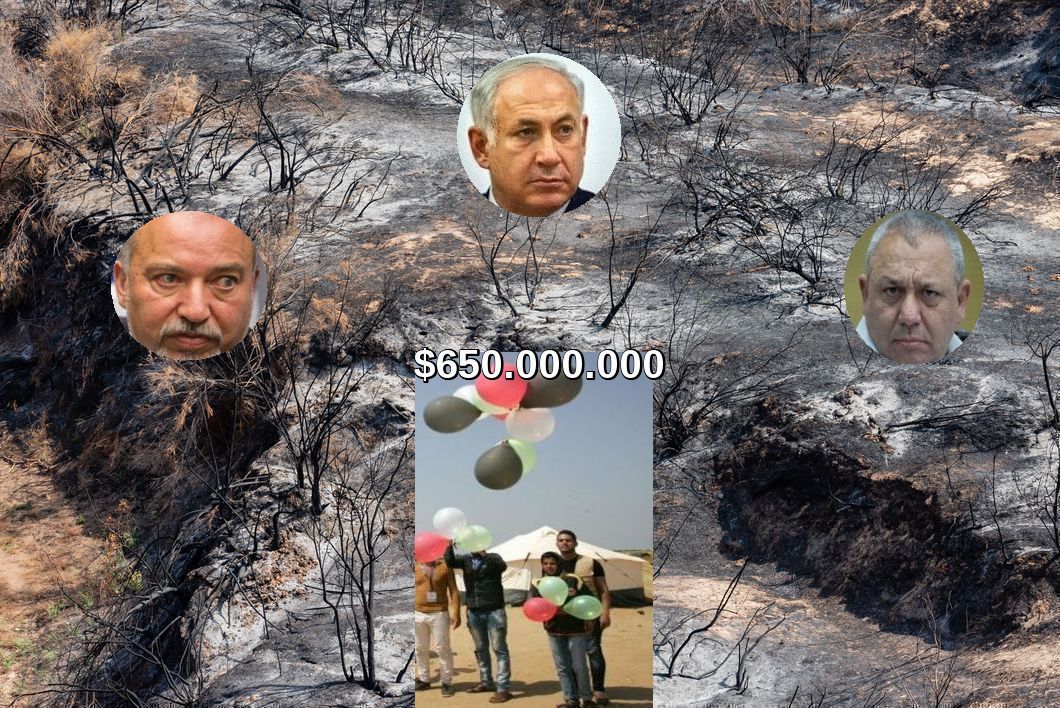
Hamas has burned to a cinder more than 35,000 dunams of flourishing Israeli land – half the area of Tel Aviv, the whole of Beersheba – since launching its “March of Return” on March 31.

But if the Palestinian terrorist rulers of Gaza walk off with the $650m aid package the UN, Egypt and Qatar are offering for a long-range truce accord with Israel – applauded by Washington – they will win the biggest prize ever awarded a serial arsonist.

During Hamas’s 11-year rule, billions of aid dollars have poured into Gaza to ease the pain of a suffering populace, but only a fraction reached its destination; the lion’s share was spent on “resistance” – i.e., consolidating Hamas’ terrorist wing, the Ezz-e-din al-Qassam and its unrelenting campaign of violence for displacing the Jewish state.

Under the new deal, Hamas will make a cool $162,500 for every month of rocket fire against Israeli towns and villages, attacks on the Israel border fence, gunfire and firebombs aimed at the Israeli troops defending the border, the sabotage of IDF equipment, and arson by incendiary kites and exploding balloons.

Nonetheless, IDF Chief of Staff, Lt. Gen. Gady Eisenkot concluded last week that Hamas terrorist chiefs, having failed to achieve anything by a host of different brands of violence, would again lose out in its campaign of arson. But it is that very campaign which has triggered the international plan to cap Hamas’ success with an exceptionally generous truce package. It stands to be rewarded with such perks as a multi-million dollar bounty; a berth at the Egyptian Suez Canal city of Port Said; a landing strip in northern Sinai’s El Arish air field; the lifting of the Israeli and Egyptian blockades on the Gaza Strip; the opening of both border crossings; more electricity power from Israel; and a large desalination plant. All in all, not such a bad haul for four months of “different brands of terror.”

The final straw for the IDF – and the most humiliating – was its failure to stop the most primitive of terror tools, balloons. It achieved what four months and 500 Hamas rockets and mortar shells failed to do.

DEBKAfile lists those gains:

  • Hamas has emerged as the first Palestinian military group to force the IDF, and the Israel government along with it, to allow terrorists to dictate the rules of the contest by dint of an oppressed civilian population held hostage.
  • Full advantage was taken of the IDF’s shying away in its counter-terror operations from causing causalties. Hamas’ top strategists were therefore never in harm’s way. Although a mass Palestinian rush on the Israeli border fence orchestrated by Hamas led to 159 deaths, most were civilians. Hamas successfully used its human shield tactic for bringing international condemnation down on Israel, embellishing its propaganda with fabricated “children”, “journalists,” a “baby” and a “nurse” who were allegedly targeted by Israeli troops.
  • Israel’s counteraction consisted of air strikes on Hamas facilities of minor importance, most of which had been evacuated in good time to escape casualties.
  • Even the IDF’s success in disarming the terror tunnels snaking under the Israeli border, before they were used to attack communities, was to prove limited in value. For each tunnel blown up, Hamas built another, manufacturing a complex, spreading underground warren on the principle of Lego.
  • The truce accord on offer requires hardly any quid pro quo from Hamas. The Palestinian terror group is asked to uphold a truce (it would be the first time), but is not required to dismantle its military (terror) arm, relinquish its arsenal of rockets, or even hand over the remains of the Israeli soldiers and hostages it has captured. Neither is anyone demanding reparations for the huge damage – material and emotional – caused neighboring Israeli communities by more than a decade of Palestinian terror and vandalism.
  • While one provision is the transfer of Gaza’s governing administration to the Ramallah-based Palestinian Authority, no one expects it to be implemented, for the simple reason that Hamas will never hand over its armed wing, and the PA is not strong enough to assume control. That provision alone is tantamount to international recognition of Hamas rule of the Gaza Strip, which it snatched from the Palestinian Authority in a military coup 11 years ago.
  • The Trump administration’s interest in forging this accord derives from the door the Palestinian Authority has shut against its “Middle East Peace Plan of the Century.” That plan will remain on paper so long as PA Chairman Mahmoud Abbas is alive, and so Washington has turned away from Ramallah to the Gaza Strip. When this door began to open, the White House this week indicated that the peace plan staff was to be beefed up ahead of its publication. A deal for Gaza will give it a head start for refocusing Palestinian national aspirations on the Gaza Strip and northern Sinai.

From the perspective of Washington, arrangements are falling into place for Israel’s northern and Gaza fronts to settle down. Russia has taken direct charge of the Syrian borders with Israel,while the US, through the Russian UN mediator Nikolai Mladanov and Egypt, is gaining a remote handle on the Gaza-Israel imbroglio.

Israel’s leaders may pat themselves on the back for dumping the two perils in the laps of Russia and America. But the arrangements taking shape are hardly likely to be sustainable for long, given the bad actors involved. With Syrian/Hizballah/pro-Iranian Shiite troops ensconced at the edge of the Israeli Golan, and Hamas only biding its time between truces for another onslaught, those arrangements are about as stable as a house of cards in a storm.

EU report details international web of Hezbollah terror funding 

August 5, 2018

Source: EU report details international web of Hezbollah terror funding – Arab-Israeli Conflict – Jerusalem Post

The EU only designated Hezbollah’s so-called military wing a terrorist entity in 2013.

BY BENJAMIN WEINTHAL
 AUGUST 5, 2018 00:19
Lebanon's Hezbollah scouts carry their parties flag while marching at the funeral of 3 Hezbollah men

A newly released European Union report on terrorism states that Lebanese nationals worked with organized crime organizations to finance Hezbollah’s terrorist activities.

The European Union Terrorism Situation and Trend Report 2018 wrote, “In 2017, member states carried out several investigations into financing of terrorism. One major investigation focused on a large network of Lebanese nationals offering money laundering services to organized crime groups in the EU and using a share of the profits to finance terrorism-related activities of the Lebanese Hezbollah’s military wing.”

The report added, “The cooperation of these money-launderers and Hezbollah’s military wing was a clear example of a nexus between organized crime and terrorism.”

The Jerusalem Post reviewed the 70-page EU report and found it did not provide any more specifics on Hezbollah’s activities in Europe. Hezbollah has played a key role in aiding Syrian dictator Bashar Assad in the Syrian civil war that has resulted in the deaths of more than 500,000 people.

The EU only designated Hezbollah’s so-called military wing a terrorist entity in 2013. US President Donald Trump, former US president Barack Obama and ex-secretary of state Hillary Clinton have urged the EU to proscribe all of Hezbollah as a terrorist organization.

The Iranian regime is the chief financial sponsor of Hezbollah, with an annual $700 million supplied by Tehran to the Lebanese Shi’ite group, according to the US government.

The Post reported in June that Al-Mustafa Community Center in the northern German city-state of Bremen is a major hub for raising funds for Hezbollah in Lebanon, according to a German intelligence report published by the Bremen intelligence agency.

The agency’s newly released report in June stated, “The Al-Mustafa Community Center supports Hezbollah in Lebanon, especially by collecting donations.”

The Post uncovered the Shi’ite organization’s bank account – the Bremen-based Sparkasse. The Bremen intelligence agency, the rough equivalent to Shin Bet (Israel Security Agency), said there are approximately 60 Hezbollah supporters in Al-Mustafa’s organization and “the Arab- Shi’ite association functions as a point of contact for Shi’ite Muslims in Bremen, especially those from Lebanon.”

Some 950 Hezbollah operatives are in Germany, according to numerous German intelligence reports. The Hezbollah members raise funds and recruit new members.

The United States, Canada, the Arab League, the Netherlands and Israel classify Hezbollah a terrorist organization. In 2012, Hezbollah operatives blew up an Israeli tour bus in Bulgaria, murdering five Israelis and their Bulgarian Muslim bus driver.

Head of Syrian chemical arms research center said assassinated

August 5, 2018

Source: Head of Syrian chemical arms research center said assassinated | The Times of Israel

Aziz Azbar, who ran CERS center thought linked to gas attacks and Iranian missile development, reportedly killed in car bombing

A screen capture from a video purporting to show the aftermath of an Israeli strike on a research facility in the Masyaf area of northwest Syria on July 22, 2018. (Screen capture: Twitter)

A screen capture from a video purporting to show the aftermath of an Israeli strike on a research facility in the Masyaf area of northwest Syria on July 22, 2018. (Screen capture: Twitter)

A Syrian scientist at the head of a research center purportedly linked to the development of chemical weapons and bombed by Israel in the past was killed in a bombing, according to Syrian reports early Sunday.

Aziz Azbar, the head of the Syrian Scientific Research and Studies Center in Masyaf, was killed along with his driver in a bombing Saturday night, according to reports.

The deaths were reported by a number of Syrian and Lebanese news outlets as well as the UK-based Syrian Observatory for Human Rights war monitor and a Facebook page purportedly linked to the Syrian military.

Azbar was close to both Syrian President and the Iranian regime, which was thought to be using the facility for arms development, according to the observatory.

According to some reports, the car Azbar and his driver were in blew up when a passerby managed to attach a bomb to it.

https://www.facebook.com/v2.8/plugins/post.php?app_id=123142304440875&channel=https%3A%2F%2Fstaticxx.facebook.com%2Fconnect%2Fxd_arbiter%2Fr%2FQX17B8fU-Vm.js%3Fversion%3D42%23cb%3Df301394d9dcea2c%26domain%3Dwww.timesofisrael.com%26origin%3Dhttps%253A%252F%252Fwww.timesofisrael.com%252Ff12f43dc4f43ab8%26relation%3Dparent.parent&container_width=600&href=https%3A%2F%2Fwww.facebook.com%2Fsyria.amer.army%2Fphotos%2Fa.1730438013854849.1073741829.1718231198408864%2F2237130619852250%2F%3Ftype%3D3%26theater&locale=en_GB&sdk=joey&width=600

There was no official confirmation of his death.

The Scientific Research and Studies Center in Masyaf, also known by its French acronym CERS, has been the target of at least two reported air attacks blamed on Israel, including one in late April said to have killed a number of Iranians.

Western officials have long associated CERS with the production of chemical weapons. Reports have also indicated an Iranian missile operation at the site.

After the July strike on the site outside of Hama in northern Syria, the observatory said the air attack had targeted a “workshop supervised by Iranians where surface-to-surface missiles are made.”

Nurlana Khalil@NuNurlanax

. Update: local sources say 10 missiles were fired by . At least 6 hit the military complex N. of . Video shows air defenses in action. . pic.twitter.com/UD6yNLwPbz https://twitter.com/QalaatAlMudiq/status/1021086656781266944?s=04 

Qalaat Al Mudiq@QalaatAlMudiq
Replying to @QalaatAlMudiq

#Pt. Update: local sources say 10 missiles were fired by #Israel. At least 6 hit the military complex N. of #Masyaf. Video shows air defenses in action. #Syria.

The site was also reportedly hit by Israel in September 2017.

View image on TwitterView image on Twitter

سفيان السامرائي

@SufianSamarrai

غارات أسرائيلية على قاعدة عسكرية ب مخصصة للإسلحةالكميائية تؤدي الى تدمير كامل لمنظومةالأسد التشغيلية هناك

Israel does not comment on reports of airstrikes in Syria but has said it will work to keep advanced weapons out of terrorists’ hands and has vowed to stop Iran from gaining a foothold in the country.

A Syrian man collects samples from the site of a suspected toxic gas attack in Khan Sheikhoun, in Syria’s northwestern Idlib province, on April 5, 2017. (AFP/Omar Haj Kadour)

In April 2017, the Trump administration placed sanctions on hundreds of CERS employees following a chemical attack on the Syrian rebel-held city of Khan Sheikhoun that killed dozens of civilians, including children.

Another CERS facility near Damascus was bombed by US, British and French forces in April after another chemical attack.

The Syrian regime has been accused of dozens of gas attacks that have killed hundreds of civilians during the war, even after it said it was giving up its stockpile.

A senior member of the Syrian opposition, citing security officials still working for the regime at the time, told The Times of Israel in 2014 that Assad’s forces were stockpiling chemical substances and missiles carrying chemical warheads at the site, which was not made available to international inspectors tasked with ensuring the destruction of the weapons.

Iranian protesters blame their government, not US, for failing economy

August 4, 2018

Source: Iranian protesters blame their government, not US, for failing economy | The Times of Israel

Religious school attacked near Tehran as opponents slam regime; rial has slipped to record lows ahead of sanctions restarting Monday after Washington pulled out of nuke deal

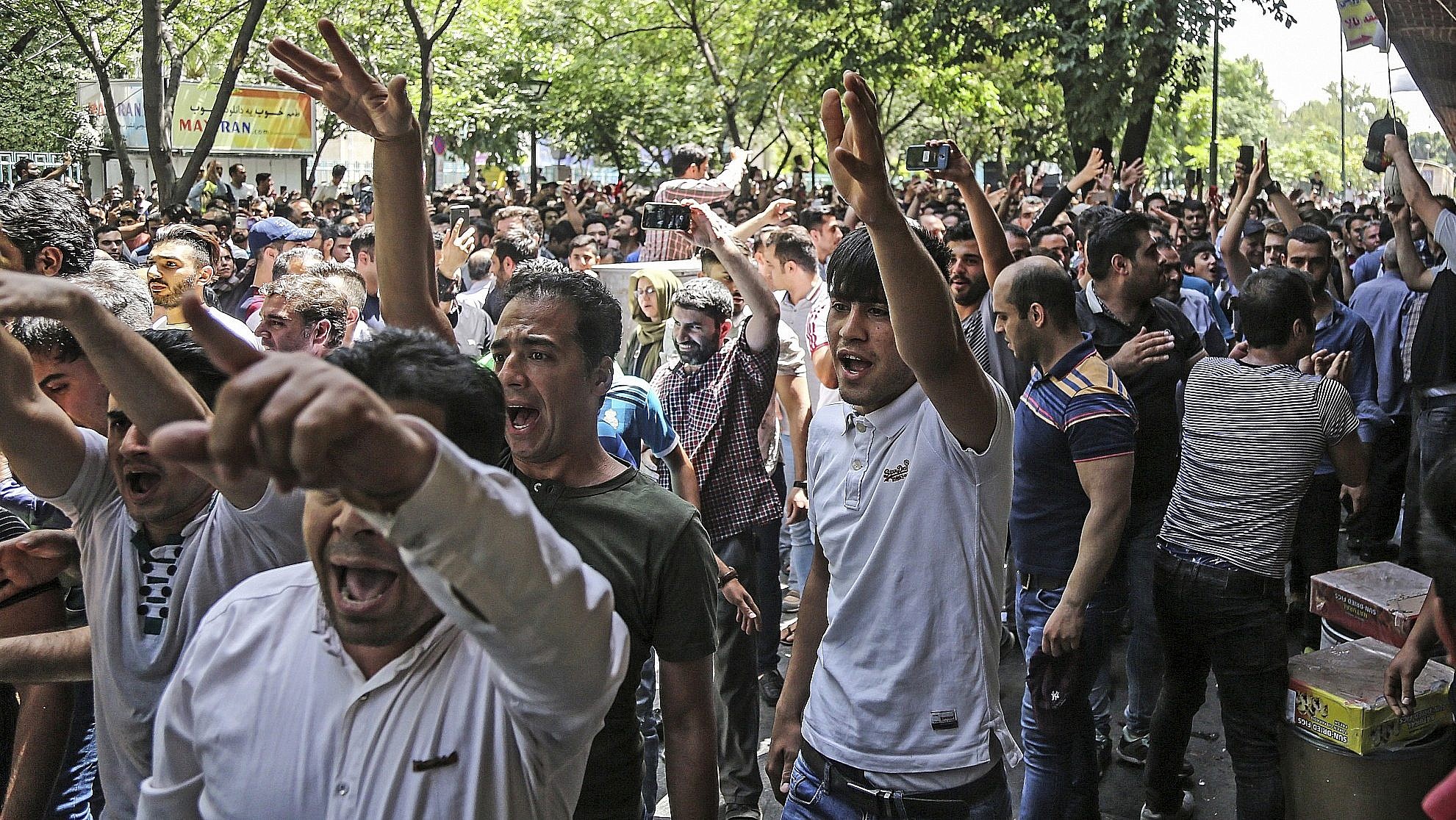
A group of protesters chant slogans at the old grand bazaar in Tehran, Iran, Monday, June 25, 2018. Protesters in the Iranian capital swarmed its historic Grand Bazaar on Monday, news agencies reported, and forced shopkeepers to close their stalls in apparent anger over the Islamic Republic's troubled economy, months after similar demonstrations rocked the country. (Iranian Labor News Agency via AP)

A group of protesters chant slogans at the old grand bazaar in Tehran, Iran, Monday, June 25, 2018. Protesters in the Iranian capital swarmed its historic Grand Bazaar on Monday, news agencies reported, and forced shopkeepers to close their stalls in apparent anger over the Islamic Republic’s troubled economy, months after similar demonstrations rocked the country. (Iranian Labor News Agency via AP)

Largely unmentioned by Iranian authorities, protests against the regime have been raging for several days in several major cities, including Isfahan, Shiraz, Mashhad and Tehran, driven by concerns over the economy as well as wider anger at the political system.

On Saturday, the conservative Fars news agency reported that hundreds of protesters had attacked a religious school in Karaj province near Tehran the night before.

The rulers of Iran may have a good reason to hide the scale of the demonstrations. According to reports, many protesters stressed that they blame their government, not Washington, for the expected effects of US sanctions, which are due to restart on Monday after the Trump Administration pulled out of the Joint Comprehensive Plan of Action (JCPOA), also known as the Iran nuclear deal.

“As long as the dictator [Supreme Leader Ali Khamenei] stands, the uprising will continue,” shouted demonstrators in the city of Karaj, the Arab News website reported on Friday.

In Isafan, marchers shouted “death to the dictator,” before appearing to set fire to police cars, CBS News reported.

“The enemy is here; they are lying when they say it is America,” protesters in Isfahan chanted, according to the People’s Mojahedin Organization of Iran (MEK) which receives support from some in the Trump administration.

The state-run IRNA news agency said Thursday around 100 people protested in the northern city of Sari, as well as unknown numbers in Shiraz, Ahavz and Mashhad, but that the demonstrations were broken up by police as they were taking place without permission from authorities.

Videos on social media, which could not be independently verified, purported to show clashes between protesters and authorities.

M. Hanif Jazayeri@HanifJazayeri

It’s ‘s brave women who are leading the chants in Karaj tonight (listen): “The mullahs must get lost”. This is the 4th night of despite crackdown by the rgm. (Video via MEK activists) @FLOTUS @StephGrisham45 @IvankaTrump @JudgeJeanine @KassyDillon pic.twitter.com/3uA23BL5fV

M. Hanif Jazayeri@HanifJazayeri

Major clashes in Karaj tonight as rgm’s storm troopers try to put down 4th night of . Chants of “Death to Khamenei” & “Death to the dictator” as ppl fend off armed forces w/ stones. Video via MEK activists @GMarquis45 @BenEvansky @EricShawnTV pic.twitter.com/gJLfIeABiW

Videos on social media in recent days have shown people chanting “Death to the dictator,” but authorities have charged that such footage was promoted by emigre opposition groups funded by the US, Israel and Saudi Arabia.

Foreign media are barred from observing or filming “unauthorized” protests.

The numerous protests that have sparked across Iran are a continuation of sorts of a nationwide anti-government movement that started gaining ground in late December and continued protesting sporadically throughout the year.

Since the US pulled out of the nuclear deal in May the Iranian rial has slipped to record lows, and has consequently led many in the authoritarian country to dare to explicitly call for an end to the rule of Iran’s Islamist leadership.

During past unrest, conservative outlets have focused on attacks against sensitive symbols such as religious buildings as a way of tarnishing the protests.

Fars said the religious school in Karaj province was attacked on Friday night. “At 9 p.m. on Friday they attacked the school and tried to break the doors down and burn things,” Fars quoted the head of the school in the town of Ishtehad, Hojatoleslam Hindiani, as saying.

It gave only his clerical rank — Hojatoleslam — not his given name.

“They were about 500 people and they chanted against the system but they were dispersed by the riot police and some have been arrested,” Hindiani said.

Amid the rapidly-spreading protests, Iran’s parliament announced Wednesday it would hold a special session to question President Hassan Rouhani about the plummeting currency and struggling economy.
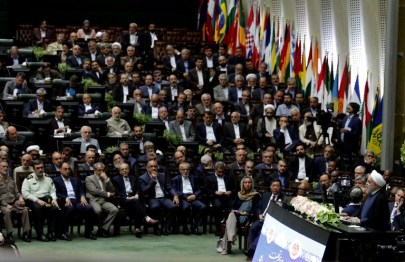
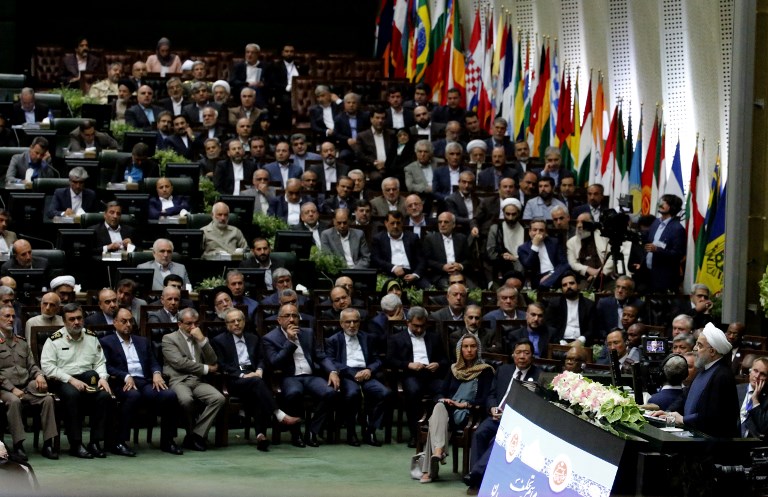
Iran’s President Hassan Rouhani (2-R) delivers a speech after being sworn in before parliament in Tehran, on August 5, 2017. (AFP PHOTO / ATTA KENARE)

Lawmakers plan to separately question Labor Minister Ali Rabiei over the 12.5 percent unemployment rate. He already appeared before parliament in March, when they voted to keep him in office.

Pressure is building on Rouhani as Iran’s economic woes mount. Iran’s Supreme Leader Ayatollah Ali Khamenei has ordered Rouhani, the speaker of parliament and the head of the judiciary to work together and find a way to resolve the problems.

On Tuesday, 200 of 290 members of parliament signed a letter to Rouhani urging him to make changes to his economic team.

Rouhani’s administration has already replaced the central bank governor and taken other measures to shore up the currency, which hit a new low this week.

Meanwhile, some hardliners have called for new elections or for Rouhani’s civilian government to be replaced by a military-led one.

Early last week, Iran’s foreign ministry rejected reports it may be open to fresh negotiations with the United States, as the country’s currency hit a record low ahead of the re-imposition of the sanctions.

“The US or parts of the US may express wishes [about talks], but after the [US] illegal withdrawal from the JCPOA and their hostile policies and push for economic pressure on the Iranian nation, I think there is no such issue” in the works, the Tasnim News Agency reported spokesman Bahram Qassemi as saying.

The foreign ministry’s rebuke of “media speculation” came two days days after the influential parliament speaker, Ali Larijani, was quoted suggesting Iran could be open to talks with the US, if such a move has widespread backing from the country’s leaders.

Qassemi also dismissed any tie between a recent trip by the Foreign Minister Mohammad Javad Zarif to Oman and the Omani foreign minister’s visit to Washington last week.
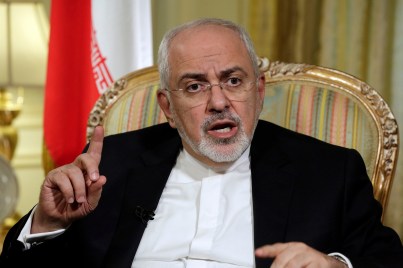
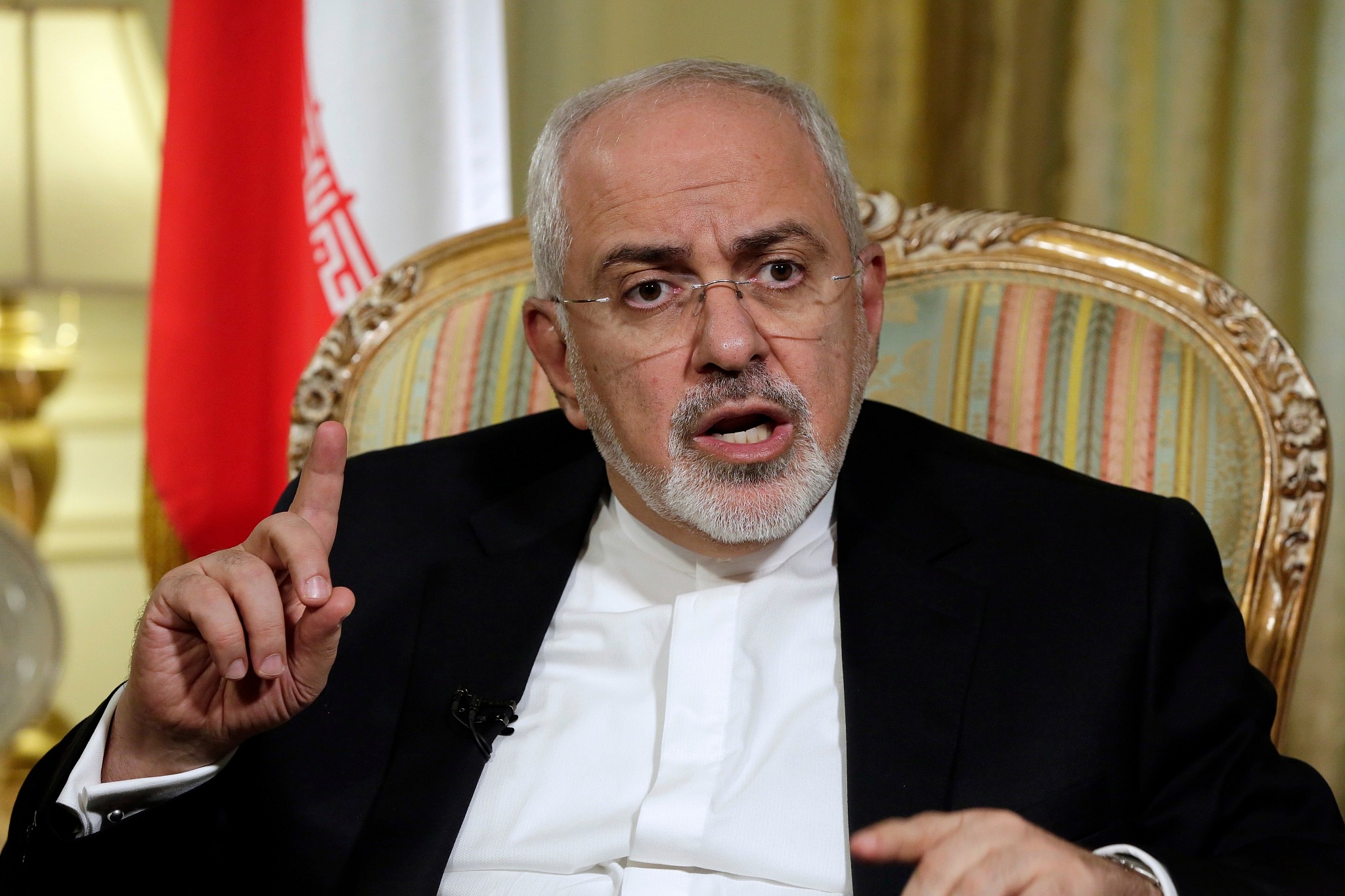
In this April 24, 2018, file photo, Iran’s Foreign Minister Mohammad Javad Zarif is interviewed by The Associated Press in New York. (AP Photo/Richard Drew,)

Oman hosted Iranian and Obama administration officials during the negotiations leading to the 2015 nuclear deal meant to limit Iran’s nuclear program.

The visit has been seen by some as a sign that Oman is acting as a mediator between the US and Iran. Muscat hosted secret preliminary talks between the Obama administration and Iran’s leadership in 2011.

Larijani was quoted in unsourced reports on Saturday purportedly saying that if the entire Iranian establishment was in agreement, Iran could negotiate with the US. This unsourced quotation was repeated prominently on Israel’s Hadashot TV news on Monday evening.

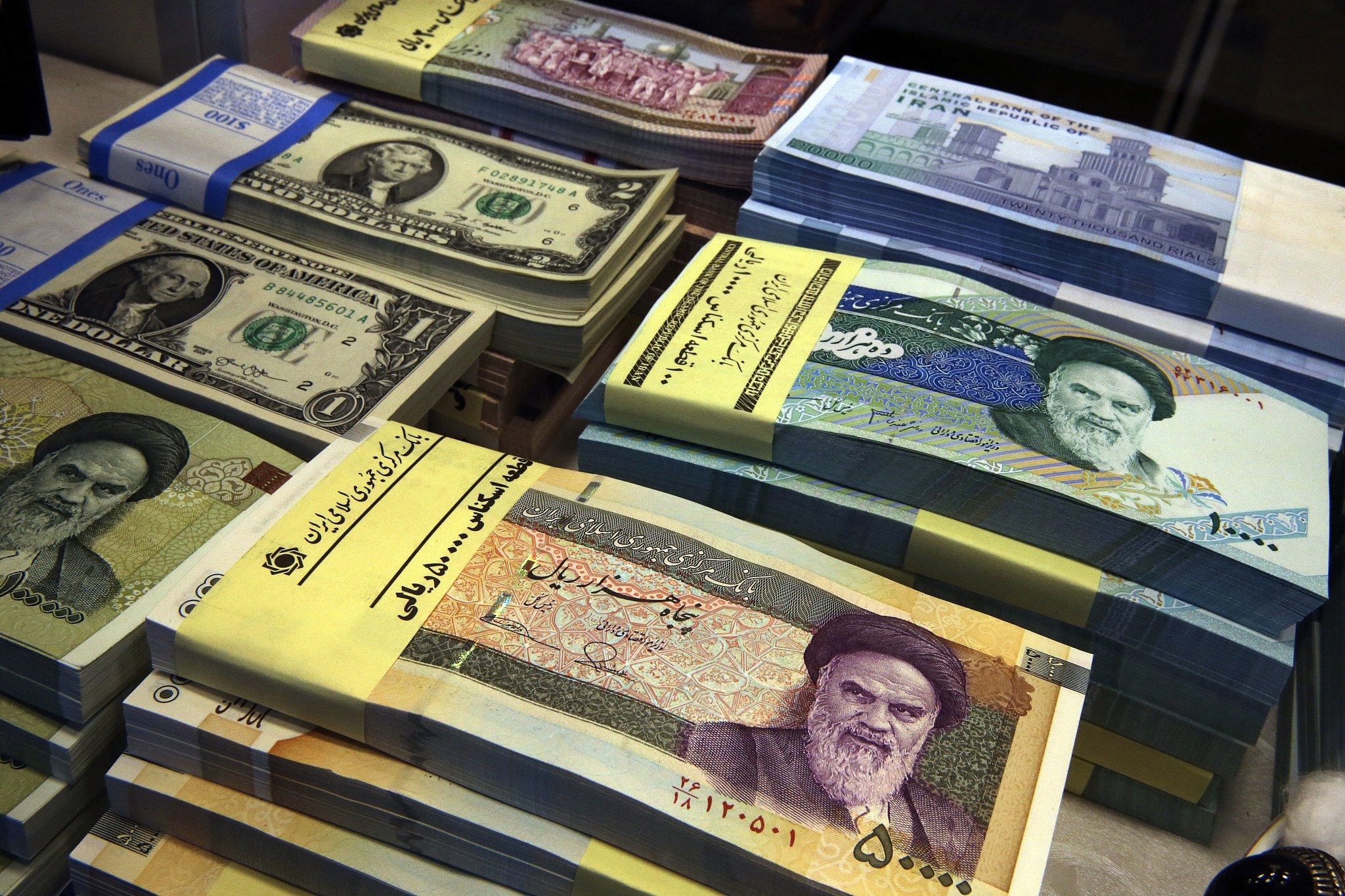
The unconfirmed reports of a possible shift in Iran’s stance on negotiations with the US have come as the free fall of its economy continued Monday, with the rial dropping to 122,000 to the dollar on the thriving black market exchange, from the previous low set the day before of 116,000 to the dollar.
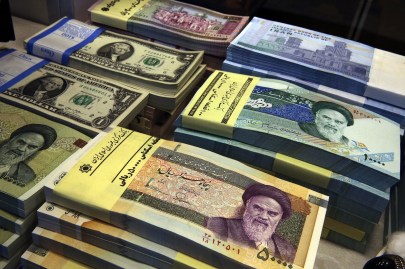
Iranian and US banknotes on display at a currency exchange shop in downtown Tehran, Iran, on April 4, 2015. (Vahid Salemi/AP)

In a statement dated Sunday, the central bank alleged the rial’s drop was the result of foreign conspiracies and said the currency’s weakness against the dollar was not a reflection of “economic realities.”

“Recent developments in the gold and forex markets are part of the conspiracies hatched by the country’s enemies in order to agitate the economy and rob the people of their psychological security,” the statement said, according to Radio Farda.

The central bank stressed it was “closely watching the developments.”

The rial has lost half its value against the dollar in just four months, having broken through the 50,000-mark for the first time in March.

The government attempted to fix the rate at 42,000 in April, and threatened to crack down on black market traders.

But the trade continued with Iranians worried about a prolonged economic downturn turning to dollars as a safe way to store their savings, or as an investment in the hope the rial will continue to drop.

With banks often refusing to sell their dollars at the artificially low rate, the government was forced to soften its line in June, allowing more flexibility for certain groups of importers.

The US is set to reimpose its full range of sanctions in two stages on August 6 and November 4, forcing many foreign firms to cut off business with Iran.

IDF strikes second Gaza cell launching incendiary balloons

August 4, 2018

Source: IDF strikes second Gaza cell launching incendiary balloons | The Times of Israel

The military says it targeted two separate groups in the northern and southern parts of the Palestinian enclave

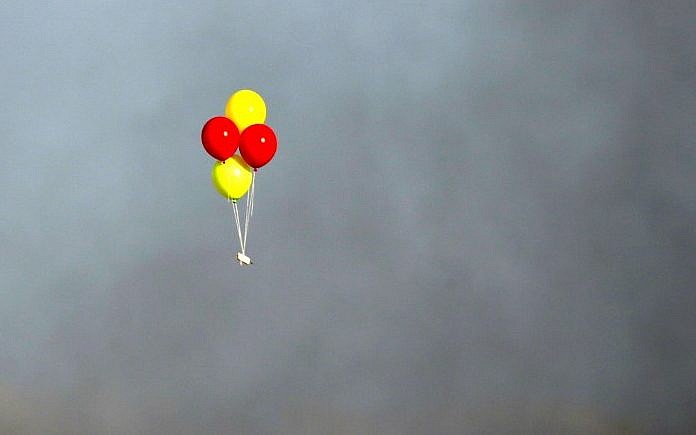
Incendiary balloons are flown toward Israel during clashes between Palestinians and Israeli troops east of Gaza City, along the border between the Gaza Strip and Israel, on July 13, 2018. (AFP Photo/Mahmud Hams)

Incendiary balloons are flown toward Israel during clashes between Palestinians and Israeli troops east of Gaza City, along the border between the Gaza Strip and Israel, on July 13, 2018. (AFP Photo/Mahmud Hams)

The IDF said it carried out a second airstrike in the Gaza Strip on Saturday afternoon, targeting a cell launching incendiary balloons into Israel from the southern Palestinian enclave. The strike came hours after the military targeted a cell launching balloons in the northern Gaza Strip.

The airstrikes came amid reports that the Strip’s Hamas rulers were considering a long-term ceasefire deal with Israel.

Earlier in the day, firefighters battled two blazes in the Gaza border area started by flaming balloons. On Friday there were 26 fires started by incendiary devices flown from Gaza.

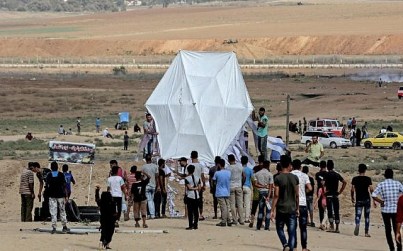
Since March 30, southern Israel has experienced hundreds of fires as a result of incendiary kites and balloons flown over the border from Gaza. Over 7,000 acres of land have been burned, causing millions of shekels in damages, according to Israeli officials.

Recently, balloons have been found farther and farther from the Gaza Strip, including as far away as the southern city of Beersheba.

Israel has struggled to counter the arson assault and has in some cases fired at Palestinians preparing to launch incendiaries, killing or injuring those involved.

Palestinians prepare to fly a kite near the Gaza border with Israel, east of Jabalia, on August 3, 2018. (AFP/ MAHMUD HAMS)

The Hamas-run health ministry in the Gaza Strip said earlier Saturday that a 15-year-old Palestinian died of his wounds hours after being shot in the stomach by Israeli soldiers during clashes at the border on Friday.

Several Palestinians breached the border fence during the large protests.

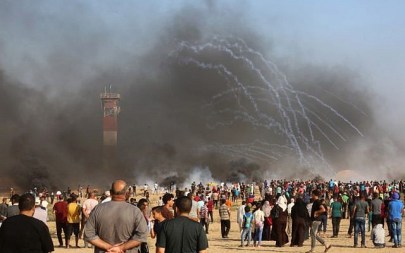
Palestinian protesters at the Israel-Gaza border, in Khan Yunis in the southern Gaza Strip, on August 3, 2018. (AFP/Said Khatib)

The army said some 8,000 people took part in the protests at five sites along the border Friday. The military said its forces responded with riot disposal means and live fire in accordance with appropriate rules of engagement.

In one incident, several Palestinians crossed the border fence, entered Israeli territory at the Kerem Shalom crossing, and threw firebombs and stones, before fleeing back into Gaza. “In response, an IDF tank shelled a post belonging to the Hamas terror group.”

Friday’s protests were held in memory of Mohammad Tareq, a Palestinian terrorist who murdered an Israeli man in a terror attack in the West Bank last week.

Organizers urged Gazans to attend Friday’s protests “in order to convey a message that Palestinians will not surrender to the dictates of Israeli terrorism until the siege is lifted,” the Haaretz daily reported.

For over three months, there have been near-weekly, violent protests along the Israel-Gaza border organized by Gaza’s Hamas rulers, leading to the most serious escalation between the two sides since the 2014 war.

The deadly clashes have seen Israeli security forces facing gunfire, grenades, Molotov cocktails, and efforts — sometimes successful — to damage or penetrate the border fence. Last month, an Israeli soldier was killed by a sniper.

According to the Gaza health ministry, 157 Palestinians have been killed since the start of the “March of Return” protests on March 30. Hamas has acknowledged that dozens of those killed were its members.

Leaked UN report claims North Korea’s nuclear & missile programs still active

August 4, 2018
https://www.rt.com/news/435083-north-korea-makes-nukes/
Official North Korean Central News Agency image shows the demolition of the Punggye-ri nuclear test site © KCNA / Reuters
North Korea has not abandoned its nuclear and missile programs, despite this year’s earlier diplomatic breakthroughs and destruction of test sites, Reuters reports, citing a confidential UN paper.

The leaked report is said to be a six-month review by independent experts monitoring the implementation of United Nations sanctions on North Korea, and was submitted to the relevant UN committee late on Friday.

The paper, as cited by Reuters, alleges that Pyongyang has not abandoned its pursuit of missile and nuclear programs. It is also violating UN sanctions by exporting weapons to a “range of Middle East [and] African states,” including to the Houthi rebels fighting against Saudi Arabia in Yemen, and has shipped coal, petroleum and textile products, all made illicit by the sanctions regime.

Read more

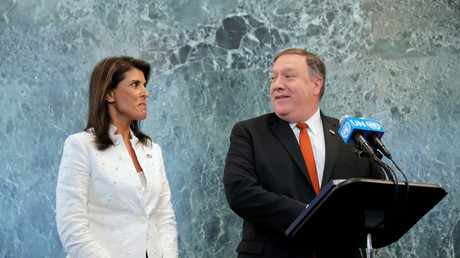
Ambassador Nikki Haley and Secretary of State Mike Pompeo at the UN, July 20, 2018 © Brendan McDermid

The report comes two months after North Korea made an unprecedented gesture by demolishing its only nuclear test site at Punggye-ri, while inviting a group of international journalists to witness it. An RT crew was at the scene. With the UN report covering six months, the excerpts quoted by Reuters do not clarify whether Pyongyang’s alleged nuclear- and missile-related activities came before or after the demolition, nor do they specify the evidence used to establish the fact of the violations.

North Korean leader Kim Jong-un indicated he was willing to denuclearize at an April meeting with his South Korean counterpart Moon Jae-in. The credit for this pledge was claimed by US President Donald Trump and his administration, and in June Trump himself went to meet Kim in an unprecedented personal visit, where Kim confirmed his commitment.

Despite the diplomatic breakthroughs, the US says the sanctions, which have been gradually choking off every venue of export and import for North Korea, must remain in place until Kim gives up all of his nukes. In July, Secretary of State Mike Pompeo said it should take 2.5 years for that to happen. In a later interview, he said it was Kim’s decision to set an actual timeline for the process.

Earlier this week, several media reports, citing anonymous officials and unspecified intelligence reports, claimed there was renewed activity at a North Korean missile factory, and that Pyongyang was making “one or two” new intercontinental ballistic missiles.

Hamas reportedly agrees to Egyptian-brokered ceasefire deal with Israel 

August 4, 2018

Source: Hamas reportedly agrees to Egyptian-brokered ceasefire deal with Israel | The Times of Israel

Terror group’s leadership said to accept terms of truce on condition of eased border restrictions; Jerusalem official says deal must include return of held Israelis

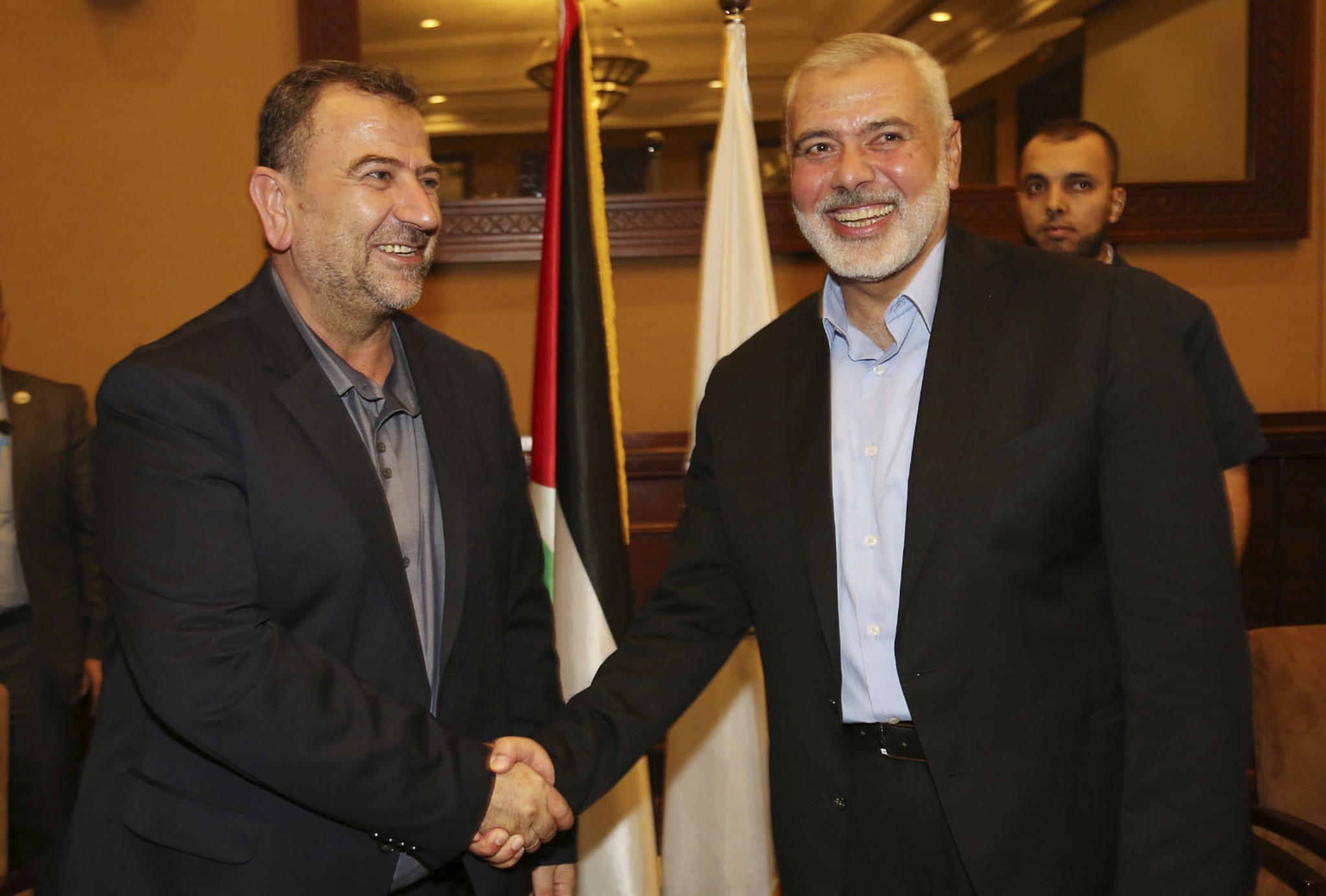
In this photo released by the Hamas Media Office, Ismail Haniyeh, right, the head of the Hamas political bureau, shakes hands with his deputy Saleh el-Arouri upon his arrival in Gaza from Cairo, Egypt, in Gaza City, Thursday, Aug. 2, 2018. (Mohammad Austaz/Hamas Media Office via AP)

In this photo released by the Hamas Media Office, Ismail Haniyeh, right, the head of the Hamas political bureau, shakes hands with his deputy Saleh el-Arouri upon his arrival in Gaza from Cairo, Egypt, in Gaza City, Thursday, Aug. 2, 2018. (Mohammad Austaz/Hamas Media Office via AP)

The Hamas leadership on Friday agreed to an Egyptian-brokered ceasefire deal with Israel on the condition that restrictions on the Gaza Strip’s border crossings be eased, Hadashot news reported. Now the leaders were waiting for an Israeli response after the cabinet meets Sunday, the TV report said.

In the wake of Hamas’s approval, the TV news station said that a “very senior” Israeli official travelled to Qatar for talks on how to implement the long-term ceasefire deal.

According to Hadashot, the first phase of the plan would see the Rafah border crossing with Egypt reopened on a permanent basis, and eased restrictions on the Kerem Shalom crossing with Israel.

The second phase of deal, according to Hadashot, would see an agreement between Hamas and Fatah that would see the Palestinian Authority take control of the Gaza Strip under the auspices of Egypt. It was not clear how this could be reconciled with Hamas’s refusal to relinquish its weaponry — a stance that has scuppered previous Fatah-Hamas reconciliation efforts.

In return, the PA would resume paying its employees in Gaza whose salaries it has withheld, the TV report said. The second phase also outlines a roadmap for elections to be held in Gaza within six months.

A  third phase would implement long-proposed humanitarian projects like the establishment of a port in the Sinai in Egypt that would serve Gaza, the report said.

The last phase, Hadashot reported, was a 5-10 year ceasefire agreement with Israel, that would include negotiations for the return of the Israeli citizens and remains of IDF soldiers held by Hamas in Gaza.

These specifics were not officially confirmed.

However, an Israeli official told Channel 10 on Friday that Israel would not be willing to accept any long-term deal with Hamas that did not include the return of the held Israelis. He said the deal stipulated that the negotiations for their return must begin immediately.

As soon as news of the reported proposal broke Friday, the families of Israeli fallen soldiers and civilians held in Gaza appealed to Prime Minister Benjamin Netanyahu and other Israeli political leaders, urging them to include the release of Israelis in any deal.

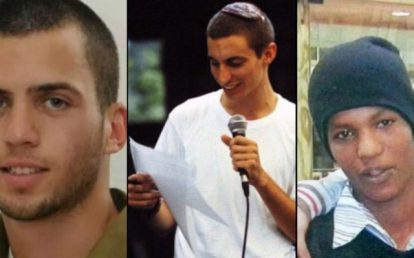
“Any deal that doesn’t include the return of Oron [Shaul], Hadar [Goldin], [Avera] Mengistu and the rest of our citizens won’t be worth the paper it’s written on, or whatever verbal promises were made for it,” read a letter to Netanyahu from the Shaul family.

Left to right: Oron Shaul, Hadar Goldin and Avraham Mengistu. (Flash90/The Times of Israel)

“For the deal to have practical and moral validity, its first stipulation must be the release of our sons,” the letter said. “A deal without the return of our sons is a surrender that only serves as evidence of our country’s weakness.”

The Shaul family plans to protest the deal in front of the Prime Minister’s Office on Sunday morning, when the security cabinet is to meet to discuss the agreement.

Reports in the Lebanese news paper Al-Akhbar earlier on Friday said the deal stipulated that Hamas must commit to “the end of the provocations along the border, or in other words, the phenomena of the flaming kites and ballons, border crossing operations and setting fire to border posts.”

The deputy head of Hamas’s politburo, Saleh al-Arouri, who served several Israeli jail terms for terrorism, arrived in the Gaza Strip late Thursday with other Hamas leaders for talks focused on renewed reconciliation efforts with Fatah and to raise the truce prospects with the terror group’s Gazan leadership, Hamas-linked media reported.

According to Al-Akhbar, Hamas’s leadership, including its Shura Council, or parliament, is expected to convene a vote on the proposal, which was brokered by UN Special Coordinator for the Middle East Peace Process Nickolay Mladenov in meetings with Netanyahu, Egyptian Foreign Minister Sameh Shoukry, and Hamas leaders in the Gaza Strip in recent weeks.

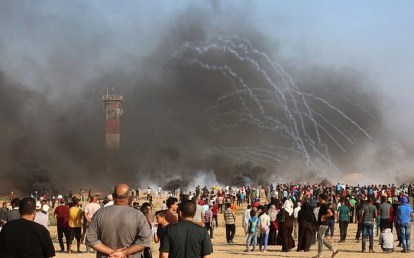
The reports of a possible ceasefire came as the IDF said Palestinians protesting along the border breached the border fence and hurled firebombs. One Palestinian was killed and 25 Palestinians were injured during the Hamas-led “March of Return” demonstrations Friday afternoon, the Hamas-run Gaza health ministry said.

The army said some 8,000 people took part in five separate protests along the border, and that troops responded with riot disposal means and live fire in accordance with appropriate rules of engagement.

For over three months, there have been near-weekly, violent protests along the Israel-Gaza border organized by Gaza’s Hamas rulers, leading to the most serious escalation between the two sides since the 2014 war.

Palestinian protesters gather as tear gas canisters are launched by Israeli forces during a demonstration at the Israel-Gaza border, in Khan Yunis in the southern Gaza Strip on August 3, 2018. (AFP/Said Khatib)

The deadly clashes have seen Israeli security forces facing gunfire, grenades, Molotov cocktails and efforts — sometimes successful — to damage or penetrate the border fence. Last month, one Israeli soldier was killed by a sniper.

According to the Gaza health ministry, 157 Palestinians have been killed since the start of the “March of Return” protests on March 30. Hamas has acknowledged that dozens of those killed were its members.

The protests have also seen Palestinians fly airborne incendiary devices toward Israeli territory, sparking hundreds of fires in southern Israel and causing millions of shekels in estimated damages.

On Friday, firefighters had worked to extinguish 16 blazes caused by incendiary balloons across Israeli communities near the Gaza Strip, a spokesman for the Israeli Fire and Rescue Services said.

The confrontations have at times spiraled into military exchanges, with Palestinians firing dozens of rockets at southern Israeli towns and the army launching air strikes on Hamas positions in Gaza.