Archive for August 2018

Dozens of rockets fired at south; IDF pounds Hamas targets in Gaza

August 9, 2018

Residents of southern Israel told to stay near bomb shelters as military strikes ‘terror targets’ in the Strip, including factory reportedly used to build attack tunnels

8 August 2018, 10:02 pm

https://www.timesofisrael.com/idf-strikes-hamas-posts-in-gaza-as-fresh-rocket-sirens-sound-in-south/

Dozens of rockets and mortar shells were fired at southern Israeli communities from the Gaza Strip on Wednesday night and into Thursday, including one barrage that slammed into the city of Sderot, injuring several Israelis, prompting the Israeli Air Force to bomb at least 12 Hamas positions across the Gaza Strip, the military said.

The air force also targeted one car that the army said was being used by terrorists to launch rockets at southern Israel from the Strip. One Hamas operative was reportedly killed in the airstrike. Unconfirmed reports claimed he was the relative of a senior Hamas commander.

Wave after wave of rocket attacks set off sirens throughout the night in the Hof Ashkelon, Sha’ar Hanegev, Sdot Negev and Eshkol regions outside Gaza, as well as the town of Netivot, sending thousands of Israelis into bomb shelters, where many bedded down with their families.

One rocket — or possibly shrapnel from an Iron Dome interceptor — damaged a home in Sderot late Wednesday night, police said. At least two rockets struck the city earlier in the day, injuring three people. At least eight others were treated for panic attacks, including two pregnant women who went into labor.

A rocket fired from the Gaza Strip that struck a factory in the Sha’ar Hanegev region of southern Israel on August 8, 2018. (Israel Police)

Around 1 a.m. another two rockets exploded in Sderot, one outside a home and another in a factory, causing damage but with no reports of injuries.

In addition, a rocket hit a factory in the Sha’ar Hanegev region, breaking through the roof and damaging equipment inside, a spokesperson for the region said. The factory was empty of people at the time of the rocket attack.

Following the attacks from Gaza, Prime Minister Benjamin Netanyahu and Defense Minister Avigdor Liberman were meeting overnight with senior officers from the IDF and other security services at the military’s headquarters in Tel Aviv, to discuss the situation and decide on a course of action.

According to the military, at least 70 projectiles were fired at southern Israel as of midnight Wednesday, including the eight that were launched at Sderot earlier in the evening.

At least 11 rockets or mortar shells were intercepted by the Iron Dome missile defense system, the army said.

“The majority of the rockets hit open areas,” the IDF said in a statement. Iron Dome does not target rockets projected to strike open areas.

Hamas claimed responsibility for Wednesday’s attacks, saying it was avenging the deaths of two operatives killed in an Israeli strike the day before — a strike that came in response to what the IDF initially identified as a shooting attack on its forces, but which was apparently an internal Hamas exercise.

“In response to Israel aggression, the Palestinian resistance has launched a large number of rockets in recent hours at the enemy,” a statement by the group said. “There was a promise [to respond] and now it has been fulfilled.”

The United Nations condemned the Hamas rocket fire.
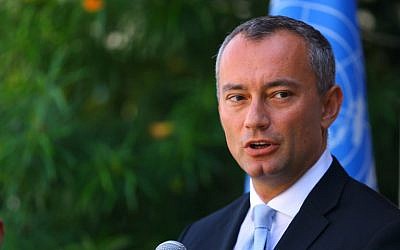
Nikolay Mladenov, United Nations Special Coordinator for the Middle East Peace Process, speaks during a press conference at the UNESCO headquarters in Gaza City, September 25, 2017. (AFP/MOHAMMED ABED)

“I am deeply alarmed by the recent escalation of violence between Gaza and Israel, and particularly by today’s multiple rockets fired towards communities in southern Israel,” UN envoy Nickolay Mladenov said in a statement.

He called on all sides to step “back from the brink” and restore calm.

“If the current escalation…is not contained immediately, the situation can rapidly deteriorate with devastating consequences for all people.”

Spokespeople for the southern Israeli regional councils said no rockets or mortar shells appeared to have struck inside any of their communities, besides the one that hit the factory. Several were found in the fields outside their gates.

The Israel Defense Forces said its warplanes conducted airstrikes on 12 “terror targets” in the Gaza Strip in response to the rockets and an earlier shooting attack on a civilian construction vehicle near the border.

An IDF aircraft also targeted a car that the military said was being used by a terror cell launching rockets at Israel. The army later released a video of the airstrike.

One Palestinian man was reportedly killed in the strike, 30-year-old Hamas man Ali al-Ghandour was killed, according to the Hamas-run Gaza health ministry.

According to the military, among the Hamas positions bombed by the fighter jets was a factory where the terror groups constructs the concrete blocks it uses for attack tunnels and a fully operational tunnel opening near the Gaza coast belonging to Hamas’s naval commando unit.

In addition, a number of Hamas facilities used to manufacture and store rockets and other military equipment were hit in the strikes, the IDF said.

According to the army, the concrete factory was originally used as a civilian hotel, but was seized by Hamas during the 2012 Operation Pillar of Defense campaign. A year later it was converted a facility to produce the concrete slabs that line the walls of tunnels, the military said.

An aerial photograph distributed by the Israeli military showing what it says is a Hamas facility used to produce concrete slabs for the group’s attack tunnels, which the IDF bombed on August 8, 2018, in response to rocket attacks from the Strip. (Israel Defense Forces)

In addition to al-Ghandour, at least six other Palestinians were injured in the Gaza Strip as a result of the IDF strikes, according to the Hamas-run health ministry.

The Israeli military said the terror group, with which it was fought three wars in the past decade, would bear the consequences of any further violence from the Gaza Strip.

An aerial photograph distributed by the Israeli military showing what it says is the opening to a tunnel opening along the Gaza coast belonging to the Hamas terror group’s naval commando unit, which the IDF bombed on August 8, 2018, in response to rocket attacks from the Strip. (Israel Defense Forces)

“The IDF sees with severity the terrorist activities of Hamas. The IDF is prepared for a variety of scenarios and is determined to fulfill its mission of defending the citizens of Israel,” the army said in a statement.

Residents of southern Israel were told to remain close to bomb shelters in case of additional rockets or mortar shells from Gaza.

The rocket attacks came amid a period of heightened tensions along the Gaza border, following months of clashes and exchanges of fire. On Tuesday, Hamas vowed to avenge the deaths of two of its members killed by IDF tank fire after the army mistakenly thought a military exercise had been a cross-border attack.

A police sapper searches the yard of a house the southern Israeli town of Sderot that was hit by a rocket attack from the Gaza Strip on August 8, 2018. (Israel Police)

On Wednesday afternoon, the military warned that it was anticipating a revenge attack by Hamas after spotting members of the terror group evacuating posts likely to be targeted by Israel in reprisal raids.

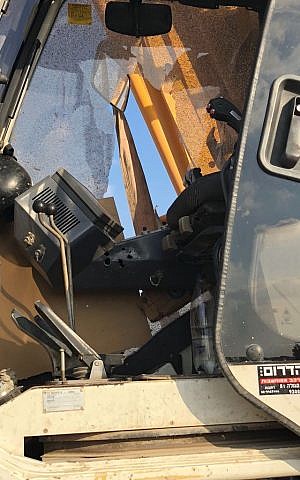
Hours later, shots were fired from the northern Gaza Strip at a number of civilian construction vehicles along the border, damaging one of them, the army said.

Damage to a construction vehicle outside the Gaza Strip, which the military says was caused by gunfire from the Palestinian enclave, on August 8, 2018. (Israel Defense Forces)

In response, an IDF tank shelled a nearby Hamas observation post.

Wednesday’s rocket fire represented a major uptick in tensions along the border, amid intensive talks between Israel and Hamas for a long-term ceasefire.

Such an agreement is meant to end not only rocket launches and shootings from Gaza but also the regular incendiary kite and balloon attacks from the Palestinian enclave that have burned large swaths of land in southern Israel and caused millions of shekels of damage.

Throughout Wednesday, at least 11 fires were sparked in southern Israel by airborne arson devices launched from the Gaza Strip. Israeli firefighters extinguished all of them, according to a spokesperson for Fire and Rescue Services.

Adam Rasgon and Times of Israel staff contributed to this report.

Jewish Children and Adults Hurt as Dozens of Rockets Fired at Israel

August 9, 2018

http://www.jewishpress.com/news/terrorism-news/rockets-from-gaza/jewish-children-and-adults-hurt-as-dozens-of-rockets-fired-at-israel/2018/08/08/

Photo Credit: Nati Shohat / Flash 90

Rockets fired from Gaza into Israel as seen from Sderot.

More than a dozen Israelis were hurt Wednesday night as Gaza’s ruling Hamas terrorist organization launched a massive, evening-long rocket attack on southern Israel.

Magen David Adom emergency medical response teams reported late in the evening that 17 people were taken to area hospitals, including at least nine with physical injuries. Two of those were critically wounded, according to the report.

Among the wounded were two 13-year-old boys, and a third who was 16 years old. A 54-year-old man was immediately taken into surgery. Ten older people were hurt as well, including several who were treated for shock.

Dozens of rockets, missiles and mortar shells were fired at the western and central Negev by terrorists in Gaza. The IDF ordered residents in the region to remain close to safe spaces and bomb shelters; most elected to bed down with their families as the rocket barrages grew closer and closer together with the passing hours.

In the first barrage, a rocket struck gas balloons outside a home in the border city of Sderot. The ensuing explosion and flames left multiple wounded, including a man with shrapnel wounds and nearly a dozen others in shock. Two pregnant women were also taken to Barzilai Medical Center after they went into labor as a result of the stress.

In response, the IDF launched a large-scale attack on terrorist positions in Gaza. Israel Defense Forces attacked 12 ‘terror targets’ throughout Gaza, including the manufacturing facility the military said had helped to build the attack tunnels.

No group has taken responsibility for the attacks thus far, but Israel is holding Hamas responsible, as it has maintained sole control over the enclave since 2007.

“The IDF sees with severity the terrorist activities of Hamas,” said the army spokesperson in a statement Wednesday night. “The IDF is prepared for a variety of scenarios and is determined to fulfil its mission of defending the citizens of Israel.”

Two hurt as at least two rockets fired from Gaza strike Sderot 

August 8, 2018

Source: Two hurt as at least two rockets fired from Gaza strike Sderot | The Times of Israel

Iron Dome shoots down two of eight projectiles after sirens blare throughout southern Israel; barrage comes amid heightened tensions, frequent flare-ups on border

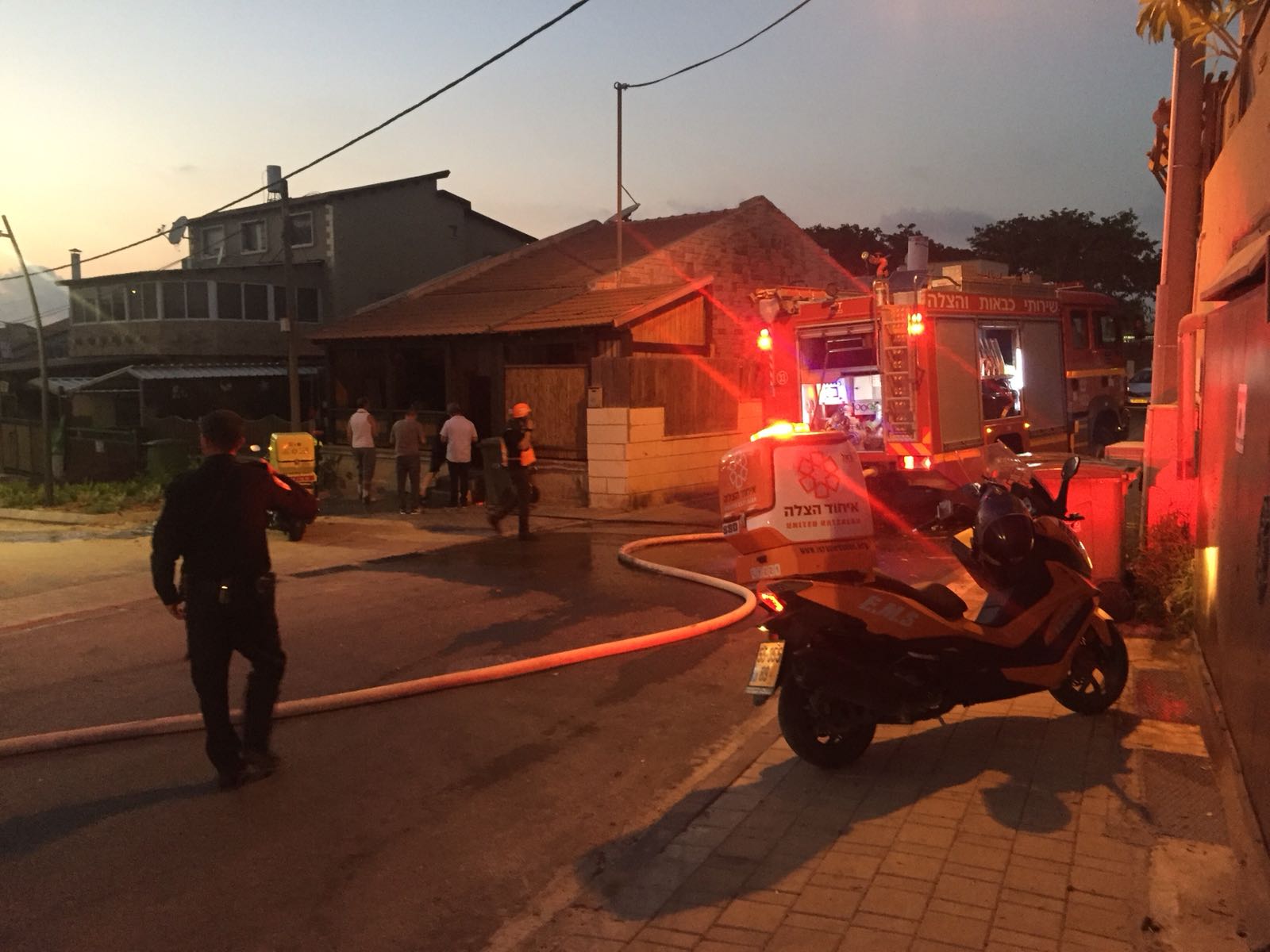
Emergency medical personnel respond to a rocket attack from the Gaza Strip that hit the southern Israeli town of Sderot on August 8, 2018. (United Hatzalah)

Emergency medical personnel respond to a rocket attack from the Gaza Strip that hit the southern Israeli town of Sderot on August 8, 2018. (United Hatzalah)

At least two rockets fired from Gaza struck the southern Israeli town of Sderot on Wednesday evening, injuring two people, hours after an exchange of fire between the military and the Hamas terrorist group along the Gaza border.

Sirens rang out in several southern Israel communities at 7:40 p.m. as Gazan terrorists apparently launched a fusillade of rockets.

According to the Israeli military, eight rockets were fired at southern Israel from the Palestinian enclave. Two of them were intercepted by the Iron Dome missile defense system.

At least two rockets from Gaza struck Sderot, according to police.

Following the rocket attack, an Israeli drone struck farmlands near Beit Lahia in the northern Gaza Strip, the Hamas-linked Palestinian Information Center reported. No injuries were reported.

In Sderot, a 34-year-old man was lightly-to-moderately- wounded by shards of broken glass while inside an apartment building in the town, according to the Magen David Adom ambulance service.

Another man in his 20s was also lightly wounded by shrapnel in a different area of Sderot. They were both taken to Ashkelon’s Barzilai Medical Center for treatment.

In addition, eight people were treated on the scene after they suffered panic attacks, including two pregnant women, MDA said.

Videos and photographs from Sderot showed heavy damage to several cars and shrapnel riddling an apartment building.

View image on TwitterView image on TwitterView image on TwitterView image on Twitter
Police bomb disposal units were called to the scene and have closed off the area, a police spokesperson said.

It was not immediately clear if the two men were injured by the impact of a Hamas rocket or by the remains of an Iron Dome interceptor missile.

Earlier in the day, the military warned that it was anticipating a revenge attack by the Hamas terrorist group after two of its members were killed in an IDF strike on Tuesday.

The rocket fire represented a major uptick in tensions along the border, amid intensive talks between Israel and Hamas for a long-term ceasefire. Such an agreement is meant to end not only rocket launches and shootings from Gaza but also the regular incendiary kite and balloon attacks from the Palestinian enclave that have burned large swaths of land in southern Israel and caused millions of shekels of damage.

On Wednesday afternoon, shots were fired from the Gaza Strip at a number of civilian construction vehicles just outside the Palestinian enclave, causing damage but no injuries.

In response, an Israeli tank shelled a Hamas observation post in the northern Gaza Strip, the army said.

There were no immediate reports of Palestinian injuries.

The engineering vehicles that were fired upon were being used to build an underground barrier around the Gaza Strip, which is meant to counter Hamas’s network of border-crossing attack tunnels.

“Terrorists shot at civilian vehicles that were being used in the effort to construct the barrier around the security fence in the northern Gaza Strip. One vehicle was hit,” the IDF said.

Damage to a construction vehicle outside the Gaza Strip, which the military says was caused by gunfire from the Palestinian enclave, on August 8, 2018. (Israel Defense Forces)

Palestinian media reported that shortly after the attack, IDF soldiers fired smoke grenades into the northern Gaza Strip, near the abandoned Karni Border Crossing.

It was not immediately clear if this was in response to the shooting attack or if it was an unrelated incident.

In addition, throughout Wednesday, at least 11 fires were sparked in southern Israel by airborne arson devices launched from the Gaza Strip. Israeli firefighters extinguished all of them, according to a spokesperson for Fire and Rescue Services.

Earlier in the day, the military closed off a highway in southern Israel on Wednesday out of concerns that Hamas might open fire at Israeli vehicles.

The military said the decision to close Route 25 and several smaller service roads near the border was made in light of recent threats by Hamas and after IDF soldiers saw that the terror group had begun abandoning several of its positions in the Strip — a move Hamas generally takes as a precaution against airstrikes before carrying out attacks against Israel.

On Tuesday, an IDF tank shelled a Hamas observation post along the Gaza border, killing two of the terror group’s fighters, after soldiers nearby mistakenly believed shots had been fired at them.

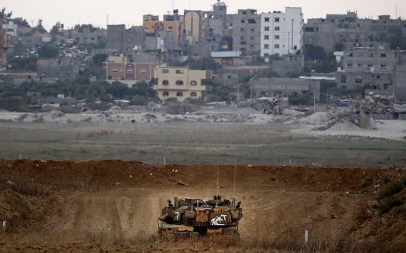
A picture taken on July 20, 2018 shows an Israeli Merkava battle tank patrolling along along the border with the Gaza Strip near Kibbutz Nahal Oz in southern Israel. (AFP Photo/Jack Guez)

The army later confirmed that the gunshots were not fired at the soldiers, but were part of a Hamas training exercise inside the Strip.

The IDF defended its decision to attack the observation post, telling the Haaretz newspaper that the shelling was justified given the information it had available at the time.

Hamas vowed to avenge its fallen members, saying it will not allow Israel to “impose a policy of bombing sites and targeting fighters without paying the price.”

On Wednesday, the military said it would work to prevent any attacks against Israeli citizens by Hamas.

“The IDF will act to ensure the security of residents of the [Gaza] area and will not allow civilians and IDF soldiers to be harmed. The IDF is prepared for a variety of scenarios,” the army said Wednesday.

Earlier Wednesday, rocket sirens sounded in Israeli communities adjacent to the Gaza Strip, sending thousands of residents running to bomb shelters in what the military later said was a false alarm. The alarm systems were triggered shortly before 10 a.m. in the city of Sderot and communities in the Sha’ar Hanegev region of southern Israel.

The Israel Defense Forces did not specify what caused the false alarm. In the past, such events have been triggered by large-caliber gunfire near the border, which the military’s sensitive detection systems misidentify as rocket fire.

Adam Rasgon and Times of Israel staff contributed to this report.
EU Unable to Neutralize US Sanctions against Iran

August 8, 2018

Iran CIVIL WAR brewing: Fury at ‘corrupt’ regime – ‘they make us poorer every day’ 

August 8, 2018

Source: Iran CIVIL WAR brewing: Fury at ‘corrupt’ regime – ‘they make us poorer every day’ | World | News | Express.co.uk

AN ongoing currency crisis and high levels of unemployment are pushing Iran to the brink of the civil war, with ordinary citizens speaking of their fury at the endemic corruption and financial mismanagement which is blighting their lives.

With prices spiralling and President Hassan Rouhani at loggerheads with US opposite number Donald Trump, things got even worse this week with the reimposition of tough economic sanctions aimed at further undermining the Islamic fundamentalist republic.

Measures which target cars, gold and other metals trading, as well as the government’s ability to buy US dollars, came into force today.

The US has acted after Mr Trump pulled out of the JPCA nuclear agreement earlier this year, the deal which eased sanctions against Iran in exchange for no longer embarking on nuclear weapons development.

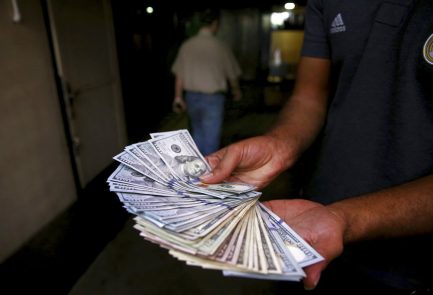
The Iranian rial has lost half of its value against the US dollar on the unofficial market this year, while the price of fruit and vegetables has increased by 50 percent since the start of the year.

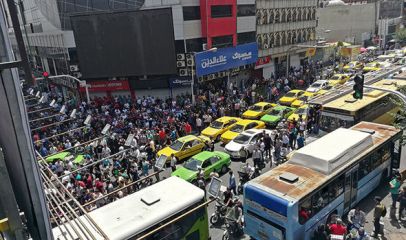
Protests in Iran

Protests in Tehran against the devaluation of the rial (Image: GETTY)

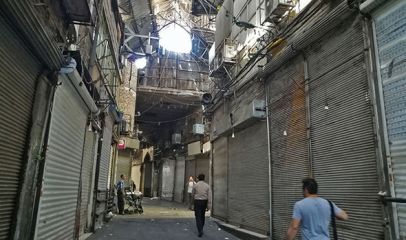
Shops closed in Iran

Shops were closed during a recent strike in Iran (Image: GETTY)

God damn this regime and its corrupt rulers

Iranian woman

In the current economic climate, low-income families are struggling to put food on the table. One woman, speaking to the Financial Times as she paid over the odds for a lettuce and a cabbage, said: “God damn this regime and its corrupt rulers.

“They have sent their children to the US and Canada while making us poorer every day.”

Recent months have been marked with protests across Iran on issues ranging from water shortages to joblessness, and the Trump administration is partly motivated by a desire to trigger a popular uprising and consequent regime change – something implied by US Secretary of State Mike Pompeo in a speech delivered last month in which he characterised the country’s rulers as a “mafia”.

The commander of Iran’s Revolutionary Guards Major General Mohammad Ali Jafari has acknowledged the gravity of the situation, declaring that “domestic weaknesses and threats are more serious” than the foreign military threat posed by the US or other countries.

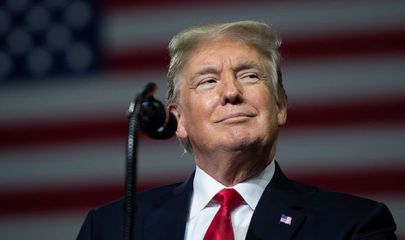
US President Donald Trump

US President Donald Trump has made no secret of his contempt for Iran’s leaders (Image: GETTY)

The rank-and-file are infuriated by allegations of corruption, while reformist and hardline politicians routinely accuse each other of fraud and mismanagement.

Ali, 61, a former member of the Revolutionary Guards in the city of Amol, said: “Corruption is so high that it has penetrated everywhere.

“Why should we struggle with daily issues and risk our lives to fill the pockets of corrupt people?”

In anticipation of the sanctions, wealthier Iranians have been stockpiling basic commodities and buying up gold and cars in an bid to protect the value of their savings.

However, less affluent people do not have this option and their complaints are increasingly taking on an anti-establishment tone.

Ali, a 19-year-old shop worker, said: “If I see protesters in the streets, I will join them.”

He explained that he worked 16-hour days, receiving one million tomans (£175) a month. A toman is equivalent to 10 rials.

He added: “But the owner of this shop receives 90m tomans in rent every month without working. Why? Is this a fair system?”

Another shopkeeper said: “Before, people who could not afford to eat meat were at least having bread and yoghurt.

“But now even yoghurt is becoming unaffordable for some families.”

Experts have warned Mr Trump’s sanction mean a price of a barrel of oil could rocket to $90.

Morgan Stanley estimates Iranian production will drop to 2.7 million barrels a day by the fourth quarter, with more than a million barrels taken offline.

Nations line up to oppose US sanctions against Iran 

August 8, 2018

Source: Nations line up to oppose US sanctions against Iran – Israel Hayom

Will US sanctions really stop Iran from backing terror?

August 8, 2018

Source: Will US sanctions really stop Iran from backing terror? – Israel Hayom

US will not prevent Iran oil exports, Iranian FM warns 

August 8, 2018

Source: US will not prevent Iran oil exports, Iranian FM warns – Israel Hayom

Report: US postpones rollout of Mideast ‘deal of the century’

August 8, 2018

http://www.israelhayom.com/2018/08/03/report-us-postpones-rollout-of-mideast-deal-of-the-century/

White House, Arab officials cite congressional elections in November, possible Israeli elections in early 2019 as reasons for delay • Trump administration seeks staff for Middle East policy team under point men Jared Kushner and Jason Greenblatt.

A White House source and senior Arab officials on Thursday said the Trump administration was postponing by several months the rollout of its so-called “deal of the century” to end the Israeli-Palestinian conflict.

The U.S. official said the administration has already decided not to present the peace plan before the congressional mid-term elections on Nov. 6 because certain components of the plan call for Israeli concessions and could harm Republican candidates’ election bids.

The official also said that if Israel goes to elections after the Jewish holidays this September, then the administration would postpone the peace plan even further, as Prime Minister Benjamin Netanyahu would not be able to adopt certain aspects during an election campaign.

Israel’s next election is scheduled for November 2019. But a single party could force early elections by withdrawing from the government coalition. Due to the wide range of views among the coalition parties, Israeli governments rarely complete a full term.

Announcing the peace plan during an Israeli election campaign “would play into the hands of [Habayit Hayehudi Chairman Naftali] Bennett and the administration understands this,” the official said, referring to the politician deemed Netanyahu’s chief rival for the premiership.

“During an election campaign, Netanyahu wouldn’t be able to say ‘yes’ to such ideas. On the other hand, he also can’t say ‘no’ to [President Donald] Trump. It appears, therefore, that the sides would rather play it smart and simply wait until the elections are over, in the U.S. and in Israel,” the official said.

If Israel does not hold elections this year, a window of opportunity for unveiling Trump’s Middle East peace plan would be opened.

Senior Arab officials confirmed to Israel Hayom that the peace plan will likely be delayed by several months, because of assessments in Egypt and Saudi Arabia that Israel will hold elections in early 2019.

The officials said that regardless of the possibility of elections in Israel, the leaders of moderate Arab states, chief among them Saudi Arabia, Egypt and Jordan, sent a joint message to the White House, saying they preferred to wait for the Congressional elections in the U.S. to conclude before the peace plan is presented.

A White House National Security Council official told Israel Hayom, “The release date for the peace plan won’t be determined by political matters in the U.S. or the political situation in Israel, but rather by the date it is completed and when the timing is appropriate.”

Meanwhile, U.S. officials said Thursday that the Trump administration was staffing up the Middle East policy team at the White House in anticipation of unveiling the still largely mysterious peace plan.

Last week, the National Security Council began approaching other agencies seeking volunteers to join the team, which will work under Trump’s Middle East peace point men, Jared Kushner and Jason Greenblatt, the officials said.

The team, which will organize the peace plan’s public presentation and any negotiations that may follow, is to be made up of three units: one concentrating on its political and security details, one on its significant economic focus and one on strategic communications, the officials said.

The establishment of a White House team is the first evidence in months that the plan is advancing. Although Trump officials have long promised the most comprehensive package ever put forward to resolve the conflict, not even a small detail of the emerging plan has been offered by Kushner, Greenblatt or any other official.

The State Department, Pentagon, intelligence agencies and Congress have been asked to detail personnel to the team for six months to a year, according to the officials, who spoke on condition of anonymity.

The agencies declined to comment, but an NSC official said that Kushner, Trump’s son-in-law and senior adviser, and Greenblatt, Trump’s special envoy for international negotiations, “are expanding their team and the resources available as they finalize the details and rollout strategy of the peace initiative.”

White House officials say the plan will focus on pragmatic details, rather than top-line concepts, in a way that will help win public support.

The Palestinian leadership has been openly hostile to any proposal from the Trump administration, saying it has a pro-Israel bias, notably after Trump recognized Jerusalem as Israel’s capital in December and moved the U.S. embassy there from Tel Aviv in May.

Since the Palestinian Authority and its President Mahmoud Abbas broke off contact after the Jerusalem announcement, the U.S. negotiating team has been talking to independent Palestinian experts.

The White House expects that the Palestinian Authority will engage on the plan and has been resisting Congressional demands to fully close the Palestine Liberation Organization office in Washington because Greenblatt and Kushner want to keep that channel open. But officials have offered little evidence to back that up.

Palestinian alienation has continued to grow as millions of dollars in U.S. assistance remains on hold and appears likely to be cut entirely. With just two months left in the current budget year, less than half of the planned $251 million in U.S. aid planned for the Palestinians in 2018 – $92.8 million – has been released, according to the government’s online tracker, http://www.foreignassistance.gov.

The remaining amount is still on hold as is an additional $65 million in frozen U.S. assistance to the U.N. Relief and Works Agency, which provides services to Palestinians in the West Bank, Gaza, Jordan and Lebanon.

In addition, Israel’s response to the plan is far from certain. Although Netanyahu is one of Trump’s top foreign allies, it remains unclear if he will back massive investment in Gaza, which is run by the terrorist Hamas movement.

For the plan to succeed or even survive the starting gate, it will need at least initial buy-in from both Israel and the Palestinians as well as from the Gulf Arab states, which officials say will be asked to substantially bankroll its economic portion. Arab officials have thus far adopted a wait-and-see approach.


Will Iran go nuclear over reimposed sanctions? – Bulletin of the Atomic Scientists

August 8, 2018

Source: Will Iran go nuclear over reimposed sanctions? – Bulletin of the Atomic Scientists

By Ezra Friedman, August 7, 2018

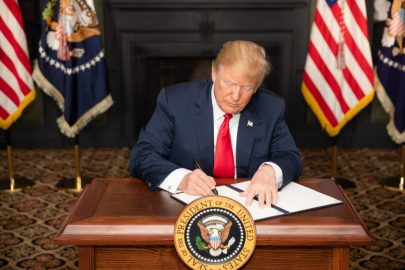
President Trump signs an Executive Order on Iran sanctions on August 5, 2018.

President Trump signs an Executive Order on Iran sanctions on August 5, 2018. Credit: Official White House photo by Shealah Craighead

Yesterday US President Donald Trump issued an executive order restoring one set of economic sanctions on Iran that were lifted by the Obama-era nuclear deal known as the Joint Comprehensive Plan of Action. The sanctions cover Iranian trade in items including metals such as gold and steel, automobiles, and aircraft.

In early November, Trump plans to reintroduce even more crippling sanctions on Iranian oil and banking. Collectively, these sanctions are likely to cause immense damage to the Iranian economy. Even carpets and foodstuffs are being sanctioned by the United States. The European Union and the three European countries that signed the nuclear deal (France, Germany, and the United Kingdom) are attempting to assemble an economic package that will save the deal from complete collapse, but so far with little progress and growing frustration on all sides. A joint statement issued yesterday by European foreign ministers says they “deeply regret” the White House decision.

By reimposing sanctions, Trump aims to force the current regime in Iran to negotiate a more comprehensive nuclear deal, or to inflict enough economic pain to change the regime’s behavior—if not the regime itself. Iran now finds itself in the crosshairs of a president who has made it his personal mission to aggressively combat Tehran.

Trump’s strategy might not have the intended effect, but it is likely to cause Iran to withdraw from the Joint Comprehensive Plan of Action (JCPOA). Does that mean Iran will go all Pyongyang and start developing nuclear weapons? Probably not. But unless a new nuclear deal can be made, Iran can be expected to resume its pre-JCPOA program of uranium enrichment, taking the country to the threshold of becoming a nuclear weapons state.

Why Iran will probably leave the JCPOA. When the JCPOA was signed three years ago, its supporters hailed it as a breakthrough against the proliferation of nuclear weapons, and a chance to welcome Iran back into the fold of nations following a long exile that began in 1979. The nuclear deal’s detractors claimed that the agreement was not broad enough, because it allowed Iran to continue its ballistic missile program unabated and to support its proxies in Syria, Iraq, Lebanon, and Yemen—thereby continuing to push an agenda of regional hegemony.

The May 8 withdrawal of the United States from the JCPOA amplified the debate. The United States is pursuing an almost fanatical campaign, lobbying its allies and partners across the globe, and educating them about the latest sanctions package—as well as the penalties for noncompliance. Critics say the sanctions regime will be ineffective because China and other countries will take advantage of the situation. But others, including several major foreign companies, are taking the sanctions seriously, in some cases withdrawing altogether from Iran.

What is clear is that sanctions will make an already difficult domestic economic situation worse in Iran. Iranians are largely young, educated, and tired of the regime’s policies. Many are angry about the billions of dollars spent in support of foreign wars, and protests are escalating. Iran also finds itself overextended regionally with challenges to its grand strategy in Yemen, Iraq, and Syria. While Tehran’s ally Bashar al-Assad will remain in power, Iran will now find itself in competition with Russia for dominance in Syria, both economically and politically, despite the high price Tehran has paid in both men and money to support Assad.

Trump has made clear that he places little weight on international norms, especially when it comes to treaties made by his predecessor. This is one of the few positive points for Iran, as Trump has largely isolated the United States from its European allies, who are now working closely with Iran and the European Union on a solution to safeguard the JCPOA. This will allow Iran to blame the collapse of the deal on the United States. But that is little compensation for the economic price the regime will pay with the return of sanctions.

A lack of effective economic and political mechanisms to secure the nuclear deal’s benefits for Iran make it clear that the JCPOA has a limited shelf life moving forward. Without access to international markets, Iran has no incentive to remain within the nuclear deal. Once Tehran weighs the costs of holding back its nuclear program versus the benefits of restarting it to pre-JCPOA enrichment levels, an Iranian exit from the nuclear deal is only a matter of time.

Why it’s not in Iran’s interest to leave the NPT. Iran has several options once it leaves the JCPOA. Some statements by Iranian leaders suggest that Iran will race to acquire a nuclear device, ramping up its nuclear program so as to achieve this goal as quickly as possible, either overtly or covertly. Iran’s critics point to its past violations of the Nuclear Non-Proliferation Treaty (NPT) in the early 2000s, confirmed by an Israeli intelligence operation earlier this year. (Iran has been a party to the treaty since 1970.)

While frightening, this scenario is unlikely, because it would place Iran in the same category as North Korea: a pariah in the eyes of the international community. On a strategic level, Tehran is keenly aware of this possibility and wants to avoid it at all costs. Even if Iran would like to have a militarized nuclear program, the cost would be massive if not unbearable for the regime.

Like North Korea, Iran is subject to many different types of sanctions, but they are nowhere near as isolating as those North Korea faces. Iran is more reliant on the world economy than North Korea is, especially with regard to petroleum-related exports, and isolation on the scale that North Korea faces would likely be a mortal wound for the regime.

Iran can wait a while before acting decisively, as many of the current UN Security Council sanctions will expire soon. A violation of the NPT by Iran would be a uniting factor for the American and European parties to the Iran nuclear deal and would force countries like Russia and China to come down hard on Iran.

Withdrawing from the NPT and pursuing a militarized nuclear program would also expose Iran to a possible military strike by the United States or Israel. While Trump seems reluctant to wield American military power, Israel has a strong record of being able and willing to strike. Israel has been unafraid to attack Iranian targets in Syria when it feels threatened on its border or in the transfer of advanced munitions from Tehran to Hezbollah via Syria. While Iran is a much larger and more powerful country on paper, Israel has proved in recent battles with Iran to be the superior force. There is strong consensus in Israel that a nuclear Iran would be an existential threat, and Prime Minister Benjamin Netanyahu has considered striking Iran in the past.

Rather than withdrawing from the NPT, it is more likely that Iran will return to something akin to a pre-JCPOA scenario, with a nuclear program that is enriching uranium to 20 percent or more without the full oversight of the International Atomic Energy Agency—which will almost certainly lose its current ability to access Iran’s known non-military nuclear sites upon Iran’s exit from the JCPOA. In this scenario, Iran will have a short “breakout period”—the time needed to produce enough weapons-grade uranium to build its first nuclear device—estimated at five weeks to a year.

It is important to note that there is a strong likelihood that some trading partners considered important to Iran economically—such as China, India, Turkey, and the European Union—will at least partially flout US extraterritorial sanctions. Such a scenario would be the best of both worlds for Tehran, allowing the regime to achieve the prestige and tacit recognition of a nuclear program that is illicit in nature, all the while not being subject to UN Security Council resolutions and maintaining its standing in the international community. The threat of a military option will not evaporate into thin air, but the United States and Israel may think twice before striking Iran, considering the possible international backlash and the possibility that military action would not cause enough damage to destroy or significantly set back Iran’s nuclear program.

A new deal must be the new goal. There is plenty of middle ground between a nuclear-armed and a nuclear-free Iran. If Iran withdraws from the JCPOA at some point, as seems likely, that would cause the complete collapse of the agreement. And if Iran returns to pre-JCPOA levels of uranium enrichment and continues its ballistic missile program and illicit regional activities, it would then be in the best interests of China, Russia, the United Kingdom, France, and Germany to work together with the United States to force Iran back to the table for negotiations and a new deal. The alternative—a new nuclear-armed or threshold nuclear state—is worse.

Trump should have leveraged the threat of withdrawal to negotiate a new deal, but that’s no longer an option. The international community now faces a situation in which a united front in support of American-led sanctions may eventually be the only way to avoid future conflict and prevent Iran from covertly violating the NPT. While Iran may not trust nor wish to engage with the United States right now, Tehran may change its tune once sanctions begin to bite, as it did during President Barack Obama’s second term in office. Europe, China, and other countries should work with Trump, despite hurt feelings and clear dislike for the president’s bullish policies on Iran and a plethora of other issues. While regime change and democracy are noble goals, history suggeststhat regime change is a fickle process that does not always lead to positive outcomes.

If Iran will not willingly curb its nuclear or ballistic missile programs or halt its illicit regional activities of its own volition, it is the international community’s responsibility to keep the regime in check. The current circumstances are not ideal, but a nuclear-armed Iran or a regime on the threshold of acquiring nuclear weapons would certainly lead to conflict if not all-out regional war.