‘If we ever have military power, will we let them keep Haifa? We’ll take it,’ Abdelsalam al-Majali says in TV interview, while praising Israel for water supply
The former Jordanian prime minister who signed the peace treaty with Israel said in a recent interview that his country would “take Haifa by force” if it ever has the military power to do so, despite the 1994 treaty.
Abdelsalam al-Majali, 93, served as prime minister in 1993-1995, during which he signed the accord with his Israeli counterpart Yitzhak Rabin, and took office again in 1997-1998.
But in a TV interview aired on August 18, he said: “The Arabs do not have any power. If we ever have military power, will we let them keep Haifa? We’ll take it.”
“If tomorrow we become stronger and can take Haifa by force, will we really decline just because we have an agreement with them?” Majali told Jordan Today TV in remarks translated by the Middle East Media Research Institute.
Earlier in the interview, Majali and the TV host had been discussing the “right of return” which Palestinians claim five million people — tens of thousands of living original refugees from what is today’s Israel, and their millions of descendants — are eligible for. Israel rejects the demand, saying that it represents a bid by the Palestinians to destroy Israel by weight of numbers and that no other population of refugees has been dealt with in that manner.
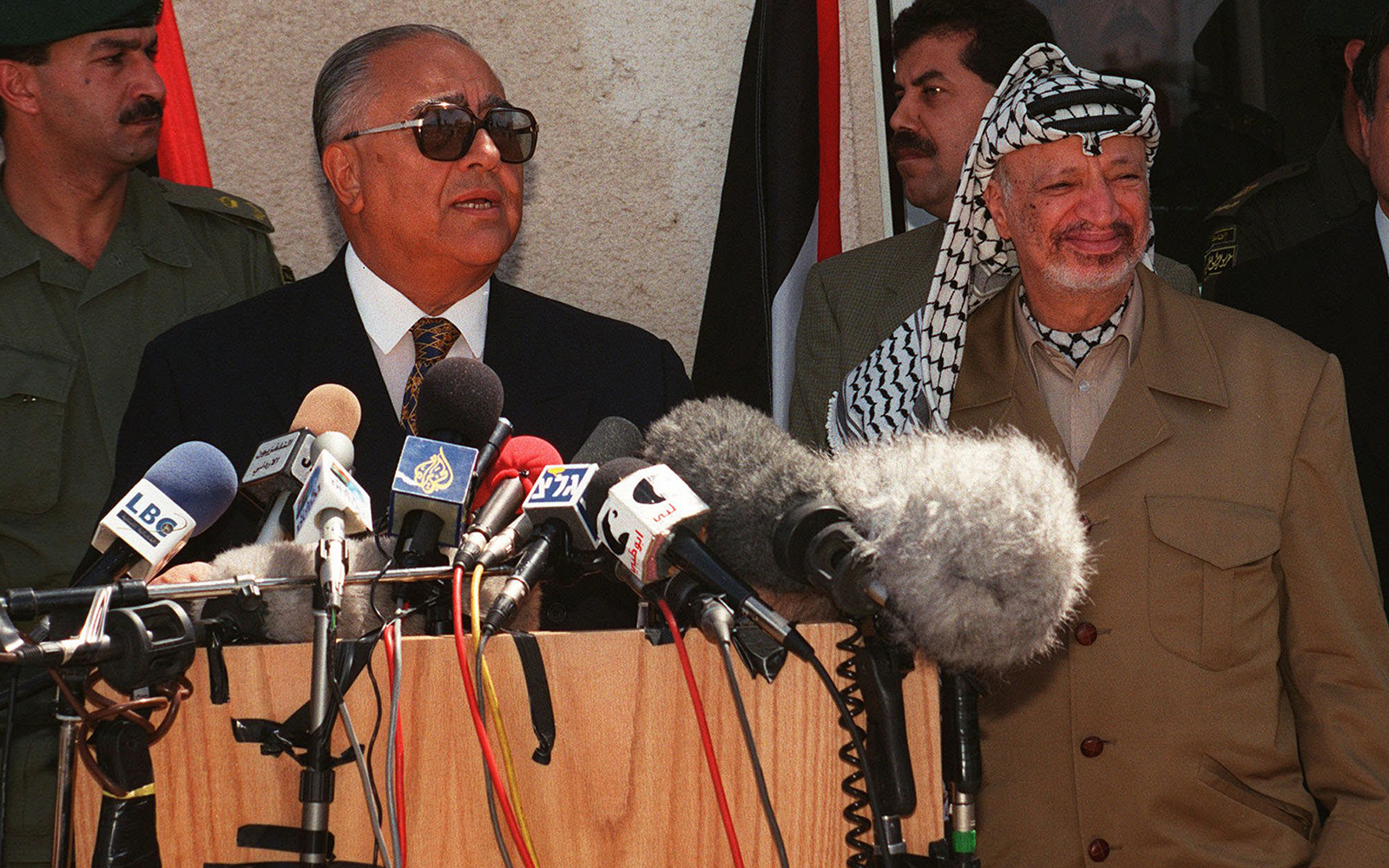
Jordanian Prime MinisterAbdelsalam al-Majali, left, speaks to reporters with Palestinian Authority President Yasser Arafat standing beside him during a press conference in Ramallah, July 20 1997. (AP Photo/Naser Naser)
“There are millions of Jordanian Palestinians who have property in Israel,” Majali said. “They have the right to get it back or get compensation for it.”
The host was opposed to the idea of compensation, equating it with the Palestinians “sell[ing] their land for a price.”
Majali said that people would collect the compensation from “Haifa, Jaffa, and elsewhere beyond the West Bank,” adding that retaking the land wasn’t possible for the time being because “[The Israelis] own that land. They live and build there, while you are not there, and you don’t have an army or anything.”
When the host argued it was better for the Palestinian cause to refuse the compensation and leave the land “occupied,” Majali said: “Well, what can you do? You lost the land to a military force. You do not have any power. All you do is talk.”
It was then that he made the remark about conquering Haifa if Jordan ever got stronger.
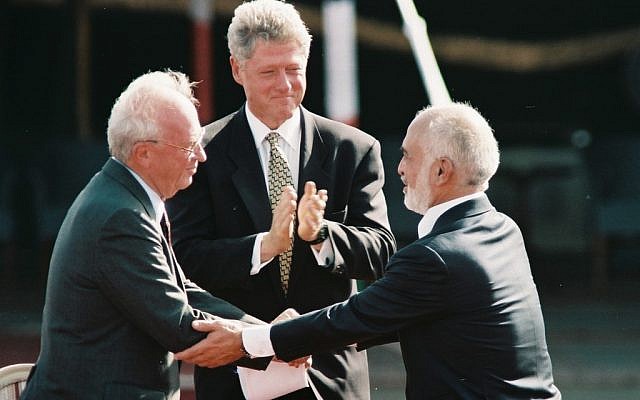
Israeli prime minister Yitzhak Rabin (left) shakes the hand of Jordan’s King Hussein at the signing of the bilateral peace treaty, October 1994 (photo credit: Nati Shohat/Flash90)
At the beginning of the interview, Majali defended the peace treaty he signed 24 years ago, which is opposed to this day by many Jordanians, saying that “my mentality is a mentality of peace.”
“As long as you do not have force of another kind, peace is your only option,” he added.
He said that contrary to what many Jordanians believe, “Israel continues to give us more water than we are due.”
Photo Credit: Abed Rahim Khatib/ Flash90-Hamas boss Yahya Sinwar
Yahya Sinwar, head of Hamas in Gaza, said on Wednesday that his group had sent a message to Israel through intermediaries that it would “turn the cauldron in the face of the occupation and let the sirens continue in Gush Dan for six months.”
Gush Dan is the common reference to the Tel Aviv metropolitan area, where an estimated four million Israelis live.
“I told the mediator, who met me and [leader of the Izz ad-Din al-Qassam Brigades] Marwan Issa, that I wanted to convey this message in the event that the efforts to calm things down failed and Israel launched a new aggression on Gaza,” Sinwar said.
According to Sinwar, Hamas is capable today of firing in five minutes the same number of rockets it launched over the 51 days of Operation Protective Edge in 2014. He claimed that “the number of tunnels and waylays prepared by the resistance forces is greater than that faced by the occupation (that’s Israel) in the previous war, and the missiles’ capabilities have improved.”
“There is discussion about a truce and the possibility of obtaining a stabilization of the 2014 truce, in return for breaking the siege in a concrete way, and the time limit for reaching this truce is not long,” the Hamas leader warned.
Sinwar revealed that there had been contacts between Israel and Hamas regarding the return of the two Israeli captives and the bodies of two missing IDF soldiers, and stressed that Hamas insists that this discussion not be part of the emerging truce deal.
Most of Sinwar’s speech was devoted to the Palestinian Authority and its senior officials, saying that any attempt by Chairman Abbas or the PA to impose sanctions on Gaza would constitute a breakdown of the reconciliation talks and Hamas would respond accordingly.
“While the occupation was acting aggressively against the residents of the Gaza Strip, Abu Mazen (Abbas’s nom de guerre) imposed sanctions on us in order to weaken the resistance,” Sinwar said, declaring, “We will not allow the collapse of Gaza at any cost.”
A Hamas spokesman on Wednesday called on the Palestinian Authority and Fatah to cancel their recognition of Israel, stop the security coordination with the IDF, and lift the sanctions from the Gaza Strip.
President Hassan Rouhani of Iran, second from left, arriving in Parliament in Tehran on Tuesday to answer lawmakers’ questions. He blamed United States sanctions for Iran’s troubles. Credit Vahid Salemi/Associated Press
By Richard Pérez-Peña Aug. 28, 2018 New York Times
{When politics has the power to define reality, you’re in big trouble. – LS}
LONDON — Iran’s Parliament summoned President Hassan Rouhani to answer questions on Tuesday about the country’s economic crisis, and then voted to reject his explanation, in a remarkable rebuke of a sitting leader.
Mr. Rouhani blamed United States sanctions, not government management, for his country’s troubles. But after he answered five questions about economic challenges like high unemployment and the collapsing value of the national currency, the rial, a majority of lawmakers voted that they were “not convinced” by four of his answers.
Elected by wide margins in 2013 and 2017, Mr. Rouhani is seen as a moderate in Iranian politics, and he campaigned on easing hostilities between his country and the West, and increasing economic opportunity. In 2015, his government struck a deal with the United States and other powers to give up elements of its nuclear program in return for the lifting of some sanctions.
But this year, President Trump withdrew the United States from that agreement and reimposed sanctions not only on Iran but also on companies doing business with the country. That has persuaded many European businesses to stay away from the Islamic republic, though their countries’ governments still support the deal.
Iran experts say that unwinding the agreement could strengthen the hand of hard-liners who oppose both the deal and Mr. Rouhani’s reformist agenda. His government runs many of the country’s daily affairs, but the ultimate power rests with the supreme religious leader, Ayatollah Ali Khamenei, and the unelected Guardian Council.
It was not clear what impact the rebuke of Mr. Rouhani would have. Officials said the matter could be referred to the judiciary, which could, in theory, find grounds for impeachment proceedings against the president.
Some analysts, however, said that impeachment was unlikely. They pointed to Ayatollah Khamenei’s recent admonition against calls for Mr. Rouhani to resign — even though Mr. Khamenei himself has been more critical of the president lately.
“Khamenei, and other members of the Iranian leadership, likely believe that removing a sitting president would further destabilize the country’s already precarious economy and potentially undermine support in the Islamic Republic’s structure,” said Henry Rome, an Iran analyst at the Eurasia Group, a political risk consultancy.
More likely, Mr. Rome said, are further efforts to remove those members of Mr. Rouhani’s cabinet deemed responsible for Iran’s economic travails, including the agriculture and industry ministers.
Mr. Rouhani’s allies remain the largest faction in Parliament. And in a country where tensions are high and protests have cropped upin many places, the potential for civil unrest could tamp down any party’s appetite for trying to remove a president and call new elections.
In an arresting aside during the proceedings, Mr. Rouhani attributed much of the economic troubles to street protests that began on Dec. 26, “when people saw suddenly that some people were chanting on the streets, and the slogans little by little went out of bounds.”
The protests, he said, encouraged Mr. Trump to declare his intention to withdraw from the nuclear agreement. “His threat of withdrawal and the domestic turbulence and international threats frightened the people,” undercutting the economy, Mr. Rouhani added.
Lawmakers said that a decision on referral to the judiciary would not be made before next week, the Iranian news agency ISNA reported.
The agency quoted Mr. Rouhani as telling Parliament, “Nobody, including the noble people of Iran, our friends and enemies around the world, must think that today is the start of a rift between the government and the Parliament.”
PM Benjamin Netanyahu has “made the struggle against the Iranian military entrenchments in Syria a top priority,” a senior Jerusalem source says • Public security minister: Latest Syria-Iran deal is an attempt to legitimize Iran’s presence there.
Ariel Kahana, Eli Leon and Israel Hayom Staff
The Israel-Syria border
|Photo: Reuters
Israel will not relent on its effort to push Iran away from its borders and Prime Minister Benjamin Netanyahu has “made the struggle against the Iranian military’s entrenchments in Syria a top priority,” a senior Jerusalem source said Tuesday.
The remarks followed reports that Iran and Syria have signed a deal for military cooperation as part of which the Islamic republic has pledged to rebuild the Syrian army, which has been severely depleted by the seven-year civil war.
The official said the Israel Defense Forces ”will continue to act with full determination against attempts by Iran to transfer military forces and weapons systems to Syria.
”Diplomatically, we will continue with our effort to [have the international community] exert pressure on the Iranian regime, as we have seen it take its toll,” he said.
Iran’s Parliament subjected President Hassan Rouhani to a public grilling on Tuesday over the country’s economic crisis, and rejected his answers as “excuses.”
Rouhani, who was summoned to answer to Parliament amid growing public criticism of the regime, admitted that U.S. sanctions on Iran were having a serious impact on the economy, saying, “Many people have lost their faith in the future of the Islamic republic and are in doubt about its power.”
Commenting on the Iran-Syria deal, Public Security Minister Gilad Erdan said, ”The pact between Syria and Iran for rehabilitating the Assad army is an excuse and a facade meant to grant legitimacy to the Iranian forces remaining in the area.
”But as far as we are concerned, no machinations keeping the Iranians in the area will be acceptable.”
Continued presence of Iranian military advisers in Syria is part of the military cooperation deal between the two countries, says Iran’s military attache to Syria • Iran will help Syria rebuild military facilities damaged during the civil war, he says.
Reuters and Israel Hayom Staff
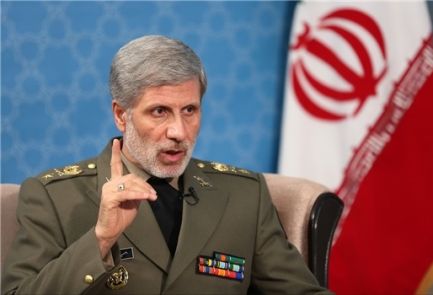
Iranian Defense Minister Brig. Gen. Amir Hatami
|Screenshot: YouTube
Iran will maintain its military presence in Syria despite U.S. pressure for its withdrawal, a senior Iranian official said on Tuesday, revealing more details about a military cooperation deal signed between Iran and Syria this week.
Iranian Defense Minister Brig. Gen. Amir Hatami visited Damascus on Saturday for talks with Syrian President Bashar Assad and senior military officials. He signed a deal for military cooperation in a meeting with his Syrian counterpart, but details of the accord were not revealed.
“The continued presence of Iranian [military] advisers in Syria was part of this military cooperation agreement between Tehran and Damascus,” the state news agency IRNA quoted Tehran’s military attache to Damascus, Abolqasem Alinejad, as saying.
“Iran will help Syria in clearing minefields in different parts of the country. Iran will help Syria to rebuild the military factories that were damaged in the war,” Alinejad said.
Iran’s Revolutionary Guards have sent weapons and thousands of soldiers to Syria to help shore up Assad during the seven-year-long civil war there.
U.S. National Security Adviser John Bolton reiterated last week Washington’s call for Iran to remove all its forces from Syria.
The United States has reimposed economic sanctions against Iran partly over its involvement in conflicts in Syria, Iraq and Yemen as well as over its nuclear and missile programmes.
Israel has also long called for its archfoe Iran to withdraw from Syria.
“The pact between Syria and Iran for rehabilitating the Assad army is an excuse and a facade meant to grant legitimacy to the Iranian forces remaining in the area,” Public Security Minister Gilad Erdan said Tuesday. “But as far as we are concerned, no machinations keeping the Iranians in the area will be acceptable.”
Iran has repeatedly said its military presence in Syria is at the invitation of the Assad government and that it has no immediate plans to withdraw. More than 1,000 Iranians, including senior members of the elite Revolutionary Guards, have been killed in Syria since 2012.
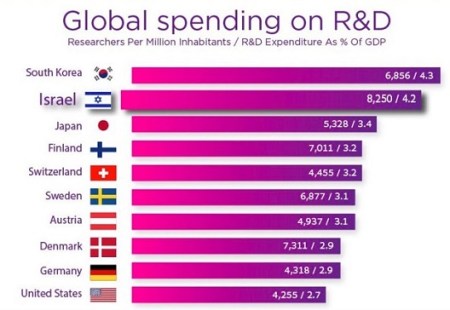
Israel second only to South Korea, ahead of Japan, Finland, Switzerland, Germany and U.S. in rankings • “This investment is necessary to promote the U.N.’s Global Sustainable Development Goals, and achieving progress,” Ambassador Danny Danon tweets.
Israel Hayom Staff
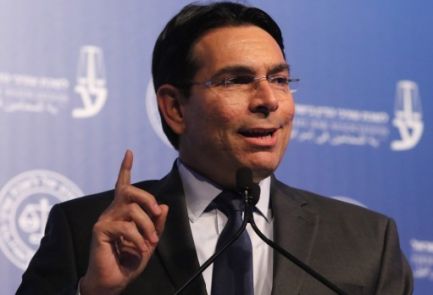
Israeli Ambassador to the United Nations Danny Danon
|Photo: KOKO
The United Nations Educational, Scientific and Cultural Organization has ranked Israel’s spending on global research and development as second in the world in terms of percentage of the country’s gross domestic product.
“According to UNESCO, Israel ranks second in global R&D spending as a % of GDP! This investment is necessary to promote the U.N.’s Global Sustainable Development Goals, and achieving progress,” Israeli Ambassador to the U.N. Danny Danon tweeted Tuesday.
Twitter / Ambassador Danny Danon
Israel was topped only by South Korea, and was ahead of Japan, Finland, Switzerland, Sweden, Austria, Denmark, Germany and the United States.
Israel’s relations with the U.N.’s cultural agency have deteriorated in recent years following a serious of anti-Israel resolutions questioning, among other things, the Jewish link to Jerusalem.
The recent arrest of two Iranian agents alleged to have been running spy operations on U.S. soil is just “the tip of the iceberg” in terms of the Islamic Republic’s efforts to conduct intelligence operations in America that could result in a terrorist attack, according to a leading lawmaker and U.S. officials who spoke to the Washington Free Beacon about the matter.
Following the arrest of two Iranian individuals charged with spying on Jewish and Israeli facilities in the California area, Rep. Peter Roskam (R., Ill.) told the Free Beacon it is likely Iran has stationed multiple regime-tied agents in the United States to conduct intelligence operations.
While the arrest of the two Iranians was met with shock in the press, Roskam said he was not surprised by the arrests, which have unearthed concrete evidence of the Islamic Republic’s efforts to foment discord across the globe, including on American soil.
“This is the tip of the iceberg,” Roskam said in an interview. “This is not a surprise and this is a result of the Iran regime getting financial support from the Obama administration in the Iran deal.”
Iran has been emboldened by the lack of international repercussions on its malevolent behavior and may have increased its intelligence operations in America in the years since the landmark nuclear deal, he said.
Iran is “acting with impunity, that deal emboldened them,” Roskam said. “This is an unmasking of that. Unfortunately it’s all too predictable. Give a malevolent regime huge amounts of cash with no restraining influence and this is what happens.”
The Trump Justice Department announced last week it had arrested two Iranians and charged them with spying on behalf of the hardline regime, a discovery that has refocused attention on the Islamic Republic’s global spy operations.
Lawmakers and experts have been warning for some time that Iran has stationed what some described as “sleeper cell” agents across the United States. These agents are believed to operate with impunity and could lay the groundwork for a large-scale terror attack on American soil.
The two Iranian individuals—identified as Ahmadreza Mohammadi-Doostdar, a dual U.S.-Iranian citizen, and Majid Ghorbani, an Iranian citizen and resident of California—were formally charged by the Trump administration “with allegedly acting on behalf of the government of the Islamic Republic of Iran by conducting covert surveillance of Israeli and Jewish facilities in the United States, and collecting identifying information about American citizens and U.S. nationals who are members of the group Mujahedin-e Khalq (MEK),” an Iranian opposition group that promotes regime change in the Islamic Republic, the DOJ announced.
One U.S. official, agreeing with Roskam’s assessment, told the Free Beacon Iran has been running “vast espionage and information operations in the United States” with virtual impunity. The arrest of the two recently charged Iranians denotes a significant shift in policy that could result in the capture of more agents.
“If there’s anything that’s become obvious in the last few months, it’s that the Iranians are running vast espionage and information operations in the United States,” said the source, who could only discuss the situation on background. “The Trump administration has been warning since day one that some of the windfall Iran got from the nuclear deal has been going into malign cyber operations.”
“The propaganda network that Facebook, Twitter, and YouTube uncovered was doubling as a hacking network that had been ramping up in the last couple of years,” the source said, referring the recent uncovering of a massive social media influence campaign believed to be organized by Iran.
Sen. Marco Rubio (R., Fla.), also a vocal critic of the Iranian regime, told the Free Beacon the recent arrest of the two Iranians is cause for major concern.
“I am deeply alarmed by the Justice Department’s new indictment against alleged Iranian agents,” Rubio said. “Iran’s regime has sponsored terrorist attacks against Americans abroad and our allies, and may now be seeking to target American citizens, as well as Jewish or Israeli facilities, on U.S. soil.”
Roskam, in his comment to the Free Beacon, noted that “Iran’s malevolence” toward Israel and other countries it considers an enemy is well documented.
“What’s new here is a level of aggression against the United States and an impunity with which they’re operating,” the lawmaker said, referring to the spy operations on Jewish targets—a cornerstone of Iran’s global terror operations, particularly its 1994 bombing of a Jewish facility in Argentina that sent shockwaves through the global Jewish community.
The operations on U.S. soil are “incredibly provocative and an indication where the Iranian regime is,” Roskam said.
Iran has publicly stated multiple times over the past years that it has a vast espionage network that includes the United States. While many have dismissed these claims as posturing, Roskam said Iran should be taken at its word.
“The takeaway is we can take the Iranians at face value,” he said. “They were declarative during the Iran negotiations: They were not willing to make any commitments as it relates to their state sponsorship of terror. It’s clear they haven’t. This can’t be a surprise to anyone. It is entirely consistent with what they’ve been communicating. The surprise is the idea anyone thought they were slowing down or giving up their aggressive disposition.”
Congress will play a prominent role in investigating the matter in the months to come. This will include working with federal law enforcement to ensure Iranian agents are not able to coordinate terror attacks on Jewish or Israeli facilities.
Earlier this year, Congress heard testimony from a panel of experts of former U.S. officials about Iran’s “sleeper cell” networks in America.
Iran, through terrorists affiliated with Hezbollah, could easily launch strikes in America.
“They are as good or better at explosive devices than ISIS, they are better at assassinations and developing assassination cells,” Michael Pregent, a former intelligence officer who worked to counter Iranian influence in the region, said during the April hearing. “They’re better at targeting, better at looking at things,” and they can outsource attacks to Hezbollah.
US Ambassador to the United Nations Nikki Haley at the Foundation for Defense of Democracies, August 28, 2018
US Ambassador to the United Nations Nikki Haley on Tuesday questioned the figures on “Palestinian refugees” being offered by the United Nations Relief and Works Agency for Palestine Refugees in the Near East (UNRWA), suggesting they are significantly inflated.
Speaking at the pro-Israel think tank Foundation for Defense of Democracies, Haley was asked by FDD President Cliff May about the US relationship with UNRWA, following the restrictions imposed on the agency by the White House and statements from President Trump and others in the administration questioning its viability.
“UNRWA can stay there, and we will be a donor if it reforms what it does,” Ambassador Haley said. “If it goes and makes sure that they’re not doing those teachings [of hate] in textbooks, if they actually change the number of refugees to an accurate account. We will look back at partnering them. But otherwise, you’re just molding an organization that has flaws into another organization, and that’s not fixing the problem. I think we have to go further than that.”
UNWRA claims to provide services to five million “Palestinian refugees,” the vast majority of whom were not yet born in 1948. Most are descendants from individuals who fled their homes in Israel’s 1948 War of Independence.
May inquired about Haley’s definition of “who is a Palestinian.”
“Right now, you have this interesting and kind of illogical situation where somebody who is a Palestinian, living in a territory he considers to be Palestine, can also say, ‘And I’m a refugee from Palestine. Here I am in Ramallah, I’m a refugee from Palestine,’” May argued, wondering: “And why isn’t the Palestinian Authority, which claims to be governing these people, assuming some responsibility as opposed to saying no, there’s a UN agency that does it, it’s funded by the donor community, which means us and a few others, we don’t need to worry about this, we can worry about other things.”
“It’s bigger than that, even,” the ambassador responded. “When you look at UNRWA, there’s a couple of issues there. First of all, you’re looking at the fact that, yes, there’s an endless number of refugees that continue to get assistance, but more importantly, the Palestinians continue to bash America. This is the government, not the people, not the Palestinian people.
“So the government continues to bash America. They have their hand out wanting UNRWA money. We were supposed to […] give them $130 million. We cut it in half, saying that they really needed to reform and fix the things they were doing, because they teach anti-Israeli and anti-American things in their textbooks. They are not necessarily doing things that would cause peace…
“So instead of the $130 million, we give them $65 million. They didn’t say thank you. UNRWA had them protest in the streets that we didn’t give more. So at the last Security Council meeting we had on the Palestinian issue and UNRWA, I went and said, ‘You are all so quick to wag your finger at us for not giving more. Where is Saudi Arabia? Where is United Arab Emirates? Where is Kuwait? Where are all of those countries? Do they not care enough about Palestinians to go and give money to make sure these kids are taken care of?”
At this point the audience applauded the ambassador.
She continued: “If the region doesn’t invest in those areas, why are we being faulted for not investing in those areas? They have to have skin in the game. They have to – they’re the ones that fight me every day on Israel issues. But yet they don’t give a penny when it comes to – any more than they have to. They give tokens, and then we still are the largest donor of UNRWA at the same time.
“So it goes to a second set. Our job is not to take the beatings that you give us, saying we’re not kind to Palestinians and then turn around pay for them. Our job is to make sure that, look, we’ll be a partner with you, but only on a partner basis of something you believe in. So you show us you care, and then we’ll come back and decide if we’re going to give.”
Tehran’s intelligence minister says ‘we brought under our control a member of a cabinet of a hostile country’ without elaborating; some Iranian media say he’s referring to Gonen Segev, former Israeli minister charged with serving as an Iranian agent.
LONDON – Security forces in Iran have arrested tens of spies working in state bodies, Intelligence Minister Mahmoud Alavi said on Tuesday, and also indirectly commented the arrest of former Israeli minister Gonen Segev, who was charged with spying for the Islamic Republic.
“You have recently heard that we brought under our control a member of a cabinet of a hostile country,” Alavi said, without specifying which country.
“The counter-espionage sector of the intelligence ministry is one the most powerful among world’s intelligence services,” he added.
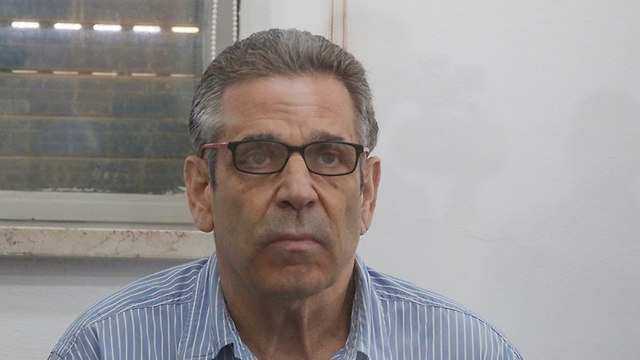
Gonen Segev in court (Photo: Olivier Fitoussi)
Some Iranian media said Alavi was referring to Israel’s former energy minister Gonen Segev, who was charged in Israel with serving as an Iranian agent in June.
Segev, energy minister from 1995 to 1996, had been living in Nigeria, where he made contact with officials at the Iranian embassy in 2012, according to Israeli investigators.
He had been jailed in Israel in 2004 after being convicted of attempting to smuggle Ecstasy pills into the country. He left Israel in 2007 after his release from prison.
Speaking of the spies Iran has allegedly captured, Alavi indicated that many of the detainees were dual nationals, but did not say when the arrests took place or which countries the spies allegedly were working for.
“I have repeatedly asked people to inform us if they know any dual national. The intelligence ministry’s anti-espionage unit has successfully identified and arrested tens of spies in different governmental bodies,” Alavi was quoted as saying by the semi-official news agency ISNA on Tuesday.
The arrest of dual nationals has increased since Iranian Supreme Leader Ayatollah Ali Khamenei said there had been “infiltration” of Western agents in Iranian decision-making bodies.
Reuters reported in 2017 that Iran’s elite Revolutionary Guards had arrested at least 30 dual nationals in recent years, mostly on espionage charges.
Tension between Tehran and some Western countries has risen since May when US President Donald Trump withdrew from an international nuclear deal with Tehran and reimposed some of the US sanctions that had been lifted after the 2015 accord in return for restrictions on the Iranian nuclear program.Iran does not recognize dual nationality and does not routinely announce arrests or charges of dual nationals, whose rights to consular assistance are enshrined in the UN Vienna Convention.
Alavi said that security forces arrested this month a member of the Islamic State militant group in southern Iran, and had disbanded a “terrorist cell” in the country’s north.
He said his ministry had foiled several plots to bomb metro stations and universities, without making any of the incidents public at the time.
Under Islamic State’s ultra-hardline Sunni Muslim ideology, Shi’ites—the majority in Iran—are considered apostates. Last year, Islamic State militants carried out attacks on the parliament in Tehran and the mausoleum of the founder of Iran’s 1979 Islamic Revolution, Ayatollah Ruhollah Khomeini. At least 18 people were killed in the attacks.








 anneinpt
 artaxes
 danmillerinpanama
 davidking1530
 Peter Hofman
 Joseph Wouk
 Peter
Peter Louisiana Steve
 WarSclerotic
Recent Comments