Archive for August 12, 2018

Between Ceasefire And War: Gaza On Knife’s Edge 

August 12, 2018

Source: Between Ceasefire And War: Gaza On Knife’s Edge – Arab-Israeli Conflict – Jerusalem Post

Israel and Hamas weigh their options after last week’s uptick in violence
BY TERRANCE J. MINTNER/THE MEDIA LINE
 AUGUST 12, 2018 20:53
Between Ceasefire And War: Gaza On Knife's Edge

It is perhaps unique to this context that both sides of the current flare-up—the Israeli army and Hamas, the terrorist group that controls the Gaza Strip—can simultaneously escalate their attacks on each other while negotiating a delicate ceasefire.

Such has been the case in recent days, leaving many on both sides wondering if the heavier blows exchanged are the final ones before a truce, or the opening salvos of a new war.

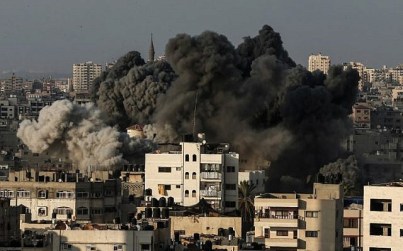
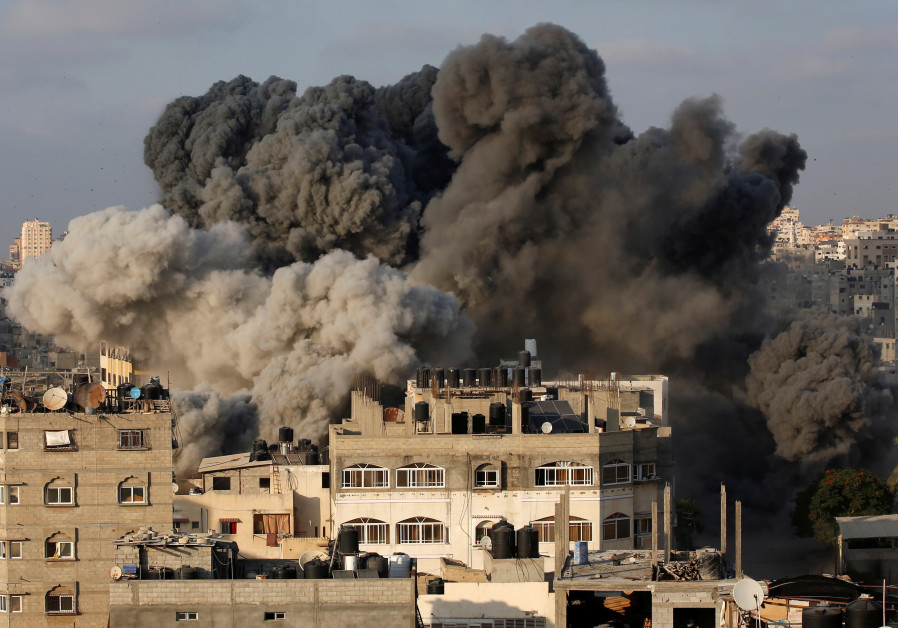
On Thursday, Israeli fighter jets flattened a five-story building west of Gaza City, injuring 18 people according to the Hamas-run Gaza Health Ministry. The army alleges that the building was used as a headquarters for Hamas’ internal security service. This, the army declared, was in response to a Hamas rocket attack on the southern Israeli city of Beersheba earlier in the day.

It was the first time since the 5-day conflict in 2014 that Beersheba, a major urban center about 25 miles from the enclave, was targeted by projectiles fired from Gaza.

Ronen Manelis, the Israeli military’s chief spokesman, said later Thursday that the bombing of the high-rise building in broad daylight was intended to send “a message to Hamas that as long as their choice of terror continues, the IDF’s [Israeli Defense Forces] responses will increase and become more powerful.”

Israeli authorities said that over 200 projectiles were launched at Israeli communities between Wednesday night and Thursday. Most of them hit open areas while the Iron Dome defense system destroyed about 25 rockets. Some projectiles, however, managed to penetrate defense systems and exploded in civilian areas, injuring several Israelis.

The rocket and mortar fire from Gaza then prompted waves of Israeli airstrikes and artillery bombardments against what the IDF described as military targets (about 150 in total) in the Strip. The Gaza Health Ministry reported that the Israeli strikes killed three and wounded six other Palestinians.

Meanwhile, incendiary kites and balloons from Gaza continued to scorch lands inside Israel. Thus far, over 7,000 acres of land have been burned, resulting in millions of dollars in damages, according to Israeli officials.

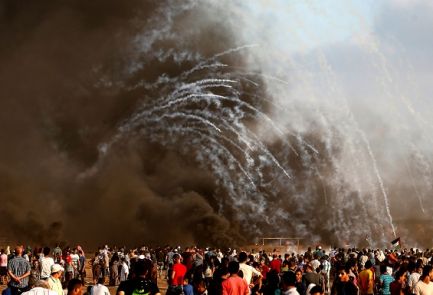
On Friday, around 9,000 Palestinian protesters gathered in five locations along Gaza’s border with Israel, with many throwing stones, makeshift bombs and Molotov cocktails at Israeli soldiers.

The Friday protests have been ongoing since March 30, when the first “March of Return” installment was held. The weekly demonstrations have resulted in over 100 Palestinian deaths by live Israeli fire. Many of those killed, the IDF alleges, were trying to breach the border fence.

On Sunday, Prime Minister Benyamin Netanyahu said before the weekly government meeting that Israel is “in the midst of a campaign against the terror [Hamas] in Gaza.

“Our demand is clear—a total cease-fire,” Netanyahu continued. “So far, we have destroyed hundreds of Hamas military targets. With every round of attacks, the IDF exacts a heavy price from Hamas. I will not reveal our operational plans, but they are ready. Our goal is to restore peace to the residents of the south and the surrounding areas. This goal will be achieved in full.”

An Egyptian official claimed on Thursday night that a cease-fire deal had been reached between the two sides. A senior Israeli source, however, quickly denied the report.

Meanwhile, Egypt and the United Nations have continued their efforts to reach a truce deal that would include much-needed economic development in Gaza, while calling for reconciliation between Hamas and Palestinian Authority President Mahmoud Abbas’ rival Fatah faction.

As hostilities spiked last week, senior Israeli officials have said more troops are being deployed to the southern front, adding that the government could start evacuating communities near the enclave in preparation for a military operation. But for now, they stated, “quiet will be met by quiet.”

Dr. Eran Lerman, Vice President of the Jerusalem Institute for Strategic Studies, told The Media Line that another war is not in the interest of either side.

He explained that if Israel seizes on a war to eradicate Hamas, an option often raised by high-ranking Israeli officials, the unknowns outweigh the perceived benefits.

“How long this could last and who could take over after Hamas—the list of volunteers is woefully short—is all unclear. If Israel doesn’t win, it then risks returning to an inconclusive cycle. What would be the point? Meanwhile, Israel would pay for it by suffering a major economic disruption.

“I’ve been thinking of Palestinian behavior in the Gaza Strip as parents sending their children into the cage to prod the lion to see what happens,” he elaborated. “That is the level of irrationality—of trying to see at what point the Israelis will finally get angry and hit the Palestinians so hard that they will finally learn a lesson.”

Maurice Hirsch, a former IDF prosecutor, explained to The Media Line that it is not in Israel’s interests to start a war, but to defend itself.

“[The army] should deliver a clear message that firing missiles constantly into Israel will not be tolerated,” he said. “The general idea of getting rid of a terrorist organization that is running Gaza and embittering the lives of the population is positive. Another question is if this option is a plausible goal or not.”

He explained that much of what started the latest round of violence is unconnected to Israel. It includes the Palestinian Authority’s attempt to subjugate Hamas by cutting or limiting electricity in Gaza, as well as withholding salaries to Gaza-based PA employees.

“Therefore, any ceasefire that could be reached would end up being broken by Hamas leaders anytime they feel that PA President Abbas is not playing to their tune. What long-term goal would this achieve for Israel? In two-months, we could find our civilians again under a barrage of 150-200 missiles in a night. I think this is something that the Israeli government shouldn’t be willing to tolerate.

“When we see Hamas leading demonstrations on the border since March, completely disregarding its civilian population, deciding to fire rockets whenever it pleases—and often basing decisions on its internal politics—this suggests that a ceasefire with Hamas would be futile,” Hirsch concluded.
“A light unto the nations”Jewish ingenuity leading the way

August 12, 2018

Yet another, in the long line of books on Jewish contributions to the world.

http://www.israelhayom.com/2018/08/10/new-book-showcases-israeli-innovation-throughout-the-years/

“Israeli Innovation” covers Israeli inventions ranging from digital printing, the USB flash drive, drip irrigation and the Iron Dome defense system • Minister: Israel is a fountain of creativity and innovation and an inspiration to the entire world.

Israeli Innovation Authority
http://www.matimop.org.il/

From cherry tomatoes to the Arrow ballistic missile defense system, a new book on Israeli innovation allows readers to discover notable Israeli inventions that have had a global impact.

Among the inventions included in “Israeli Innovation,” a book by the Israeli Innovation Authority, are the Iron Dome rocket defense system, the USB flash drive, innovative water desalination technologies, cherry tomatoes, the Arrow ballistic missile defense system, multiple sclerosis medicine Copaxone, the balloon expandable stent, drip irrigation and digital printing, to name a few.

“Thanks to the recognition of the importance of research, development and mainly human capital, we have become a fountain of creativity and innovation and a technological greenhouse that is an inspiration to the entire world and a source of national pride,” said Economy Minister Eli Cohen, whose office oversees the IIA.

“Since its inception, Israel has recognized the importance of research, development and innovation to its existence and the prosperity of the state. Today, too, Israel is first in the world in investment in these fields,” he said.

According to Israeli Innovation Authority Director Aharon Aharon, “Israel is known around the world as the ‘startup nation,’ a nation in which innovation, entrepreneurship and breakthrough technologies bring prosperity and economic growth. Many tourists come to Israel to see the past; investors come to Israel to see the future. Thanks to the entrepreneurs and inventors behind these products, we are known as the ‘innovation nation.'”

“Israeli Innovation” comes in both bilingual Hebrew-English and Chinese editions. A printable edition of the book is now available to the general public on the Israel Innovation Authority’s website.

Aussies strip citizenship from 5 wannabe martyrs

August 12, 2018

Meet your maker, inshallah.

https://www.breitbart.com/jerusalem/2018/08/09/australia-strips-citizenship-from-five-syria-based-islamic-state-terrorists/

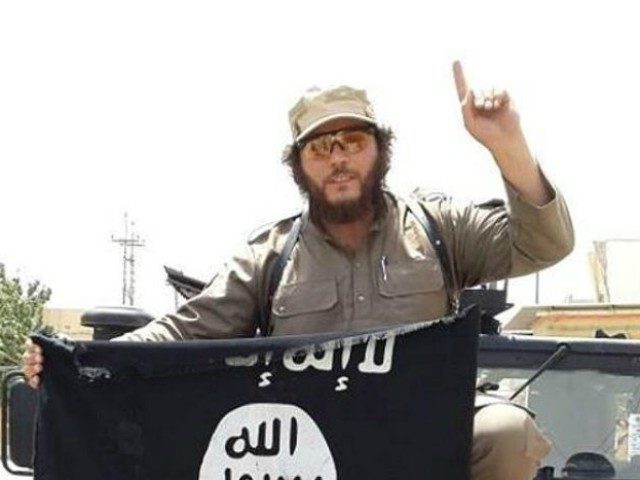
AUSTRALIAN JIHADIST FIGHTER KHALED SHARROUF (TWITTER)

Australia has stripped five Syria-based dual nationals of their citizenship due to their involvement with the Islamic State terrorist group, a government minister said Thursday.

A total of six people have now lost their Australian citizenship since the law was changed in 2015 to enable dual nationals to lose their citizenship rights for actions contrary to their allegiance to Australia, Home Affairs Minister Peter Dutton said.

They join notorious Daesh fighter Khaled Sharrouf (pictured) — who made headlines when he posted a Twitter image of his young son holding a severed head — as the only nationals to be kicked out under tougher anti-terror laws.

[And here is the charming son, holding the pixelated head:

Image result for khaled sharrouf child head

“I can confirm that five more individuals have ceased to be Australian citizens because of their involvement with Daesh offshore,” Mr. Dutton said in a statement.

“Fundamentally, citizenship requires allegiance to this country… these five dual-nationals have been acting against Australia’s interests by engaging with terrorism and have effectively chosen to leave the Australian community.”

The five are all aged in their 20s and 30s. Mr. Dutton provided no further details on their identities but welcomed their exclusion, saying “Australia is a safer place for not having them return.”

Sharrouf, the first Australian national stripped of his passport for Daesh links, was also a Lebanese citizen. He left Australia for Syria in 2013 with his family.

His Australian wife Tara Nettleton, who went with him, has since died and Sharrouf was believed to have been killed in a drone strike in Iraq in 2015.

Under section 35 of the Australian Citizenship Act, a dual national’s Australian citizenship automatically ceases if they act contrary to their allegiance to Australia by engaging in terrorism-related conduct.

This includes those who fight for or who are in the service of a declared terrorist organization overseas. The Islamic State group was declared a terrorist organization for these purposes since May 2016.

Want a luxury holiday? Go to Gaza!

August 12, 2018

Looks nice to me… but maybe no alcohol…

https://www.facebook.com/whitechalet.co/


Next Israel-Gaza conflict is ‘just a matter of ‎time,’ ministers surmise 

August 12, 2018

Source: Next Israel-Gaza conflict is ‘just a matter of ‎time,’ ministers surmise – Israel Hayom

Israel is not looking for war, but Gaza tensions ‎make it highly likely

August 12, 2018

Source: Israel is not looking for war, but Gaza tensions ‎make it highly likely ‎ – Israel Hayom

U.S. ambassador urges Britain to ditch support for Iran nuclear deal

August 12, 2018

Source: U.S. ambassador urges Britain to ditch support for Iran nuclear deal – Middle East – Jerusalem Post

Britain, France and Germany have sought to keep the deal alive after the United States exited the 2015 accord.

BY REUTERS
 AUGUST 12, 2018 12:31
U.S. ambassador urges Britain to ditch support for Iran nuclear deal

LONDON, Aug 12 (Reuters) – The United States urged Britain on Sunday to ditch its support for a 2015 nuclear deal with Iran and instead join forces with Washington to counter the global threat it says Tehran poses.

Despite opposition from European allies, US President Trump in May pulled the United States out of a deal between world powers and Tehran under which international sanctions were lifted in return for curbs on Iran’s nuclear program.

Since then, Britain, France and Germany have sought to keep the deal alive, while Trump has prepared new sanctions, saying a broader and more balanced deal is needed. Iran has denounced the sanctions as “US unilateralism”.

US Ambassador to Britain Woody Johnson criticized Tehran for funding “proxy wars and malign activities” instead of investing in its economy. He said Iran needed to make tangible and sustained changes to behave like a normal country.

“Until then, America is turning up the pressure and we want the UK by our side,” Johnson wrote in the Sunday Telegraph newspaper.

“It is time to move on from the flawed 2015 deal. We are asking global Britain to use its considerable diplomatic power and influence and join us as we lead a concerted global effort towards a genuinely comprehensive agreement.”

Asked about Johnson’s article, the British foreign office pointed to comments from Middle East minister Alistair Burt, who last week ruled out Britain going along with the United States.

Burt said the deal was an important part of regional security and that, with the European Union, the government was trying to protect British companies from the US sanctions when dealing with Iran. Britain remained open to talks with the United States on how to address concerns about Iran.

Iranian President Hassan Rouhani said last week that Trump’s repudiation of the nuclear deal was illegal and Iran would not yield to Washington’s renewed campaign to strangle Iran’s vital oil exports.

But protests have broken out in Iran as its currency has collapsed in value and inflation has soared. The protests have often begun with slogans against the high cost of living and alleged financial corruption, but quickly turned into anti-government rallies. (Reporting by William James; Editing by Mark Potter)ll be back.

Netanyahu: Israel won’t accept anything less than a full ceasefire in Gaza 

August 12, 2018

Source: Netanyahu: Israel won’t accept anything less than a full ceasefire in Gaza | The Times of Israel

Hamas has paid a heavy price in recent hostilities, Israel has operational plans ready, prime minister says

Prime Minister Benjamin Netanyahu leads the weekly meeting at the Prime Minister's Office in Jerusalem on July 29, 2018. (Alex Kolomoisky/Pool Yedioth Ahronoth/Flash90)

Prime Minister Benjamin Netanyahu leads the weekly meeting at the Prime Minister’s Office in Jerusalem on July 29, 2018. (Alex Kolomoisky/Pool Yedioth Ahronoth/Flash90)

Prime Minister Benjamin Netanyahu on Sunday warned Hamas that Israel will continue to operate against the terrorism stemming from the Gaza Strip, apparently confirming that no official ceasefire agreement had been reached with the terrorist group.

“We are in the midst of a campaign against terror in Gaza. It entails an exchange of blows; it will not end in one strike. Our demand is clear – a complete ceasefire. We will not suffice with less than this,” said Netanyahu.

Speaking at the opening of the weekly cabinet meeting, the prime minister added said Israel wouldn’t rest until security was restored in full for the residents of southern Israel.

“As of now, we have destroyed hundreds of Hamas military targets, and in each round the IDF exacts an additional heavy price. I will not reveal our operational plans here; they are ready,” Netanyahu said. “Our objective is to restore the quiet to residents of the south and the area adjacent to the Gaza Strip. This goal will be achieved in full.”

A plume of smoke rises from the remains of a building west of Gaza City that was targeted by the Israeli Air Force in response to a rocket attack that hit southern Israel earlier in the day on August 9, 2018. (Mahmud Hams/AFP)

Senior Israel officials maintain the country has not agreed to the ceasefire which Hamas announced late Thursday and said went into effect at midnight. Hamas claims the deal was mediated by Egypt and other regional players.

The apparent truce came after two days of spiraling violence that saw the heaviest exchanges of fire between Israel and the Gaza terrorist organization since 2014’s Operation Protective Edge.

Energy Minister Yuval Steinitz said earlier on Sunday that Israel could overthrow Hamas, as a report indicated that Israel was mulling assassinating the leaders of the terrorist group that rules the Gaza Strip.

“Toppling Hamas is an option, and we are closer to it than ever,” the Likud minister told the Kan public broadcaster.

Energy Minister Yuval Steinitz attends a plenum session at the Knesset in Jerusalem,
May 23, 2018. (Yonatan Sindel/Flash90)

Steinitz, a member of the high-level security cabinet, also maintained that Israel has not signed a ceasefire with the terrorist group.

“The last round [of fighting] severely harmed the production of missiles and drones. We as a [security] cabinet should see the general picture – we have not signed a truce agreement and we are keeping our cards close to our chest,” he said.

Steinitz also addressed criticism that Israel had capitulated by allowing the apparent ceasefire to go into effect without demanding full security for the residents of communities surrounding the enclave, and the return of the bodies of soldiers Hadar Goldin and Oron Shaul, killed during the 2014 Gaza war, and the two civilians Avera Mengistu and Hisham al-Sayed, who are also believed to be held in the Strip.

“We do not have to go to war every time they hit us,” Steinitz said. “Sometimes we will embark on military campaigns, or forceful responses.”

The site where a projectile from the Gaza Strip hit a house in the Eshkol region of southern Israel, injuring two people, on August 9, 2018. (Eshkol Security)

Steinitz’s comments came as the Haaretz daily reported on Sunday that Israel has formulated a plan to assassinate members of the senior Hamas leadership, but is waiting to see the outcome of the Egypt and UN-brokered negotiations before implementing it.

Defense sources told the newspaper that it is believed that assassinations are preferable to a wide-scale ground offensive in Gaza, while acknowledging that targeted killings could lead to the start of a military campaign.

Mazen Faqha upon his release after the Gilad Shalit deal in 2011. (Screen capture: Twitter)

The newspaper noted that the killing of Hamas official Mazen Faqha last March, in a shooting attributed to Israel but for which it has not claimed responsibility, spread widespread tension and disruption in Gaza as factions fought over areas previously controlled by Faqha.

Sources also told the paper that the Israeli defense establishment hopes to delay any broad conflict until at least the end of 2019, when construction of a technological above- and below-ground barrier along the Gaza borderwill be completed.

Senior Israeli officials have said that “quiet will be met by quiet,” implying that the country is not seeking an escalation of violence, but has not openly committed to an end to hostilities. Instead, military officials hope the terror group has internalized the damage Israel can cause to its infrastructure.

“Hamas understands very well what it has lost in the past few months; it can’t ignore it,” a senior IDF officer told the newspaper.

Despite the apparent truce and reprieve in rocket fire, violence has continued on the border, and Israeli tanks struck two Hamas posts in the Gaza Strip Friday evening after a grenade was hurled at troops and amid intense violence during mass riots in several locations along the border.

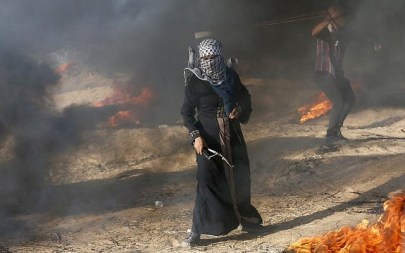
A Palestinian protester holds a slingshot during a demonstration at the Israel-Gaza border, in Khan Younis in the southern Gaza Strip on August 10, 2018. (AFP PHOTO / Said KHATIB)

Around 9,000 Palestinians participated Friday in violent weekly border protests. Some protesters rioted near the fence, threw makeshift bombs, Molotov cocktails and rocks at Israeli soldiers, and burned tires to create a smokescreen. In one incident a grenade was thrown at Israeli troops, but caused no casualties. Several attempts were made to breach the security fence.

The Hamas-run Gaza health ministry said three Palestinians were killed in Friday’s violence.

A large incendiary kite launched from Gaza lands on power lines near Kibbutz Sufa, August 11, 2018. Photo: Israel Electric Corporation

Meanwhile, incendiary kites and balloons from Gaza have continued to plague Israeli border communities, with a large incendiary kite landing on power lines near Kibbutz Sufa on Friday, causing blackouts in surrounding homes.

On Saturday afternoon the IDF said it targeted a cell responsible for launching incendiary balloons in the northern Gaza Strip. Reports in Palestinian media said two people were injured in the Israeli strikes in El-Bureij.There were also Palestinian reports of a second IDF strike elsewhere in the Gaza Strip.

Southern Israel has experienced hundreds of fires as a result of incendiary kites and balloons flown over the border from Gaza in recent months. Over 7,000 acres of land have been burned, causing millions of shekels in damages, according to Israeli officials.

Since March, there have been near-weekly, violent protests along the Israel-Gaza border organized by Gaza’s Hamas rulers, leading to the most serious escalation between the two sides since the 2014 war.

The deadly clashes have seen Israeli security forces facing gunfire, grenades, Molotov cocktails, and efforts — sometimes successful — to damage or penetrate the border fence. Last month, an Israeli soldier was killed by a sniper.

Over 100 Palestinians have been killed since the start of the “March of Return” protests on March 30. Hamas has acknowledged that dozens of those killed were its members.

Iran has only begun to feel the pain of Trump’s sanctions

August 12, 2018

To the Persian warriors fighting (against the odds) the shiite islamic theocracy: we proudly stand with you and respect your courage and valour.

https://nypost.com/2018/08/06/iran-has-only-begun-to-feel-the-pain-of-trumps-sanctions/

Iran's President Hassan Rouhani

As the Iranian regime reels under the strain of renewed sanctions, the Trump administration is already preparing the next phase.

We see too little of it in our press, but Iranians are increasingly taking to the streets and the clerics’ hold on power is weakening.

And it’s about to get worse for the regime. A new round of US sanctions, announced in advance, kicked in Monday. It restricts currency transfers and bans trade in gold, silver, aluminum, steel and other metals.

Most of the new sanctions have already been factored in, changing the way the world does business in Iran. European politicians, who’ve sanctified President Barack Obama’s nuclear deal, are calling on companies to stay put and do business in Iran, as the seven-party Joint Comprehensive Plan of Action dictates.

But business is business.

After the nuke deal was signed, France’s Renault was eager to position itself for the day all sanctions would be removed, cutting deals to dominate Iran’s car market. Anticipating Monday’s sanctions, however, Renault announced an end to all its Iran businesses in July — even though it sells no cars in America.

Meanwhile, under US pressure, Germany’s central bank last week announced new limits on foreign access to cash, blocking a desperate attempt by cash-strapped Tehran to withdraw 300 million euros ($375 million) from a Hamburg-based Iranian-controlled bank.

European politicians, still bitter over the Trump administration’s decision to pull out of the Iran deal and reimpose sanctions, like to issue defiant press releases. But the American squeeze is working. “We know Iran is increasing activities throughout Europe, and so we must be vigilant,” US Ambassador to Germany Richard Grenell told me Monday.

Buckle up. The next sanctions phase, due in November, will hit Iran’s only viable source of income: oil.

Iran’s oil exports are expected to be halved. Saudis, Russians and Americans will seek to fill the void, making sure Iran, not global consumers, feels the pain.

So you’d think (and the regime had hoped) Iranians would blame America. Instead, striking truck and taxi drivers, workers in faraway dusty towns, environmentalists, women, bazaar salesmen — all blame the regime.

With good reason. Obama’s generous JCPOA-related gifts to the regime, more than $100 billion in cash, never trickled down to the people. The money was spent on regional wars, propping up global terror organizations and lining the pockets of regime bigwigs.

The Iranian people no longer buy the “Great Satan” trope. “Even the bazaaris [who strongly supported the regime] know that impediment to normal life is not international, but domestic,” says Behnam Ben Taleblu, an Iran watcher at the Foundation for Defense of Democracies.

And as protests swell, “many of the enforcers, those who joined the Basij and Revolutionary Guards because it was their only employment option, may also defect and join the uprising,” says the Israeli Farsi broadcaster Menashe Amir. “After all, they’re Iranian too.”

The Western press largely ignores or belittles such tectonic shifts, but the Trump administration doesn’t.

Last month, Secretary of State Mike Pompeo met Iranian-Americans in California, expressing support for the protesters. In a Sunday tweet, he backed “the Iranian people’s right to protest against the regime’s corruption & oppression without fear of reprisal.”

Trump’s strategy — turning to the Iranian people — is a major departure from Obama’s coddling of the clerics. Without declaring it outright, Washington has been encouraging regime change, or at least trying to force an end to the regime’s pursuit of nukes, missiles and Mideast aggression.

Sure, regime change could be chaotic, lengthy and bloody. It could lead to an even more repressive, dictatorial and cruel leadership than the current one. Then again, it may liberate the Iranian people and, more likely, end Tehran’s pursuit of the most dangerous arms and the spread of global violence and terrorism.

“Yes, it’s hard to get worse than the Islamic Republic, but the Mideast is full of surprises,” cautions Ben Taleblu. Yet, he adds, a new regime, “popular and representative, will benefit the Iranian people, the Mideast and the international community.”

The potential risks are dwarfed by ample rewards, so by all means, tighten the screws. On to the next Iran sanctions phase.

Israeli Air Force Gets First-Ever Female Squadron Commander

August 12, 2018

Another proud warrior, standing shoulder to shoulder in the shield wall, at the front line against the forces of hate and evil.

I raise my drink to you, Lieutenant Colonel G.

Israeli Air Force Gets First-Ever Female Squadron Commander

The Israeli Air Force has appointed the first female squadron commander in its 70-year history.

According to Israel’s Channel Two, the commander, who for security reasons is referred to only as “G.,” will be promoted to lieutenant colonel and put charge of the 122nd Squadron, known as “Nachshon.” The squadron is composed of planes specifically geared toward intelligence gathering.

The 34-year-old G. has been active in the Air Force since 2003, and has served in several command positions, including deputy commander of the “Nachshon” Squadron itself.

G. — currently a major — said that she was “happy with the appointment,” which she called “a great privilege alongside a great responsibility.”

“The real work is ahead of me,” she added. “I’m proud to serve in the Air Force.”

Galia Wallach, chairwoman of the Israeli women’s rights organization Naamat, hailed G.’s accomplishment, saying, “We are talking about another goal achieved and we must ensure that it’s not the last. I praise the IDF, the Air Force commander, and especially Lieutenant Colonel G. who won the post through merit and not pity. The IDF sent an important message today to Israeli women — even the skies are not the limit for you.”