Hamas mistakenly assumes it has enough wiggle room to continue walking on the ledge and firing projectiles at Israel • The intensity of the latest round of violence can be reduced, but generally speaking, bringing it to an end will be harder than ever.
Prof. Eyal Zisser
A car sustains damage in a rocket strike in the southern Israeli city of Sderot
|Photo: Yehuda Peretz
Israel has exhibited maximum restraint in recent weeks in the face of incessant rocket fire from Gaza. This restraint is a testament to the country’s self-confidence and might, not to mention capable leadership and sound judgment on the part of the political and military echelons.
This restraint affords Israel many advantages, as it prevents an unwanted escalation while allowing for substantial diplomatic and military achievements.
Sometimes, however, such restraint can backfire and have the opposite of the desired effect. On the eve of the 1967 Six-Day War, for example, the Israeli government’s restraint emboldened the enemy to the point of sparking a regional conflagration.
There is no doubt that Hamas are listening to the experts and commentators in Israel, who are constantly saying that for Israel, there is no better alternative than Hamas in Gaza, and that Israel needs to avoid toppling Hamas and retaking the Strip. Hence the unbearable lightness of Hamas’ trigger finger.
So Hamas is projecting a willingness to reach an agreement with Israel, which will ensure relative calm along the Israel-Gaza border. But at the same time, they mistakenly assume that they have enough wiggle room to continue walking on the ledge and firing projectiles at Israel. They believe this will improve their bargaining position, enhance their image as a force capable of twisting Israel’s arm and, most importantly, establish new ground rules, similar to the ones in Lebanon – which would restrict Israel’s freedom of action in Gaza.
Israel and Hamas are on the verge of spiraling back into a familiar pattern, in which a new round of violence would be utterly devastating for Gaza and ultimately leave the Palestinian population and Hamas’ leadership in the same position they are now, or possibly worse off.
Every day that passes, new red lines are being crossed. For example, just yesterday, a rocket was fired into Beersheba for the first time since 2014. The intensity of the latest round of violence can be lowered, as the current cease-fire demonstrates, but generally speaking, every attempt to bring the violence to an end will be harder than ever.
The next few days will decide whether Israel and Hamas are headed for another war • If Israel wants to end the next round of violence quickly and effectively it has to take forceful action now, to make Hamas understand the price it will be made to pay.
Yoav Limor
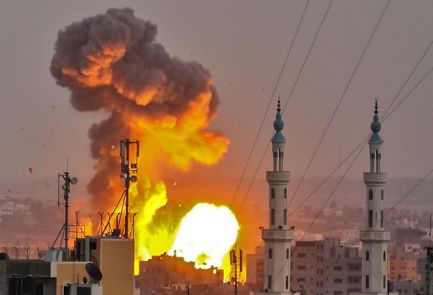
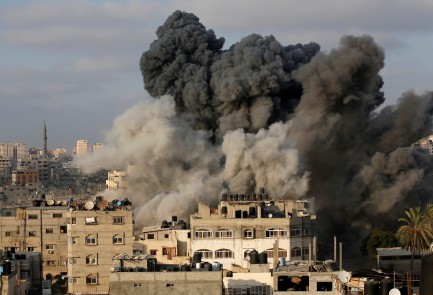
A fireball explodes in Gaza City during an Israeli strike on a Hamas target
|Photo: AFP
Despite the serious escalation in the southern sector on Thursday, both Israel and Hamas have been careful not to break all the familiar rules of the game, thus allowing for the possibility of a cease-fire.
The operational scope exercised by both sides may indicate otherwise – Hamas has fired over 180 projectiles at Israel and the IDF has struck dozens of targets in Gaza – but an analysis of the targets shows both parties “played by the rules”: Hamas aimed at the Gaza-vicinity communities and Sderot (the rocket fire on Beersheba was the work of a rogue terrorist group in Gaza) and the IDF did its best to minimize Palestinian casualties.
It is, however, clear to both sides that they are playing with fire – literally. Every Hamas rocket or Israeli strike have lethal potential, which in turn, could cause the situation to spiral out of control.
There is also the issue of critical mass: The Israeli communities near the Gaza border are already on edge and another sleepless night or two is all it would take for the public to demand immediate action. Gaza’s residents also have nothing to lose at this point, but contrary to what some in Israel hope, pushing Gazans into a corner with the hope that they will turn against Hamas may only cause them to rally around the Islamist terrorist group and support its war.
Meanwhile, as of Thursday night, efforts to mediate a cease-fire were less than enthused. The Egyptians are sitting on the fence, perhaps because they are fed up and perhaps because they want to teach Hamas a lesson. Earlier this week, Egypt allowed a delegation of exiled Hamas officials, including Deputy Hamas leader Saleh Arouri, to travel to Gaza through the Rafah crossing to discuss a cease-fire, but as soon as the delegation left violence flared-up.
Israel hopes Egypt will realize Hamas is ungrateful and restrict the delivery of fuel and goods through Rafah into Gaza, but it is unlikely that this measure would be in Israel’s interest in the long-run, as it prefers Egypt maintain the role of mediator.
What should concern Israel most is the fact that it once again misunderstood Hamas’ intentions. The standing assessment in recent weeks was that the terrorist group was not interested in war and would go to great lengths to avoid it, and those who supported this view cited Hamas leaders’ frantic rush to seek a truce after every border skirmish over the past few weeks.
Recent days have shown that the organization’s intentions are different. The elimination of two of its snipers on Tuesday gave it the pretext for war, but Israel should not feel too bad – Hamas knows how to relay information to Israel and if it wanted to, it could have made it clear that it was conducting a drill near the border. Since it didn’t, the IDF deemed the snipers an imminent threat and eliminated them.
This was just the excuse Hamas needed to ignite the border. Gaza’s rulers have failed to effect change using the diplomatic route, so they naturally reverted to the familiar military one, just like they did in 2014, on the eve of Operation Protective Edge.
Israel has made it clear to Hamas that the path on which it is on is doomed to fail, as its offer of cease-fire will not extend beyond the opening of the Kerem Shalom cargo crossing and the expansion of the fishing zone off Gaza’s coast. All other demands – the construction of air and sea ports and an ease of the restrictions placed on the types of goods delivered into Gaza – will require a broader agreement that will have to include the return of the two Israelis and the remains of two soldiers held in Gaza, as well as an end to Hamas’ armament efforts.
For the moment, Hamas seems to believe that continued rocket fire will break Israel. The IDF, for its part, continues to strike Hamas targets to convince the terrorist group to stop. The next 24-48 hours are critical, and if the fighting continues, it is highly likely that Israel will significantly increase the scope and range of its strikes, which would necessarily spell escalation.
While neither side is ready to declare war, the distance between these skirmishes and a full-fledged conflict is short, and crossing the line between them could prove instantaneous.
This prospect requires the Israeli military to significantly bolster defenses, as Hamas may try to launch a surprise attack – most likely using a terror tunnel – to abduct soldiers and/or civilians, as it did in 2014.
Additional forces have already been deployed on the ground, and the military said that if need be, Gaza-vicinity communities would be evacuated so as to ensure no harm comes to their residents.
From an offensive standpoint, the IDF will have to come up with creative solutions, given that it has been denied a significant opening move. Hamas’ leaders in Gaza have gone underground and the group has cleared all major headquarters and posts, and while destroying Hamas’ operational infrastructure has its value, it is not as effective as razing a high-rise.
For these reasons, if Israel wants to end the next round of violence quickly and effectively it should wage a far more intense military campaign than before to make sure that Hamas understands the price it will be made to pay.
Israel would prefer not to go to war with Hamas over kite terrorism but Gaza’s rulers should not confuse that with apprehension • The simple fact is that clear priorities must be set and Israel must decide which of the threats it faces is truly urgent.
Maj. Gen. (ret.) Yaakov Amidror
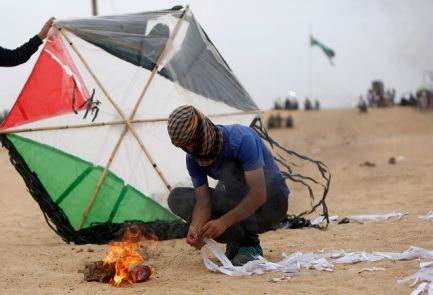
A Palestinian in Jabaliya prepares a kite before flying it over the border with Israel
|Photo: AFP
In his book “To Hell and Back: Europe 1914-1949,” Ian Kershaw, one of the great historians of our time, writes an amazing sentence that sums up the last two weeks before the beginning of World War I, the war that wiped out nearly 100 years of prosperity and destroyed Europe: “There was no chance of stopping the war. Considerations of prestige alone created a situation in which neither side could retreat.”
It is important that we remember this sentence because in Israel – a small state that has to invest its (considerable) resources in battles that are necessary to ensure its existence and security – decision-makers must pick not only their battles but also where to forego military moves.
The rationale is simple: you cannot fight all disruptive elements all the time. Clear priorities must be set and Israel cannot afford to launch wars over considerations of “prestige.”
This is not simple, and Israel’s captains can error exactly where the rulers of Germany and Russia, France and Britain did. The real challenge is to identify, among the many threats in the region, the ones that must be dealt with in order to ensure Israel’s survival, and if need be, to fight them to the brim.
On the other hand, when it comes to “prestige,” Israel would be wise to exercise restraint and opt for minimal activity, so as not to interfere with the main objective.
For this reason, for example, the military’s extensive capabilities cannot be “wasted” on a minor threat such as kite terrorism, regardless of how annoying it is, or how much of an affront it is to Israel and the IDF’s pride.
Kite terrorism is nothing to discount but, so far at least, it has not caused any serious harm. It has not cost human lives, the financial damage it has caused has been minor, and it has not infringed on the IDF’s freedom of operation in the southern sector.
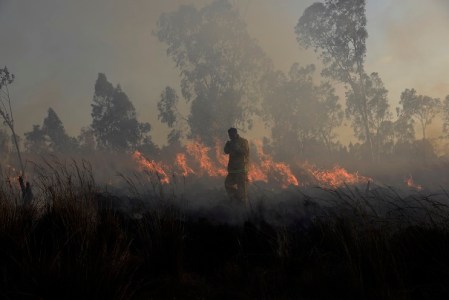
Palestinian arson terrorism has so far sparked over 1,000 fires on the Israeli side of the border
Arson terrorism is the default option of a beaten organization that is unable to mark any substantial achievement opposite the Israeli military’s success in neutralizing its offensive abilities. Israel must devise a solution to this nuisance, but we cannot confuse this relatively unimportant situation with the other challenges Israel faces, especially vis-à-vis Iran in general and particularly the Iranian presence in Syria. Keeping a cool head and the correct perspective is vital for a realistic decision-making process.
The widespread use of terms like “pride” and “national honor” date back to a time when Israel struggled to cement its global position and its ability to deter its enemies despite being a small, poor, and underpopulated country.
Back when Israel’s overall position was precarious the softer issues of pride, prestige and honor were also an important part of building an image of power, both domestically and internationally. Now that Israel is the strongest country in the region militarily and economically, when its relations with most of the world’s countries, including some Arab states, are stronger than ever, one can set pride somewhat aside and focus on more significant things.
Clearly, when there is an important interest, even in a secondary sector like the Gaza Strip, it must be protected even if it comes at the price of possible escalation. This was also the case on the day Hamas threatened that thousands of Palestinians would rush the Israel-Gaza border and the IDF did not hesitate to mount a forceful response.
While there is a place for these considerations even during negotiation with Hamas on some sort of cease-fire, the main issue remains that, for the duration of the agreement, Hamas has something of a guarantee that Israel will not interfere with its efforts to improve its arsenal and capabilities as long as Israel enjoys peace and quiet on its border with Gaza.
In the face of this grave weakness, the broader consideration must be taken into account: A cease-fire deal with Hamas will allow Israel to focus mainly on stopping Iran’s efforts to entrench itself militarily in Syria. Iran would very much prefer that Israel focus on the Gaza Strip. The advantage of an agreement with Hamas is that it postpones Israel’s need to deal with Gaza at this time. This is very important and that is why this option must be considered seriously.
Why hasn’t the Israel Defense Forces used all of its force to combat the growing terrorism from the Gaza Strip? Not surprisingly, this is a question many Israelis are finding difficult to answer. For some, this frustration translates into blunt language directed at both the military and the political echelon. Yet even if Hamas foolishly drags Israel into a wide-scale conflict, the IDF has had three good reasons to adhere to its policy of containment and measured military responses.
The first consideration concerns Israel’s long-term interest in avoiding taking full and ongoing military control of Gaza, a possible outcome of an all-out military campaign; and the no less problematic possibility of a bloody draw, which could stem from a partial campaign. There can be no doubt the IDF is capable of subduing and controlling the escalation. The Hamas leadership is motivated by irrational urges, and so Israel prefers to try to manage its steps through the involvement of a third side – Egyptian intelligence, for example – who have a better chance of giving their interlocutors a clearer idea of the level of risk they are taking.
From this point, we can derive a second consideration: Israel has a role to play in the band of regional forces that raise the banner of stability and are partners in the fight against radical Islamism in all its forms, from Iran to the Islamic State. It is precisely because of this partnership that Israel must exhaust the potential for joint action with Egypt. Both countries view Hamas as an enemy, an enemy upon whom it would be best to deter than to engage in an all-out conflict, the outcome of which would be difficult to control.
A third consideration stems from the possible ramifications of embarking on a military campaign in the south at the height of what might quickly develop in a crisis in the north. Tensions between the United States and Iran, along with economic problems in Tehran, make it ever more likely that the Iranian regime will make some provocative moves. A watchful eye in the north demands that the IDF remain as available as possible to fortify deterrence against Israel’s chief enemy.
Col. (ret.) Dr. Eran Lerman, former deputy director of the National Security Council, is the vice president of the Jerusalem Institute for Strategic Studies.
Cabinet orders IDF to take ”forceful action” against Hamas in wake of massive rocket salvo • In first since 2014, rocket fired at Beersheba • U.S. “fully supports Israel’s right to defend itself” • Israeli envoy to U.N.: Security Council must denounce Hamas.
Gadi Golan, Ariel Kahana, News Agencies and Israel Hayom Staff
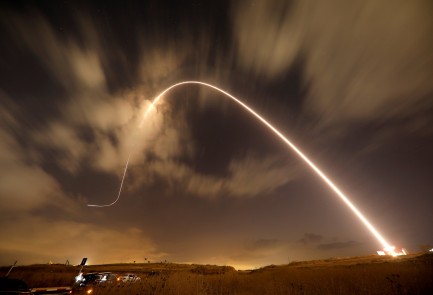
The Iron Dome defense system engaging rockets launched from Gaza towards the southern city of Sderot
|Photo: Reuters
Israel on Friday denied claims by Hamas, the terrorist organization ruling the Gaza Strip, that a cease-fire has been reached following aday of near-constant fire on Israeli communities near the border and Israeli strikes on Hamas asset in the coastal enclave.
Hamas officials said late Thursday that their truce with Israel came into effect on 11:45 p.m., ending an intense two-day burst of violence that had pushed the region closer to war.
Hamas’ Al Aqsa TV reported that the Egyptian-brokered deal has taken hold “on the basis of mutual calm.” It said the deal was mediated by Egypt and other unidentified regional players.
The Gaza-based Islamic Jihad terrorist group, however, also denied agreeing to a truce with Israel, but nevertheless, the Israel-Gaza Strip border seemed quiet on Friday morning.
During the latest round of violence, the fiercest seen in the sector over the past few weeks, Hamas fired over 180 projectiles at Israeli border-adjacent communities and the Israeli Air Force targeted some 150 Hamas positions in Gaza.
Reuters
Smoke billows over the Gaza Strip following an Israeli strike on a Hamas terror target
A Thai farm worker in her 20s sustained serious injuries when a rocket struck a packing facility in the Eshkol Regional Council on Thursday morning. Another employee was lightly hurt and at least 20 others were wounded in separate incidents.
On Thursday afternoon, a Grad rocket hit an open area in Beersheba, 22 miles from Gaza, triggering sirens in the southern city for the first time since the 2014’s Operation Protective Edge. No injuries or damage were reported in the incident.
Hamas denied firing the rocket at Beersheba, an assertion backed by the IDF. On Thursday evening, Islamic Jihad claimed responsibility for the incident.
Prime Minister Benjamin Netanyahu convened a special session of the Diplomatic-Security Cabinet on Thursday evening to discuss the volatile situation on the border.
The cabinet ordered the military to take unspecified ”forceful action” against Hamas and the other terrorist groups in Gaza. The IDF has since reinforced the units deployed along the border. with defense officials saying the military was ready for any scenario.
Sources at the Prime Minister’s Office said that Hamas, via Egyptian officials and U.N. Middle East envoy Nickolay Mladenov, had been asking for a cease-fire since Thursday morning, but Israel continued to strike terror targets in Gaza.
Senior Jerusalem officials stressed that Thursday’s operation was not the beginning of a military campaign in Gaza, but rather was meant to deal Hamas a serious blow and generate deterrence.
Israel had Hamas have fought three wars over the past decade, in 2008, 2012 and 2014.
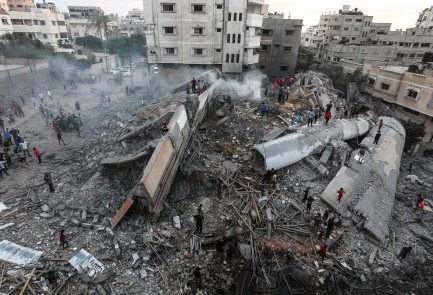
Following the rocket fire on Beersheba, the IAF struck a five-story building in northwest Gaza. Gaza’s Health Ministry said 20 people were wounded in the strike on the premises, which housed both a Hamas internal security office and what Palestinian media called “a culture and sciences center.”
Hamas denounced the “barbaric” attack as an Israeli attempt to undermine the Egyptian mediation efforts.
Reuters
A Gaza City building leveled by an Israeli strike, Thursday
In a series of tweets, the IDF said, “IAF fighter jets targeted a five-story building in the Rimal neighborhood in northern Gaza. Hamas’ internal security forces used the building for military purposes.
”Hamas’ internal security unit is responsible for all security operations carried out inside Gaza, and is considered to be an executive branch of Hamas’ political leadership. The building served as the office of active unit members. A significant part of the unit’s members are also Hamas military operatives.”
IDF Spokesperson Brig. Gen. Ronen Manelis told reporters that the military was “determined to restore calm to southern Israel. Hamas is the one pushing for an escalation. We have struck over 150 targets, some highly strategic and important. This policy will intensify until such time as calm is restored.”
Manelis stressed that “there is no comparison between the damage we have inflicted on Hamas and the damage it has caused us. The group has sustained hundreds of casualties and it has lost multiple assets, including tunnels.
”After four years of preparations, our abilities opposite Gaza are at their peak. If we need to launch a military campaign it will be clear-cut and decisive,” he said.
At the United Nations, Israeli Ambassador Danny Danon urged the U.N. Security Council to condemn Hamas militants for what he called “the unprovoked terrorist attack” on southern Israel.
The United States State Department issued a statement saying it was monitoring the situation in Gaza closely.
”We’ve been watching this as it has been unfolding, and it’s a very concerning situation that has taken place in Gaza,” State Department spokeswoman Heather Nauert said at a press briefing.
”Overall, we condemn the launching of missile attacks into Israel and call for an end to the destructive violence. We’ve seen reports that 180 or so rocket attacks have taken place, shot from Gaza into Israel, and we fully support Israel’s right to defend itself and to take actions to prevent provocations of that nature,” she stressed.
Pressed by a reporter who insisted that the current escalation was not started by Hamas, Nauert replied, ”I’m not going to get into how this thing started. Let’s not forget that Hamas bears ultimate responsibility for the dire humanitarian situation in Gaza. It’s a tremendous concern of ours.”
Council heads and mayors in southern Israel are furious at Prime Minister Binyamin Netanyahu and Defense Minister Avigdor Lieberman for their desire to seek a cease-fire with Hamas instead of launching a military operation to destroy Hamas and restore Israeli deterrence after Hamas launched about 200 rockets against Israel in under two days.
Tamir Idan, head of the Sdot Negev Regional Council, said that “no one has informed us of the cease-fire. There was no hesitation. Hamas determines when fighting will begin, and when it will end.”
“We expect a military operation that will remove Hamas, or a comprehensive and long-term arrangement that will include all kinds of terror,” Idan added.
Sderot Mayor Alon Davidi echoed Idan’s sentiments: “I understand the desire to reach negotiations, but in my opinion the cease-fire is a mistake. We will have to reach an operation, to eradicate this terror. The intermittent war is unhealthy for us and not good for the State of Israel,” Davidi said.
Gadi Yarkoni, head of the Eshkol Regional Council, expressed the hope that any peace agreement with the Gaza Strip would include economic support for the communities surrounding the Gaza Strip. “An ongoing reality of four months of security tension reached an extreme point yesterday. We went through a day of heavy barrage of fire to our communities and canceled educational activities and cultural and community events.”
“In the past few hours there has been quiet and we hope that the latest tension has been ‘the storm before the calm’, after which there will be an arrangement that will ensure long-term calm,” Yarkoni said.
Jewish Home MK Bezalel Smotrich slammed Defense Minister Liberman for failing to take decisive action against Hamas.
“Defense Minister Avigdor Liberman is proving to a ceaseless prattler. He is one of the weakest and strategically ignorant people in the State of Israel, and the one who has the greatest gap between his words and his actions. He cannot to serve as defense minister in the next term,” Smotrich said.
The head of the IDF’s Southern Command Maj. Gen. Herzl Halevi, center-left, speaks with Sderot mayor Alon Davidi, center-right, during a visit to the southern town, which was hit repeatedly with rocket fire from the Gaza Strip on August 9, 2018. (Israel Defense Forces)
Leaders of Israeli cities and towns near the Gaza border on Friday criticized the government over an apparent ceasefire with Hamas and called for a long-term solution, after a two-day bout of violence saw the heaviest exchange of fire between Israel and the Gaza terrorist organization since the 2014 war.
Hours after fighting grounded to a halt, local officials called on the government to secure a permanent end to rocket fire from the Palestinian coastal enclave, whether by military or diplomatic means.
Residents of southern Israel for several months have been rattled by a series of one or two-day rounds of fighting between Hamas and Israel, sending them scrambling to their bomb shelters and raising fears of war. In all cases, violence later subsided under ceasefires negotiated by Egypt and the UN, before resuming weeks later.
Alon Davidi, the mayor of Sderot, which suffered the brunt of the rocket fire from Gaza, said the effective truce was a “mistake” and that the IDF must decisively curb attacks on Israel through military action.
“I understand the desire to enter negotiations, but in my opinion the ceasefire is a mistake,” Davidi said. “We need to a military operation to eradicate this terror. The intermittent war is unhealthy for us and unhealthy for the State of Israel.”
The Hamas terror group said a ceasefire had been reached “on the basis of mutual calm” and went into effect at midnight. It said the deal was mediated by Egypt and other regional players.
Alon Davidi, mayor of the southern Israeli city of Sderot, attends a press conference in Jerusalem, March 27, 2017. (Hadas Parush/Flash90)
Israel denied there was a truce, but a senior Israeli official told Israel Radio that “quiet would be met with quiet.” There were no instances of violence reported along the border overnight.
Gadi Yarkoni, the head of the Eshkol Regional Council adjacent to the Gaza border, said that he hoped the sides would reach a permanent solution.
“This drawn-out reality of four months of security tension reached its climax yesterday,” he said. “We went through a day of heavy firing on our towns, we had to stop educational activities as well as cultural and communal events. In the past few hours there is quiet and we hope that the recent tension was ‘going up for the sake of coming down,’ and afterwards we will have an agreement which will guarantee quiet for the long term.”
He said the uncertainty was taking its toll on the local population.
Gadi Yarkoni (R) of the Eshkol Regional Council (Facebook)
“The events of the past few months and the sharp transitions from calm to emergency have a serious impact on the residents of the Gaza periphery.”
Tamir Idan, head of the Sdot Negev Regional Council in southern Israel, also said the reported ceasefire was a mistake.
“If we are really talking about a ceasefire, which has not yet been officially confirmed, it is in my opinion a serious mistake, creating a framework in which we have a new normality whereby Hamas controls the fire and decides when to end it,” he said, according to a Walla news report.
“We expect sharp, harsh and unequivocal action against Hamas which will end the terror in all its forms immediately, and which will allow the residents of the Gaza periphery to return to normal like all other citizens,” he added.
The leaders of Moshav Netiv Ha’asara, adjacent to the border, said the ceasefire was “simply an embarrassment” and made a mockery of those who lived in the area.
“The place looks like a ghost town this morning,” the council head said. “Because of irresponsible announcements like these most of the families have fled. Only the farmers remain, who cannot leave, and they’ve been told that if they work it will be their responsibility — as if they have any choice — because from their perspective it is do or die.”
On Friday morning, the IDF Home Front Command announced that all security restrictions in southern Israel had been lifted.
The reported ceasefire on Thursday came just an hour after the security cabinet completed a four-hour meeting on Gaza, instructing the military to “continue acting forcefully” against terror groups in the Strip,
IDF spokesman Lt. Col. Jonathan Conricus said Thursday that Gaza terror groups have fired about 150 rockets at Israel in the past 24 hours, while Israel has struck some 140 Hamas targets in Gaza.
He said the rocket that landed in Beersheba — some 40 kilometers (25 miles) from the Gaza border– required a more powerful, longer-range rocket, marking a significant escalation in violence.
A picture taken on August 9, 2018, shows people inspecting the rubble of a building targeted by the Israeli Air Force in response to a rocket attack that hit southern Israel earlier in the day on August 9, 2018. (AFP Photo/Mahmud Hams)
1. Until we meet again: A day of rocket strikes and Israeli reprisal raids ended with a shaky ceasefire, but nobody is convinced the last projectile has been fired and the feeling that war is in the offing is stronger than ever.
If those words look familiar, it’s because I published them on July 15, but it’s just as relevant today, as it may be after the next round of fighting. If Israel and Hamas are stuck in a seemingly endless loop of bad decisions and worse consequences, then the two are currently in the hangover stage after another bender, searching blurry-eyed for their AA sponsor’s phone number, but instead finding a series of texts from their bros inviting them for another night out.
“Until next time,” reads a headline on a Yossi Yehoshua column in Yedioth Ahronoth, which kind of says it all.
As a sign of the frustration felt not only in the border region, at an outdoor performance of Verdi’s Nabucco in Tel Aviv Thursday night attended by tens of thousands, the conductor stopped the show before the famous “Va Pensiero” (The Hebrew slaves’ chorus) to dedicate the song to the residents of the south and demanded that “something must change so kids can sleep at night, on both sides of the border.” It received the largest applause of the night.
2. Keep it copacetic: Calm can be reached either through war or a long-term deal and it seems that while the army and Hamas prefer the latter, others are insistent that girding for battle may be the better choice.
The defense establishment thinks the chances of all-out war have decreased significantly, Haaretz reports.
A Hamas official says that the terror group is not interested in going to battle, but wanted to send a message that it won’t tolerate being attacked, according to Channel 10, citing Asharq al-Awsat.
The rescinding of special instructions keeping southerners close to their bomb shelters is seen by many as a sign that the army believes the ceasefire will remain in place, at least for a few days.
But Israel is clearly girding for the next round and trying to return what little is left of its deterrent capability, as evidenced by the front page of Israel Hayom, seen as a government mouthpiece, vowing with a large headline that “The attacks will continue until the rockets stop.”
3. The last bullet: While a ceasefire after a day of rockets seems de riguer at this point, it’s still a feat to get the sides to stop fighting, writes former national security adviser Yaakov Amidror in Israel Hayom.
“Both sides want to prove that they can keep firing, because a one-sided ceasefire will be seen as weak,” he writes.
“Neither side wants to lose control, nobody wants this to descend into war, but each side is fighting for the right to shoot the last bullet,” Nahum Barnea writes in Yedioth Ahronoth.
4. US pressure: That Egypt puts pressure on Hamas to stop firing rockets is an old story, but Haaretz’s Zvi Bar’el says that the US is also putting pressure on Israel to keep from hitting Gaza too hard.
“Both Washington and Cairo see ending Gaza’s humanitarian crisis as much more important than dealing with the tactical confrontation between Israel and Hamas,” he writes.
Bar’el also notes that both Egypt and Israel (and the US) want to rebuild Gaza with a responsible party in charge, a status they have all granted to Hamas: “In the past, Israel negotiated with Hamas only over prisoner exchanges and ceasefires. Now, it’s holding diplomatic and economic negotiations with Hamas over Gaza’s future. The fact that Israeli and Hamas officials aren’t negotiating directly doesn’t change the fact that talks are taking place.”
5. Aiming at the IDF: Not all Israelis are willing to view Hamas as a partner, even a secret one. Representing those — including many in the government — who want the IDF to go further against the terror group, Israel Hayom’s Amnon Lord issues a scathing attack on the military..
“The army doesn’t want to kill balloon and kite launchers and places itself as judge over someone who has been convicted of murder who says, ‘I was forced to pull the trigger, what can I do.’ But on the other side of the border is the body.”
“That’s how it is in the western Negev. On the Gazan side they are ‘kids’ but on our side is the destruction of thousands of dunams.”
He’s not alone. In the right-wing Israel National News website, columnist Boaz Shapiro also directs fire at the heads of the army — and the government — whom he says “have long shown weakness and inertia which are not understood on any level, and are not transparent.”
“Tell me… do important people not understand what even a child understands,” he writes, directing his message specifically at prime Minister Benjamin Netanyahu, Defense Minister Avigdor Liberman, and army head Gadi Eisenkot.
6. Scaredy rabbit: Channel 20, also on the right, put together a strange gag on Thursday in which anchor Boaz Golan interviewed a bunny (the Hebrew version of a scaredy cat), apparently to show how weak the army and government are.
“Netanyahu is doing great work in many fields, but with anything regarding Gaza, many feel he has failed,” presenter Boaz Golan wrote later.
7. Dome of Arc: If there’s anything the Israeli press does agree on, it’s on the sublimity of this picture of an Iron Dome rocket interceptor, captured by Amir Cohen of Reuters.
Incredible @Reuters photo (Amir Cohen) of Iron Dome interception of Gaza rocket. It’s like that scene in Harry Potter where his wand meets with Voldemort’s. pic.twitter.com/xUSUfXFZH9
The picture, or variations of it, grace the pages and screens of pretty much every media outlet (at least those that subscribe to Reuters).
8. Bogota bummer: Mystery still surrounds Colombia’s decision to recognize Palestine, just as the country seemed to be moving closer to Jerusalem, and came as a surprise to pretty much everybody.
Before the news became public (though after the outgoing government of Juan Manuel Santos signed the official recognition) Tzachi Hanegbi, representing Israel at the inauguration of new president Ivan Duque, wished the outgoing administration luck and happily gave interviews, a sign of how clueless Israel’s government was about the news, ToI’s Raphael Ahren reports.
Mixed messages were coming from Bogota, long considered Israel’s most staunch ally in Latin America, following the move, leaving Israel’s Foreign Ministry nonplussed and unable to answer reporters questions for 16 hours after the move was announced. The only one to make a statement was Israel’s Embassy in Bogota, which issued an angry denunciation, in Spanish.
“The fact that ministry spokesperson Emmanuel Nahshon did not even provide reporters with a Hebrew translation of the Bogota embassy’s angry statement led Israel’s Diplomatic Correspondents’ Association to send him a formal protest letter,” Ahren writes.
A Palestinian source tells ToI that the move was because Santos “agreed that Netanyahu doesn’t do anything to advance peace.”
Amichai Stein, a reporter for Israel’s public broadcaster, writes on Twitter that a Colombian official told him that the new government may yet reverse the cancellation.
#BREAKING: Colombian official tells me: “All options are on the table – including the cancelation of the recognition of the Palestinian state”. Confirms the former & the current FM minister spoke on this issue in the past, but says “They were surprised of the announcment” https://t.co/tAeYh19ppO
9. Just say no: Haaretz Knesset correspondent Chaim Levinson jokes on Twitter that Likud lawmakers are now demanding Colombia stop importing drugs into Israel.
10. Who is Israel: With Sacha Baron Cohen continuing to make headlines each time a new episode of “Who is America” comes out, especially for the exploits of his Israeli macho character Erran Morad, Shmuel Rosner writes in the New York Times that the stereotype might reflect more on Americans than Israelis.
“Israel’s most avid supporters in America might like us more as crude machos than as start-up entrepreneurs. They might even prefer our satirized fossils to our real selves,” he writes.
But Rosner also says that the stereotype isn’t false and there are still many “Morads” roaming about Israel: “Every Israeli who serves in the military knows that we still have Morads. But for every idiotic Morad, we also have two prankish Cohens. That’s why we can afford a laugh.”
Terrorist groups in Hamas-controlled Gaza fired 180 rockets into Israel on Wednesday and Thursday, including a long-range rocket that landed near the southern Israeli town of Beersheba.
The Israel Air Force struck back, flattening a Hamas security headquarters.
The international media went into its usual anti-Israel spin mode, describing the violence as “clashes” instead of what it was: an unprovoked attack on civilians by Hamas, which is using the violence to gain diplomatic leverage and convince the world to send money.
Israeli leaders, and the Israeli public, are beyond frustrated — even though the U.S.-funded Iron Dome system has destroyed many of the rockets. Some are calling for Hamas leaders to be targeted. Many want Hamas itself to be crushed once and for all.
If Israel wants to destroy Hamas, and liberate the Gaza Strip from its iron-fisted Islamist rule — now more than a decade old — there will never be a better time. President Donald Trump is the most pro-Israel leader the United States has ever produced, and his team of Middle East negotiators are so frustrated with Palestinian intransigence that they have called for cutting economic aid to Gaza.
If Israel were to undertake a tough ground assault, with Hamas hiding behind civilians in hospitals and in booby-trapped buildings, it would — finally — have a friend in the White House who would withstand international pressure and allow it to fight until victory.
Moreover, Iran, the patron of regional terror, is in the midst of a crippling economic and political crisis. The Iranian regime, tied down in Syria, struggling with a collapsing currency, and facing mass protests in the streets, would hesitate before helping its proxy terror groups in Gaza. It would also be less likely than in the past to open a northern front by using Hezbollah to attack Israel.
The window of opportunity may not last long. Democrats have a good chance of winning back the U.S. House of Representatives in November. If they do, they will bring a new crop of anti-Israel politicians to Washington, along with a new hostility to Israel. Not one Democrat attended the opening of the new U.S. embassy in Jerusalem earlier this year, and none attended the party at the Israeli embassy in Washington, DC, to mark the occasion. The party rank-and-file are increasingly drawn to Israel-hating leaders.
One such is Alexandria Ocasio-Cortez, who will likely win New York’s 14th congressional district. She recently complained about the “occupation of Palestine” (despite not being able to explain what it was), and sided with Hamas over Israel in border clashes.
Another is Rashida Tlaib, a Palestinian-American who won the Democratic primary in Michigan’s 13th congressional district on Tuesday. She is close to antisemite Linda Sarsour, and backed Palestinian terrorist Rasmea Odea in her bid to avoid deportation.
A House controlled by Nancy Pelosi would make it harder for the Trump administration to support Israel. Republicans could still win, but Israel cannot afford to take that chance. If it wants to “free Palestine” from Hamas, the time may be now — or never.
After 250 rockets from Gaza hit Israeli locations, one a heavy Grad, Israel’s security cabinet meeting Thursday, Aug. 9, directed the IDF to continue to pursue “powerful action against terrorist forces.”
This was tantamount to a decision against a major Israeli military campaign against Hamas at this time, while instead carrying on with tit-for-tat air strikes as before, and leaving the targeted communities to their despair. Some 19 people were injured in the last two days.
Hamas is therefore still allowed to call the shots, exactly as it has done in the last four months, while inflicting in Israel diverse brands of terror. It is still up to Hamas to decide whether to stop shooting rockets at Israel or continue the barrage ongoing for two days, as well as determining the level of its retaliation for Israeli reprisals.
Therefore, after an Israel air strike demolished the five-story Hamas internal security building in the Gaza City’s Rimal district – in return for the first Grad fired on Beersheba, a major city in southern Israel, in four years, Hamas is expected to ratchet up its rocket fire on Israeli civilian locations in the coming hours and days. Israel forewarned residents of the Rimal district of the bombardment. The building was therefore empty of Hamas officials, a repeat of the “knock on roof” tactic the Israeli Air Force used in the past to avert collateral civilian casualties in counter-terror attacks.
This practice is an element in the IDF-Hamas duel which has its own strange rules. In the heat of Wednesday’s rocket barrage, Chief of Staff Lt. Gen. Gady Eisenkot stated that the IDF “is better prepared than it has been in the past decades.” Prepared for what? No answer was forthcoming from the cabinet the next day. In the general’s judgment, Hamas has still not broken those unwritten rules. He therefore persuaded the prime minister Binyamin Netanyahu and Defense Minister Avigdor Lieberman to hold back from approving a full-scale campaign to halt Hamas’ nagging violence once and for all.
Realizing that this stance will offend the popular will, in the sight of the suffering of the targeted population of southwestern Israel, both have not been seen or heard in public for some days. Meanwhile, they are hoping against hope that something may come of the long term truce mediation effort conducted by the UN emissary and Egypt, although realistic chances of this are practically nil.












 anneinpt
 artaxes
 danmillerinpanama
 davidking1530
 Peter Hofman
 Joseph Wouk
 Peter
Peter Louisiana Steve
 WarSclerotic
Recent Comments