Anglican Bishop Graham Tomlin, heads the diocese of Kensington in the Royal Borough of Kensington and Chelsea, which has many of London’s most expensive residential properties, is undoubtedly a man of brains and good works.[1]
On May 26, 2018, however, he published in The Times an article, entitled, “If this rich vein of wisdom disappears, a part of us dies”. The “rich vein of wisdom” to which he refers is the long tradition of Christian thought and experience in the region where the religion first appeared, and was handed down through centuries of Islamic rule. For the most part, the article is a well-argued defence of Christians in the Middle East:
The systematic persecution of Christians in the Middle East is a serious threat. The number of Christians in Middle Eastern countries has fallen from about 20 per cent to 4 per cent in recent years and regular bomb attacks on Christians in Egypt are becoming part of a deadly pattern.
So far so good. Tomlin’s heart is surely in the right place. But immediately after that he goes on:
Even in Jerusalem, new regulations are threatening to tax the Christian churches out of existence, prompting the recent unprecedented closure of the Church of the Holy Sepulchre as an act of protest. The buildings from ancient times will still stand, but if Christians are hounded out of the Middle East, driven to emigrate by radical Islam, or, in the case of many Palestinian Christians, by the lack of opportunities to thrive in Israel, this rich source of wisdom will disappear just like the ruins of Palmyra.
The “ruins of Palmyra” is, of course, a reference to the widespread destruction of the famous Syrian site, one of the wonders of the ancient world, by Islamic State in 2015 and again in 2017. Referring to this desecration, however vaguely, implies some sort of moral contiguity between ISIS and Israel.
Now, there is no question that ISIS at its height and even today has played a heavy-handed role in the persecution of Christians in the Middle East, notably in Iraq, where one of the oldest Christian communities in the world is under threat of extinction. In Mosul and elsewhere, Islamic State fighters painted the Arabic letter nun (n) on the doors and walls of Christian houses to indicate that the inhabitants were Christians (nasara, nasrani – Nazarenes). Given that such Islamic persecution is overwhelmingly real, one has to ask what the bishop is doing by referring twice in this context to Israel. Does Israel really persecute Christians, “systematically” or any other way?
Tomlin is broadly correct in saying that “The number of Christians in Middle Eastern countries has fallen from about 20 per cent to 4 per cent in recent years”. That is true across the board, but Israel is the only country in the Middle East and beyond where the actual numbers of Christians have risen. In 1947, when the UN General Assembly created Israel as a state, some 143,000 Christians lived in the Palestine region to the West of Transjordan. That was a percentage of 7% of the population. But of those 143,000, only 34,000 remained within the state of Israel, a mere 3%. Since then, the number of Christians in Israel proper has risen to 130,000 (just over 2%, given the growth in numbers of Jews and Muslims), while many have been leaving Gaza and the West Bank, largely because of Islamic persecution.
In Israel, Christians, like the followers of several other religions, are given the full protection of the law, their holy places, including churches, are guaranteed security under the 1967 “Protection of Holy Places Law“. This protection applies, not just to the major denominations (Judaism, Islam, Christianity), but to numerous minority groups. For Christians, it applies broadly to the officially recognized churches (Catholic, Orthodox, Monophysite, and Protestant, which together make up around 20 very old institutions (many indigenous and reaching back to the earliest Christian years), with another 30 denominations. Outside of Israel, Muslim states across the Middle East ban, restrict or actively persecute indigenous churches, such as the Copts in Egypt or Christians in Turkey, where Pastor Andrew Brunson is currently facing 35 years in jail, seemingly for preaching Christianity. Christian churches are banned outright in countries such as Saudi Arabia, and conversion of Muslims to Christianity is forbidden. Muslims who do convert suffer severe consequences as apostates, sometimes death. Thirteen Muslim-majority countries sentence apostates to death. In the Maldives, just owning a Bible is punishable by death. In a list of the 25 most dangerous countries for Christians, 18 Muslim states are listed.
In 2014, Duane Andrew Miller published a long study of the status of Muslims who convert to Christianity in the Catholic St. Francis Magazine. Commenting on the situation in the West Bank, Gaza and Israel, he describes how converts in the West Bank may be banished or killed by their families and those in Gaza executed. Further down, he writes:
In Israel, the situation is different. Muslims in Israel have the freedom to convert, and Christians in Israel have the freedom to openly incorporate Muslim converts into their churches. I estimate that there are about 300 or so CMB’s (Christians of Muslim Background) in Israel, and perhaps a few hundred more in the West Bank. Nonetheless, this rarely happens. In Israel, persecution will not originate from the state, but according to a Catholic priest in Jerusalem (where, independent of Occupation, citizens are under Israeli law) they can welcome Muslim converts, but they will often be persecuted and even killed by their families.
When such conversions are accepted by the church authorities, documents certifying this change of religion are submitted to the state of Israel to make the shift legal.
If Israel plays a part in the persecution of Christians, it must be doing a very bad job indeed when it even protects the rights of Muslim apostates — something that could well lead to friction with the Arab-Israeli Muslim community. In other countries, Muslim mobs sometimes attack churches where converts worship, as in Egypt. But Israeli security forces have so far prevented such attacks.
Israel protects not just the rights of Jews, Muslims and Christians, but those of many other religious communities, including some who are bitterly opposed by Muslim fundamentalists or others. Two stand out: Ahmadi Muslims and members of the Baha’i faith.
Ahmadis are followers of a 19th-century Indian leader (Mirza Ghulam Ahmad), who tried to reform Islam by, for example, abolishing the law of jihad and expressing tolerance for other faiths. They number around 10 million and are hated and persecuted in several Muslim countries such as Bangladesh, Indonesia, and, above all, Pakistan, where they number between 500,000 to 4 million. In 1974, under President Zia-ul-Haq’s Islamization of the country, Ahmadis were declared non-Muslims and are still treated as the worst people, worse than Shi’I Muslims, Jews or Christians.
Ahmadis arrived in Mandate Palestine in the 1920s, and many settled there when Israel was established in 1948. Around 2,200 are concentrated in the Kababir District of Haifa, where they have a large mosque and other institutions. They play a small but significant role in social relations, emphasizing interfaith activity and ways of conflict resolution. Israel is the only country in the region which gives this inoffensive yet despised community the right to worship, preach, and go about its daily life without fear of molestation.
Just down the road from Kababir, along the front side of Mount Carmel going straight up from Haifa’s famous harbour is an even more astonishing religious site – the world center of the Baha’is. The Baha’i faith is another religion that emerged (and broke away) from Islam in the mid-nineteenth century, in this instance from Shi’ism in Iran. Today, its followers, from almost every nationality and race, number around 5 million, with a presence in almost every country, literature in over 800 languages, and eight major Houses of Worship around the globe, the best-known of which is the astonishing Lotus Temple in New Delhi, which has been described as the most visited building in the world, more than the Taj Mahal. Baha’is in most Muslim countries keep their adherence secret. Their belief in two prophets after Muhammad, the truth of all major religions, and a religious law that has abolished the Islamic shari’a make them universally hated by Muslims.
This hatred is particularly fierce in Iran, where Baha’is are the largest religious minority, and where they are severely persecuted. Many have been executed, others killed by mobs, their leaders are in prison, Baha’is are forbidden to attend universities, and all the Baha’i holy sites and cemeteries have been razed to the ground. International calls by the UN (on numerous occasions), the United States, Human Rights Watch, large numbers of intellectuals, and other states to end the persecution have gone unheeded by Iran’s regime.
In Israel, the Baha’is are supported fully by the state. They have built their two holiest shrines in Israel (one in Haifa, the holiest near Acco), and on the slopes of Mount Carmel their World Center: vast terraced gardens, an arc of white marble buildings, including the seat of their international governing body, the Universal House of Justice, central archives, and more. They have other sacred sites in Acco and its surroundings as well.
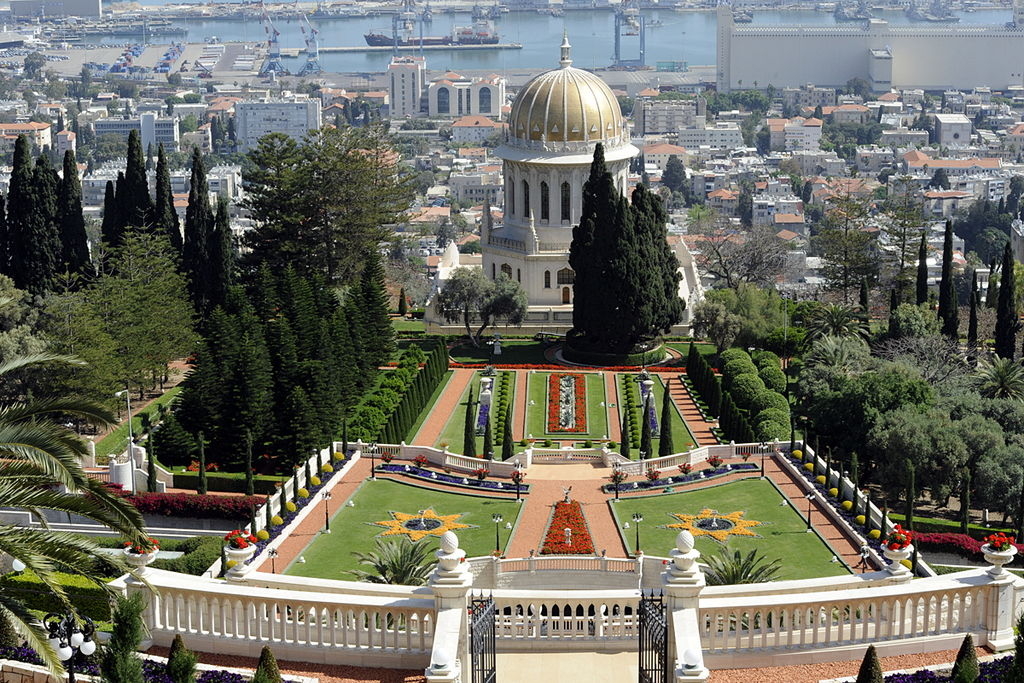 Protected by Israel’s freedom of religion, Baha’is have built their two holiest shrines in Israel, and on the slopes of Mount Carmel their World Center (pictured): vast terraced gardens and white marble buildings, including the seat of their international governing body, the Universal House of Justice, and central archives. (Image source: US Embassy Israel/Wikimedia Commons) Protected by Israel’s freedom of religion, Baha’is have built their two holiest shrines in Israel, and on the slopes of Mount Carmel their World Center (pictured): vast terraced gardens and white marble buildings, including the seat of their international governing body, the Universal House of Justice, and central archives. (Image source: US Embassy Israel/Wikimedia Commons) |
Israel’s openness to religious freedom is shown in many other ways, all of which portray a society in which even its enemies are treated well. When Israeli forces entered eastern Jerusalem in 1967, at the end of the Six Day War, a unit of Lt. Gen. Mordechai Gur’s Brigade 55 took the Old City from the occupying Jordanian troops who had been based there but had slipped away the night before. What followed was, by any standards, one of the most profound moments in religious history.
For centuries, Jews had prayed to return to Jerusalem and to possess the Temple Mount, the site of the first and second Jewish temples. When Gur and his men took control of the Mount, centuries of longing came to a glorious end in this spectacular triumph over the latest effort to destroy the new Israeli state. With the Mount in Jewish hands, the Brigade’s Communications Officer brought out an Israeli flag and was given permission to hoist it from the Dome of the Rock. The Dome and the nearby al-Aqsa Mosque are two of the most sacred Islamic sites and had rested on the Mount for centuries. Climbing with the Intelligence Officer onto the Dome itself, he attached the flag to a pole.
Within moments, an order came to lower the flag. Israel’s Defense Minister, Moshe Dayan, watching through binoculars from Mount Scopus some distance away, urgently radioed Colonel Gur and demanded that the flag be removed.
Author and journalist Yossi Klein Halevi summarized the significance of this act and what followed shortly after:
It is, in retrospect, an astonishing moment of religious restraint. The Jewish people had just returned to its holiest site, from which it had been denied access for centuries, only to effectively yield sovereignty at its moment of triumph. Shortly after the war, Dayan met with officials of the Muslim Wakf, who governed the holy site, and formally returned the Mount to their control. While Israeli soldiers would determine security and stand at the gates, the Wakf would determine who prayed at the site, an arrangement that would effectively bar non-Muslim prayer. The Temple Mount was no longer in Gur’s hands.
As an expression of religious tolerance and a gesture towards avoiding bloodshed, this concession to Israel’s enemies must surely be unparalleled in history.
It should be clear from the above that Israel is one of the least likely countries in the world to persecute the followers of any religion. A well-educated and thinking man, Tomlin ought to have known this or have been able to check the facts for himself. None of the above is remotely secret. Yet he lumps Israel in with the Muslim states which carry out the “systematic persecution of Christians in the Middle East”.
As for his statement that “even in Jerusalem, new regulations are threatening to tax the Christian churches out of existence”, he is exaggerating the true story and is massively out of date: the taxation that was to have been introduced has been cancelled across the board.
By February 27, the Israeli government and Jerusalem’s Mayor Nir Barkat agreed to suspend the taxation plan in its entirety, even though many Israeli citizens felt that this involved a concession too far. After all, this exempted Christian institutions from paying taxes on commercial enterprises such as hotels, shops and other businesses; and the same taxes were already made payable by synagogues. In April 2017, Tel Aviv’s historic Great Synagogue was forced to close because it could not pay taxes for its financial activities. Yet Israeli authorities felt it important to forego an appreciable and legally justifiable sum of money rather than to dismay the country’s Christians. Despite this gesture (which was not extended to Jewish places of worship), a full three months later, an Anglican bishop somehow felt the need to cite the abandoned tax plan as an example of Middle Eastern persecution of Christians.
Tomlin further compounded his antagonism by claiming that “Palestinian Christians” lack opportunities to “thrive in Israel” and that this is a further example of this “persecution”. “Palestinian Christians” do not even live in Israel — at all. They are based in the West Bank (in dwindling numbers), Gaza (also close to disappearance), and some in East Jerusalem. The rest, who live in Israel are Israeli citizens and, as such, entitled to exactly the same rights as Jews, Muslims, atheists and all other citizens. Arab Israelis are entitled, for example, to enter university (20% of students, to match the 20% of the general population), to enter parliament if elected, have their own political parties, serve as Supreme Court and lower court judges, and to enter any profession they wish for which they are qualified. Why, then, say they lack opportunities to thrive? There may be discrimination, which exists, as it does in every other country — but not as a result of official mistreatment, and certainly not as a consequence of “persecution”. In fact, the Israeli government has taken strong measures to punish anti-Arab actions and to improve the situation for both Israeli citizens and Palestinian Arabs in East Jerusalem.
There are indeed restrictions on Arabs living in East Jerusalem, including the Old City. Of the 300,000 Arabs living there, 20,000 are Israeli citizens — but they are not by any means denied basic rights, and many of the limitations they face are self-imposed:
As permanent residents, east Jerusalemites are entitled to receive assistance from the National Insurance Institute and other welfare services that Israelis are entitled to, and the free education system is open to them. They also have freedom of movement, to move freely throughout the entire country (unlike West Bank Palestinians, who are required to obtain a permit to enter into Israel).
As permanent residents, east Jerusalemites are not eligible to vote in the national election for the Knesset. However, they have the option to vote and to run in the municipal election to the Jerusalem City Council. A very low percentage of the residents chose to exercise this right, as part of the ongoing ban on Israeli institutions. Among many of the east Jerusalem’s Arabs, taking part in these sorts of activities was perceived as normalization of ties with Israel.
It is important to note that, although not in large numbers, many Arabs have achieved high office in Israel’s government, judicial system, premier hospitals, universities and more. Salim Joubran was the first Arab to serve on Israel’s Supreme Court. Oscar Abu Razeq served as deputy director of the Tax Authority and director general of the Interior Ministry. Khaled Kabub was recently nominated to serve on the Supreme Court but withdrew for personal reasons. George Karra, a Christian Arab, joined the Supreme Court in 2017. He had previously acted as the presiding judge in the trial for rape of Israeli President Moshe Katsav, sending him to jail. Even if the situation is not perfect, failure to note Israeli efforts to allow its Arab citizens to thrive is defamatory and far from helpful.
How does Tomlin not even mention the dire situation of religious persecution in Iran, one of the worst in the world, where Christians suffer alongside Baha’is, notably those who are converts from Islam, something that can incur the death penalty? Or Saudi Arabia, where Christians are denied most of their human rights, including the right to worship freely? In fact, why include Israel at all?
One can only conclude that Tomlin shares the negative attitudes to Israel — often seen as anti-Semitism — that are fostered in many Christian churches worldwide, including those in the West Bank. These attitudes have been recorded many times by the present writer, here, here, here, and here.
The problem Israel faces from churchmen who attack the Jewish state has never been better summed up than by the Italian journalist, Giulio Meotti:
Christianity is dying in Syria and Iraq. Christian churches are demolished, Christian crosses are burned and replaced with flags of the Islamic State, Christian houses are destroyed, entire Christian communities are displaced, Christian children are massacred, and everything is done in plain sight. Islamists proclaim on a daily basis that they will not stop until Christianity is wiped off the face of the earth. So, are the world Christian bodies denouncing the Islamic forces for the ethnic cleansing, genocide and historic demographic-religious revolution their brethren are suffering? No. Christians these days are busy targeting the Israeli Jews.
Denis MacEoin (PhD, Cambridge) has lectured in the Department of Religious Studies at Newcastle University. Among much other academic work, he has authored many books and articles on the Baha’i religion, which is a reference point in the present article. He lives in the UK and is a Distinguished Senior Fellow at New York’s Gatestone Institute.










 anneinpt
 artaxes
 danmillerinpanama
 davidking1530
 Peter Hofman
 Joseph Wouk
 Peter
Peter Louisiana Steve
 WarSclerotic
Recent Comments