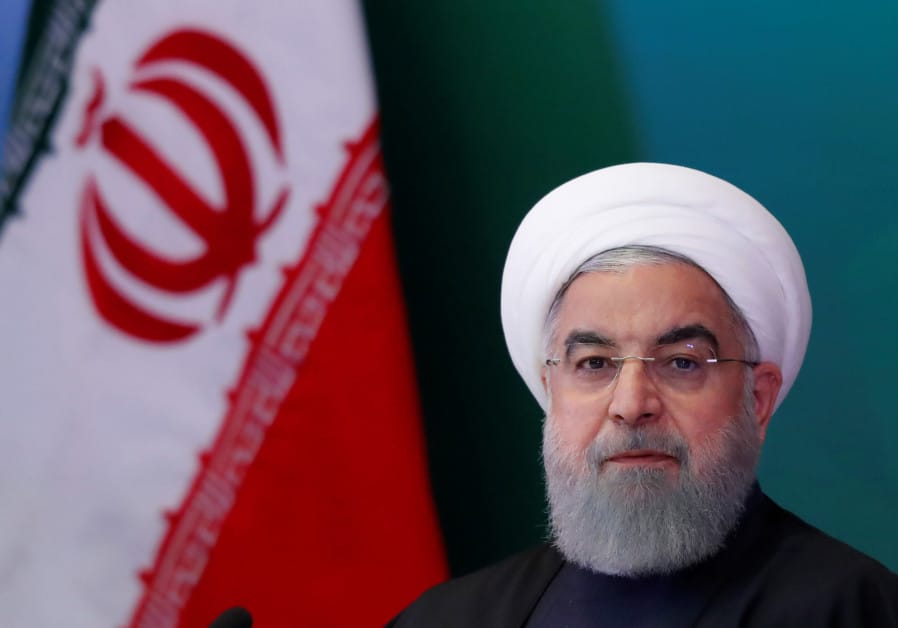
Archive for June 2018

Up to 35 Hamas rockets fired from Gaza – not 12 as the IDF claimed. Balloons set 25 fires

June 27, 2018

Source: Up to 35 Hamas rockets fired from Gaza – not 12 as the IDF claimed. Balloons set 25 fires – DEBKAfile

Whereas the IDF counted 12 rockets descending on Israel from the Gaza Strip early Wednesday, June 27, local security officials counted 35. Hamas kites, balloons ignite up to 25 fires a day on average.

It is getting harder than ever to understand what the IDF is playing at on the Gaza front by allowing the Palestinians to terrorize southern Israel day by day at will.

Just a week ago, Hamas unleashed 45 rockets and mortar rounds in one night against the Israeli population and then ludicrously laid down a new rule for the confrontation: For every IDF strike in response to a Palestinian act of terror, Hamas would reciprocate against Israeli towns and villages on equal terms.

By letting Hamas write the rules, the IDF allowed this terrorist organization to cripple it ability to fight back.

This is how the current cycle works: The Israeli Air Force strikes empty Hamas observation posts strung along the Gaza border with Israel, after the terrorists remove themselves to safety in good time. The IDF then releases images of the crews at these posts hurling incendiary balloons and kites across the border to vandalize Israeli farms – but refrains from attacking them, bombing only the empty vans used to transport the explosive toys. Hamas retaliates for these “attacks” with rockets against Israeli homes. The result: Hamas is sitting pretty.

For the sake of hitting empty Hamas lookout posts and vans, 200,000 Israeli civilians are condemned to sleep in shelters or rush to protected areas every night. After nights disturbed by repeated raucous rocket alerts and rushing children to safety, mothers, fathers and children are advised by the IDF “to go back to their normal routines” the next day.

So far, the alerts and the shelters have effectively prevented casualties from the latest campaign of terror that Hamas launched in March. But the people dwelling and working around the Gaza Strip know they are living on borrowed time. In the June 20 barrage, only one of the 45 rockets and shells fired was intercepted; 10 landed inside residential areas.

This Wednesday, it turns out that three out of 35 were intercepted, and one was already over the town of Sderot when it was caught. Hamas has undoubtedly  discovered that Israel cannot handle a barrage of dozens of rockets fired almost simultaneously, since a large part of its Iron Dome anti-rocket fleet is deployed on Israel’s northern border against a possible escalation from Syria. For how long will Israel let Hamas hold all the cards and get away with terror?

US demands world halt Iranian oil imports by November 4 

June 27, 2018

Source: US demands world halt Iranian oil imports by November 4 | The Times of Israel

Amid economic protests in Tehran, Washington ups pressure on other countries to halt business or suffer sanctions; senior diplomat warns ‘we’re not granting waivers’

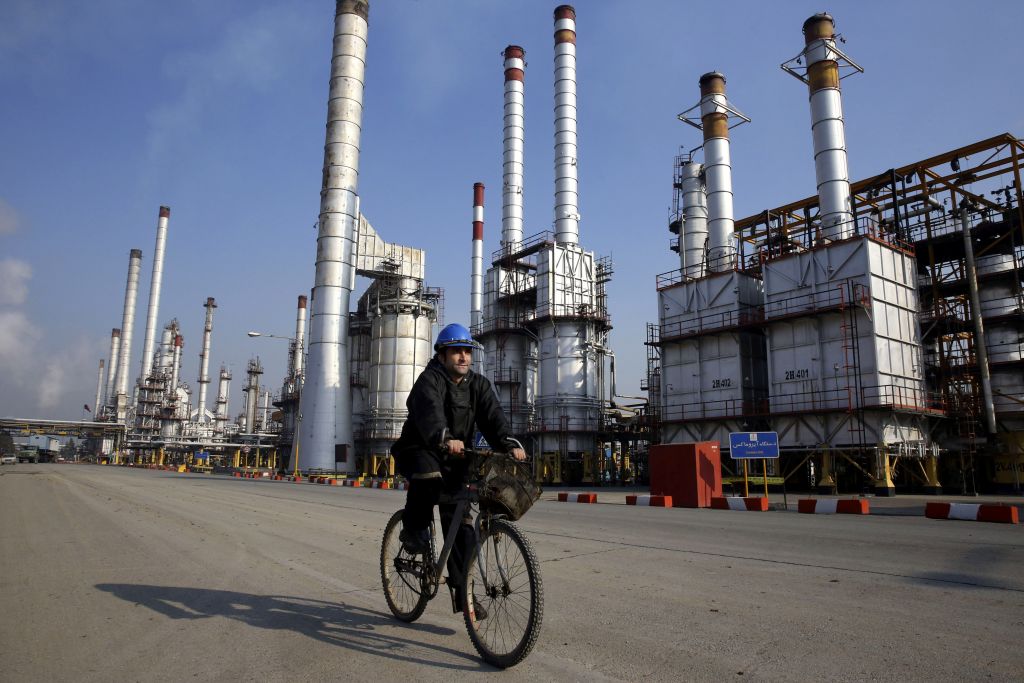
An Iranian oil worker rides his bicycle near an oil refinery south of the capital, Tehran, December 22, 2014. (AP/Vahid Salemi)

An Iranian oil worker rides his bicycle near an oil refinery south of the capital, Tehran, December 22, 2014. (AP/Vahid Salemi)

WASHINGTON — The United States warned Tuesday that countries around the world must stop buying Iranian oil before November 4 or face a renewed round of American economic sanctions.

A senior State Department official warned foreign capitals “we’re not granting waivers” and described tightening the noose on Tehran as “one of our top national security priorities.”

Last month US President Donald Trump withdrew the United States from the Iran nuclear deal, re-imposing US sanctions that had been suspended in return for controls on Tehran’s nuclear program.

Now, Washington is stepping up pressure on other countries to follow suit, including European allies who begged him to stay in the accord and major Iranian customers like India, Japan and China.

European powers in particular have been attempting to negotiate exemptions for their firms, but the official confirmed that Trump intends to stick to his 180-day deadline, expiring November 4.

“I would be hesitant to say zero waivers ever,” he said, but added that the official position is: “No, we’re not granting waivers.”

The senior US official, briefing reporters on condition of anonymity, admitted that this would be unpopular.

“This is a challenge for them, this is not something that any country that imports oil from Iran … wants to do voluntarily because, you know, we’re asking them to make a policy change.

“China, India? Yes, certainly their companies will be subject to the same sanctions that everybody else is,” he said. “We will certainly be requesting that their oil imports go to zero.”

Iran has faced mounting economic woes since the US pulled out of the 2015 nuclear accord.

On Tuesday angry protesters in Tehran held a second day of demonstrations over the country’s anemic economy as President Hassan Rouhani told the nation that it faces an “economic war” with the United States following America’s pullout from the deal.
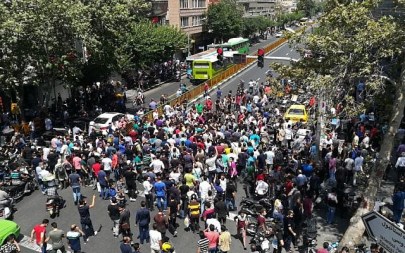
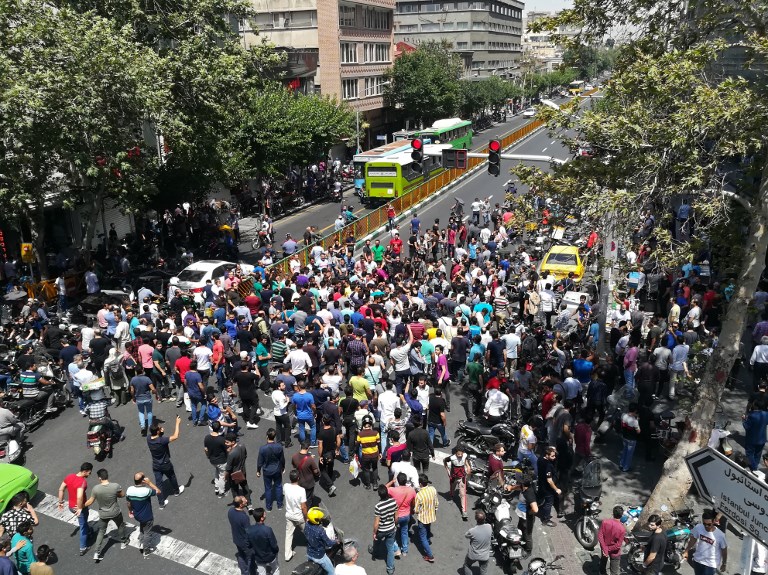
Iranian protesters in central Tehran on June 25, 2018. (AFP Photo/Atta Kenare)

While online videos showed demonstrators again confronting police on Tehran’s streets and alleyways, the protests looked far smaller than those on Monday, when security forces fired tear gas on crowds in front of parliament.

Rage persists over the plunging of the Iranian rial to 90,000 to the dollar — double the government rate of 42,000 rials to $1 — as people watch their savings dwindle and shopkeepers hold onto some goods, uncertain of their true value.

Similar economic protests roiled Iran and spread to some 75 cities and towns at the end of last year, becoming the largest demonstrations in the country since the months-long rallies following the 2009 disputed presidential election. The protests in late December and early January saw at least 25 people killed and nearly 5,000 arrested, but took place largely in Iran’s provinces rather than in the capital, Tehran.

These latest protests have hit Iranian commercial areas, including the sprawling, historic warrens of Tehran’s Grand Bazaar, the home of conservative merchants who backed the country’s 1979 Islamic Revolution and overthrow of Shah Mohammad Reza Pahlavi. It remains unclear who is leading these protests, though analysts say hard-liners wanting to challenge Rouhani likely sparked the demonstrations at the end of last year.
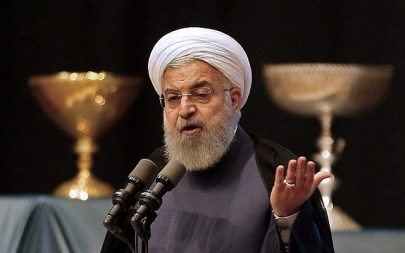
Iran’s president Hassan Rouhani gives a speech in the city of Tabriz in the northwestern East-Azerbaijan province on April 25, 2018, (Atta Kenare/AFP)

On Tuesday, witnesses described a noticeable presence of riot police on the capital’s streets. Official reports and comments also were slim in Iran’s state-controlled media, though Prosecutor Abbas Jafari Dolatabadi said the “main provocateurs” of Monday’s protests were arrested. He did not elaborate on the number of people detained.

The state-run IRNA news agency euphemistically referred to one incident Tuesday in which the city’s metro line was temporarily shut down near the Grand Bazaar, saying it happened “because of some people gathered there.”

On Tuesday morning, Rouhani addressed a meeting of judges that included the head of the country’s judiciary and parliament. While a relative moderate within Iran’s theocratic government, Rouhani struck a hard line himself against America.

“We are fighting against the United States, it wants to make an economic war,” the president said. “The US cannot defeat our nation; our enemies are not able to force us to their knees.”

That’s a far cry from the optimism shared by Rouhani and other Iranians when the 2015 nuclear deal was enacted between Iran and six world powers, including America. Iran agreed to limit its enrichment of uranium in exchange for the lifting of economic sanctions.

But that deal came under Barack Obama’s administration. Trump, who campaigned on a promise of tearing up the deal, pulled America out of the deal in May. The ensuing turmoil has seen international firms and oil companies back away from their own billion-dollar deals with Iran.

Rouhani’s own power within Iran’s government appears to be waning, with some openly calling for military officials to lead the country.

Iran also has suggested it could immediately ramp up its production of uranium in response to the US pullout, potentially escalating the very situation the nuclear deal sought to avoid — having an Iran with a stockpile of highly enriched uranium that it could use to build atomic bombs.

Tehran has long denied wanting to build nuclear weapons, despite fears from the West and the United Nations.

Parliament Speaker Ali Larijani, speaking at the same event as Rouhani, appeared to directly criticize his administration.
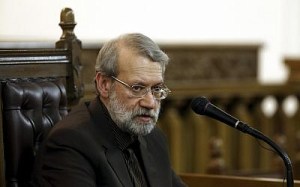
Iranian parliament speaker Ali Larijani speaks during a press conference in Tehran, Iran, March 13, 2017. (AP Photo/Ebrahim Noroozi)

“The government hasn’t done enough to confront the economic problems,” the conservative politician said, according to the semi-official ISNA news agency.

The protests  have seen unusual scenes of demonstrators chanting against continued Iranian spending of billions of dollars on regional proxy wars and support for terrorist groups, which many say has meant less investment in the struggling economy at home.

In recent years, Iran has provided financial aid to Palestinian terror groups Hamas and Islamic Jihad, Lebanon’s Hezbollah, Yemen’s Houthi rebels and Shiite militias in Iraq. Since the start of the Syrian civil war in 2011, Tehran has poured a reported $6 billion into propping up president Bashar Assad’s government.

Monday’s protests in Tehran and around the country — including economically hard-hit cities like Kermanshah in western Iran — included shouts of “Death to Palestine,” “No to Gaza, no to Lebanon” and “Leave Syria and think of us.” Chants of “We don’t want the ayatollahs” and “Death to the dictator” were also heard at some rallies.

Tunnel-busting system wins top Israeli defense prize

June 27, 2018

Source: Tunnel-busting system wins top Israeli defense prize | The Times of Israel

Two other projects also win security award, one for stopping terrorists with ‘big data,’ the other is classified

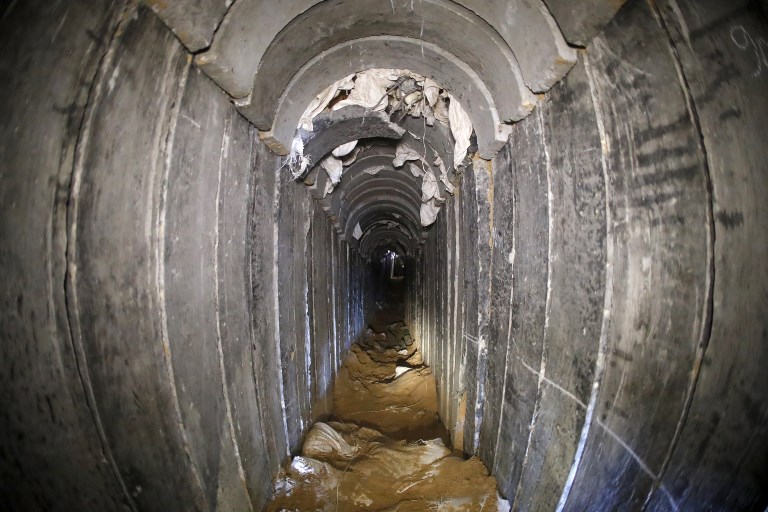
A destroyed Palestinian Islamic Jihad tunnel, leading from Gaza into Israel, near the southern Israeli kibbutz of Kissufim. (Jack Guez/AFP/POOL)

Israel awarded its top defense prize to three high-level projects on Tuesday, including one that is classified, which were determined to have significantly contributed to the country’s security.

On Tuesday night, President Reuven Rivlin presented the three Israel Defense Prizes, alongside Defense Minister Avigdor Liberman, IDF chief Gadi Eisenkot, and director-general of the Defense Ministry Udi Adam.

The Israel Defense Prize is awarded each year by the president to individuals, units, or projects that are found to have significantly improved the security of the state.

One prize was granted to the project to locate attack tunnels from the Gaza Strip, which Israel has used to destroy at least 10 border-crossing tunnels since October 2017, the Defense Ministry said.

The system relies on a variety of sensors to locate the subterranean passages, though the exact nature of the project remains classified.

“This is a system that has no equal in the world, which has led to a turning point in the campaign to thwart the tunnel threat,” the ministry said.

Liberman lauded the program, saying it took a “strategic weapon” away from the Hamas terrorist organization, the main digger of these attack tunnels.

“The tunnel detection project is based on technology that is unique in the world, which is practically science fiction. Thanks to the minds that are sitting here… we have taken from Hamas its strategic weapon, in which it has invested most of its rearmament budget: hundreds of millions of dollars,” the defense minister said.

“Attack tunnels have become burial tunnels,” Liberman added.

Defense Minister Avigdor Liberman awards the Israel Defense Prize to an IDF officer at the President’s Residence in Jerusalem on June 26, 2018. (Ariel Hermoni/Defense Ministry)

The tunnel-finding system was created by the Defense Ministry’s Administration for the Development of Weapons and Technological Infrastructure (MAFAT), the IDF’s Ground Forces, the Gaza Division, the Prime Minister’s Office, and the Rafael and Elbit defense contractors.

In its announcement, the Defense Ministry said the system was possible thanks to a number of “technological breakthroughs in a number of creative projects.”

The second award was granted to a project whose details are almost entirely classified.

The ministry said the project “gave the first solution of its kind to a central threat to the State of Israel.”

It involved both technological advancements and “extraordinary operational courage,” which has given a “significant and unique strategic contribution to the security of the state,” according to the Defense Ministry.

The third prize was granted to a technological project that was designed to identify potential terrorists using large amounts of data.

“The project dramatically influenced the security reality, mainly in thwarting hundreds of terror attacks,” the ministry said.

Liberman said the project was “no less incredible” than the tunnel detection system.

“It can be said responsibly that many citizens owe you their lives,” he told the prize recipients.

Apparently to keep aspects of these projects a secret, the Defense Ministry would not specify the recipients for each one. Instead, the ministry said that the two prizes were awarded to: Military Intelligence, the IDF Central Command’s intelligence unit, the IDF J6/C4I & Cyber Defense Directorate, MAFAT, the Prime Minister’s Office, and the Israel Aerospace Industries MLM Division, which manufacturers missiles and space vehicles.

The Israel Defense Prize has been given yearly by the president since 1958. Though the prize is sometimes given for lifetime achievement, generally the recipients are responsible for the creation of a new piece of technology or a specific operation.

Over the years, the prize has been awarded to both individuals, like Uzi Gal who received the first Israel Defense Prize in 1958 for creating the Uzi submachine gun, and entire teams, like the group responsible for the development of the TROPHY anti-missile system that protects Israeli tanks and armored personnel carriers, which won in 2014.

At least 12 rockets launched from Gaza after army strikes Hamas cell’s car 

June 27, 2018

Source: At least 12 rockets launched from Gaza after army strikes Hamas cell’s car | The Times of Israel

Iron Dome intercepts 3 projectiles; IDF says it targeted operatives involved in flying incendiary devices into Israel, Palestinians report none hurt

A rocket fired from Gaza that landed in a street in one of the communities of the Eshkol region on June 20, 2018. (Eshkol region)

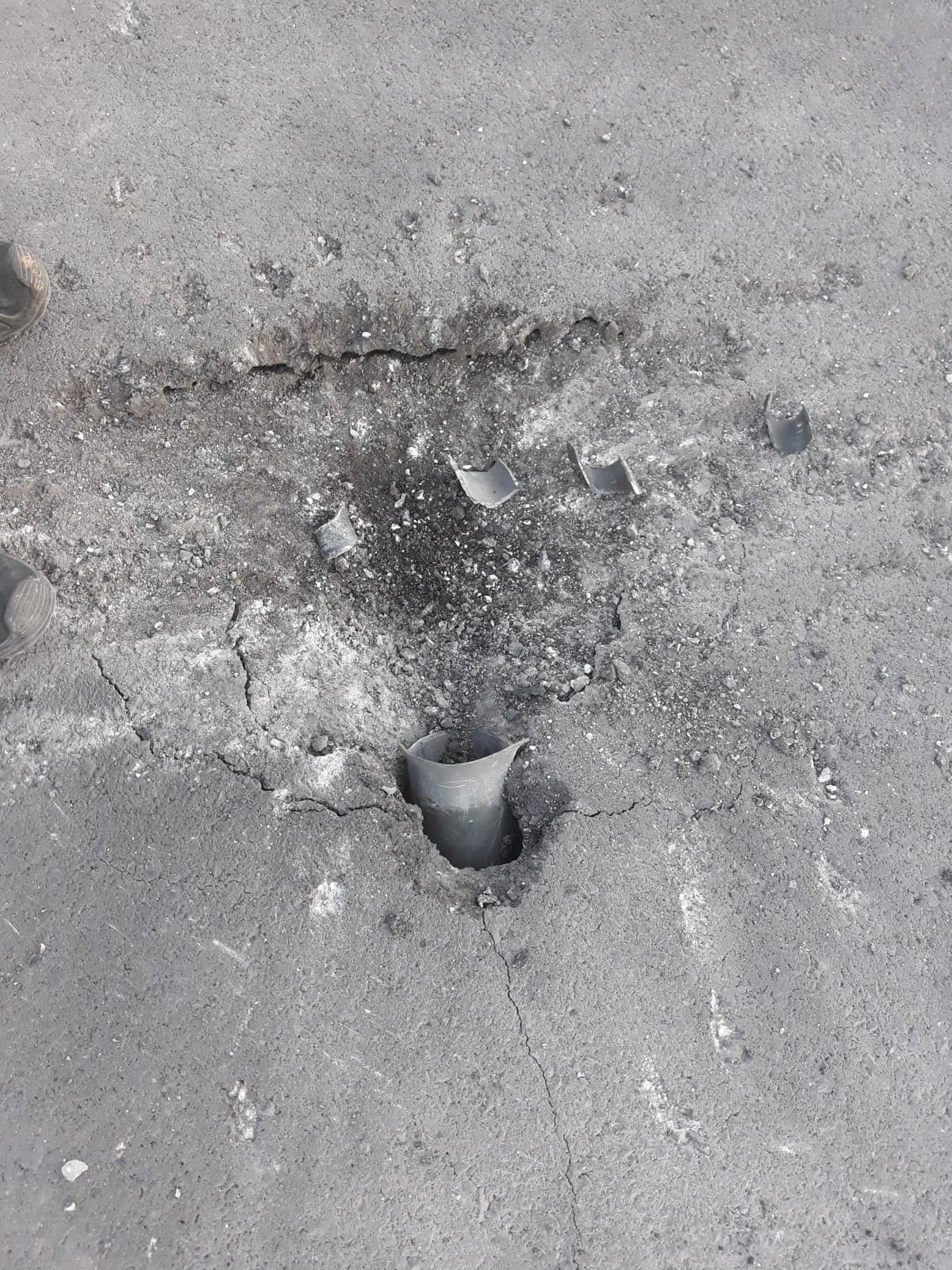
Rocket sirens blared multiples times in communities surrounding the Gaza Strip overnight Tuesday, as Palestinians launched at least a dozen rockets at southern Israel after the military struck a Hamas vehicle in the center of the coastal enclave.

The alarms rang out in towns and small communities throughout the Eshkol, Sha’ar Hanegev, Sdot Negev and Hof Ashkelon regions. At least three rockets were intercepted by the Iron Dome missile defense system. There were no reports of casualties or damage in Israel.

In the hours following the flareup, the army and the relevant regional councils held a “situational assessment” meeting and decided to allow schools to open as usual on Wednesday. No special instructions were given to residents of the area, according to local government officials.

Throughout the day on Tuesday, Palestinians launched incendiary balloons into southern Israel, sparking several fires in the area.

In response, the Israel Defense Forces launched a number of strikes in the Gaza Strip shortly after 1 a.m., targeting a car that the army said belonged to a senior Hamas operative involved in the airborne arson attacks. In addition, the army said it used aircraft and a tank to strike two Hamas outposts in the north of the Strip.

Palestinians said the vehicle that was hit belonged to one of the Hamas terror group’s field commanders and was parked in Gaza’s Nuseirat refugee camp. There were no casualties reported.

“Bombings will be answered with bombings,” Hamas said after the exchanges.

Earlier Tuesday Palestinians said Israeli drones destroyed two cars and an observation post in Gaza that were being used by a group of Palestinians to launch incendiary balloons into southern Israel. The military confirmed that its aircraft conducted three strikes in response to repeated arson attacks from the coastal enclave.

No Palestinian injuries were reported.

The IDF conducted similar airstrikes on Sunday, firing at groups of Gazans launching incendiary kites and balloons into southern Israel. In one case, three people were injured as an IDF drone fired a missile at a cart being used by the group, according to local Palestinian media.

On Monday, a total of 11 fires were caused in southern Israel by airborne arson devices, according to local government officials.

Palestinians prepare a kite with flammable materials that they will fly into southern Israel from Rafah, in the southern Gaza Strip, on June 22, 2018. (Abed Rahim Khatib/Flash90)

The Israeli military has carried out multiple warning strikes in recent weeks at groups of Gazans preparing to launch incendiary devices toward Israel. The army has said repeatedly that it will act to prevent the launch of the airborne incendiary devices and explosives.

Since March 30, Palestinians in the Gaza Strip have launched countless kites, balloons and inflated latex condoms bearing flammable materials, and occasionally explosives, into Israeli territory, sparking near-daily fires that have burned thousands of acres of farmland, parks and forests.

Israeli leaders have warned that the military is prepared to take more intense offensive action against the phenomenon.

Israeli leaders have been split on how to respond to those responsible for the airborne arson attacks, with some calling for the IDF to shoot the kite flyers and balloon launchers on sight, while others argue that it would be a step too far.

Judah Ari Gross contributed to this report.

Echoes of the revolution, but will Iran’s protests bring down the regime?

June 27, 2018

Source: Echoes of the revolution, but will Iran’s protests bring down the regime? – International news – Jerusalem Post

It was a revolution for bread and liberty, welfare and freedom”

BY SAMUEL THROPE
 JUNE 26, 2018 18:28
People protest in Tehran, Iran December 30, 2017 in this still image from a video obtained by REUTER

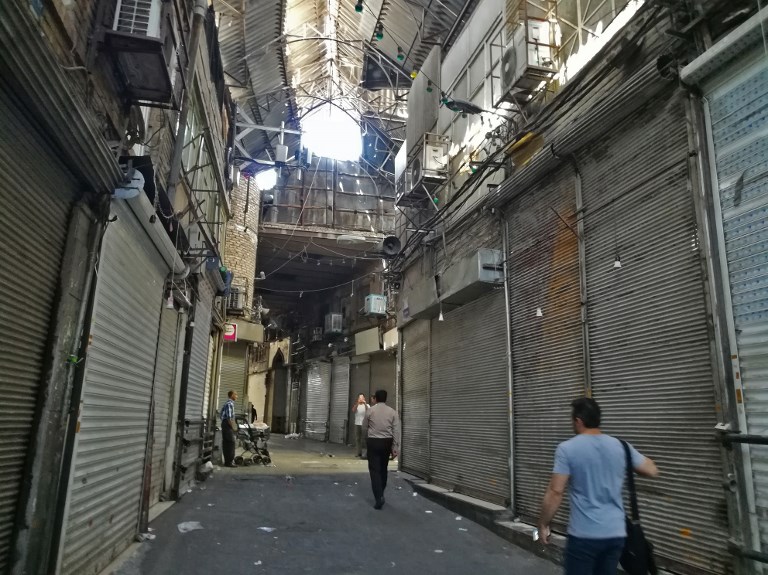
Pictures and video posted to social media and news websites show thousands of demonstrators marching past striking merchants’ shuttered stores – even in Tehran’s central bazaar, a bastion of religious conservatism in the cosmopolitan capital – and closed shops in Kermanshah and Tabriz as well. Police fired tear gas at demonstrators approaching the parliament building in the capital, the BBC and other media outlets reported.

For David Menashri, Professor Emeritus at Tel Aviv University and a leading expert on Iran, this news has a familiar resonance.

“Two years before the Islamic Revolution, I lived in Iran,” Menashri told The Jerusalem Post. “I saw what was bothering the Iranian people. The country was rich and the people were poor. And it’s repeating now.”

“It was a revolution for bread and liberty, welfare and freedom,” he said. “Forty years later, there is no greater liberty or more freedom in Iran today than there was under the Shah – which was no democracy. Under the Shah to speak against the government was a crime; today to speak against them is a sin.”

This week’s demonstrations, the biggest in Iran since 2012, were sparked by rising prices and the plummeting value of Iran’s currency, the rial. It sank as low as 90,000 against the dollar in the unofficial market on Monday from 87,000 on Sunday and around 75,500 last Thursday, according to foreign exchange website Bonbast.com. At the end of last year, the rial stood at 42,890.

While Iran’s economic woes have become more severe in the wake of renewed US sanctions and President Donald Trump’s decision to withdraw from the 2015 nuclear accords, Menashri says that Iran’s problems run deeper.

“It is easy to attribute everything to American policy,” he said. “But even if you had all these sanctions removed, the economic situation would not be good.” Iran’s military involvement in the civil war in Syria, as well as in Lebanon, Iraq and Yemen, and the country’s support for Hamas, have used up most of the influx of funds that Tehran received after signing the nuclear accords, Menashri said.

“Iranians know that a great deal of their economic misery is because of mismanagement and corruption inside the country, because of priorities they don’t share,” he said.

Despite the fact that Iran’s parliament and president are popularly elected, and President Hassan Rouhani won a second term handily last year, Menashri explained that the elected government does not set the country’s economic priorities.

“In Iran, the president is only a president,” Menashri said. “I’m sure that Rouhani would have liked to have a different regional policy for Iran, but he doesn’t have a say. And with the withdrawal of the United States from the deal, the power of the radicals [and Supreme Leader Ali Khamenei] is much more than it used to be.”

However, although observers abroad have predicted that these and earlier protests could lead to the overthrow of the Islamic Republic, Menashri is skeptical.

“It is possible that one of these cycles will expand and lead to that,” he said. “Ultimately, it will happen. The ground is ready, the displeasure is deep. But to come out with a larger movement, you need the intelligentsia and the underprivileged joining a movement together, as it was during the Islamic Revolution.”

During Menashri’s time in Iran on the eve of the 1979 revolution, economic problems also played a major role in the unrest leading up to the overthrow of leader Muhammad Reza Shah Pahlavi.

“The difference is that [then,] there were 37-38 million people, but today Iran is a country of more than 80 million people,” Menashri said. “To deal with the economic problems of a country the size of Iran or Egypt is much more difficult… it requires significant change in the priorities of the government – and to focus inside the country, rather than on policies of projecting power beyond the borders.”

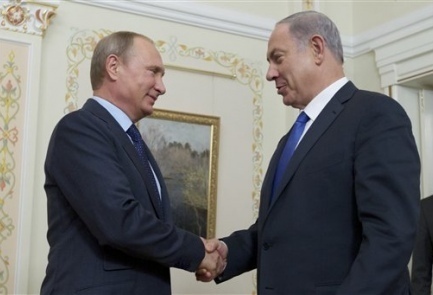
Russian president invites PM Netanyahu to World Cup ‎final in Moscow ‎ 

June 26, 2018

Source: Russian president invites PM Netanyahu to World Cup ‎final in Moscow ‎ – Israel Hayom

Mental health break .

June 26, 2018

Police dog performs CPR on officer


Iran economic protests enter second day amid rial’s collapse

June 26, 2018

Source: Iran economic protests enter second day amid rial’s collapse | The Times of Israel

Rouhani dismisses protests as foreign propaganda as demonstrations show growing anger at regime’s support for regional terror groups at expense of country’s troubled economy

Iranian protesters in central Tehran on June 25, 2018. (AFP Photo/Atta Kenare)

Iranian protesters in central Tehran on June 25, 2018. (AFP Photo/Atta Kenare)

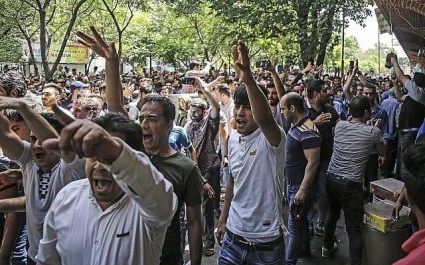
Protests continued in Iran for a second day Tuesday amid an economic crisis that many Iranians are blaming on their government’s foreign policies, even as Tehran dismissed the protests as “foreign media propaganda.”

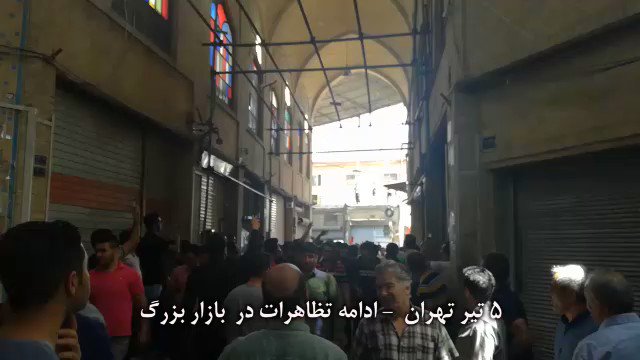
At Tehran’s Grand Bazaar, protesters, including many local shopkeepers, urged owners to close their shops in an expanding strike following the collapse of the country’s currency amid the renewal of US sanctions over the regime’s nuclear program.

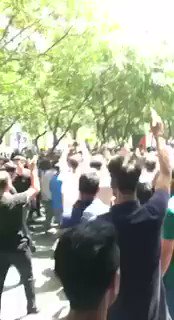
Videos posted on social media showed hundreds of people taking part at the bazaar on Tuesday and hundreds more marching down streets of Tehran.

Iranian President Hassan Rouhani on Tuesday sought to calm growing discontent at the tanking economy, assuring the public the country would be able to withstand the new sanctions imposed by US President Donald Trump in the wake of the American exit from the Iran nuclear deal earlier this year.

In speech broadcast live on state TV, Rouhani blamed the spontaneous demonstrations that erupted across the country a day earlier on “foreign media propaganda,” and accused the US of waging “an economic war” against Tehran.

“Even in the worst case, I promise that the basic needs of Iranians will be provided. We have enough sugar, wheat, and cooking oil. We have enough foreign currency to inject into the market,” Rouhani said according to the Reuters news agency.

The president accused Washington of waging a “psychological, economic and political war” on Iran, and warned it would pay a high price for exiting the 2015 accord that lifted international sanctions in exchange for a scaling back of Tehran’s atomic program.

“Withdrawal was the worst decision he [Trump] could make. It was appalling. It hurt America’s global reputation,” he added. “The US cannot defeat our nation, our enemies are not able to get us to their knees.”

The protests  have seen unusual scenes of demonstrators chanting against continued Iranian spending of billions of dollars on regional proxy wars and support for terrorist groups, which many say has meant less investment in the struggling economy at home.

In recent years, Iran has provided financial aid to Palestinian terror groups Hamas and Islamic Jihad, Lebanon’s Hezbollah, Yemen’s Houthi rebels and Shiite militias in Iraq. Since the start of the Syrian civil war in 2011, Tehran has poured a reported $6 billion into propping up president Bashar Assad’s government.

Iranian shops closed at the ancient Grand Bazaar in Tehran on June 25, 2018. (AFP Photo/Atta Kenare)

Monday’s protests in Tehran and around the country — including economically hard-hit cities like Kermanshah in western Iran — included shouts of “Death to Palestine,” “No to Gaza, no to Lebanon” and “Leave Syria and think of us.” Chants of “We don’t want the ayatollahs” and “Death to the dictator” were also heard at some rallies.
Police attempted to suppress the Monday protests in Tehran with tear gas, but early reports from Iran on Tuesday seem to indicate the demonstrations are only expanding.

Asharq Al-Awsat English

@aawsat_eng

| Protests erupted in the capital for the third straight day – activists

Monday’s protests in Tehran began at the capital’s sprawling Grand Bazaar, which has long been a center of conservatism in Iranian politics and where the ayatollahs’ 1979 Islamic Revolution first gathered pace. Protesters there forced storekeepers to close down their shops.

Masoud Dalvand@Masoud_Dalvand

June 26, ,
Protesters are chanting shop owners to close their stores:
“Close it, close it” , continue to &

At the end of last year, similar economic protests roiled Iran and spread to some 75 cities and towns, becoming the largest demonstrations in the country since its 2009 disputed presidential election. The protests in late December and early January saw at least 25 people killed and nearly 5,000 arrested.

Raman Ghavami@Raman_Ghavami

,
Early morning in Tehran protesters chanting “Iran has become like Palestine,why don’t you stand up people”.
Yesterday protesters in Tehran and Shiraz also chanted “death to Palestine,death to Syria, death to the @bbcpersian.”
A very different picture from Iran.

However, those protests largely struck Iran’s provinces as opposed to Tehran itself. Analysts believe conservative elements in the regime may have encouraged the first protest that took place in Mashhad to try to weaken President Hassan Rouhani, considered a moderate member of the ruling ayatollah class. The protests then spiraled out of control, with people openly criticizing both Rouhani and Supreme Leader Ayatollah Ali Khamenei.

The slogans heard at Monday’s rallies mark a shift in Iranian street protests, where “Death to Israel” and “Death to America” are commonly heard. The protests signaled widespread unease in the wake of US President Donald Trump’s decision to withdraw America from Iran’s nuclear deal with world powers and restore sanctions on the country.

According to Hadashot TV news’s veteran Middle East analyst Ehud Ya’ari, Monday’s protests marked the first time that Iranians have chanted “Death to Palestine” during anti-regime protests.

In the last six months, Iran’s currency has lost almost 50 percent of its value, with the US dollar now buying around 85,000 rials on the open market.

Apart from the rial’s collapse, the Iranian private sector has long been starved of investment, its banking system is crippled by bad loans and record levels of unemployment mean a third of under-30-year-olds are out of work.

A group of protesters chant slogans at the old grand bazaar in Tehran, Iran, June 25, 2018. (Iranian Labor News Agency via AP)

Rouhani’s government has struggled with the economic problems, including high unemployment. A government-set exchange rate of 42,000 rials to $1 has generated a vibrant black market. On Monday, state television quoted Iranian Central Bank chief Valiollah Seif as saying the government plans to create a parallel market next week to combat the black market.

Meanwhile, some conservatives have called for new elections or for Rouhani’s civilian government to be replaced by a military-led one. The Fars news agency, believed to be close to Iran’s paramilitary Revolutionary Guard, made a point Monday of publishing an article from the Sobh-e No daily newspaper describing the government as being ready to “bow down to foreign threats and sit at the negotiation table.”

Eshaq Jahangiri, Iran’s first vice president, was quoted Monday as saying, “We’re on the verge of an economic war by an economic terrorist,” referring to the US.

“Conditions will get worse in future,” Jahangiri said, according to the pro-reform Etemad daily newspaper. “Even our friends and neighbors like Russia, China and Europeans can’t help us today.”

Agencies contributed to this report.

Israeli jets strike Iranian cargo plane unloading munitions in Damascus

June 26, 2018

Source: Israeli jets strike Iranian cargo plane unloading munitions in Damascus – DEBKAfile

( If this is true {it is Debka} then WOW, plain and simple… JW )

Syrian army sources: Israeli airborne missiles hit an Iranian air force Ilyushin Il-76 cargo plane unloading munitions at Damascus military airport early Tuesday, June 26. The explosions caused the plane to burst into flame with a number of unidentified casualties, according to other sources.

Elsewhere, there were loud explosions just north of Israel’s Golan border with Syria. The Syrian army spokesman said they were caused by Syrian anti-air missiles aimed at intruding Israeli fighter jets over Khader village in the Beit Jinn pocket of Mt. Hermon opposite IDF outposts.

DEBKAfile’s military sources don’t rule out the possibility that the attack on the Iranian cargo plane was conducted by Israel ground-to-ground missiles rather than its air force.  This form of IDF attack has recurred in recent weeks against Iranian and Syrian targets across the border.

In a third arena, the Syrian army and a Hizballah-Shiite militia force advanced Tuesday on the Iraqi border and, according to a Syrian military source, captured Post 400 at the provisional border crossing. This opened the door for the entry into Syria a second time of Iraqi Shiite militias under the command of Iran’s Revolutionary Guards. Their previous attempt to cross over on June 17-18 was hammered by the Israeli air force, compelling the Iraqi militiamen to pull back. If the Syrian army’s claim to have seized Post 400 is borne out, then Syria can offer Iran another opportunity for opening up a land bridge from Tehran through Iraq to the Mediterranean and so reverse the effect of the former Israeli action.

Rouhani says Iran will not give in to pressure from Trump

June 26, 2018

Source: Rouhani says Iran will not give in to pressure from Trump – Middle East – Jerusalem Post

On Monday, police patrolled Tehran’s Grand Bazaar as security forces struggled to restore normality after clashes with protesters angered by the rial’s collapse.

BY REUTERS
 JUNE 26, 2018 12:04
Rouhani says Iran will not give in to pressure from Trump

LONDON – President Hassan Rouhani promised Iranians the government would be able to handle the economic pressure of new US sanctions, a day after traders massed outside parliament to protest against a sharp fall in the value of the national currency.

Washington is to start reimposing economic penalties on Tehran in coming months after US President Donald Trump quit an agreement between major world powers and Iran in which sanctions were lifted in return for curbs on its nuclear program.

This may cut Iran’s hard currency earnings from oil exports, and the prospect is triggering a panicked flight of Iranians’ savings from the rial into dollars.

On Monday, police patrolled Tehran’s Grand Bazaar as security forces struggled to restore normality after clashes with protesters angered by the rial’s collapse, which is disrupting business by driving up the cost of imports.

Defending his economic record, Rouhani said the government’s income had not been affected in recent months, and the fall in the rial was the result of “foreign media propaganda.”

“Even in the worst case, I promise that the basic needs of Iranians will be provided. We have enough sugar, wheat, and cooking oil. We have enough foreign currency to inject into the market,” Rouhani said in a speech broadcast live on state television.

The International Monetary Fund estimated in March that the government held $112 billion of foreign assets and reserves, and that Iran was running a current account surplus. These figures suggested Iran might withstand the sanctions without an external payments crisis.

Iran’s judiciary chief warned on Tuesday that the “economic saboteurs,” who he said were behind the fall of rial, would face severe punishment, including execution or 20 years in jail.

“The enemy is now trying to disrupt our economy through a psychological operation. In recent days some tried to shut down the Bazaar, but their plot was thwarted by the police,” Ayatollah Sadeq Larijani was quoted as saying by Fars news agency.

The Iranian government is implementing new plans to control rising prices, including banning imports of over 1,300 products, preparing its economy to resist threatened US sanctions.

Rouhani said the fresh US sanctions were part of a “psychological, economic and political war,” adding that Washington would pay a high price for its actions.

“Withdrawal was the worst decision he (Trump) could make. It was appalling. It hurt America’s global reputation,” he said.

In late December, demonstrations which began over economic hardship spread to more than 80 Iranian cities and towns. At least 25 people died in the ensuing unrest, the biggest expression of public discontent in almost a decade.

Demonstrators initially vented their anger over high prices and alleged corruption, but the protests took on a rare political dimension, with a growing number of people calling on Supreme Leader Ayatollah Ali Khamenei to step down.