Archive for June 2018

Prince William to Abbas: ‘I’m glad our two countries work so closely together’

June 27, 2018

The royal is expected to later meet with Palestinian youth, and to participate in events celebrating Palestinian culture, music and food

Britain’s Prince William, left, and Palestinian Authority President Mahmoud Abbas meet in the West Bank city of Ramallah, Wednesday, June 27, 2018. (Alaa Badarneh/Pool Photo via AP)

Britain’s Prince William was greeted by an honor guard in the West Bank city of Ramallah on Wednesday before sitting down with Palestinian Authority President Mahmoud Abbas.

“I’m very glad our two countries work so closely together and have had success stories with education and relief work in the past, so, long may that continue,” the royal told Abbas.

“My sentiments are the same as yours in hoping that there is a lasting peace in the region,” the prince said.

“The Palestinian side is committed to the peace process with the Israelis, so both states could live peacefully together within the borders of 1967,” Abbas responded.

Britain’s Prince William reviews honour guards before meeting with Palestinian President Mahmud Abbas in the West Bank city of Ramallah on June 27, 2018. (AFP/Ahmad Gharabli)

UK Ambassador to Israel David Quarrey last week defended describing Jerusalem’s Old City as being part of the “Occupied Palestinian Territories” in the prince’s itinerary.

“All the terminology that was used in the program was consistent with years of practice by British governments. It’s consistent with British government policy,” he told reporters.

“The duke is not a political figure,” Quarrey went on. “He’ll be here to see a little bit of the country and to get to meet some of the people here.”

The Duke of Cambridge, the second in line to the British throne, is expected to later meet with Palestinian young people, and to participate in events celebrating Palestinian culture, music and food.

On Wednesday morning he met with Israeli youth and took a stroll down Tel Aviv’s famed Rothschild Boulevard with Eurovision winner Netta Barzilai.

Britain’s Prince William poses for a group photo with Jewish and Arab children at the Neve Golan Stadium in the Israeli Mediterranean coastal city of Jaffa on June 26, 2018. (AFP/Pool/Heidi Levine)

On Tuesday, President Reuven Rivlin asked William to convey to Abbas “a message of peace.”

Hosting the duke in his official Jerusalem residence, Rivlin said the Palestinians need to accept that Jews have returned to their ancestral homeland and that it was about time Israelis and Palestinians end their conflict.

Prince William — the first member of the British royal family to make an official visit to Israel since the state was founded in 1948 — also expressed hope for peace in the Middle East.

On Tuesday evening, the royal hailed Israel as a vibrant country that “thrives on innovation, diversity, talent and excellence,” and said ties were at an all-time high.

He also promised Britain’s support in the quest for peace between Israel and its neighbors.

“I know I share a desire with all of you, and with your neighbors, for a just and lasting peace. The United Kingdom stands with you, as we work together for a peaceful and prosperous future,” he said at an event at the home of the British ambassador in Ramat Gan.

On Thursday, the duke is to tour Jerusalem’s Old City, where he is expected to visit the Western Wall, the Church of the Holy Sepulchre and Al-Aqsa Mosque, though these visits have not been officially confirmed. He will also go to the Russian Orthodox Church of St. Mary Magdalene to visit the grave of his great-grandmother, Princess Alice.

A present .

June 27, 2018

Just watch sport and even world cup soccer .

http://www.myfeed4u.com/section/football/

IDF Attacked Parked Car, After Making Sure Kite Launchers Were Gone

June 27, 2018

IDF Attacked Parked Car, After Making Sure Kite Launchers Were Gone

Israelis living near the Gaza Strip border experienced yet another tense night in the south, as a warplane and a tank attacked a vehicle in the Nusseirat refugee camp belonging to a Hamas operative who leads a squad that launches firebomb kites and balloons at Israel. The IDF also attacked two Hamas observation posts in the northern Gaza Strip.

In response, Hamas launched a high-trajectory attack, and the IDF reports that 13 rocket launchings have been identified in Israeli territory. Ma’an cites a Hamas claim to 19 launches.

In any event, three rockets were intercepted by the Iron Dome aerial defense system, and, according to the IDF Spokesperson, there were no casualties in all those noisy and flashy exchanges of fire.

Which is the real story in the current nightly exchanges between the IDF and Hamas: they are staged, bloodless shows of patriotic valor with neither side trying to hurt the other side in a way that would start the slippery slope to an unavoidable war.

According to Hakol Hayehudi, the IDF continues to make sure no harm comes to enemy terrorists. The Tuesday night attack was against a parked vehicle belonging to a Hamas terrorist (most Israeli media call them “activists”), only after a professional IDF intelligence gathering operation had confirmed that the vehicle was empty and there was no fear that its owner would be hurt, God forbid.

Also, those two Hamas positions that were attacked were empty. Wouldn’t want to hurt a Hamasnik now, would we.

The reason behind this complicated ballet – or, if you prefer kabuki theater – is that Prime Minister Benjamin Netanyahu, Defense Minister Avigdor Liberman, and the entire IDF brass don’t want a war, and neither does the Hamas leadership. But both must appease their rank and file, and so they continue to attack meaningless targets. Hamas, too, has been careful to shoot its rockets at meaningless civilian targets, with the proverbial hits on Israeli kindergartens early enough in the day so no one is hurt, thank God.

Meanwhile, the brazen arson terrorists continue to burn entire swaths of Israeli fields and forests, but those are insured, so it’s not so bad.

For future reference, keep this in mind: we will know that the IDF is serious about stopping Hamas when Arabs start getting killed in those attacks (God forbid).

Trump Admin-Tied Group Presents Plan for Israeli-Palestinian Peace

June 27, 2018

Paper circulating on Capitol Hill would bolster White House effort to win peace

Gaza

Getty Images

BY:

Trump Admin-Tied Group Presents Plan for Israeli-Palestinian Peace

A think-tank with close ties to the Trump administration is circulating on Capitol Hill and elsewhere a new comprehensive plan on how the White House can foster Israeli-Palestinian peace following President Trump’s landmark decision to relocate the U.S. embassy in Israel to the country’s capital city of Jerusalem, according to a copy of the plan viewed by the Washington Free Beacon.

The Security Studies Group, or SSG, a foreign policy organization with close ties to top Trump administration officials, is seeking to garner support for the White House’s latest push to foster peace between Israel and the Palestinians. The plan presents a roadmap the administration can follow to achieve a two state solution for the parties.

Officials are focused on pressuring the Palestinian Authority government to rein in its support for terrorism and accept a good faith offer that could alter the regional balance for both the Israeli and Palestinian people, sources said.

Those who have reviewed the plan told the Free Beacon that SSG is laying the groundwork to counter the Obama administration’s efforts to pressure Israel into accepting a plan many said would compromise the Jewish state’s security. “This is the first comprehensive survey of what the diplomatic terrain looks like now that Trump has reversed many of Obama’s anti-Israel moves,” said one senior GOP congressional staffer familiar with the paper. “American diplomats have a range of new opportunities but also new challenges, because the Palestinians got used to having America slap around Israel for them, and since we’re now back in the business of supporting Israel they’ve been throwing a global temper tantrum and holding their breath until they turn purple.”

“This study lays out a lot of that, including what more can to be done to reverse the anti-Israel UN resolution Obama’s diplomats generated,” the source said.

In addition to outlining multiple failed attempts by past administrations to ink a peace plan, SSG’s paper provides a fresh pathway forward for the Trump administration on the heels of its decision to relocate the U.S. embassy to Jerusalem, a move met with fanfare in Israel but with consternation by many Arab nations.

The paper, authored by Middle East expert Matthew RJ Brodsky, recommends the Palestinians be given the entirety of the Gaza Strip and around 96 percent of the territory linked to it by the West Bank.

The West Bank would subsequently be annexed by Israel by up to 10 percent to account for housing communities and other territory where Israelis have been living for decades. This would include critical land points such as the corridors along the Jordan Valley, according to the plan.

The plan also addresses the refugee issue, which has been a sticking point for some time as Israel seeks to retain the Jewish nature of its country. Accepting a mass wave of Palestinians into the country would fundamentally alter Israel’s population composition.

“The establishment of an independent Palestinian state will provide a national homeland for all Palestinians, including the refugees, and thereby bring an end to the historic Palestinian refugee issue and the assertion of any claims against Israel arising from it,” according to the plan.

Palestinian citizens would be permitted to resettle in a new Palestinian state or continue living in their host countries or other locales that would accept them. Israel would also be pressed to accept Palestinians for humanitarian reasons.

Jerusalem would remain Israel’s undivided capital city under the plan.

“This is a monograph that details the evolution of the conflict’s core issues and tracks their treatment in the three previous U.S.-led negotiating efforts that led to offers to end the dispute,” SSG said in a statement to the Free Beacon. “Entitled, ‘Resolving the Israeli-Palestinian Conflict,’ the SSG also offers what it believes could serve as a negotiating framework for a final status agreement that meets the goal of two states for two peoples with a Palestinian state for Palestinians alongside a secure state of Israel recognized as the nation-state of the Jewish people.”

Brodsky, the report’s author, told the Free Beacon that the Palestinians must be convinced to abandon violence and come to the negotiating table in earnest.

“The bottom line is that the Palestinian Authority needs to get a handle on its mythology, come to the table, and accept a reasonable statehood offer,” Brodsky said. “It will be good for the Palestinian people, the Israelis, and the region. For far too long they have not been honest with their own people, let alone themselves. The peace process isn’t like a fine bottle of wine that improves with age.”

“Each time they turn toward violence and away from the negotiating table, they spoil their future prospects,” he said. “Luckily, America’s regional allies recognize this and can hopefully provide some direction should [PA President Mahmoud] Abbas find himself lost in his own rhetoric again.”

The White House and State Department did not respond to requests for comment on the progress in peace talks over the past months.

Progress in law to withhold terrorist salaries

June 27, 2018

Committee approves in second and third readings law to withhold terrorist salaries from tax revenues Israel transfers to PA.

Committee vote Im Tirtzu

The Knesset Foreign Affairs and Defense Committee approved in second and third readings the law to withhold terrorist salaries from tax revenues Israel transfers to the PA.

Only MK Robert Ilatov of Yisrael Beiteinu voted against the bill, which will be voted on in the Knesset plenum next Monday.

The bill was approved by the committee without the clause requested by Prime Minister Netanyahu and Defense Minister Liberman, a clause that conditions the withholding on a decision of the political-security cabinet.

Bereaved families attending the meeting asked to transfer the funds allocated to a special fund for terror victims, but the committee’s legal advisor explained the move was legally improper.

Law initiator MK Maj. Gen. (res.) Elazar Stern (Yesh Atid) said “the insistence on principles and persistence paid off. The law was approved according to the original wording we submitted. What’s important to me is that no more families join the club of the bereaved and that the Palestinian Authority understand that supporting terror doesn’t pay.”

Knesset Member Avi Dichter (Likud) said, “This is a moral law that sends a clear message to us, to the Palestinian Authority as well as to the entire world: Israel will not be a conduit for transferring money to terrorists.”

Im Tirtzu movement Policy Department head Alon Schwartzer, whose movement is accompanying the bereaved families, welcomed the bill’s approval: “Approval of the bill in second and third readings despite the difficulties is an historic move.

“The State of Israel must do its utmost to stop Arab terror and this law is another step forward in creating a complete deterrence package against terrorism. We’ll continue to accompany the bereaved families who courageously and resolutely lead an uncompromising struggle against terror and for justice,” he added.

MK Robert Ilatov (Yisrael Beiteinu) explained his opposition to the law. “Committee members are celebrating and the bereaved families are crying outside the committee hall. The scandalous clause approved today, that I was the only one who opposed it, says that the money will not really be withheld from the Palestinian Authority, but will be kept on the side in a ‘savings fund’ with compound interest.

“Instead of sending populist messages and making videos for Twitter, I’d expect MKs who approved this clause to look the Israeli public in the eye and explain why at the end of the process, which was accompanied by many congratulations and smiles, the terrorist’s salaries will still reach the Palestinian Authority and eventually the terrorists.”

Erdogan win sets up prolonged stand-off with US

June 27, 2018

Source: Erdogan win sets up prolonged stand-off with US

Dave Clark

,

AFP
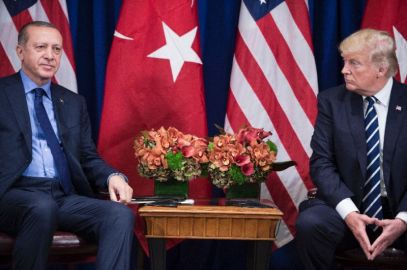
Turkey's President Recep Tayyip Erdogan and US President Donald Trump, in New York in September 2017
Turkey’s President Recep Tayyip Erdogan and US President Donald Trump, in New York in September 2017 (AFP Photo/Brendan Smialowski)
More

Washington (AFP) – Washington’s chilly reaction to Recep Tayyip Erdogan’s election victory and consolidation of his presidential powers reflect expectations that no thaw in US-Turkish ties is imminent.

Erdogan’s position as Turkey’s leader remains strong, but his parliamentary majority now depends not just on his own AKP party but also on the nationalist MHP — no friend to America.

So in the medium term, despite opposition gains, he will have little room to compromise on the long list of issues that have hurt ties with NATO and with US President Donald Trump’s administration.

And in particular, Erdogan is now even less likely to bend on his key beef with Washington: Turkey’s determined opposition to the Pentagon’s continued support for Kurdish militia inside Syria.

“The fact that he had to enter a formal coalition with ultranationalists is very important,” said Asli Aydintasbas, political columnist and a fellow of the European Council on Foreign Relations.

“That dependency is going to be a difficult thing to manage at times,” she added, in a call with US-based journalists.

Soner Cagaptay, head of the Turkish Research Program at The Washington Institute, was also pessimistic about US-Turkish ties.

“If you thought Turkey’s foreign policy already had little room to maneuver on issues of Kurdish nationalism, you’re going to be surprised how that room is going to narrow down,” he said.

Warning that Erdogan’s tough stance has “near universal support” at home, he said: “Turkey is going to voice its opposition to US support for the YPG more frequently and more forcefully.”

As part of its strategy to defeat the jihadist Islamic State group in Syria and northern Iraq, the US-led anti-IS coalition has co-opted the Kurdish YPG militia into the so-called Syrian Democratic Forces (SDF).

Turkey’s government — and a large majority of Turkish voters — see the YPG as little more than an offshoot of the “terrorist” PKK, with which Ankara has been at war for decades.

Turkish troops and allied Syrian Arab rebels have stormed one YPG enclave in northern Syria and now Ankara and Washington are in talks to defuse a stand-off around the town of Manbij.

Kemal Kirisci of the Brookings Institution noted that opposition calls for better relations with the European Union had not impressed voters as much as Erdogan’s “anti-Western narrative.”

– ‘Hostage diplomacy’ –

Nevertheless, he wrote, Turkey’s main challenges in its region and in Syria especially will come from Russia and Iran, suggesting Ankara may have to mend fences with its traditional allies.

But Syria is only one of a raft of issues complicating US-Turkish relations.

Under Erdogan, after a July 2016 coup attempt, dozens of Western citizens were arrested and many charged with terrorism offenses, in what some in Washington do not hesitate to call “hostage diplomacy.”

The case of Andrew Brunson, a Christian pastor who had been in Turkey for more than two decades has become a cause celebre and Trump’s administration has repeatedly demanded that he be freed.

Turkey, conversely, has demanded that the United States send home 77-year-old Fethullah Gulen, the exiled Islamic preacher and leader of a global movement who now lives in Pennsylvania.

Erdogan accuses Gulen of being behind the failed coup and some of the corruption allegations that had dogged his rule, but US authorities have requested evidence to back the extradition bid.

Yet another bone of contention concerns arms sales.

Despite being a leading NATO ally, Turkey has entered into an understanding to buy Russia’s advanced S-400 air defense system, in defiance of US sanctions on Moscow.

The State Department has protested and US lawmakers have suggested the deal could endanger a sale of the F-35 Joint Strike Fighter to Turkey.

Still more issues cloud ties — such as the behavior of Erdogan’s bodyguards, who have twice brawled with peaceful demonstrators in Washington — but things work out better behind the scenes.

– ‘Prickly nationalists’ –

US officials speaking on condition of anonymity say that when Erdogan is not playing up to his anti-American base work can be accomplished.

But they note that, while former secretary of state Rex Tillerson and national security adviser H.R. McMaster built a rapport with Ankara, their successors Mike Pompeo and John Bolton have yet to do so.

Colonel Rich Outzen, a US army and State Department policy advisor, said he hadn’t expected the election to make ties any easier, given the Turkish electorate’s 45 to 50 percent block of “prickly nationalists.”

Speaking in a personal capacity at a think tank event, he admitted that none of the outstanding disputes are “made any easier” by the result.

But he said talks on resolving Turkey’s concerns about Manbij and the border, while a “difficult process”, had left him “reasonably upbeat.”

US Army purchases Trophy tank active defense system

June 27, 2018

Source: US Army purchases Trophy tank active defense system

American military signs $193 million deal to outfit M1 Abrams tanks with Rafael-developed active defense system that detects and intercepts threats while communicating location of attacker.
Rafael Advanced Defense Systems announced Tuesday that a $193 million sales agreement was signed whereby the US military will purchase its Trophy active defense system for tanks and armored personnel carriers.

The deal was signed between Rafael and US-based defense contractor Leonardo DRS which will supply the American military with the systems, to be installed on the M1 Abrams battle tank; they will be manufactured in the US and Israel.

The Trophy, developed jointly by Rafael and Elta Systems, is the only active defense system for armored vehicles in the world. it has been successfully tested under operational conditions and offers troops survivability and maneuverability capabilities.The system is installed on hundreds of ground combat platforms in the IDF, including Merkava Marks 3 and 4, as well as the Namer armored personnel carriers. The product is currently under supply contracts to be installed on more than 1,000 IDF platforms. The system has already proven its defense capability against anti-tank missiles and other threats.

Tank with Trophy system

Tank with Trophy system

Trophy consists of sensors that detect and classify the threat and its precise location. Next, the system launches a countermeasure to intercept the threat. Date regarding the position of the attacker is transmitted by the Trophy system to field forces in order to decisively neutralize the threat.Since its first battlefield interception in March, 2011, the system has proven itself numerous times, especially during Operation Protective Edge in Gaza.

“(The contract) is the culmination of years of intensive work by government-backed industries to protect US military fighters and address critical capacity gaps in its armored configuration,” said Aaron Hankins, vice president and general manager of Leonardo DRS’ Land Systems.

“Rafael has been providing defense solutions to the US Army for more than two decades with passive protection for vehicles such as the Bradley, Stryker and AAV7, and we are proud to continue to do so with the ‘Trophy’ system,” said Moshe Elazar, deputy CEO and drector of Rafael’s Land and Sea Division.

Chief of staff: IDF well prepared for war

June 27, 2018

Source: Chief of staff: IDF well prepared for war

A day after the IDF ombudsman warns of a series of failures in the IDF apparatus that could come to the fore in the army’s levels of readiness for a conflict, Lieutenant-General Eisenkot says, ‘We have made a significant step in securing the IDF’s preparedness for war.’

“I visit training sessions and see the operational activity proving that the IDF has high abilities and good preparedness, along with the duty to locate weaknesses and failures and work vigorously to fix them,” Eisenkot said Monday evening at a tribute to the reserve forces at the Knesset. “I am very proud of the command ranks, which has scored noteworthy achievements.

“As part of the five-year Gideon efficiency plan, we have made a significant step in securing the IDF’s preparedness for war. We have built an advanced service model implementing the government’s decision to shorten the service, develop the commanders and non-commissioned officers and utilize the human capital to the fullest.”

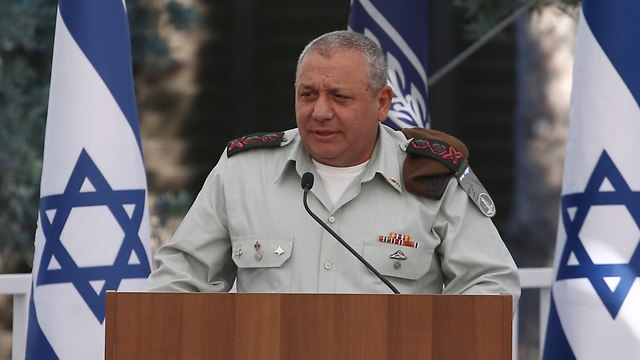
Eisenkot. ‘Reserve forces’ training and skills increased significantly in 2017’  (Photo: Ohad Zwigenberg)

Eisenkot. ‘Reserve forces’ training and skills increased significantly in 2017’ (Photo: Ohad Zwigenberg)

According to the IDF chief, “We are in the midst of a complicated period in terms of security, filled with challenges from the north and from the south, and we must remember that the IDF’s strength depends on people, spirit, equipment, skills and unity. We will keep reinforcing them through actions expressing their supreme importance, while showing respect for the dedication and loyalty of the reserve forces as a team serving the State of Israel.”

Eisenkot noted that “the reserve forces’ training and skills increased significantly in 2017. This year, we doubled the number of reserve forces participating in operational occupation, to allow the IDF’s tip of the spear forces to increase the training to 50 percent of their time.

“The IDF units on the ground, in the air and in the sea are operating around the clock and tested on a daily basis in thwarting terror in Judea and Samaria, in protecting the state’s borders in the south and in the north and in continuous offensive activity to thwart advanced abilities and reduce the threats to the state.”

The IDF ombudsman warned on Monday that a new gloomy annual report which he has produced points to a plethora of shortcomings in the military’s operational capabilities, casts doubt on its readiness for a conflict in the south and highlights the subpar standards in the quality among senior military staff.

General (res.) Yitzhak Brik published what will be his final annual report as IDF and Defense Ministry ombudsman having occupied the post for a decade.

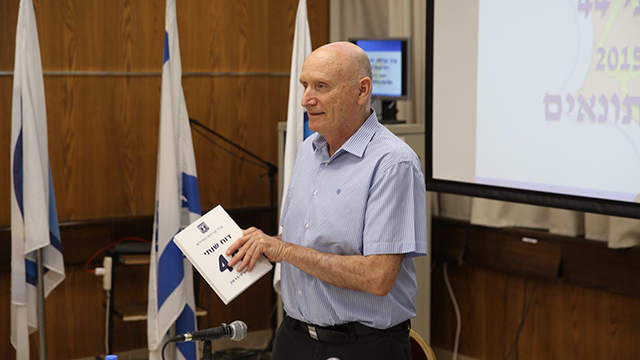
IDF ombudsman, Major-General (res.) Yitzhak Brik  (Photo: Motti Kimchi)

IDF ombudsman, Major-General (res.) Yitzhak Brik (Photo: Motti Kimchi)

“If I read you these reports, you would fall over,” Brik said of the report whose content is not made available to the public.

The report is rife with pessimistic conclusions and highlights a series of failures in the IDF apparatus that he says could come to the fore in the IDF’s levels of preparation during the next war.

According to Brik, concerning discrepancies exist between the public declarations and bravado about the IDF’s capabilities and the realities on the ground.

“There are documents that back up my claims and not only direct statements from senior officers and officers in the field,” he explained.

“There is a lack of regular military monitoring of military processes, disciplinary problems and a failure to fulfil orders. Take as an example the fact that two billion shekels were invested in emergency storage units after the Second Lebanon War, but the project was abandoned,” Brik said.

Bibi’s outreach to the Iranian people

June 27, 2018

Another great video from Bibi (1 min 12 sec long)

Reaching out to the Iranian people, using the World Cup.

Stoking the fires of discontent amongst the Iranians by telling the uncomfortable truth about the Iranian leadership… 

Good tactics, good skills from Bibi.

And right at the start of the video he shows off some pretty good soccer skills as well.


Syrians fleeing to Israel border as Jordan shuts gates amid Daraa offensive 

June 27, 2018

Source: Syrians fleeing to Israel border as Jordan shuts gates amid Daraa offensive | The Times of Israel

Residents say Golan frontier is safest since ‘regime and Russian airplanes cannot strike’ there; UN counts 50,000 displaced, with nowhere to go

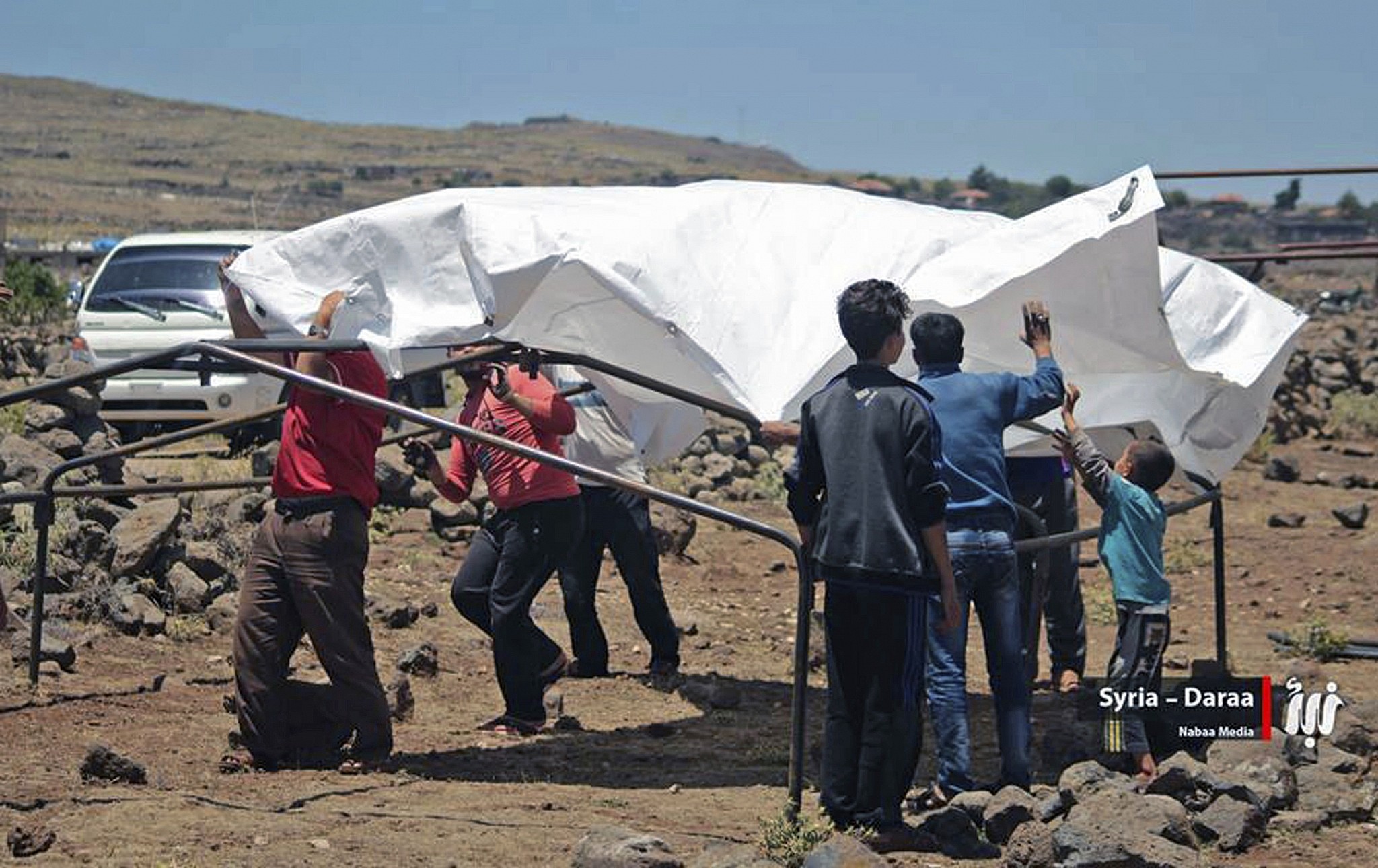
This June 22, 2018 photo provided by Nabaa Media, a Syrian opposition media outlet, shows people who fled from Daraa setting up a tent in the village of Bregia, near the Syria-Israel border, southern Syria. (Nabaa Media, via AP)

This June 22, 2018 photo provided by Nabaa Media, a Syrian opposition media outlet, shows people who fled from Daraa setting up a tent in the village of Bregia, near the Syria-Israel border, southern Syria. (Nabaa Media, via AP)

Civilians in southern Syria have begun to flee to the border with Israel, as government forces on Tuesday pushed deeper into rebel-held territories in Daraa province under the cover of airstrikes and Jordan said it would not accept any more refugees.

The United Nations estimated that up to 50,000 people have been displaced by the week-long offensive.

Jordan said its borders will remain closed for any new refugees, calling on the UN to provide security in southern Syria.

Jens Laerke, a spokesman for the UN Office for the Coordination of Humanitarian Affairs, said aid officials were “deeply concerned” for those fleeing the fighting and heading toward the sealed border with Jordan.

He called on warring parties to “ensure the protection of these civilians, according to international law.”

Daraa’s residents described living in extreme fear and said many had also headed to the border with Israel, believing it to be safer.

“The safest place is the border with Israel because the regime and Russian airplanes cannot strike the area near the Israeli border,” said Waseem Kiwan, a 36-year old civilian in the village of Tafas north of Daraa city.

Qalaat Al Mudiq@QalaatAlMudiq

S. : Central Op. Room announces one T-72 destroyed with another strike on Busra Harir front. Pictures show a Colonel & a Rebel cmdr of mortar battalion killed in that region. pic.twitter.com/9ZS88NAXc4

Qalaat Al Mudiq@QalaatAlMudiq

S. : civilians displaced due to Assad & |n bombardment amassing near border with . http://wikimapia.org/#lang=en&lat=32.953368&lon=35.899887&z=11&m  pic.twitter.com/AGnDtCUNNl

View image on TwitterView image on TwitterView image on TwitterView image on Twitter
He said nothing is spared in the intensive bombing campaign, including makeshift hospitals, civil defense centers, and UN affiliated offices.

“The area is heading toward a catastrophe, a humanitarian catastrophe in every sense of the word,” he said. “People are living in extreme fear.”

An Israeli military spokesperson said the IDF “is prepared for a large variety of scenarios and is monitoring the events in the area.”

Israel has never taken in Syrian refugees except temporarily to provide medical treatment.

In January 2017, Israel announced a plan to take in 100 Syrian refugees, but officials said the initiative never got off the ground and no Syrians were allowed in the country.

Younis Shtawi, a police officer in the Daraa village of Umm al-Mayadeen, said several villages, including Busra al-Harir, Atesh, and communities in al-Lujat have been emptied of people in recent days.

“No one stayed,” Shtawi said.

Since last Tuesday, Syrian troops have targeted rebel-held areas in eastern Daraa, one of the country’s last major rebel strongholds.

Smoke rises above buildings during an airstrike by Syrian regime forces on the town of Busra al-Harir, east of the southern Syrian province of Daraa on June 24, 2018. (Mohamad ABAZEED/AFP)

The strategic area was part of a truce deal reached last July between the United States, Russia, and Jordan.

The offensive’s goal appears to be regaining control of the border crossing with Jordan, which has been in rebel hands since 2015. Syrian President Bashar Assad’s recent military victories, including the capture of Damascus suburbs and southern neighborhoods, have propelled the push.

Opposition activists said Syrian and Russian warplanes are taking part in the offensive. Russia’s air force threw its weight behind Assad’s forces in 2015, turning the tide of the war in his favor.

On Tuesday, the pro-government Central Military Media said Syrian troops gained control of al-Lujat, a rocky area in northeastern Daraa. It said the capture would have a domino effect on other parts east of Daraa and cut rebel supply lines.

Other pro-government media said the army intends to bring the entire province under its control and is likely to move on to western Daraa, where it has conducted a series of airstrikes Monday.

The Britain-based Syrian Observatory for Human Rights, a war-monitoring group, reported that government troops were advancing in al-Lujat and captured seven new villages in the area.

Displaced Syrians are seen leaving opposition held areas of Daraa on June 26, 2018. ( Mohamad ABAZEED/AFP)

Daraa-based opposition activist Osama Hourani denied the government controlled parts of al-Lujat, saying the area, known for its caves and rocky plains, will be a challenge for Assad’s troops.

The US has said the Syrian offensive risked broadening the conflict and called on Russia to end what it called violations of the truce.

Israel has also carried out a series of strikes recently on Syrian and Iranian forces in the area, warning against the expansion of Iran’s role in Syria. Iranian advisers and Iran-backed militias are embedded with Syrian troops.

The UN World Food Program put the number of displaced from the Daraa fighting at nearly 50,000, saying it has delivered urgently-needed food across the Syria-Jordan border in the west. It said the fighting closed supply routes, causing a spike in prices of fuel and other basic supplies.

“We’re sleeping in the open air, under the trees, in the mosques and schools. Those lucky to find a tent have to share it with four or five other families,” a displaced man named Nidal told WFP.

Jordan’s Foreign Minister Ayman Safadi urged the UN to provide security in southern Syria. “Our borders will remain closed,” Safadi wrote on his Twitter account.

Jordan is already hosting about 660,000 registered Syrian refugees and estimates that the number of displaced Syrians in the overburdened country is twice as high.