Archive for June 2018

Israel to join largest international maritime exercise for first time

June 3, 2018

Source: Israel to join largest international maritime exercise for first time – Israel News – Jerusalem Post

Taking place off of the coast of Hawaii, 26 nations will participate in the US-led Rim of the Pacific (RIMPAC) from June 27 to August 2nd.
BY ANNA AHRONHEIM
 JUNE 3, 2018 13:03
Amid rising tension with Iran, Israel to join largest int'l navy exercise

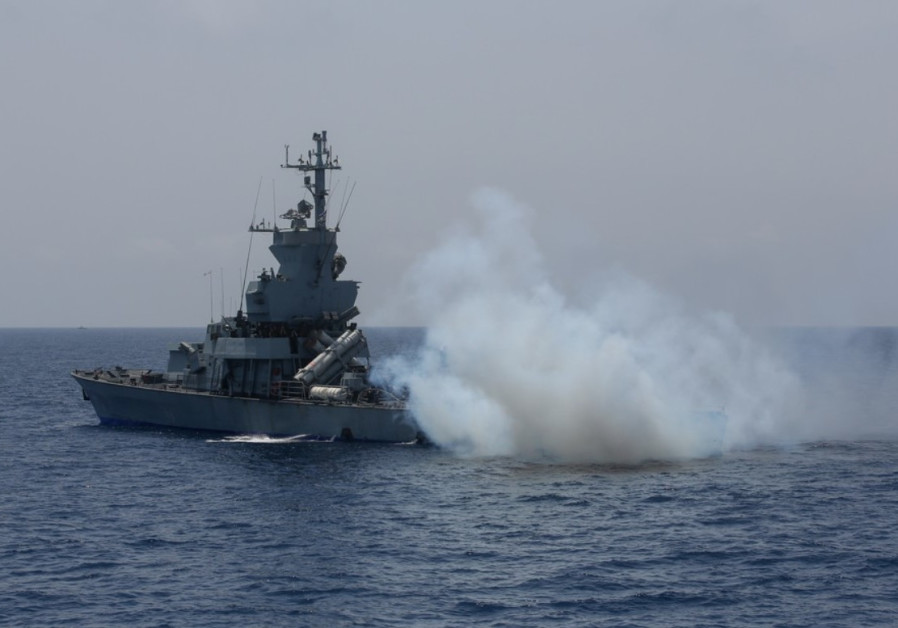
In face of rising tensions with Iran, Israel will participate – for the first time – in the biennial Rim of the Pacific (RIMPAC) multinational naval exercise led by the US 3rd fleet off of the coast of Hawaii and Southern California later this month.

RIMPAC, the world’s largest international maritime exercise, will be be held from June 27 to August 2nd and will see the participation of 26 nations, 47 surface ships, five submarines, 18 national land forces, and more than 200 aircraft and 25,000 personnel.

With the theme of RIMPAC 2018 being “Capable Adaptive Partners,” the drill will work to increase multi-national cooperation and trust as well as enhance interoperability of troops.

Israel will be joining other first-time participants Brazil, Sri Lanka and Vietnam.

Other countries participating in RIMPAC 2018 are Australia, Brunei, Canada, Chile, Colombia, France, Germany, India, Indonesia, Japan, Malaysia, Mexico, Netherlands, New Zealand, Peru, South Korea, the Philippines, Singapore, Thailand, Tonga and the United Kingdom.

China was uninvited from participating due to its ongoing militarization of the disputed Spratly Islands in the South China Sea.

According to the US Navy RIMPAC will focus on a wide range of capabilities “critical to ensuring the safety of sea lanes and security on the world’s oceans” with drills ranging from disaster relief to counter-piracy, mine clearance operations, air defense exercises to complex maritime warfare.

“Participating nations and forces will exercise a wide range of capabilities and demonstrate the inherent flexibility of maritime forces,” read a statement released by the US 3rd fleet.

“These capabilities range from disaster relief and maritime security operations to sea control and complex warfighting. The relevant, realistic training program includes amphibious operations, gunnery, missile, anti-submarine and air defense exercises, as well as counter-piracy operations, mine clearance operations, explosive ordnance disposal, and diving and salvage operations.”

The combined live field training exercise will included tactical level and limited operational level training and will feature live firing of a Long Range Anti-Ship Missile (LRASM) from a US Air Force aircraft, surface to ship missiles by the Japan Ground Self-Defense Force, and a Naval Strike Missile (NSM) from a launcher on the back of a Palletized Load System (PLS) by the US Army.

While Israel’s Navy is relatively small compared to other IDF corps it has a significant amount of territory to protect since the expansion of the country’s exclusive economic zone (EEZ) from 40 miles to 150 miles four years ago.

Israel regularly participates in naval exercises with the United States such as the trilateral Noble Dina exercise between the US, Israeli and Greek navies as well as a joint IDF Special Forces and US Marines military exercise in the Negev Desert dubbed ‘Noble Shirley,’ which involved special units from the Israeli Air Force, Navy and ground forces.

Israeli Navy’s Salvage and Underwater Missions Unit also held a wide-ranging two-week drill in Haifa dubbed “Noble Melinda” with its counterparts from the US and France where the three navies drilled on scenarios involving naval mines, underwater demolitions and sea-based terror attacks.
Report: US has reservations about Israel-Russia deal

June 3, 2018

Source: Report: US has reservations about Israel-Russia deal

Asharq Al-Awsat reports Washington wishes to continue exerting pressure on Syrian President Assad, and so it has reservations on Israeli-Russian deal that would see Iranian, Hezbollah troops withdrawn from southern Syria and Assad forces take over.
The United States has reportedly expressed reservations about the understandings reached between Israel and Russia on the withdrawal of Iranian and Hezbollah forces from southern Syria, the London-based Asharq Al-Awsat newspaper reported Saturday, citing Western diplomatic sources.According to the paper, the American reservations stemmed from the US desire to continue exerting pressure on Syrian President Bashar Assad.

According to an earlier report in Asharq Al-Awsat, the Iranian and Hezbollah forces will initially pull back its forces to within 20 kilometers of the border, and later to a range of 60 to 70 kilometers, with Russia underlining the fact that this was a gradual process.

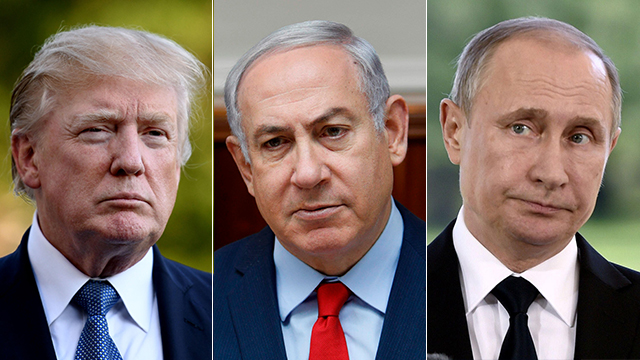
US President Trump, Israel's Prime Minister Netanyahu and Russian President Putin (Photo: MCT, AFP, Reuters)

US President Trump, Israel’s Prime Minister Netanyahu and Russian President Putin(Photo: MCT, AFP, Reuters)

Russian President Vladimir Putin reportedly wanted Israel to allow Assad’s army to move southwards to the Jordanian border and secure all of the Syrian Golan Heights.

In return, the Russian president is willing to promise Israel that Iran’s Revolutionary Guards Corps and Iran-affiliated militias will not be present in the territories Assad’s army takes.

Assad himself has rebuffed claims of an Iranian military presence in his country, while accusing Israel of launching attacks on his territory and of propagating “lies” about its massive aerial offensive launched earlier in May.

The embattled Syrian president told Russia Today that Iran’s presence in his country was limited to officers who were assisting the Syrian army. Apparently referring to the May 10 attack by Israel, Assad said “we had tens of Syrian martyrs and wounded soldiers, not a single Iranian” casualty.

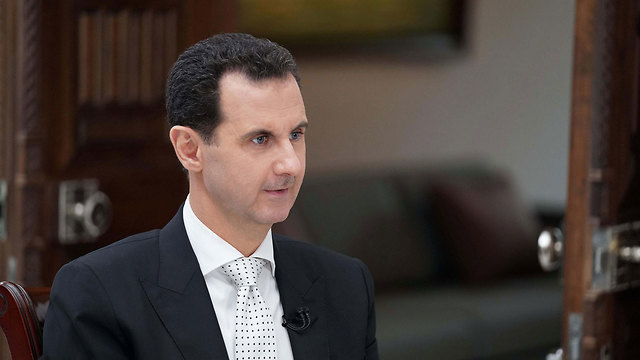
Syrian President Bashar Assad (Photo: Reuters)

Syrian President Bashar Assad (Photo: Reuters)

However, Iran-backed militias, including Lebanon’s Hezbollah terror group, have played a big role in support of Assad during the conflict. Iran’s Revolutionary Guards have also deployed in the country, and scores of Iranian soldiers have been killed in battles with insurgents in Syria, including a number of officers.

Israel, which is deeply alarmed by Tehran’s influence in Syria, earlier this month said it destroyed dozens of Iranian military sites in Syria, after Iranian forces fired rockets at Israeli territory for the first time.

Syria’s Foreign Minister Walid Muallem echoed his president’s claims on Saturday, saying that Iranian military advisers are embedded with Syrian troops, Tehran has no combat forces or fixed bases in the country.

Muallem insisted to reporters that Iran’s presence is legitimate and based on an invitation of the government, and that Israel was making false claims to try and pressure Iran, its archrival.

“There are Iranian advisers in Syria some of whom were martyred while working with the Syrian Arab army and their presence is part of an agreement and in coordination with the armed forces on where they should be,” Muallem said. “There are no fixed military bases for the Islamic Republic of Iran and what Israel is circulating are lies.”

“When the conspiracy against Syria began in 2011 our brothers in the Islamic Republic of Iran came to help Syria in fighting terrorism,” Muallem said adding that the Syrian people are “grateful” for this help from Iran.

“As long as there is war on terrorism, Syria as a sovereign state will cooperate with whoever it wants in fighting terrorism,” he said.

Muallem denied reports that an agreement was reached between regional and other powers over the situation of southwestern Syria where the country’s Golan Heights are located.

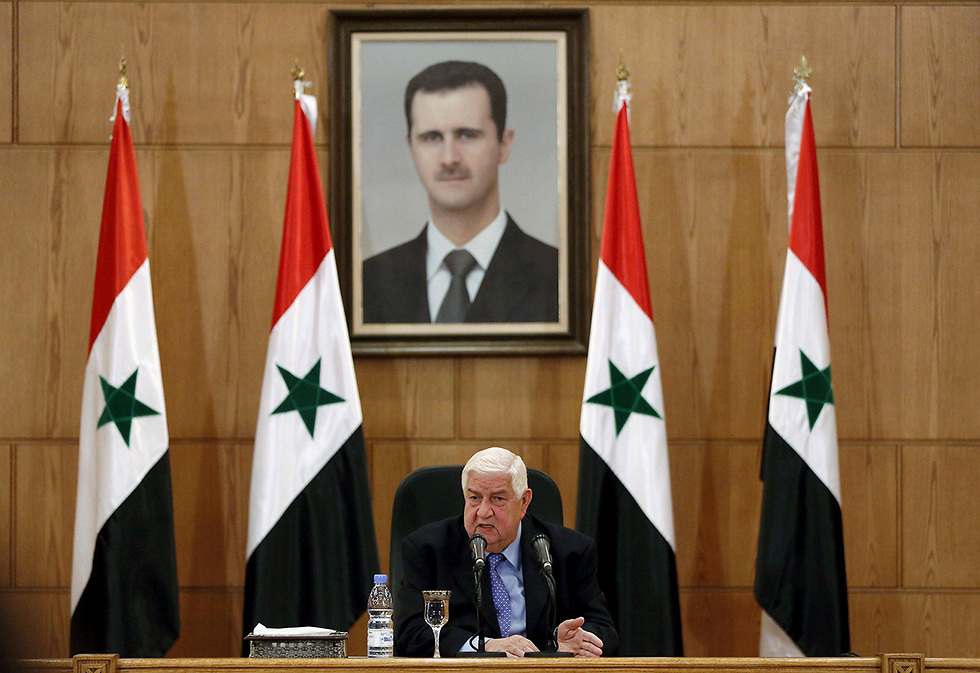
Syrian Foreign Minister Walid Muallem  (Photo: Reuters)

Syrian Foreign Minister Walid Muallem (Photo: Reuters)

On Friday, Russia’s ambassador to the UN Vasily Nebenzia said he heard from the news that an agreement was reached on “certain disengagement in the southwest of Syria and, I think, my understanding is that an agreement has been reached.”

However, asked about Nebenzia’s comments Muallem said no agreement has been reached for southern Syria, adding that Damascus is not currently involved in any negotiations over the area.

Earlier this week, Russia’s Foreign Minister Sergey Lavrov said Syrian troops should be positioned on the border with Israel. The area between the southern province of Daraa and the Golan Heights has emerged as a flashpoint in a wider standoff between Israel and Iran, and the United States has warned it will take action to protect a cease-fire there.

The Britain-based Syrian Observatory for Human Rights, a war monitor, reported on Thursday that Iranian troops and members of Lebanon’s Iran-backed Hezbollah group are getting ready to withdraw from southern Syria.

A Syria-based official with the Iran-led axis of resistance denied the report.

Muallem reiterated the government’s position that it aims to regain control of the whole country.

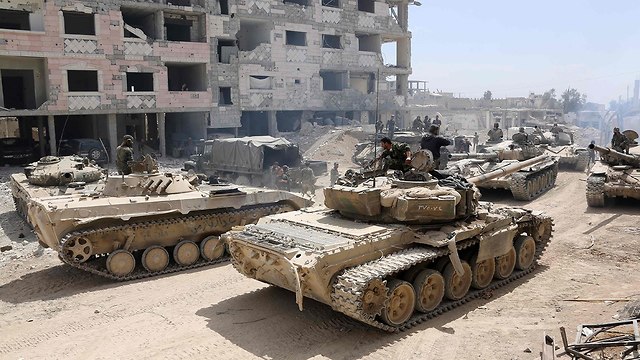
Syrian army tanks (Photo: AFP)

Syrian army tanks (Photo: AFP)

Syrian government forces, in their strongest position since the early months of the seven-year conflict, have driven rebels out of all territory near the capital Damascus this year.

For weeks there have been reports that the government’s next target would be the zone in the south, one of only two large areas left in the hands of fighters seeking to topple Assad.

Rebels control stretches of southwest Syria, bordering the Israeli Golan Heights, while Syrian army troops and allied Iran-backed militias hold nearby territory.

“We strongly support Russian efforts to drive terrorists out of the Syria-Jordan border and to bring the area under Syrian army control,” the secretary of Iran’s Supreme National Security Council, Ali Shamkhani, told the Shargh Daily.

He also repeated Tehran’s denial that it has military advisors in that part of Syria. “We have said before that Iranian military advisers are not present in southern Syria and have not participated in recent operations,” Shamkhani said.

The Associated Press and Reuters contributed to this report.

Israel, Damascus deny deal reached on southern Syria 

June 3, 2018

Source: Israel, Damascus deny deal reached on southern Syria – Israel News – Jerusalem Post

Netanyahu: We maintain right to strike at Iran.

BY TOVAH LAZAROFF
 JUNE 3, 2018 00:25
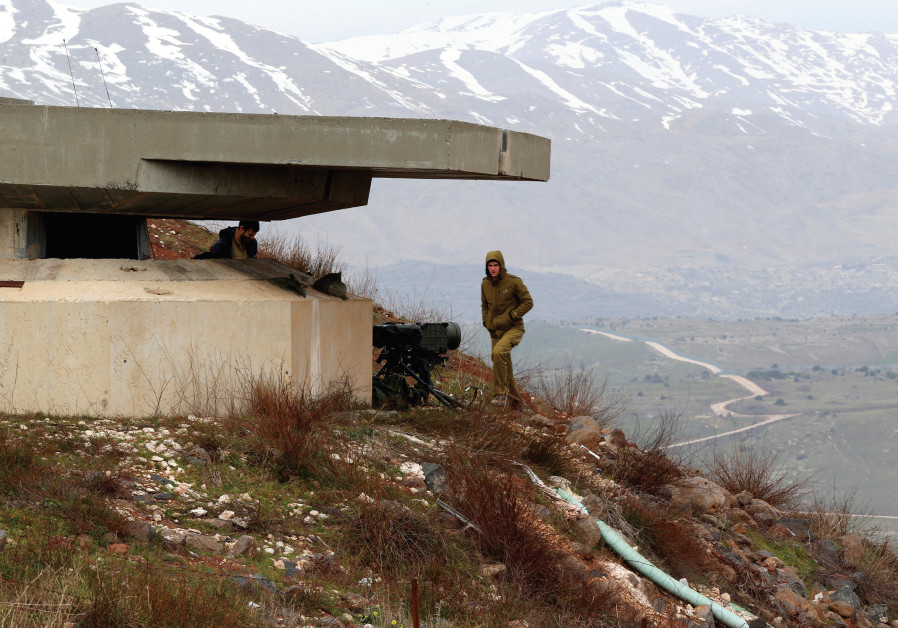
AN ISRAELI soldier stands next to the Golan border with Syria. Iran’s encroachments into Syria has l

AN ISRAELI soldier stands next to the Golan border with Syria. Iran’s encroachments into Syria has led to increased tensions.. (photo credit: REUTERS)

“Israel denies reports that an understanding has been reached,” a diplomatic source said on Saturday.

The source added that Prime Minister Benjamin Netanyahu had spoken last week with both Russian President Vladimir Putin and US Secretary of State Mike Pompeo about Syria and Iran.

Netanyahu “emphasized that Iran must withdraw from all of Syria and that Israel would continue to maintain its freedom to act against Iranian military entrenchment anywhere in Syria,” the source said.

Syrian Foreign Minister Walid Moualem said that an agreement on southern Syria must include a US withdrawal of its forces from the Tanf base in the south.

He added that Damascus had not engaged in talks over the country’s southern region.

“Do not believe any statements that talk about agreements in the south unless you see the United States withdraw its forces from Tanf base.

It must withdraw its forces from Tanf base. This is Syrian land and there is no doubt of Syria’s sovereignty over it,” Moualem said.

Russia has already called for all foreign forces to leave Syria.

On Friday, the London-based Arabic newspaper Asharq al-Awasat reported that Israel and Russia had agreed to keep Iran out of southern Syria.

Just one day earlier, the Syrian Observatory for Human Rights said it had seen a Russia-backed plan to return government forces to the country’s border areas with Israel and Jordan. It further reported that Iran and its proxy forces, such as Hezbollah, were preparing to withdraw from southern Syria.

Defense Minister Avigdor Liberman, who visited Moscow briefly on Thursday to meet with his Russian counterpart Sergei Shoigu, said that he felt that Israel’s security concerns were understood.

At the UN on Friday, Russian Ambassador Vasily Nebenzya indicated that an agreement had been reached with regard to southern Syria.

“I heard news that were in the press and elsewhere about an agreement reached on certain disengagement in the southwest of Syria and I think my understanding is that the agreement was reached. Whether it has been implemented as of now I cannot answer, but I understand that the parties that were involved in reaching the agreement are satisfied with what they reached,” he said, according to the Russian media site TASS.

“If it has not been done by now, it will be done in the near future,” he added.

The Syrian government wants to recapture insurgent territory in the southwest through a settlement in which fighters accept state rule or leave.

Southwest Syria, near the borders with Jordan and Israel, remains one of the big chunks of Syria still outside the control of the state, which has recovered swathes of the country with the help of Russian jets and Iran-backed militias.

Rebel factions hold stretches of Quneitra and Deraa provinces in the southwest, bordering the Golan Heights, while Syrian army troops and allied forces control nearby territory.

Moualem said Damascus had communicated with the US-backed Syrian Democratic Forces (SDF) but no negotiation process had started over the fate of their territory in the north and east.

He added that Raqqa city, which the Kurdish-led SDF militias seized from Islamic State with US support, “must be rebuilt and liberated” from any foreign presence.

Syrian government forces, in their strongest position since the early months of the seven-year conflict, have driven rebels out of all territory near Damascus this year.

For weeks there have been reports that the government’s next target would be the zone in the south, one of only two large areas left in the hands of fighters seeking to topple President Bashar Assad.

Washington says any offensive in the area would violate a cease-fire it has jointly sponsored with Moscow for that part of Syria, and has warned it would take “firm measures” in response.

The secretary of Iran’s Supreme National Security Council, Ali Shamkhani, told the Shargh daily that his country had no military advisers in southern Syria.

“We have said before that Iranian military advisers are not present in southern Syria and have not participated in recent operations,” Shamkhani said.

“We strongly support Russian efforts to drive terrorists out of the Syria-Jordan border and to bring the area under Syrian army control,” he added

New Gaza flareup: Four more Palestinian rocket volleys spark 15 Israel airstrikes 

June 3, 2018

Source: New Gaza flareup: Four more Palestinian rocket volleys spark 15 Israel airstrikes – DEBKAfile

Gaza Palestinians violated their own ceasefire Saturday night, June 2, after just three days, making naught of Israel’s claim of deterrence.

For the latest round in their three-month offensive, the Palestinians Saturday night switched to a more frugal method: instead of letting dozens of single rockets loose across a wide swathe of southern Israel, they launched small volleys at their unfortunate neighbors. They calculated they could traumatize Israel unendurably no less than they did by last week’s massive rocket barrage, while economizing on rockets and laying in stocks for the long haul.

And so on Saturday night, twin-rocket salvos hit Sderot, the Eshkol district, the Hof Ashkelon council and Shear Hanegev, sparking loud red warning sirens across the region up to Lachish. Iron Dome downed four.

Israel’s retaliation was immediate: air strikes against 10 Hamas military targets in the first round, followed by another five after dawn Sunday – most hitting factories turning out or storing weapons and ordnance and the Hamas naval compound on the Gaza shore. No casualties were reported by the Palestinians.

Only two days ago, after the Palestinians declared a ceasefire following Egyptian mediation, high-placed Israeli officials were saying “It will take them time to repair the fundamental damage we caused their military infrastructure,” and from the government: Israel will meet non-violence in kind. A senior IDF officer in a briefing to reporters explained that it was decided at the highest level to cut the Gaza operation short so as not to detract from the principal focus against Iran in the north.

In no time, this posture was proved untenable by two unpleasant doses of reality:

  1. The highest Israeli level, both government and military, is not in control of initiatives for Gaza flare-ups or ceasefires. Those decisions are in the hands of the chiefs of the Palestinian terrorist organizations Hamas, Islamic Jihad, the smaller fry – and their patrons.
  2. If the IDF shies from fighting an enemy on two fronts, how will it manage if the potential of conflagrations on three fronts materializes?
  3. The Palestinian “ceasefire” applied only to rocket and mortar fire. The violent assaults on the border fence, the rocks and bottle bombs hurled at soldiers, and the flaming kites consuming thousands of dunams of Israel farmland and nature reserves continued without pause.

DEBKAfile reported last Tuesday, May 29, when Palestinian rockets and mortars were flying hour after hour: “For now, they see no reason to change their mode of operation.” This still holds true. We also reported that the Palestinian wholesale terror campaign is the brainchild of the Iranian Revolutionary Guards Al Qods Brigades and the Lebanese Hizballah. That too is still true and so it continues to go forward in well-calculated, professional stages.

Since Palestinian terrorist groups were always better at propaganda than Israel, they have the edge in the international arena. They strike an especially strong chord in the circles opposed to the anti-Iran strategy conducted by President Donald Trump and Prime Minister Binyamin Netanyahu.

Those circles cheer the Palestinians on as the flames rise over the Israeli communities next door to the Gaza Strip.
Israel’s leaders have not come up with the right deterrence for halting the wave of Palestinian terror emanating from the Gaza Strip. Hence its recurrence time and time again.

Israel won the lottery with Trump, but will pay the price when he’s gone

June 3, 2018

Source: Israel won the lottery with Trump, but will pay the price when he’s gone

Op-ed: As the big winners, we’ll have a problem with the Democrats in the future. We can see it in their eyes, in their reactions, in the media’s attitude. If they win the next elections, they’ll erase the Trump legacy just like he erased the Obama legacy. They’ll take revenge.
The State of Israel won the lottery. Prime Minister Benjamin Netanyahu picked the right numbers.
After years in which Israel had no control of the international arena and was forced to maneuver between an impossible American initiative and an illogical European initiative, something changed.US President Donald Trump’s arrival at the White House was more dramatic than any other event in the Middle East in the past few decades. America is back to being a regional player—despite its contradictory statements—and all of the things going on around us are the counterreaction: The embassies moving to Jerusalem, the Russian declaration on limiting the Iranian presence in Syria, and mainly putting the Israeli-Palestinian conflict into the right proportions.

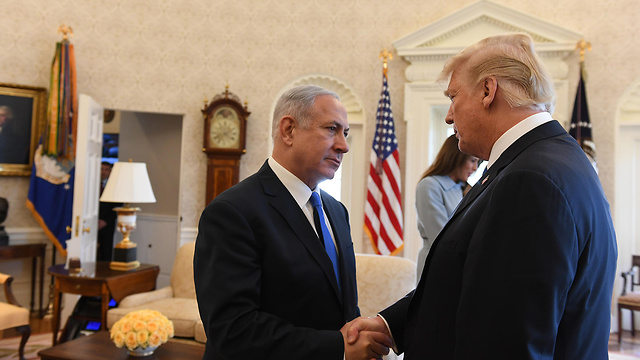
Netanyahu and Trump. Statistics say the chance of winning a large sum again is very small, and this also applies to Trump as a prize (Photo: Haim Katz/GPO)

Netanyahu and Trump. Statistics say the chance of winning a large sum again is very small, and this also applies to Trump as a prize (Photo: Haim Katz/GPO)

Last week, I participated in three meetings with American political tourists. Israel is filled with students, journalists, professors, human rights activists, believers and others who arrive to “see the news” with their own eyes. Anyone walking around Jerusalem these days could find them on every corner.

Israel is an interesting story in every possible discipline. We have a developed technology and exact sciences here, archaeology and history under every building, theology in every corner, an interesting economy that is worth studying, innovative water desalination projects, philosophy of human nature, and of course countless angles on national and religious conflicts.

In each of these meetings, on all of these issues, Trump’s name was raised at the very beginning and at the very end of the conversation. The Americans have stopped examining Israel through the “shared values,” the military aid, the interests and even the conflict. They are examining us through “are you for Trump or for our adversaries?”

Most of those who come here actually belong to the more liberal audience. They see Trump as a mystery and see his connection with us as a cause for concern. It’s hard to say they are wrong about the mystery. Trump is a strange person. I wouldn’t want him as Israel’s leader, but I’m very happy he’s in the White House.

Like others, I was wrong too. I was convinced Trump would do the opposite of what he said he would do. Every time he spoke about his “ultimate deal” for the Middle East, I was convinced he would clash with us at some point. Every declaration or action was accompanied by the great fear of the “price tag” on the day after. Today, I’m no longer convinced of anything, apart from the fact that Trump shook the international conventions and benefitted the world.

Thanks to his insanity and late night tweets, something positive is happening in the North Korean arena, a country which played a critical role in Syria’s nuclearization attempt. Thanks to erasing the Obama legacy, Trump nullified the problematic agreement with Iran. Thanks to his attitude towards Israel, we can understand for the first time how biased the attitude was until now. Thanks to Trump’s allegedly irrational diplomacy, we can understand how distorted his predecessor’s logic about foreign relations was.

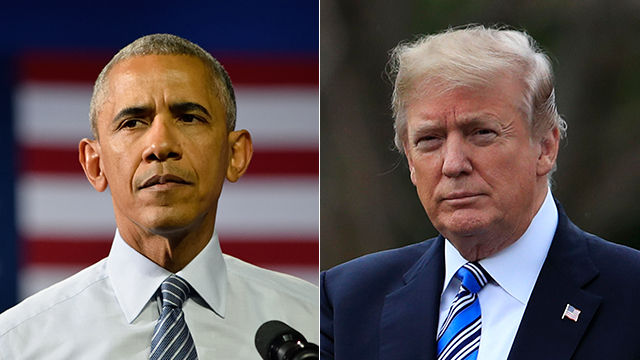
Thanks to Trump’s allegedly irrational diplomacy, we can understand how distorted Obama’s logic about foreign relations was (Photos: AP, Shutterstock)

Thanks to Trump’s allegedly irrational diplomacy, we can understand how distorted Obama’s logic about foreign relations was (Photos: AP, Shutterstock)

But all these insights make no difference, because we’re not the focus here. We just won the lottery, we’re not the lottery enterprise. There are winners who receive the money, become millionaires overnight, but understand that there is a risk. They take a deep breath, carefully plan their moves, seek advice, and then invest anonymously. And there are winners who receive the money, show it to everyone, spend it and go crazy.Statistics say the chance of winning a large sum again is very small. The same applies to the case of Trump as a prize. Liberal Americans hate him and see him as the source of all evil in the world, and the Democratic Party is radicalizing its views. In our context, it’s already alarming. If his moves vis-à-vis North Korea or Iran succeed, the attitude towards him will likely change. In the meantime, they’re there.

As the big winners, this means we’ll have a problem with the Democrats on the day after. We can see it in their eyes, in their reactions, in the media’s attitude. If they win the next elections, they’ll erase the Trump legacy just like he erased the Obama legacy. They’ll take revenge. It’s not us, it’s them; the American polarization psychology. The basic and perhaps only piece of advice when it comes to a large sum of money in such a win is investment diversification.

IDF conducts second round of Gaza airstrikes after overnight fire

June 3, 2018

Source: IDF conducts second round of Gaza airstrikes after overnight fire | The Times of Israel

Sirens blare in southern Israel throughout night, sending thousands to bomb shelters; three projectiles intercepted, one rocket said to land in open area

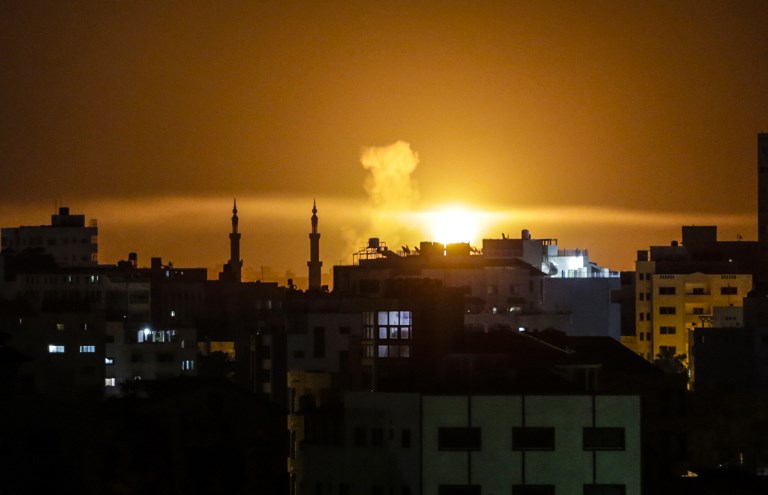
An explosion is seen in Gaza City after an airstrike by Israeli forces in response to a rocket attack earlier in the evening on June 2, 2018. (AFP PHOTO/Mahmud Hams)

An explosion is seen in Gaza City after an airstrike by Israeli forces in response to a rocket attack earlier in the evening on June 2, 2018. (AFP PHOTO/Mahmud Hams)

Israeli jets early on Sunday morning carried out a second round of airstrikes in a matter of hours the Gaza Strip, the army said, after four projectiles were fired overnight at southern Israel by Palestinian terror groups in the coastal enclave, shattering an unofficial ceasefire agreement.

The Israeli raids targeted “five terror targets in a military compound belonging to the naval force of the terror group Hamas in the northern Gaza Strip,” the Israel Defense Forces said.

The air force on Saturday night had carried out 10 airstrikes on Hamas targets in response to earlier rocket fire.

Responding to four separate attacks on southern Israel in the predawn hours of Sunday, the Iron Dome missile defense system intercepted three projectiles, with another apparently landing in Israeli territory, the army said.

Thousands of Israelis were sent rushing to bomb shelters throughout the night as sirens were repeatedly triggered to warn of incoming fire.

The army said it held Hamas, which rules the Strip, responsible for the rocket attacks.

The first projectile was launched shortly after 12:30 a.m., setting off sirens in the southern town of Sderot and surrounding Sha’ar Hanegev region.

Smoke billowing in the background following an Israeli air strike Gaza City, May 29, 2018. (THOMAS COEX/AFP)

The second was fired less than an hour later, triggering alarms in the Eshkol region, the army said.

At 2:45 a.m., sirens sounded in the Sha’ar Hanegev and Hof Ashkelon regions in southern Israel as another projectile was lobbed at southern Israel.

All three were shot down by Iron Dome, the army said. It was not immediately clear if the projectiles were rockets or mortar shells.

At 3:20 a.m., sirens again went off in the Shaar Hanegev and Sdot Negev regions, with the army confirming another “launch from the Gaza Strip to Israeli territory,” and identifying the projectile as a rocket.

According to the Walla website, it exploded in an open area.

There were also several rocket attacks earlier on Saturday evening.

The renewed rocket fire followed significant clashes on the Gaza border on Friday and a massive flareup last week, in which Palestinian terror groups launched over 100 rockets and mortar shells into southern Israel and the military responded by striking more than 65 Hamas and Palestinian Islamic Jihad sites in the Strip.

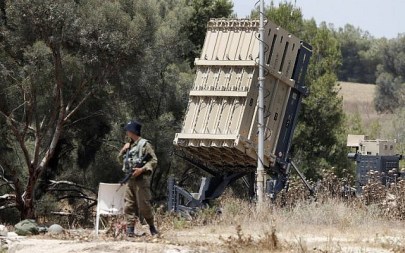
Israeli soldiers stand guard next to an Israeli Iron Dome defense system, designed to intercept and destroy incoming short-range rockets and artillery shells, deployed along the border with the Gaza strip on May 29, 2018. (AFP PHOTO / JACK GUEZ)

In response to the rocket attack on Saturday evening, the IDF launched its first strikes on targets throughout the Gaza Strip just before midnight.

“The IDF, using fighter jets, attacked 10 terror targets in three compounds belonging to the Hamas terror group in the Gaza Strip. Among the targets that were attacked were two sites used to manufacture and store weapons and a military compound,” the army said.

According to the Hamas-affiliated Shehab news agency, the planes struck sites in Gaza City’s Shejaiya neighborhood, in the Nuseirat refugee camp and outside the city of Khan Younis.

The Palestinian Quds news site also reported Israeli strikes outside the city of Rafah.

There were no immediate reports of casualties.

A video, posted on social media, reportedly showed the bombing of the targets in Shejaiya, which sent a large fireball into the sky.

The rocket launches appeared to be the first violation of a fragile ceasefire in effect since Wednesday morning, but came after a weekend of intense violence along the Gaza border.

On the Palestinian side of the border, thousands attended a funeral for a young female volunteer medic, who Palestinians say was shot and killed by the IDF while tending the injured during violent protests on the Gaza border.

The border tensions comes following a week that saw the worst escalation of violence between Israel and Hamas since the 2014 war in Gaza. Palestinian terror groups on Wednesday and Thursday fired more than 100 rockets and mortars at towns and cities in southern Israel, and the IDF responded with dozens of airstrikes on Hamas military targets. After almost 24 hours of fire, a tacit understanding and unofficial ceasefire began, though both sides have described it as fragile.

Also Saturday night, firefighters were working to put out three large fires in Israel along the Gaza Strip border, believed to have been started by incendiary kites flown from the coastal enclave on Saturday.

The largest fire was near Kibbutz Carmia, adjacent to the northern Gaza Strip. Preliminary estimates suggested that between 2,000 and 3,000 dunams (500 to 740 acres) of fields and parts of a nature reserve adjacent to the kibbutz were destroyed.

NATO chief: Alliance won’t defend Israel In War With Iran

June 2, 2018

Source: NATO chief: Alliance won’t defend Israel in war with Iran – Middle East – Jerusalem Post

A German Green Party politician questioned the statement on Twitter.

BY BENJAMIN WEINTHAL, ANNA AHRONHEIM
 JUNE 2, 2018 19:43

NATO Secretary-General Jens Stoltenberg enters the new NATO headquarters building in Brussels

Jens Stoltenberg, the head of the North Atlantic Treaty Organization (NATO), told a German media outlet on Saturday
that NATO would not side with Israel in the event that the Islamic Republic of Iran attacks the Jewish state..

The NATO chief told Der Spiegel magazine that “the security guarantee [of NATO] does not apply to Israel” because the Jewish state
is not a member of the 29 country alliance.

In response to the Stoltenberg’s announcement, the German Green Party politician and former head of the German-Israel parliamentary group in the Bundestag, Volker Beck, asked on Twitter: “That raises the question. What does this clarification mean for the security dialogue between NATO, EU, Germany and Israel? It points to at least very different starting points and positions of interest.”

Tensions between Israel and Iran have escalated in recent months, with Israel striking Iranian military bases in Syria, including in a May 8 attack that reportedly left 9 Iranian military personnel dead.

Stoltenberg’s statement comes despite growing cooperation between Israeli and the NATO alliance, including Israel’s participation in a joint naval exercise in late May. Earlier Israel-NATO joint naval and air force exercises took place in December.

Israel’s relationship with NATO is defined as a “partnership,” and the country has been a member of NATO’s Mediterranean Dialogue since it was initiated in 1994, along with six other non-NATO Mediterranean countries: Jordan, Algeria, Egypt, Mauritania, Morocco and Tunisia. The goal of the group is to enable dialogue and cooperation on security and counterterrorism issues.

However, Turkey, a member of NATO since 1952, objected to Israel’s cooperation as part of the Mediterranean Dialogue since Israeli-Turkish ties soured six years ago.

Following a Turkish-Israeli reconciliation in 2016, Ankara withdrew its longstanding veto against Israel being accepted as a partner nation to the organization, and Jerusalem opened its first ever diplomatic mission to NATO headquarters in Brussels.

In the face of Russia’s growing military presence in the eastern Mediterranean, especially in Syria, NATO’s strategic interest in the region is increasing — as is Israel’s importance to the alliance.

U.S. considers deploying defense system amid concern over Iranian threat 

June 2, 2018

Source: U.S. considers deploying defense system amid concern over Iranian threat – Diaspora – Jerusalem Post

Iran’s Shahab 3 missiles can already travel 2,000 km, enough to reach southern Europe, and its Revolutionary Guards have said they will increase the range if threatened.

BY REUTERS
 JUNE 1, 2018 14:47
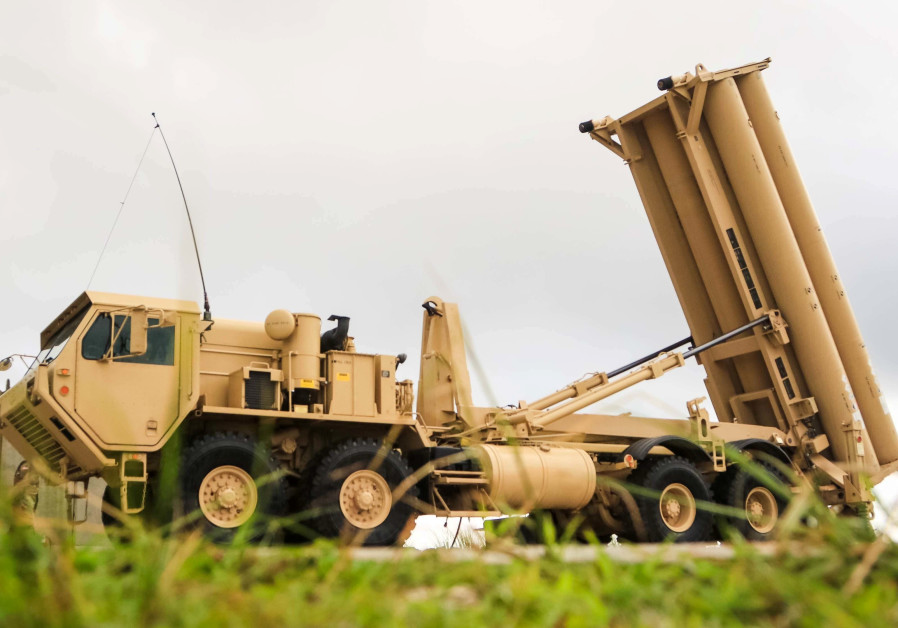
A U.S. Army Terminal High Altitude Area Defense (THAAD) weapon system is seen on Andersen Air Force

BERLIN – The US military has held preliminary discussions about moving a powerful missile defense system to Germany to boost European defenses, according to two sources familiar with the issue, a move that experts said could trigger fresh tensions with Moscow.

The tentative proposal to send the Terminal High Altitude Area Defense (THAAD) system to Europe predates US President Donald Trump’s decision to withdraw from the 2015 Iran nuclear accord, and comes amid a broader push to strengthen Europe’s air and missile defenses.

While Europe and the United States are at odds over the fate of the nuclear agreement, they share concerns about Iran’s continued development of ballistic missiles.

Iran’s Shahab 3 missiles can already travel 2,000 km, enough to reach southern Europe, and its Revolutionary Guards have said they will increase the range if threatened since the range is capped by strategic doctrine, not technology constraints.

US European Command has been pushing for a THAAD system in Europe for years, but the US withdrawal from the Iran nuclear accord has added urgency to the issue, said Riki Ellison, head of the non-profit Missile Defense Advocacy Alliance.

A senior German military official cited the need to add more radars across Europe to better track and monitor potential threats, and cue interceptors if needed.

The US Defense Dept said no such action had been decided.

“There are currently no plans to station THAAD systems in Germany. We do not discuss potential future military planning, as we would not want to signal our intent to potential adversaries. Germany remains among our closest partners and strongest allies,” said Pentagon spokesman Eric Pahon.

Deploying another US defensive system to Europe could reassure NATO allies in southern Europe already within striking range of Iran’s missiles, said one military official from that region.

Talk of deploying a THAAD system in Europe also comes against the backdrop of rising tensions between the West and Russia.

NATO has long insisted that its missile defense program is not directed at Russia, but the alliance has adopted a tougher tone toward Moscow in the wake of the poisoning of a Russian former spy in England.

Moscow denies any involvement in the poisoning, and blames the tensions on NATO’s military expansion eastward, and its assembly of a ballistic missile shield with a key site in Romania that was declared combat-ready in 2016.

Moving THAAD to Germany could plug a radar gap caused by a two-year delay in completion of a second Aegis Ashore missile defense site in Poland that was initially due to open this year.

The issue may be raised in a new Pentagon missile defense review expected in early June.

The review may draw a closer connection between missile defense and a need to deter Russia that was highlighted in the new US national defense strategy, said Tom Karako, senior fellow at the Center for Strategic and International Studies.

MESSAGE TO EUROPEAN ALLIES

One US military official said there had been preliminary talks with German military officials on moving a THAAD system to Ramstein Air Base in Germany, headquarters for the US Air Force in Europe and NATO Allied Air Command.

“It would be a further political message to the Europeans that we’re serious about protecting our allies,” said the official. “The initial assessment is that Germany would very likely not have a problem with a THAAD deployment,”

US General Curtis Scaparrotti, head of US European Command, last week said he was seeking more troops and equipment to deter Russia, but declined further comment.

A second source said German officials were open to the move as a way to better protect civilian populations.

The German defense ministry is working to rebuild its own short- and medium-range missile defenses after years of cuts.

Starting later this year, it also plans to review territorial missile defense needs in a conceptual study that will also look at THAAD and the Arrow 3 anti-missile system built by Israel and the United States, a spokesman said.

The German foreign ministry, which oversees foreign troops stationed in Germany, said it could not confirm sending any signals about a possible THAAD deployment to the United States.

Washington does not need Germany’s permission to move such equipment under existing basing contracts, but the sources said a formal notification would be sent before any move to proceed.

The THAAD system is built by Lockheed Martin Corp with a powerful Raytheon Co AN/TPY-2 radar, to shoot down short-, medium-, and intermediate-range ballistic missiles.

US vetoes Kuwaiti resolution calling for “int’l protection” of Palestinians

June 2, 2018

Source: US vetoes Kuwaiti resolution calling for “int’l protection” of Palestinians – Arab-Israeli Conflict – Jerusalem Post

In UN counter-vote, Israel sees a new strategy that puts it on offense.

BY MICHAEL WILNER
 JUNE 1, 2018 23:43
U.S. Ambassador to the United Nations Nikki Haley vetoes a resolution for protection of Palestinians

U.S. Ambassador to the United Nations Nikki Haley vetoes a vote as Bolivian Ambassador Sacha Llorenty votes for a Arab-backed resolution for protection of Palestinian civilians. (photo credit: SHANNON STAPLETON / REUTERS)

WASHINGTON — When the Trump administration demanded a UN Security Council vote on Friday meant to counteract a Kuwaiti resolution condemning Israel, the Israelis saw the birth of a new diplomatic strategy that it hopes becomes the norm.

Under the plan, Israel would no longer face hostile votes at the council without the US counter-punching, demanding a vote on language that calls out “the hypocrisy of the council,” Danny Danon, Israel’s ambassador to the UN, told The Jerusalem Post on Friday.

“This is changing the rules of the game — we are now on the offense,” Danon said. “Its the beginning of a new strategy and of new rules.”

The US vetoed Kuwait’s resolution, in the works for weeks, in a Friday afternoon vote, alongside abstentions from the United Kingdom, the Netherlands, Poland and Ethiopia. Israel was pleased with the extent of opposition to the measure, and considers the tally a mark of progress, although Israeli officials expressed concern with France’s vote in favor.

“The final text is certainly not perfect– we would have liked it to establish clearly Hamas’ responsibility, and condemn the rocket launches against Israel,” said France’s envoy, Francois Delattre. “But the deep consultations in recent weeks led to significant improvements.”

The Kuwaiti proposal called for “international protection” for Palestinians in Gaza, and declined to mention the role of Hamas in governing the coastal strip. The US measure would have condemned Hamas as a terrorist organization and for its recent firing of over 70 rockets onto Israeli territory, but it too failed, only receiving one vote – from the US itself – in its favor.

“When the United Nations sides with terrorists over Israel, as the Kuwait resolution does, it only makes a peaceful resolution to this conflict harder to reach,” Haley said, explaining the US veto. “It is resolutions like this one that undermine the UN’s credibility in dealing with the Israeli-Palestinian conflict.”

Haley said she was offering members an alternative in the form of a resolution that explicitly condemns Hamas for its “grip” on Gaza. “There is an alternative,” she said. “This resolution rightly brings responsibility where it belongs.”

It is that alternative that has sparked hope in the Israeli team that a new strategy has taken shape.

“From now on, whenever there’s going to be a resolution like this condemning Israel, it won’t be just a US veto that follows,” Danon said. “There will be a proactive effort to expose the hypocrisy of the council.”

June 12 summit is on, says Trump after 2 hours with top North Korean official 

June 2, 2018

Source: June 12 summit is on, says Trump after 2 hours with top North Korean official – DEBKAfile

Kim Yong Chol, right-hand of North Korea’s ruler, hand-delivered a letter from Kim Jong-un to US President Donald Trump at the White House on Friday, June 1. After they talked for nearly two hours, Trump respectfully escorted his visitor to the car and told reporters: Get ready to travel to Singapore next Friday after the “good will” shown by Pyongyang. The summit with Kim Jong-un would not be a one-day event, he said, but the start of a process of negotiation. Trump also disclosed a plan to mark the end of the Korean war after nearly 70 years.

He said Kim had sent him “a very nice letter,” but then denied having opened it yet. Trump’s talks with Kim Yong Chol, North Korea’s former spymaster,  ranged over sanctions, denuclearization, political and security guarantees for the regime and the prosperity awaiting North Korea after denuclearization – in support of which he said Japan, South Korea and China would be involved. He noted that they did not discuss human rights.
Asked by reporters to comment on Russian foreign minister Sergei Lavrov’s visit to Pyongyang Thursday and his advice to North Korea to give up nuclear weapons,  only in return for the phased lifting of US sanctions, Trump said, “if the Russians are positive, I’m happy. I hope they are.” He also commented later: “We have hundreds more sanctions which we have held back because we are talking. You will see how powerful our sanctions are for Iran.”

DEBKAfile: The signing of a peace treaty for ending the Korean war is widely interpreted as closing down the demilitarized zone dividing the two Koreas since the war ended in the 1953 armistice accord. This in turn may augur the start of the historic process of reunification.