Archive for June 2018

Report: Mossad agents assassinated Iranian advisers in Libya

June 5, 2018

Source: Report: Mossad agents assassinated Iranian advisers in Libya – Israel Hayom

US envoy Friedman slams media for critical coverage of Israel 

June 5, 2018

Source: US envoy Friedman slams media for critical coverage of Israel – Israel Hayom

Iran could drive fresh wave of refugees into Europe, Netanyahu warns

June 5, 2018

Source: Iran could drive fresh wave of refugees into Europe, Netanyahu warns – Israel Hayom

Reality check: Iran isn’t going anywhere 

June 5, 2018

Source: Reality check: Iran isn’t going anywhere – Israel Hayom

Prof. Eyal Zisser

It’s probably best to start with the bottom line: Iran didn’t invest hundreds of millions, perhaps billions of dollars in Syria, didn’t lose thousands of fighters, members of the Revolutionary Guard Corps and regular army alike, and didn’t draft tens of thousands of Shiite conscripts into the pro-Iranian militias it trains and funds – to suddenly up and leave just because Putin or Assad ask politely.

What’s more important is that in contrast to the reports in the Israeli media, neither Putin nor Assad asked the Iranians to leave Syria at all. Indeed, the Russian president called for the withdrawal of all foreign forces from Syrian soil. First and foremost, however, he was referring to the American forces which still in control one-quarter of Syrian territory, mostly in the Kurdish areas in the northeast, and which also grant protection to the rebels in the country’s south. The Russians would also like the Turks to leave the areas they control in Syria’s north. Finally, they want Israel to let Assad retake control of the Syrian Golan Heights and the country’s south, and to eradicate the rebels which, until recently, Jerusalem has supported.

Iran isn’t in Russia’s crosshairs, because Moscow doesn’t see it as a competitor or adversary (for now, at least). Iran is simply the vessel the Russians use to advance their goals in Syria.

The Russians understand Israel’s concerns pertaining to Iran. They also don’t want Israel to “go nuts” and pummel the Assad regime, which they have all but dragged to the finish line and victory. Hence they are willing to facilitate efforts to remove Iranian forces from the Golan border, a demand they believe the Iranians can accept – as a temporary, confined concession on the path to Tehran’s greater goal of establishing a permanent foothold in Syria.

Just for the record, in their deal with the Americans from half a year ago the Russians already committed to keeping the Iranians from the Israeli border and, incidentally, to also prevent the Syrian regime from attacking the rebels in southern Syria. The Iranians, though, haven’t left southern Syria and Assad’s regime is on the verge of an offensive against the rebels there. What’s disconcerting isn’t Russia’s willingness to toss the signed deal into the trash, rather the Americans’ willingness to “go with the flow” and accept the violation of the deal they promoted.

This doesn’t mean that Russia and Iran aren’t competing or that inherent tensions don’t exist; both want to control Syria when the civil war ends. We can assume that Assad, too, will eventually look to rid his country of Iran’s invasive presence and influence in Syria’s internal affairs, threatening to permeate all government institutions, the army and even the Alawite ethnic group. Assad also won’t want the Iranians to embroil him in a clash with Israel. Although he’s attested to living his entire life in the shadow of “Israeli aggression,” he knows very well that Israel is not his main enemy or problem.

He’ll cross that bridge when he gets there. For now, and certainly in the weeks and months ahead, Assad and Putin both need the Iranians. After all, next to the Russian jets in the air, the tide of the war was turned and the survival of Assad regime is ensured by Iranian and Hezbollah forces on the ground.

Generally speaking, Russia’s problem – namely its competition, rivalry or cold war – is with the United States and the West, not with Iran. The latter, as stated, is a tool wielded by the Russians in their fight against the West and there is no reason to relinquish it. Will disengagement from Iran make Assad a darling of the international community and open doors for him in Washington, after slaughtering hundreds of thousands of his own people; and will Iran’s exit from Syria win Putin points in his fight in Ukraine, Eastern Europe and other corners of the globe – with Washington and Western Europe? No, of course it won’t.

It is therefore feasible to reach loose understandings on keeping Iran away from the Israeli border, but it’s also uncertain the Russians even have the desire or ability to make that happen. What’s clear is the fight to dislodge Iran from Syria is still far from over.

Eyal Zisser is a lecturer in the Middle East History Department at Tel Aviv University.

Israel foils Syrian plot to assassinate PM Netanyahu 

June 5, 2018

Source: Israel foils Syrian plot to assassinate PM Netanyahu – Israel Hayom

Iran to increase uranium enrichment. US-Israeli strike on nuclear facilities comes closer – DEBKAfile

June 5, 2018

Source: Iran to increase uranium enrichment. US-Israeli strike on nuclear facilities comes closer – DEBKAfile

( As with all Debka File pieces, take their conclusions with a grain of salt. – JW )

Iran is to inform the UN nuclear watchdog in Vienna on Tuesday, June 6, of its decision to increase uranium (UF6) enrichment capacity in response to the US exit from the 2015 nuclear accord.

Iran’s Atomic Energy Organization spokesman Behrouz Kamalvandi, announcing this, did not mention a date for this process to begin or the grade of enrichment. Supreme ruler Ayatollah Khamenei’s said Monday night: “I have ordered Iran’s atomic energy agency to be prepared to upgrade our (uranium) enrichment capacity” if the 2015 nuclear deal with the world powers falls apart after the US withdrawal. Chairman Ali Akhbar Salehi of the atomic organization forecast this development some days ago.

DEBKAfile reported on May 24 that if Iran returned to expanded uranium enrichment, the US and Israel would prepare to attack its enrichment facilities and other key nuclear facilities to prevent the Islamic Republic from resuming its progress towards a nuclear weapon capability. Now that Tehran is taking that step, it is up to President Donald Trump to decide on America’s response. His decision will be colored heavily by his fast approaching summit with North Korean leader Kim Jong-un in Singapore on June 12.

To convince Kim that he is coming well-armed for demanding the total dismantling of Pyongyang’s nuclear and ballistic programs, Trump may find it necessary to meet Iran’s decision to expand uranium enrichment with a military response. Khamenei’s step gives Trump a very tight timeline for a decision.

It was also timed to override the object of Prime Minister Binyamin Netanyahu’s European trip. The European signatories of the deal, Germany, France and the UK have been scrambling to save the nuclear deal by diplomatic efforts to persuade Iran to limit its ballistic missile program and expansionist activities in the Middle East.

Khamenei made it clear that the two issues are non-negotiable, as Israel warned them would happen. Netanyahu therefore finds their leaders floundering for their next step.

Now the statement by NATO Secretary General Jens Stoltenberg this week that the alliance would not back Israel if it came under attack from Iran comes closer to reality than before.

So too, does Khamenei’s decision on May 29, to replace the commander of the Khatam al-Anbiya Air Defense Headquarters Gen. Farzad Ismail, which is in charge of Iran’s air defenses, and appoint his deputy Brig-Gen. Alireza Sabahi Fard as acting commander, after two Israel F-35 stealth fighters flew over Iran’s nuclear facilities and left Iranian air space unnoticed.

Aussies demand palestinians reveal if aid money is for terrorists

June 5, 2018

I have my doubts this will lead to any significant change, but still, its about time.

Julie Bishop and Eric Abetz are pretty good allies of Israel, at least as far as you can be while in a major political party.

Australia Demands Palestinians Reveal if Aid Money Funds Terrorist ‘Martyrs’

http://www.breitbart.com/jerusalem/2018/06/01/australia-demands-palestinians-reveal-if-aid-money-funds-terrorist-martyrs/

Australia has demanded assurances from the Palestinian Authority that Aus­tralian aid has not funded payments to terrorist “martyrs” or their families.

The Palestinian Authority has in the past been accused of dispersing stipends or “martyr payments” of up to $US3500 ($4600) a month to the families of those killed while attacking Israel.

In 2017 alone, the Palestinian Authority’s budget showed a “huge increase” in the funding of salaries for imprisoned terrorists and the families of “martyrs,” according to an Israeli research institute.

Palestinian Media Watch said the amount of money allocated by the PA for payments to terrorists jailed in Israel in 2017 rose 13 percent to $158 million — compared to $135 million in 2016. During the same time frame, disbursements for family members of dead terrorists increased by 4 percent — to $197 million from $183 million.

Foreign Minister Julie Bishop said such payments are in conflict with Australian values and a letter to the authority demanding answers was sent from Canberra this week.

“Obviously that is completely at odds with Australian values,” an official from the Department of Foreign Affairs and Trade (DFAT) told a Senate estimates hearing on Thursday

“So on the 29th of May our Foreign Minister has written to her counterpart raising concerns about these payments that show up in the Palestinian Authority’s budget and seeking assurances that the Australian funding (does not) in any way enable or encourage acts of violence.”

The official said: “The Foreign Minister herself sought further explanation and assurance from the Palestinian Authority.”

Senator Eric Abetz told the committee he was pleased Ms Bishop sought the clarification.

“The Palestinian martyr fund not only encourages murder and terror attacks, it is a major barrier to peace in the Middle East,” he said.

Mr. Abetz wants Australia to cut its $43 million in aid to Palestinian authorities until the martyr fund is wound up.

Iran’s Khamenei: Those who attack Tehran will be struck 10 times harder

June 4, 2018

Khamenei said Iran had no intention of curbing its influence in the Middle East.

By REUTERS June 4, 2018

Source Link: Iran’s Khamenei: Those who attack Tehran will be struck 10 times harder

Bonus Link: AYATOLLAH KHAMENEI Threatens to ‘Eradicate’ Israel, Orders Atomic Agency to Ramp Up Uranium Levels ‘Without Any Delay’

{Battle lines are being drawn. – LS}

ANKARA – Iran’s top leader said on Monday it would respond harshly to any attack and that Western demands for limits on its ballistic missile program are a “dream that will never come true.”

“Tehran will attack 10 times more if attacked by enemies… The enemies don’t want an independent Iran in the region… We will continue our support for oppressed nations,” he said.

Khamenei said Iran had no intention of curbing its influence in the Middle East and urged Arab youth to stand up to US pressure.

“Young Arabs, you should take action and the initiative to control your own future … Some regional countries act like their own people’s enemies,” he said in an allusion to US-allied Gulf Arab states who have supported rebels fighting to topple Syrian President Bashar al-Assad, a close ally of Tehran.

Tensions between Iran and the West have resurged since President Donald Trump pulled the United States out of world powers’ 2015 nuclear deal with Tehran, calling it deeply flawed.

European signatories are scrambling to save the accord, which they see as crucial to forestalling an Iranian nuclear weapons, by protecting trade with Iran against the reimposition of US sanctions to dissuade Tehran from quitting the deal.

Under the deal, the Islamic Republic curbed its disputed nuclear energy program and in return won a lifting of most international sanctions that had hobbled its economy.

One of Trump’s demands – which European allies back in principle – is negotiations to rein in Iran’s ballistic missile program, which was not covered by the nuclear deal.

Iranian Supreme Leader Ayatollah Ali Khamenei again said this was non-negotiable. “Some Europeans are talking about limiting our defensive missile program. I am telling the Europeans, ‘Limiting our missile work is a dream that will never come true,” he said in a televised speech.

Trump also objected that the 2015 deal did not address Iran’s nuclear work beyond 2025 or its role in conflicts in Yemen and Syria. Though committed to the deal, European powers share Trump’s concerns and want broader talks with Iran to address the issues.

“Our enemies have staged economic and psychological… warfare against us and new American sanctions are part of it,” Khamenei told a gathering to mark the 29th anniversary of the death of Iranian revolutionary leader Ayatollah Ruhollah Khomeini.

Khamenei: Israel a ‘cancerous tumor’ that ‘must be eradicated’

June 4, 2018

Iran’s supreme leader says destruction of Jewish state is ‘possible and will happen,’ slams ‘traitorous countries’ for not defending Palestinians

Ayatollah Ali Khamenei delivers a speech during Labor Day at a workers’ meeting, April 30, 2018. (AFP Photo/Iranian Supreme Leader’s Website /HO)

Iranian Supreme Leader Ayatollah Ali Khamenei on Sunday lashed out at Israel, calling the Jewish state the “cancerous tumor” of the region that must be “removed and eradicated.”

In a series of tweets Sunday, Khamenei leveled harsh criticism at Israel for its handling of the violent Hamas-orchestrated “March of Return” protests along the Gaza border.

Beyond kites: ‘Fire balloons’ increasingly used to set southern Israel ablaze

June 4, 2018

Source: Beyond kites: ‘Fire balloons’ increasingly used to set southern Israel ablaze | The Times of Israel

Total of at least 17,500 dunams – nearly 7 square miles – of land burned as Palestinians repeatedly send airborne incendiary devices across border

More recently, however, a new arson tactic has been gaining popularity along the Gaza border. Instead of kites, a different children’s toy is being flown into Israel: helium balloons.

The concept is the same: Launch the airborne incendiary devices into the air and rely on the breeze from the coast to push them into Israeli territory, where they can start a fire.

The balloon tactic has been in use for at least a month and a half, but it has picked up in recent weeks.

In total, approximately 17,500 dunams (4,300 acres, or nearly seven square miles) of land have been burned in more than 250 fires over the past two months, more than half of it in nature reserves, according to initial assessments.
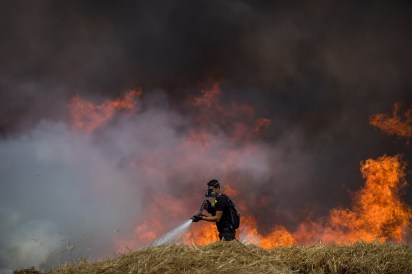
Israeli firefighters extinguish a fire in a wheat field caused from kites flown by Palestinian protesters, near the border with the Gaza Strip, May 30, 2018. (Yonatan Sindel/Flash90)

Authorities have yet to determine how many of the fires were started by kites and how many by balloons. “Kite terror” has become a catch-all term for the phenomenon.

As of Monday, there have been no injuries caused by the fires, but the cost of the damage is high and expected to increase, as there’s no sign that Palestinians in Gaza are giving up on the arson tactic.

The blazes, specifically those in nature reserves, have also wreaked havoc on local wildlife, ecologists say. And there are more fires every day.

The balloons themselves do not cause the fires — helium is an inert gas — but they carry flaming material attached to a long string. In some cases, just a few party balloons are used. In others, it is a larger cluster of latex balloons, capable of carrying far more substantial incendiary devices.

As with the kites, the Israeli military has yet to come up with a response to this threat. A pilot program using drones to take down the incoming kites and balloons was deemed a failure, Israel’s Kan TV reported Saturday night.

For now, Israel’s primary means of combating these airborne firebombs remains preparedness and a rapid response when blazes do break out.

Authorities, as well as individual farmers, monitor the area and when an incoming kite or balloon is spotted, they rush to the scene in order to put out the fire before it spreads.

Farmers use tractors to dig up the area around the fire in order to starve out the flames until firefighters can arrive to put out the blaze entirely.

They are not always successful.
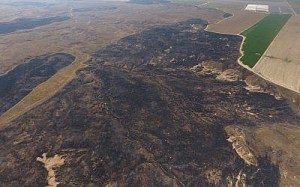
Drone images show the massive destruction caused by fire kites to the Be’eri Nature Reserve, adjacent to Gaza. (Credit: DRONEIMAGEBANK)

Some 10,000 dunams (2,470 acres) of parks and nature reserves have been burned in recent weeks, according to a spokesperson for the Nature and Parks Authority, who stressed that the authority did not yet have definitive evidence that all of the fires were caused by kites or balloons.

Just on Saturday, some 300 dunams (74 acres) of the Carmia nature reserve — approximately a third of the park’s total land area — went up in flames in one of the largest individual blazes since the start of the “fire kite” phenomenon. Israel’s Hadashot news reported that there were suspicions the Carmia fire may have been started by a “fire balloon” that spread the flames as it blew through the area, but this could not be immediately confirmed. Authorities said they were still investigating the cause of the fire.

Over 5,000 dunams (1,235 acres) of farmland has been burned, most of it wheat fields, according to the Tax Authority, which is processing compensation requests from area farmers.

Driving through the area, it is rare to see a field or patch of trees that does not have at least one blotch of scorched earth from one of the fires sparked by a kite or balloon.

An Israeli farmer puts out a fire in his wheat field that was started by an incendiary kite from Gaza, outside Kibbutz Nahal Oz in southern Israel, on May 14, 2018. (Judah Ari Gross/Times of Israel)

In addition, approximately 2,500 dunams (620 acres) of Jewish National Fund forests was burned, a spokesperson for the organization said, adding that the JNF would complete its final assessment of the damage on Tuesday.

The Tax Authority said there have been no requests for compensation made by the JNF or the Nature and Parks Authority yet.
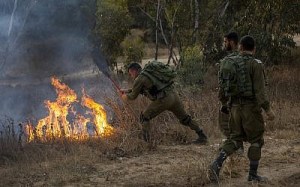
An Israel soldier extinguishes a fire started by a kite with attached burning cloth launched by Palestinians from Gaza on June 1, 2018. (AP Photo/Tsafrir Abayov)

The Tax Authority estimates that the damage to farmland alone will cost at least NIS 5 million ($1.4 million), to be paid from the government’s fund for damage caused by terrorist activity.

On Sunday, Prime Minister Benjamin Netanyahu announced that in order to cover the cost the government would withhold funds from the Palestinian Authority.

The decision raised eyebrows among Israeli analysts, who pointed out that the PA does not control the Gaza Strip. Indeed, the Authority’s primary rival, the Hamas terror group, has ruled the enclave since ousting the PA in 2007.

Penalizing the PA for Hamas actions would almost certainly not encourage Hamas to stop the kite arson and would probably have the opposite effect.

WWII-era weapon

The tactic of using “fire balloons” might be a new one in Gaza, but its history goes back decades.

In World War II, Japan used such “fire balloons” against the United States, sending 9,000 huge hydrogen-filled balloons into the Pacific jet stream where the air currents could push them toward American territory.

Approximately 300 of these balloons reached North America, causing relatively little damage. However, one of them was responsible for the only casualties of World War II in the mainland United States.

On May 5, 1945, an incendiary bomb that had been carried into America by a Japanese balloon exploded in the rural town of Bly, Oregon, killing six people.