Archive for June 2018

Netanyahu describes drones as a true nightmare for Israel

June 14, 2018

Source: Netanyahu describes drones as a true nightmare for Israel

Speaking at new security conference in Jerusalem, PM highlights a range of security-related challenges facing Israel, says country working on developing technological solutions to the ‘huge’ drone threat, adding Israel strikes balance in maintaining security and safeguarding civil liberties.
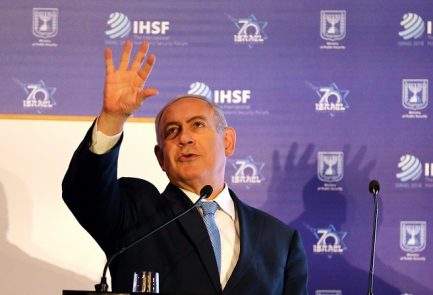
Prime Minister Benjamin Netanyahu described on Thursday the threat of drones against Israel as “a true nightmare,” adding that the country is currently working on inventing technological solutions to counter the “huge” challenge.“You don’t need vast state apparatus, you don’t need the foreign intelligence services of superpowers, you don’t need anything,” the prime minister said, while delivering remarks at the first ever International Forum for Public Security Ministers and the War against Terrorism.“You need this $50 contraption and 5 kilos of TNT attached to it” to reach to the White House, Netanyahu explained at the conference held in the Orient Jerusalem Hotel on the capital’s popular Emek Refa’im street.

“This distribution of technology has immense consequences that I think are not obviously understood. We’re working on it right now,” he said, delivering his speech first in English and then in Hebrew.

“We have to think of how we can harness technology against this technology. We’re doing that in Israel, we’re developing this. I cannot tell you that we have solved this but I think that we could join hands as best as we can to try to address this challenge,” he stated optimistically, while warning of the gravity of the drone threat.

“It is huge. It is huge. And precisely because it is so small, it’s so huge. It’s a big one,” Netanyahu said, before moving onto the threat of cyber security and Israel’s contribution in the field.

“Israel now accounts for 20 per cent of the global private investment in cybersecurity. That’s a lot, because given that we’re one tenth of one per cent of the world’s population, that’s 200 times our weight in the global population and we’re second only to the United States on this,” the prime minister boasted as he displayed on a PowerPoint presentation the Be’er Sheva Cyber Security Complex.
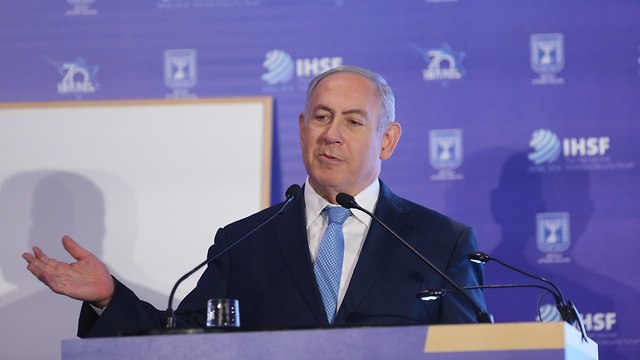
PM Netanyahu at the conference (Photo: Alex Kolomoisky)

PM Netanyahu at the conference (Photo: Alex Kolomoisky)

Despite the myriad security challenges facing the Jewish state, Netanyahu said that the country had struck an appropriate and delicate balance of simultaneously maintaining security and civil liberties.

“I think few countries, if any, have been challenged continuously like us by war, by terror, by outright calls for our extermination, and yet there wasn’t a day, not an hour, not a moment or a second where Israel’s democracy was ever questioned,” he said.

“We maintained it rigorously by maintaining the twin poles of security and civil rights … security first, balance always,” he continued.

Turning to the issue of social media, the prime minister praised the benefits that have bloomed from the 20th century phenomenon, including enhanced international communication and its contribution to the overthrow of dictatorial regimes. However, he also highlighted the negative ramifications and the impact on terrorism.

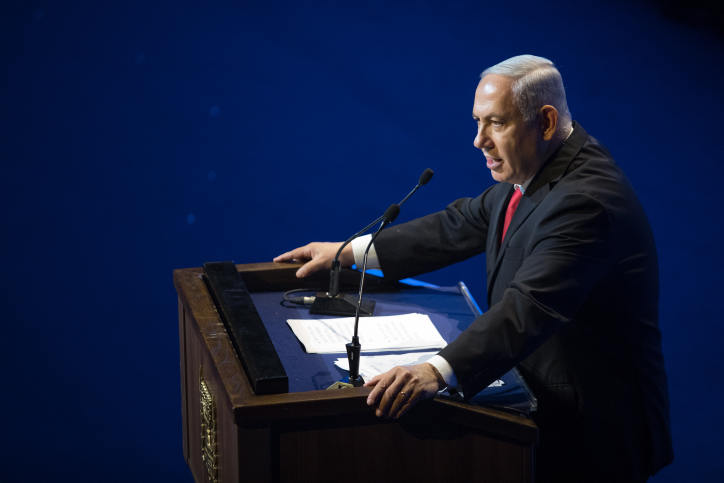
 (Photo: Inbar Tvizer)

(Photo: Inbar Tvizer)

“It’s also a way to inspire hate and violence and extremism. Radical Islam is using it in obvious ways and they’re not the only ones,” he said.

That said, he reiterated that Israel was developing algorithms and meshing technological solutions with police and IDF field experience to clamp down on terror-related threats emanating from social media, while facing the challenge “in the balance of having security and civil rights.”

Netanyahu then presented a map of the Middle East that he called “the red and the black”, with various ISIS-controlled countries colored in red and Iran-controlled countries colored in black.

“We have done more than any other country actually to foil terrorist attack from Daesh (ISIS) from a variety of countries because the parks of this inflammation go to every continent from Australia to South America and everything in between. And Israel has stopped dozens and dozens and dozens of terrorist attacks from ISIS,” he said.
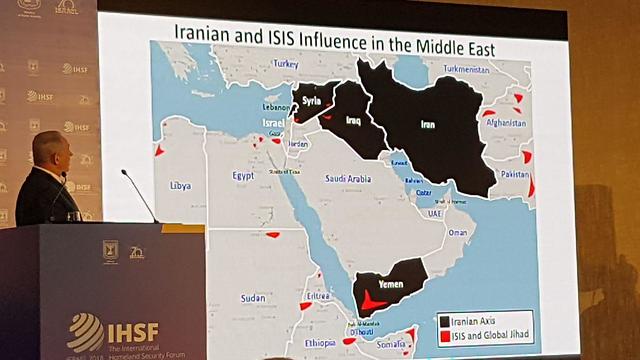
 (Photo: Inbar Tvizer)

(Photo: Inbar Tvizer)

Netanyahu accused Iran, which has been helping Damascus beat back a seven-year-old rebellion, of bringing in 80,000 Shi’ite fighters from countries like Pakistan and Afghanistan to mount attacks against Israel and “convert” Syria’s Sunni majority.

“That is a recipe for a re-inflammation of another civil war—I should say a theological war, a religious war—and the sparks of that could be millions more that go into Europe and so on … And that would cause endless upheaval and terrorism in many, many countries,” Netanyahu said.

“Obviously we are not going to let them do it. We’ll fight them. By preventing that—and we have bombed the bases of this, these Shi’ite militias—by preventing that, we are also offering, helping the security of your countries, the security of the world.”

Netanyahu did not elaborate. About half Syria’s pre-war 22 million population has been displaced by the fighting, with hundreds of thousands of refugees making it to Europe.

Reuters contributed to this report.
IDF general warns foreign officials Iran setting up bases in Syria

June 14, 2018

Source: IDF general warns foreign officials Iran setting up bases in Syria | The Times of Israel

Kan broadcaster airs leaked footage of Military Intelligence chief telling visiting security ministers that Tehran’s looking not to support Assad, but to attack Israel

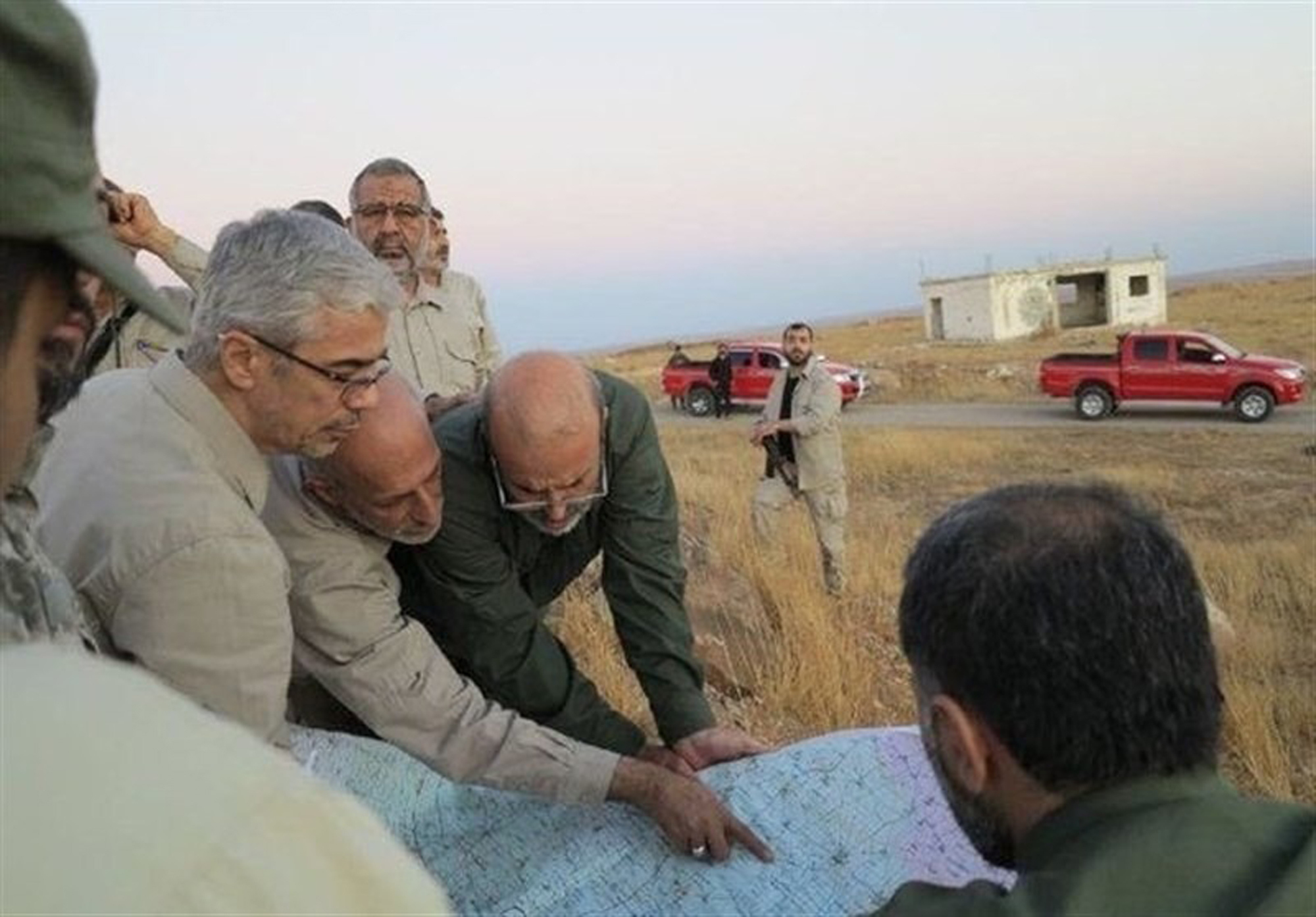
This file photo provided on Friday October 20, 2017 by the government-controlled Syrian Central Military Media, shows Iran's army chief of staff Maj. Gen. Mohammad Bagheri, left, looking at a map with senior officers from the Iranian military as they visit a front line in the northern province of Aleppo, Syria. (Syrian Central Military Media, via AP, File)

This file photo provided on Friday October 20, 2017 by the government-controlled Syrian Central Military Media, shows Iran’s army chief of staff Maj. Gen. Mohammad Bagheri, left, looking at a map with senior officers from the Iranian military as they visit a front line in the northern province of Aleppo, Syria. (Syrian Central Military Media, via AP, File)

The head of Military Intelligence revealed a map of suspected Iranian bases in Syria to a group of foreign security officials on Wednesday, noting they were not located near the sites of battles between the Syrian regime and rebel groups, according to a video of the speech leaked to Israeli TV news.

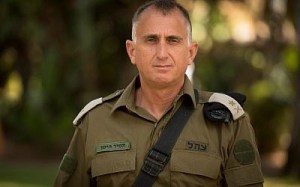
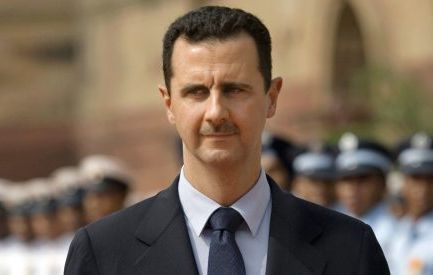
Maj. Gen. Tamir Hyman told the visiting homeland security ministers that the purpose of these Iranian bases was to establish a foothold in Syria in order to threaten the State of Israel, not to assist Syrian dictator Bashar Assad.

“You probably think it’s because they are trying to help the Assad regime fight extremists, fight terror. Well, get ready for a surprise: In all these places on the map there has been no fighting going on for half a month,” Hyman said, according to the recording broadcast on Wednesday night by Israel’s Kan news.

The general made his remarks at a homeland security conference held in Jerusalem this week, hosted by Public Security Minister Gilad Erdan.

The footage, apparently filmed surreptitiously by a participant, was not of high enough quality to make out the exact locations of the Iranian bases, but showed them spread throughout the country.

Maj. Gen. Tamir Hyman, the head of the IDF’s Northern Corps, who was named as the army’s incoming Military Intelligence chief, in an undated photograph. (Israel Defense Forces)

Hyman, who took over as Military Intelligence chief in March, noted that at this stage, Assad’s victory in the devastating Syrian civil war is all but guaranteed, yet his allies, the Iranians, do not appear to be preparing to leave the area.

“There is no real threat to Assad, so why do they stay there?” the general said, speaking in English.

“If they had wanted to assist the regime,” Hyman added, Assad could now tell them “thanks and goodbye.”

Instead, the Syrian dictator has said that Iran’s presence in the country is nonnegotiable, as Russia and the United States attempt to broker a settlement or ceasefire for the Syrian civil war, in which approximately half a million people have been killed and nearly a million displaced.

The relationship between Syria and Iran “will not be part of any settlement” and is “not in the international bazaar,” Assad told Iran’s Al Alam TV on Wednesday night.

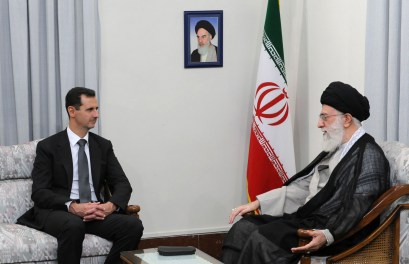
In this file photo from October 2, 2010, Iranian Supreme Leader Ayatollah Ali Khamenei, right, talks with Syrian President Bashar Assad in Tehran, Iran. (Office of the Supreme Leader, via AP, File)

The dictator repeated a claim oft-heard from Syrian and Iranian officials that Tehran does not maintain military bases in Syria. This is routinely dismissed as nonsense by Israeli, Arab and Western defense officials.

According to Hyman, Iran’s focus is establishing a military network with which it can threaten to attack Israel.

“[The Iranians] are trying to increase their effort of creating the ability and capability to launch rockets and to establish cells of terror that can enter Israel and harm the villages on the Golan Heights,” the general said.

“Nobody noticed the regional expansion that Iran did [in the Middle East]. Iran exploited that situation while everyone else in the world was focused on something else and expanded its network of terror,” he said.

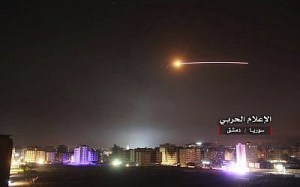
Anti-aircraft fire rises into the sky as Israeli missiles hit air defense positions and other military bases around Damascus, Syria, on May 10, 2018, after what the Israeli military said was an Iranian barrage of rockets against Israeli bases on the Golan Heights. (Syrian Central Military Media, via AP)

Hyman also referred to Israel’s clash with Iran in Syria on May 10, in which Israel says that Iranian forces launched 32 rockets at Israel’s forward defensive line along the border with Syria on the Golan Heights.

According to Israel, four of the incoming rockets were shot down; the rest fell short of Israeli territory. In response, over the next two hours Israeli jets fired dozens of missiles at Iranian targets in Syria and destroyed a number of Syrian air defense systems.

It was the most serious military confrontation between the two bitter enemies to date.

Hyman called Iran’s attack “a total failure, operationally,” but said that Tehran nevertheless saw it as a “huge success” as it was able to launch the rockets and force Israel to open bomb shelters in the north.

Last month, Hyman accompanied Defense Minister Avigdor Liberman on a working visit to Russia in order to meet with their Russian counterparts as part of Israel’s ongoing diplomatic efforts to secure an Iranian withdrawal from Syria.

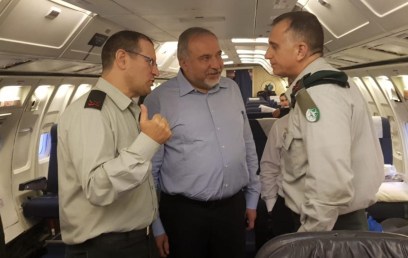
Defense Minister Avigdor Liberman speaks with his military secretary Brig. Gen. Yair Kohls, left, and the head of Military Intelligence Maj. Gen. Tamir Hyman, right, during a flight to Moscow on May 30, 2018. (Ariel Hermoni/Defense Ministry)

According to reports, Moscow is prepared to force Iran to pull its forces from the area closest to the border. Israel has rebuffed the offer, calling for Iran to pull out of Syria entirely.

“It doesn’t matter if it’s 40 kilometers or 80 kilometers. If they’re setting up missile systems in Homs, Hama or in Deir Ezzor, they will have enough range to hit Israeli territory,” Liberman said at a conference last week.

Last Friday, the Wall Street Journal reported that Iranian-backed forces stationed on the Golan border, including from the Hezbollah terror group, had also begun posing as Syrian military units, in a ploy to try to stave off pressure from Israel.

Earlier this week, the Reuters news agency reported that the Syrian military had recently deployed additional air defenses near the border with Israel, apparently as a result of the ongoing tensions over Iran’s presence in Syria.

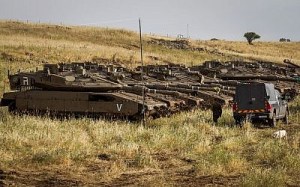
Israeli soldiers seen beside tanks near the Israeli-Syrian border in the Golan Heights on May 10, 2018 (Basel Awidat/Flash90)

The deployment was announced days after the Israel Defense Forces launched a surprise exercise on the Israeli Golan Heights.

The IDF said the exercise was not tied to current events but was “planned in advance as part of the 2018 training schedule.”

According to the Reuters report, the air defense reinforcement included the deployment of a Russian-made Pantsir S-1 system, also known as a SA-22, which the commander said was meant to “renew the air defense system against Israel in the first degree.”

The Israeli Air Force destroyed a SA-22 air defense system during its air raids on May 10, the army said at the time.

Israel’s long-running, but relatively quiet, campaign against Iran and its proxies, notably the Lebanon-base Hezbollah terrorist group, came to light and stepped up considerably in February, after an Iranian drone carrying explosives briefly entered Israeli airspace before it was shot down and, simultaneously, Israel launched a counterattack on the T-4 air base in central Syria from which the drone had been piloted.

In April, Israel attacked the T-4 air base again after Iran brought in an advanced anti-aircraft system. The Israeli strike killed at least seven members of Iran’s Islamic Revolutionary Guard Corps.

Since the April attack, Iranian officials have regularly threatened Israel with promises of eventual retribution.

Iran says it will begin uranium enrichment if nuclear deal unravels 

June 14, 2018

Source: Iran says it will begin uranium enrichment if nuclear deal unravels – Israel Hayom

Assad says Iran’s presence in Syria ‘not negotiable’ 

June 14, 2018

Source: Assad says Iran’s presence in Syria ‘not negotiable’ – Israel Hayom

Israel unveils kamikaze drone designed to hit complex targets 

June 14, 2018

Source: Israel unveils kamikaze drone designed to hit complex targets – Israel Hayom

Israel warned to avoid Syria strikes as World Cup kicks off in Russia 

June 14, 2018

Source: Israel warned to avoid Syria strikes as World Cup kicks off in Russia – Israel Hayom

Netanyahu: Iran has brought 80,000 Shiite fighters into Syria

June 14, 2018

Source: Netanyahu: Iran has brought 80,000 Shiite fighters into Syria – Israel Hayom

Iran poised to resume enrichment at deep Fordow facility

June 14, 2018

Source: Iran poised to resume enrichment at deep Fordow facility – DEBKAfile

After Iran warned it will leave the nuclear accord unless benefits are forthcoming, an atomic energy official in Tehran said that uranium enrichment would resume at Fordow – if that happens.

Iranian President Rouhani issued that warning to his French counterpart Emmanuel Macron on Tuesday. On Wednesday, June 13, Iran’s Atomic Energy Organization (AEOI) spokesman Behrouz Kamalvandi stated in Tehran that new work would begin on the nuclear program on the orders of Supreme Leader Ayatollah Ali Khamenei. “Currently the Supreme Leader has ordered that the programs be carried out within the parameters of the nuclear deal,” Kamalvandi said. “And when he gives the order we will announce the programs for operating outside of the nuclear deal for reviving Fordow.”

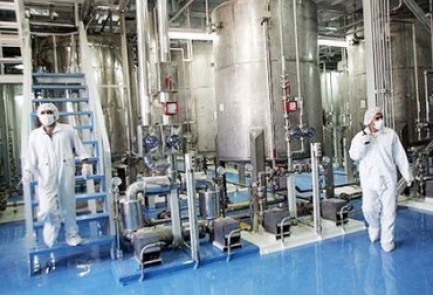
Fordow, one of Iran’s two big enrichment sites, is equipped with 8,000 advanced centrifuges capable of turning out in a short time uranium enriched to the 20pc grade, required for making a nuclear weapon. At Natanz, Iran’s second large enrichment site, the advanced equipment just installed is believed to include high-speed IR6 centrifuges. Much of Natanz is deep underground and Fordow is buried inside a mountain to keep them safe from aerial bombardment.

The AEOI statement from Tehran had three purposes:

  1. To demonstrate the next day that Iran is unconcerned by the June 12 summit between President Donald Trump and North Korea’s Kim Jong-un for the nuclear disarmament of the Korean peninsula.
  2. It was a defiant response to the US president’s comment after the Singapore summit. He said that Iran was in a different place compared to three months ago. “I hope that at the appropriate time after sanctions, really harsh sanctions, kick in, they will negotiate a new deal. Right now, it’s too soon.” Tehran made sure in its response to stress its resolve to continue on its nuclear path regardless.
  3. The statement, combined with Rouhani’s remark to Macron, showed that the Iranian leadership is lined up solidly against Trump’s strategy and determined to resume its nuclear program.
  4. The underground enrichment facility at Fordow, not far from the religious town of Qom, is exceptionally difficult to destroy by air or missile. It consists of a network of long and twisting shafts so designed that if a section is hit, at least 10 chambers will continue to operate. An attempt was made in 2012 to disrupt the plant by sabotaging its high-tension power supply. After that, an independent power station was installed underground.

UN condemns Israel for Gaza violence, but not Hamas

June 14, 2018

General Assembly passes resolution calling for “protection” for Palestinians but overrides U.S.-backed amendment censuring Hamas for rocket fire, diverting aid to terrorism • Israeli envoy Danny Danon: U.N. “colluding with a terrorist organization.”

By Yoni Hersch, News Agencies and Israel Hayom Staff June 14, 2018

Source Link: UN condemns Israel for Gaza violence, but not Hamas

{So, what is it this time? …disproportionate use of force, genocide, islamophobia, not enough Israeli casualties, bad hair day? Honestly, it just gets old, folks. – LS}

The U.N. General Assembly voted on Wednesday in favor of a Palestinian-backed resolution condemning Israel for excessive use of force against Palestinian civilians, overriding an amendment proposed by the United States to censure Hamas for rocket attacks against Israel and for diverting aid resources for terrorist purposes.

The U.S. amendment initially passed by a vote of 62-58, with 42 abstentions, but it was ultimately rejected when General Assembly President Miroslav Lajcak declared that under a General Assembly rule, a two-thirds majority was needed.

U.S. Ambassador to the U.N. Nikki Haley appealed the decision, citing another rule that only a majority vote is required to pass an amendment.

After a short break, Lajcak put the U.S. appeal to a vote. The U.S. narrowly lost that vote 66-73, with 26 abstentions.

The General Assembly adopted the original version of the resolution with 120 votes in favor, eight against, and 45 abstentions. It had been put forward by Algeria, Turkey and the Palestinians after the United States vetoed a similar resolution in the 15-member U.N. Security Council earlier this month.

More than 120 Palestinians have been killed in the Gaza border riots since March 30. The largest number of deaths occurred on May 14, and Hamas confirmed that most of the casualties were Hamas operatives.

While the General Assembly text condemned the firing of rockets from the Gaza Strip into Israeli civilian areas, it did not mention Hamas, which rules Gaza and is responsible for the rocket fire, nor did it mention the Palestinian riots on the Gaza border.

“The nature of this resolution clearly demonstrates that politics is driving the day,” Haley told the General Assembly before the vote.

“It is totally one-sided. It makes not one mention of the Hamas terrorists who routinely initiate the violence in Gaza.”

Algerian Ambassador Sabri Boukadoum, representing Arab nations, sought to block a vote on the U.S. amendment, saying it was not relevant to the resolution and also undermined reconciliation efforts between rival Palestinian factions Hamas and Fatah as well as the “remote prospects” of reviving peace negotiations with Israel.

Before the vote, Israel’s Ambassador to the U.N., Danny Danon, told the assembly, “By supporting this resolution you are colluding with a terrorist organization; by supporting this resolution you are empowering Hamas.”

Australia, the Marshall Islands, Micronesia, Nauru, Solomon Islands and Togo joined Israel and the United States in voting against the resolution.

The resolution also calls on U.N. chief Antonio Guterres to recommend an “international protection mechanism” for the Palestinian territories.

“We need protection of our civilian population,” Palestinian U.N. envoy Riyad Mansour told the General Assembly before the vote.

He said the resolution was “intended to contribute to a de-escalation of the volatile situation.”

“We cannot remain silent in the face of the most violent crimes and human rights violations being systematically perpetrated against our people,” Mansour said.

The resolution calls on Guterres to report back within 60 days on proposals “on ways and means for ensuring the safety, protection and well-being of the Palestinian civilian population under Israeli occupation, including … recommendations regarding an international protection mechanism.”


With eyes on Iran, Netanyahu praises Trump over North Korea summit 

June 14, 2018

Source: With eyes on Iran, Netanyahu praises Trump over North Korea summit | The Times of Israel

PM hails US president’s Singapore meeting with Kim Jong Un as an ‘important development for Israel, the region and the entire world’

Prime Minister Benjamin Netanyahu speaks at the American Jewish Committee (AJC) Global Forum, in the Jerusalem Convention Center, on June 10, 2018. (Yonatan Sindel/Flash90)

Prime Minister Benjamin Netanyahu speaks at the American Jewish Committee (AJC) Global Forum, in the Jerusalem Convention Center, on June 10, 2018. (Yonatan Sindel/Flash90)

Prime Minister Benjamin Netanyahu on Tuesday hailed US President Donald Trump’s summit in Singapore with North Korean dictator Kim Jong Un as “historic” and an “important step” in denuclearizing the Korean Peninsula, while linking the meeting to the US leader’s “tough stance” on Iran.

“I congratulate US President Donald Trump for the historic summit in Singapore,” Netanyahu said in a statement. “It is an important step in the effort to denuclearize the Korean Peninsula.”

“President Trump also takes a tough stance against Iran’s attempt to arm itself with nuclear weapons, as well as against its aggression in the Middle East. This is leaving its mark on the Iranian economy,” he continued, referring to Trump’s withdrawal from the landmark 2015 pact last month.

“Trump’s policy is an important development for Israel, the region and the entire world,” Netanyahu added.

Trump and Kim held the unprecedented meeting in Singapore, after which they signed a joint document praised by both leaders.

On the heels of the Singapore summit, the US president on Tuesday said he hopes to negotiate a “real deal” with Iran over its nuclear program after Washington’s renewed, “brutal” sanctions kick in.

“I hope that, at the appropriate time, after the sanctions kick in — and they are brutal what we’ve put on Iran — I hope that they’re going to come back and negotiate a real deal because I’d love to be able to do that. But right now it’s too soon to do that,” Trump told reporters after meeting Kim.

Trump withdrew the US from the nuclear deal on May 8. The 2015 agreement required Iran to curb its uranium enrichment in exchange for relief from international sanctions. Following his withdrawal from the pact, Trump has announced the restoration of US sanctions, while European leaders are trying to preserve the deal.

Iran has said it will ramp up its uranium enrichment capabilities and last week opened a new facility geared toward producing enrichment centrifuges that will operate within the limits of the nuclear deal.

Israeli ministers on Tuesday also applauded the Trump-Kim meeting over the “strong” message it sends to the Islamic Republic.

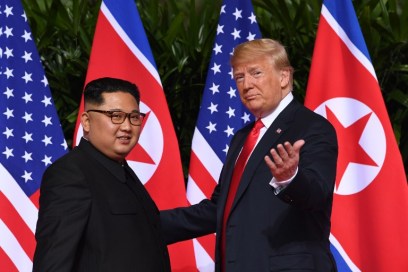
US President Donald Trump (R) gestures as he meets with North Korea’s leader Kim Jong Un (L) at the start of their historic US-North Korea summit, at the Capella Hotel on Sentosa island in Singapore on June 12, 2018. ( AFP PHOTO / SAUL LOEB)

Energy Minister Yuval Steinitz told The Associated Press that North Korea giving up its nuclear weapons would send a “strong” signal to Iran. He says it would “increase the pressure on Iran” to give up its nuclear infrastructure and capabilities.

Regional Cooperation Minister Tzachi Hanegbi (Likud) also drew a parallel with Iran, praising the summit as “a mortal blow” to the Islamic Republic’s regional policies.

“The first glimmerings of reconciliation between the United States and North Korea are a mortal blow to the radical axis led by Iran,” he said in a statement Tuesday.

“This is just the beginning of a long and exhausting negotiation process, full of crises and disagreements. But the bottom line, as of now, is welcome: Trump’s aggressive and uncompromising policy is proving itself. This is wonderful news for the free world, and for Israel.”

Earlier Tuesday, Public Security Minister Gilad Erdan, the #2 lawmaker on the ruling party’s Knesset list, said the meeting with Kim was “a tremendous achievement” and said a similar meeting between Trump and Iranian President Hassan Rouhani would “not be terrible.”

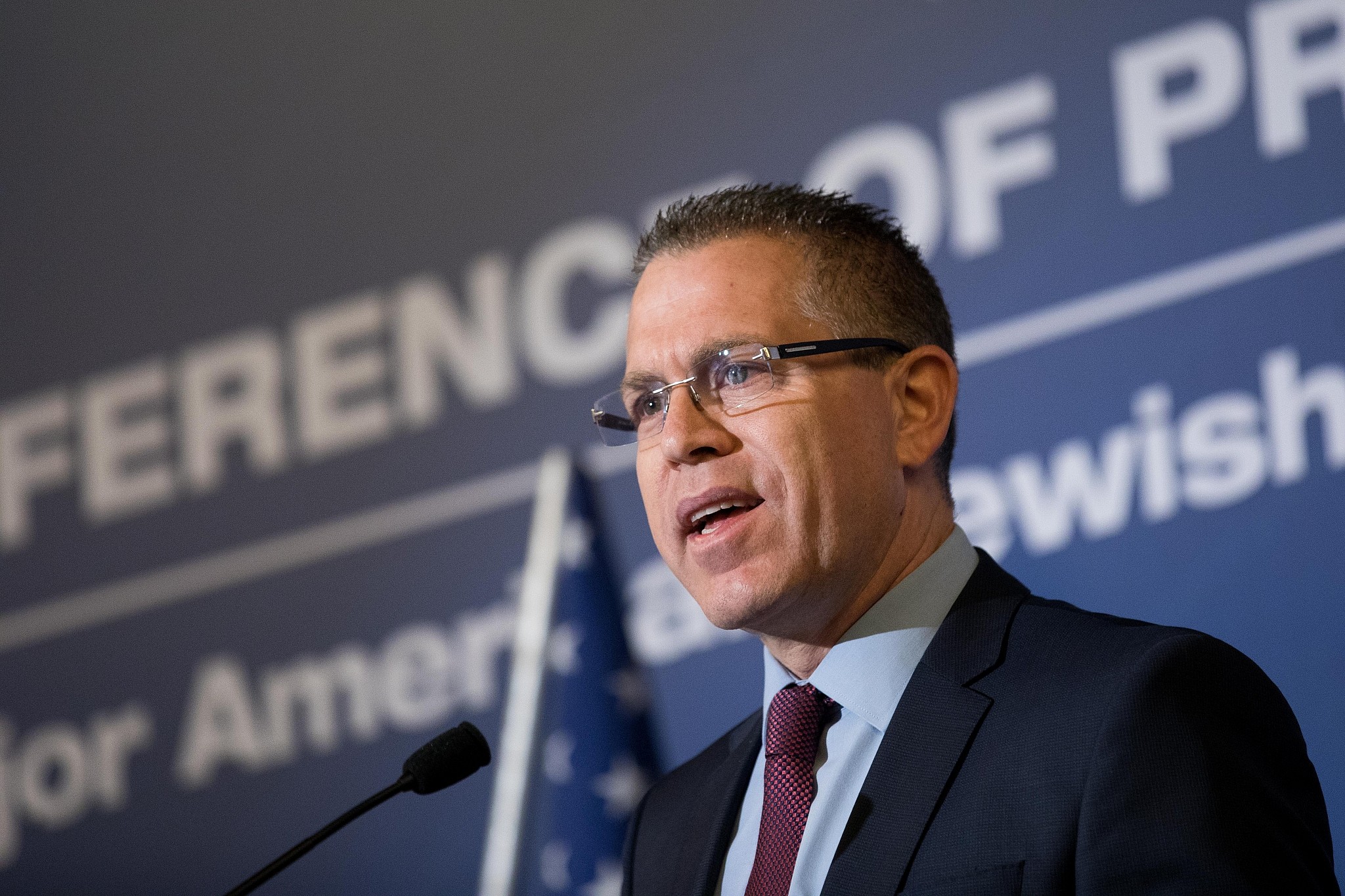
Public Security Minister Gilad Erdan speaks at the Conference of Presidents of Major American Jewish Organizations, at the Inbal Hotel in Jerusalem, February 19, 2018. (Yonatan Sindel/Flash90)

“Given Trump’s values, both as expressed during the election and afterwards in his actions, it would not be terrible if such a meeting happens, as long as its goal and purpose is to dismantle Iran’s nuclear weapons [program], and also, as Trump understands, that’s not enough, but [the goal must also be] to change the nature of the regime and its support for terror all over the world, certainly in the Middle East.”

The summit — unthinkable only months ago — comes after the two nuclear-armed foes appeared on the verge of conflict late last year as they slung personal insults and Kim conducted nuclear and missile tests.

Times of Israel staff contributed to this report.