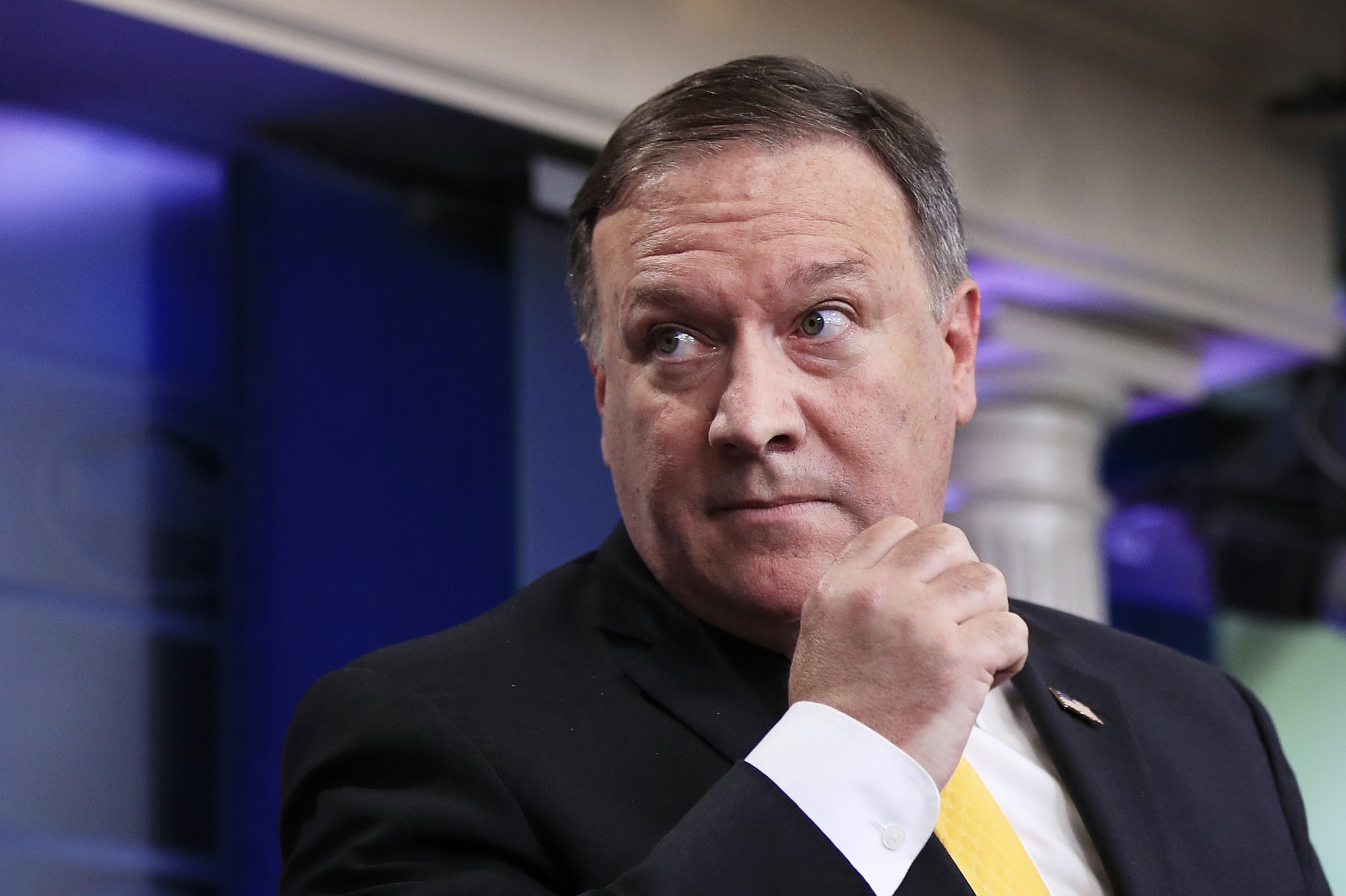
US Secretary of State Mike Pompeo talks to reporters about North Korea during the daily press briefing in the Brady press briefing room at the White House, in Washington, June 7, 2018. (AP Photo/Manuel Balce Ceneta)
US Secretary of State Mike Pompeo said he hoped the US would never have to take military action against Iran, but warned that should Tehran pursue the acquisition of nuclear weapons, it would stand to face the “wrath of the entire world.”
Speaking during an interview with MSNBC broadcast on Saturday, Pompeo said that no matter the fate of the 2015 Iranian nuclear deal — which the US pulled out of last month, angering Tehran and America’s European allies and signatories to the agreement — it would not be in Iran’s interest to develop nuclear arms.
“I hope they understand that if they begin to ramp up their nuclear program, the wrath of the entire world will fall upon them,” he said, during the wide-ranging interview which focused heavily on Washington’s recent outreach to North Korea, and ongoing talks on Pyongyang’s denuclearization.
“When I say wrath, don’t confuse that with military action. When I say wrath, I mean the moral opprobrium and economic power that fell upon them. That’s what I’m speaking to. I’m not talking to military action here. I truly hope that that’s never the case. It’s not in anyone’s best interests for that,” he added.
Pompeo said that US President Donald Trump has been “very clear” on Iran. “Iran will not get a nuclear weapon nor start its weapons program on this President’s watch,” he said, according to a transcript of the interviewmade available by the US State Department.
Trump’s announcement on May 8 that Washington was withdrawing from the Iran nuclear deal was a fulfillment of a campaign promise made by the then-candidate to scrap the deal. The US president had often blasted the controversial agreement forged under his predecessor, President Barack Obama, casting it as “defective” and unable to rein in Iranian behavior or halt the Islamic Republic’s quest to develop nuclear weapons. Trump said the 2015 agreement, which included Germany, France, Russia, China, and Britain, was a “horrible one-sided deal that should never ever have been made.”
European allies Germany, France, and Britain had urged Trump to remain part of the deal and said they would stick by the agreement regardless.
In his Saturday interview, Pompeo rebuffed the suggestion that America had “separated from our allies on this issue of Iran,” and suggested that although allies may have disagreed with Washington’s move to withdraw from the accord, they understand the wider threat posed by Iran
“When I talk to my Arab friends, the Israelis, all of those in the region, they are right alongside us. And even when I speak to the Europeans, with whom we have a difference about the JCPOA [the Joint Comprehensive Plan of Action, as the deal is formally called] they too understand the threat that Iran presents, whether it’s malign activity with [Lebanese terror group] Hezbollah or in Yemen or in Syria or in Iraq, or its missile program that is launching missiles into airports that Westerners travel through,” he said.
“There is a unified understanding of Iran’s malevolent behavior, and it will be an incredibly united world should Iran choose to head down a nuclear weapons path,” he added.
While the fate of the JCPOA is not yet clear as Iran has said it will remain in the deal but could resume nuclear activity if need be, Pompeo said that “if they began to move towards a weapons program, this would be something the entire world would find unacceptable, and we’d end up down a path that I don’t think this is the best interest of Iran, other actors in the Middle East, or indeed the world.”
( Merklel has already ruined Europe with her open immigration policies, I am completely unmoved by her “crocodile tears” about Iran. – JW )
We see Iran’s activities with regard to Israel’s security and with regard to Jordan’s border,” German chancellor says after meeting Jordan’s King Abdullah • “Iran’s aggressive tendencies must not only be discussed, but rather we need solutions urgently.”
Reuters and Israel Hayom Staff
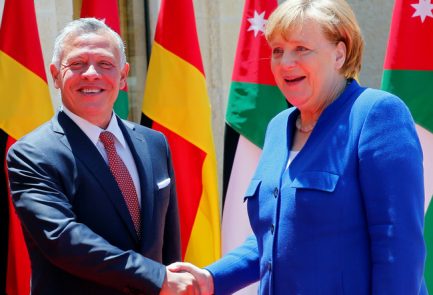
Jordan’s King Abdullah and German Chancellor Angela Merkel in Amman
|Photo: Reuters
European countries share concerns over Iran’s ballistic missile program and want solutions to its “aggressive tendencies” in the Middle East, German Chancellor Angela Merkel said on Thursday.
“Iran’s aggressive tendencies must not only be discussed, but rather we need solutions urgently,” Merkel said after meeting with Jordan’s King Abdullah in Amman.
She announced 384 million euros ($445 million) of aid to Jordan this year.
Germany has remained party to the 2015 Iran nuclear deal, which lifted sanctions on Iran in exchange for it curbing its nuclear program, after U.S. President Donald Trump withdrew from it in May.
Merkel said on Thursday that while European countries want to maintain the accord, they share concerns over Iran’s ballistic missile program, its presence in Syria, and its role in the war in Yemen.
Iran is a major military supporter of Syrian President Bashar Assad, sending some of its own forces to Syria and backing Shiite militias from Lebanon and Iraq who are fighting there.
Gulf and Western countries accuse Iran of arming the Houthi rebel group in Yemen, an allegation it denies.
Merkel also voiced support for Jordan’s concerns about Iranian activity in southwestern Syria near the Jordanian and Israeli borders, where Syria is ramping up military action.
“You live not just with the Syria conflict, but also we see Iran’s activities with regard to Israel’s security and with regard to Jordan’s border,” she said.
Earlier this month, after meeting Prime Minister Benjamin Netanyahu, Merkel said Iran’s regional influence was “worrying, especially for Israel’s security.”
King Abdullah, who met Netanyahu on Monday and Trump’s son-in-law and regional envoy Jared Kushner on Tuesday, said there could be no peace in the Middle East without a Palestinian state with Jerusalem as its capital.
The United States is preparing a new peace plan, which has not yet been made public, but has already angered Palestinians by recognizing Jerusalem as the capital of Israel.
Abdullah this month appointed a new prime minister after the country’s biggest protests in years over taxes and price increases pushed by the International Monetary Fund.
Merkel said reforms should be balanced and “not hit the wrong people.”
In addition to the aid for Jordan, Germany is also providing it with a $100 million credit line to help it cope with the requirements of the IMF reforms, Merkel said.
( Haaretz is a heavy leftist newspaper. Like most of the MSM they can’t stop gnashing their teeth at every success either Trump or Netanyahu achieve. They have to work real hard with pretzel-like logic in this article to show that Trump is actually BAD for Israel. Pathetic… – JW )
Netanyahu always tells us Trump has Israel’s back on Iran. But the president won’t confront tyrants, intent as he is on unraveling America’s commitments abroad. If Tehran races to nuclear capability, Israel will pay the price – alone
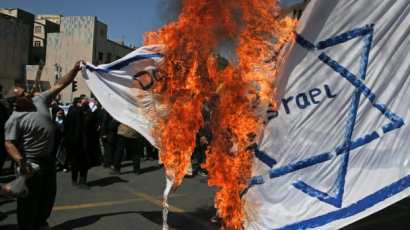
Iranian protesters burn a representation of the Israeli flag in their annual anti-Israeli Al-Quds, Jerusalem, Day rally in Tehran, Iran. June 8, 2018Vahid Salemi/AP
As U.S. President Donald Trump’s behavior becomes increasingly erratic and grotesque, untethered to decency or truth, his right-wing supporters in Israel and the American Jewish community are getting a little nervous.
At times, the president of the United States seems, in the words of Andrew Sullivan, to be simply “bonkers.” The latest round of Trump outrages, involving the incarceration of infants and toddlers, has left even his most hard-core backers wondering if the president’s megalomania has obliterated his grasp of reality.
U.S. President Donald Trump speaks at a campaign rally, Wednesday, June 20, 2018, in Duluth, Minn. Jim Mone/AP
Nonetheless, right-wing Jews in Israel and America, led by Prime Minister Benjamin Netanyahu, seem prepared to overlook Mr. Trump’s deficiencies. Yes, they acknowledge off the record, the president is crude and crass. Yes, he engages in regular ridicule of “others” – Muslims, Mexicans, Arabs, Europeans, Hispanics, and especially, immigrants. Yes, he has unleashed popular passions that threaten liberty and give comfort to bigots and anti-Semites.
But never mind, because Trump is a friend of Israel. He has put the Palestinians in their place. He moved the American embassy from Tel Aviv to Jerusalem. And above all, he pulled America out of the hated Iran deal, removing the threat that this deal posed to Israel’s very existence.
For those who are perplexed by Jewish attitudes toward Trump, Iran is the key to the puzzle. How can Israel, and so many Jews, stand behind a fanatic bully like Trump? The answer is that, in some respects, it is precisely due to his unrestrained temperament.
Nehemia Shtrasler made this argument in Haaretz. Both America and Israel, he wrote, are threatened by evil terrorist regimes like Iran and North Korea. And President Trump recognized what his predecessor U.S. President Barack Obama could not see: that a language of threats and force is the only way to contend with the tyrants in our dangerous world.
Why did Kim Jong Un promise to “denuclearize”? According to Shtrasler, because the American president imposed sanctions and threatened to annihilate Kim’s country, causing him to change his strategy. And the same threatening, tough-guy approach will soon work with Iran, which is already feeling the pressure of newly-imposed American sanctions.
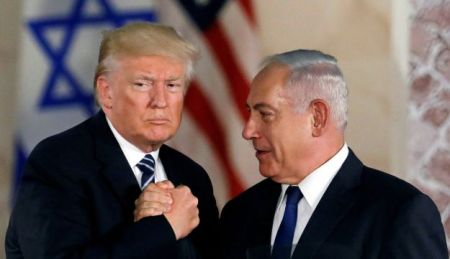
U.S. President Donald Trump and Israeli Prime Minister Benjamin Netanyahu shake hands after Trump’s address at the Israel Museum in Jerusalem May 23, 2017.RONEN ZVULUN/REUTERS
And so, the thinking goes, Trump may be an imperfect, inexperienced, shoot-from-the-hip president. But as Netanyahu is always reminding us, this president has Israel’s back. And in scrapping the nuclear agreement with Iran, we are told, he has saved the Jewish state.
The problem with this argument is that it is wrong.
To Nehemia Shtrasler and Trump supporters everywhere, I suggest that they consider the following: Trump is a betrayer. In his non-stop efforts to promote himself and his very narrow view of American interests, he has betrayed virtually every country friendly to America and every alliance of which America is a part. He has betrayed NATO and the European Union. He has betrayed Britain and Canada. He has betrayed Japan and South Korea.
And Israel and the Jewish people are not exempt. When it comes to Iran, they too will be betrayed.
Let us look at the facts.
Shtrasler sees in Trump’s actions a principled toughness against America’s enemies. But Trump has few real principles other than self-advancement and political survival. And while it is true that the Iran nuclear agreement is deeply flawed, Trump’s campaign promise to withdraw from it was not rooted in commitment to Israel’s welfare. In fact, Israel played virtually no role in Trump’s political life prior to the election.
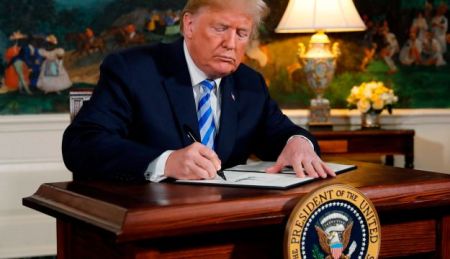
U.S. President Donald Trump signs a proclamation declaring his intention to withdraw from the Iran nuclear deal, May 8, 2018.\ JONATHAN ERNST/ REUTERS
Trump opposed the deal for a variety of reasons: He loves being a foreign policy maverick, the deal was identified with Obama, and it was unpopular with Evangelical Christian leaders. And since most Americans didn’t much care about it, abandoning it was relatively risk free.
But this rationale hardly means that the president has a plan for what to do now, or that Israel will end up better off than it was before. In fact, the opposite is almost certainly true.
Trump and administration officials claim that American sanctions at a time of economic uncertainty in Iran will force the Iranians back to the negotiating table to make a “better deal.” Such a scenario is not impossible.
But another alternative, more likely in many ways, is that rigorously enforced sanctions will push the Iranians to renounce the agreement themselves and resume nuclear enrichment activity. As Amos Yadlin and Ari Heistein point out in The Atlantic, Iran will choose negotiations over bomb building only if there is “the credible threat of a military strike.”
And while many in Israel and the Jewish community do not want to admit it, such a threat simply does not exist.
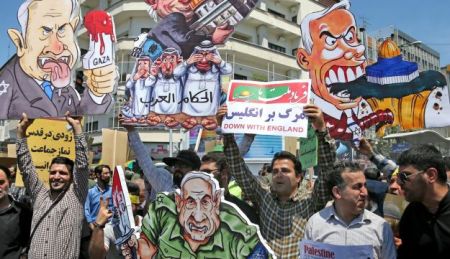
Iranian protesters hold up caricatures of leaders of Israel during the annual anti-Israeli Al-Quds, Jerusalem, Day rally in Tehran, Iran, Friday, June 8, 2018Ebrahim Noroozi/AP
President Trump loves to talk tough. He loves to shock and disrupt, and to bully and brag. But bullies, as we know, are not strong; they are weak. When confrontations come, they back away. And to the extent that Trump’s foreign policy has a direction at all, it is to withdraw from overseas commitments and to extricate America from engagement abroad.
Stephen Sestanovich argues correctly, also in The Atlantic, that Trump is not a simple isolationist. He has too big an ego for that. He is not opposed to a measure of activism if the cost is small and if he can make himself appear strong, decisive, and, for example, a terrorist fighter. Nonetheless, while Trump does not have a consistent foreign policy, certain sentiments and instincts dominate his world view – and always have. And the most important of these is resistance to significant American military involvement.
What all this means is that if Iran returns to nuclear enrichment, America will not act militarily. Trump’s view is that trade wars are one thing, but fighting wars are costly, messy, and unpopular. Foreign conflicts are to be avoided, period. And to his own deep reservations must be added his Putin obsession. Russian Prime Minister Vladimir Putin, we should remember, values his relationship with Iran and its leaders. That Trump would bomb Iran against Putin’s wishes is unthinkable.
Obviously, no one wants America to go to war. And it would be far better to resolve America’s problems with Iran in peaceful ways. But the point is that Trump pulled out of the Iran deal without having a Plan B, or for that matter, even a Plan A. And if Iran decides to race to nuclear capability, a real possibility, the country that will be most threatened is Israel.
Trump, in other words, is not a confronter of tyrants. He is an appeaser of tyrants, intent on unraveling America’s commitments abroad. And Israel is likely to pay the price.
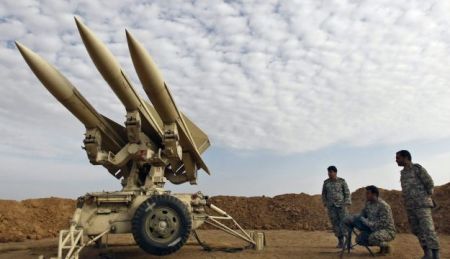
Iranian military prepare missiles to be launched. Iran claims its air defenses can challenge potential Israeli air strikes. Nov. 13, 2012AP
Yadlin and Heistein recognize this possibility, and their proposal is that Israel should be prepared to act alone, with an American “green light.” But as they note, it would be essential for Israel to conduct a surgical strike and then find a way to avoid further escalation.
The problem, of course, is that it is not at all clear that a surgical strike would be sufficient to knock out Iran’s nuclear capacity; most American experts think it would not. And following an Israeli attack on Iran, escalation of the conflict is not only possible but likely.
Bottom line? If the result of President Trump’s actions is that Iran does not make a deal but opts to obtain the bomb, Israel will be exposed as it has never been before. Netanyahu’s fawning over Trump will have been for naught. Israel will have been betrayed.
Netanyahu has always expected that he will be remembered by history for his role in dealing with Iran. He will be. But that role may be different than the one he anticipated.
Eric H. Yoffie, a rabbi, writer and teacher in Westfield, New Jersey, is a former president of the Union for Reform Judaism. Twitter: @EricYoffie
The proliferating anti-Israel activism, driven by the rise to power of the political far-left, is establishing Spain as the EU member state most hostile towards the Jewish state.
A Madrid-based organization, Action and Communication on the Middle East (ACOM), which is fighting the anti-Israel BDS movement in Spain, said that Valencia’s motion was anti-Semitic and an incitement to hatred.
“The BDS movement in Spain acquired its current virulence with the emergence of Podemos, a ‘Chavist’ far-left party financed by Venezuela and Iran…. As Podemos gained control of the municipal governments in the main Spanish cities, the anti-Israel movement had access to multiple economic, human and organizational resources…. Podemos has driven over 90 such declarations in Spain in jurisdictions covering a population of over eight million people” — Ángel Más, president, ACOM.
Valencia, the third-largest city in Spain, has approved a motion to boycott Israel and slander it by declaring the city an “Israeli apartheid-free zone.” The move comes days after Navarra, one of Spain’s 17 autonomous communities, announced a similar measure. In all, more than 50 Spanish cities and regions have passed motions condemning Israel. The proliferating anti-Israel activism, driven by the rise to power of the political far-left, is establishing Spain as the EU member state most hostile towards the Jewish state.
The Valencian measure, introduced by the far-left party València en Comú, was approved during a plenary session of the city council on May 31. The motion, which commits the city to refrain from engaging in business contacts or cultural events with Israeli authorities or companies, aims at establishing Valencia as “a global reference for solidarity with the Palestinians.”
The city of Valencia, Spain has approved a motion to boycott Israel and slander it by declaring the city an “Israeli apartheid-free zone.” (Image source: Ben Bender/Wikimedia Commons)
The motion, which libelously describes Israel as an “apartheid regime,” accuses the Jewish state of “colonialism,” “racism,” “ethnic cleansing,” “tyranny,” and “genocide.”
The measure, which claims to reflect the “dignity, solidarity and justness” of the Valencian people, was introduced by Neus Fábregas Santana, a city councilor whose Twitter feed reveals an obsession with demonizing and delegitimizing Israel.
Santana works closely with a group called BDS País Valencia, the local branch of a worldwide movement trying to delegitimize Israel, the only democracy in the Middle East.
BDS País Valencia is currently promoting a Spanish documentary about the Gaza Strip called “Gas the Arabs,” a title that alleges, falsely, that the Jews in Israel are doing to the Arabs today what the Nazis in Germany did to the Jews during the Second World War.
An activist with BDS País Valencia, Mireia Biosca, said the motion in Valencia had three objectives:
“The first is the dismantling of the apartheid wall and the return to the borders of 1967. The second is the end of apartheid both in Palestine and in Israel, and the third is the right of return.”
Biosca also said BDS País Valencia would work to prevent the Eurovision song contest from being held in Israel in 2019:
“There is a very clear line: first to ensure that states do not participate in the festival, and obviously a campaign to prevent the festival from being in Jerusalem. For me it is equally boycottable if it is decided that Eurovision will be held in Tel Aviv….”
A Madrid-based organization, Action and Communication on the Middle East (ACOM), which is fighting the anti-Israel BDS movement in Spain, said that Valencia’s motion was anti-Semitic and an incitement to hatred. It said it was studying whether to take legal action against the City Council of Valencia for violating the Spanish Constitution and promoting discrimination based on religion, ethnicity or national origin:
“The declaration is full of lies, manipulations and libels, whilst it calls for the city to formally adhere to the BDS movement and declare itself ‘free of Israeli apartheid’ (a known euphemism in Spain for Judenrein [free of Jews], where any perceived sympathizer of the Jewish State is demanded to publicly denounce the policies of the only democracy in the Middle East in order to be admitted to social, political, economic or civic activities in the municipality) ….
“We informed the local press of the illegality of the BDS campaign, detailing dozens of judicial cases won by ACOM in the Spanish Courts that proved the unconstitutionality of exclusionary measures.”
ACOM has filed more than twenty lawsuits against provincial and town councils which have enacted boycotts of Israel.
Much of the BDS activity in Spain is being promoted by Podemos (translated in English as “We Can”), a neo-Communist party founded in March 2014 to protest the economic austerity measures put into place after the European debt crisis. Podemos received more than 20% of the vote in the national election held on December 20, 2015 and is now the third-largest party in Parliament.
Podemos head Pablo Iglesias and his deputy, Íñigo Errejón, served as advisors to the late Venezuelan President Hugo Chávez, and have been accused of receiving more than €7 million ($8 million) from Chávez to fund their political activities in Spain. Podemos has also been accused of receiving funding from the Islamic Republic of Iran.
Iglesias has a long history of anti-Semitism: he has downplayed the Holocaust, describing it as “a bureaucratic and administrative decision”; compared the Gaza Strip to the Warsaw ghetto; and described Spanish police who apprehend illegal immigrants as being the same as SS guards.
Iglesias hosts a television program, “Fort Apache,” which is broadcast on HispanTV, a Spanish-language cable television network owned by the Iranian government. He has been accused of using his show to repeat anti-Semitic conspiracy theories and tropes.
In a June 7 interview on RTVE, a leading state-owned television and radio broadcast network, Iglesias, said that Israel was an “illegal” country: “We need to act more firmly against an illegal state like Israel. Israel’s actions are illegal. The apartheid policies of Israel are illegal.”
València en Comú, the political party which sponsored the BDS motion in Valencia, is a local offshoot of Podemos. The motion was approved with support from Compromís, a coalition of Communist and left-wing nationalist parties, as well as the Spanish Socialist Party (PSOE), which recently took over the central government in Madrid.
BDS motions have also been approved in: Abrera, Alcoi, Alhaurín de la Torre, Artés, Badalona, Barberà del Vallès, Barcelona, Benlloch, Campillos, Casares (Malaga), Castrillón, Castro del Río, Catarroja, Concentaina, Córdoba, Corvera, El Prat, Gijón, Gran Canaria, La Roda Llangreu, Los Corrales, Madrid, Mairena del Aljarafe, Molins de Rei, Montoro, Muro, Navalafuente, Navarra, Oleiros, Olesa de Montserrat, Onda, Pamplona, Petrer, Ripollet, Rivas-Vaciamadrid, Sabiñánigo, San Fernando, San Roque, Sant Adrià del Besòs, Sant Cebriá de Vallalta, Sant Celoni, Santa Eulària (Ibiza), Sant Boi de Llobregat, Sant Feliu de Llobregat, Sant Pere de Ruidebitlles, Santiago de Compostela, Sant Quirze del Vallès, Seville, Telde, Terrassa, Trebujena, Velvez-Málaga, Viladamat, Viloria del Henar, Xeraco and Zaragoza, among others.
ACOM President Ángel Más explained the dynamics behind the rise of the BDS movement in Spain:
“The BDS is a global phenomenon that is born from the modern anti-Semites’ acceptance of the improbability of defeating Israel through military confrontation or terrorist attacks. The objective is the same: the annihilation of the Jewish homeland, ‘from the river to the sea.’ But now, BDS tries to push the international community to condemn Israel as a pariah state and ostracize all those that support her: Zionists. Jews.
“The delegitimizers, as old-time bigots, mask their thuggery, presenting themselves as victims and hiding their true intentions. They appeal to public feelings against oppression or abuse and the sympathy for underdogs and suffering minorities.
“The BDS movement in Spain acquired its current virulence with the emergence of Podemos, a ‘Chavist’ far-left party financed by Venezuela and Iran. Podemos won 25% of the votes in Spain’s 2015 local elections. Before those elections, BDS was a marginal confederation of small groups focusing on academic and cultural boycotts of Israel. The core group that formed Podemos had been active in the BDS initiatives for years, and hostility against Israel was a top priority in their political agenda.
“As Podemos gained control of the municipal governments in the main Spanish cities, including Madrid, Barcelona, Zaragoza and Cadiz, the anti-Israel movement had access to multiple economic, human and organizational resources. When those far-left groups occupied public institutions, they didn’t distinguish between their own sectarian agenda and the government’s agenda.
“Local administrations (provincial and municipal) formally joined the BDS movement and declared their territories ‘free of Israeli apartheid.’ In effect, Judenrein. Stickers were distributed to be exhibited in shops and offices, public companies were instructed not to work with Israeli firms or individuals and Spanish citizens suspected of being associated or sympathetic to the Jewish state were demanded to repudiate it publicly in order not to be excluded from social, political, economic and civic life.
“Podemos has driven over 90 such declarations in Spain in jurisdictions covering a population of over eight million people. Its plan was to create an oil spill of hatred reaching the majority of Spain in 18 months. This was an existential threat, and we had to act….
“No local boycott is too small to go unchallenged. BDS groups carefully manipulate the information reaching political decision makers, spend massive resources on media campaigns and are masters at social media intoxication. In general, pro-Israel groups are lagging behind in the application of analysis and action in those fields.”
As American peace team holds talks in Israel and is boycotted by Abbas, his aide Saeb Erekat claims US wants to separate West Bank from Gaza, ‘terminate’ UNRWA
PLO Secretary General Saeb Erekat in his Ramallah office, November 23, 2015. (AFP/Abbas Momani)
Top Palestinian negotiator Saeb Erekat on Saturday accused the US peace team of working to topple the Palestinian Authority, as the American envoys wrapped up a visit to the region aimed to push the Trump administration’s peace plan and enlist humanitarian aid for the Gaza Strip.
US President Donald Trump’s senior adviser and son-in-law Jared Kushner, along with Jason Greenblatt, met with Prime Minister Benjamin Netanyahu Friday following meetings earlier in the week with the leaders of Jordan, Saudi Arabia, Qatar, and Egypt. They are expected to meet again with Netanyahu Saturday evening before returning to the US.
Mahmoud Abbas’s Palestinian Authority is refusing to meet with the team, having boycotted the Trump administration since December.
Erekat claimed that, during the meeting with Kushner and Greenblatt, Netanyahu said he was prepared to help address the humanitarian situation in Gaza with the tax revenues Israel collects on behalf of the PA.
“The goal behind this is to sustain the coup [by which Hamas seized Gaza from Abbas in 2007] and keep Gaza separated from the West Bank on the way to creating a mini-state in Gaza while bringing down the Palestinian Authority in the West Bank,” Erekat told Voice of Palestine radio, according to the PA’s official Wafa news agency.
Prime Minister Benjamin Netanyahu (2nd from right) meets at his Jerusalem office with the ambassador to the US, Ron Dermer (right); White House adviser Jared Kushner (center); US Ambassador David Friedman (second left); and special envoy Jason Greenblatt, on June 22, 2018. (Haim Zach/GPO)
Erekat alleged the US is working to remove Abbas and overthrow the PA, pointing to an article by Greenblatt earlier this month calling for Erekat’s ouster. Greenblatt accused Erekat of exacerbating the conflict and impeding progress toward peace after the latter attacked Washington over its peacemaking role.
“In order to target the leadership, the US administration starts by creating a state of destabilization and confusion in the West Bank and at the same time works on undercutting international consensus on rejecting the so-called deal of the century and American conspiracies and support for the Palestinian cause,” Erekat said.
He also said Kushner and Greenblatt are seeking the “termination” of the UN’s Palestinian refugee agency, in the wake of their alleged belief Jerusalem is no longer an issue after Trump recognized the city as Israel’s capital.
“They want to terminate the role of UNRWA by proposing direct aid to the countries hosting the Palestinian refugees and sideline the UN agency,” Erekat said. “On top of this, they are planning financial aid to the Gaza Strip worth one billion dollars for projects, also separate from UNRWA and under the title of solving a humanitarian crisis.”
He added: “All this is actually aimed at liquidating the issue of the Palestinian refugees.”
The US earlier this year cut some $250 billion to the budget of the United Nations Relief and Works Agency for Palestine Refugees, or UNRWA.
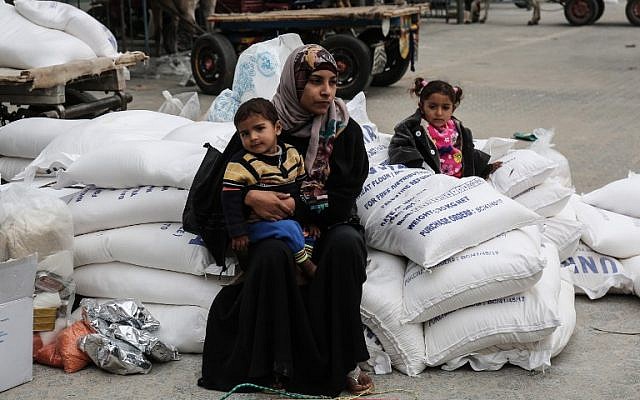
A Palestinian woman sits with a child after receiving food supplies from the United Nations’ offices at the United Nations’ offices in the Khan Younis refugee camp in the southern Gaza Strip, February 11, 2018. (AFP/Said Khatib
Israel has often criticized UNRWA, accusing it of sheltering terrorists and allowing Palestinians to remain refugees even after settling in a new city or country for many generations, thus complicating a possible resolution to the Israeli-Palestinian conflict.
It also accuses UNRWA of helping to perpetuate the Palestinian narrative of Israel’s illegitimacy by uniquely granting refugee status to the descendants of refugees, even when they are born in other countries and have citizenship there, conditions that do not apply to the refugees cared for by the UN’s main refugee agency, UNHCR, which cares for all other refugees worldwide. The population of Palestinian refugees thus grows each year, even as other refugee populations in the world shrink with each passing generation.
Separately, Abbas’ spokesman said Saturday that the alleged efforts by the US to undercut the PA would not bear fruit.
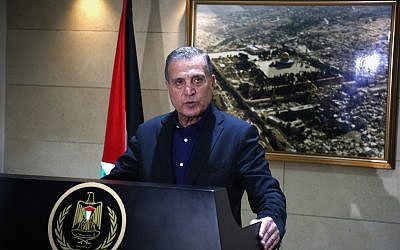
Nabil Abu Rudeineh, spokesman of PA President Mahmoud Abbas. (Flash90)
“The American delegation should abandon the illusion that creating false facts and falsifying history are going to help it sell those illusions,” Wafa quoted Nabil Abu Rudeineh as saying.
“The right address for achieving a just and lasting peace that cannot be bypassed, neither regionally nor internationally, is the Palestinian decision-maker represented by President Mahmoud Abbas and the Palestinian leadership supported by the legitimate international community and the Arabs, who made this clear to the American delegation,” Abu Rudeineh added.
He also said the US should “stop pursuing imaginary political alternatives and projects aimed at splitting the Palestinian homeland to prevent the establishment of our Palestinian state.”
Kushner and Greenblatt did not meet with any Palestinian officials on their Middle East trip, with the PA boycotting the Trump administration since the Jerusalem recognition.
The decision greatly angered Palestinians, who claim East Jerusalem as the capital of their future state, though Trump stressed he was not taking a stance on the city’s borders, which he said must be agreed upon by the sides.
As Turks prepare to head to the polls Sunday in a snap election called by incumbent President Recep Tayyip Erdogan, Foreign Policyhas published what is essentially a summary blueprint outlining the ways Erdogan could steal the election, noting “Sunday’s vote is one he can’t afford to lose.”
As we previously commented, though the man who has dominated the nation’s politics for almost two decades is not expected to lose, a consensus is emerging that the vote should be regarded as a referendum on his person and leadership.
And now, a visible surge in popularity for the rival secularist Republican People’s Party (CHP) candidate has pundits declaringthe opposition actually has a chance.
AKP President Recep Tayyip Erdogan and Republican People’s Party (CHP) challenger Muharrem Ince. Image via Hurriyet
Erdogan has often boasted that he has never lost an election and, as recent polls indicate, he is unlikely to lose this time either (but likely by a thin margin). Since 2002, he and his AKP (Justice and Development Party) have won five parliamentary elections, three local elections, three referendums and one presidential election.
The president moved elections that weren’t supposed to be held until 2019 forward by more than a year in hopes of smashing an unprepared opposition, but there’s yet a possibility this could backfire.
Ironically, the move could blow up in Erdogan’s face as he called for the early elections at a moment when the economy appeared strong, but which in the interim began tanking — giving all but die-hard AKP supporters reason for serious pause as the opposition’s message becomes louder.
His legacy has already been established as ushering in Turkey’s transformation from a parliamentary to a presidential system, giving a disproportionate share of power to the president, and should he win he’ll assume even greater executive powers after last year’s referendum which narrowly approved major constitutional changes related to the presidency.
But Erdogan’s main opposition candidate, Muharrem Ince, is this week drawing immense crowds according to a variety of reports, and gaining support from a cross-section of Turks increasingly fed up with Erdogan’s power-grabbing.
Ince, a former high school physics teacher widely seen has having much more charisma, has mirrored Erdogan’s firebrand and combative rhetoric while taking direct aim at the Islamic conservative Justice and Development Party (AKP) leader’s enabling corruption and nepotism, and his further overseeing an economy in tailspin with the lira having lost nearly 20% of its value since the year began, inflation at 12%, and interest rates at 18%.
Muharrem Ince’s simple yet pointed appeal goes something like this: “Erdogan is tired, he has no joy and he is arrogant,” he told hundreds of thousands of supporters at an Izmir rally on Wednesday. CNN noted the rally presented“what looked like the largest crowd in the elections period yet.”
Muharrem Ince’s Wednesday rally in Izmir as shown on Turkish television. Crowd size estimates ranged from 250,000 up to millions, depending on who was commenting.
Sunday’s election is being widely described the most important in recent Turkish political history — a crossing the Rubicon moment for Erdogan as he stands to inherit an unprecedented and likely irreversible level of sweeping executive authority.
The current Council of Ministers, all members of parliament, will cease to exist and the president will appoint advisors and deputies to run the country. Parliament, especially if it remains in the hands of Erdogan’s Justice and Development Party (AKP), will be nothing but a rubber stamp. Erdogan over the years has amassed an enormous amount of power by molding state institutions to his liking and by eliminating anyone from his entourage who can even minimally challenge him. Every single member of the party owes his or her position directly to Erdogan. This patronage system permeates all levels of the bureaucracy, which has lost its independence.
So again, on June 24 losing is not an option for Erdogan.
1) He’s already engineered electoral law for less oversight of ballots:
He has engineered several changes to the electoral law, two of which could be game-changers. The first is the elimination of the requirement that all ballots be stamped by officials. This practice will open up the system to abuse in obvious ways — it was precisely such a last-minute change that allowed the government to claim victory in 2017 during the constitutional referendum.
2) Erdogan’s own party cronies will manage and appoint officials for Sunday’s election process:
Erdogan’s second change to the electoral law concerns the ballot box overseers: Whereas in the past political parties nominated candidates who were chosen by a draw, under the new rules overseers are to be chosen among local officials whose jobs are ultimately determined by the government and the state.
3) Switching ballot locations especially in Kurdish areas:
Suppressing the Kurdish vote is critical for the government… one can expect more shenanigans in Kurdish-majority areas, because Erdogan needs to push the Peoples’ Democratic Party below the 10 percent threshold to ensure that his party wins a majority of seats in parliament.
4) Erdogan now essentially owns the judicial system, the military, and media – all of which will be leveraged:
The Supreme Electoral Council, the judicial system, and the military — until recently Erdogan’s most dedicated nemesis — are all now under Erdogan’s control. The military was completely denuded of its higher ranks following the July 2016 failed coup attempt…
…The national press, meanwhile, is completely dominated by Erdogan’s acolytes. The results are unsurprising: In the last two weeks of May, a study demonstrated that the president and his party received far more coverage on three government-owned television stations, including a Kurdish-language one.
5) No detail has been left untouched, but last minute “shenanigans” will ensure victory if it’s close:
Erdogan, the consummate politician, is not leaving anything about this election to chance; no detail has been too small to escape his attention.
…Still, it is quite doubtful that he will allow anything but a total victory for himself — one should expect a great deal of shenanigans on the part of the ruling party in the final run-up to the June 24 vote.
( Ringo is coming to Israel this week for 2 concerts… –
JW )
“It Don’t Come Easy” is a song by English musician Ringo Starr that was released as a non-album single in April 1971. Apart from in North America, where “Beaucoups of Blues” had been a single in October 1970, it was Starr’s first single release since the break-up of the Beatles. The song was a commercial success, peaking at number 1 in Canada and number 4 in both the US and UK singles charts.
The recording was produced by Starr’s former bandmate George Harrison, who also made an uncredited contribution as a composer. Starr performed the song with Harrison at the Concert for Bangladesh in August 1971 and it has remained one of his most popular hits as a solo artist.
Lyrics
It don’t come easy
You know it don’t come easy
It don’t come easy
You know it don’t come easy
Got to pay your dues if you wanna sing the blues
And you know it don’t come easy
You don’t have to shout or leap about
You can even play them easy
Open up your heart, let’s come together
Use a little love
And we will make it work out better
I don’t ask for much, I only want your trust
And you know it don’t come easy
And this love of mine keeps growing all the time
And you know it don’t come easy
Peace, remember peace is how we make it
Here within your reach
If you’re big enough to take it
Got to pay your dues if you wanna sing the blues
And you know it don’t come easy
You don’t have to shout or leap about
You can even play them easy
Peace, remember peace is how we make it
Here within your reach
If you’re big enough to take it
I don’t ask for much, I only want your trust
And you know it don’t come easy
And this love of mine keeps growing all the time
And you know it don’t come easy
Hezbollah flag flies in Lebanon (CC Upyernoz/Wikipedia)
Facebook and Twitter accounts belonging to Hezbollah have been closed, the Lebanese terror group said Saturday.
Hezbollah said on the Telegram encrypted messaging app that the closures came without warning and were “part of the propaganda campaign against the resistance due to the important role of the organization’s information apparatus in various arenas.”
There was no immediate explanation from either Facebook or Twitter on the decision to block the accounts.
Despite the closures, internet users were directed to new and already existing pages associated with Hezbollah, the Ynet news site reported.
While the companies have previously blocked pages belonging to the Iran-backed terror group, the shutting down of the accounts came after recent threats by Israeli officials to take legal action against social media companies for hosting the accounts of terror groups.
Public Security Minister Gilad Erdan earlier this month sent a letter to Twitter CEO Jack Dorsey warning the company could face prosecution in Israel if it does not block accounts belonging to Hezbollah and Palestinian terror groups Hamas and Islamic Jihad.
Erdan said unlike other social media companies, Twitter in many cases has declined to remove content posted by terrorist groups.
Justice Minister Ayelet Shaked has also threatened legal action against Twitter over the social media giant’s alleged refusal to crack down on posts by terror operatives.
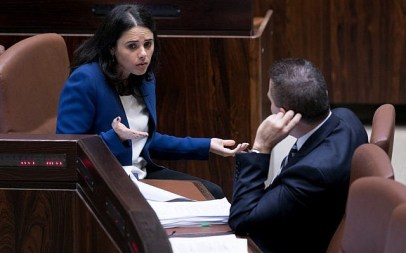
Justice Minister Ayelet Shaked, left with Public Security Minister Gilad Erdan during a plenum session in the Knesset, Jerusalem, on November 16, 2016. (Yonatan Sindel/Flash90)
The blocking of the Hezbollah accounts also came a day after the terror group released new footage on social media from the 2006 border attack on Israeli soldiers that sparked the Second Lebanon War.
The footage uploaded to a Twitter account associated with the terror group appears to show the moments after Hezbollah operatives shot and killed Israeli troops patrolling along the border with Lebanon.
The grainy video clip shows an Israel Defense Forces Humvee following the attack that killed three soldiers in July 2006.
Two bodies appear to be lying to the vehicle’s right as Hezbollah men are seen running away from the car. A bomb then goes off inside the vehicle.
The video then goes on to show footage that appears to depict the terrorists fleeing the scene of the attack, both on foot and by car.
It was not immediately clear what prompted the video’s release.
Hezbollah has broadcast footage from the attack in the past.
In 2016 al-Mayadeen, a television channel affiliated with the Shiite organization, aired a three-episode documentary series commemorating the war’s 10-year anniversary. It included footage of Hezbollah fighters training for the attack.
Hezbollah also released videos in 2007 and 2012, including footage from the attack and audio from the IDF’s communications that day. The video released in 2012 included the part of the raid in which Hezbollah fighters opened fire on the IDF Humvee and crossed the border into Israeli territory. The clip ended right as the Hezbollah commandos reach the ruined vehicle.
The attack and subsequent abduction of the bodies of soldiers Ehud Goldwasser and Eldad Regev led to hostilities that developed into the Second Lebanon War.
The 34-day war, which saw thousands of Hezbollah rockets pummeling northern towns, claimed the lives of 165 Israelis, including 44 civilians. Over 1,100 Lebanese, including both Hezbollah fighters and civilians, were killed.
Dr. Charles Krauthammer, perhaps the most luminous and incisive columnist of this generation, had announced two weeks ago that he was stricken with terminal cancer and had only weeks to live. He passed away Thursday. I feel an obligation to pay homage to this incredible man, and to add a Jewish, Zionist and personal angle to the many tributes to him that have rightly poured forth.
For 38 years, Krauthammer’s columns, essays and lectures have stood as pillars of conservative principle and moral clarity. On foreign policy matters, he was unquestionably the most radiant intellectual hawk in America, and on Middle East affairs he was the most consistent defender of Israel and the U.S.-Israel special relationship.
Two examples of his razor-sharp writing regarding Israel and American Middle East policy will suffice, among hundreds of exhibits.
Krauthammer wrote in a 2014 op-ed in The Washington Post about “Kafkaesque ethical inversions” that make for Western criticism of Israel. The world’s treatment of Israel is Orwellian, he wrote, “fueled by a mix of classic anti-Semitism, near-total historical ignorance and reflexive sympathy for the ostensible Third World underdog.”
He understood that eruptions featuring Palestinian casualties (such as recent Hamas assaults on the Gaza border) were “depravity.”
The goal, according to Krauthammer, is to produce dead Palestinians for international television: “To deliberately wage war so that your own people can be telegenically killed is indeed moral and tactical insanity.” But it rests on a very rational premise. “The whole point is to draw Israeli counterfire,” to produce dead Palestinians for international television, and to ultimately undermine support for Israel’s legitimacy and right to self-defense.
In 2015, again in The Washington Post, he repeatedly skewered President Obama’s nuclear deal with Iran, calling it “the worst agreement in U.S. diplomatic history.” To Obama, he wrote accusingly: “You set out to prevent proliferation and you trigger it. You set out to prevent an Iranian nuclear capability and you legitimize it. You set out to constrain the world’s greatest exporter of terror threatening every one of our allies in the Middle East and you’re on the verge of making it the region’s economic and military hegemon.”
Krauthammer’s profound understanding of Jewish history, his admiration for Israel, and his very deep concern for its future were on fullest display in a masterful essay he published in The Weekly Standard in 1998 entitled “At Last, Zion.” The essay contained a sweeping analysis of Jewish peoplehood, from Temple times and over 2,000 years of Diaspora history to the modern return to Zion.
Krauthammer understood that American Jewry was dying. “Nothing will revive the Jewish communities of Eastern Europe and the Islamic world. And nothing will stop the rapid decline by assimilation of Western Jewry.” The dynamics of assimilation were inexorable in America and elsewhere, he wrote.
Israel, Krauthammer understood, was different. “Exceptional,” he called it – because Israel was about “reattachment of Russian and Romanian, Uzbeki and Iraqi, Algerian and Argentinean Jews to a distinctively Hebraic culture,” and this gave it civilizational and societal staying power for the long term.
“The return to Zion is now the principal drama of Jewish history,” he wrote. “What began as an experiment has become the very heart of the Jewish people – its cultural, spiritual, and psychological center, soon to become its demographic center as well. Israel is the hinge. Upon it rest the hopes – the only hope – for Jewish continuity and survival.”
However, because “soon and inevitably the cosmology of the Jewish people will have been transformed again, turned into a single-star system with a dwindling Diaspora orbiting around,” Krauthammer was apprehensive. “The terrible irony is that in solving the problem of powerlessness, the Jews have necessarily put all their eggs in one basket, a small basket hard by the waters of the Mediterranean. And on its fate hinges everything Jewish,” he wrote.
Israel’s centrality, he feared, was a “bold and dangerous new strategy for Jewish survival” because of the many security threats posed to the country, chiefly among them the specter of Iranian nuclear weapons.
Indeed, Krauthammer’s essay thinks the unthinkable and contemplates Israel’s disappearance. And while Jewish political independence has been extinguished twice before and bounced back following centuries of dispersion, Krauthammer doubted that the Jewish People could pull the trick again. “Only the Jews defied the norm. Twice. But never, I fear, again.”
I challenged Krauthammer about his pessimistic perspective on the survival of Israel and the Jewish People at a Tikvah Fund seminar in 2016, where he engaged the Fund’s erudite chairman, Roger Hertog, in the deepest of conversations on strategy and identity.
In this lengthy conversation (which you can watch and read online here), Krauthammer admitted to “trembling doubt” about God alongside belief in some transcendence in the universe, and then he repeated his sobering solicitudes about Israel’s precariousness. He spoke of the impossibility of a fourth Jewish commonwealth – were Israel, transcendence forbid, to be crushed.
I gently reproached Krauthammer on theological terms, by saying that “those of us who moved to Israel out of a grand meta-historic sense of drama believe that our third Jewish commonwealth won’t fail. Whatever it takes, we’ll make it work.”
I sensed that Krauthammer was glad for my emotive intervention, since he immediately and poignantly responded (in Hebrew): “Netzach Yisrael lo yishaker” (the eternity of Israel will not lie, or fail).
Krauthammer continued: “That’s what my father used to say when he talked about Israel. I feel as an obligation to make sure of that throughout my life, I did what I could, because that prospect would be, would make everything I’ve done lose its value. There’s nothing more important than that.”
And then referencing my aliyah, Krauthammer said, “I honor your choice. … I commend you for that.” He went on to describe how he too considered moving to Israel after college, at the urging of his then-philosophy professor David Hartman.
And then Krauthammer asked me: “I wonder what it’s like, and maybe you could tell me, to be an Israeli putting your kids on your bus, not for terrorism reasons, but just going to school and raising them, knowing, what will it be like if and when Iran has the bomb? … It’s the existence of the Iranian bomb, knowing that it’s out of your hands. The whole point of Israel is to put it back in the hands of the Jews, back where it was in 68 A.D., that was the point. Assuming Israel’s deterrence works and all that, once that happens, once it’s in the hands of genocidists, then what does that feel like? Do you think there might be emigration as a result? Do you have a feeling about that?”
I answered: “My personal sense is that Israeli society is becoming more traditional, more deeply rooted, more ideological than before. I’m talking about secular Israeli society, digging in for the long term and not being frightened away despite the shadow that you’re talking about.”
And Krauthammer responded to me, again in Hebrew: “As you people say, ‘kol hakavod.'” (“Bravo.”)
So now it’s time for me to return the compliment, and say to Dr. Charles Krauthammer: Kol hakavod to you! On behalf of so many Jews, Americans and Israelis alike, thank you for your resilience, brilliance and steadfast support. We miss you already.
David M. Weinberg is vice president of the Jerusalem Institute for Strategic Studies, jiss.org.il. His personal website is davidmweinberg.com.
Military is collaborating with several defense contractors in a bid to devise measures to counter the growing threat posed by incendiary kites and balloons • IDF braces for border riots as terrorist groups warn strikes on Gaza will prompt rocket fire on Israel.
Nikki Guttman, Daniel Siryoti and Israel Hayom Staff
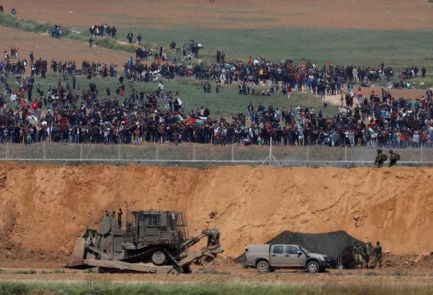
A Hamas demonstration on the Gaza-Israel border
|Photo: PA
Tensions on the Israel-Gaza Strip border ran high Friday, in the wake of Wednesday’s rocket salvo on southern Israel and ahead of yet another Hamas-orchestrated demonstration on the security fence.
Hamas officials urged Gazans to amass at the fence in honor of those killed and wounded in the border riots campaign since it was launched on March 30. Organizers said they plan to hold memorials for the 120 Palestinians killed near the security fence over the past three months.
The Israeli military deployed additional troops near the border, including special forces, snipers and sappers and, for the first time, it plans to use cutting-edge lasers and sensors to combat the kite terrorism that has been wreaking havoc on the Gaza-vicinity communities for weeks.
The new sensors are designed to spot particularly small targets like incendiary kites and balloon, which usually evade the radar systems deployed in the area.
Once a sensor identifies a flaming object, military drones will be launched to intercept it.
The IDF’s Southern Command and GOC Army Headquarters are collaborating with several defense contractors in their effort to devise a solution for kite terrorism.
Palestinian arson terrorism continued to rage Thursday, as 20 fires erupted as a result of incendiary kites and balloons sent over the border.
Authorities say that over 8,000 acres of forest and agricultural land on the Israeli side of the border have been reduced to ash over the past six weeks, causing tens of millions of shekels in damage.
With incendiary kites and balloons posing a growing threat to the safety and livelihoods of residents in Israeli communities near the border, as well as to local wildlife and vegetation, there has been a growing demand from the residents for the IDF to intensify its response against terrorist kite cells.
While some politicians and defense officials have advocated surgical strikes against such cells – a policy the IDF employs against terrorists firing rockets at Israel – the military has cautioned that targeting kite flyers, most of whom are teenagers, would lead to a rapid security escalation opposite the Gaza Strip that, in turn, is likely to lead to a full-fledged military campaign.
Also on Thursday, the Katif Center in the border-adjacent community of Nitzan dedicated an electronic memorial commemorating soldiers and civilians killed in the area.
Deputy Defense Minister Eliyahu Ben-Dahan (Habayit Hayehudi) spoke at the ceremony, saying that the tensions on the border prove that the 2005 disengagement from Gaza was a mistake.
”Anyone in their right mind that looks at what is happening now can see that we made a foolish mistake. We may have thought we were promoting a new Middle East, but today we see exactly how untrue that assumption was.”
Yesh Atid leader Yair Lapid visited the Gaza-vicinity communities Thursday and said, “It’s not just the fields that are burning here, it’s Israeli deterrence. Hamas has to be made to pay a price.”
Hamas and Islamic Jihad leaders, for their part, warned Thursday that any Israeli strike on the coastal enclave will be met with rocket fire on Israel.

 The city of Valencia, Spain has approved a motion to boycott Israel and slander it by declaring the city an “Israeli apartheid-free zone.” (Image source: Ben Bender/Wikimedia Commons)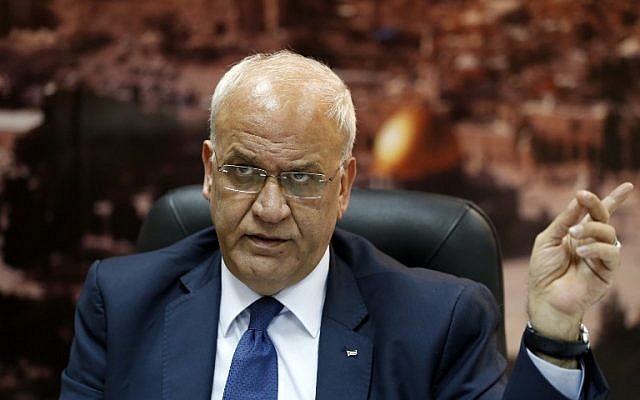







 anneinpt
 artaxes
 danmillerinpanama
 davidking1530
 Peter Hofman
 Joseph Wouk
 Peter
Peter Louisiana Steve
 WarSclerotic
Recent Comments