Archive for June 14, 2018

UN condemns Israel for Gaza violence, but not Hamas

June 14, 2018

General Assembly passes resolution calling for “protection” for Palestinians but overrides U.S.-backed amendment censuring Hamas for rocket fire, diverting aid to terrorism • Israeli envoy Danny Danon: U.N. “colluding with a terrorist organization.”

By Yoni Hersch, News Agencies and Israel Hayom Staff June 14, 2018

Source Link: UN condemns Israel for Gaza violence, but not Hamas

{So, what is it this time? …disproportionate use of force, genocide, islamophobia, not enough Israeli casualties, bad hair day? Honestly, it just gets old, folks. – LS}

The U.N. General Assembly voted on Wednesday in favor of a Palestinian-backed resolution condemning Israel for excessive use of force against Palestinian civilians, overriding an amendment proposed by the United States to censure Hamas for rocket attacks against Israel and for diverting aid resources for terrorist purposes.

The U.S. amendment initially passed by a vote of 62-58, with 42 abstentions, but it was ultimately rejected when General Assembly President Miroslav Lajcak declared that under a General Assembly rule, a two-thirds majority was needed.

U.S. Ambassador to the U.N. Nikki Haley appealed the decision, citing another rule that only a majority vote is required to pass an amendment.

After a short break, Lajcak put the U.S. appeal to a vote. The U.S. narrowly lost that vote 66-73, with 26 abstentions.

The General Assembly adopted the original version of the resolution with 120 votes in favor, eight against, and 45 abstentions. It had been put forward by Algeria, Turkey and the Palestinians after the United States vetoed a similar resolution in the 15-member U.N. Security Council earlier this month.

More than 120 Palestinians have been killed in the Gaza border riots since March 30. The largest number of deaths occurred on May 14, and Hamas confirmed that most of the casualties were Hamas operatives.

While the General Assembly text condemned the firing of rockets from the Gaza Strip into Israeli civilian areas, it did not mention Hamas, which rules Gaza and is responsible for the rocket fire, nor did it mention the Palestinian riots on the Gaza border.

“The nature of this resolution clearly demonstrates that politics is driving the day,” Haley told the General Assembly before the vote.

“It is totally one-sided. It makes not one mention of the Hamas terrorists who routinely initiate the violence in Gaza.”

Algerian Ambassador Sabri Boukadoum, representing Arab nations, sought to block a vote on the U.S. amendment, saying it was not relevant to the resolution and also undermined reconciliation efforts between rival Palestinian factions Hamas and Fatah as well as the “remote prospects” of reviving peace negotiations with Israel.

Before the vote, Israel’s Ambassador to the U.N., Danny Danon, told the assembly, “By supporting this resolution you are colluding with a terrorist organization; by supporting this resolution you are empowering Hamas.”

Australia, the Marshall Islands, Micronesia, Nauru, Solomon Islands and Togo joined Israel and the United States in voting against the resolution.

The resolution also calls on U.N. chief Antonio Guterres to recommend an “international protection mechanism” for the Palestinian territories.

“We need protection of our civilian population,” Palestinian U.N. envoy Riyad Mansour told the General Assembly before the vote.

He said the resolution was “intended to contribute to a de-escalation of the volatile situation.”

“We cannot remain silent in the face of the most violent crimes and human rights violations being systematically perpetrated against our people,” Mansour said.

The resolution calls on Guterres to report back within 60 days on proposals “on ways and means for ensuring the safety, protection and well-being of the Palestinian civilian population under Israeli occupation, including … recommendations regarding an international protection mechanism.”
 

With eyes on Iran, Netanyahu praises Trump over North Korea summit 

June 14, 2018

Source: With eyes on Iran, Netanyahu praises Trump over North Korea summit | The Times of Israel

PM hails US president’s Singapore meeting with Kim Jong Un as an ‘important development for Israel, the region and the entire world’

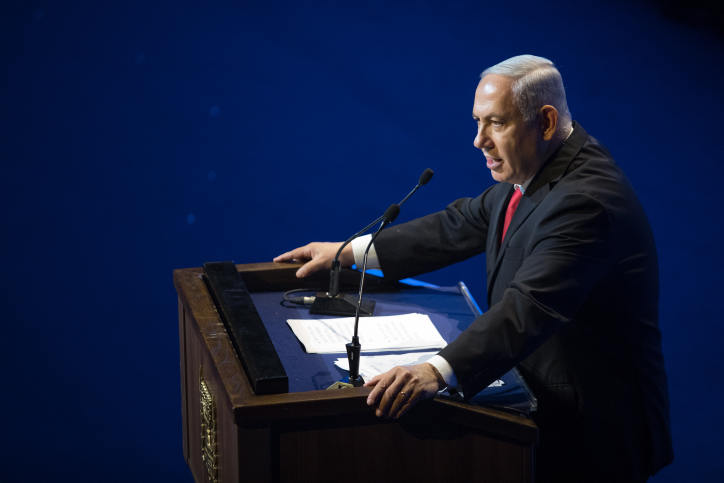
Prime Minister Benjamin Netanyahu speaks at the American Jewish Committee (AJC) Global Forum, in the Jerusalem Convention Center, on June 10, 2018. (Yonatan Sindel/Flash90)

Prime Minister Benjamin Netanyahu speaks at the American Jewish Committee (AJC) Global Forum, in the Jerusalem Convention Center, on June 10, 2018. (Yonatan Sindel/Flash90)

Prime Minister Benjamin Netanyahu on Tuesday hailed US President Donald Trump’s summit in Singapore with North Korean dictator Kim Jong Un as “historic” and an “important step” in denuclearizing the Korean Peninsula, while linking the meeting to the US leader’s “tough stance” on Iran.

“I congratulate US President Donald Trump for the historic summit in Singapore,” Netanyahu said in a statement. “It is an important step in the effort to denuclearize the Korean Peninsula.”

“President Trump also takes a tough stance against Iran’s attempt to arm itself with nuclear weapons, as well as against its aggression in the Middle East. This is leaving its mark on the Iranian economy,” he continued, referring to Trump’s withdrawal from the landmark 2015 pact last month.

“Trump’s policy is an important development for Israel, the region and the entire world,” Netanyahu added.

Trump and Kim held the unprecedented meeting in Singapore, after which they signed a joint document praised by both leaders.

On the heels of the Singapore summit, the US president on Tuesday said he hopes to negotiate a “real deal” with Iran over its nuclear program after Washington’s renewed, “brutal” sanctions kick in.

“I hope that, at the appropriate time, after the sanctions kick in — and they are brutal what we’ve put on Iran — I hope that they’re going to come back and negotiate a real deal because I’d love to be able to do that. But right now it’s too soon to do that,” Trump told reporters after meeting Kim.

Trump withdrew the US from the nuclear deal on May 8. The 2015 agreement required Iran to curb its uranium enrichment in exchange for relief from international sanctions. Following his withdrawal from the pact, Trump has announced the restoration of US sanctions, while European leaders are trying to preserve the deal.

Iran has said it will ramp up its uranium enrichment capabilities and last week opened a new facility geared toward producing enrichment centrifuges that will operate within the limits of the nuclear deal.

Israeli ministers on Tuesday also applauded the Trump-Kim meeting over the “strong” message it sends to the Islamic Republic.

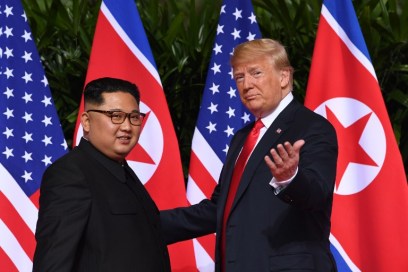
US President Donald Trump (R) gestures as he meets with North Korea’s leader Kim Jong Un (L) at the start of their historic US-North Korea summit, at the Capella Hotel on Sentosa island in Singapore on June 12, 2018. ( AFP PHOTO / SAUL LOEB)

Energy Minister Yuval Steinitz told The Associated Press that North Korea giving up its nuclear weapons would send a “strong” signal to Iran. He says it would “increase the pressure on Iran” to give up its nuclear infrastructure and capabilities.

Regional Cooperation Minister Tzachi Hanegbi (Likud) also drew a parallel with Iran, praising the summit as “a mortal blow” to the Islamic Republic’s regional policies.

“The first glimmerings of reconciliation between the United States and North Korea are a mortal blow to the radical axis led by Iran,” he said in a statement Tuesday.

“This is just the beginning of a long and exhausting negotiation process, full of crises and disagreements. But the bottom line, as of now, is welcome: Trump’s aggressive and uncompromising policy is proving itself. This is wonderful news for the free world, and for Israel.”

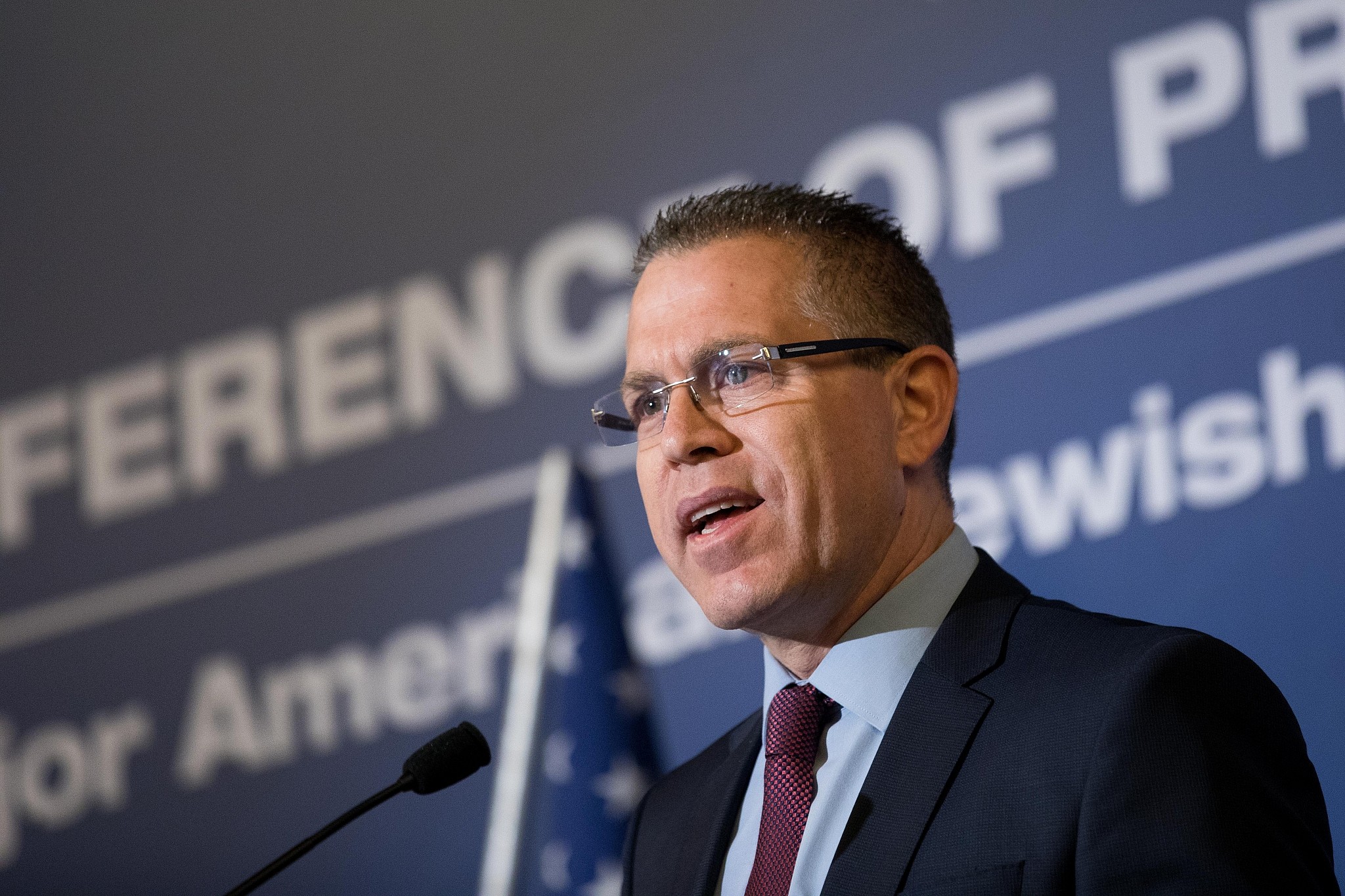
Earlier Tuesday, Public Security Minister Gilad Erdan, the #2 lawmaker on the ruling party’s Knesset list, said the meeting with Kim was “a tremendous achievement” and said a similar meeting between Trump and Iranian President Hassan Rouhani would “not be terrible.”

Public Security Minister Gilad Erdan speaks at the Conference of Presidents of Major American Jewish Organizations, at the Inbal Hotel in Jerusalem, February 19, 2018. (Yonatan Sindel/Flash90)

“Given Trump’s values, both as expressed during the election and afterwards in his actions, it would not be terrible if such a meeting happens, as long as its goal and purpose is to dismantle Iran’s nuclear weapons [program], and also, as Trump understands, that’s not enough, but [the goal must also be] to change the nature of the regime and its support for terror all over the world, certainly in the Middle East.”

The summit — unthinkable only months ago — comes after the two nuclear-armed foes appeared on the verge of conflict late last year as they slung personal insults and Kim conducted nuclear and missile tests.

Times of Israel staff contributed to this report.

German lawmakers approve €1 billion drone lease from Israel

June 14, 2018

Source: German lawmakers approve €1 billion drone lease from Israel | The Times of Israel

Long-range surveillance Heron-TP aircraft deal had faced opposition by center-left parliamentarians because UAVs can also be armed

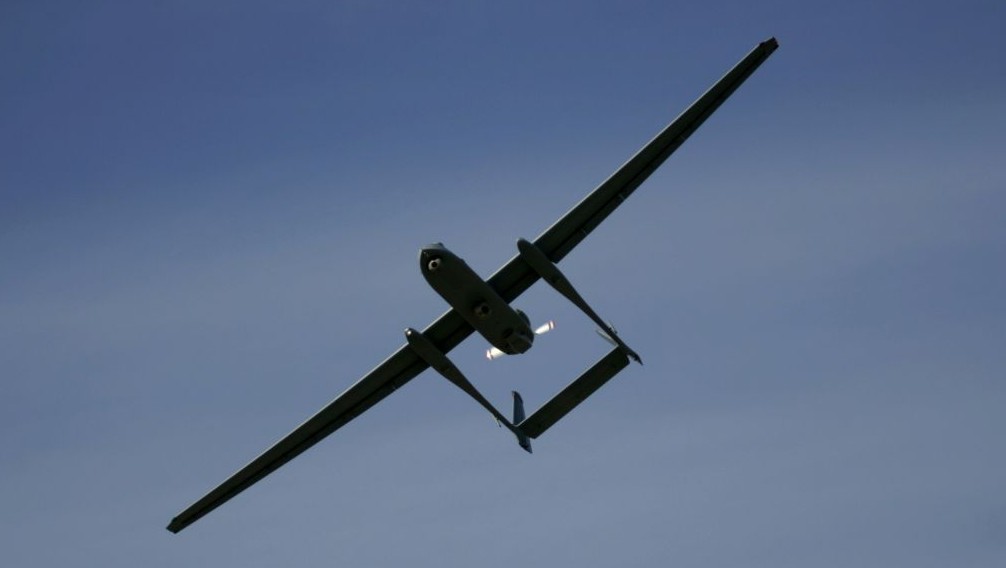
The Eitan drone, also known as the Heron TP flies during a display at the Palmahim Air Force Base in Israel, March 7, 2007. (AP/Ariel Schalit/File)

The Eitan drone, also known as the Heron TP flies during a display at the Palmahim Air Force Base in Israel, March 7, 2007. (AP/Ariel Schalit/File)

Germany’s parliamentary budget committee on Wednesday approved a military lease of Israeli-made Heron-TP drones in a deal worth an estimated €1 billion ($1.85 billion).

The deal had faced opposition from the center-left Social Democrats, who are partners in the ruling coalition, because the surveillance drones can also be equipped with weapons.

Prime Minister Benjamin Netanyahu welcomed the approval of the deal.

“This is an enormous contribution to the Israeli defense industry and the Israeli economy. This giant deal is an expression of the strategic cooperation between Germany and Israel and attests to the potential of the Israeli industry to contribute to countries like Germany,” Netanyahu said in a statement.

Netanyahu discussed the deal with German Chancellor Angela Merkel during their meeting last week in Berlin, according to the statement from the Prime Minister’s Office.

Germany’s coalition parties agreed in February to lease unarmed drones built by Israel Aerospace Industries and to hold a debate on arming the aircraft at a later date.

The opposition Greens party voted against the deal, noting that €50 million ($58 million) had already been set aside for a program to arm the drones.

“The big promised debate about the arming of the drones is a farce given what’s already included in this contract,” said Greens lawmaker Tobias Lindner, who is on the budget committee, according to the Reuters news agency.

The deal, which will see the drones leased through 2027, includes two contracts. The first is with Airbus to manage the drones, while the other was inked with the Israeli government to provide training, infrastructure, and logistics, the report said.

The long-endurance drones will be based in Israel.

Germany is leasing the drones until European-built drones are ready for operation around 2025, according to the report.

Trump’s Pressure on Iran Working Better Than Expected, Says Israeli Intel

June 14, 2018

Interesting article, good to have an insight into what the sanctions mean in terms of examples on the ground.

For example, looks like Iranian soccer players won’t be getting the Nike cleats for their boots for the World Cup.

Oh well, that’s the price you gotta pay. Actions have consequences.

Good on ya Trump, and good riddance Obama for throwing money at the Iranians. 

P.S. Interesting comment at the end about the Iranian announcement to increase enrichment capacity.

Trump’s Pressure on Iran Working Better Than Expected, Says Israeli Intel

Tehran had hoped for high profits from deals with Europe and U.S. companies – but now the regime faces abandonment by them – and the economic woes have started to create pressures on Tehran

https://www.haaretz.com/israel-news/.premium-north-korea-summit-trump-iran-pressure-working-israel-says-1.6170642

U.S. President Donald Trump speaks during a news conference after his meeting with North Korean leader Kim Jong Un at the Capella Hotel on Sentosa island in Singapore June 12, 2018

The decision by U.S. President Donald Trump to pull his country out of the Iran nuclear deal has already wreaked widespread economic damage to Iranians. According to intelligence assessments presented to Israeli leaders, the chain reaction of the American decision last month has been more severe than originally forecast.

Trump announced his decision last month, threatening at the same time to reinstate harsh sanctions against the Iranian oil industry and foreign firms that trade with it. These steps are supposed to go into full effect at the beginning of November. Some American companies, among them airplane manufacturer Boeing and General Electric, which signed contracts to supply equipment to Iran’s outdated oil industry, are already preparing to halt their investments in the country.

It was reported this week that sports equipment maker Nike canceled at the last minute a delivery of soccer cleats to the Iranian national squad, which is participating in the World Cup starting Friday in Russia. In Europe, British Petroleum announced that it would end its investment partnership with the Iranian oil company in deep-sea drilling off the Scottish coast.

Ministers from Great Britain, France, Germany and the European Union sent a letter at the beginning of June to Trump administration cabinet members, in which they asked the United States to exempt energy, aviation and health companies from the secondary American sanctions – which target European companies trading with Iran. European giant Airbus signed contracts worth $1 billion with Iran after the nuclear deal was signed in 2015. Another large European company liable to be hurt by the sanctions is French energy company Total.

According to Israeli intelligence, Iran had hoped to reap sizeable profits from deals with European and American companies during the coming period. However, now the Tehran regime faces abandonment by companies that already signed contracts, in addition to the negotiations with other companies, because of the American move. Thus, internal pressure on the regime, in the form of frequent demonstrations by the opposition in cities across the country, is also coming into play. Most of the demonstrations focus on the cost of living.

Israeli intelligence officials have the impression that the double economic pressure, domestically and from abroad, is accelerating the division at the top of the regime between the conservative camp and the more moderate one. Part of the dispute involves the question of Iranian foreign aid to terrorist and guerilla organizations across the Middle East. According to various assessments, Tehran disburses nearly $1 billion annually to these clients, including Hezbollah, Shi’ite militias fighting on its behalf for the Assad regime in Syria, Houthi rebels in Yemen and two Palestinian organizations in the Gaza Strip, Hamas and Islamic Jihad. The moderate camp supports cutting these expenditures. Some protesters in Iran have made vocal calls or waved signs condemning the use of government funds for these purposes at the expense of the Iranian people.

Still, despite the combination of developments worrying the Iranian regime, Israeli intelligence officials do not rush to conclude that the regime’s stability is under threat. Iran’s leadership has already coped well with previous waves of protest, including early this year.

In the wake of America’s departure from the nuclear agreement, Iran announced last week that it would renew the process of increasing its uranium enrichment capability. However, these moves are still being taken within the limits set in the Vienna agreement and do not constitute a violation of it. It looks mainly like a declarative action aimed at the European nations signed onto the agreement, and not as a prelude to an Iranian withdrawal from it.