Archive for June 14, 2018

Between Kim and Qom 

June 14, 2018

Source: Between Kim and Qom – Israel National News

he Trump-Kim summit raises more questions than it has yet been able to answer. And the Iranians await those answers with baited breath because a very short chain connects Tehran to North Korea.
Contact Editor

Dr. Mordechai Kedar, 14/06/18 07:30 | updated: 12:18

This week’s much publicized meeting in Singapore between US President Donald Trump and North Korean despot Kim Jong Un, held the entire world’s attention for days, in no small part because of the important, multi-leveled questions on regional, international and internal fronts that it raises.

Regionally and internationally, the entire world would like to know whether Trump can succeed in convincing Kim to give up his nuclear arsenal. Will Kim agree to the establishment of a supervisory body with teeth that ensures that the agreement is fully and strictly carried out?  Will Trump grant Kim guarantees to ensure that if he gives up nuclear arms he does not suffer the fate of Qaddafi after that despot did the same? Will North Korea be allowed to come out of its international isolation and will the economic sanctions upon that country be removed? Will countries interested in investing in North Korean economic projects be able to do so?

Regarding internal matters, the questions continue. Will Kim liberate his citizens from their current strangulation? Will he close the “reeducation” camps in which thousands of North Koreans are incarcerated? Will the public executions for sullying Kim’s honor be stopped? Will the man in the street enjoy the economic agreements expected to be signed with foreign countries, or will the royal family and its cronies concentrate all the profits in their pockets?

In the end, the most important question of all for North Koreans is whether Trump intends to create a linkage between the international questions and  the internal ones. That is, will Trump condition the lightening of political and economic sanctions on a change in Kim’s attitude to human rights and political liberty for North Korea’s citizens, including the shutting down of torture and death camps in addition to the nuclear issues?

Most pundits doubt that this will occur, because in the long run, a change in nuclear arming is a political one, while a change in the human rights situation means a change in the form of government.  Changing government policy is unquestionably easier than changing the way the government functions. It is to be hoped that changes in the country’s regime do occur, but in a measured fashion, step by step, not with undue haste and not as a result of pressure or upheaval.

This week Kim fired three Army generals, perhaps a sign to Trump that he is willing to change his policies. We will all have to wait to see if Kim actually does replace the cadre surrounding him as well as his policies, both on the internal, regional and international planes.

The answers to these questions seem to depend most on the “interpersonal chemistry” and personal relations that Trump and Kim succeed in forming between them, as America’s political stance has, over the last year and a half, become dependent almost entirely on Trump’s personal approach.

There are those in the US and the world who see this as a good sign, but there are many who look at it askance and many who strongly disapprove. Many of the commentators discuss Trump and Kim’s body language and small gestures, their tones of voice, the number of seconds their handshakes took, the invitation Trump extended to Kim to visit the US and the White House and whether their meeting went on longer than planned.

The Europeans, for their part, see Trump’s personal approach in a negative light, because running economic and political policy with a US businessman’s approach to things is totally unacceptable to Europe. The Europeans are accustomed to the past in which the US never worried about its own interests in such an obvious manner.

The discordant way in which last week’s G7 conference in Canada ended proved once again to the Europeans that Trump’s first interest on every issue is what America stands to gain, and that he acts in unpredictable ways that ordinary political predictions cannot foresee.

Two years ago, did anyone expect that any US president would meet with the head of North Korea?  I sense that the Europeans are deathly afraid that the US will opt for the lion’s share of the contracts for rehabilitating North Korea. The US Stock Exchange is already reacting to this possibility positively – and Trump keeps tweeting how proud he is of that outcome.

As far as we in the Middle East are concerned, the meeting between Trump and Kim is probably more significant to us than to any other region, because a very short, strong chain connects what Trump and Kim decide with what happens between the US  and Iran.

Trump threatens both of them in the same fashion:  He tweeted threats of a nuclear attack on North Korea, withdrew from the Iran nuclear deal and slapped economic sanctions over Iran and any country that maintains economic ties with it.

The Arab world is following the progress of the Trump-Kim summit closely, because the Arabs see it as a promo for what is going to happen to US-Iran relations. Clearly, if Trump manages to persuade or force Kim to really give up his nuclear project, there is going to be a tweet one minute later declaring his intention to do the same to Iran regarding its nuclear and missile-rich aspirations.

UN Secretary General António Guterres has already announced, to Iran’s chagrin, that the goal of the Trump-Kim summit must be convincing North Korea to give up its nuclear project.

In our region, the Middle East, people keep asking: Does Trump want to meet with Khamenei?  What will they talk about?  Do they have anything at all in common? Even if they reach an agreement on the issues over which they disagree, can they possibly develop any interpersonal chemistry?  Would there be enough mutual trust between them to believe that any agreements they reach are based on both sides’ genuine intentions?  Or will Trump and Khamenei’s natural distrust prevent their achieving any understandings or agreements? Does the Ayatollahs’ feeling of superiority at being “true believers” allow them to accept Trump, the Christian whose daughter converted to Judaism, who recognized Jerusalem as the capital of the Jewish people and moved his embassy there – as a legitimate negotiating partner?

Above all, the most important questions are: If Trump and Kim reach a real agreement on dismantling North Korea’s nuclear weapons and missiles, how much will this strengthen Trump’s determination to force a similar agreement on the Iranians? How much influence will any kind of agreement signed between Trump and Kim have on Iranian intransigence? How much success will Trump have in forcing the Iranians to cease interfering in the affairs of other countries such as Lebanon, Syria, Iraq, Yemen, Saudi Arabia and the Emirates?   Can Trump significantly lower the level of Iranian anti-Israel rhetoric? Will Trump attempt to forge a connection between regional and international issues and those dealing with human rights and political liberty in Iran? And if he does try, will he succeed?

It seems too early to answer these questions after one summit meeting. We have no idea what is going to happen between the US and North Korea during the period following the historic meeting of the two leaders. The coming weeks will see various advisors and officials of both sides spending long hours trying to formulate a statement committing both sides to the agreements and understandings their leaders reached in Singapore. As we all know, “the devil is in the details,” and writing down oral understanding in an agreement in which every word is significant, can turn out to be a very difficult, lengthy and exhausting process, one that may very well make both sides realize that a clear and binding agreement is beyond their reach at  this point.

The Iranians are awaiting future developments with baited breath. They know that what happens between Trump and Kim will have discernible influence on what happens between Washington and Qom.

Written in Hebrew for Arutz Sheva, translated from Hebrew by Rochel Sylvetsky
War with Israel would be a fatal blow for Iranian regime | Arab News

June 14, 2018

Source: War with Israel would be a fatal blow for Iranian regime | Arab News

Tensions between Israel and the Islamic Republic of Iran have reached an unprecedented level. Relations between the Iranian regime and Israel are at breaking point not only because of tough rhetoric, but also due to the heightened geopolitical, military and strategic tensions between the two countries.

For the first time since Iran’s clerical establishment assumed power in 1979, the two old rivals recently engaged in military combat in a third country: Syria, Iran’s staunchest ally. Last month, Iranian forces used Syria’s backyard to attack and bombard Israel with rockets. The next day, Israel responded by targeting the military bases of Iran’s Islamic Revolutionary Guard Corps in Syria.

Iranian leaders, including Supreme Leader Ali Khamenei and the senior cadre of the IRGC and its various military branches, have long claimed that they have the capability to destroy Israel. Most recently, Brig. Gen. Hossein Salami, commander-in-chief of the IRGC, said that any military war between Iran and Israel would result in the latter’s annihilation. To come out triumphant in such a battle, the Commander-in-Chief of Iran’s army, Maj. Gen. Abdolrahim Mousavi, said: “The army will move hand-in-hand with the IRGC so that the arrogant system will collapse and the Zionist regime will be annihilated.”

Putting aside the rhetoric of its leaders, can Iran win a direct and fully fledged military war with Israel? To answer this question, the military capabilities of the two nations ought to be meticulously examined.

The Iranian regime boasts about its manpower, and views the size of the country and its population as an advantage. Iran’s population is roughly 10 times larger than that of Israel: Iran has a population of 80 million, while Israel’s is about 8 million. Iran’s surface area is approximately 80 times bigger than Israel, at about 1.7 million square kilometers compared to Israel’s 22,000.

When it comes to manpower, Iran’s active and reserve personnel is approximately 1 million, while Israel’s is roughly 650,000. It is believed that Israel could conscript up to 3 million soldiers if needed, while the total manpower available for Iran is about 47 million, which is considered to be the largest national available manpower in the Middle East.

But it is important to point to three crucial caveats here. First of all, Iran cannot totally rely on its available manpower because many young people are disaffected and disenchanted with the regime. Recent protests are strong indications of the youth’s disenchantment with Iranian politicians. Roughly 60 percent of Iran’s population is under the age of 30. Not only may the youth not join the regime’s forces in a war with Israel, but they may view the war as an opportunity to rise up and overthrow the theocracy from within. This could pose a significant threat for the ruling mullahs, as it would mean they would have to fight two battles at the same time if they go to war with Israel.

More importantly, the nature of modern warfare has altered dramatically in the last few decades, in the sense that the most important issue is which country has the more advanced combat and military technology. Third, since the two countries do not share a border, manpower becomes less of a key factor. As a result, the most important elements are the air force, air defense systems and their related advances in technology.

Putting aside the rhetoric of its leaders, can Iran win a direct and fully fledged military war with Israel?

Dr. Majid Rafizadeh

When it comes to advancements in military technology, there is no comparison between Tel Aviv and Tehran, because Israel is considerably superior. The Israeli Air Force is considered to be one of the best in the world, partially due to the combat experience of its pilots, who have operated in various wars. Israel’s technologically advanced fighter jets, such as the F-4 Phantom II, F-15, and F-35 Lightning II, are much superior to Iran’s jets, which were either bought from the US before the 1979 revolution or obtained from Russia.

Another criteria to measure military capability is linked to the nations’ defense systems. While Iran has recently obtained the Russian-made S-300 system, Israel relies on three sophisticated systems: The Iron Dome, the US-made Patriot system, and the Magic Wand missile interception system.

Finally, the game-changer is linked to Israel’s nuclear capabilities. It is believed that Israel has about 80 nuclear warheads, which can be delivered through ballistic missiles, unmanned aerial vehicles (known as drones), or combat aircraft.

Although Iran boasts of its military capabilities and threatens that it can easily annihilate Israel, it has no chance of winning a direct military war. The Iranian leaders are indeed aware of such a fact, as they have resorted to using proxies and third countries to target Israel for almost four decades. Iranian leaders are cognizant of the fact that any direct war with Israel would be a fatal blow to the regime and would endanger the hold on power of the mullahs.

  • Dr. Majid Rafizadeh is a Harvard-educated Iranian-American political scientist. He is a leading expert on Iran and US foreign policy, a businessman and president of the International American Council. Twitter: @Dr_Rafizadeh
Disclaimer: Views expressed by writers in this section

Netanyahu describes drones as a true nightmare for Israel

June 14, 2018

Source: Netanyahu describes drones as a true nightmare for Israel

Speaking at new security conference in Jerusalem, PM highlights a range of security-related challenges facing Israel, says country working on developing technological solutions to the ‘huge’ drone threat, adding Israel strikes balance in maintaining security and safeguarding civil liberties.
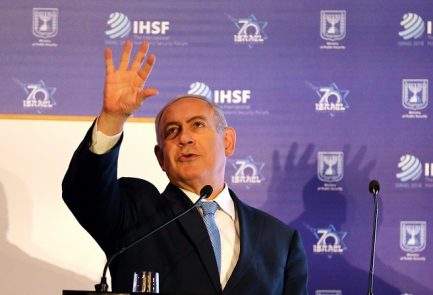
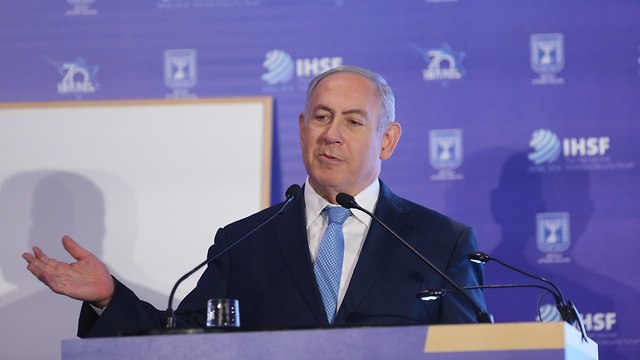
Prime Minister Benjamin Netanyahu described on Thursday the threat of drones against Israel as “a true nightmare,” adding that the country is currently working on inventing technological solutions to counter the “huge” challenge.“You don’t need vast state apparatus, you don’t need the foreign intelligence services of superpowers, you don’t need anything,” the prime minister said, while delivering remarks at the first ever International Forum for Public Security Ministers and the War against Terrorism.“You need this $50 contraption and 5 kilos of TNT attached to it” to reach to the White House, Netanyahu explained at the conference held in the Orient Jerusalem Hotel on the capital’s popular Emek Refa’im street.

“This distribution of technology has immense consequences that I think are not obviously understood. We’re working on it right now,” he said, delivering his speech first in English and then in Hebrew.

“We have to think of how we can harness technology against this technology. We’re doing that in Israel, we’re developing this. I cannot tell you that we have solved this but I think that we could join hands as best as we can to try to address this challenge,” he stated optimistically, while warning of the gravity of the drone threat.

“It is huge. It is huge. And precisely because it is so small, it’s so huge. It’s a big one,” Netanyahu said, before moving onto the threat of cyber security and Israel’s contribution in the field.

“Israel now accounts for 20 per cent of the global private investment in cybersecurity. That’s a lot, because given that we’re one tenth of one per cent of the world’s population, that’s 200 times our weight in the global population and we’re second only to the United States on this,” the prime minister boasted as he displayed on a PowerPoint presentation the Be’er Sheva Cyber Security Complex.

PM Netanyahu at the conference (Photo: Alex Kolomoisky)

PM Netanyahu at the conference (Photo: Alex Kolomoisky)

Despite the myriad security challenges facing the Jewish state, Netanyahu said that the country had struck an appropriate and delicate balance of simultaneously maintaining security and civil liberties.

“I think few countries, if any, have been challenged continuously like us by war, by terror, by outright calls for our extermination, and yet there wasn’t a day, not an hour, not a moment or a second where Israel’s democracy was ever questioned,” he said.

“We maintained it rigorously by maintaining the twin poles of security and civil rights … security first, balance always,” he continued.

Turning to the issue of social media, the prime minister praised the benefits that have bloomed from the 20th century phenomenon, including enhanced international communication and its contribution to the overthrow of dictatorial regimes. However, he also highlighted the negative ramifications and the impact on terrorism.

 (Photo: Inbar Tvizer)

(Photo: Inbar Tvizer)

“It’s also a way to inspire hate and violence and extremism. Radical Islam is using it in obvious ways and they’re not the only ones,” he said.

That said, he reiterated that Israel was developing algorithms and meshing technological solutions with police and IDF field experience to clamp down on terror-related threats emanating from social media, while facing the challenge “in the balance of having security and civil rights.”

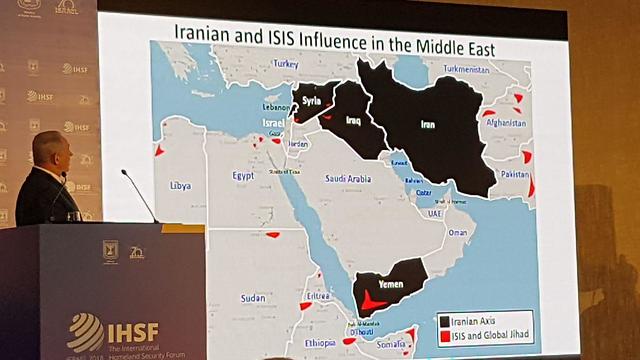
Netanyahu then presented a map of the Middle East that he called “the red and the black”, with various ISIS-controlled countries colored in red and Iran-controlled countries colored in black.

“We have done more than any other country actually to foil terrorist attack from Daesh (ISIS) from a variety of countries because the parks of this inflammation go to every continent from Australia to South America and everything in between. And Israel has stopped dozens and dozens and dozens of terrorist attacks from ISIS,” he said.

 (Photo: Inbar Tvizer)

(Photo: Inbar Tvizer)

Netanyahu accused Iran, which has been helping Damascus beat back a seven-year-old rebellion, of bringing in 80,000 Shi’ite fighters from countries like Pakistan and Afghanistan to mount attacks against Israel and “convert” Syria’s Sunni majority.

“That is a recipe for a re-inflammation of another civil war—I should say a theological war, a religious war—and the sparks of that could be millions more that go into Europe and so on … And that would cause endless upheaval and terrorism in many, many countries,” Netanyahu said.

“Obviously we are not going to let them do it. We’ll fight them. By preventing that—and we have bombed the bases of this, these Shi’ite militias—by preventing that, we are also offering, helping the security of your countries, the security of the world.”

Netanyahu did not elaborate. About half Syria’s pre-war 22 million population has been displaced by the fighting, with hundreds of thousands of refugees making it to Europe.

Reuters contributed to this report.

IDF general warns foreign officials Iran setting up bases in Syria

June 14, 2018

Source: IDF general warns foreign officials Iran setting up bases in Syria | The Times of Israel

Kan broadcaster airs leaked footage of Military Intelligence chief telling visiting security ministers that Tehran’s looking not to support Assad, but to attack Israel

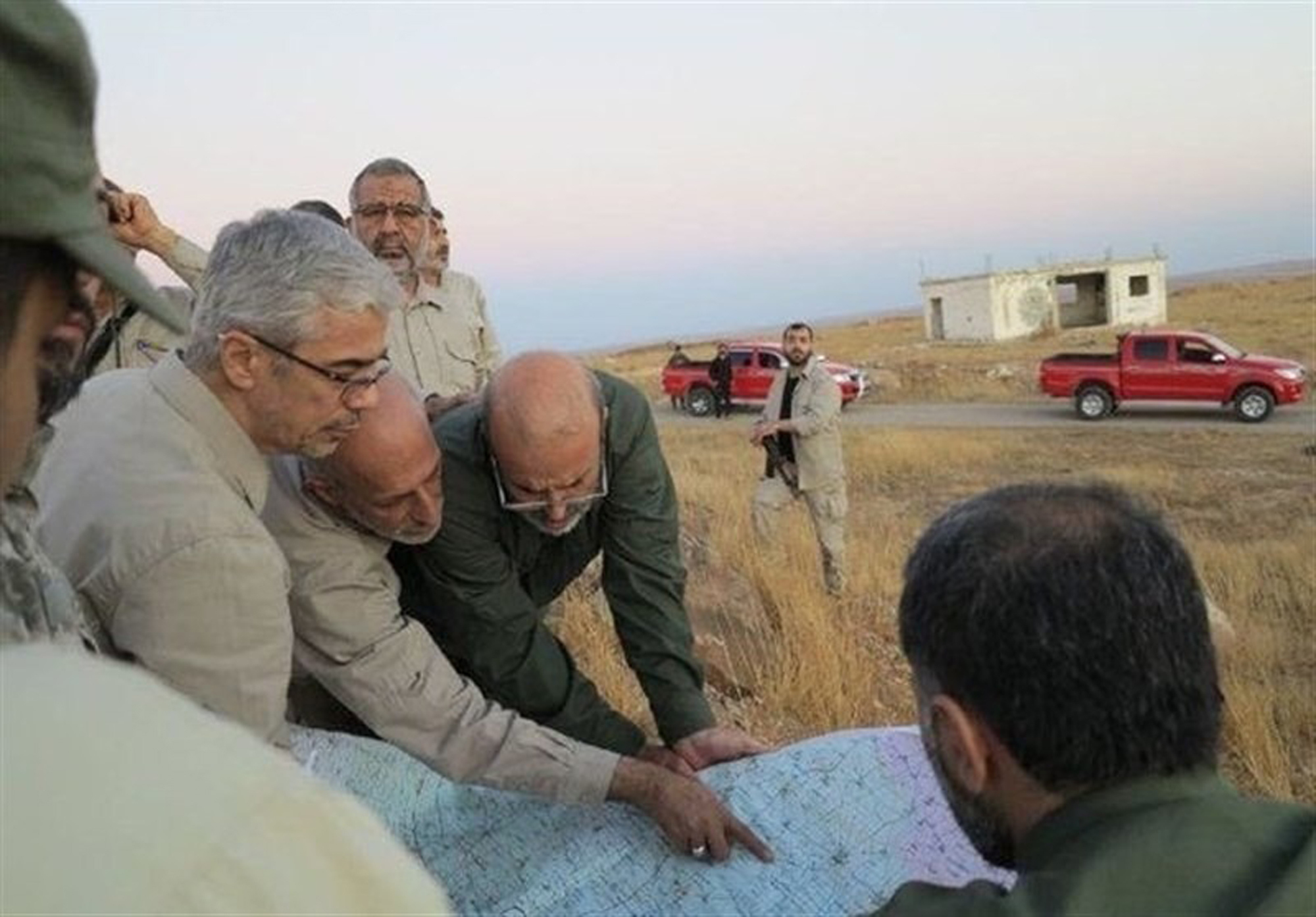
This file photo provided on Friday October 20, 2017 by the government-controlled Syrian Central Military Media, shows Iran's army chief of staff Maj. Gen. Mohammad Bagheri, left, looking at a map with senior officers from the Iranian military as they visit a front line in the northern province of Aleppo, Syria. (Syrian Central Military Media, via AP, File)

This file photo provided on Friday October 20, 2017 by the government-controlled Syrian Central Military Media, shows Iran’s army chief of staff Maj. Gen. Mohammad Bagheri, left, looking at a map with senior officers from the Iranian military as they visit a front line in the northern province of Aleppo, Syria. (Syrian Central Military Media, via AP, File)

The head of Military Intelligence revealed a map of suspected Iranian bases in Syria to a group of foreign security officials on Wednesday, noting they were not located near the sites of battles between the Syrian regime and rebel groups, according to a video of the speech leaked to Israeli TV news.

Maj. Gen. Tamir Hyman told the visiting homeland security ministers that the purpose of these Iranian bases was to establish a foothold in Syria in order to threaten the State of Israel, not to assist Syrian dictator Bashar Assad.

“You probably think it’s because they are trying to help the Assad regime fight extremists, fight terror. Well, get ready for a surprise: In all these places on the map there has been no fighting going on for half a month,” Hyman said, according to the recording broadcast on Wednesday night by Israel’s Kan news.

The general made his remarks at a homeland security conference held in Jerusalem this week, hosted by Public Security Minister Gilad Erdan.

The footage, apparently filmed surreptitiously by a participant, was not of high enough quality to make out the exact locations of the Iranian bases, but showed them spread throughout the country.

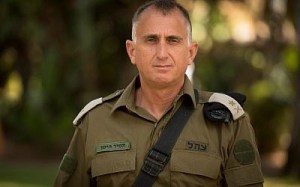
Maj. Gen. Tamir Hyman, the head of the IDF’s Northern Corps, who was named as the army’s incoming Military Intelligence chief, in an undated photograph. (Israel Defense Forces)

Hyman, who took over as Military Intelligence chief in March, noted that at this stage, Assad’s victory in the devastating Syrian civil war is all but guaranteed, yet his allies, the Iranians, do not appear to be preparing to leave the area.

“There is no real threat to Assad, so why do they stay there?” the general said, speaking in English.

“If they had wanted to assist the regime,” Hyman added, Assad could now tell them “thanks and goodbye.”

Instead, the Syrian dictator has said that Iran’s presence in the country is nonnegotiable, as Russia and the United States attempt to broker a settlement or ceasefire for the Syrian civil war, in which approximately half a million people have been killed and nearly a million displaced.

The relationship between Syria and Iran “will not be part of any settlement” and is “not in the international bazaar,” Assad told Iran’s Al Alam TV on Wednesday night.

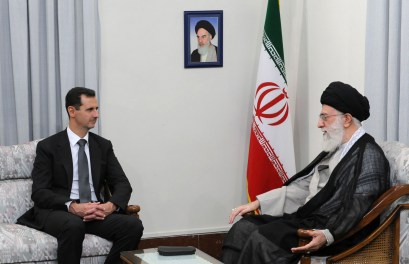
In this file photo from October 2, 2010, Iranian Supreme Leader Ayatollah Ali Khamenei, right, talks with Syrian President Bashar Assad in Tehran, Iran. (Office of the Supreme Leader, via AP, File)

The dictator repeated a claim oft-heard from Syrian and Iranian officials that Tehran does not maintain military bases in Syria. This is routinely dismissed as nonsense by Israeli, Arab and Western defense officials.

According to Hyman, Iran’s focus is establishing a military network with which it can threaten to attack Israel.

“[The Iranians] are trying to increase their effort of creating the ability and capability to launch rockets and to establish cells of terror that can enter Israel and harm the villages on the Golan Heights,” the general said.

“Nobody noticed the regional expansion that Iran did [in the Middle East]. Iran exploited that situation while everyone else in the world was focused on something else and expanded its network of terror,” he said.

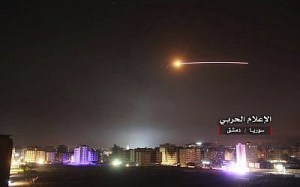
Anti-aircraft fire rises into the sky as Israeli missiles hit air defense positions and other military bases around Damascus, Syria, on May 10, 2018, after what the Israeli military said was an Iranian barrage of rockets against Israeli bases on the Golan Heights. (Syrian Central Military Media, via AP)

Hyman also referred to Israel’s clash with Iran in Syria on May 10, in which Israel says that Iranian forces launched 32 rockets at Israel’s forward defensive line along the border with Syria on the Golan Heights.

According to Israel, four of the incoming rockets were shot down; the rest fell short of Israeli territory. In response, over the next two hours Israeli jets fired dozens of missiles at Iranian targets in Syria and destroyed a number of Syrian air defense systems.

It was the most serious military confrontation between the two bitter enemies to date.

Hyman called Iran’s attack “a total failure, operationally,” but said that Tehran nevertheless saw it as a “huge success” as it was able to launch the rockets and force Israel to open bomb shelters in the north.

Last month, Hyman accompanied Defense Minister Avigdor Liberman on a working visit to Russia in order to meet with their Russian counterparts as part of Israel’s ongoing diplomatic efforts to secure an Iranian withdrawal from Syria.

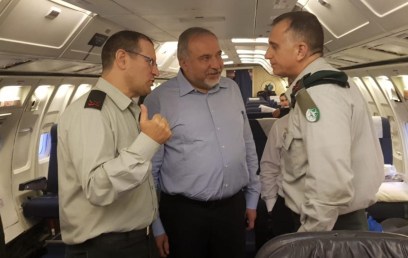
Defense Minister Avigdor Liberman speaks with his military secretary Brig. Gen. Yair Kohls, left, and the head of Military Intelligence Maj. Gen. Tamir Hyman, right, during a flight to Moscow on May 30, 2018. (Ariel Hermoni/Defense Ministry)

According to reports, Moscow is prepared to force Iran to pull its forces from the area closest to the border. Israel has rebuffed the offer, calling for Iran to pull out of Syria entirely.

“It doesn’t matter if it’s 40 kilometers or 80 kilometers. If they’re setting up missile systems in Homs, Hama or in Deir Ezzor, they will have enough range to hit Israeli territory,” Liberman said at a conference last week.

Last Friday, the Wall Street Journal reported that Iranian-backed forces stationed on the Golan border, including from the Hezbollah terror group, had also begun posing as Syrian military units, in a ploy to try to stave off pressure from Israel.

Earlier this week, the Reuters news agency reported that the Syrian military had recently deployed additional air defenses near the border with Israel, apparently as a result of the ongoing tensions over Iran’s presence in Syria.

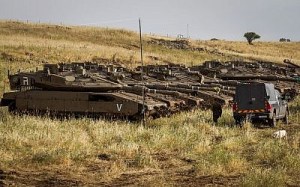
Israeli soldiers seen beside tanks near the Israeli-Syrian border in the Golan Heights on May 10, 2018 (Basel Awidat/Flash90)

The deployment was announced days after the Israel Defense Forces launched a surprise exercise on the Israeli Golan Heights.

The IDF said the exercise was not tied to current events but was “planned in advance as part of the 2018 training schedule.”

According to the Reuters report, the air defense reinforcement included the deployment of a Russian-made Pantsir S-1 system, also known as a SA-22, which the commander said was meant to “renew the air defense system against Israel in the first degree.”

The Israeli Air Force destroyed a SA-22 air defense system during its air raids on May 10, the army said at the time.

Israel’s long-running, but relatively quiet, campaign against Iran and its proxies, notably the Lebanon-base Hezbollah terrorist group, came to light and stepped up considerably in February, after an Iranian drone carrying explosives briefly entered Israeli airspace before it was shot down and, simultaneously, Israel launched a counterattack on the T-4 air base in central Syria from which the drone had been piloted.

In April, Israel attacked the T-4 air base again after Iran brought in an advanced anti-aircraft system. The Israeli strike killed at least seven members of Iran’s Islamic Revolutionary Guard Corps.

Since the April attack, Iranian officials have regularly threatened Israel with promises of eventual retribution.

Iran says it will begin uranium enrichment if nuclear deal unravels 

June 14, 2018

Source: Iran says it will begin uranium enrichment if nuclear deal unravels – Israel Hayom

Assad says Iran’s presence in Syria ‘not negotiable’ 

June 14, 2018

Source: Assad says Iran’s presence in Syria ‘not negotiable’ – Israel Hayom

Israel unveils kamikaze drone designed to hit complex targets 

June 14, 2018

Source: Israel unveils kamikaze drone designed to hit complex targets – Israel Hayom

Israel warned to avoid Syria strikes as World Cup kicks off in Russia 

June 14, 2018

Source: Israel warned to avoid Syria strikes as World Cup kicks off in Russia – Israel Hayom

Netanyahu: Iran has brought 80,000 Shiite fighters into Syria

June 14, 2018

Source: Netanyahu: Iran has brought 80,000 Shiite fighters into Syria – Israel Hayom

Iran poised to resume enrichment at deep Fordow facility

June 14, 2018

Source: Iran poised to resume enrichment at deep Fordow facility – DEBKAfile

After Iran warned it will leave the nuclear accord unless benefits are forthcoming, an atomic energy official in Tehran said that uranium enrichment would resume at Fordow – if that happens.

Iranian President Rouhani issued that warning to his French counterpart Emmanuel Macron on Tuesday. On Wednesday, June 13, Iran’s Atomic Energy Organization (AEOI) spokesman Behrouz Kamalvandi stated in Tehran that new work would begin on the nuclear program on the orders of Supreme Leader Ayatollah Ali Khamenei. “Currently the Supreme Leader has ordered that the programs be carried out within the parameters of the nuclear deal,” Kamalvandi said. “And when he gives the order we will announce the programs for operating outside of the nuclear deal for reviving Fordow.”

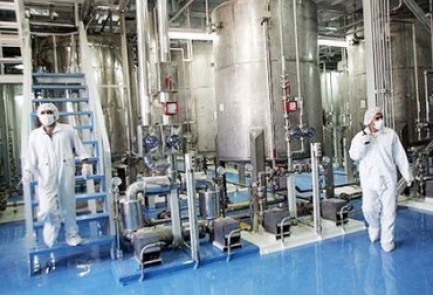
Fordow, one of Iran’s two big enrichment sites, is equipped with 8,000 advanced centrifuges capable of turning out in a short time uranium enriched to the 20pc grade, required for making a nuclear weapon. At Natanz, Iran’s second large enrichment site, the advanced equipment just installed is believed to include high-speed IR6 centrifuges. Much of Natanz is deep underground and Fordow is buried inside a mountain to keep them safe from aerial bombardment.

The AEOI statement from Tehran had three purposes:

  1. To demonstrate the next day that Iran is unconcerned by the June 12 summit between President Donald Trump and North Korea’s Kim Jong-un for the nuclear disarmament of the Korean peninsula.
  2. It was a defiant response to the US president’s comment after the Singapore summit. He said that Iran was in a different place compared to three months ago. “I hope that at the appropriate time after sanctions, really harsh sanctions, kick in, they will negotiate a new deal. Right now, it’s too soon.” Tehran made sure in its response to stress its resolve to continue on its nuclear path regardless.
  3. The statement, combined with Rouhani’s remark to Macron, showed that the Iranian leadership is lined up solidly against Trump’s strategy and determined to resume its nuclear program.
  4. The underground enrichment facility at Fordow, not far from the religious town of Qom, is exceptionally difficult to destroy by air or missile. It consists of a network of long and twisting shafts so designed that if a section is hit, at least 10 chambers will continue to operate. An attempt was made in 2012 to disrupt the plant by sabotaging its high-tension power supply. After that, an independent power station was installed underground.