Archive for June 5, 2018

European Investment Bank balks at proposal to offset U.S. Iran sanctions

June 5, 2018

Source: European Investment Bank balks at proposal to offset U.S. Iran sanctions – Middle East – Jerusalem Post

The resistance from the European Union’s lending arm underscores the limits of the bloc’s ability to shield trade with Iran from the re-imposition of US sanctions.

BY REUTERS
 JUNE 5, 2018 16:26
HOW MUCH more money from the ‘Great Satan’ for Iran? ‘Since the Iranians received their payment, the

BRUSSELS – The European Investment Bank has balked at an EU proposal to do business in Iran to help offset US sanctions and save the 2015 nuclear deal, EU sources told Reuters, under pressure from the United States – where the bank raises much of its funds.

The resistance from the European Union’s lending arm underscores the limits of the bloc’s ability to shield trade with Iran from the re-imposition of US sanctions after President Donald Trump abandoned the nuclear accord last month.

European Commissioners are expected on Wednesday to endorse the EU executive’s plan to encourage the EIB to support investments by European businesses in Iran, where the bank has never before done business.

The move has symbolic value as EU officials see it as one of the easiest to deliver on in response to Iran’s demands that it show proof of its commitment to the nuclear deal.

A total of six EU diplomats, EU officials and sources at the bank said that within the EIB there are growing concerns that the Commission’s plan would imperil its multi-billion-dollar funding program.

“The bank is unhappy with the Commission proposal because the bank raises funds on US markets,” said one EU diplomat.

As one of the world’s largest borrowers, the EIB raised 56.4 billion euros ($66 billion) last year on international capital markets. The bank fears that the threat of US sanctions over Iran could scare off bond buyers.

While Iran was added in March to a list of potentially eligible countries for EIB activity, any plan to upgrade that status needs the approval of EU governments and the European Parliament. The bloc wants the measure in place before Aug. 6, when US sanctions begin to take effect.

Even then, it would be up to the bank’s governors, made up of the finance ministers of the EU’s 28 member states, to decide whether to seek an agreement with Tehran to engage there.

The bank declined to comment on the Commission’s plan.

“This would be an enabling measure, which would not oblige the EIB to take action,” the Commission said in an emailed statement to Reuters.

Despite its political mandate, sources say the plan throws up many hurdles.

The bank currently steers clear, for instance, of engaging in jurisdictions listed as high-risk under the FATF, a global group of government anti-money-laundering agencies. That includes Iran.

Roughly a third of its lending operation is dollar denominated, given the global reach of the US financial system.

And while an EU budget guarantee partly shields the bank against losses outside the bloc, it would not address the funding risks.

“This isn’t going to be easy,” another EU diplomat said. “The bank is well aware of the dangers of US sanctions on its own operations.”

US PRESSURE

In back channels, Washington has also been lobbying the bank to object to the Commission’s plan, two EU sources said.

“The United States is pushing pressure on the bank not to go ahead and invest in Iran, warning of the consequences,” an EU official said.

Trump abandoned the agreement between Tehran and six world powers on May 8, arguing that it did not rein in Iran’s ballistic missile program or support for proxies in Syria, Iraq, Yemen and Lebanon.

The remaining parties are trying to keep the deal alive.

Europe has focused on preserving the economic incentives for Iran to stick to the accord, which lifted international sanctions in return for Tehran curbing its nuclear program.

In Tehran last month, Europe’s Energy Commissioner Miguel Arias Canete said he had told Iranian officials the new EIB mandate and other measures to “neutralize bad news” turning public opinion in Iran against the deal would be fast tracked.

Richard Nephew, a former administration official under then-US President Barack Obama, said that the US administration has many levers to discourage the bank from engaging in Iran even without imposing sanctions on the EIB itself.

At a stretch, it could choose to pursue a new executive order prohibiting US persons from investing in the EIB while there is a reasonable risk of the bank evading US measures.

“Europe and the United States are so integrated that it is implausible that the Europeans will be able to use current institutions to engage in transactions with Iran,” he said.

“If they really want to do this, then they’ll need to set up siloed institutions that have no US exposure and then to protect those institutions with the threat of retaliation against the United States.”

Iran Moves to Lift Its Nuclear Enrichment Capacity

June 5, 2018


The Natanz nuclear site in Iran, in 2007. A new centrifuge assembly center there hints at a future resumption of industrial-scale enrichment.Credit Hasan Sarbakhshian/Associated Press

By Thomas Erdbrink June 5, 2018 New York Times

Source Link: Iran Moves to Lift Its Nuclear Enrichment Capacity

{I remember when the media gleefully announced Iran’s nuclear weapons ‘breakout’ was only 10 years away. Then is was 5 years followed by 2 years. Finally, they said 6 months or less. That was years ago.  Makes you wonder just where they are today. – LS}

TEHRAN — Iran announced on Tuesday that it had completed a new centrifuge assembly center at the Natanz nuclear site, in a first step to increasing its enrichment capacity.

While Iran said it would keep enrichment within limits set by the 2015 nuclear accord, the center’s opening seemed to signal that it could swing to industrial-level enrichment if that agreement, which the United States withdrew from last month, should further unravel.

The head of the Atomic Energy Organization of Iran, Ali Akbar Salehi, told state television that the center’s construction had been “in line with our safeguard commitments but not publicly announced.”

A spokesman for the Iranian nuclear agency, Behrouz Kamalvandi, said a letter had been sent to the International Atomic Energy Agency explaining the action. He also told the semiofficial Iranian Students’ News Agency that Tehran would increase its capacity to produce uranium hexafluoride, a feedstock for centrifuges.


Iran’s supreme leader, Ayatollah Ali Khamenei, said on Monday that the country would adhere to enrichment limits set in the 2015 nuclear accord.CreditOffice of the Supreme Leader, via EPA

It was unclear whether the assembly center would actually begin to produce new centrifuges.

Under the 2015 nuclear deal, Iran stopped enriching uranium to the 20 percent level that would allow for rapid development of a nuclear weapon and agreed to a limit of under 5 percent. It will adhere to that limit, Iran’s supreme leader, Ayatollah Ali Khamenei, said in a speech on Monday.

It was also uncertain whether the opening of the centrifuge plant would have any significant impact on Iran’s nuclear program, which continues to be closely monitored by the International Atomic Energy Agency.

When Tehran agreed in 2015 to roll back its nuclear program in exchange for the lifting of international and United States sanctions, European companies rushed to enter the Iranian market. European governments have been working to keep the deal alive and protect those investments after President Trump dismayed many on the Continent by withdrawing and reimposing banking sanctions.

However, the American sanctions would still be a major problem, particularly for multinational companies, and several European firms have already announced plans to pull out of Iran. On Monday, the French group PSA, the maker of Peugeot and Citroën cars, which produces 440,000 vehicles a year in Iran, started closing its joint ventures with local auto manufacturers, though PSA said it would seek a waiver from the United States to maintain that production level.

In his speech, Ayatollah Khamenei warned the Europeans that Iran’s patience was limited, but analysts said that Tehran’s demands of guaranteed purchases of Iranian oil and free bank transfers with the European Union might exceed what the bloc could deliver in any rescue plan for the agreement.

“The Europeans expect the Iranian nation to tolerate and grapple with the sanctions, to give up their nuclear activities, which is an absolute requirement for the future of the country, and also to continue with the restrictions that have been imposed on them,” Ayatollah Khamenei said. “I would tell these governments that this bad dream will not come true.”

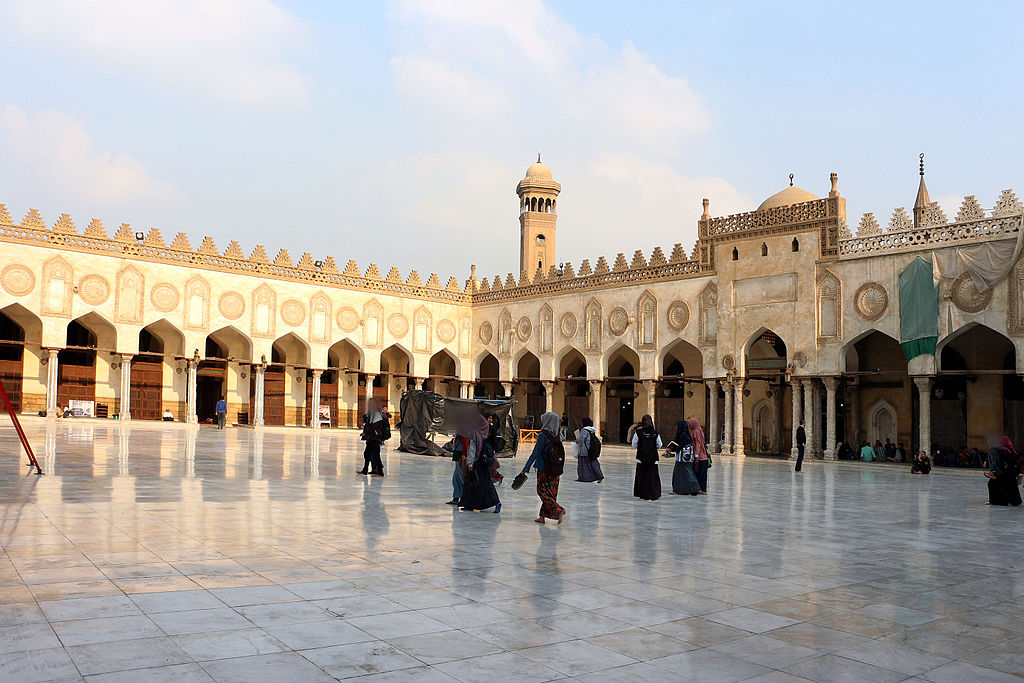
Egypt’s Al-Azhar Insists on Anti-Semitism

June 5, 2018

Lieberman: Khamenei announcement shows Iranian leadership in state of panic

June 5, 2018

Source: Lieberman: Khamenei announcement shows Iranian leadership in state of panic

Commenting on Iranian supreme leader’s declaration that he has ordered preparations to increase uranium enrichment capacity, defense minister says ‘it’s a response to Peugeot’s announcement that it is suspending its activity in Tehran. Iran is afraid that all European investors will leave;’ Minister Katz: If Iran does good on its threats, it will be attacked by international coalition.
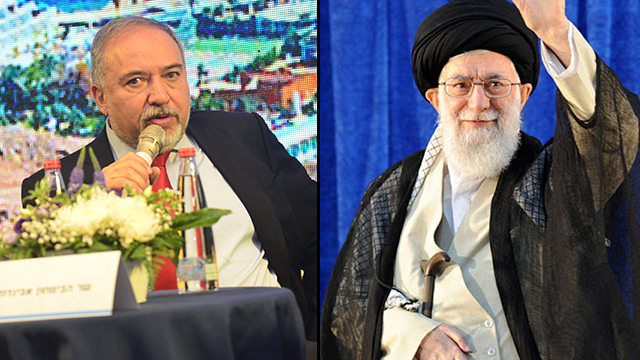
Iranian Supreme Leader Ali Khamenei’s announcement that he has ordered preparations to increase uranium enrichment capacity is “a sign of the hysteria and panic in the Iranian leadership,” Defense Minister Avigdor Lieberman said Tuesday.Speaking at a conference of the Institute of Certified Public Accountants in the southern city of Eilat, Lieberman said: “It’s a response to Peugeot’s announcement that it is suspending its activity in Tehran. When such a corporation announces that it is leaving Iran because of the sanctions, it’s a sort of signal to the entire business community, to all the investors, and this is not a marginal company. This company is one of pillars of European economy, so Iran is afraid that all European investors will leave its territory.”

Lieberman and Khamenei (Photos: Meir Ohayon, EPA)

Lieberman and Khamenei (Photos: Meir Ohayon, EPA)

Lieberman went on to address the unrest in Iran, saying that “we haven’t seen strikes and protests like the ones of the past months since the Khomeini era. It’s also the truck drivers and big bazaars’ strike. There is no doubt that they’re also concerned about the economic issue.”

The defense minister added that the Iranian issue was “not an Israeli problem,” but a regional and global problem. “We see Iranian subversion not only against the State of Israel. We see them in Yemen, in Bahrain, in the Gulf, in Lebanon, so it’s a regional threat. Whoever has been listening in the past few months, in the past six months, to the leaders of Saudi Arabia, to the foreign minister, I sound like a dove of peace compared to them.

“When you see the Saudi leaders referring to the Iranian regime as ‘today’s Hitler’ and ‘Nazis’ and anything you can think about, so it’s must be way beyond Israel. So we must constantly talk about it with the international community, because a major part of the terrorist activity around the world is funded and guided by Iran, inspired by Iran. Even when you take a report about the situation of terror in the world, Iran appears there every year as the biggest sponsor of terror in the entire world.”

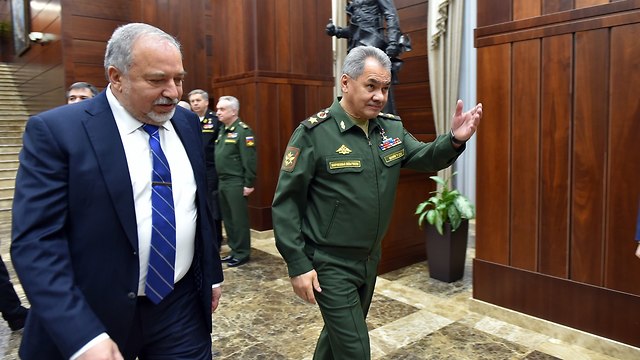
Lieberman with Russian Defense Minister Sergey Shoygu. ‘Iran a regional and global problem’ (Photo: Defense Ministry)

Lieberman with Russian Defense Minister Sergey Shoygu. ‘Iran a regional and global problem’ (Photo: Defense Ministry)

Earlier Tuesday, Intelligence Minister Yisrael Katz told Ynet that if Iran acted on its threats to boost its uranium enrichment capacity, it would be attacked by the US-led international coalition.

“The Iranian announcement about an intention to resume uranium enrichment for military purposes point to a complete state of panic in the leadership. The economic sanctions announced by US President Donald Trump are beginning to have an impact, even before the formal stage that will start in August.

“Many international companies—including Western European companies, from France, England, Germany and even Russia, have already announced their intention to suspend their activity in Iran because they don’t want to be subject to the American sanctions.”

According to Katz, the situation that has been created leaves Tehran with two options: Either to accept the United State’s conditions or “start a process of an economic collapse, and maybe even a regime collapse. If we learn, and we will learn, either from their announcement or some other way, that they are resuming the development of that nuclear program and advancing it, a US-led international coalition will threaten and then deal Iran a military blow.

“The Trump doctrine is very clear,” Katz added. “The president is a man of his word. He said, ‘I will cancel or change the agreement.’ There was no change, he cancelled it. He imposed harsh sanctions.

“We have made it clear that we will never allow Iran to develop a nuclear weapon, even if we have to face it alone. Fortunately, we are not alone.”

Dr. Emily Landau, a nuclear proliferation expert, believes the Iranian threat is aimed at pressuring the Europeans and making them stay in the existing nuclear agreement and accepting Iran’s demands.

“One of their demands is that the Europeans won’t harass them about the ballistic missiles and about their regional activity, that they will promise to buy oil from them and that they won’t stop any economic deals. It’s hard to see the Europeans accepting these demands,” she explained.

According to Dr. Landau, Iran is interested in maintaining the current agreement, “because it contains many advantages in return for few concessions. We have received this announcement as part of efforts made by all sides to exert pressure, but it doesn’t mean they’re headed in that direction. It will be a very radical act on their part if they actually do it, and the response will likely be firm too, at least on the American response.”

Report: Mossad agents assassinated Iranian advisers in Libya

June 5, 2018

Source: Report: Mossad agents assassinated Iranian advisers in Libya – Israel Hayom

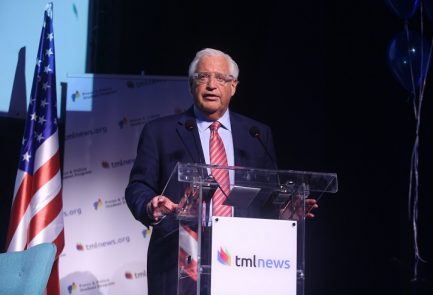
US envoy Friedman slams media for critical coverage of Israel 

June 5, 2018

Source: US envoy Friedman slams media for critical coverage of Israel – Israel Hayom

Iran could drive fresh wave of refugees into Europe, Netanyahu warns

June 5, 2018

Source: Iran could drive fresh wave of refugees into Europe, Netanyahu warns – Israel Hayom

Reality check: Iran isn’t going anywhere 

June 5, 2018

Source: Reality check: Iran isn’t going anywhere – Israel Hayom

Prof. Eyal Zisser

It’s probably best to start with the bottom line: Iran didn’t invest hundreds of millions, perhaps billions of dollars in Syria, didn’t lose thousands of fighters, members of the Revolutionary Guard Corps and regular army alike, and didn’t draft tens of thousands of Shiite conscripts into the pro-Iranian militias it trains and funds – to suddenly up and leave just because Putin or Assad ask politely.

What’s more important is that in contrast to the reports in the Israeli media, neither Putin nor Assad asked the Iranians to leave Syria at all. Indeed, the Russian president called for the withdrawal of all foreign forces from Syrian soil. First and foremost, however, he was referring to the American forces which still in control one-quarter of Syrian territory, mostly in the Kurdish areas in the northeast, and which also grant protection to the rebels in the country’s south. The Russians would also like the Turks to leave the areas they control in Syria’s north. Finally, they want Israel to let Assad retake control of the Syrian Golan Heights and the country’s south, and to eradicate the rebels which, until recently, Jerusalem has supported.

Iran isn’t in Russia’s crosshairs, because Moscow doesn’t see it as a competitor or adversary (for now, at least). Iran is simply the vessel the Russians use to advance their goals in Syria.

The Russians understand Israel’s concerns pertaining to Iran. They also don’t want Israel to “go nuts” and pummel the Assad regime, which they have all but dragged to the finish line and victory. Hence they are willing to facilitate efforts to remove Iranian forces from the Golan border, a demand they believe the Iranians can accept – as a temporary, confined concession on the path to Tehran’s greater goal of establishing a permanent foothold in Syria.

Just for the record, in their deal with the Americans from half a year ago the Russians already committed to keeping the Iranians from the Israeli border and, incidentally, to also prevent the Syrian regime from attacking the rebels in southern Syria. The Iranians, though, haven’t left southern Syria and Assad’s regime is on the verge of an offensive against the rebels there. What’s disconcerting isn’t Russia’s willingness to toss the signed deal into the trash, rather the Americans’ willingness to “go with the flow” and accept the violation of the deal they promoted.

This doesn’t mean that Russia and Iran aren’t competing or that inherent tensions don’t exist; both want to control Syria when the civil war ends. We can assume that Assad, too, will eventually look to rid his country of Iran’s invasive presence and influence in Syria’s internal affairs, threatening to permeate all government institutions, the army and even the Alawite ethnic group. Assad also won’t want the Iranians to embroil him in a clash with Israel. Although he’s attested to living his entire life in the shadow of “Israeli aggression,” he knows very well that Israel is not his main enemy or problem.

He’ll cross that bridge when he gets there. For now, and certainly in the weeks and months ahead, Assad and Putin both need the Iranians. After all, next to the Russian jets in the air, the tide of the war was turned and the survival of Assad regime is ensured by Iranian and Hezbollah forces on the ground.

Generally speaking, Russia’s problem – namely its competition, rivalry or cold war – is with the United States and the West, not with Iran. The latter, as stated, is a tool wielded by the Russians in their fight against the West and there is no reason to relinquish it. Will disengagement from Iran make Assad a darling of the international community and open doors for him in Washington, after slaughtering hundreds of thousands of his own people; and will Iran’s exit from Syria win Putin points in his fight in Ukraine, Eastern Europe and other corners of the globe – with Washington and Western Europe? No, of course it won’t.

It is therefore feasible to reach loose understandings on keeping Iran away from the Israeli border, but it’s also uncertain the Russians even have the desire or ability to make that happen. What’s clear is the fight to dislodge Iran from Syria is still far from over.

Eyal Zisser is a lecturer in the Middle East History Department at Tel Aviv University.

Israel foils Syrian plot to assassinate PM Netanyahu 

June 5, 2018

Source: Israel foils Syrian plot to assassinate PM Netanyahu – Israel Hayom

Iran to increase uranium enrichment. US-Israeli strike on nuclear facilities comes closer – DEBKAfile

June 5, 2018

Source: Iran to increase uranium enrichment. US-Israeli strike on nuclear facilities comes closer – DEBKAfile

( As with all Debka File pieces, take their conclusions with a grain of salt. – JW )

Iran is to inform the UN nuclear watchdog in Vienna on Tuesday, June 6, of its decision to increase uranium (UF6) enrichment capacity in response to the US exit from the 2015 nuclear accord.

Iran’s Atomic Energy Organization spokesman Behrouz Kamalvandi, announcing this, did not mention a date for this process to begin or the grade of enrichment. Supreme ruler Ayatollah Khamenei’s said Monday night: “I have ordered Iran’s atomic energy agency to be prepared to upgrade our (uranium) enrichment capacity” if the 2015 nuclear deal with the world powers falls apart after the US withdrawal. Chairman Ali Akhbar Salehi of the atomic organization forecast this development some days ago.

DEBKAfile reported on May 24 that if Iran returned to expanded uranium enrichment, the US and Israel would prepare to attack its enrichment facilities and other key nuclear facilities to prevent the Islamic Republic from resuming its progress towards a nuclear weapon capability. Now that Tehran is taking that step, it is up to President Donald Trump to decide on America’s response. His decision will be colored heavily by his fast approaching summit with North Korean leader Kim Jong-un in Singapore on June 12.

To convince Kim that he is coming well-armed for demanding the total dismantling of Pyongyang’s nuclear and ballistic programs, Trump may find it necessary to meet Iran’s decision to expand uranium enrichment with a military response. Khamenei’s step gives Trump a very tight timeline for a decision.

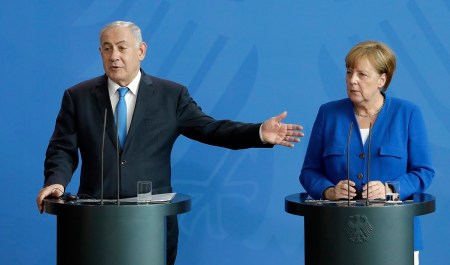
It was also timed to override the object of Prime Minister Binyamin Netanyahu’s European trip. The European signatories of the deal, Germany, France and the UK have been scrambling to save the nuclear deal by diplomatic efforts to persuade Iran to limit its ballistic missile program and expansionist activities in the Middle East.

Khamenei made it clear that the two issues are non-negotiable, as Israel warned them would happen. Netanyahu therefore finds their leaders floundering for their next step.

Now the statement by NATO Secretary General Jens Stoltenberg this week that the alliance would not back Israel if it came under attack from Iran comes closer to reality than before.

So too, does Khamenei’s decision on May 29, to replace the commander of the Khatam al-Anbiya Air Defense Headquarters Gen. Farzad Ismail, which is in charge of Iran’s air defenses, and appoint his deputy Brig-Gen. Alireza Sabahi Fard as acting commander, after two Israel F-35 stealth fighters flew over Iran’s nuclear facilities and left Iranian air space unnoticed.