Archive for April 2018

Russian supply of S-300 systems to Syria major threat to IAF

April 18, 2018


Since the Russians entered the bloody conflict in 2015, the Syrian regime has become more brazen in its responses to Israeli strikes.

By Anna Ahronheim April 15, 2018 06:35 The Jerusalem Post

Source Link: Russian supply of S-300 systems to Syria major threat to IAF

{If Assad’s upgraded air defense system is successful in shooting down an Israeli pilot, I suspect all hell will break loose. -LS}

With Russia considering supplying the S-300 surface-to- air missile systems to Syria, Israel’s air superiority is at risk of being challenged in one of its most difficult arenas.

With a de-confliction mechanism in place with Russia over Syria in order to avoid any unwanted conflict with the superpower, Israel has largely had free reign over Syrian skies to carry out strikes on targets deemed a threat to the Jewish state.

Over the course of Syria’s seven-year-long civil war, Israel has publicly admitted to having struck over 100 Hezbollah convoys and other targets in Syria, while keeping mum on hundreds of other strikes that have been attributed to the Jewish state.

Prime Minister Benjamin Netanyahu has said that strikes will continue when “we have information and operational feasibility.”

Syrian air defenses are largely Soviet-era systems, comprised of SA-2s, SA-5s and SA-6s, as well as more sophisticated tactical surface-to-air missiles such as the SA-17 and SA-22 systems. The most up-to-date system that Moscow has supplied to the Syrian regime is the short range Pantsir S-1, which has shot down drones and missiles that have flown over Syria.

Russian chief of main operational directorate Col.-Gen. Sergei Rudskoy said Saturday evening that “In the past year and a half, Russia has fully restored Syria’s air defense system and continues to further upgrade it.”

Moscow had “refused” to supply the surface-to-air missile system to Syria a few years ago after “taking into account the pressing request of some of our Western partners.”

But following US-led air strikes on the Syrian regime’s chemical weapons infrastructure, Russia considers “it possible to return to an examination of this issue, not only in regard to Syria but to other countries as well,” he said.

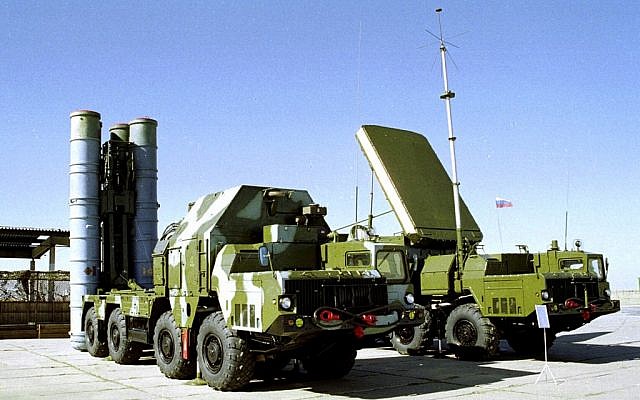
The advanced S-300 would be a major upgrade to Syrian air defenses and pose a threat to Israeli jets as the long-range missile defense system can track objects like aircraft and ballistic missiles over a range of 300 kilometers.

A full battalion includes six launcher vehicles, with each vehicle carrying four missile containers for a total of 24 missiles, as well as command- and-control and long-range radar detection vehicles.

The system’s engagement radar, which can guide up to 12 missiles simultaneously, helps guide the missiles toward the target. With two missiles per target, each launcher vehicle can engage up to six targets at once.

Since the Russians entered the bloody conflict in 2015, the Syrian regime has become more brazen in its responses to Israeli strikes.

Last March, Israeli jets carrying out air strikes against several targets in Syria were targeted with three anti-aircraft missiles with a 200-kilogram warhead. The missiles were shot down by the Arrow advanced missile-defense system in the first usage of the system in a combat situation.

In February, Syria succeeded – after launching a salvo of between 15-20 anti-aircraft missiles – in bringing down an Israeli F-16 (which crashed inside Israeli territory) that was carrying out a strike. Both pilots ejected from the jet and have since returned to duty.

If the Russians supply the advanced S-300 to Syria, Israeli jets may face these scenarios more often. And it could be just a matter of time before an Israeli pilot is killed.


Europe to Hamas: Disarm and we’ll rebuild Gaza

April 18, 2018

If accepted, the European offer would mean Hamas would refrain from any violence against Israel for at least five years.

By YAMI ROTH / MAARIV
April 16, 2018 15:36
http://www.jpost.com/Arab-Israeli-Conflict/Europe-to-Hamas-Disarm-and-well-rebuild-Gaza-549965

European groups recently passed on to Hamas a wide-reaching proposition to solve the humanitarian crises in Gaza, The Jerusalem Post’s sister publication Maariv reported on Monday.

If accepted, Hamas would relinquish armed struggle against Israel for at least five years. In exchange, an EU-created institution would pay the salaries of the Gaza strip civic administration and run all humanitarian affairs there.

While the concept of connecting wide-scale humanitarian and financial aid to Gaza with Hamas rejecting terrorism and violence is not new, this offer is unique in including an assumption of comprehensive authorities by a European body that would operate in the Gaza strip.

For Hamas, it may be tempting that the financial aid for health, education and developing public administration would come directly from a European body and not via the Palestinian Authority in the West Bank, currently controlled by Mahmoud Abbas, as is currently the practice.

Another important aspect of the European proposal is that it marks a different direction from that of the Palestinian effort of national reconciliation. The report says that the offer is meant to provide a possible scenario should Abbas make good on his threat to withdraw all support to the Gaza strip under Hamas. The Hamas negotiation team is reportedly still studying the European offer before responding to it.

It is also possible that the European offer is useful for Hamas as it provides them with one more bargaining chip as negotiations with Abbas, conducted with the help of Egypt, continue with the eventual goal of national Palestinian reconciliation.

In a round of talks held in the Gaza strip on Saturday, Hamas refused the demands made by Abbas and passed on by the Egyptian negotiation team. The demands were that the security, legal and tax collecting powers in the Gaza strip be handed over to the PA as a condition for national reconciliation.

Hamas also insisted that their delegation set to meet in Cairo next week to continue the negotiations will be composed of Hamas Political Bureau members residing in Lebanon and Qatar and not those based in the Gaza strip. It would seem this is Hamas making a statement that matters on the ground, such as the weekly protests along the Israel-Gaza border, are too pressing to send Gaza-based staff abroad for negotiations. Hamas has refused to comply with Egyptian requests to halt these protest marches.

Assad’s land grab: Refugees face losing the homes they fled under new law

April 18, 2018


A displaced Syrian family at a government checkpoint in Idlib province in April 2018 (AFP)

Property owners in Syria and abroad must present deeds to offices inside the country by early May or the state could seize their holdings.

By Bahira al-Zarier, Barrett Limoges Wednesday 18 April 2018 09:53 UTC

Source Link: Assad’s land grab: Refugees face losing the homes they fled under new law

{First he takes his citizens’ lives, then he takes their property. What next, Mr. Assad? – LS}

AMMAN – Scrolling through his Facebook feed at his home in Jordan last week, Syrian refugee Salim Muhammad’s eyes fell upon a news headline that made his heart sink.

Under a new property law issued by the Syrian government in early April, Muhammad has one month to prove ownership of his house and land in a village near Homs that he fled under government shelling in 2012, or risk losing it.

“I always held out hope that we could go back,” Muhammad told Syria Direct. “This decree has destroyed all chance of that.”

Introduced on 2 April, Law 10 sets in motion a massive overhaul of the government land registry across Syria, state news agency SANA reported.

Law 10 gives property owners both in Syria and abroad just 30 days – starting 11 April – to present their deeds to local council offices in the country. Otherwise, the state can liquidate their titles and seize their holdings. Once the registration window closes, “the remaining plots will be sold at auction,” reads Article 31 of the law.

For citizens living abroad like Muhammad, family members as distant as a second cousin may present the documents in their stead.

However, the millions of Syrians impacted by Law 10 include refugees and internally displaced people without family back home to assist with registration, as well as people whose deeds were lost or destroyed during the war.

Security sign off

Perhaps most ominously for opposition supporters, all property owners wishing to register their lands must first obtain approval from state security officials, a lawyer in Damascus familiar with the law told Syria Direct. The lawyer spoke on condition of anonymity for fear of repercussions.

“Without this approval, they will not be able to prove ownership of the property,” said the lawyer. “Therefore, it would be sold at auction or claimed by another person.”

“Herein lies the seriousness of this decree,” she added.

The Daraya Executive Council discusses the return of displaced residents earlier this month (Daraya Executive Council)

The need for security clearance could exclude large swathes of the Syrian population inside and outside the country with outstanding arrest warrants or known anti-government sympathies from registering their property.

Muhammad is one of them. Although he still has the deed for his house and land in the south Homs village of al-Buwaidah a-Sharqiyah, he said the Syrian government has issued an outstanding warrant for his arrest.

“I am wanted by the regime on charges of incitement and attending demonstrations,” said Muhammad. “I understand that the regime means to take our property with a legal text, creating new laws to suit their interests.”

Law 10 comes in the immediate wake of the Syrian government’s recapture of East Ghouta, one of the last major rebel-held areas near Damascus, in early April. The subsequent displacement of more than 60,000 residents to opposition territory leaves the fate of thousands of properties near Damascus uncertain.

Under the new law, former residents of the enclave would now need family members to register property on their behalf, or go to government territory themselves and risk arrest.

The Damascus lawyer who Syria Direct contacted this month said that, although Syria has long needed to update the property registry, she believes the timing of Law 10 makes its motives suspect.

“The timing of the decree, in light of the war which has seen millions displaced and the creation of refugees who cannot return to their homes because of the security situation, certainly raises doubts,” she said.

Bureaucratic mess

Even before the latest property law, international aid agencies warned of legal ramifications surrounding the issue of lost or damaged property in Syria. A Norwegian Refugee Council report this past February estimated that the state could face more than 2 million lawsuits from Syrians seeking restitution for lost or damaged property in the wake of the civil war.

The subject of property titles and deeds in Syria is greatly complicated by the existence of parallel administrative systems that sprang up across a patchwork of opposition areas during the conflict. When government forces recapture these areas, documentation produced by opposition authorities is of little use.

Furthermore, many property documents have been lost or destroyed in recent years as residents fled shelling and ground fighting in regions across Syria.

According to the same NRC report, only nine percent of Syrians who fled their country during the war have access to their property deeds today. An estimated 5.6 million people have fled the country as refugees, and a further 6.1 million people are displaced inside Syria.

Abdel Hameed a-Shami, a 28-year-old media activist from the formerly rebel-held south Damascus city of Darayya, currently lives in opposition-held northern Syria with his family. He left Darayya in August 2016 when all of the city’s fighters and residents were evacuated in a surrender agreement with the Syrian government.

A-Shami’s family owned a home in Darayya, but the activist said that he, too, is wanted by the government and cannot register his property. Many other former Darayya residents are in a similar position, he said.

A map of a property to be registered in Daraya (Daraya Executive Council)
“There are thousands of families from Daraya that are living outside now, entire families that are wanted by the regime,” a-Shami told Syria Direct. He fears the Syrian government is using the law to seize the homes of opposition supporters and give them to its own support base.

In Jordan, Muhammad and his family have few options, he said. With no family left in Syria to register their property and no way for Muhammad to receive security approval due to his arrest warrant, he believes it is only a matter of time until he officially loses his property in Homs.

“The [government] decision has made me lose all hope of returning to Syria,” Muhammad said. “The regime has abandoned us, bombed us, destroyed us, and now they want to take away our homes and lands.”


Hamas “Press Office”: Truth Finishes Last

April 18, 2018

Israel – 70 Years Of Achievements

April 18, 2018

Europe, Trump and the Iran Deal

April 18, 2018

Bracing for Iranian counterstrike, Israel exposes Iran’s air defenses in Syria

April 17, 2018

Israel Hayom Staff April 17, 2018

Source Link: Bracing for Iranian counterstrike, Israel exposes Iran’s air defenses in Syria

{Too close for comfort. – LS}

The deployment of Iranian air defenses and drone units in Syria is personally directed by Quds Force commander Maj. Gen. Ghasem Soleimani, IDF says • Iran’s military support of Syria, to the tune of $6 billion a year, delivered under the guise of “humanitarian aid.”

The Israel Defense Forces on Tuesday revealed new information about the deployment of Iranian air defenses in Syria, further exposing Tehran’s attempts to entrench itself militarily in the war-torn country.

Tensions between Israel and Iran have been steadily escalating since an Iranian drone that breached Israeli airspace on Feb. 10 was shot down by the Israeli Air Force.

An Israeli official confirmed to The New York Times Monday that it was the IAF that struck the T4 air base in Homs, last week. Seven members of Iran’s elite Quds Force were killed in the strike, including the commander of its drone unit in Syria.

Israeli officials said the drone, which the IDF found had been weaponized and on an offensive mission, was launched from T4.

Fuming over the strike, Iran has vowed to exact vengeance on Israel.

Iranian Foreign Ministry spokesman Bahram Qassemi said Monday that “Israel will receive a blow for what it did at the T4 base. The days when the Zionist regime would hit and run are over. … I suggest to the Israelis to refrain from foolish steps if they want to continue their treacherous existence,” he warned.

The IDF said Tuesday that the deployment of Iranian air defenses in Syria was personally supervised by Quds Force commander Maj. Gen. Ghasem Soleimani, one of the most powerful military figures in the Iranian regime.

Iran is a close ally of Syrian President Bashar Assad and it has lent his forces significant logistical, technical and financial support in their war against the rebels.

According to the United Nations envoy to Syria, Staffan de Mistura, the Iranian government spends at least $6 billion annually on maintaining Assad’s government. Independent researchers believe Iran’s support of Assad’s regime amounts to over double that sum.

Israeli defense officials said that the majority of Iran’s military support is delivered to Syria under the guise of humanitarian aid.

Since 2015, the Iranian Air Force has been conducting routine flights into Syria, using military cargo planes disguised as civilian Iranian airlines to transport weapons and combat personnel, including drone operators.

The Quds Force is said to be focused on establishing air defenses and drone operations in Syria, so it can use them to launch direct offensives against Israel.

The IDF believes that any direct clash between Israel and Iran on the northern border would be carried out by the Revolutionary Guards’ air force rather than by ground troops.


Israel Defense Forces on High Alert, Preparing for Iranian Direct Retaliation

April 17, 2018

Israel Defense Forces on High Alert, Preparing for Iranian Direct Retaliation

Photo Credit: IDF Spokesperson

Israel’s military is on high alert preparing for the strong probability of direct retaliation from Iran in response to last week’s attack on the Tiyus (T-4) air base in central Syria.

Seven of the 14 people killed in the Israeli air strike on the base were members of Iran’s Revolutionary Guards Corps’ elite Quds Force.

Israeli media have been supplied with a map that displays five Iranian-controlled bases in Syria – clearly the five Iranian targets to be hit by the IDF in retaliation if Iran attacks Israel. The targets include Damascus International Airport – through which Iran flies in its weapons and military gear; the Sayqal air base; the T-4 (Tiyus) air base; an air field near Aleppo (Haleb); and a military base near Deir ez-Zour.

Map of Syria provided to Israeli media showing approximate locations of five bases believed to be under the control of Iran

Quds Force commander Qasem Soleimani this week issued a direct threat to Israel from Damascus after arriving for a briefing on the T-4 air strike, which an Israeli official told The New York Times this week was indeed was carried out by Israel’s Air Force.

He warned in remarks quoted Tuesday by Lebanon’s Ad-Diyar newspaper that the Jewish State “is going to pay the price,” according to Israel’s Hadashot news.

The Quds Force commander was briefed on the air strike by Iranian and Syrian officers, and also met with members of the Iranian-backed Hezbollah guerrilla force during his rare visit to the Syrian capital.

Iranian Foreign Ministry spokesperson Bahram Qasemi told media on Monday that retaliation would forthcoming “sooner or later” and that Israel would “regret its misdeeds… The Zionist regime should not be able to take action and be exempt from punishment,” he said, according to Iranian news media.

Israel has said it will not allow Iran to maintain a permanent military foothold in Syria.

IDF source credits Israel with attack on Iranians in Syria

April 17, 2018

April 16, 2018

Latest News from Israel

American paper cites anonymous officer who says Israel acted to contain Iranian efforts to establish bases in Syria, but later amends report to reflect IDF’s official position.

By: Batya Jerenberg, World Israel News

Although nobody would confirm the admission officially, a senior member of the IDF was quoted in the New York Times Monday as stating that Israel did indeed attack a Syrian air base a week ago.

“It was the first time we attacked live Iranian targets — both facilities and people,” said the source, according to the paper.

The T-4 base that was hit by at least three missiles had been the launchpad of an Iranian drone sent into Israeli airspace on February 10th which had been quickly shot down by an Israeli air force helicopter.

Israel had openly reacted to the violation of its sovereignty at the time by hitting the base with several IAF jets in what was the largest strike on Syria since the First Lebanon War. IAF Chief of Staff Brig. Gen. Tomer Bar described that mission as an attack on advanced long-range surface-to-air missiles, components of Syria’s air-defense system, and the Iranian mobile control center that had been responsible for the drone.

Last week’s missile strike was therefore the second go at the same target, but this time seemingly with intent to specifically hit the Iranians hard, as the source said. Fourteen people were reported killed, including seven Iranian Quds Force members and the head of their drone unit. In fact, the purpose of the attack was reportedly to totally eliminate Tehran’s drone program at the central Syrian base.

The timing of the raid – right after Syria had bombed a rebel-held enclave with chemical weapons that killed dozens and injured hundreds – led Syria to first accuse the American administration of it. But the Americans denied any role, and Syria, along with its Russian and Iranian allies, quickly pointed the finger at Israel, which remained silent. And still does — officially.

Previously, Prime Minister Benjamin Netanyahu has publicly and repeatedly warned that Israel would not allow its deadliest enemy to build missile factories or set up forward bases in Syria that endanger Israel’s existence. And as the military source also noted, “This is the first time we saw Iran do something against Israel — not by proxy. This opened a new period.”

The question is whether this new period of direct confrontation between the two powers in the Middle East will be a limited one or not.

The author of the NY Times article, Thomas Friedman, later updated the piece after the IDF spokesman’s office contacted him, adding the following: “After the story appeared, the Israeli Army’s spokesman’s office disputed the characterization and accuracy of the raid by my Israeli source, and emphasized that Israel maintains its policy to avoid commenting on media reports regarding the raid on the T4 airfield and other events. He would not comment further.”


US Says Russia Trying to Complicate Syria Chemical Weapons Investigation

April 17, 2018


FILE – State Department spokeswoman Heather Nauert speaks during a briefing at the State Department in Washington, Aug. 9, 2017.

April 17, 2018 6:31 AM VOA News

Source Link: US Says Russia Trying to Complicate Syria Chemical Weapons Investigation

{Russia has already visited the site and didn’t bother to take a team of independent observers? Hmmm…very troubling. – LS}

The U.S. State Department says Russia has tried to block an international watchdog from investigating a suspected chemical attack in Syria “by making it more complicated” for the specialists to do their work.

“They probably want to do that because they recognize that the longer that a site goes untested the more that the elements, the chemicals, can start to disappear,” State Department spokeswoman Heather Nauert told Alhurra television.

The investigators from the Organization for the Prohibition of Chemical Weapons arrived in Syria on Saturday, but so far have not been able to begin their work in Douma.

A Russian official says the OPCW team is set to visit the area east of Syria’s capital on Wednesday.

Russia has blamed the delays on airstrikes carried out Saturday by the United States, France and Britain on three Syrian chemical weapons facilities. Russia’s Deputy Foreign Minister Sergei Ryabkov also said the mission was not allowed in because it lacked approval from the United Nation’s Department for Safety and Security.

Russian President Vladimir Putin listens during a meeting in Moscow, Russia, Friday, April 13, 2018.

U.N. officials in New York disputed the claim.

“The United Nations has provided the necessary clearances for the OPCW team to go about its work in Douma,” said U.N. spokesman Stephane Dujarric. “We have not denied the team any request for it to go to Douma.”

He added that U.N. Secretary-General António Guterres is very supportive of the investigation.

“The secretary-general wants to see the fact-finding mission have access to all the sites it needs to have access to, so that we can have the most thorough and full picture of the facts,” Dujarric said.

The U.S. envoy to the OPCW, Ken Ward, said Monday it was his understanding Russia had already visited the site and he raised concerns of tampering before the OPCW carries out its fact-finding mission.

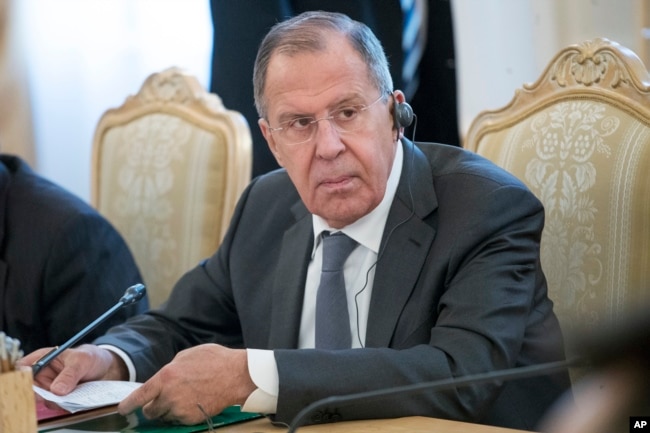
Russian Foreign Minister Sergey Lavrov denied that accusation, telling the BBC he guarantees Russia “has not tampered with the site.”

Russian Foreign Minister Sergey Lavrov attends a meeting in Moscow, Russia, April 5, 2018.

Lavrov said that evidence cited by the United States, Britain and France to justify Saturday’s missile attack was based “on media reports and social media.” He denied any chemical weapons attack had occurred, accusing Britain of staging the attack.

The Group of Seven leading industrialized nations issued a joint statement Tuesday endorsing the airstrikes.

“We fully support efforts made by the United States, the U.K. and France to decrease the capacity to use chemical weapons by the Assad regime and to prevent their future use,” the leaders of Canada, France, Germany, Italy, Japan, Britain, the United States and European Union said.

Syrian media reported another missile attack early Thursday in Homs province, but later said it was a false alarm and not an outside attack that triggered air defense systems.

Syrian media reported another missile attack early Thursday in Homs province, saying government air defenses shot down most of the missiles fired at an air base. The reports did not say who was responsible, and the U.S. military said neither it nor the coalition it leads was operating in that area at the time.

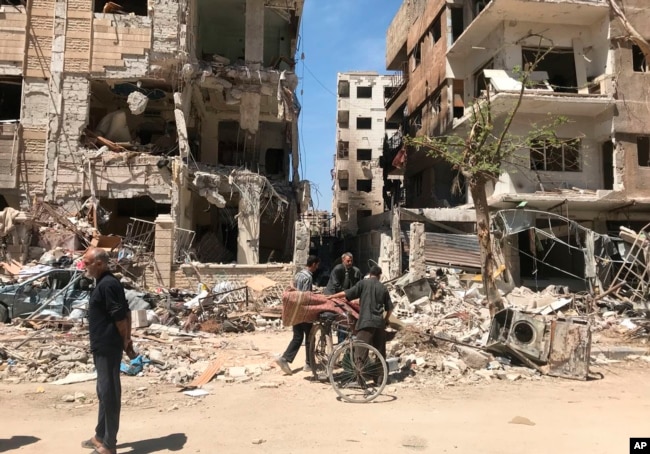
People stand in front of damaged buildings, in the town of Douma, the site of a suspected chemical weapons attack, near Damascus, Syria, April 16, 2018.

Nauert told Alhurra the United States is pushing for a renewed focus on the so-called Geneva process the United Nations began in 2012 as a roadmap for ending the Syrian conflict with a new constitution and elections.

“The only thing that I can hope that is positive that came out of the terrible news in Syria last week is to reinvigorate that political process,” she said. “So it is our hope now that countries will go back to the Geneva process and we’ll be able to make some progress there.”

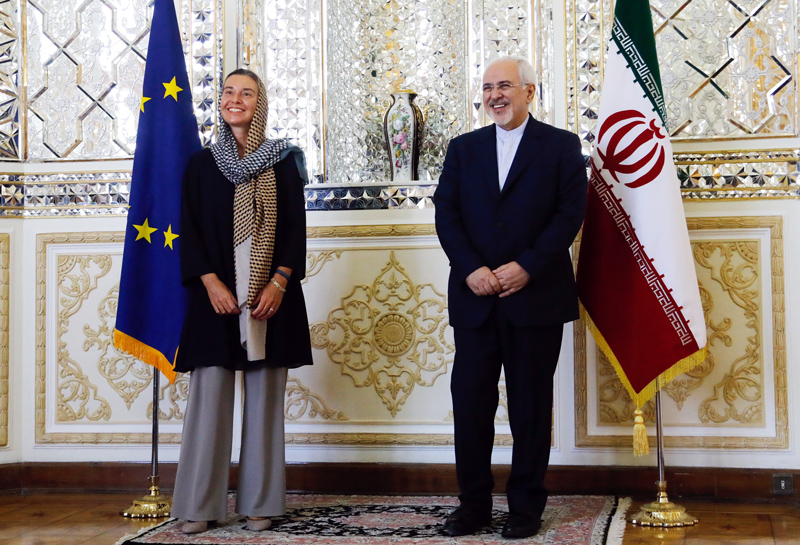
EU foreign policy chief Federica Mogherini made a similar call Monday ahead of a ministerial meeting, saying there is a clear need to push for re-launching the U.N.-led peace process.