History your time more than worth !
History your time more than worth !
Netanyahu’s 70th Independence Day Greeting: We’re Just Getting Started
Prime Minister Benjamin Netanyahu has issued his Independence Day greetings:
“This year Israel celebrates its 70th anniversary.
That’s 70 years of freedom.
70 years of democracy.
70 years of bettering the world.
Israel’s success didn’t happen overnight.
Men and women from every walk of life – young and old, Jew, Christian, Muslim, religious and secular, men and women that have worked hard to build our nation.
As I travel around the world meeting other leaders, I am struck by their appreciation and admiration for Israel.
They seek Israel’s technology.
They seek Israel’s ingenuity.
They seek Israel’s genius.
I am proud that Israel is helping people in Latin America, in Africa, in Asia and in many other places to live healthier and safer lives.
Here’s the best part.
We’re just getting started.
70 years is the blink of an eye in historical terms.
I have no doubt that 70 years from now, Israel will be even stronger, even more prosperous than it is today.
Thank you to our many friends around the world.
Happy Birthday, Israel.”

by Deborah Danan19 Apr 2018 Breitbart
Source Link: Sheldon Adelson Donates $70 Million to Birthright in Honor of Israel’s 70th Anniversary
{To protest this kind of generosity in this manner is absurd. – LS}
The Birthright Israel project brings young Jewish people from around the world to Israel on educational 10-day trips. Since it was launched in 2000, the group has brought more than 600,000 young adults to the Jewish state.
“Before Israel was founded, my father always said he wished there was a place where Jewish people could live. He always wanted to go, but by the time I could send him, he said he was too old and too sick. I don’t want any kid to say they were too old or too sick to visit Israel,” Adelson said in a speech to the 650 people in attendance at the gala hosted at the Ziegfeld Ballroom in Midtown.
Some $125 million was raised at the event in New York.
To date, Adelson, who is one of Israeli Prime Minister Benjamin Netanyahu’s most prominent backers, has contributed more than $400 million to Birthright Israel.
A group of Jewish anti-Birthright protesters gathered outside the gala in New York Sunday night holding up signs that said, “We are the Jewish future” and chanting, “No free trips on stolen land! Boycott Birthright that’s our plan!” The protesters were also handing out symbolic plane tickets under the slogan “return the birthright.” The group was mostly comprised of Jewish youth from the radical anti-Israel group Jewish Voice for Peace.
Michael Steinhardt, 77, one of the founders of Birthright Israel, called the demonstrators “left-wing, stupid young Jews” and flipped the bird at them.
“I passed this group of protesters behind a barrier and it was clear these were young Jews,” Steinhardt said later. “Birthright is such a warm, welcoming, non-political enterprise you’d think they could find better things to protest. They were screeching something and I gave them the finger, and that was that,” Steinhardt said.

“I find it really peculiar that so many Jews are supporting BDS and events like their protest,” Steinhardt told Haaretz. “I don’t really understand it, but that’s my age catching up with me, I guess.”
Ben Lorber, JVP’s campus coordinator, told Haaretz that his group believes, “Birthright offers a Disney-fied portrayal of Israel-Palestine and it’s simply unjust that we get a free trip while our friends – Palestinian refugees – are unable to visit, much less return to their homes.” Lorber added, “We think the Palestinians deserve the right to return to their homes and an end to the occupation.”
Israel holds that the so-called Palestinian “right of return,” in which Palestinians would return to the ancestral homes they fled during the establishment of the state in 1948, would spell the end of the Jewish state.

Debka April 19, 2018
Source Link: Is a thick gaseous cloud hiding Russia’s first S-300 delivery to Syria?
{We’ll know for sure once they are deployed. – LS}
As Israel celebrated its 70th anniversary, a Russian ship unloaded a suspect military cargo from a freighter at the Syrian port of Tartous. Was Moscow answering Israel’s celebration by delivering advanced S-300 air defense missiles as a show of support for Bashar Assad?
This not confirmed. However, DEBKAfile’s military sources report that the Russians undoubtedly took advantage of Israel’s preoccupation with its Independence Day revelries to deliver advanced weapons systems for the Syrian army. The Russian ship docked in Tartous on Wednesday afternoon, April 18. Before unloading it, they positioned in the Russian section of the port giant compressors which spewed thick gaseous clouds over the operation to hide it from oversight by Israel’s surveillance planes, drones and satellites. This tactic intensified Israel’s suspicion that the cargo included S-300 weapons systems.
On Tuesday, April 17, Russian Foreign Minister Sergei Lavrov said Moscow had refused Syria’s demand for the advanced S-300 missiles, but since the “appalling act of aggression” committed by the US, France and Britain, “Moscow was ready to consider any means to help the Syrian army curb further aggression.”
According to our military sources, the Russian vessel was sighted crossing through the Bosporus near Istanbul on Monday, i.e., just two days after the Western strike on Syria’s chemical sites. No attempt was made to conceal the presence on its decks of military equipment, which looked like the command vehicles of missile batteries and radar apparatus. The ship was loaded at the Russian military port of Novorossiysk on the Black Sea.


A U.S. Army soldier stands guard in front of the Peace House at the truce village of Panmunjom inside the demilitarized zone separating the two Koreas, South Korea, April 18, 2018.
April 19, 2018 5:31 AM Reuters via VOA News
Source Link: Moon: N. Korea Wants Peninsula Without Nukes
{Even though the outcome is unknown at this point, you have to admit this is historic. Of course, the MSM will never give Trump any credit. Besides, imagine the impact on Iran if the North Koreans disarmed and made peace with the USA and South Korea. – LS}
SEOUL, SOUTH KOREA —
North Korea has expressed its desire for “complete denuclearization” of the Korean Peninsula and is not seeking conditions such as U.S. troops withdrawing from the South first, South Korean President Moon Jae-in said Thursday.
Moon said big-picture agreements about normalization of relations between the two Koreas and the United States should not be difficult to reach through planned summits between North and South, and between the North and the United States, in a bid to rein in the North’s nuclear and missile programs.
“North Korea is expressing a will for a complete denuclearization,” Moon told reporters. “They have not attached any conditions that the U.S. cannot accept, such as the withdrawal of American troops from South Korea. All they are expressing is the end of hostile policies against North Korea, followed by a guarantee of security.”
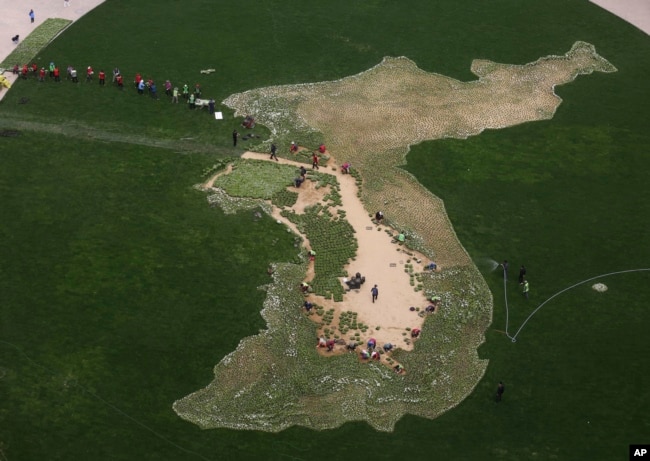
Workers plant flowers in the shape of the Korean Peninsula on the lawn to wish for a successful inter-Korean summit at Seoul Plaza in Seoul, South Korea, April 13, 2018. North Korean leader Kim Jong Un will meet South Korean President Moon Jae-in April 27 at the border.
Armistice change
North Korea has defended its weapons programs, which it pursues in defiance of U.N. Security Council resolutions, as a necessary deterrent against perceived U.S. hostility. The United States stations 28,500 troops in South Korea, a legacy of the 1950-53 Korean War.
North Korea has said over the years that it could consider giving up its nuclear arsenal if the United States removed its troops from South Korea and withdrew its so-called nuclear umbrella of deterrence from South Korea and Japan.
South Korea announced Wednesday that it is considering how to change a decades-old armistice with North Korea into a peace agreement as it prepares for the North-South summit this month.
Reclusive North Korea and the rich, democratic South are technically still at war because the 1950-53 conflict ended in a truce, not a peace treaty.
Moon also said he saw the possibility of a peace agreement, or even international aid for the North’s economy, if it denuclearizes.
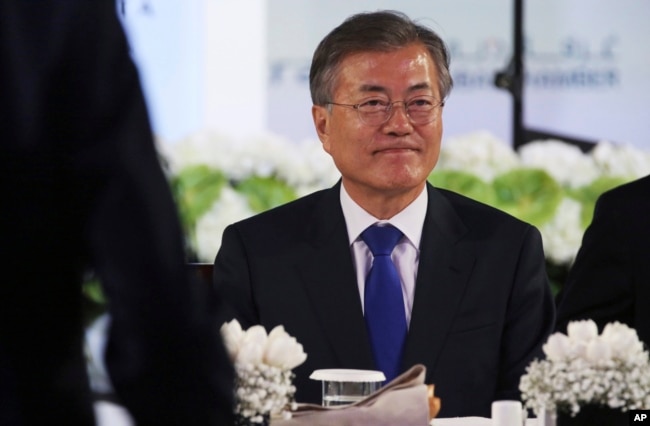
South Korean President Moon Jae-in attends a luncheon in Dubai, United Arab Emirates, March 27, 2018. Moon said agreements on big-picture issues between the Koreas should not be difficult to reach.
‘A lot of constraints’
But he also said the summit had “a lot of constraints,” in that the two Koreas could not make progress separate from the North Korea-United States summit, and could not reach an agreement that transcends international sanctions.
“So first, the South-North Korean summit must make a good beginning, and the dialogue between the two Koreas likely must continue after we see the results of the North Korea-United States summit,” Moon said.
U.S. CIA Director Mike Pompeo visited North Korea last week and met leader Kim Jong Un, with whom he formed a “good relationship,” U.S. President Donald Trump said Wednesday, ahead of a summit planned for May or June.
North Korea meanwhile will hold a plenary meeting of its ruling party’s central committee Friday, state media KCNA said Thursday. The meeting was convened to discuss and decide “policy issues of a new stage” to meet the demands of the current “important historic period,” KCNA said.

President Vladimir Putin reportedly wants to give US President Donald Trump another chance to make good on pledges to improve ties and avoid escalation.PHOTO: EPA-EFE
PUBLISHED APR 18, 2018, 11:44 AM SGT The Straits Times
Source Link: Putin seeks to dial down tensions with US as sanctions continue to bite
{First, Kim now Putin. Not tired of all the winning yet. – LS}
MOSCOW (BLOOMBERG) – After US sanctions crippled an entire Russian industry and air strikes in Syria threatened the first direct clash between nuclear superpowers since the Cold War, President Vladimir Putin is seeking to dial down the tension.
Russia’s leader wants to give President Donald Trump another chance to make good on pledges to improve ties and avoid escalation, according to four people familiar with the matter.
One said the Kremlin has ordered officials to curb their anti-US rhetoric.
Mr Putin’s decision explains why lawmakers on Monday (April 16) suddenly pulled a draft law that would’ve imposed sweeping counter-sanctions on US companies, two of the people said.
The relatively limited nature of the weekend attacks on alleged chemical weapons facilities in Syria, where Russia is backing government forces in a civil war, was seen as a positive sign in the Kremlin, considering Mr Trump’s ominous tweets announcing missiles would soon be flying.
“Putin is ready to make numerous, deep concessions, but he has to appear like he’s not losing,” said Mr Igor Bunin of the Centre for Political Technologies, a consultancy whose clients include Kremlin staff. “He understands Russia can’t compete with the West economically and he doesn’t plan to go to war with the West.”
The Kremlin is still coming to grips with the economic impact of the most punitive penalties the US has imposed since first sanctioning Russia four years ago, over the conflict in Ukraine.
The latest measures, which Treasury called payback for Mr Putin’s “malign activity” in general, hit one of the country’s most powerful businessmen, billionaire Oleg Deripaska, the hardest.
Shares of Mr Deripaska’s aluminium giant Rusal have plunged about 70 per cent in Hong Kong since the US basically banned the company from the dollar economy on April 6, erasing about US$6 billion (S$7.87 billion) of value and threatening 100,000 jobs at a time when Russia is limping out of its longest recession in two decades.
Mr Putin, who is due to be sworn in for what may be a final six-year term next month, is keen to avoid having another major company suffer a similar fate.
It could be too late to reverse the downward spiral that’s taken relations to the lowest level in decades.
While Mr Trump is open to trying to improve ties, Congress and much of his administration are committed to keeping the pressure up on a country many view as America’s No. 1 enemy after allegations of Kremlin meddling in the 2016 elections.
Further complicating the diplomatic dance are the often-conflicting signals coming from the White House.
Mr Trump’s reported decision on Monday to put the brakes on new Russian sanctions triggered a brief rally in the rouble, which fell the most since June 2015 last week.
On Tuesday, for example, economic adviser Larry Kudlow sent Russian markets reeling when he said “additional sanctions are under consideration”.
Still, the Kremlin is holding back from further escalation.
On Monday, legislators abandoned – at least for now – a Bill that would have limited a broad range of trade with the US, from farm products and medications to aviation and space.
One of the most outspoken critics of the Pentagon, Deputy Prime Minister Dmitry Rogozin, said a proposed ban on selling rocket engines “would hurt Russia more than the US”, given Moscow’s dependence on American contracts.
Even before the US attacks in Syria, the Kremlin told officials to tone down threats of retaliation.
Russia’s ambassador to Lebanon doesn’t seem to have gotten the message. In an interview with local television that made headlines the world over, he said Russia wouldn’t hesitate to shoot down missiles and attack whatever platforms they were launched from if its forces were threatened.
The Kremlin was livid, according to one official, and the warning wasn’t repeated.
With the initial euphoria over Mr Trump’s surprise election victory long over, officials say they’re convinced there’s little the US President can do to overcome what they see as entrenched anti-Russian bias among a Washington establishment that’s determined to maintain global dominance at any cost.
Last month’s waves of diplomatic expulsions throughout the West over the nerve agent attack on a Russian turncoat spy in the UK accelerated a breakdown in relations that’s been building for years.
Still, officials are holding out hope that Mr Trump might be able to stop the downward slide, especially after he congratulated Mr Putin on his re-election in March and dangled the prospect of a White House summit.
To be sure, plenty of areas of tension remain, including over alleged Russian hacking, trolling and other forms of online aggression.
US and UK officials this week issued a rare joint warning of what they called stepped up Russian probing of corporate and government computer systems in the West.
“Russia is our most capable hostile adversary in cyber space,” said Mr Ciaran Martin, chief executive officer of Britain’s National Cyber Security Centre.
The alert included advice to companies about how to protect themselves and warned specifically of attacks on routers, the devices that channel data around a network.
While reluctant to give precise details of the threat, officials said once a router is hacked, it can be used to capture data and even attack other computers, potentially overwhelming the Internet.
But Mr Vladimir Frolov, a former Russian diplomat who’s now a foreign policy analyst in Moscow, said such cyber activities don’t usually weigh on state-level negotiations since all countries are pursuing the same capabilities.
“Cyber espionage is considered a legitimate activity, it shouldn’t really affect bilateral relations,” he said.
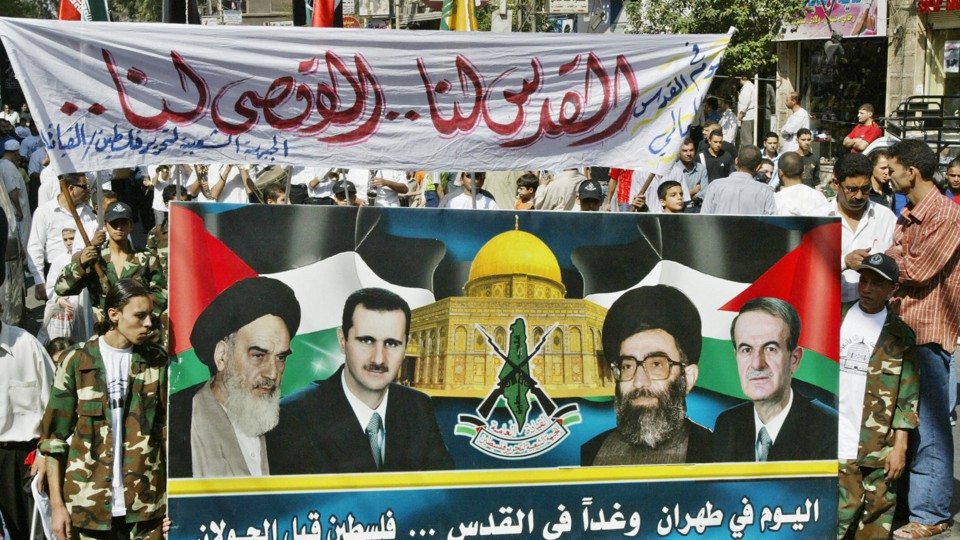
At a time of economic hardship, Tehran has provided billions of dollars to help Assad crush Islamist rebels. The question is why.
Karim Sadjadpour Apr 16, 2018 Via The Atlantic
Source Link: Iran’s Real Enemy in Syria
{Never forget, it is Assad who is to blame for Iran’s military expansion in Syria. – LS}
“What kind of a nation wants to be associated with the mass murder of innocent men, women, and children?” President Trump asked Russia and Iran Friday night after launching air strikes against the Syrian regime. “The nations of the world can be judged by the friends they keep.”
Despite his speechwriters’ best efforts, if there is one thing Donald Trump and Iran share it is an inability to be shamed. {The media cannot resist taking a stab at Trump, no matter what. – LS} Over the last seven years no country has done more, financially and militarily, to back the Bashar al-Assad regime’s mass murder of Syrians than the Islamic Republic of Iran, a theocracy that claims to rule from a moral high ground. Within hours of joint American, French, and British targeted military strikes in Syria, Iranian president Hassan Rouhani called Assad to pledge his solidarity.
At a time of great economic hardship in Iran, Tehran has provided billions of dollars to arm, train, and pay tens of thousands of Arab, Afghan, and Pakistani Shia militants help Assad crush Sunni Islamist rebels. Tehran, the victim of heinous chemical weapons attacks by Saddam Hussein three decades ago, has provided Assad the means to deliver these same weapons, while simultaneously denying that he uses them. The question is why?
Distilled to its essence, Tehran’s steadfast support for Assad is not driven by the geopolitical or financial interests of the Iranian nation, nor the religious convictions of the Islamic Republic, but by a visceral and seemingly inextinguishable hatred for the state of Israel. As senior Iranian officials like Ali Akbar Velayati, a close adviser to Supreme Leader Ayatollah Ali Khamenei, have commonly said, “The chain of Resistance against Israel by Iran, Syria, Hezbollah, the new Iraqi government and Hamas passes through the Syrian highway. … Syria is the golden ring of the chain of resistance against Israel.” So long as the 78-year-old Khamenei remains in power, this hatred will justify Tehran’s continued commitment of blood and treasure to support Assad’s use of all means necessary—including chemical weapons—to preserve his rule.
In ostensibly trying to avenge what he portrays as one injustice, however, Tehran has helped Assad perpetrate a far greater one. The number of Syrian deaths since 2011 (an estimated 500,000, though the UN has stopped counting) is more than five times greater than the approximately 90,000 Arabs (roughly 20-30 percent of them Palestinian) killed in the last 70 years of the Palestinian-Israeli conflict, while more than twice as many Syrians (12 million) as Palestinians have been displaced.* Indeed since 2011 far more Palestinians have been killed by Assad (nearly 3,700) than by Israel, including by chemical weapons. “If their way to return Palestinians back home is displacing millions of Syrians,” said my friend Kassem Eid, one of around half a million Palestinian refugees who grew up in Syria, and a victim of one of Assad’s chemical weapons attack, “I don’t want to go back to Palestine.”
* * *
The Iran-Assad alliance is a study in contradictions. While Iranian advocates for secularism are viciously repressed, Assad routinely says, “The most important thing is that Syria should be secular.” Iranian women who defy the mandatory hijab are subject to violence and imprisonment, while Hezbollah fighters celebrate military victories in Damascus nightclubs alongside scantily-clad escorts. While nude Renaissance art is censored in Europe so as not to offend the religious sensibilities of visiting Iranian officials, Assad’s forces have deliberately used rape as a tool of repression against opponents. Khamenei implores his subjects to buy Iranian products to boost economic self-sufficiency, while Tehran’s largesse has helped subsidize Assad’s wife Asmaa—an unveiled fashionista—sustain what looks like her primary passion: shopping in London.
From the outset of the Syrian uprising in 2011, Assad and Iran assiduously sought to crush moderate opposition and indulge radical Islamists in order to engineer a no-win proposition for the West: Assad or jihadists. Yet Tehran has tried to portray its role in Syria as an existential battle for Iran, against the forces of Sunni radicalism. “Syria is Iran’s 35th province,” said Mehdi Taeb, a head of the Revolutionary Guards intelligence wing and a close advisor to Iranian Supreme Leader Ayatollah Ali Khamenei. “If we lose Syria we won’t be able to hold Tehran.” While Assad’s collapse would undoubtedly be a strategic blow to the Islamic Republic, Iran has been a nation-state for virtually 2,500 years before now without the benefit of a Syrian vassal state. Just as Russia outlived the USSR, so will Iran outlive the Islamic Republic.
Though Iranians feel the financial costs of the Syria war, Tehran has outsourced the human costs. Iran’s 40,000-strong Shia foreign legion—composed of Lebanese, Afghans, Iraqis, and Pakistanis—have endured five times more casualties in Syria than Iranians. Afghan militias—known as the Fatemiyoun Division—have paid the highest price. Most are not enthusiastic holy warriors but undocumented manual laborers, some underage, whom the Iranian Revolutionary Guards present with an offer they can’t refuse: 10-year residency permits in Iran—mitigating the risk of forced deportation—and $800 per month to go to Syria, purportedly to protect the Shiite shrine of Sayyida Zainab, a granddaughter of the Prophet Muhammad, outside Damascus. Lacking basic training and often illiterate, these Afghan troops are instead used as initial assault cannon fodder. “Sometimes we had no supplies,” said one former Afghan fighter, “no water, no bread—hungry and thirsty in the middle of the desert.” For Palestine.
* * *
The burden of defending Iran’s role in Syria to Western audiences has fallen on the shoulders of Tehran’s U.S.-educated Foreign Minister Javad Zarif. Among Zarif’s considerable talents is an ability, and willingness, to tell brazen untruths with tremendous conviction. Shortly after Zarif insisted Iran had “no boots on the ground” in Syria, for example, the Revolutionary Guards announced their 1,000th casualty. In the aftermath of each chemical weapons attack by Assad, Zarif has systematically absolved Assad of responsibility by following the same playbook:
First, remind everyone that Saddam Hussein—backed by Western powers—used chemical weapons against Iran during the 1980-1988 Iran-Iraq war. In other words, Syrian children are not the victims; Iran is still the victim. Second, ambiguously condemn chemical weapons use “by anyone.” This allows Zarif’s Western allies to acknowledge his humanity. When pressed, however, Zarif has always claimed that it was the Syrian opposition—backed by American and Israel—that has used chemical weapons, not Assad. Zarif has paid little reputational cost for this whitewashing; the Nobel Peace Prize committee continues to mention him as an annual nominee.
After seven years, and with billions of dollars of sunk costs, an assertive Russian partner, and a U.S. president that aspires to withdraw from the region, Tehran feels vindicated in Syria. It is alleged to be building permanent military bases outside Damascus, with armed drones capable of reaching Israel. Periodic, limited U.S. military strikes against Assad’s weapons depots are not likely to change this calculus. Hopes that Assad’s mass repression or use of chemical weapons would compel Tehran to reassess its support have been proven wrong. Just as Iranians today frequently evoke how Saddam used chemical weapons against Iran over three decades ago, Syrians will have similarly long memories of Iranian complicity.
While Friday night’s missile shower illustrated the clear power asymmetry between Washington and Tehran, the last seven years have also illustrated the two countries’ asymmetry of commitment in Syria. In contrast to Donald Trump—who did not care about Syria last week and will likely not care about Syria next week {Again, the media cannot resist taking a stab at Trump, no matter what. – LS}—Ayatollah Khamenei’s opposition to Israel, and his commitment to Syria, has not wavered for four decades. Like Captain Ahab chasing Moby Dick, the 78-year-old Khamenei will take this pursuit to the grave with him.
In the 1998 movie American History X, a vivid portrait of America’s neo-Nazi movement—America’s Islamist equivalent—Edward Norton’s character is a young radical sent to prison for committing a hate crime. When a sympathetic former teacher visits him in prison to try to talk sense, he remains intransigent. The teacher’s simple parting comment, however, was powerful enough to cause Norton to reflect. “Just ask yourself one thing,” said the teacher. “Has anything you’ve done made your life better?”
Amidst all the carnage and destruction in Syria, a similar question could be posed to Khamenei. Has anything that Iran has done in Syria, or elsewhere for that matter, advanced its goal of destroying Israel and liberating Palestine? Khamenei appeared to contemplate this question recently. “Today the body of Muslim world is severely wounded,” he said. “Enemies of Islam have managed to baffle the Muslim world by staging war and discord, giving the enemy more security in the region. In Western Asia, the Zionist regime thrives in a safe haven, while Muslims are posed against one another.” Long live Palestine. {LLP??? – LS}




 anneinpt
 artaxes
 danmillerinpanama
 davidking1530
 Peter Hofman
 Joseph Wouk
 Peter
Peter Louisiana Steve
 WarSclerotic
Recent Comments