Archive for April 2018

Following Threat from Iran, Israel Strikes Syrian Position in Response to Spillover Fire

April 24, 2018

by TheTower.org Staff | 04.23.18 5:36 pm

Source Link: Following Threat from Iran, Israel Strikes Syrian Position in Response to Spillover Fire

{How dare Israel interrupt Assad while he’s busy killing more of his citizens. – LS}

Following a threat from an Iranian general to destroy Israel, the IDF targeted a position of the Syrian army, a client of Iran, after spillover fire landed in Israel, The Times of Israel reported Monday.

According to the IDF, a mortar landed near Israel’s border fence with Syria following a skirmish between the Syrian army and rebel groups in the area. Israel then targeted a Syrian artillery cannon which was in the general area where the mortar was fired from.

A statement from the IDF said, “The IDF sees the Syrian regime as responsible for every action in its territory and will not tolerate violations of the sovereignty of the State of Israel and the security of its citizens.”

The latest limited clash between Israel and Syria comes in the wake of a threat against Israel by Iran, the patron of Syria’s ruler Bashar al-Assad.

On Saturday, Major General Abdolrahim Mousavi, commander of Iran’s army, threatened that Iran’s regular army and Iran’s Islamic Revolutionary Guard Corps (IRGC) would combine to “annihilate” Israel within 25 years, Iran’s semi-official Fars News Agencyreported.

“When the arrogant powers create a sanctuary for the Zionist regime to continue survival, we shouldn’t allow one day to be added to the ominous and illegitimate life of this regime,” Mousavi said while addressing a ceremony in Tehran.

Though he echoed a prediction about Israel’s destruction articulated by Supreme Leader Ayatollah Ali Khamenei’s first in 2015 and reiterated in 2016, Mousavi explained that Iran’s military will continuously be working towards that goal until then.  “The Army will move hand in hand with the IRGC so that the arrogant system will collapse and the Zionist regime will be annihilated,” he added.

On Friday, IRGC Lieutenant Commander Brigadier General Hossein Salami made similar comments, threatening that if war broke out between Israel and Iran, “you can be assured that it will result in wiping you off, the smallest target is your existence, there is no smaller target than that.”

Salami’s language closely mirrors a threat that Israel “must be wiped off the earth,” which was written on a ballistic missile that Iran tested two years ago.

Iran has ratcheted up its rhetoric against Israel since an airstrike against an airbase in Syria, where Iran had personnel and advanced weapons. Seven Iranian military personnel were killed in the airstrike, which has been attributed to Israel. One, an IRGC colonel, was reportedly in charge of Iran’s drone program. In February, a drone launched from the airbase, known as T-4, penetrated Israeli airspace, before being shot down. Last week, Israel announced that the drone was loaded with explosives and was meant to carry out an attack on Israeli soil.

Iran heats war rhetoric to cover up military buildup in Syria 

April 23, 2018

Source: Iran heats war rhetoric to cover up military buildup in Syria – DEBKAfile

Tehran is drumming up an oral war of attrition against Israel as a ruse to deter the IDF from striking the military hardware and personnel flowing into Syria.

Iran is pouring out violent threats in a rising crescendo against the Jewish state for two goals: One is to keep Israel off-balance and frozen in a high defense posture on its northern borders; and two, to con Israel into fearing that any IDF action would tip over into an all-out conflict. This stratagem allows Tehran to keep up a continuous stream of hardware and personnel into Syria and Lebanon free of hindrance by Israel’s air force and missiles, and so anchor its military presence in both of Israel’s northern neighbors.
Tension between Tehran and Jerusalem has been high since April 9, when an Israel air strike knocked out a Revolutionary Guards air force command center at the Syrian T-4 air base. But, apart from blistering threats of retaliation, Iran has none nothing. Israel celebrated its Independence Day under clear skies, although the following day, Friday, April 20, the Guards deputy commander Gen. Hossein Salami warned that Iran’s hand “was on the trigger of its missiles” and Israel’s air bases were “within reach.” But Tehran sees an opportunity for taking a high tone against Israel following three developments:

  1. The missile strike conducted by the US, the UK and France on Syrian chemical sites on April 14 was a letdown. And also, against expectations, the Western attack avoided Iranian targets, although Hizballah and other pro-Iranian forces played a central role in the Syrian conquest of East Ghouta and its use of chemical weapons. Saudi sources put out a report on Friday alleging that 15 Iranian officers were killed in the missile strike. There are no grounds for this report and it appears to have been designed for home consumption.
  2. President Donald Trump repeatedly asserts that he is determined to pull American troops out of Syria as soon as possible. This gift is a boon for Tehran’s goals. It will remove the main obstacle, a US military presence along the Syrian-Iraq border, that impedes the transfer of pro-Iranian Shiite militias from Iraq into Syria and the creation of a continuous land bridge from Tehran to the Mediterranean. In celebration of its effortless gain, reports appeared on Saturday that Iran, Iraq and Syria had undersigned a project for building a 1,700km highway from Tehran to Damascus via Baghdad that will be ready for traffic in two years.
  3. Moscow and Jerusalem are at loggerheads over Syria after a long period of amity. Tehran has taken note of President Vladimir Putin’s recent warning to Israel that its air force operations in Syria would no longer have the freedom previously enjoyed. Putin has therefore removed another big obstacle from Tehran’s goals. Iran will make every effort to deepen the rift.

For all these reasons, Prime Minister Binyamin Netanyahu and Defense Minister Avigdor Lieberman cannot be satisfied with their protestations of the IDF’s readiness and willingness to pick up the gauntlet against any threat. Tehran’s belligerent rhetoric is a cover for an action which Israel’s leaders have vowed to prevent. This can’t be done by talk alone.

Trump to Netanyahu: Do you care about peace or not?

April 23, 2018

Source: Trump to Netanyahu: Do you care about peace or not? – Israel News – Jerusalem Post

Trump’s direct and unscripted question to Israel’s leader shocked advisors present for the call.

BY JPOST.COM STAFF, MAARIV ONLINE
 APRIL 23, 2018 08:38
US President Donald Trump congratulates Prime Minister Leo Varadkar of Ireland, during a phone call

 US President Donald Trump congratulates Prime Minister Leo Varadkar of Ireland, during a phone call at the Oval Office, June 27, 2017. (photo credit: CARLOS BARRIA / REUTERS)

In a telephone call last year, US President Donald Trump bluntly asked Prime Minister Benjamin Netanyahu whether he is genuinely interested in peace with the Palestinians, Axios reported Sunday.

The question, which shocked those in the room, came in the midst of a longer, and largely friendly, conversation between the two leaders. According to three sources familiar with the call, Trump had recently read news reports stating that Netanyahu was planning to expand Jewish settlement construction to shore up support among his right-wing base. The president believed such a move would unnecessarily anger the Palestinian leadership and endanger his much-tauted “deal of the century” to solve the Israeli-Palestinian conflict.

The report does not record Netanyahu’s answer to Trump’s direct query.

“The president has an extremely close and candid relationship with the prime minister of Israel and appreciates his strong efforts to enhance the cause of peace in the face of numerous challenges,” a senior White House official responded to the Axios article.

“The president has great relationships with a number of foreign leaders but that doesn’t mean he can’t be aggressive when it comes to negotiating what’s best for America,” added White House Press Secretary Sarah Sanders.

The revelation of the unvarnished exchange between the two leaders comes only a month before the implementation of Trump’s controversial decision to move the American embassy in Israel from Tel Aviv to Jerusalem, according to a recent State Department press release.

The new embassy will open in May, to “coincide with Israel’s 70th anniversary,” the press release states. The embassy will be located in the building that now houses the US Consulate General, in Jerusalem’s Arnona neighborhood.

“This is a great day for the people of Israel,” Netanyahu said in a statement issued by the Israeli embassy in Washington. “President Trump’s decision to move the United States Embassy to Jerusalem on the coming Independence Day follows his historic declaration in December to recognize Jerusalem as Israel’s capital. This decision will turn Israel’s 70th Independence Day into an even bigger celebration. Thank you President Trump for your leadership and friendship.

Trump’s decision to move the American embassy came on the heels of his December announcement that the United States officially recognized Jerusalem as Israel’s capital.

The Palestinian response to the upcoming embassy relocation was swift. The move showed a “determination to violate international law, destroy the two-state solution and provoke the feelings of the Palestinian people as well as of all Arabs, Muslims and Christians around the globe,” said Saeb Erekat, the chief Palestinian negotiator, in a February interview with Reuters.

“Trump and his team have disqualified the US from being part of the solution between Israelis and Palestinians; rather, the world now sees that they are part of the problem,” Erekat said.

French, German leaders will bring Trump the same message: Save the Iran nuclear deal

April 23, 2018

Source: French, German leaders will bring Trump the same message: Save the Iran nuclear deal

French, German leaders will bring Trump the same message: Save the Iran nuclear deal
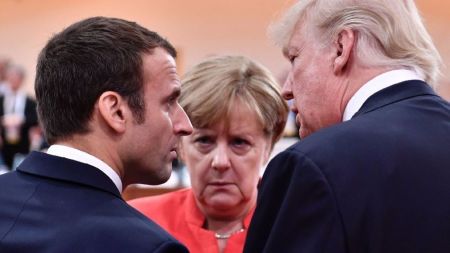
President Trump with French President Emmanuel Macron and German Chancellor Angela Merkel at the G20 meeting of the world’s top economies in Hamburg, Germany, on July 7, 2017. (John Macdougall / AFP/Getty Images)


 President Trump faces a European double bill this week as a crucial deadline looms for a decision on whether to withdraw from the Iran nuclear deal.

French President Emmanuel Macron and German Chancellor Angela Merkel, arriving back to back, will bring a unified message: Save the deal.

“I don’t have any Plan B for nuclear [protections] against Iran,” Macron said Sunday on Fox News. “Let’s preserve the framework because it is better than a sort of North Korea-type situation.”

Iran’s foreign minister made the point more dramatically, warning that if Trump quits the 2015 accord, Tehran may respond by relaunching and intensifying its now-blocked nuclear program.

Iranian Foreign Minister Mohammad Javad Zarif, who helped negotiate the nuclear deal, said on CBS’ “Face the Nation” that Iran might consider “resuming at a much greater speed” its nuclear activities.

“Obviously the rest of the world cannot ask us to unilaterally and one-sidedly implement a deal that has already been broken,” Zarif said.

“I think the international community has seen that … the United States under this administration has not been in a mood to fulfill its obligations,” he said. “So that makes the United States not very trustworthy.”

The dual nuclear dilemmas — Iran and North Korea — are coming to a head in a dramatically short span of time.

Trump has vowed to scrap the 2015 Iran accord unless co-signatories France, Germany and Britain can “fix” it. Unless revisions are made, he has vowed not to sign another waiver of U.S. sanctions on May 12, the next deadline, potentially wrecking the deal.

Trump also is hoping to meet with North Korean leader Kim Jong Un by mid-June in a push to roll back the country’s growing nuclear arsenal. On Sunday, Trump uncharacteristically sought to downplay expectations of the proposed summit. “Only time will tell,” he tweeted.

U.S. and European diplomats have been brainstorming ways to address some of Trump’s concerns, including Iran’s production of ballistic missiles and its support for militant groups elsewhere in the Middle East — issues that were never tied to the nuclear deal.

But the diplomats still are not “across the finish line,” a senior administration official told reporters Friday.

Both Macron and Merkel will try to persuade Trump not to renege on the deal.

Macron, who arrives Monday for a three-day official state visit, and Merkel, who comes Friday for a 24-hour working visit, have other concerns, including the tariffs that Trump has imposed on steel and aluminum.

Macron has the best chance of getting through to Trump. The U.S. president seemed enamored of the brash, self-confident French leader, admiring his Bastille Day military parade last summer and dinner under the stars at the Eiffel Tower.

“We have a very special relationship because both of us are probably the maverick of the systems on both sides,” Macron said Sunday.

The bonne amitié seems to be growing between the two leaders despite divergent political views on issues from the international role in Syria to climate change.

Macron “has broken the code when it comes to dealing with President Trump,” said Heather Conley, director of the Europe program at the Center for Strategic and International Studies, a nonpartisan Washington think tank.

“He has been, I think, the most successful in trying to convince the president to think through some very important issues … to France and to the European Union,” Conley added.

French and British warplanes joined the U.S. military in recent airstrikes on three alleged chemical weapons facilities in Syria, a contribution that the White House was quick to applaud.

Trump’s relationship with Merkel has been less warm. Unlike in France, which has a semi-presidential system, Germany’s chancellor is not directly elected, so Europe’s longest-serving elected leader must act through compromise and coalition, messy concepts for Trump.

After the Iranian nuclear deal, trade will top Merkel’s agenda. She, Macron and other European leaders often express frustration that Trump, in his emphasis on bilateral trade agreements, displays a misunderstanding of how the European Union works.

Most trade and commerce must be handled through rules governing the 28-nation bloc, not individual member states.

Macron will get Trump’s first official state dinner, a formal affair Tuesday night at the White House. The Trumps also will dine with Macron and his wife, Brigitte, on Monday night in private at Mount Vernon in Virginia, the plantation home of George Washington, and Macron will lay a wreath at Arlington National Cemetery.

Most significant, perhaps, he will address a joint session of Congress on Wednesday, a rare honor. Invited by Republican congressional leadership, Macron will speak on the anniversary of President Charles de Gaulle’s historic speech to Congress in 1960.

The Francophile fanfare is a far cry from 2003, when Republican lawmakers, angry that France opposed the U.S.-led invasion of Iraq, ordered cafeterias on Capitol Hill to change offerings of French fries to Freedom fries, and French toast to Freedom toast.

Unlike Macron, the staid Merkel has never really gotten along with Trump. He openly mocked her on Germany’s decision to accept refugees flowing out of Syria.

Because she heads the largest economy in the European Union, Merkel will lobby Trump for exemptions to his plans to impose trade tariffs. Analysts say she has repeatedly pointed out to Trump that German investment in the U.S. is larger than the other way around — to the tune of $291 billion that creates 680,000 U.S. jobs.

“It is a clear sticking point,” said Jeffrey Rathke, a former State Department official who is a senior fellow at CSIS. “Anything that damages the [transatlantic] trading relationship has the potential to spiral out of control.”

Even Macron, for all his affinity for Trump, has few concrete accomplishments to cite from the relationship. He failed to stop Trump from pulling out of the Paris climate accord, and he views Russian President Vladimir Putin with alarm.

The Iran deal is likely to be the next major point of friction in U.S.-Europe relations.

French, German and British officials say they have been negotiating in good faith with their American counterparts on ways to improve what all agree is a flawed deal. But they also say they have little certainty of what Trump really wants or would accept.

Some of Trump’s major objections are time limits on some restrictions in the deal, so-called sunset clauses.

“Europe has spent the last 15 months muddling through, trying to understand what Trump’s actual policies are … and with limited success,” said Derek Chollet, a defense and security expert at the German Marshall Fund of the United States. “The best you can say about U.S.- European relations now is that they’re extremely fragile.”

Staff writer Noah Bierman contributed to this report.

Iranians hit by ‘perfect currency storm’

April 23, 2018

By Frud Bezhan and Niusha Boghrati, Radio Free Europe / Radio Liberty
Via World Tribune April 22, 2018

Source Link: Iranians hit by ‘perfect currency storm’

{Did not know there were so many millionaires in Iran. For a little less than $20 US, you can be a millionaire too…in rials. – LS}

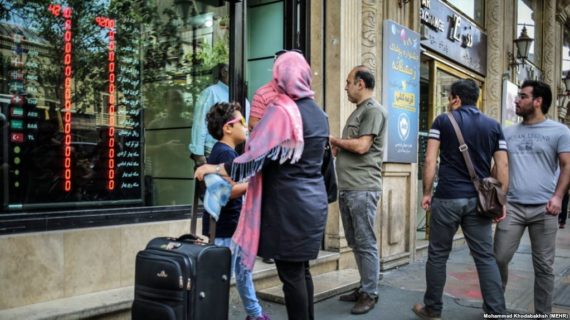
Iranian travelers stand in front of a currency exchange in Tehran, hoping to exchange money on April 11.

Every day, hundreds head to Tehran’s bustling Ferdowsi street to buy foreign currency, only to find that many exchange offices have shut up shop, have turned off their currency-rate displays, or have signs up reading, “We don’t have U.S. dollars to sell.”


Iranian travelers stand in front of a currency exchange in Teheran on April 11. / MEHR

A nationwide dollar-buying panic is in full swing, spurred by the plunging value of the Iranian rial, a sluggish economy, and fears that the United States will reimpose crippling sanctions on the Islamic republic.

With the rial hitting all-time lows, the government has imposed an official exchange rate of 42,000 rials against the dollar, set a cap on the amount of foreign currency that citizens can hold outside banks, and sent police to patrol exchange shops to ensure that no under-the-table currency trading is going on.

But economists say the new currency measures will be difficult to maintain. Exchangers are hoarding U.S. dollars, and Iranians who require foreign hard currency for business or travel are already defying the government and turning to the black market, where the rate has skyrocketed.

“A few days ago, I went to several exchange offices to buy $300,” a Tehran businessman who did not want to reveal his name told RFE/RL’s Radio Farda. “But I couldn’t even purchase $100. So I was forced to buy several hundred dollars on the black market. I paid 58,000 rials for $1.”

The businessman said exchange offices had U.S. dollars to sell, but would not do so for the government’s set rate of 42,000 rials. Instead, he said, exchangers were still selling dollars for free-market exchange rates, despite Tehran’s warning that those caught trading foreign currency outside official rates would face arrest.

“The currency crisis has made us poor,” he said. “But I have an import business so I need to buy American dollars otherwise I can’t continue my work.”

‘We Weren’t Prepared For This’

The new measures are affecting Iranians who study, travel, or do business abroad, as well as those who keep their savings in dollars.

“My family sent my brother to study overseas,” a young Iranian man told Radio Farda on condition of anonymity. “The day he left, the [free-market] exchange rate was 35,000 rials to every dollar. Now, unfortunately, the dollar has reached 60,000 rials.”

“Now, we can’t afford to send him money anymore,” the young man said, adding that “we weren’t prepared for this.”

Police patrol exchange shops to ensure that no under-the-table currency trading is going on.

President Hassan Rohani, who was elected to a second term in 2017 on pledges to boost jobs and the recession-hit economy, has been under fire. In January, grievances against the government spilled over into antigovernment protests across Iran. The demonstrations were crushed, leaving at least 25 people dead.

“One of the reasons I voted for Rohani was because I thought he would improve the economy,” the young man said. “But in the last few months we have seen, unfortunately, that the administration doesn’t have the necessary policies or ability to improve the economy.”

‘Perfect Currency Storm’

Iran’s currency has lost close to half its value on the free market since September, when the dollar was at 36,000 rials. The currency hit a record low of 60,000 on the free market last week.

Steve Hanke, an economist teaching at Johns Hopkins University in Baltimore, says economic mismanagement and residual international sanctions on Iran have worked to “create a perfect currency storm.”

Iran has been unable to reap the full benefits of the 2015 nuclear deal with world powers — under which Tehran curbed its contentious nuclear program in exchange for sanctions relief.

This is partly due to resistance among Iran’s hard-line conservative camp to opening up the state-controlled economy, residual U.S. sanctions linked to Iran’s human rights record and ballistic-missile program, and European companies’ continued wariness of investing in Iran because of fears of U.S. penalties. Economists say this has severely affected Iran’s access to trading relationships, finance, and foreign investment.

Valiollah Seif, the current governor of the Central Bank of Iran, has blamed “enemies” and “traces of plotting.”

The spiraling currency has also been driven by fears of a return of crippling sanctions if U.S. President Donald Trump carries out his threat to exit the nuclear deal with Tehran.

Iran has long had trouble managing its currency market. In 2012, the government tried to set an official, single, rate for the currency, but the attempt failed.

“The new currency system is bound to fail,” Hanke says. “Iranians will continue to flock to the black market for the safety of foreign currency. Also, no economy has ever been given life by devaluations.”

“The currency crisis will not stimulate exports and it will not stimulate domestic production either,” he adds. “The weak rial will be associated with higher interest rates and more inflation, however.”

‘Economic War’

Rohani’s government has deflected blame for the currency crisis on detractors at home and abroad. Government spokesman Mohammad Baqer Nobakht said on April 10 that Iran was in an “economic war, and enemies seek to create problems for our economy.”

The head of Iran’s central bank, Valiollah Seif, was met with angry objections and interruptions from lawmakers in parliament last week, with many demanding his resignation.

Seif blamed the plunging value of the rial on “lack of certainty” about the future and said that “enemies know the issue and try to use any opportunity” to create trouble for Iran. He also referred to “traces of plotting” by regional rivals, including Saudi Arabia and the United Arab Emirates, without elaborating.

Vice President Eshagh Jahangiri blamed “noneconomic, unjustified, and unpredictable factors” for the rial’s collapse, given that he said the country’s exports were performing strongly.

“There should not be such incidents in an economy that always has a surplus of foreign currency. Some say interference by foreign hands is disrupting the economic climate and some say domestic machinations are spurring these things in order to destabilize the climate in the country,” Jahangiri added.
As U.S., North Korea plan to meet, Iran warns against Trump deals

April 22, 2018

Michelle Nichols WORLD NEWS APRIL 21, 2018

Source Link: As U.S., North Korea plan to meet, Iran warns against Trump deals

{Must be time for another pallet of cash. Nope. Not on Trump’s watch. – LS}

NEW YORK (Reuters) – A U.S. push to change the Iran nuclear deal was sending a “very dangerous message” that countries should never negotiate with Washington, Iran’s foreign minister warned as U.S. and North Korean leaders prepare to meet for denuclearization talks.

Speaking to reporters in New York on Saturday, Mohammad Javad Zarif also said that for French President Emmanuel Macron and German Chancellor Angela Merkel “to try to appease the president (Donald Trump) would be an exercise in futility.”

Trump will decide by May 12 whether to restore U.S. economic sanctions on Tehran, which would be a severe blow to the 2015 pact between Iran and six major powers. He has pressured European allies to work with Washington to fix the deal.

Macron and Merkel are both due to meet with Trump in Washington this week.

“The United States has not only failed to implement its side (of the deal), but is even asking for more,” said Zarif, who is in New York to attend a U.N. General Assembly meeting.

“That’s a very dangerous message to send to people of Iran but also to the people of the world – that you should never come to an agreement with the United States because at the end of the day the operating principle of the United States is ‘what’s mine is mine, what’s yours is negotiable,’” he said.

U.S. Ambassador to the United Nations Nikki Haley said earlier this month that North Korean leader Kim Jong Un has “looked at the Iran deal, he’s seen what he can get and he’s seen how he can push through loopholes and we’re not going to let that happen again.”

Under the Iran nuclear deal, Tehran agreed to curb its nuclear program in return for relief from economic sanctions. Trump’s predecessor, Barack Obama, struck the pact to try to keep Iran from building a nuclear weapon but Trump believes it has “disastrous flaws.”

Zarif said if Washington leaves the deal, there were many options being considered by Tehran, including complaining through a dispute mechanism set up by the agreement or simply leaving the deal by restarting its nuclear activities.

“We will make a decision based on our national security interests when the times comes. But whatever that decision will be, it won’t be very pleasant to the United States,” he said.

When asked if Iran could stay in the deal with the remaining parties, Zarif said: “I believe that’s highly unlikely because it is important for Iran to received the benefits of the agreement and there was no way Iran would do a one-sided implementation of the agreement.”

Iran has always said its nuclear program was only for peaceful purposes and Zarif said if Tehran resumed its nuclear activities it would not be intended “to get a bomb.”

“America never should have feared Iran producing a nuclear bomb, but we will pursue vigorously our nuclear enrichment. If they want to fear anything its up to them,” Zarif said.


The U.S Issues Three Warnings to Turkey in Two Days

April 22, 2018

By Ilhan Tanir 2018-04-21 16:25 GMT Assyrian Intl News Agency

Source Link: The U.S Issues Three Warnings to Turkey in Two Days

{Three strikes and you’re out. – LS}

The first of three warnings from Washington to Turkey came on Wednesday morning from the U.S. House Foreign Affairs Committee (HFAC). Speaking before the committee was A. Wess Mitchell, assistant secretary of State for European and Eurasian Affairs at the U.S. State Department.

There were several Turkey-related issues Mitchell addressed. Many of HFAC members questioned the detention and ongoing trial of American pastor Andrew Brunson who has been jailed in Turkey for over 18 months. Mitchell stated that Turkey’s indictment, which also included accusations that Brunson was working with both the Kurdistan Workers’ Party (PKK) and what the Turkish government calls the Fethullahist Terror Organization (FETÖ), to divide Turkey are “laughable.” He also said that Turkey appears determined to purchase the S-400 air defense system from Russia, which could spell US embargoes on Turkey.

Personally, this is the first time I have heard the sanctions message given so clearly. U.S. officials have been talking about the possibility of sanctions on Turkey, but Mitchell’s certainty while speaking appeared new.

Furthmore, Mitchell noted some of the potential impacts of the F35 fighter jet project, which has been much-discussed by certain members of Congress in the past, but again, I do not remember if it was ever mentioned by a US administration official.

Turkey has made large investments in the F35, which is considered to be the next generation fighter jet. Some parts for the F35 are even produced in Turkey. Although the U.S. administration has not made any open or veiled threats regarding the F35 in the past, this week, a senior official at the U.S. State Department stated such possibility.

U.S. officials have been particularly unhappy about the fact that a large number of Russian personnel have expected the arrival of the Russian S-400 to gather information from all other military bases in Turkey. Although Ankara is insistent on its message that the S-400 deal is signed and completed, the US continues to harden its stance on the S-400, and it is likely that we will see heavy embargoes as a result.

The second message from Washington came from the Pentagon on Thursday.

This warning came from U.S. Department of Defense spokesperson Dana White. White pointed out that none of the 105 missiles fired by the U.S. and coalition partners France and Britain at three targets near Damascus were cut off by Russian air defense systems. “The Russian-manufactured air defense systems were totally ineffective,” White said while she noted that the system failed a second time when it accidentally sent missiles two days after the attack.

White added that Washington communicated the message to Ankara that Turkey’s S-400 system will not work with NATO systems.

For any other countries besides Turkey that are thinking of pouring money into Russian S-400s, the Pentagon is effectively stating that these systems are useless, and they will be ineffective especially against U.S. and NATO weapons.

Finally, following the warnings from Congress and the Pentagon, a third warning came from the U.S. State Department.

At Thursday’s press briefing, in response to Ahval’s question as to that whether the U.S. government has confidence in Turkish government that the fair and free elections can be held in Turkey under the state of emergency, State Department Spokesperson Heather Nauert said, “During a state of emergency, it would be difficult to hold a completely free, fair, and transparent election in a manner that’s consistent with Turkish law and also Turkey’s international obligations… We are following this very closely. We have concerns about their (the Turkish government’s) ability to hold it (an election) during this type of state of emergency. We would certainly like to see free and fair elections, but there’s a concern here.”

It should not be forgotten that the U.S. administration never designated the 2017 presidential referendum election as fair, free, or transparent last year.

This time around, just one day after Erdoğan announced a snap election, Washington is already calling into question the legitimacy of the upcoming election under the state of emergency.


Iran Has Sleeper Cells in the U.S.—And the Media is Fast Asleep

April 21, 2018

Snapshots Blog April 20, 2018

Source Link:
Iran Has Sleeper Cells in the U.S.—And the Media is Fast Asleep

{Information is the best defense. – LS}

The Islamic Republic of Iran has proxies serving as “sleeper cells” in the U.S., according to sworn congressional testimony. Yet, U.S. news outlets have largely neglected the story.

Several “intelligence officials and former White House officials confirmed to Congress” on April 17, 2018, that “Iranian agents tied to the terror group Hezbollah have already been discovered in the United States,” according to a Washington Free Beacon article by reporter Adam Kredo (“Iranian-Backed ‘Sleeper Cell’ Militants Hibernating in U.S., Positioned for Attack,” April 17, 2018). The officials told members of Congress that it would be “relatively easy” for Iran to use its proxies to carry out attacks in the U.S.

Hezbollah is a Lebanese-based, Iranian-backed, U.S.-designated terrorist group. Hezbollah calls for Israel’s destruction and has murdered hundreds of Americans, as CAMERA detailed in its 2016 backgrounder on the organization.

Michael Pregent, an adjunct fellow at the Hudson Institute, a Washington D.C.-based think tank, and a former intelligence adviser to U.S. Army Gen. David Petraeus, told the U.S. Congress that Hezbollah was “as good or better at explosive devices than ISIS,” “better at assassinations and developing assassination cells” and “better at targeting.” Indeed, as CAMERA has noted, former U.S. Deputy Secretary of State Richard Armitage referred to Hezbollah as the “A team” of terror groups.

Although the majority of analysts testified that Iranian proxies like Hezbollah pose a threat to the U.S. homeland, many news outlets failed to report their testimony. A Lexis-Nexis search showed that The Washington Post, The Baltimore Sun, USA Today, among others, did not report the analyst’s remarks. By contrast, The Washington Free Beacon provided a detailed report.

The failure of journalists to cover the story is striking considering the levity of the testimony. Emanuele Ottolenghi, a senior fellow at the Foundation for the Defense of Democracies and author of The Pasdaran: Inside Iran’s Islamic Revolutionary Guard Corps, testified:

“A survey of cases prosecuted against Hezbollah operatives in the past two decades shows that the terror group remains a threat to the security of the U.S. homeland and the integrity of its financial system. Iran and Hezbollah sought to carry out high casualty attacks against U.S. targets multiple times. Additionally, they built networks they used to procure weapons, sell drugs, and conduct illicit financial activities inside the United States.”

Ottolenghi noted that U.S. law enforcement arrested two Hezbollah operatives, Samer El Debek and Ali Mohammad Kourani, indicting them in May 2017 for “casing targets for possible future terror attacks.” Both were members of Hezbollah’s External Security Organization (ESO), also known as the Islamic Jihad Organization (IJO) or External Security Apparatus (ESA). ESO is tasked with carrying out terrorist attacks and other operations, such as money laundering and drug smuggling, throughout the world.

The two Hezbollah operatives—both naturalized U.S. citizens—underwent military training in Lebanon and procured explosives, as well as night-vision goggles and drone technology. Ottolenghi testified that El Debek scoped out potential targets, including New York’s John F. Kennedy and La Guardia International Airports and the U.S. Armed Forces Career Center in Queens, New York. In 2007, Iranian proxies planned to blow up the fuel tanks at JFK airport, but were thwarted by authorities.

Nader Uskowi, a former policy adviser to the U.S. Central Command, told Congress that Iran is believed to have an auxiliary fighting force of around 200,000 militants spread across the Middle East—many of them battle hardened from fighting in the Syrian Civil War. “It doesn’t take many of them to penetrate this country and be a major threat,” Uskowi said. “They can pose a major threat to our homeland.”

Such a threat warrants coverage from news providers; not silence.

How Israel Rules The World Of Cyber Security: VICE on HBO 

April 21, 2018


Despite it’s usual anti-Israel slant, Vice does a creditable job in this piece, – JW

Russia says Trump invited Putin to US during phone call

April 20, 2018

US president reportedly made the invite during a phone call with his Russian counterpart as relations between the two countries grow increasingly frosty, telling him he would be happy to see him at the White House; Trump reportedly said he would also be happy to visit Moscow.

Reuters|Published:  04.20.18 , 10:11

https://www.ynetnews.com/articles/0,7340,L-5235710,00.html

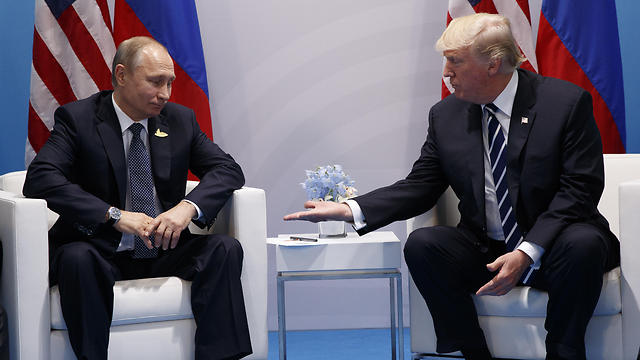
US President Donald Trump invited his Russian counterpart Vladimir Putin to the United States during a phone call, and said he would be glad to see Putin in the White House, RIA Novosti reported on Friday, citing the Russian Foreign Ministry.

The news agency quoted Foreign Minister Sergei Lavrov as saying Trump returned to the subject of an invitation a couple of times during a phone call with Putin. Trump told Putin he would be happy to make a reciprocal visit to Russia, the RIA news agency quoted Lavrov as saying.

President Trump with President Putin (Photo: AP)

President Trump with President Putin (Photo: AP)

“We proceed from the fact that the US president in a telephone conversation…made such an invitation, said he would be glad to see (Putin) in the White House, would then be glad to meet on a reciprocal visit,” said Lavrov, according to a transcript of an interview with RIA on the foreign ministry website.

“He returned to this topic a couple of times, so we let our American colleagues know that we do not want to impose, but we also do not want to be impolite, and that considering that President Trump made this proposal, we proceed from the position that he will make it concrete.”

Rolling out a welcome for Putin in the White House could anger Trump’s domestic critics, who accuse Russia of hostile acts against Western countries, including the United States.

“I would simply turn your attention to the fact that Donald Trump after this phone conversation has said several times in both Tweets and in words that it is necessary to resolve issues with Russia, we want to have good relations with Russia, this is better than not having good relations, and that only a fool thinks otherwise,” Lavrov said. “We also hear this.”

Trump and Putin spoke by phone on March 20.

Also on Friday, the RIA agency reported that Lavrov said that US military strikes on Syria last week removed any moral obligation Russia had to withhold S-300 anti-aircraft missile systems from its ally Syrian President Bashar al-Assad.

Lavrov was also quoted as saying that, prior to the US strikes on Syrian targets, Russia had told US officials which areas of Syria represented “red lines” for Moscow, and the US military action did not cross those lines.

He said that he was convinced Russian President Vladimir Putin and US President Donald Trump would not allow an armed confrontation between their two countries, RIA reported.

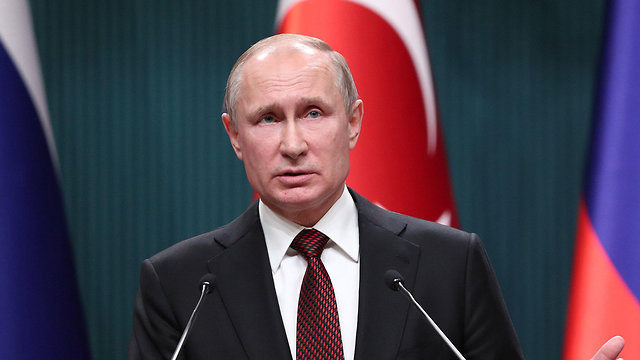
President Putin (Photo: EPA)

President Putin (Photo: EPA)

The developments take place as relations grow increasingly frosty between the US and Russia, with matters coming to a head after the US led a strike against military targets in Syria last Saturday in response for Assad’s use of chemical weapons that killed dozens of people.

President Trump praised the “perfectly executed strike” in Syria carried out by Washington and its Western allies early Saturday. The attack promted a scathing response from Moscow, which accused the US and its allies of “diplomatic hooliganism” for their “blatant disregard of international law.”

First published: 04.20.18, 10:11