Archive for April 2018

Congressmen Call for Disclosure of U.S. Aid to Palestinian Terrorists

April 25, 2018

Letter calls for suspension of aid to the Palestinians

Palestinian president Mahmud Abbas

Palestinian Authority President Mahmoud Abbas / Getty Images

BY:

Members of Congress hope to compel the State Department to disclose the amount of U.S. aid money the Palestinian Authority has given to convicted terrorists and their families, according to a congressional communication viewed by the Free Beacon that calls for a complete freeze in U.S. aid to the Palestinian government.

Reps. David McKinley (R., W.V.) and John Ratcliffe (R., Texas) are circulating a letter to Republican offices urging them to join an effort to compel the State Department to detail the amount of taxpayer money that has been used by the Palestinian government to pay terrorists under a longstanding policy known as “pay to slay.”

Following passage of the Taylor Force Act, which requires the Palestinian government to stop these payments or face a full cutoff in aid, the lawmakers are seeking to immediately freeze U.S. aid to the Palestinians until the State Department explains to lawmakers how it plans to enforce the new law.

The letter follows a recent Free Beacon report disclosing that the Palestinian Authority continues to spend U.S. aid dollars on terrorists. Palestinian officials have also made clear that they have no intention of following the new law and will continue to provide terrorists and their familiar with compensation.

“We urge you to immediately suspend all aid payments to the Palestinian Authority,” the lawmakers write, according to a copy of the letter viewed by the Free Beacon. “Further, we urge you to make the cessation of this abhorrent practice that incentivizes terrorism a pre-condition for any U.S.-brokered peace talks between the sovereign state of Israel and the Palestinian Authority.”

The lawmakers also demand the State Department outline in detail, “how many foreign aid dollars went to the PA that were then used to fund terrorists prior to passage of the Taylor Force Act?”

Lawmakers are additionally requesting information on what measures the administration is “planning to take to enforce the law and suspend aid to the PA, given the above statements and the content of their proposed budget?” according to the letter, which is addressed to secretary of state nominee Mike Pompeo.

The State Department is required to report to Congress this week on its implementation of the Taylor Force Act and explain what efforts it is taking to stop Palestinian payments to terrorists.

Asked about the state of play on Wednesday, a State Department official declined to provide information on the reporting requirement and further information showing the Palestinian government continues to provide salaries to terrorists.

Organizations tracking the Palestinian media recently disclosed that the PA is slated to spend at least eight percent of its 2018 budget on its so-called martyr’s fund. That figure amounts to about $355 million, according to Palestinian Media Watch.

Palestinian President Mahmoud Abbas, in a recent speech, outlined his intention to continue paying terrorists, a point highlighted by the lawmakers in their letter to Pompeo.

“There is something that the Americans are telling us to stop—the salaries of the martyrs and the martyrs’ families,” Abbas was quoted as saying. “Of course we categorically reject this. We will not under any circumstances allow anyone to harm the families of the prisoners, the wounded, and the martyrs. They are our children and they are our families. They honor us, and we will continue to pay them before the living.”

The lawmakers go on to request the Trump administration require the Palestinians to abandon this  practice as a pre-condition for peace talks with Israel.

Other members of Congress are lining up behind the effort as well. 

“Congress took a bipartisan and resolute stance in the budget deal last month: We will not continue to provide aid to the Palestinian Authority if they use those funds to pay terrorists and their families. These evil individuals seek to harm the United States and our ally Israel,” said McKinley. “We call on the State Department to cease aid payments to the Palestinian Authority until it can be confirmed that they have complied with this requirement.”

North Korea’s nuclear test site has collapsed … and that may be why Kim Jong-un suspended tests

April 25, 2018

PUBLISHED : Wednesday, 25 April, 2018 South China Morning Post

Source Link: North Korea’s nuclear test site has collapsed … and that may be why Kim Jong-un suspended tests

{Remember when the NORKS destroyed a reactor and pledged an end to their nuclear program? Remember seeing the Clinton’s and Madeleine Albright sipping champagne with Kim’s father with big smiles of accomplishment on their faces? Disgusting, wasn’t it. Well, not this time Rocket Boy. There’s a new sheriff in town. I suggest you don’t screw with him. He’s no Clinton. – LS}

North Korea’s mountain nuclear test site has collapsed, putting China and other nearby nations at unprecedented risk of radioactive exposure, two separate groups of Chinese scientists studying the issue have confirmed.

The collapse after five nuclear blasts may be why North Korean leader Kim Jong-un declared on Friday that he would freeze the hermit state’s nuclear and missile tests and shut down the site, one researcher said.

The last five of Pyongyang’s six nuclear tests have all been carried out under Mount Mantap at the Punggye-ri nuclear test site in North Korea’s northwest.

One group of researchers found that the most recent blast tore open a hole in the mountain, which then collapsed upon itself. A second group concluded that the breakdown created a “chimney” that could allow radioactive fallout from the blast zone below to rise into the air.

A research team led by Wen Lianxing, a geologist with the University of Science and Technology of China in Hefei, concluded that the collapse occurred following the detonation last autumn of North Korea’s most powerful thermal nuclear warhead in a tunnel about 700 metres (2,296 feet) below the mountain’s peak.

The test turned the mountain into fragile fragments, the researchers found.

The mountain’s collapse, and the prospect of radioactive exposure in the aftermath, confirms a series of exclusive reports by the South China Morning Post on China’s fears that Pyongyang’s latest nuclear test had caused a fallout leak.

Radioactive dust could escape through holes or cracks in the damaged mountain, the scientists said.

“It is necessary to continue monitoring possible leaks of radioactive materials caused by the collapse incident,” Wen’s team said in the statement.

The findings will be published on the website of the peer-reviewed journal, Geophysical Research Letters, likely next month.

North Korea saw the mountain as an ideal location for underground nuclear experiments because of its elevation – it stood more than 2,100 metres (6,888 feet) above sea level – and its terrain of thick, gentle slopes that seemed capable of resisting structural damage.

The mountain’s surface had shown no visible damage after four underground nuclear tests before 2017.

But the 100-kilotonne bomb that went off on September 3 vaporised surrounding rocks with unprecedented heat and opened a space that was up to 200 metres (656 feet) in diameter, according to a statement posted on the Wen team’s website on Monday.

As shock waves tore through and loosened more rocks, a large section of the mountain’s ridge, less than half a kilometre (0.3 mile) from the peak, slipped down into the empty pocket created by the blast, leaving a scar visible in satellite images.

Wen concluded that the mountain had collapsed after analysing data collected from nearly 2,000 seismic stations.

Three small earthquakes that hit nearby regions in the wake of the collapse added credence to his conclusion, suggesting the test site had lost its geological stability.

Another research team led by Liu Junqing at the Jilin Earthquake Agency with the China Earthquake Administration in Changchun reached similar conclusions to the Wen team.

The “rock collapse … was for the first time documented in North Korea’s test site,” Liu’s team wrote in a paper published last month in Geophysical Research Letters.

The breakdown not only took off part of the mountain’s summit but also created a “chimney” that could allow fallout to rise from the blast centre into the air, they said.

Zhao Lianfeng, a researcher with the Institute of Earth Science at the Chinese Academy of Sciences in Beijing, said the two studies supported a consensus among scientists that “the site was wrecked” beyond repair.

“Their findings are in agreement to our observations,” he said.

“Different teams using different data have come up with similar conclusions,” Zhao said. “The only difference was in some technical details. This is the best guess that can be made by the world outside.”

Speculation grew that North Korea’s site was in trouble when Lee Doh-sik, the top North Korean geologist, visited Zhao’s institute about two weeks after the test and met privately with senior Chinese government geologists.

Although the purpose of Lee’s visit was not disclosed, two days later Pyongyang announced it would no longer conduct land-based nuclear tests.

Hu Xingdou, a Beijing-based scholar who follows North Korea’s nuclear programme, said it was highly likely that Pyongyang had received a stark warning from Beijing.

“The test was not only destabilising the site but increasing the risk of eruption of the Changbai Mountain,” a large, active volcano at China-Korean border, said Hu, who asked that his university affiliation not be disclosed for this article because of the topic’s sensitivity.

The mountain’s collapse has likely dealt a huge blow to North Korea’s nuclear programme, Hu said.

Hit by crippling international economic sanctions over its nuclear ambitions, the country might lack sufficient resources to soon resume testing at a new site, he said.

“But there are other sites suitable for testing,” Hu said. “They must be closely monitored.”

Guo Qiuju, a Peking University professor who has belonged to a panel that has advised the Chinese government on emergency responses to radioactive hazards, said that if fallout escaped through cracks, it could be carried by wind over the Chinese border.

“So far we have not detected an abnormal increase of radioactivity levels,” Guo said. “But we will continue to monitor the surrounding region with a large [amount] of highly sensitive equipment and analyse the data in state-of-the-art laboratories.”

Zhao Guodong, a government nuclear waste confinement specialist at the University of South China, said that the North Korean government should allow scientists from China and other countries to enter the test site and evaluate the damage.

“We can put a thick layer of soil on top of the collapsed site, fill the cracks with special cement, or remove the pollutants with chemical solution,” he said.

“There are many methods to deal with the problem. All they need [to do] is ask.”

Iran’s navy commander threatens to sink US ships

April 25, 2018

Admiral Ali Fadavi says Americans will land in a ‘catastrophic situation,’ amid escalating rhetoric over endangered nuclear deal

Today, 9:14 am

https://www.timesofisrael.com/irans-navy-commander-threatens-to-sink-us-ships/

Commander of the Islamic Revolution Guards Corps (IRGC) Navy Rear Admiral Ali Fadavi. (Fars)

A top Iranian general has threatened to sink the United States Navy’s ships, warning that the US would find itself in a “catastrophic situation” amid an ongoing war of words between the countries over the possibility President Donald Trump’s could exit a landmark nuclear deal.

“The actual information that the Americans have about us is much less than what they think they have. When will they figure this out? When it is too late,” the Revolutionary Guard Corps’s navy commander, Admiral Ali Fadavim, told Iranian television on Saturday.

“They will definitely figure it out when their ships are sunk, or when they find themselves in a catastrophic situation,” Fadavi threatened in an interview with IRINN TV, according to a translation by the Middle East Media Research Institute.

Trump is threatening to tear up the 2015 agreement aimed at curbing nuclear efforts unless European capitals agree to supplement it with tougher controls on Tehran’s missile program and future ability to return to nuclear fuel enrichment.

Iran’s President Hassan Rouhani on Tuesday warned the US that it would face serious consequences should it pull out of the deal, which Washington says falls short of preventing Iran from producing atomic weapons.

“I am telling those in the White House that if they do not live up to their commitments, the Iranian government will react firmly,” Rouhani said in a speech broadcast live on state television, according to Reuters.

“If anyone betrays the deal, they should know that they would face severe consequences,” he added.

Iranian Foreign Minister Mohammad Javad Zarif gives a speech during the Munich Security Conference on February 18, 2018 in Munich, southern Germany. (AFP PHOTO / Thomas KIENZLE)

Iran has been upping the rhetoric, with Foreign Minister Mohammad Javad Zarif warning Saturday that Tehran was ready to “vigorously” resume uranium enrichment if the US ditched the accord.

Zarif told reporters in New York that Iran is not seeking to acquire a nuclear bomb, but that its “probable” response to a US withdrawal would be to restart production of enriched uranium – a key bomb-making ingredient.

Other Iranian officials have threatened withdrawal from the Treaty on the Non-Proliferation of Nuclear Weapons.

Trump has set a May 12 deadline for the Europeans to “fix” the agreement, which provided for curbs to Iran’s nuclear program in exchange for relief from financial sanctions.

On Monday Russian Foreign Minister Sergey Lavrov said that he had agreed with his Chinese counterpart that the two countries would “obstruct” any attempt by Trump to “sabotage” the deal.

Iran Threatens to Withdraw from Nuclear Non-Proliferation Treaty

April 25, 2018

by Adelle Nazarian24 Apr 2018

http://www.breitbart.com/national-security/2018/04/24/iran-threatens-withdraw-nuclear-non-proliferation-treaty/

AFP/ASIF HASSAN

A senior Iranian official said on Tuesday that Tehran may withdraw from the nuclear non-proliferation treaty (NPT) if President Donald Trump scraps the Joint Comprehensive Plan of Action (JCPOA), or Iran nuclear deal.

Iran has been party to the NPT since 1970.

“This is one of three options that we are considering,” Ali Shamkhani, the secretary of Iran’s Supreme National Security Council, said about the possibility that Iran will withdraw from the NPT if Trump dismantles the nuclear Iran deal. According to Reuters, Shamkhani made the statement during a news conference broadcast on state television and also stated that the Atomic Energy Organization of Iran was ready for some “surprising actions” if the nuclear deal was scrapped.

Also on Tuesday, Iran’s President Hassan Rouhani reportedly warned Trump that there would be “severe consequences” if he “betrays the deal.”

advertisement

“If anyone betrays the deal, they should know that they would face severe consequences,” Rouhani said in Tabriz. He reportedly added, “Iran is prepared for all possible situations” and said, “I am telling those in the White House that if they do not live up to their commitments … the Iranian government will firmly react.”

Last week, Iran’s Foreign Minister Mohammad Javad Zarif threatened that the United States would face an “unpleasant” response if Washington decides to pull out of the Iran nuclear deal saying, “Definitely, the measure that the Islamic Republic would take and the reaction that the international community would show to the US move would be very unpleasant to the Americans.”

French President Emmanuel Macron arrived in Washington, DC, on Monday in a last-ditch attempt to keep America in the JCPOA.

During his joint press conference with the leader of the free world, Macron said it was time to work on a new Iran deal, saying, “I can say that we have had very frank discussions on that, just the two of us. We, therefore, wish from now on to work on a new deal with Iran.”

During the press conference, Trump warned Iran against restarting its nuclear program. “You’ll find out about that. It won’t be so easy for them to restart. They’re not going to be restarting anything. They restart it, they’re going to have big problems, bigger than they’ve ever had before,” Trump said.

Israel, US concerned by recent Iranian cargo flights to Syria — report

April 25, 2018

Source: Israel, US concerned by recent Iranian cargo flights to Syria — report | The Times of Israel

Officials said to fear the planes are transporting weapons which could be used to attack Israel

Technicians prepare Ilyushin Il-76TD long-haul cargo aircrafts for the upcoming MAKS-2015, the International Aviation and Space Show, in Zhukovsky, outside Moscow, on August 21, 2015. (AFP/KIRILL KUDRYAVTSEV)

Technicians prepare Ilyushin Il-76TD long-haul cargo aircrafts for the upcoming MAKS-2015, the International Aviation and Space Show, in Zhukovsky, outside Moscow, on August 21, 2015. (AFP/KIRILL KUDRYAVTSEV)

US and Israeli intelligence officials are concerned over a number of cargo flights that have flown from Iran to Syria in recent weeks, CNN reportedon Wednesday.

A US administration official confirmed to the network that the US and Israel fear the planes are being used to transport weapons for troops loyal to Syrian President Bashar Assad or Iranian forces operating in the country, which could then be used to attack Israel.

Although there have been shipments from Iran to Syria in the past, these recent flights were said to have been noted as they arrived in the wake of the April 13 US-led strikes on Syrian military targets in response to an alleged chemical gas attack on the town of Douma that killed dozens.

A Twitter account tracking air traffic around the world recently published details of at least two Syrian Air Force IL-76 cargo flights between Iran and Syria, and the US official told CNN that other flights including at least one Iranian cargo plane have also been monitored by intelligence services.

The news network also reported concerns that the transports were replenishing anti-aircraft missiles depleted when Syria targeted Israeli jets carrying out a raid in February.

Israel carried out strikes on targets in Syria after an explosives-laden drone was flown into Israeli airspace on February 10. The Israeli military said at the time that between one-third and one-half of Syria’s air defenses were destroyed during the strikes.

During a Syrian counterattack against the Israeli jets, one F-16 was hit by anti-aircraft fire and crashed in a field in northern Israel after the pilot and navigator ejected from it.

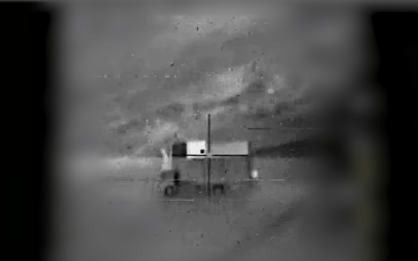
The mobile command center from which Israel says an Iranian operator flew a drone from Syria into Israeli airspace on February 10, 2018. (Israel Defense Forces)

Western officials have accused Iran of using seemingly civilian airlines as fronts for the Iranian Revolutionary Guard Corps to conduct military transport missions to Syria from Tehran’s Mehrabad Airport.

Pouya Airlines, for instance, was subjected to US sanctions in 2014 for “transporting illicit cargo, including weapons, to Iran’s clients in the Levant,” according to the US Treasury Department.

Over time, the IRGC began setting up its own facilities on Syrian military bases and air fields.

Reported Iranian attempts to bring advanced weaponry into Syria come at a time of unprecedented tension between Jerusalem and Tehran, including mutual threats of attack. Most recently, Iran has vowed revenge over an airstrike on the T-4 airbase in Syria in April that was said to have killed several Iranian military figures and has widely been blamed on Israel, which has not confirmed it was behind it.

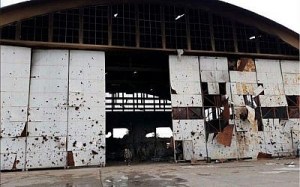
A photo released by Iranian media reportedly shows the T-4 air base in central Syria after a missile barrage April 16, 2018. (Iranian media)

The secretary of Iran’s Supreme National Security Council said Tuesday that Tehran “will choose the time and place” to mete out its “inevitable” response for the strike on the T-4 base.

“The entity that gives itself the right to attack the sovereignty of another country and to target forces fighting terrorism must certainly have thought about the results and consequences of that attack and the corresponding reaction,” Ali Shamkhani told reporters.

Shamkhani’s words came days after the IDF released a map showing five Iranian-controlled bases in Syria that would apparently constitute potential targets for an Israeli response should Iran carry out any kind of attack.

Iran has access to a variety of surface-to-surface missiles, from short-range Fajr-5 rockets to medium-range Fateh 110 missiles, which have a range of approximately 300 kilometers (190 miles) to long-range Shehab ballistic missiles capable of hitting targets over 1,300 kilometers (800 miles) away.

To counter those threats, Israel has a multi-tiered missile defense system consisting of the Iron Dome for short-range rockets and mortar shells, the David’s Sling for medium-range missiles and the Arrow for long-range ballistic missiles.

Judah Ari Gross contributed to this report

Iran says will punish Israel for alleged air strike in Syria – Middle East 

April 25, 2018

Source: Iran says will punish Israel for alleged air strike in Syria – Middle East – Jerusalem Post

However, the timing and other specifics were unclear as of yet.

BY JULIANE HELMHOLD
 APRIL 25, 2018 10:36
Iran missile

 A ballistic missile is launched and tested in an undisclosed location, Iran, March 9, 2016. . (photo credit: REUTERS)

The secretary of Iran’s Supreme National Security Council Ali Shamkhani said on Tuesday that the Islamic Republic will definitely punish Israel for the air strike on the Syrian T-4 airbase near Homs, in which several Iranian officers were killed, Iranian affiliated PressTV boadcasting agency reported.

“The Israeli regime’s aggression against Syria is a breach of this country’s national sovereignty and territorial integrity and runs counter to all international regulations and principles,” he said in a news conference which was broadcast on state television.

“When a regime assumes the right to violate another country’s airspace in a planned move and also to target forces fighting with terrorism, it should have definitely considered its consequences and retaliatory reactions before,” Shamkhani emphasized.

However, the timing and other specifics were unclear as of yet, the secretary of the Supreme National Security Council added. “The punitive measures of the Islamic Republic of Iran are definite but when, how and under what circumstances this will happen is in the hands of the Islamic Republic of Iran.”

Reiterating the Iranian regime’s stance that through its actions it is pursuing peace and stability in the region, Shamkhani added that “The Islamic Republic of Iran has paid a considerable price in order to establish regional stability and fight against Takfiri [inter-Muslim] terrorism. Therefore, it cannot remain indifferent to the worrying increase of destabilizing measures by the US, the Zionist regime [Israel] and some of their regional allies.”

Tensions between the Islamic Republic and Israel started rising after the infiltration of an armed Iranian drone into northern Israel in February and the April 9 air strike on a Syrian T-4 airbase that killed seven Iranian Revolutionary Guards Corps (IRGC) members, something that Israel has not confirmed or denied but was blamed for by Iran as well as Russia.

Rhetoric has been riding high in this latest spar between Israel and the Islamic Republic. Last Friday, when speaking at a festive cabinet meeting honoring Independence Day, Prime Minister Benjamin Netanyahu said that anyone who harms Israel will pay a heavy price.

“We hear the threats from Iran, and the IDF and security forces are prepared for every possible Iranian move. We will fight whoever tries to harm us. We will not shy away from action against those who threaten our security. They will pay a heavy price.”

Israel last week also released details about what it described as an Iranian “air force” deployed in neighboring Syria, including civilian planes suspected of transferring arms, a signal that these could be attacked should tensions with Tehran escalate.

Hossein Salami, second-in-command of Iran’s Revolutionary Guard, immediately responded by saying: “Do not trust your airbases, they are within the range of fire. Our fingers are on the trigger and the missiles are ready to launch. The moment the enemy decides to act against us, we will launch them. We have learned ways to overcome our enemies, and we can harm the enemy’s vital interests anywhere we want.”

Reuters contributed to this report.

The shadow war between Israel and Iran takes center stage

April 25, 2018

By Ishaan Tharoor April 24 at 12:59 AM Washington Post

Source Link: The shadow war between Israel and Iran takes center stage

{My bet is Iran’s failing economy will curve the Mullahs’ wreckless desire for all out war with big and little satan.  Besides, Trump is fixing to tighten the thumbscrews of sanctions. – LS}

The rumblings of an open conflict between Israel and Iran in Syria are growing louder. When President Trump launched yet another one-off missile salvo against the Syrian regime, it came on the heels of a suspected April 9 Israeli strike on an Iranian facility at a Syrian air base, which drew howls of condemnation from the regime’s patrons in Moscow and Tehran.

Though Israel didn’t acknowledge responsibility for the attack, it fit a familiar pattern. Since 2012, the Israelis are believed to have launched more than 100 strikes on suspected Iranian-linked positions in Syria. Israeli officials privately argue that these measures are necessary to prevent a permanent Iranian threat on their borders and stymie the flow of weaponry to Iran’s Lebanese proxy, Hezbollah.

“No matter the price, we will not allow a noose to form around us,” Israeli Defense Minister Avigdor Lieberman told Israel Radio over the weekend. But he cautioned against talk of outright hostilities. “I hope not,” he said when asked whether war was imminent. “I think that our primary role is to prevent war, and that requires concrete, real deterrence as well as readiness to act.”

Iran’s Foreign Minister Mohammad Javad Zarif made similar appeals for calm in a Sunday interview with CBS News, though he accused the Israelis of escalating “tension by violating Syrian airspace.”

“I do not believe that we are headed towards regional war. But I do believe that, unfortunately, Israel has continued its violations with international law, hoping to be able to do it with impunity because of the U.S. support and trying to find smokescreens to hide behind,” Zarif said.

Still, Zarif warned that Israel was playing a risky game. “They should expect that if they continue to violate territorial integrity of other states, there’ll be consequences,” he said. “The easiest answer would be to stop — to stop these acts of aggression, to stop these incursions.”

But the Israelis have made clear that an entrenched Iranian presence in Syria marks a new red line. They point to the new threat of Iranian drones, potentially armed with explosives, entering Israeli airspace, as well as the old threat of rockets launched from southern Lebanon. The April 9 strike, according to one account, was Israel’s first direct attack on Iranian equipment and personnel and killed a senior Iranian drone commander.

Last week, the Israeli military leaked details and satellite images of the existence of an Iranian “air force” in Syria, including civilian planes they claimed were ferrying shipments of arms. The leak was supposed to signal to the Iranian Revolutionary Guard, the powerful military organization that dominates Iran’s foreign policy decisions, that Israel had new targets already in sight should the Iranians or their proxies attack.

From the Iranian perspective, their presence in Syria is a legitimate defense of their beleaguered ally, Syrian President Bashar al-Assad. And they see their capacity to threaten Israel from next door as a potential deterrent against a long-standing regional foe.

“Israeli leaders frequently threaten to bomb Iran, so having strong military proxies near Israel’s borders gives Iran some protection,” wrote Ben Hubbard and David Halbfinger of the New York Times. “If Israel attacks Iran, the thinking goes, it knows it can expect a painful response from Hezbollah in Lebanon, and perhaps from other militias now operating in Syria.”

The deepening tensions come at a time of growing discontent within the Islamic Republic. A tanking economy has blown the lid on popular frustration with the regime and even prompted Zarif’s putative boss, President Hassan Rouhani, to complain about the costly war effort in Syria. But the prospect of broader confrontation with Israel — and the likely upcoming drama over Iran’s nuclear deal with world powers — may persuade regime hard-liners that now is the time to circle the wagons.

“The shadow war has come to light after the decision by the Iranian leadership to proceed with the IRGC’s plans to establish permanent bases in Syria. This was not a unanimous decision,” wrote Anshel Pfeffer in the Times of London. “The faction in Tehran led by the country’s president, Hassan Rouhani, is in favor of investing in Iran’s domestic economy the huge amounts of money these bases will cost. But the IRGC has the ear of the nation’s supreme leader, Ali Khamenei, and it is keen to capitalize on the investment it has made in propping up the Assad regime for the past seven years.”

The way forward is treacherous. “Iran is determined to entrench its positions in Syria, and Israel is determined to prevent them,” said Amos Yadlin, a former commander of Israeli military intelligence, to Pfeffer.

He suggested that Russia, whose forces help prop up the regime’s air defenses and whose diplomats are key interlocutors to both the Iranians and the Israelis, will play a critical role. “Conflict is inevitable unless Putin steps in to prevent it,” Yadlin said. But recent events suggest that the Russians have limited influence over Iran and are more concerned about reinforcing the Syrian regime.

At the same time, some foreign policy figures in Washington seem keen on letting Israel continue its covert campaign against the Iranians. They see Israeli strikes as necessary at a time when President Trump wants to disengage from the Syrian conflict and outsource the stabilization of the country to Iran’s Sunni Arab rivals.

But other experts contend that this does not amount to a real strategy. “There is a pathway to containing and deterring Iran in Syria … but it requires more than just Israel’s itchy trigger finger and cheerleading from the sidelines by Arab autocracies,” wrote Suzanne Maloney of the Brookings Institution, who argued for more robust diplomatic engagement from the Trump administration and cautioned against alienating allies by pulling out of the nuclear deal.

In February, the International Crisis Group issued a report warning that the current atmosphere of tensions made “miscalculation more likely” in Syria. Since then, the risks of an escalation have only intensified.

Palestinians Furious US Won’t Call Judea, Samaria ‘Occupied’

April 25, 2018

The State Department ceased using the term “occupied” in references to Judea and Samaria, sparking Palestinian anger. 

Apr 24, 2018

By: United with Israel Staff

https://unitedwithisrael.org

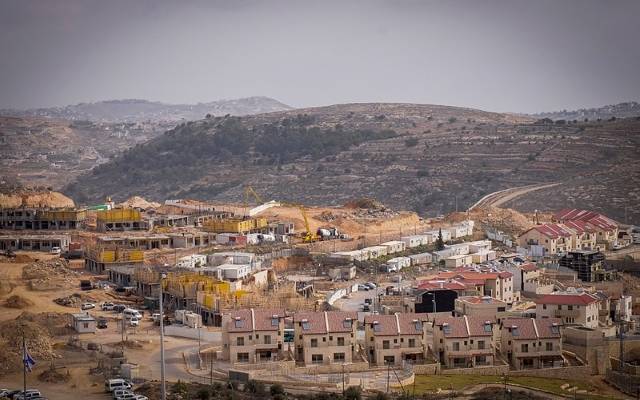
Construction in Efrat, Judea. (Gershon Elinson/Flash90)

The Palestinian Ministry of Foreign Affairs on Monday condemned the US State Department for dropping the term “occupied  territories” when referring to the Judea and Samaria region in its annual human rights report.

The ministry said in a statement that “this act is another one in a long list of US actions and policies targeting Palestine and the Palestinian people”.

“The current administration of US President Donald Trump has abandoned its respect for international law and has actually taken steps that violate this law by implementing illegitimate and illegal positions on Palestine and the Palestinian-Israeli conflict,” the Palestinians charged.

“The American administration is not only biased towards Israel, but fully embraces its illegal policies to a point they have become part of US ideology and policies,” said the Foreign Ministry.

The Palestinians stressed, however, that by dropping the term “occupied territories” from the US State Department report, “it does not in any way mean anything and does not eliminate the concept of occupied territory according to international law and international legality, but it reveals to the world once again the reality of the US positions, especially for those who refuse to see them as they are.”

In it latest annual report on human rights,  the State Department did not use the controversial term “occupied” in references to various territories in and adjacent to Israel.

Israel liberated Judea and Samaria and unified Jerusalem in the 1967 Six Day War. Israel has since annexed those liberated parts of Jerusalem.

While the term “occupied” had been used in such reports since the Carter administration, the 2017 version drops this term, which is generally used pejoratively to criticize Israeli policy following military victories through which the Jewish state acquired control of various territories.

The change comes after US Ambassador to Israel David Friedman advised the department in December to stop using the “misleading” term “occupied” in references to Judea and Samaria.

The term “occupied” is considered by many to be a loaded phrase intended to demonize Israel with regard to its activities in disputed areas.

In response to the State Department’s change in terminology, Israel’s Defense Minister Avigdor Liberman tweeted over the weekend, “the lie of the occupied Palestinian territories begins to be revealed. They say that a lie repeated often enough becomes true, but the truth is forever stronger. The State Department report is proof of that.”

US and France to demand ‘new deal’ from Iran

April 25, 2018

April 24, 2018

World Israel News – Latest News from Israel

The presidents of the US and France announced their commitment to correct flaws in the current nuclear agreement with Iran.

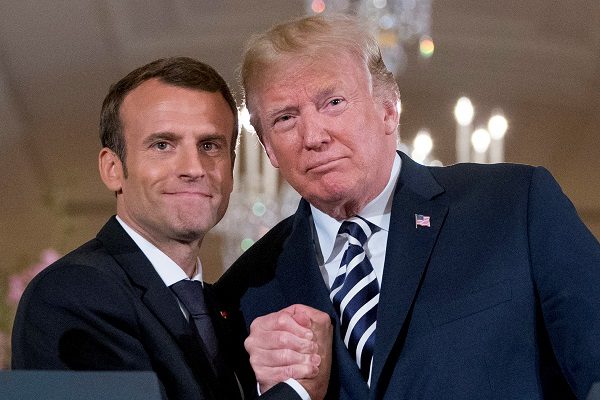
President Donald Trump and French President Emmanuel Macron. (AP Photo/Andrew Harnik

By: World Israel News Staff

At a press conference in Washington with US President Donald Trump by his side, French President Emmanuel Macron issued a joint call for a new direction in the multi-national nuclear agreement with Iran.

After “very frank discussions” between the two leaders, Macron announced that the US and France would “from now on … work on a new deal with Iran,” reported AFP.

“I think we will have a great shot at doing a much bigger, maybe, deal,” declared Trump at the press conference on Tuesday. The president reiterated that the current agreement is “a bad deal, a bad structure.”

According to Macron, the revised agreement would address not only Iran’s nuclear ambitions, but also Tehran’s ballistic missile program, its influence throughout the Middle East, and post-2025 activity.

While Trump has repeatedly threatened to walk away from the 2015 deal, under which Iran enjoyed relief from crippling sanctions and was guaranteed a civilian nuclear program, European powers have urged the US to stay in the deal.

May 12 represents the next deadline for Trump to decide whether to demand changes to the deal by refusing to re-certify it, a step that European powers claim would be a breach of the agreement.

In response to potential challenges from the US, Tehran continues to threaten to accelerate enrichment activities. The Islamic Republic has also become increasingly belligerent in Syria, posing an imminent threat on Israel’s border with its war-torn neighbor.

Trump took the opportunity on Tuesday to respond to Iran’s most recent threats, warning, “They’re not going to be restarting anything. If they restart it, they’re going to have big problems, bigger than they ever had before. And you can mark it down.”


Is Israel-Iran clash imminent?

April 24, 2018

Al-Monitor

Source Link: Is Israel-Iran clash imminent?

{A sustained war with Israel would drain an already faltering Iranian economy and I suspect they know it. – LS}

Senior members of the Israeli security establishment are predicting that the month of May will be one of the most volatile periods in the current era. Maj. Gen. (Res.) Amos Yadlin, the former head of the Israel Defense Forces (IDF) Military Intelligence Directorate, said in an interview published April 22, “I have not seen a May this dangerous since May 1967.”

Of particular note, two of the five military fronts concerning Israel have rapidly escalated in recent months. In the campaign against Iran being waged in Syria, the two sides have inched closer to an unprecedented tipping point. The situation in Gaza has worsened, with mass marches and protests held at the border fence every Friday for the past four weeks, in addition to the ongoing humanitarian crisis in the enclave.

The odds for an all-out war between Israel and its opponents this summer are no longer miniscule. As I wrote April 18 in Al-Monitor, Defense Minister Avigdor Liberman said at a Cabinet meeting that it is possible that war will, indeed, erupt, and if so, Israel will have to cope with Iran, Syria, Hezbollah and the Lebanese army as well as Hamas, Palestinian Islamic Jihad and Salafist groups in Gaza.

Many Israeli legislators are worried, because for the first time in a long time, consensus exists among Israel’s top brass about the situation and how to deal with it. There are no dissenting or minority opinions on the subject, no moderate voices warning against escalation and the possible results. It reminds some of Israel’s statesmen of the heady days between the 1967 war and before the eruption of the 1973 Yom Kippur war, which resulted in one of Israel’s greatest military catastrophes.

“The fact is that the entire military elite, the prime minister and the defense minister, all the Cabinet ministers, and almost all members of the opposition — even almost all of the media — are united behind the government’s policy,” said one source to Al-Monitor who served in several senior ministerial positions and requested anonymity. “This [unity] arouses my suspicions. It creates an unhealthy situation in which the prime minister and ministers do not stop for a minute to ask themselves, ‘Is this scenario truly unavoidable? Do we have an iron-clad reason to embroil ourselves in a war that might cause thousands of deaths on the Israeli home front as well?’”

An examination of Israel’s strategic situation shows the current period to be ripe in terms of a possible confrontation with Iran. Syrian President Bashar al-Assad is busy trying to survive and therefore would have no intention of taking an active part in such a conflict. Hezbollah, meanwhile, wants to retain its arsenal of rockets and missiles for “Judgement Day,” and therefore is distancing itself from possible conflict. Thus, assuming Iran has to face Israel alone, this scenario would be a golden, one-off opportunity for Israel to create new rules of the game and secure its redlines in Syria — that is, it will not tolerate an Iranian presence in Syria, period.

Such is the current thinking of Israel’s leadership. The problem is that in the case of a serious flare-up, basic working assumptions can vanish into thin air with the launching of hundreds or thousands of missiles from both sides.

In the last few days, Israel and Iran have found themselves fighting a war of words. Hossein Salami, the vice commander of Iran’s Islamic Revolutionary Guard Corps (IRGC), threatened Israel with annihilation, claiming that all of Israel’s air force bases would be destroyed if a confrontation erupts. Meanwhile Prime Minister Benjamin Netanyahu retorted with equally harsh threats. Iranian Foreign Minister Mohammad Javad Zarif assumed the role of the responsible adult, dismissing a “regional war.” He also stated, however, “If they [Israel] continue to violate [the] territorial integrity of other states, there’ll be consequences.”

Israel views Gen. Qasem Soleimani, the head of the IRGC’s elite Quds Force, as the “head of the snake,” the man behind Iranian efforts to put Israel in a stranglehold. Soleimani leads the aggressive faction surrounding Iranian Supreme Leader Ayatollah Ali Khamenei, while President Hassan Rouhani and his people share more moderate views and oppose Iran’s increasing involvement in Syria and the efforts expended to “export the revolution.”

According to intelligence that reached the West, Soleimani was behind the Iranian decision to disclose that seven IRGC members were killed in the April 8 assault attributed to Israel on the T4 air base near Homs. The names of the guards were released, and mass public funerals were held. Western intelligence sources believe that this was an attempt by Soleimani to force the Iranian leadership, mainly Rouhani, into acting against Israel and support a harsh military reprisal, for which Israel is waiting.

According to some assessments, Iran will try to retaliate using an Israeli approach: hitting a military base, inflicting losses on soldiers, but not targeting civilians. It is believed that the strike will be carried out from Syrian territory against a military target in northern Israel. The IDF is preparing for such a scenario, but what will Israel’s political echelon do after the Iranian reprisal? Will it decide to “contain” it and forgo retaliation? Undertake a symbolic reprisal or launch an aggressive assault to eliminate additional Iranian targets on Syrian territory? This last option might serve to turn the entire northern front into one big conflagration.

All eyes are focused on two triumvirates: Khamenei, Rouhani and Soleimani in Iran and Netanyahu, Liberman and IDF Chief of Staff Gen. Gadi Eizenkot in Israel. For the first time in ages, both sides are not certain they want to avoid a confrontation at all costs.

Netanyahu might well use the heating up on the northern front to neutralize or delay his trials and tribulations on the legal-criminal front. According to one scenario, he could try to assemble an emergency government by asking the opposition, led by Isaac Herzog in the Knesset and including the Zionist Camp (led by Avi Gabbay, chair of the Labor Party) and Yesh Atid (led by Yair Lapid), to join. This would enable him to appear as the nation’s leader in a time of crisis and downplay the police investigations tightening around him.

The chances that such a scenario will play out are not as low as they used to be. The closer the decisive moment gets, the more and brighter the warning lights. The traditional restraining elements in Israeli politics have been weakened, the consensus in Israel is worrisome and the slope is more slippery than ever. To this, one should add revelations in the April 23 edition of the Russian newspaper Kommersant, according to which Russia plans to supply Syria with an S-300 aerial defense system in the near future, free of charge. These revelations might generate a preventive Israeli strike, which could not only ignite that arena, but also drag Russia deeper into it.