Archive for April 2018

US concerned by destabilising and malign activities’ of Iran, says Mike Pompeo after meeting Benjamin Netanyahu

April 30, 2018

Source: US concerned by destabilising and malign activities’ of Iran, says Mike Pompeo after meeting Benjamin Netanyahu

Tel Aviv: The United States is deeply concerned by Iran’s “destabilising and malign activities”, new Secretary of State Mike Pompeo said after meeting Israeli prime minister Benjamin Netanyahu on Sunday.

Pompeo was speaking on a flying visit to the region, where he had earlier met with Saudi King Salman in Riyadh and stressed the need for unity among Gulf allies as Washington aims to muster support for new sanctions against Iran.
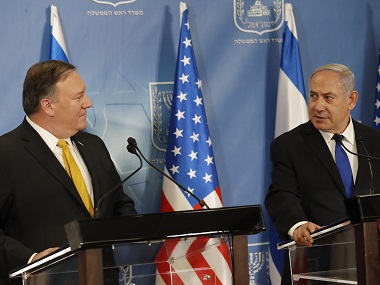
US Secretary of State Mike Pompeo and Israeli prime minister Benjamin Netanyahu during a press conference. AP

US Secretary of State Mike Pompeo and Israeli prime minister Benjamin Netanyahu during a press conference. AP

The whirlwind trip to NATO in Brussels and to West Asia allies came only hours after Pompeo was confirmed as Trump’s top diplomat. He has not even visited his own office yet, he told Netanyahu.

Speaking alongside the Israeli leader, Pompeo said in Tel Aviv: “We remain deeply concerned about Iran’s dangerous escalation of threats towards Israel and the region.”

He added: “Strong cooperation with close allies like (Israel) is critical to our efforts to counter Iran’s destabilising and malign activities through West Asia, and indeed, throughout the world.”

Pompeo also said that the relocation of the American embassy to Jerusalem, a move set to take place on 14 May, was “recognising (the) reality” of “Jerusalem as the capital of Israel and the seat of its government.”

Netanyahu echoed Pompeo’s focus on Iran, stressing the closeness of US and Israeli cooperation on the issue.

“I think the greatest threat to the world and to our two countries, and to all countries, is the marriage of militant Islam with nuclear weapons, and specifically the attempt of Iran to acquire nuclear weapons. We have had a very productive talk on this subject,” he said.

In Saudi Arabia earlier, Pompeo said that the US would abandon the 2015 nuclear deal with Iran, reached under President Donald Trump’s predecessor, unless talks with European partners yield improvements to ensure the Islamic Republic never possesses nuclear weapons.

“Iran destabilises this entire region. It supports proxy militias and terrorist groups. It is an arms dealer to the Houthi rebels in Yemen. It supports the murderous Assad regime (in Syria) as well,” he said in joint remarks with Saudi foreign minister Adel al-Jubeir.

“Gulf unity is necessary and we need to achieve it.”

Pompeo also addressed the rift between Qatar and its neighbours, telling reporters after leaving Riyadh: “We are hopeful that they will, in their own way, figure out how to remove the dispute between them.”

Saudi Arabia, along with the United Arab Emirates, Bahrain and Egypt, cut off travel and trade ties with Qatar last June, accusing it of supporting terrorism and Iran.

Doha has denied the accusations and has said its three fellow Gulf countries aim to curtail its sovereignty. Iran denies supporting terrorism or having sought to develop nuclear weapons.

The United States, which has military bases in both Qatar and some of the countries lined up against it, is trying to mediate the Qatar feud. Trump publicly sided with the Saudis and Emiratis early in the crisis, but is now pushing for a resolution to maintain a united front against Iran.

Yemen’s armed Iranian-aligned Houthi movement has fired over 100 missiles into Saudi Arabia, the latest salvo killing a man on Saturday in the southern Saudi province of Jizan.

The United States and the Saudi-led coalition that intervened in Yemen’s civil war in 2015 accuse Iran of providing the missiles to its Houthi allies, which Tehran denies.

Nuclear deal

Pompeo’s trip comes as Trump considers whether or not to abandon a self-imposed 12 May deadline for the Iran nuclear deal he sees as deeply flawed.

He has called on Gulf allies to contribute funding and troops to stabilise areas in Iraq and Syria where a US-led coalition has largely defeated Islamic State jihadists.

Earlier this month, Jubeir said Saudi Arabia would be prepared to send troops into Syria under the US-led coalition if a decision is taken to widen it.

Asked about Saudi troops on the ground in Syria, Pompeo said: “We will sit down and talk about… how to best make sure that this is not America alone working on this, it’s the Gulf states working alongside us.”

On Wednesday, Iranian president Hassan Rouhani waved aside US and European discussions over changes to the nuclear accord and dismissed Trump as a “tradesman” who lacked the qualifications to deal with a complex international pact.

“We’ve certainly made some (progress with the Europeans),” Pompeo said on Sunday. “There is still work to do. They said, ‘Great, we will support you if you get the fixes’.”

Britain said on Sunday that it, France and Germany – the other signatories to the 2015 Iran deal along with Russia, China and the European Union – agreed that the accord was the best way of stopping Tehran from gaining nuclear weapons.

“(We) committed to continue working closely together and with the US on how to tackle the range of challenges that Iran poses – including those issues that a new deal might cover,” a statement from British prime minister Theresa May’s office said.

The 2015 agreement limited Iran’s enrichment of uranium for nuclear fuel to help ensure it could not be turned to developing bomb material, and Tehran secured a removal of most international sanctions in return.

Iran has repeatedly said its ballistic missile programme has nothing to do with its nuclear work and is non-negotiable.

Trump sees three defects in the deal: a failure to address Iranian ballistic missiles; the terms under which UN inspectors can visit allegedly suspect Iranian nuclear sites; and “sunset” clauses under which key limits on the Iranian nuclear programme start to expire after 10 years.

Pompeo’s thumbs up for Israel to counter Russian-backed Iranian drive in Syria

April 30, 2018

Source: Pompeo’s thumbs up for Israel to counter Russian-backed Iranian drive in Syria – DEBKAfile

 As US Secretary of State Mike Pompeo and Prime Minister Binyamin Netanyahu sat down on Sunday, April 29 in Tel Aviv to discuss the Iranian threat, a Russian-backed Syrian force struck across the Euphrates to capture a string of US-backed fortified Kurdish SDF villages. This incursion of a key US area of influence region in eastern Syria, if confirmed, would rip up a key element of the US-Russian de-confliction zones accord and provide Iran with a springboard for a leap up to the Iraqi border.

Pompeo, on his first Middle East Trip as Secretary of State, reiterated in Tel Aviv – as he did in Riyadh earlier Sunday – that the nuclear deal will need to be fixed or it would be abandoned by President Donald Trump’s on May 12. Standing alongside Netanyahu, the secretary backed Israeli efforts to counter Iran in Syria. He said the US is committed to “rolling back to the full range of Iranian malign influence in Syria,” specifically mentioning “Iran’s missile systems, its support for Hezbollah, its importation of thousands of Shiite fighters into Syria.” Pompeo added, “We strongly support Israel’s sovereign right to defend itself.”

DEBKAfile: This was taken as a US green light for Israel to take on the elements threatening its security from Syria. The secretary also stressed that the US would continue to fight ISIS and not tolerate the Assad regime using chemical weapons.
Our military sources add: If the Syrian push into the US-held region is confirmed, it will tell the Trump administration and its new secretary of state that while they were busy arranging for US troops to leave Syria, Moscow was expanding its support for Iran to move in and deepen presence in that country.

Russia, Iran and Syria were not deterred when their attempt last year to cross the Euphrates was repulsed by the US contingent with heavy casualties inflicted on Russian forces. The same coalition tried again on February 10 and were again thrown back by the US air force. But our military sources report that, on April 13-14, shortly before the US-UK-French missile strike on Syria’s chemical weapons sites, Russian forces were seen transferring to the Syrian army upgraded bridging equipment for their new attempt on Sunday. A few hours after the Syrian army’s claims of success, however, Kurdish troops said they had mounted a counter-offensive and forced the Syrian forces “far away” from the territories they captured.

Pompeo winds up his three-day Middle East tour in Amman before returning home to Washington.

Claim That Iran Is Complying With The Nuke Deal Is A Lie

April 30, 2018

by Jeff Dunetz | Apr 29, 2018 via The Lid

Source Link: Claim That Iran Is Complying With The Nuke Deal Is A Lie

{No inspections are being made under the current agreement? What a joke!! – LS}

Between now and May 12th President Trump will announce his decision as to whether or not he will pull out of the JCPOA, the Nuclear deal with Iran. This reporter’s prediction is that the President will announce the United States will be leaving the Iran deal. His May announcement isn’t really the big one, two months later in July the U.S. will decide July whether or not to reimpose the American imposed sanctions with the terrorist regime and if the decision is yes, that will break the deal apart.  But whether you agree with the President or not, any claim that we should stay in the deal because Iran is complying with the JCPOA is simply not true.

President Trump said his final decision about the JCPOA would be based on achieving three improvements to the deal;  First, eliminate the provisions under which key nuclear restrictions expire over time. Second, stop Tehran’s nuclear-capable long-range missile program. Finally, allow for the inspection of military sites where the regime conducted clandestine nuclear activities in the past and may be doing so now.

The nuclear-capable long-range missile plan and the expiration were concessions made by the spineless team of Obama and Kerry. But the third item, inspections of military sites is allowed under the JCPOA . Because of a secret side deal revealed by the Associated Press, Iran gets to self-inspect the Parchin militarybase with no IAEA inspectors present. However, all other military base inspections are allowed under the JCPOA.

The IAEA has the authority under UN Security Council resolution 2231 (the JCPOA) to request access to sites and equipment associated with Section T. The resolution “requests the Director General of the IAEA to undertake the necessary verification and monitoring of Iran’s nuclear-related commitments for the full duration of those commitments under the JCPOA.” In addition, the resolution states: “The International Atomic Energy Agency (IAEA) will be requested to monitor and verify the voluntary nuclear-related measures as detailed in this JCPOA.”

Despite the what the JCPOA states, the Iranian authorities claim military sites are off limits to the IAEA. And the IAEA refuses to push the point because they don’t want Iran to seem non-compliant.This lack of access lead to the IAEA’s announcement that has been unable to verify a key part of the JCPOA, “Section T”  which outlines “Activities which could contribute to the design and development of a nuclear explosive device” Per the deal the “Section T”  activities include:

  • Designing, developing, acquiring, or using computer models to simulate nuclear explosive devices.
  • Designing, developing, fabricating, acquiring, or using multi-point explosive detonation systems suitable for a nuclear explosive device, unless approved by the Joint Commission for non-nuclear purposes and subject to monitoring
  • Designing, developing, fabricating, acquiring, or using explosive diagnostic systems (streak cameras, framing cameras and flash x-ray cameras) suitable for the development of a nuclear explosive device, unless approved by the Joint Commission for non-nuclear purposes and subject to monitoring. 82.4.
  • Designing, developing, fabricating, acquiring, or using explosively driven neutron sources or specialized materials for explosively driven neutron sources.
  • Designing, developing, fabricating, acquiring, or using explosive diagnostic systems (streak cameras, framing cameras and flash x-ray cameras) suitable for the development of a nuclear explosive device, unless approved by the Joint Commission for non-nuclear purposes and subject to monitoring.
  • Designing, developing, fabricating, acquiring, or using explosively driven neutron sources or specialized materials for explosively driven neutron sources.
  • Designing, developing, fabricating, acquiring, or using explosively driven neutron sources or specialized materials for explosively driven neutron sources.

We don’t know if Iran is violating” Section T.”  But because they are not allowing inspections on military sites and because they the IAEA won’t push the issue, we do not know if they are complying either.

Another example of non-compliance is Iran was supposed to reveal its nuclear history. According to the JCPOA, Iran was supposed to reveal the all the details of their nuclear program and “fess up” to the U.N. inspectors about their previous nuclear activity. The reason for this historical inquiry is not to find out whether or not Iran had a nuclear weapon’s program so they could be reprimanded for being bad children. The knowledge is needed to understand what the Iranian nuclear program was before the agreement so IAEA will know how, when, and where to inspect their program in the future. Iran refused to let this happen and eventually, during the Obama administration, the U.S. stopped asking.

Iran broke the terms of the heavy water provisions of the deal twice in 2016 but Obama let them “off the hook.”  According to the Obama/Kerry capitulation, err— JCPOA, the rogue regime was to keep no more than 130 metric tonnes of heavy water (which is used to manufacture weapons-grade plutonium). But the Iranians kept producing the heavy water and were over the cap in February and November 2016

Iranian heavy water production overages put Obama’s Iranian deal (his only foreign policy legacy besides screwing Israel) between a rock and a hard place. Either the Obama administration could find someone to purchase the excess heavy water (which would allow Iran to make a profit off of violating the deal) or expressing that Iran was in noncompliance of the deal, which would put Obama’s legacy in danger.

The first time Iran went over (February) the Obama administration purchased the overage for $8.6 million. Sensing a good way to make some extra spending money for the Ayatollah,  Iran violated the P5+1 deal again in November by over-producing the heavy water. When asked State Department spokesperson Mark Toner refused to call the overproduction a violation — “I’m not going to use the V word necessarily in this case” — and the Iranians eventually found someone else to purchase the excess (It is not true that Sec. Kerry criticized Mr.Toner to the carpet for not calling the overproduction an “Iranian revenue enhancement.”)

That’s nice the way Obama paid to let Iran off the hook.

Iran was circumventing the deal’s measures against acquiring nuclear-related materials outside the approved channels. They were repeatedly caught trying to acquire sensitive materials outside the mandatory procurement channels. Since the times they were caught, no country reported to the UN Security Council on items going to Iran without passing through the approved channels

However, the low number of proposals has raised the question of whether Iranian companies are simply ignoring the JCPOA requirements. When asked about the low number of proposals, Iran told officials that Iranian industries are depending on domestic production and that its industries do not trust the Europeans out of fear of not obtaining spare parts in the future. (Spare parts are specific to equipment, so an inability to obtain them in the future may render certain equipment inoperable). This, however, is at odds with Iran’s plans to increase industrialization across many industries, which would require NSG Part 2 parts that Iran does not make. This would be an incentive for Iranian industries to go elsewhere for the needed goods. Is Iran telling the truth when it says its industries are living without these essential dual-use goods, or is it buying these goods outside of the procurement channel?

Iran was in violation of the provision limiting the number of advanced centrifuges. ” It had also run 13-15 IR-6 centrifuges in a cascade that was supposed to be limited to ten centrifuges.” But lucky for them, some of their other centrifuges broke down putting them in compliance again.

Here’s the bottom line according to the Institute for Science and International Security (known by its unfortunate initials ISIS)

Iran has repeatedly tested the boundaries of the Joint Comprehensive Plan of Action (JCPOA) and in many cases crossed the line into a violation. Many of these violations and efforts to push the boundaries have not been reported by the International Atomic Energy Agency (IAEA) in its quarterly reports to member states, reflecting a failing on its part. But the information is not classified, and we have reported on these violations and controversies in previous reports.

The IAEA reports that Iran is in compliance with the JCPOA because they refuse to report its violations, and its refusal to push the issue of inspections of military sites per the terms of the deal gives the rogue regime cover to violate the deal where or whenever it wants.

These aren’t the only reasons President Trump should pull out of the deal just a review of compliance, Reasons Trump should pull out of the deal are outlined here Why Trump MUST Pull Out Of The Iran Nuclear Deal.

Explosions at Syrian Military Base Cause 2.6 Magnitude Earthquake

April 30, 2018

Explosions at Syrian Military Base Cause 2.6 Magnitude Earthquake

The explosion near Hama Sunday night, April 29, 2018.

A 2.6 magnitude earthquake was recorded close to Taqsees, Hama, Syria at 10:40 PM local time (3:40 NY time) Sunday, at the same time Syrian TV reported several explosions in the same area.

 Moments later, videos of an intense set of explosions, reportedly at a Syrian military base at Jabal al-Bukhut 47, some 10 miles south-east of Hama, began to pop on the social networks.

One report cited a hostile strike (Israel) that targeted an ammunition depots in the Hama area which is one of the depots used mostly by Iran’s Islamic Revolutionary Guard Corps.

A SANA report headlined Explosions heard in Hama and Aleppo countryside, authorities working to identify their cause.

Secondary explosions, including missiles flying into the air can be seen on other videos.


Report: US plans to reveal Israeli-Palestinian peace outline after Jerusalem embassy opening

April 29, 2018

The US is reportedly expected to reveal a new outline for the Israeli-Palestinian peace process after the US embassy opening in Jerusalem. The plan will include compensation to the Palestinians, a senior political source told Hadashot.

Maria Burtin
http://www.jerusalemonline.com/news/middle-east/israeli-palestinian-relations/report-us-to-reveal-israeli-palestinian-peace-outline-after-embassy-opening-35592
Netanyahu and Jared Kushner Photo Credit: Amos Ben Gershom/GPO
The new American outline for an Israeli-Palestinian peace deal will be revealed after the American embassy opening in Jerusalem and will include compensation to the Palestinians, a high-ranking source told Hadashot news on Saturday.

The compensation is meant to bring the Palestinians back to the negotiating table, said the source. Meanwhile, US Secretary of State Mike Pompeo is scheduled to arrive in Israel today. Pompeo was confirmed last week by the Senate, and unlike his predecessor, Rex Tillerson, he seems interested in playing an active role in the Israeli-Palestinian peace process.

 On Friday, US President Donald Trump said that he may visit Israel for the Jerusalem embassy opening in May, taking Israeli officials by surprise. Trump’s comment about his possible appearance at the ceremony was surprising since there is no plan for such a visit and Trump is not included in the list of attendees provided by the Americans, Hadashot news reported.

Trump also talked about the low moving costs of the embassy. According to the President, his suggestion to use and remodel a pre-existing building reduced the costs from $1 billion and the duration of the move to only three months.

Palestinians must make peace or shut up, Saudi crown prince said to tell US Jews

April 29, 2018

Israel’s Channel 10 news: In meeting last month in New York, Mohammed bin Salman castigated Abbas and predecessors for spurning opportunities for 40 years

Today, 9:06 pm

https://www.timesofisrael.com/palestinians-must-make-peace-or-shut-up-saudi-crown-prince-said-to-tell-us-jews/

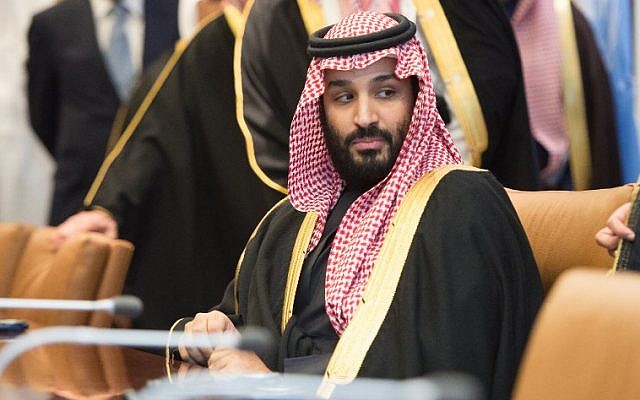
Prince Mohammed bin Salman Al Saud, crown prince of Saudi Arabia, attends a meeting at the United Nations in New York City, March 27, 2018. (Bryan R. Smith/AFP)

At a meeting with Jewish leaders in New York last month, Saudi Crown Prince Mohammed bin Salman castigated the Palestinian leadership for rejecting opportunities for peace with Israel for decades, and said they should either start accepting peace proposals or “shut up.”

Citing what it said were multiple sources, Israel’s Channel 10 News on Sunday night quoted what it said were remarks made by the crown prince at the meeting that left those who were present “staggered” by the ferocity of his criticism of the Palestinians.

At a meeting with Jewish leaders in New York last month, Saudi Crown Prince Mohammed bin Salman castigated the Palestinian leadership for rejecting opportunities for peace with Israel for decades, and said they should either start accepting peace proposals or “shut up.”

Citing what it said were multiple sources, Israel’s Channel 10 News on Sunday night quoted what it said were remarks made by the crown prince at the meeting that left those who were present “staggered” by the ferocity of his criticism of the Palestinians.

“It’s about time that the Palestinians accept the offers, and agree to come to the negotiating table — or they should shut up and stop complaining,” he reportedly went on.

Prince Salman also told the US Jewish leaders that “the Palestinian issue is not at the top of the Saudi government’s agenda” and elaborated, “There are much more urgent and more important issues to deal with — such as Iran,” according to the TV report.

Nonetheless, the crown prince reportedly stressed that there would have to substantive progress toward an Israeli-Palestinian accord before the Saudis and other Arab states would deepen their relationships with Israel. “There needs to be significant progress toward an agreement with the Palestinians before it will be possible to advance negotiations between Saudi Arabia and the Arab world and Israel,” he was quoted saying.

The TV report dated the meeting to March 27, during the prince’s extensive visit to the US. It did not name those present. The Saudi Embassy said that the crown prince was to have met that week with Jewish leaders, including Rabbi Rick Jacobs, president of the Union for Reform Judaism; Rabbi Steven Wernick, head of the United Synagogue of Conservative Judaism; and Allen Fagin, executive vice president of the Orthodox Union. That meeting, however, which also included Christian leaders, took place on March 28.

The TV report was based on a cable to the Foreign Ministry from an Israeli diplomat in the New York consulate, who was briefed on the meeting by those present, and three other sources who were familiar with the content of the meeting. One of those present told the TV channel that the group was staggered by what the prince had to say, and all but fell off their chairs.

A number of news reports, including by The New York Times and Reuters, have claimed in recent months that the Saudi crown prince has pressured Palestinian Authority President Mahmoud Abbas to accept a much-anticipated Trump administration peace proposal.

After he met with Jewish and Christian leaders on March 28, the Saudi Embassy in Washington said the meeting “emphasized the common bond among all people, particularly people of faith, which stresses the importance of tolerance, coexistence, and working together for a better future for all of humanity.”

A statement from the embassy added that “the Kingdom of Saudi Arabia has always, and will continue to champion expanding dialogue, building a better understanding among the faiths, and focusing on the shared humanity of all peoples.”

No specific details of what the faith leaders and crown prince spoke about were released.

In an interview published a few days later,  the crown prince recognized Israel’s right to exist and extolled the prospect of future diplomatic relations between his kingdom and the Jewish state.

In an extensive interview with The Atlantic’s Jeffrey Goldberg, the prince laid out his vision for the future of the Middle East, including the possibility of cooperation with Israel.

Asked whether he believes “the Jewish people have a right to a nation-state in at least part of their ancestral homeland,” he replied: “I believe that each people, anywhere, has a right to live in their peaceful nation. I believe the Palestinians and the Israelis have the right to have their own land.”

However, in keeping with the terms of his kingdom’s regional peace proposal, the Saudi crown prince added that an agreement with the Palestinians was a prerequisite to formal relations. “But we have to have a peace agreement to assure the stability for everyone and to have normal relations,” he said.

Did he have “no religious-based objection to the existence of Israel?” he was further asked. To which the crown prince replied: “We have religious concerns about the fate of the holy mosque in Jerusalem and about the rights of the Palestinian people. This is what we have. We don’t have any objection against any other people.”

Asked about anti-Semitism in Saudi Arabia, he said: “Our country doesn’t have a problem with Jews. Our Prophet Muhammad married a Jewish woman. Not just a friend — he married her. Our prophet, his neighbors were Jewish. You will find a lot of Jews in Saudi Arabia coming from America, coming from Europe. There are no problems between Christian and Muslims and Jews. We have problems like you would find anywhere in the world, among some people. But the normal sort of problems.”

Israel and Saudi Arabia have no official relations and the kingdom does not recognize the Jewish state. Israel has hinted at clandestine ties with Saudi Arabia in recent years, stressing the two countries share an interest in countering Iran. The rumors of covert relations have been denied by Saudi officials. Still, a Saudi general visited Jerusalem in 2016 and met with Israeli lawmakers, and Saudi officials have met with Israeli officials on several occasions in public. Saudi Arabia also allowed Air India to fly to and from Tel Aviv via its airspace, last month.

Discussing whether a shared concern over Iran was bringing Israel and Saudi Arabia together, he said: “Israel is a big economy compared to their size and it’s a growing economy, and of course, there are a lot of interests we share with Israel, and if there is peace, there would be a lot of interest between Israel and the Gulf Cooperation Council countries and countries like Egypt and Jordan.”

Salman also discussed the threat to the Middle East he said was posed by Iran, even saying that Ayatollah Ali Khamenei, the supreme leader of the Islamic Republic, “makes Hitler look good.”

“Hitler didn’t do what the supreme leader is trying to do. Hitler tried to conquer Europe. This is bad,” he explained. “But the supreme leader is trying to conquer the world. He believes he owns the world. They are both evil guys. He is the Hitler of the Middle East. In the 1920s and 1930s, no one saw Hitler as a danger. Only a few people. Until it happened. We don’t want to see what happened in Europe happen in the Middle East. We want to stop this through political moves, economic moves, intelligence moves. We want to avoid war.”

Shortly afterwards, Saudi King Salman reaffirmed his nation’s support for the Palestinians in a conversation with US President Donald Trump.

The king “reaffirmed the kingdom’s steadfast position toward the Palestinian issue and the legitimate rights of the Palestinian people to an independent state with Jerusalem as its capital,” the official Saudi Press Agency said.

WATCH: ‘You Occupy a Special Place in My Heart,’ US Secretary of State Tells Netanyahu

April 29, 2018

“You’re an incredibly important partner [and] occupy a special place in my heart too,” Pompeo told Netanyahu in Tel Aviv.

Apr 29, 2018

https://unitedwithisrael.org

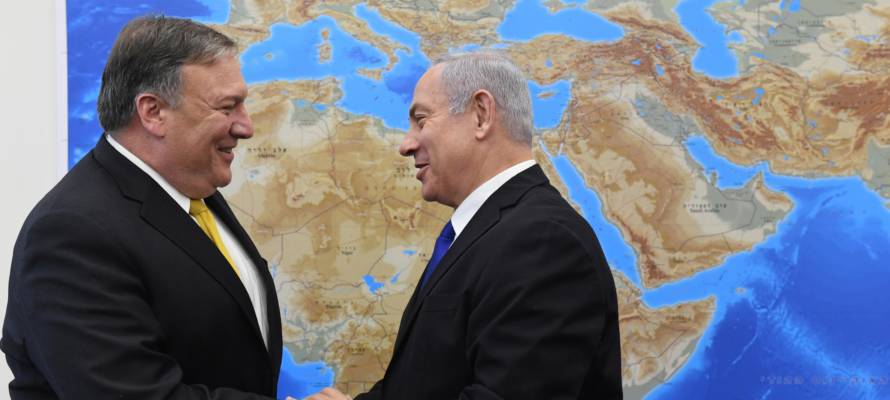
US Secretary Mike Pompeo (L) and PM Benjamin Netanyahu Haim Zach (GPO)

The prime minister congratulated Pompeo, the former CIA director, upon his new position, saying, “We are very proud of the fact that this is your first visit as Secretary of State.”

Pompeo replied, “You’re an incredibly important partner [and] occupy a special place in my heart too.”

Pompeo, a fierce critic of the Iran nuclear deal, is on his first trip abroad as secretary of state. His first stop was Saturday in Saudi Arabia, and Iran is reportedly top on his agenda.

Watch the video and see the warmth between the Israeli leader and the top US diplomat!

PM to discuss Iranian threat with visiting US secretary of state

April 29, 2018

Source: PM to discuss Iranian threat with visiting US secretary of state – Israel Hayom

Iranian foreign minister: US demands on nuclear deal ‘unacceptable’

April 29, 2018

Source: Iranian foreign minister: US demands on nuclear deal ‘unacceptable’ – Israel Hayom

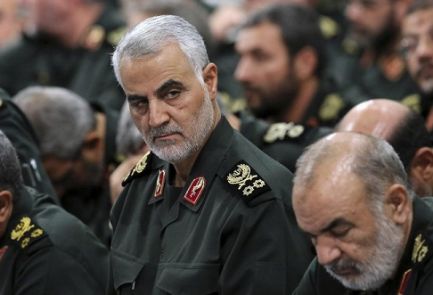
Report: Iran’s supreme leader looking to oust Quds Force commander 

April 29, 2018

Source: Report: Iran’s supreme leader looking to oust Quds Force commander – Israel Hayom