Archive for March 2018

Analysis: The coming war

March 9, 2018

There is a feeling of calm before the storm here in Israel.

Flag of Iran iStock

Yochanan Visser is an independent journalist/analyst who worked for many years as Middle East correspondent for Western Journalism.com in Arizona and was a frequent publicist for the main Dutch paper De Volkskrant. He authored a book in the Dutch language about the cognitive war against Israel and now lives in Gush Etzion. He writes a twice weekly analysis of current issues for Arutz Sheva

Iran’s Supreme Leader Ayatollah Ali Khamenei has changed his time schedule for the destruction of Israel and at the beginning of March promised a Sunni Syrian religious scholar he would lead prayers in Jerusalem fairly soon.

His words are not merely rhetoric since the Iranians are making rapid progress in preparations for a concerted effort to destroy the Jewish state via its proxies in Lebanon, Syria and the territories controlled by the PA and Hamas.

During a meeting with Muhammad Abdul-Sattar al-Sayyid, the Syrian Minister of religious affairs and Syrian religious scholars, Khamenei promised al-Sayyid he would see the day that he would be able “to lead prayers in al-Quds” (Jerusalem).

“I hope that you and we will see the day when you are conducting public prayers in Quds, God willing. We believe that that day will come. It is possible that this humble person and people like us will not be living on that day, but it will come eventually and it will not come late,” according to Khamenei

Severeal years ago, the Iranian dictator said Israel would be erased from the face of earth within 25 years.

During the meeting with the Syrian scholars Khamenei elevated the status of Syrian dictator Bashar al-Assad whom he praised for being “a great example of resistance and a fighting image.”

Calling al-Assad an “example” for the resistance movement – the loose coalition of terrorist movements and rogue regimes fighting Israel- is another indication Iran and its allies in Syria are shifting their focus toward Israel now that the Russian-supported Iranian axis is on the verge of victory in the seven-year-old Syrian war.

The pro-Assad coalition of Shiite militias who make up the bulk of the Syrian army today is currently eliminating the last hubs of Islamist rebels in eastern Ghouta near Damascus and in the northern province Idlib in Syria.

At the same time Iran is continuing to build the military infrastructure which will be needed in the coming confrontation with the IDF.

A recent New York Times report indicated the Islamic Republic is building missile facilities and military bases in Syria while bringing its proxies closer to the Israeli border.

In addition, Fox News reported last week Iran is building big missile silos on a military base near Damascus.

Fox News obtained images of the base from ImageSat International which showed the Quds force of the Iranian Revolutionary Guards Corps (IRGC) had built two hangars for missiles which can hit Israel anywhere.

A similar base was destroyed by Israel during the first direct confrontation between the IAF and the IRGC on February 10, 2018.

This week Amir Ali Hajizadeh, the commander of the Islamic Revolutionary Guard Corps Aerospace Force, said Iran has tripled its missile production despite international efforts to curb the program.

Hajizadeh scoffed at Israel and other Western powers such as France for their “hypocrisy” in trying to stop further expansion of the Iranian missile program.

France is leading the effort to reduce the threat from Iranian missiles, however, French Foreign Minister Jean-Yves Le Drian failed to book progress while visiting Iran at the beginning of this week.

Another indication both Israel and Iran are preparing for war is detectable in Lebanon.

Last week, Joseph Aoun, the commander of the Lebanese Armed Forces (LAF), told reporters the Lebanese army is ready for a new conflict with Israel if the IDF encroaches further on the border of Lebanon.

Aoun’s threat was related to mounting tensions between Lebanon and Israel over additional security measures the IDF is currently undertaking near the Lebanese border and a dispute over a gas field which straddles the maritime border between the two countries.

There’s more.

A former Syrian general who headed the chemical weapons program of Assad’s army this week disclosed Iran and Syria have supplied chemical weapons to Hezbollah.

Suhair al-Saqit told the Hebreeuw paper Maariv the chemical warheads in Hezbollah’s possession are produced in Syria.

He also said Assad had transferred a large part of his chemical weapons stockpile to Hezbollah ahead of international inspections which took place after Assad gassed thousands of Syrian civilians during the first period of the Syrian civil war.

Fox News furthermore, reported a new UN investigation revealed North Korea has delivered new chemical weapons to Syria and that satellite images showed North Korean engineers are working on chemical weapons facilities in Syria.

Republican senator Lindsey Graham who visited Israel last week said he had become increasingly worried about the Iranian threat to Israel after he visited the borders between Israel, Lebanon and Syria.

“It’s far worse than I thought it would be,” Graham said before reporting he had seen Hezbollah and Syrian army flags very close to the Israeli border on the Golan Heights.

“Southern Lebanon is a nightmare, it makes Gaza looking stable” Graham said before adding “Israel is in a no-win situation.”

He was referring to the approx. 130,000 missiles pointing at Israel from Lebanon.

Graham could have added that the Lebanese army has been turned into an ally of Hezbollah with U.S. support as columnist Caroline Glick reported this week.

Glick also wrote the presence of UNIFIL in southern Lebanon has been rendered useless against Hezbollah’s growing threat against Israel because the LAF is blocking UNIFIL from carrying out its mandate as a peace keeping force.

Israel on the other hand, is increasingly carrying out reconnaissance missions in Lebanon.

The Lebanese army almost daily reports violations of Lebanese airspace by IAF warplanes and drones while the Israeli navy briefly entered Lebanese territorial waters this week.

“There is a feeling of calm before the storm here in Israel,” blogger Vic Rosenthal wrote this week adding that the “coming war” will probably be the “toughest in Israel’s history.”

Iran and its proxies are expected to lob more than 1,000 missiles a day at Israel from at least three fronts in this ‘coming war’ as many observers, politicians and IDF officers in Israel call it.

These three fronts are Lebanon, Gaza and Syria and it is expected Israel’s various anti-missile shields will be unable to cope with this amount of missiles.

This is why some observers now think the time has come to take preemptive action against the Iranian threat on the lines of what happened in 1967 at the outset of the Six-Day-War when the IAF destroyed almost all Egyptian and Syrian warplanes before the war actually began.

“Israel is exceptionally vulnerable to attack by precision weapons, as on the one hand it is an advanced Western country dependent on sophisticated technologies, and on the other it is small, with very concentrated infrastructures and very little redundancy,” two IAF veterans wrote in a study last year.

They could have added that the bulk of Israel’s population is living in areas in the center of country and the Iranians have already warned they would flatten Tel Aviv and its suburbs in the Gush Dan area.

All the above are the reasons Prime Minister Benyamin Netanyahu spoke in apocalyptic terms regarding the increasing Iranian threat to Israel when he held a speech at the annual American Israel Public Affairs Committee (AIPAC) conference in the U.S.

“We must stop Iran. We will stop Iran,” Netanyahu vowed.

Massive Iranian Missile Buildup Sparks Fear of ‘Second Holocaust’

March 8, 2018

Growing concern Trump admin will cave to Iran, legitimize missiles capable of hitting Israel

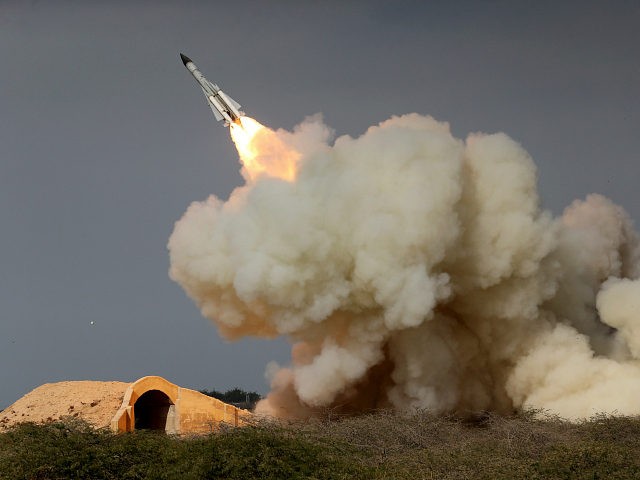
Iran launches a "Persian Gulf" ballistic missile

BY:

Massive Iranian Missile Buildup Sparks Fear of ‘Second Holocaust’

Iran is undertaking a massive buildup of its ballistic missile program, sparking fears of a “second Holocaust” amid sensitive international negotiations that could see the Trump administration legitimize Iranian missiles capable of striking Israel, according to multiple sources familiar with ongoing diplomatic talks.

As the Trump administration and European allies continue discussions aimed at fixing a range of flaws in the landmark Iran nuclear deal, sources familiar with the progression of these talks say the United States is caving to European demands limiting restrictions on Iran’s ballistic missile program.

While the Trump administration went into the negotiations with a hardline stance on cutting off Iran’s ballistic missile program, it appears the United States is moving closer in line with European positions that would only regulate a portion of the missiles.

Multiple sources with knowledge of the ongoing talks told the Washington Free Beacon U.S. officials have been backpedaling on key demands originally proposed by President Trump in order to preserve the agreement and appease European allies who are eager to continue doing business with Tehran.

Senior Trump administration officials recently told the Free Beacon the United States is prepared to abandon the nuclear deal if European allies fail to address what it views as a range of flaws in the nuclear deal that have enabled Iran’s missile buildup and allowed it to continue critical nuclear research.

However, it appears the United States is losing ground in the talks, moving closer to the European position, which includes what insiders described as only cosmetic changes to the nuclear deal that fail to adequately address Iran’s massive missile buildup.

“If Trump doesn’t take control of these negotiations, he will be to Iranian missiles what Obama was to Iranian enrichment,” said one veteran foreign policy official with direct knowledge of the ongoing negotiations in Europe. “Combined, Obama and Trump’s negotiators could end up giving us a bipartisan Iranian nuclear weapon capable of bringing a second Holocaust. What does it say that Donald Trump’s negotiators have a weaker position on Iranian missiles than the United Nations?”

Speculation the Trump administration will cave on the missile issue has been fueled by off-record meetings between Trump administration officials and foreign policy insiders, as well as recent comments by the State Department that only “long-range” missiles are currently up for discussion, according to sources who spoke to the Free Beacon.

The State Department would not comment on the current state of the talks, but told the Free Beacon the ballistic missiles issue remains on the agenda.

This includes “preventing Iran from developing or testing a long-range ballistic missile,” according to a State Department official.

This does not appear to include shorter-range missiles that could strike Israel.

A White House National Security Council official also declined to discuss the current state of the negotiations, only telling the Free Beacon, “talks are ongoing.”

One senior congressional official with knowledge of the efforts to crackdown on Iran’s missile program expressed shock at how the administration’s negotiating position has evolved.

“Give me a break,” said the source, who was not authorized to speak on the record about the sensitive discussions. “Is the U.S. negotiating position really going to be watered down from the standard laid out in UNSCR 2231,” the United Nations Security Council resolution banning Iranian ballistic missile work.

“We need to address the Iranian ballistic missile threat as it appears today, and ensure Iran does not have a free pass to potentially test and acquire ballistic missiles that can be used to rain nuclear bombs down on Riyadh and Jerusalem,” the source said.

As discussions of the deal continue, the U.S. intelligence community has issued a wide ranging warning about the progress Iran has made in its ballistic missile work, which is among the largest stockpile in the region.

Iran currently “has the largest inventory of ballistic missiles in the Middle East,” according to the U.S. director of national intelligence, who recently highlighted the issue in an annual threat assessment.

“Tehran’s desire to deter the United States might drive it to field an ICBM,” or intercontinental ballistic missile, which is capable of carrying a nuclear payload, according to the DNI. “Progress on Iran’s space program, such as the launch of the Simorgh SLV in July 2017, could shorten a pathway to an ICBM because space launch vehicles use similar technologies.”

Iran has used billions of dollars in cash windfalls it received as part of the nuclear agreement to pursue ballistic missile research and construction, according to the U.S. intelligence community.

“Iran continues to develop and improve a range of new military capabilities to target U.S. and allied military assets in the region, including armed UAVs, ballistic missiles, advanced naval mines, unmanned explosive boats, submarines and advanced torpedoes, and anti-ship and land-attack cruise missiles,” the DNI warned. “Iran has the largest ballistic missile force in the Middle East and can strike targets up to 2,000 kilometers from Iran’s borders.”

This endangers Israel and is fueling concerns the Trump administration will fail to constrain the program at a time when Iran is increasingly threatening the Jewish state with a strike.

While United Nations Security Council resolutions currently ban Iran from conducting ballistic missile work, the Islamic Republic has openly flaunted the ban and vowed to never stop its buildup.

In 2013, the Obama administration and Congress agreed that Iran should not be able to test fire any ballistic missile exceeding 500km, or about 310 miles. That benchmark eventually increased to 2,000km, or 1,240 miles, following opposition by Iran.

Legislation proposed by Rep. Peter Roskam (R., Ill.) includes a “zero tolerance” clause on Iranian ballistic missiles, meaning that all sanctions waived as part of the nuclear deal would snapback if Iran tests any ballistic missile. Supporters have described the legislation as the “gold standard for how to fix the Iran deal when it comes to ballistic missiles.”

With concerns mounting that the Trump administration will walk back its support of a full ballistic missile ban, insiders worry that Israel will suffer the consequences.

“Trump will be legitimizing Iranian missiles that can wipe Israel off the map,” said one insider with knowledge of the talks and the administration’s evolving position. “What does it say that Donald Trump’s negotiators have a weaker position than [Democratic leader] Harry Reid and the United Nations?”

Omri Ceren, a managing director at The Israel Project, a DC-based educational organization that has worked closely with the administration on Iran issues, told the Free Beacon that any fix that does not fully ban ballistic missiles is a failure.

“Congress and the Israelis are on the same page about this. The only acceptable fix to the Iran deal is one that prohibits all nuclear capable ballistic missiles, which is what the relevant U.N. resolution says anyway, if the international community would ever bother to enforce it,” Ceren said. “House Republicans even explicitly laid out those expectations in recent legislation they advanced.”

The Odd Couple: Why Iran is Backing the Taliban

March 8, 2018

Stratfor Worldview March 8, 2018

Source Link: The Odd Couple: Why Iran is Backing the Taliban

{The friend of my enemy is my enemy. – LS}

In the conflict in Afghanistan, there are few stranger bedfellows than Iran and the Taliban. The former is the spiritual hub of Shiite Islam, while the latter is a vociferously anti-Shiite Sunni fundamentalist movement. Changing circumstances, however, have brought the onetime foes into a kind of partnership. Whatever its ideological differences with the insurgent outfit, Tehran has every reason to maintain its tactical partnership with the Taliban — while also keeping its ties to the Afghan government.

Kabul’s New Coast

As a regional heavyweight, Iran has long been involved in Afghan affairs. The Islamic republic, for instance, has recruited fighters from Afghanistan’s Shiite Hazara community and from its own 3 million-strong Afghan refugee population to fill out the Fatemiyoun Brigade it has fighting alongside government forces in Syria. Tehran and Kabul also have pursued extensive economic cooperation, especially on the Chabahar port on Iran’s Arabian Sea coast. In May 2016, Iranian President Hassan Rouhani signed an agreement with Afghan President Ashraf Ghani and Indian Prime Minister Narendra Modi to develop the port, a $31 billion project.

For Iran, Chabahar is critical to diversifying the country’s port access beyond Bandar Abbas, which currently processes 85 percent of its seaborne traffic. For landlocked Afghanistan, the venture represents an opportunity to break its reliance on Pakistani ports. India, meanwhile, wants to use Chabahar to ease its economic inroads into Central Asia by bypassing archrival Pakistan. Rouhani, flanked by Afghan and Indian officials, formally inaugurated the first phase of the project — which has languished in developmental limbo for many years — in December 2017, two months after the first Indian shipment arrived there.

The Enemy of My Enemy

But even as Iran’s leaders work with their counterparts in Kabul over Chabahar, Tehran is also reportedly offering clandestine support to the Afghan government’s most potent enemy, the Taliban. The main reason for Iran’s backing is the rise of the Islamic State’s Khorasan chapter in Afghanistan. Unlike the Taliban, whose chief aim is to reconquer Kabul, the Khorasan group is part of a transnational jihadist movement that threatens Iran, too. (An Islamic State cell, in fact, carried out the coordinated attacks in the country’s capital that killed 17 people in June 2017.) The Islamic State has been active in Afghanistan since 2015. And while it maintains a presence in 30 of Afghanistan’s 399 districts, mainly in the country’s eastern Nangarhar province, the group has yet to seize control of any territory. The Taliban have clashed with the newcomers in the past few months in Nangarhar and northern Jowzjan province.

In addition, the Taliban are currently staging around two attacks a week in three districts of Farah province, along the border with Iran, according to a recent BBC study. Although direct evidence of Iranian support for the attacks hasn’t surfaced, previous cross-border attacks in Farah suggest that Tehran may be backing the latest offensives there. In October 2016, for example, the Afghan military fought off a three-week Taliban siege in the province, during which they killed four alleged Iranian commandos who were battling alongside the group. Iran reportedly also provides the insurgents arms, including AK-47 assault rifles, mortars and rocket-propelled grenades.

The Taliban, in turn, have demonstrated an interest in cultivating deeper ties with the Islamic republic as well. In 2016, the group’s leader at the time, Mullah Akhtar Mansoor, visited Iran allegedly in an effort to diversify his group’s sources of support. Mansoor was killed in a U.S. drone strike after he crossed into Pakistan’s Balochistan province in May of that year. But five months later, the Taliban appointed an envoy to Iran in a further sign of its increasing engagement with Tehran.

Iran Hedges Its Bets

Supporting the Taliban offers Iran a way to counter the Islamic State’s expansion to its east, and Tehran will feel justified in backing the insurgents so long as the transnational jihadist group has a presence in Afghanistan. Beyond counterterrorism, though, Iran wants to maintain contact with the Taliban to be in their good graces if they eventually assume a role in the Afghan government. Even the United States, which has been battling the Taliban for more than a decade and a half, has admitted that a power-sharing deal in Afghanistan likely would involve the Taliban. In that case, Iran will be well-placed to expand its reach in the South Asian country, having kept its ties with both the Taliban and the government’s NATO-backed components.

Iran isn’t the only regional power following this strategy. Countries such as Pakistan and Russia also have intervened in the war-torn state to safeguard their interests. While Islamabad continues to support the Taliban’s leaders, Moscow reportedly has sent fuel shipments by way of Uzbekistan’s Hairatan border crossing for the group to resell. (Russia’s alleged support for the group is a remarkable policy reversal given that the Taliban are the descendants of the mujahideen who fought the Soviets in their 1979 invasion.)

Though there’s no love lost between Iran and the Taliban, the circumstances of the day oblige Tehran to act pragmatically to ward off the Islamic State. The jihadist group’s activity in the country, moreover, provides Iran with a useful pretext to maintain a presence in its long-unstable eastern neighbor. As Iran and other foreign powers use the Taliban to their own ends, the group will keep up its violent insurgency, making it hard for the United States to withdraw from Afghanistan after more than 16 years of war.

US, IDF troops train to protect Israel from ballistic missiles together 

March 8, 2018

Source: US, IDF troops train to protect Israel from ballistic missiles together | The Times of Israel

US general says Juniper Cobra exercise, which simulates a large-scale missile attack, could look similar to actual deployment of American troops to Israel in time of war

HATZOR AIR BASE — Thousands of American and Israeli soldiers are preparing for the real possibility that they will have to fight “shoulder to shoulder” against a massive ballistic attack on the State of Israel, officials from both countries said Thursday.

On Sunday, the two militaries launched the nearly-month-long Juniper Cobra exercise, which will simulate such a missile barrage. The biennial drill is this year’s premier exercise for the US European Command (EUCOM) and one of the most important for the Israel Defense Forces, with approximately 2,500 soldiers from each army taking part.

“For more than four weeks, they will train shoulder to shoulder, the same as we will fight in times of crisis. It’s not just about an exercise,” Brig. Gen. Tzvika Haimovitch, Israel’s air defense commander, told reporters on Thursday.

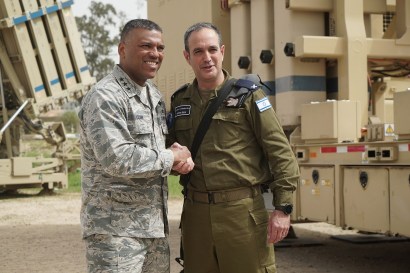
Israeli air defense commander Brig. Gen. Tzvika Haimovitch, right, shakes hands with Lt. Gen. Richard Clark, head of the US delegation to the 2018 Juniper Cobra air defense exercise in March 2018. (Israel Defense Forces)

Israel considers ballistic missiles, specifically precision-guided ones, to be one of the most significant threats facing the Jewish state, in the form of the Hezbollah terrorist group’s massive arsenal of short- and medium-range rockets, as well as the intercontinental ballistic missiles that Iran is working to develop.

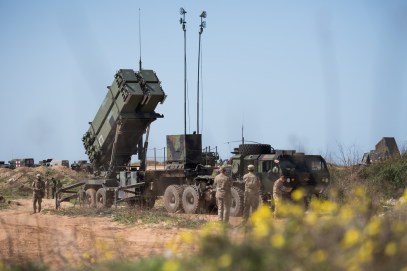
American, Israeli troops deploy a radar array during the 2018 Juniper Cobra air defense exercise in March 2018. (US Army)

During Juniper Cobra, the countries’ top air defense systems — for Israel the Iron Dome, David’s Sling, Patriot and Arrow; for the US the Aegis, the Patriot, the Terminal High Altitude Area Defense (THAAD) and TPY-2 radar system — will be tested in the exercise, though for the most part only in computer simulations, officials said.

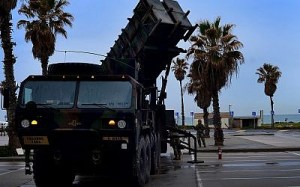
The majority of the exercise will take place in the Israeli Air Force’s Hatzor base, located in central Israel, east of the city of Ashdod. During the exercise, the base, which is ordinarily home to two F-16 fighter jet squadrons, will act as a menagerie of sorts for Israeli and American missile defense systems, with open lots filled to the edges with launchers, radars and mobile command centers.

Towards the end of Juniper Cobra, an Israeli short-range Iron Dome interceptor missile and long-range Patriot interceptor missile will be launched, along with an American Patriot missile, Haimovitch said.

American, Israeli troops deploy a Patriot missile defense battery during the 2018 Juniper Cobra air defense exercise in March 2018. (Israel Defense Forces)

While the Israeli brigadier general lauded the exercise and the “deep and strong relationship” between the two counties that it represents, details about what specifically this year’s Juniper Cobra would be simulating were relatively scant.

“We will be practicing real scenarios, complex, multi-directional threats. Both close and far away,” Haimovitch said.

The official patch for the 2018 Juniper Cobra air defense exercise in March 2018. (US Army)

The words “Iran,” “Hezbollah” and “Hamas” went entirely unheard as American and Israeli military officers discussed air defense exercises, even though the type of missile attack against Israel being simulated would most likely be carried out by Hezbollah and Hamas, with the backing of Iran.

Instead, officials would say only that they were training against attacks by “state and non-state actors.”

The types of missiles that the militaries were preparing against also went unspecified, even as Israeli officials regularly single out the threat of Iranian precision-guided missiles being manufactured for and transferred to the Hezbollah terrorist group in Lebanon.

A Hezbollah fighter stands behind an empty rocket launcher, May 22, 2010. (AP/Hussein Malla)


The Iran-backed terrorist group is believed to have 100,000 to 150,000 rockets and missiles in its stores, with the capability of launching over 1,000 per day in the case of war. This too went largely undiscussed, though Haimovitch acknowledged that the militaries were preparing for “large-scale salvos and more accurate rockets.”

His counterpart, Lt. Gen. Richard Clark, the head of the US Third Air Force command and the head of the American delegation to Juniper Cobra, said the armies “will be ready for whatever threat, whenever it may happen.”

According to Israeli and American officials, the purpose of the Juniper Cobra exercise, which has been running since 2001, is twofold: share and swap knowledge on missile defense and improve ties between the two militaries in order to develop a common understanding in the case of war.

A convoy of American and Israeli vehicles move supplies ahead of the 2018 Juniper Cobra air defense exercise in March 2018. (Israel Defense Forces)

Showing the depths of the American-Israeli cooperation, Clark noted that not only had he developed a friendship with his counterpart Haimovitch, but that their families had developed a relationship as well.

“As I walk around our camp, I see Israeli and American forces sitting side by side in our operations center, operating equipment, eating togetheer in the dining facility. It’s a great opportunity for us to build that glue that will make interoperability work,” he said.

American, Israeli troops deploy a Patriot missile defense battery during the 2018 Juniper Cobra air defense exercise in March 2018. (US Army)

While Israel often touts its self-defense abilities, the United States has in the past stepped in to provide assistance in wartime. Haimovitch noted that in the case of missile defense, this happened during the 1991 First Gulf War when the US deployed Patriot missile defense batteries, which at the time were far more rudimentary, after Saddam Hussein launched a number of Scud missiles at Tel Aviv, killing three people, injuring scores more and damaging several buildings.

“If the conditions arise and we are requested by the government of Israel, then we will be deployed to assist in the defense of the State of Israel. We would deploy forces much in the way they’re deployed in this exercise,” Clark said.

Haimovitch described the assistance from the US military as “another tool in the toolbox” of the IDF.

“It’s another method among a lot of activities and events to help us be ready once the orders come,” he said.

American, Israeli troops take part in a the 2018 Juniper Cobra air defense exercise in March 2018. (US Army)

The 2018 Juniper Cobra exercise was divided into three main parts, Haimovitch said. The first few days saw the American and Israeli “boots on the ground” prepare for the drill. The following two weeks will mostly focus on tabletop and computer-based simulations of a large-scale ballistic missile attack and the response by the air defense systems. The final portion will include the live-fire exercises of the Patriot and Iron Dome systems.

The David’s Sling missile defense battery, which was declared operational in 2017 and so did not take full part in the 2016 exercise, will participate in this year’s exercise, but will not be fired.

Israeli Air Force Lt. David Segal, who serves in a David’s Sling battery, told reporters on Thursday that the system received positive reviews from the American troops, who “only have good things to say about it.”

The David’s Sling missile defense system seen at the Hatzor Air Base, Israel. Sunday, April 2, 2017. (AP Photo/Sebastian Scheiner)

Col. David Shank, of US EUCOM’s 10th Army air and missile defense command, described it as an “extremely capable missile defense system.”

The David’s Sling is designed to intercept medium-range missiles, such as the Iranian Fateh 110 and Syrian M-600, which are believed to be in the arsenals of Hezbollah.

This year’s exercise, with its nearly 5,000 participants, will be the largest Juniper Cobra, beating out the 2016 drill, in which some 3,200 soldiers took part, by a wide margin. It also appears to be larger than the 2012 joint US-Israel Austere Challenge ballistic missile exercise.

Not all of the 2,500 US troops taking part in Juniper Cobra are physically present in Israel; a portion of them are participating from American bases in the United States and EUCOM’s base in Germany, Clark said.

Officials said that planning for the 2018 exercise began shortly after the end of the 2016 Juniper Cobra. As such, they said, the recent developments in the region — notably the February 10 clashes between Israel, Iran and Syria — did not have a direct impact on the types of scenarios being simulated in the exercise.

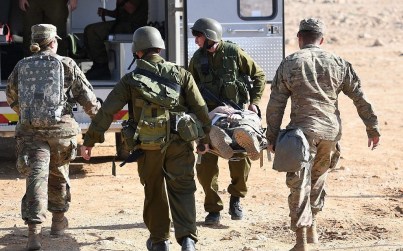
In addition to the missile defense exercise, the US troops will also participate in several drills outside of Juniper Cobra, like a medical drill simulating the response to an accidental gas explosion on an army base.

Turkey Threatens Exxon Mobil & The US 6th Fleet Off Cyprus

March 8, 2018

by Tyler Durden Thu, 03/08/2018 – 06:10 Zero Hedge

Source Link: Turkey Threatens Exxon Mobil & The US 6th Fleet Off Cyprus

{With friends like this, who needs enemies? – LS}

Turkish Prime Minister Binali Yıldırım threatened not only hydrocarbon survey ships of oil giant Exxon Mobile but also the US 6th Fleet is participating in a naval exercise in the area 7-18 March 2018.

As KeepTalkingGreece.com reports, Yildirim said:

“The Republic of Cyprus would not be allowed to get away with selling the energy resources surrounding the island,” Yildirim said on Wednesday. With reference to the turkey-occupied North part of Cyprus, he added “the natural riches surrounding the island of Cyprus is the common wealth of all the people who live on the island.”

And he threatened that:

“This and other provocative activities that create faits accomplis will be responded to in an appropriate fashion.”

It was a clear message even to the US Fleet as some media have linked its presence off  Cyprus to the Exxon survey, saying the Fleet was going to protect the Exxon Mobile survey vessels.

Last month, Turkish war ships threatened to sink drilling ship commissioned by Italy’s ENI and ultimately managed to block the process as the Italian diplomacy did not dare to put the lives of their fellowmen at risk.

A day earlier, President Recep Tayyip Erdogan, reacting to U.S. Sixth Fleet heading to East Mediterranean, said , “while European states’ boats abandoning refugees to death, we try to rescue every innocent’s life. You can only make it there with your Sixth Fleet, aircraft carrier.”

Yildirim underlined that any underground riches surrounding the island should only be extracted with the permission of both the island’s administrations.

“Any work in which one of these interlocutors is not part of the deal will be evaluated by us as a threat to the sovereign rights of North Cyprus,” he said.

Turkey has been illegally occupying 40% of Cyprus since 1974. It is only Turkey that recognizes “North Cyprus” as ‘state’, while the rest of the world considers as an “illegal” …something with no sovereign rights at all.

Meanwhile, in Cyprus…

One wonders just how far Turkey is willing to push Washington…


Iran’s Khamenei says won’t negotiate with West over regional presence

March 8, 2018

by reuters Thursday Mar 8, 2018 6:59am via The Foreign Desk

Source Link: Iran’s Khamenei says won’t negotiate with West over regional presence

{Nothing surprising here. Just a reminder of what we’re dealing with. – LS}

LONDON (Reuters) – Iran will not negotiate with the West over its presence in the Middle East, Supreme Leader Ayatollah Ali Khamenei said, days after the visiting French foreign minister sought to discuss Tehran’s role in regional conflicts.

Jean-Yves Le Drian traveled to Tehran on Monday with a brief to reaffirm Europe’s support for a nuclear deal that opened Iran’s economy while echoing U.S. concern about Tehran’s missile program and its influence in the region.

“European countries come (to Tehran) and say we want to negotiate with Iran over its presence in the region. It is none of your business. It is our region. Why are you here?” Khamenei was quoted as saying by his official website.

Khamenei said Iran would only negotiate on that issue with other states in the region.

“We will negotiate with America, when we wanted to be present in America,” he added.

U.S. President Donald Trump has threatened to pull out of the nuclear deal unless three European signatories help “fix” the accord by forcing Iran to limit its sway in the Middle East and rein in its missile program.

French President Emmanuel Macron has criticized the program and raised the possibility of new sanctions.

Tehran supports Syria’s President Bashar al-Assad in the government’s war against rebel forces, including groups backed by the West, and is an ally of Israel’s enemy Hezbollah in Lebanon.

Palestinians increase payments to terrorists to $403 million

March 7, 2018

By Lahav Harkov March 6, 2018 The Jerusalem Post

Source Link: Palestinians increase payments to terrorists to $403 million

{The price of murder just went up. – LS}

The Palestinian Authority increased its payments to terrorists and their families by nearly $56 million, Knesset Foreign Affairs and Defense Committee chairman Avi Dichter (Likud) said overnight Monday, when a bill to discourage the practice passed a first reading.

Dichter pointed out that PA President Mahmoud Abbas authorized the 2018 PA budget on Sunday, and that there is a PA law that says 7% of each budget must go to paying terrorists, or to their families, if they’re killed in the act.

The increase “means that the PA will employ more terrorists as PA workers,” Dichter said. “Except that the terrorists who work for the PA have a special quality – they are employed both as dead and living terrorists.

“Murderers like the ones who killed the Fogel family” – two Palestinians killed five out of eight members of the family in Itamar, including a three-month-old, in 2011 – “are heroes to the PA. This is not a whim. It’s in the PA’s constitution,” Dichter added.

The PA paid terrorists and their families more than $347m. in 2017. Terrorists who have been sentenced to three to five years in Israeli prisons receive the average income of a Palestinian, about $580 per month. The families of those who committed more severe crimes and were involved in killing Israelis receive five times that each month for the rest of their lives.

Terrorists receive more from the PA if they are married, for each child they have, if they live in Jerusalem or if they’re an Israeli citizen.

The bill that passed a first reading on Monday, proposed by Yesh Atid MK Elazar Stern and Dichter, would require the government to deduct the amount the PA paid to terrorists and their families from the taxes and tariffs Israel collects for the PA. The proposal was inspired by the Taylor Force Act, a US bill named after an American victim of Palestinian terrorism, which would cut all US aid to the PA until the terrorist payments are stopped.

Stern said when he presented the bill to the Knesset that “there is no opposition or coalition” on the matter.

“In the current situation, there is an incentive for terrorism, which only pushes away peace,” Stern said. “This bill is not only meant to promote the security of citizens and residents of the State of Israel, but to promote peace.”

According to Stern, “Palestinians have said when they were interrogated that they continued terrorism in order to go to jail and get more money.

“We can pay back money, but we can’t bring back human lives taken by terrorism,” he added.

Likud MK Amir Ohana wondered: “How did this absurd situation continue until now, with the State of Israel transferring money to the PA, which engages in glorification and pays families of terrorists. This bill is part of the fight against terrorism, and the economic arena is also a place for this fight.”

Joint List MK Yousef Jabareen said the bill is “colonialist legislation at its best… The bill is collective punishment for the Palestinian population… This is how the occupation is perpetuated.”

According to Jabareen, the payments to terrorists and their families are similar to National Insurance payments: “Their goal is to help the families so they don’t starve.”

MK Aida Touma-Sliman, also of the Joint List, called the bill theft.

“The proposal says to ‘deduct,’ but really it means to steal,” she said. “This is the condescending attitude which suits occupiers who think they can continue lashing out at another nation and not admit that the occupation is the source of all injustice.”

MK Mossi Raz of Meretz argued that the bill would be a violation of the Oslo Accords, in which Israel agreed to collect the tax money for the PA.

The bill passed 52-10. There is a second version of the legislation, drafted by the Defense Ministry, which the Foreign Affairs and Defense Committee is holding up, because it opposes an article in the proposal that would grant the security cabinet the option of not deducting the funds.

Iran: We Can Produce Enriched Uranium in Two Days if U.S. Pulls Out of Nuclear Deal

March 6, 2018

By Adelle Nazarian 6 Mar 2018 Breitbart

Source Link: Iran: We Can Produce Enriched Uranium in Two Days if U.S. Pulls Out of Nuclear Deal

{Two days is probably the amount of time needed to move all that hidden enriched uranium out of hiding. – LS}

Iran claimed Monday that it could produce higher enriched uranium within a 48-hour period if the United States exits the 2015 nuclear deal, otherwise known as the Joint Comprehensive Plan of Action (JCPOA).

“If America pulls out of the deal … Iran could resume its 20 percent uranium enrichment in less than 48 hours,” Behrouz Kamalvandi, spokesman for the Atomic Energy Organisation of Iran, told al-Alam TV, according to Reuters.

Iran has fired nearly two dozen ballistic missiles, at least 16 of them nuclear-capable missiles, since signing the controversial 2015 nuclear deal.

While President Donald Trump and his administration have indicated the United States’s intention to see the deal discarded, Germany, Britain, France, Russia, and China appear to be committed to keeping the deal intact.

Iran has continuously insisted that its ballistic missile program is purely for defensive purposes. The regime has also denied that it is supplying arms and missile technology to Houthi rebels in Yemen and, despite evidence showing otherwise, that the ballistic missiles that were fired into Saudi Arabia from Yemen were not theirs.

In December, Iran claimed that United States Ambassador to the United Nations Nikki Haley “fabricated” her announcement that the charred remains of a short-range ballistic missile discovered in Yemen, which was prominently displayed behind her during her speech, originated in Iran.

That same month, an independent panel to the U.N. Security Council declared, “Design characteristics and dimensions of the components inspected by the panel are consistent with those reported for the Iranian designed and manufactured Qiam-1 missile.”

Last week, ahead of his trip to Iran this week, French Foreign Minister Jean-Yves Le Drian’s said at a news conference with Russian Foreign Minister Sergey Lavrov that Iran’s ballistic missiles program “worries us enormously.” He reportedly added, “Having such tools is not uniquely defensive, given the distance they can reach.”

In October, Iran said it has no need to increase the range of its ballistic missiles because they were already capable of reaching U.S. forces stationed in the region.

Israel PM Netanyahu’s speech at AIPAC Policy Conference 2018 

March 6, 2018


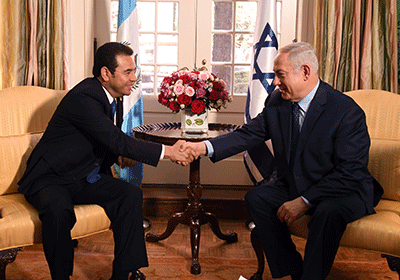
Following US lead, Guatemala to move its embassy to Jerusalem 

March 6, 2018

Source: Following US lead, Guatemala to move its embassy to Jerusalem – Israel Hayom