Archive for March 26, 2018

‘I’ve got your back’: How Israel scored U.S. support for bombing Syria 

March 26, 2018

Source: ‘I’ve got your back’: How Israel scored U.S. support for bombing Syria – Israel News – Jerusalem Post

Bush looked intently at Olmert: “I didn’t think you would have the ‘courage’ to do it, Ehud.”

BY MIKE EVANS
 MARCH 26, 2018 08:15

Former president George W. Bush and former prime minister Ehud Olmert meet at the White House, 2008

 Former president George W. Bush and former prime minister Ehud Olmert meet at the White House, 2008. (photo credit: JASON REED/REUTERS)

The two leaders sat in the private residence at the White House: President George W. Bush and President Ehud Olmert.

Both held lit cigars in celebration of the bombing of the Syrian reactor. Bush looked intently at Olmert: “I didn’t think you would have the ‘courage’ to do it, Ehud.” Olmert responded, “I told you I would do it.” Bush responded, “Well, at least I’m taller than you, Ehud.”

Like two little boys, the two men stood back-to-back in a photo-op attempt to measure their height.
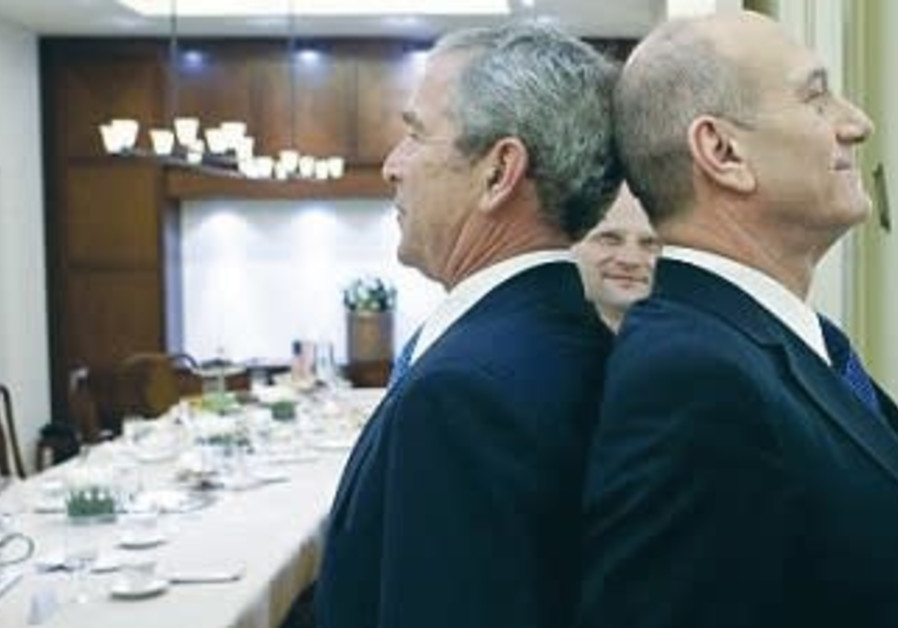
George Bush and Ehud Olmert (credit: Eric Draper)

George Bush and Ehud Olmert (credit: Eric Draper)

I first saw the picture when it stood for a time on a credenza behind Olmert’s desk.

It was signed by President Bush with the words, “I’ve got your back.”

The scenario began on September 6, 2007, at an eastern Syria complex which allegedly housed a nuclear reactor.

It was being built with the aid of the North Koreans, according to The New Yorker.

The attack on the Syrian site was the result of a raid that had taken place in Vienna months earlier and that which Israel has never taken responsibility for. According to former Jerusalem Post editor David Makovsky, writing in The New Yorker in 2012, Mossad agents had dared to infiltrate the home of Ibrahim Othman, the chief of the Syrian Atomic Energy Commission. Makovsky wrote: “Othman was in town attending a meeting of the International Atomic Energy Agency’s board of governors, and had stepped out. In less than an hour, the Mossad operatives swept in, extracted top-secret information from Othman’s computer, and left without a trace.”

As a result, the Mossad learned that apparently the rumors of a nuclear reactor being erected in Syria were true. The decision-making process to demolish the Syrian reactor began with what would be a battle between two Ehuds: prime minister Olmert and defense minister Ehud Barak. Barak charged Olmert with being too precipitous and not making proper preparations, while Barak thought the prime minister was overly-enthusiastic.

While the two men debated the incursion, Olmert took the unprecedented step of contacting Bush to seek US assistance. Bush was aware only of a “well-hidden facility in eastern Syria” and declined American aid. He felt there was no well-defined rationale for an attack.

In a meeting with prime minister Olmert, he told me Bush had offered the services of then-secretary of state Condoleezza Rice to try to work out a diplomatic solution to the problem. Olmert said his response was, “We don’t need diplomacy. I need you to take it out – or I will.”

When Bush declined, Olmert gave the green light.

The prime minister chose, however, to follow in the footsteps of Menachem Begin, who ordered the destruction of Iraq’s Osiris reactor in 1981. He made two slight deviations: Olmert sought input from President Bush, and then after the fact chose not to inform the entire world of Israel’s attack.

When the Israel Air Force leveled the site northwest of Damascus during the nighttime hours of September 6, 2007, worldwide awareness was centered on the fact that Syria had nuclear ambitions rather than on the means of the destruction.

Israel’s resolve to create an aura of obscurity around the incursion was an effort to maintain Syrian President Bashar Assad’s stature while deterring a retaliatory strike. With over a decade of hindsight, it seems Olmert was correct in making that choice: war was averted, and Israel sustained no losses.

Apart from the obvious contentious responses from Iran and North Korea, global leaders maintained silence.

Today, the international community can look back with gratitude to the Israelis for eliminating what would have been an even greater threat from Islamic State had that terrorist group been able to secure nuclear devices from either Iraq or Syria.

In subsequent years, data emerged regarding the Israeli mission. As the aircraft completed their task, one simple word, “Arizona,” was whispered over the airwaves. It was a confirmation that the mission had been completed, the site destroyed, and not one Israeli pilot had been lost. When that was conveyed to prime minister Olmert, he sent a communiqué to Prime Minister Recep Tayyip Erdogan of Turkey informing him of the circumstances surrounding the attack and asking him to apprise President Assad in Syria. Regardless of the wording of the dispatch, the message was, “Don’t build another nuclear plant.”

The Syrian strongman was caught in what some would call “a rock and a hard place.”

He could not readily decry Israel’s destruction of a nuclear reactor that he avowed was non-existent. Silence was also exercised by Olmert and the Israelis. According to the Syrian Arab News Agency, the IAF simply “dropped some ammunition” and returned to Israeli airspace, and erroneously commented that no damage had been done.

Since the Syrian attack in 2007, Israel had been reticent to announce security strikes beyond its boundaries. Such occurrences are often reported by foreign entities that have “somehow” attained video recordings or photographs.

An ambiguous statement may be forthcoming from Israeli sources, but details are generally omitted.

During the past several years, there have been reports of numerous Israeli attacks inside Syria reported by foreign news sources. The Israelis have assumed responsibility for a few incidents, and even when one of their F-16s was shot down in February 2018, it had little, if any, effect on Israel’s determination to protect its homeland.

The author is a No. 1 New York Times bestselling author with 80 published books. He is the founder of Friends of Zion Museum in Jerusalem of which the late president Shimon Peres, Israel’s ninth president, was the chairman.


U.S. pledges record $705 million in missile defense aid to Israel 

March 26, 2018

Source: U.S. pledges record $705 million in missile defense aid to Israel – Israel News – Jerusalem Post

“I thank our great friend the United States, which has invested $6.5 billion to defend the skies of the State of Israel. We are grateful for the assistance.”

BY ANNA AHRONHEIM
 MARCH 26, 2018 10:47
Iron dome

 Iron Dome launcher fires an interceptor rocket . (photo credit: REUTERS)

The United States Congress has dramatically increased its budget for the Israeli missile defense programs by $148 million to include ongoing Iron Dome and Arrow 3 development.

“I am pleased and excited to announce that the US Congress has approved a record sum for Israel’s missile defense program: $705m. in 2018!” Defense Minister Avigdor Liberman announced on Monday.

According to Israel’s Defense Ministry, the increase of funding was requested for production of the Iron Dome, David’s Sling and Arrow-3 missile defense systems.

Together, the systems provide Israel with a protective umbrella able to counter threats posed by both short and mid-range missiles used by Gaza terror groups and Hezbollah as well as the threat posed by more sophisticated long-range Iranian ballistic missiles.
The newest generation of the Arrow 3 system, which will be tested in Alaska this summer, is believed to have better-intercepting capabilities at a much higher altitude and much further away from Israeli soil.

The increase in the budget will also be used for further trials of all systems as Israel and the US continue to develop additional capabilities for them against future aerial threats.

“I thank our great friend the United States, which has invested $6.5 billion to defend the skies of the State of Israel,” Liberman continued. “We are grateful for the assistance and uncompromising commitment of the administration and Congress to Israel’s security. Tomorrow in Jerusalem I will meet with a delegation of congressmen headed by Israel’s friend Nancy Pelosi, and will thank them personally.”

The announcement came mere hours after the Iron Dome system mistook gunfire in the Gaza Strip for a missile barrage, launching close to 10 interceptor missiles after multiple Code Red alarms were mistakenly activated in communities in the Hof Ashkelon and Sha’ar HaNegev Regional Councils and in the southern city of Sderot.

The army said that it has opened an investigation into the incident.

Earlier on Sunday, Maj.-Gen. Herzl Halevi, head of the IDF’s intelligence directorate, warned of a possible Palestinian “explosion” ahead of Israel’s Independence Day next month.

Tensions on Israel’s southern and northern borders have been rising in recent months, with Israel recently completing the large-scale Juniper Cobra missile defense exercise with the United States.

Over the course of the two-week long exercise, troops drilled on possible challenging and complex scenarios adapted to Israel’s operational reality such as missile threats in various sectors simultaneously as well as the threat posed by precise missiles that Iran is trying to produce for Hezbollah.

Hamas terrorists stage first “military exercise” with tunnels, drones, rockets 

March 26, 2018

Source: Hamas terrorists stage first “military exercise” with tunnels, drones, rockets – DEBKAfile

The Hamas military wing, launching its first “exercise” on Sunday, March 25, tested its internal tunnel network, test-fired rockets towards the sea and lofted drones and gliders. “We have an army,” said a spokesman. Its initial communique aped the format of IDF spokesmen’s announcements. DEBKAfile’s military sources report: Most of the ground forces operated out of the internal tunnel network; the rocket squads fired between 10 and 12 rockets towards preset areas of the Mediterranean Sea; and a large number of drones made in Iran were lofted. Hamas mobilized four regional brigades for the exercise, all of them drilled for autonomous action. The terrorist group, striving hard for the image of a proper army rather than a paramilitary or terrorist organization, is preparing to release its greatest secret, the names of its senior officers.

As DEBKAfile reported earlier Sunday, this exercise is the prologue for  the Palestinian extremists’ next act of war on Israel, “The Great March of Return” – or the “March of Millions,” starting on Passover Eve, March 30, and unfolding up until May 15, when Israel celebrates its 70th anniversary of independence and the Palestinians mark a day of mourning for the Naqba. A tent city is going up behind the Gaza the border to house large numbers of civilians, including many women and children, who are intended by the sheer force of masses to flatten the border fence and surge across into Israel. That is the Hamas plan.
Before launching its “exercise,” four Hamas operatives managed on Saturday night, March 24, to cut through the Gaza-Israel security fence near Kibbutz Kissufim and reached unnoticed the big IDF crane and other equipment used for building a concrete wall fitted with sensors dozens of meters under group for blocking terrorist tunnels under the Gaza border into Israel. Still unnoticed, they poured flammable materials on the equipment and ignited it. Alerted by the black smoke, Israeli soldiers arrived in time to beat out the fire, while the four infiltrators escaped and slipped back across the border. Found later were containers of gasoline and glue.

Hamas therefore came close to pulling off a sabotage operation that caught Israel’s defense chiefs napping a week ahead of its threatened mass march and in the middle of widely publicized account of IDF preparations for thwarting it  The IDF retaliated as per usual by bombing a Hamas compound in Rafah, in southern Gaza.  But clearly Defense Minister Avigdor Lieberman, IDF Chief of Staff, Lt. Gen. Gady Eisenkot and the Gaza Region’s OC Brig.-Gen. Yehuda Fuchs, have some explaining to do, DEBKAfile’s military sources note. Not surprisingly Israel’s defense cabinet was called into urgent session Sunday when some of the ministers posed hard questions over the infiltration: How did the IDF spotters posted round the clock miss the four infiltrators? Where were the units supposed to be deployed behind the sand banks along the border fence? Were there no guards at the site of the heavy engineering equipment used in works for blocking the tunnels? Above all, how was the IDF preparing to thwart the big Hamas event in the next six weeks?
The IDF spokesman issued a bombastic announcement which offered no answers to any of those questions. “The IDF takes a grave view of all attempts to damage Israel’s security infrastructure and the security fence as well as breaches of Israel’s sovereignty above and below ground. Hamas is held responsible for any aggression emanating from the Gaza Strip.

