Archive for February 2018

Haley Tells UN: Iran’s attack on Israel is ‘wake-up call’ to the world

February 16, 2018

February 15, 2018

Latest News from Israel

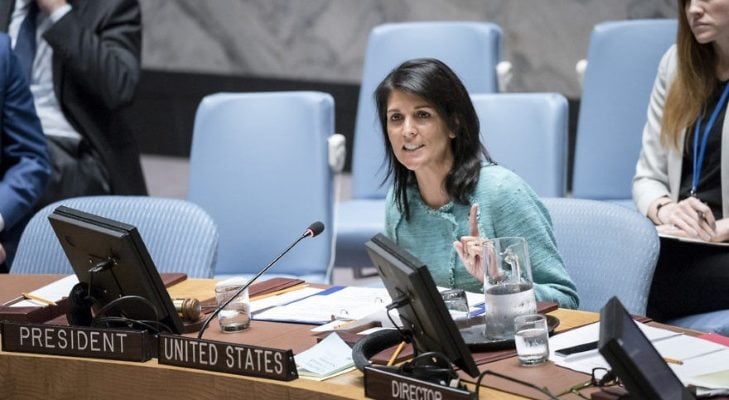
US Ambassador to the UN Nikki Haley (UN/Rick Bajornas)

Haley told the UN Security Council that Iran’s attack on Israel from Syria last weekend was a “wake-up call” to the world.

By: JNS.org

US Ambassador to the United Nations (UN) Nikki Haley told the Security Council on Wednesday that Iran’s drone incursion into Israel last weekend was a “wake-up call” to the world over the Islamic Republic’s belligerence in the Middle East.

An Iranian drone breached Israeli territory from Syria last weekend and was shot down by an IAF attack helicopter. As a result of the incursion, Israeli jets attacked a Iranian mobile command center near Damascus, where the drone originated from. However, Syrian forces responded with anti-aircraft fire at the Israeli jets, damaging one jet and forcing the pilots to eject after they crossed back into Israeli airspace.

Haley told the UNSC that the incident was an “egregious and unprompted escalation” by Iran.

“Iran was once again doing what it does—risking conflict and testing the will of its neighbors and opponents to resist its aggression,” said Haley. “Israel rightly took action to defend itself. The United States will always stand by our ally when confronted with provocations from Iran, Hezbollah or the Assad regime.”

Haley further asserted that “this incident shines a spotlight on the reality in Syria today. We are seeing actors engage in a dangerous game of pushing boundaries, instead of behaving responsibly and committing to peace.”

She added that “the Assad regime has become a front for Iran, Hezbollah and their allies to advance the irresponsible and dangerous agenda for the Middle East.”

The drone flight, she said, serves as “a wake-up call for all of us. Iran and Hezbollah are making plans to stay in Syria.”


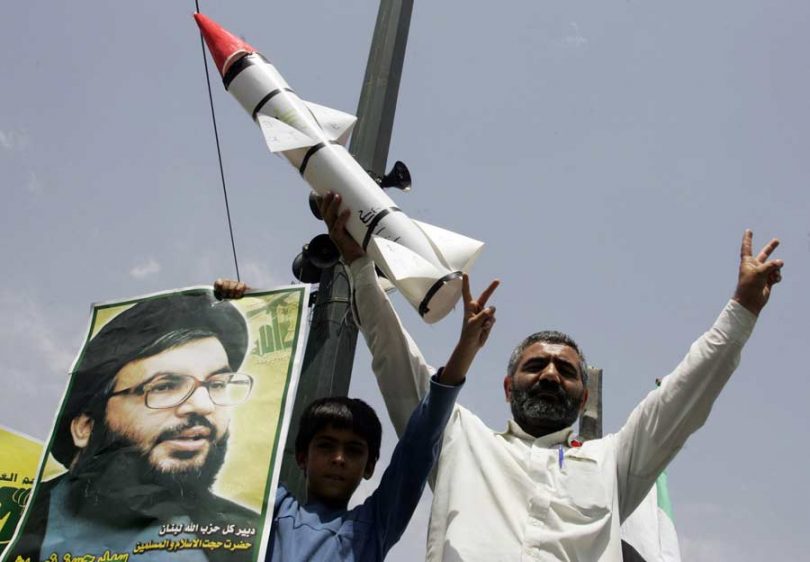
Pro-Hezbollah Website Says Group Could Have 500,000 Rockets Pointed at Israel in a Year

February 16, 2018

by TheTower.org Staff | 02.15.18 4:45 pm

Source Link:
Pro-Hezbollah Website Says Group Could Have 500,000 Rockets Pointed at Israel in a Year

{Ouch! – LS}

A pro-Hezbollah website boasted that in a year, the Iran-backed terror group could have 500,000 rockets, which, according to an expert, would give Hezbollah the ability to “saturate Israel with rockets,”making the next war “nasty,” Adam Kredo reportedWednesday for the Washington Free Beacon.

An article at the Dahiya website, a Lebanese pro-Hezbollah site, claimed that Syrian President Bashar al-Assad rejected a request by Russian President Vladimir Putin to remove the 70,000 missiles Iran has deployed across Syria. Assad, according to the article, has ordered his army to build and camouflage missile silos to allow Hezbollah to build its rocket arsenal in Syria alone to reach 500,000.

“The ability for Iran to move weaponry into Syria is only limited by Iran’s transportation fleet and what they have available in their arsenal,” Jonathan Schanzer, a former Treasury terror financing expert and currently senior vice president of the Foundation for Defense of Democracies told the Free Beacon. He added that this makes matters difficult for Israel as “Iran is exploiting the fog of war and it’s working.”

“The strategy may now be emerging: saturate Israel with rockets from two northern fronts and overwhelm their air defenses,” Schanzer assessed. “Israel has some big decisions ahead. The longer they wait to neutralize this threat, the more nasty that two-front rocket arsenal becomes.”


How Israel Could Take The Fight Directly To Iran

February 15, 2018

By Charles Bybelezer | The Media Line February 15, 2018

Source: How Israel Could Take The Fight Directly To Iran

{No more hiding behind proxies. – LS}

While conventional military options targeting Iran are unlikely, Israel nevertheless has options

The conflagration this past weekend between Israeli and Iranian forces is being billed as a new stage in the longstanding, albeit to date largely covert, war between the two adversaries. For the first time, Iranian troops perpetrated a direct attack on Israel; initially, by sending a drone across the border from Syria and then by firing the anti-aircraft missile that downed an IDF jet which had reentered Israeli airspace after conducting a retaliatory mission.

The events were significant both because of the success in downing the Israeli warplane, the first such occurrence in decades, but also because it evidences Iran’s growing foothold in the Syrian theater, a development that Jerusalem vehemently opposes and has vowed to prevent at all costs. Overall, Iran’s actions suggest that it feels sufficiently emboldened to use its own forces to harm the Jewish state.

According to Lt. Col. (ret.) Yiftah Shapir, a career officer in the Israeli Air Force and the former head of the Military Balance Project at Israel’s Institute for National Security Studies, the incident constitutes a strategic shift “as it marks the first occasion that the Iranians openly engaged Israel, whereas previously this was done via its proxies. It may be,” he qualified to The Media Line, “that the Iranians misjudged the [intensity of the] Israeli response and that the status quo will be restored for a period of time.”

By contrast, Saturday’s flare-up was not the first time that Israel directly struck Iranian assets. In December, the IDF reportedly destroyed a military facility being built by Tehran ​​in al-Kiswah, just south of Damascus. Notably, in 2015, Israeli strikes killed at least six Iranian troops in the Syrian Golan Heights, including a general in the Revolutionary Guard Corps. Also targeted was Jihad Mughniyeh, son of the notorious former Hizbullah operations chief Imad who was himself killed in an Israeli-attributed 2008 car bombing in Syria.

Furthermore, Israel’s Mossad has been implicated in the assassination of multiple nuclear scientists on Iranian soil, not to mention the deployment of the Stuxnet cyber-weapon, a computer worm developed in conjunction with Washington that wreaked havoc on Iranian nuclear installations even after being discovered in 2010.

So whereas the latest confrontation along the northern border was in some ways exceptional, it does not inevitably entail a long-term escalation or that the conflict be brought out into the open, albeit these are both distinct possibilities.

In fact, while the political and military echelons have made clear that Israel is not seeking an escalation, its so-called “red lines”—namely, the transfer of advanced weaponry to Hizbullah in Lebanon and Iran’s military entrenchment in Syria—continue to be violated; this, despite the IDF having conducted well over 100 cross-border strikes to protect its interests over the past eighteen months. Additionally, Iran has started construction on a subterranean facility in Lebanon to manufacture long-range precision missiles that could allow Hizbullah to target, with great accuracy, critical Israeli infrastructure in a future war.

Taken together, these developments raise the question of whether Israel’s deterrence vis-a-vis Tehran and its Lebanese proxy may be weakening, which would necessitate modifying its military strategy.

“Israel’s [decision-making process] now depends largely on what the Iranians and Hizbullah do moving forward,” Brig. Gen. (res.) Nitzan Nuriel, former director of Israel’s Counter-Terrorism Bureau, told The Media Line. “Throughout the years Israel has taken action all over [the region] to make sure that its interests are met. Israel needs to use all the tools available to it, including through its allies.”

While one incident is unlikely to cause a dramatic change in Jerusalem’s calculus, it is possible that the Israeli army could eventually adopt a page out of Tehran’s playbook by taking the fight directly to the Iranian heartland.

To this end, most experts agree that a full-scale military operation targeting Iran’s atomic facilities—the likes of which Prime Minister Binyamin Netanyahu reportedly advocated for in 2012 but which was shelved due to opposition from the defense establishment and the Obama administration—is currently off-the-table. While the debate previously centered on the ability to set-back Iran’s nuclear program by enough time to justify the risks, today the political climate has rendered the discussion moot.

The signing of the Iran nuclear deal in 2015 effectively ended the possibility for such a mission—the ramifications considered untenable. On the one hand, with the U.S. still committed to the agreement—in addition to Russia, China and European nations—the political fall-out from any major military foray into Iran would dwarf the backlash in the wake of the destruction of the Osirak nuclear reactor in Iraq in 1982 and the atomic facility in Deir ez-Zor, Syria in 2007. On the other hand, since the accord was forged Tehran has deepened its penetration into Lebanon, Syria and the Gaza Strip, all but ensuring that the targeting by Israel of its atomic infrastructure would ignite a war on all three fronts.

Moreover, as U.S. President Donald Trump mulls withdrawing altogether from the deal any Israeli action targeting Iran’s nuclear program—military or otherwise—could be self-defeating as it could hinder the American leader’s efforts to either re-impose “crippling” sanctions on the Islamic Republic or at the very least strengthen the atomic agreement by addressing, perhaps in a follow-on pact, Tehran’s ballistic missile program and regional adventurism.

Nevertheless, Israel has non-military options according to former Mossad chief Danny Yatom. “Israel should consider all possibilities, including targeting Iran directly, but as part of a grand strategy. I would not exclude the potential that Israel will also use proxies,” he contended to The Media Line. ”

This could include mobilizing the Peoples Mujahedin of Iran (MEK), for example, which may have carried out the killing of Iranian nuclear scientists on Israel’s behalf. Jerusalem has allegedly provided funding, training and possibly arms to the exiled anti-regime group.

The Paris-based MEK maintains a presence in Iraq and, covertly, in Iran, from where it has been accused of fomenting civil unrest including the recent week-long nationwide protests. Recently delisted by the U.S. as a terror group, it also purportedly has links to Saudi Arabia and therefore could act as an intermediary between the Jewish state and Riyadh to facilitate the coordination of their positions. The Iranian dissident organization also monitors Tehran’s nuclear program (in fact it was the first non-state actor to reveal it) and might therefore serve as an additional intelligence source for Israel moving forward.

It is a shadowy game no doubt, but the MEK, among other groups, could also be used as a conduit through which to convey Israel’s increasingly bold message to the Iranian masses; namely, that Jerusalem is not their enemy but, rather, the Mullahs themselves. In this respect, Netanyahu has numerous times over the past year directly addressed the Iranian people, reinforcing the fact that Israel marks a distinction between the regime and the population.

“Israel’s policy of speaking directly to the Iranian people is right, as today one can send messages not only via television, radio and written press but also through social media, which can reach millions,” Yatom stated. “Why not speak to the population over the heads of the Iranian regime?”

The Israeli premier, in conjunction with U.S. President Donald Trump, also publicly backed the recent demonstrations in Iran, suggesting that Jerusalem and Washington may be on the same page, readying to invest further energies into empowering the Iranian opposition with the aim of promoting regime change.

“It is very important to address the Iranian populace, as relations with Israelis were strong not only under the Shah but also historically there is no real animosity between Iran and Israel,” Eliezer Tzafrir, the former head of the Mossad station in Iran explained to The Media Line. “The Iranian youth wants a major departure from the radicalism. They want Internet, they want men and women to be able to publicly meet. One day they will succeed.”

Given the high stakes, Israel will in the near future like have to make some hard strategic decisions that could effectively chart its course for years to come. If it is serious about maintaining its qualitative military advantage—not in the region, mind you, but, rather, even along its borders—it may be forced to undertake significant operations in both Lebanon and Syria, which could very well lead to full-blown conflict.

“We cannot preclude the possibility that Israel will take action to destroy the factory [in Lebanon], especially because it says so clearly, which effectively makes it an obligation,” Yatom stressed. “There is a very big difference between tens of thousands of rockets in Hizbullah’s hands that are not as precise and those that can potentially hit specific buildings.

“In this case, the threat to Israel will be much more severe and it is better to deal with it before they produce the technology than after,” he continued. “We must take into consideration that if that happens it might ignite a medium- or large-scale military exchange. But it appears that the situation is going to deteriorate anyhow unless there will be a coherent international effort to push the Iranians out of Syria and put more restraints on Hizbullah.”

In the interim, Jerusalem might consider indirect action, allowing it to maintain plausible deniability while reducing the prospects of unintended consequences that could lead to a major intensification of the conflict. The impact of such a shot across the bow against the Iranian regime might resonate even more loudly given the proximity to home.


Palestinian Diplomat: ‘We’ll Keep Teaching Our Kids to Throw Rocks!’

February 15, 2018

By: The Tower and United with Israel Staff Feb 14, 2018

Source Link:
Palestinian Diplomat We’ll Keep Teaching Our Kids to Throw Rocks

{First rocks, then explosives.  Shouldn’t they be learning to throw footballs?  – LS}

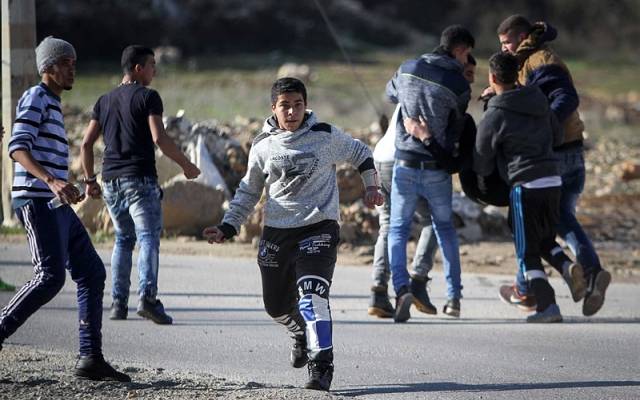
A member of the Palestinian delegation to the United Nations (UN) told a group of students that Palestinians are “very expert at throwing the stones” and that they would not stop teaching their children to do so, Ynet reported Tuesday.

In the recording obtained by Ynet,  Abdullah Abu Shawesh, who is both a senior adviser to the UN’s Development Group and a member of the Palestinian UN mission, told a group of visiting Canadian students from McGill University’s international relations program that the Palestinians “are very clever and very expert at throwing the stones. We are very proud to do that. We will not stop to learn our kids (to do that).”

“We are very proud that we are stone throwers. I’m one of them. Now I became a little bit older, but I stay resistant in the name of my kids,” he added.

Later, Abu Shawesh added details about  his own stone throwing during the first Intifada. “I was in high school. I never missed an opportunity to throw stones. This is our life. We develop our resistance every day. We’re proud of it.”

When informed of Abu Shawesh’s comments, Danny Danon, Israel’s Ambassador to the UN stated that “the Palestinians are no longer trying to hide the truth. The Palestinian leadership and its representatives are inciting against Israel and openly encouraging terrorism. The international community must not allow it.”

“It cannot be that inside the UN, which is supposed to make peace and protect human rights, a diplomat will incite to violence and terrorism, which wounds and even kills innocent Israelis,” Danon added.

Poisoning the Minds of Palestinian Children

The PA educational system routinely poisons the minds of Palestinian children by educating them to hate Israel and Israelis through terror-promoting messages. It even uses cultural mediums such as school plays, sports events and summer camps for this heinous objective.

Fatah, led by Palestinian Authority (PA) head Mahmoud Abbas, in December posted on its Twitter account a photo of a young boy using a slingshot to shoot stones, along with instructions on how best to throw rocks:

“In order to hit the target, there are three conditions,” the guide recommends. “1. Stand stably and balance your legs, arms, and body well. 2. Focus your gaze on the center of the target, and do not look at anything else. 3. Keep the desired balance between your body and your weapon. You are the one that controls the weapon, and not the other way around,” the guide stresses, according to a translation provided by Palestinian Media Watch (PMW), a watchdog that monitors Palestinian incitement to terrorism and anti-Semitism.

“If you did not understand this, read it again, and if you still have not understood, here is an example picture for you,” Fatah posted.


Israel said to fear Assad chemical weapons spillover into Golan Heights

February 15, 2018

In classified cable to envoys in 15 key countries, Foreign Ministry reportedly stresses Israel would respond to such a situation in ‘strongest possible terms’

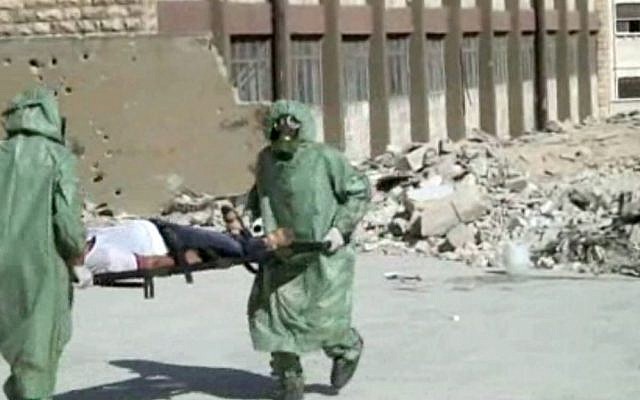
Illustrative photo: this image, from a video posted on September 18, 2013, shows Syrians in protective suits and gas masks conducting a drill on how to treat casualties of a chemical weapons attack, in Aleppo, Syria (AP)

The Foreign Ministry fears poison gas may leak into Israel if the Assad regime uses chemical weapons against rebels near the Golan Heights, and has reported warned of a punishing response should such a situation unfold.

The ministry sent a classified cable to 15 Israeli ambassadors around the world, providing the envoys with guidelines for sending strong messages against Iran, Syria and Hezbollah to their host countries, following last week’s infiltration of an Iranian drone and subsequent downing of an Israeli F-16, Channel 10 news reported Wednesday.

In acknowledging Jerusalem’s fear of chemical spillover into the Golan Heights, the cable directed the envoys to convey that “it must be made clear that such an incident would require Israel to respond in the strongest possible terms.”

The Foreign Ministry asked its ambassadors to emphasize to the senior political leaders in the countries where they are stationed that Iran’s entrenchment in Syria could increase the Islamic Republic’s desire to carry out additional attacks on Israel, which would lead to an escalation of hostilities in the entire region.

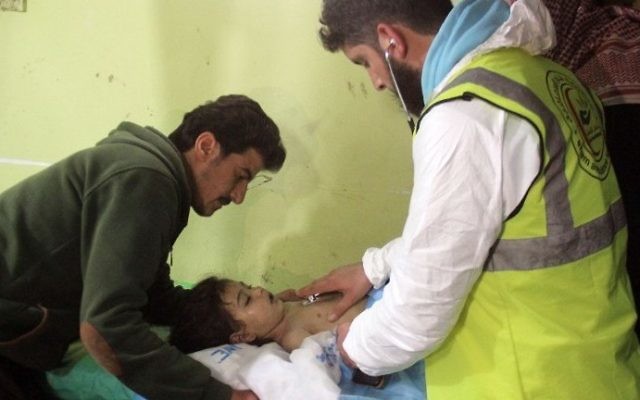
An unconscious Syrian child receives treatment at a hospital in Khan Sheikhun, a rebel-held town in the northwestern Syrian Idlib province, following a suspected toxic gas attack on April 4, 2017. (AFP Photo/Omar Haj Kadour)

“We must convey the message that Israel will not allow this and will defend itself, its citizens, and its sovereignty,” the cable said, according to the report.

In July 2012, a similar concern reverberated across Israel that terror groups could gain control of Syria’s large stockpile of chemical weapons. Officials at the time said Assad could transfer the weapons to the Hezbollah terrorist group. The number of gas masks distributed to civilians subsequently saw an immediate and significant rise.

The Syrian government on Wednesday denied it possessed chemical weapons and branded the use of such arms “immoral and unacceptable.”

A joint investigation team comprising experts from the UN and the Organization for the Prohibition of Chemical Weapons concluded that the Syrian government used chlorine gas in at least two attacks in 2014 and 2015 and used the nerve agent sarin in an aerial attack on Khan Sheikhoun last April 4 that killed about 100 people and affected about 200 others.

On February 1, Washington said Assad’s regime could be making new chemical weapons and warned it was considering fresh strikes against the regime.

Other messages that the Israeli envoys were asked to convey included calls on the international community to pressure Iran to halt its support of the Hezbollah terror group and to prevent the organization from purchasing and manufacturing precision missiles which could be used to target Israel, Channel 10 reported.

A senior Israeli official told Channel 10 that the ambassadors were asked to pass along the warnings in light of Jeruslem’s “sense” that the international community has not been taking Israel’s willingness to act against Iran’s entrenchment in Syria seriously.

A senior Syrian official on Tuesday warned Israel that it would face “surprises” if it launches any attacks on his country, claiming the Jewish state mistakenly thinks Syrian forces are incapable of defending the country.

Before dawn on Saturday, an Iranian drone was flown into Israeli airspace near the Jordanian border before it was shot down by an Israeli attack helicopter. Israel then conducted a series of airstrikes against positions in Syria, including the Iranian unmanned aerial vehicle’s mobile command center, according to the Israel Defense Forces.

Defense Minister Avigdor Liberman has since hinted that Israel would continue carrying out airstrikes where necessary, calling on Syria and Iran “to not be silly” or “provocative.”

During the reprisal raid, one of the eight Israeli F-16 fighter jets that took part in the operation was apparently hit by a Syrian anti-aircraft missile and crashed. The Israeli Air Force then conducted a second round of airstrikes, destroying between a third and half of Syria’s air defenses, according to IDF spokesperson Lt. Col. Jonathan Conricus.

Macron Vows to Reform Islam in France

February 14, 2018

“It is time to bring in a new generation.”

He can not even stop moslims praying in the streets .

  • The overall objective of President Macron’s plan is to ensure that French law takes precedence over Islamic law for Muslims living in the country.
  • The plan, as currently conceived, is vague and short on details, but appears to involve three broad pillars: determining who will represent Muslims in France; delineating how Islam in France will be financed; and defining how imams in France will be trained.
  • “It is time to bring in a new generation. We have seen fifteen years of debate to defend the interests of foreign states.” — Hakim el-Karoui, a French-Tunisian expert on Islam who is advising Macron on the reforms.

French President Emmanuel Macron, in a declared effort to “fight fundamentalism” and “preserve national cohesion,” has promised to “lay the groundwork for the entire reorganization of Islam in France.”

According to Macron, the plan, similar in ambition to Austria’s Islam Law, is aimed at seeking to “better integrate” Islam in France in order to “place it in a more peaceful relationship with the state.”

A key priority is to reduce outside interference by restricting foreign funding for mosques, imams and Muslim organizations in France. The plan’s overall objective is to ensure that French law takes precedence over Islamic law for Muslims living in the country.

In a February 11 interview with the Journal du Dimanche, Macron said that the plan, which is being coordinated by the Interior Ministry, will be announced within the next six months: “We are working on the structuring of Islam in France and also on how to explain it,” Macron said. “My goal is to rediscover what lies at the heart of secularism—the possibility of being able to believe as well as not to believe—in order to preserve national cohesion and the possibility of having free religious conscience.”

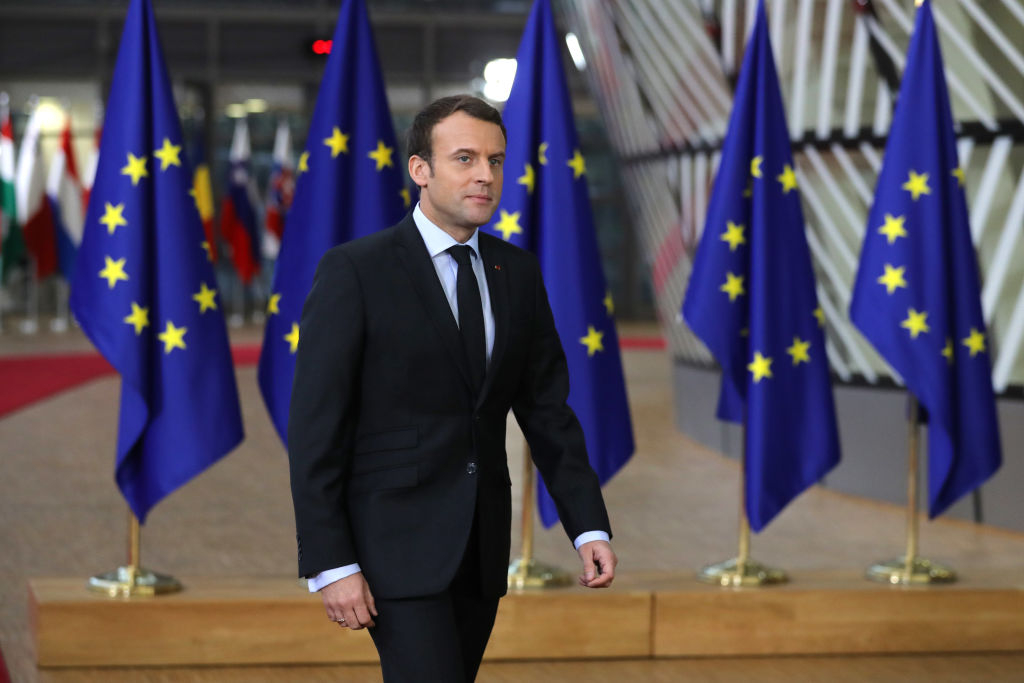
Emmanuel Macron, President of France. (Photo by Dan Kitwood/Getty Images)
Macron also said that he was consulting a broad array of experts and religious leaders for their input into the reform plan: “I see intellectuals and academics, such as [French Islam expert] Gilles Kepel, and representatives of all religions, because I think we need to draw heavily on our history, the history of Catholics and Protestants.” He added:

“I will never ask any French citizen to be moderate in his religion or to believe moderately in his God. That would not make much sense. But I will ask everyone, constantly, to absolutely respect all the rules of the Republic.”

Macron’s plan, as currently conceived, is vague and short on details, but appears to involve three broad pillars: determining who will represent Muslims in France; delineating how Islam in France will be financed; and defining how imams in France will be trained.

Representation of Muslims in France

A key aspect of Macron’s plan is to reform the French Council of the Muslim Faith (Conseil français du culte musulman, CFCM), the official interlocutor between Muslims and the state in the regulation of Islam in France. The organization, which represents approximately 2,500 mosques in France, was established in 2003 by then Interior Minister Nicolas Sarkozy.

The CFCM has long faced criticism for being ineffective and contentious, largely because the rotating presidency has allowed interference by foreign countries—mainly Algeria, Morocco and Turkey—seemingly to prevent Muslims from integrating into French society. Macron said the objective was to end what he called “consular Islam” and to open the CFCM to “the most integrated” Muslims.

“It is time to bring in a new generation,” said Hakim el-Karoui, a French-Tunisian expert on Islam who is advising Macron on the reforms. “We have seen fifteen years of debate to defend the interests of foreign states.”

The Interior Ministry intends to have its reforms in place by 2019, when the CFCM will hold elections to renew its leadership. “The moment is propitious for advancing the necessary reforms,” said Anouar Kbibech, former president of the CFCM.

Macron’s plan also reportedly involves establishing a “Grand Imam of France,” modeled on the position of Chief Rabbi. The individual would have the “moral authority” to represent Islam in front of the state. It remains unclear how such an individual would reconcile the competing strains of Islam to be able to represent them all.

Financing Islam in France

Macron’s second priority is to “reduce the influence of Arab countries,” which, he argues, “prevent French Islam from returning to modernity.” His plan would restrict foreign governments or entities from funding Muslim places of worship and training imams in France. Hundreds of French mosques are being financed by countries in the North African Maghreb and Persian Gulf.

The new plan would also attempt to illuminate the financial dealings of mosques by bringing them under the jurisdiction of a French law that regulates cultural associations. French mosques currently adhere to a law that regulates non-profit associations, which allows for more opaque bookkeeping.

Macron raised the possibility of revising the 1905 “Law on the Separation of the Churches and State,” which established state secularism in France. The 1905 law, among other provisions, banned government funding of religious groups in France. Addressing the prospect that French taxpayers might soon be asked to pay for Muslims to worship in France, Macron said: “The 1905 law is part of a treasure that is ours, but it did not consider the religious fact of Islam because it was not present in our society, as it is today.”

Macron’s plan reportedly also envisages establishing a so-called Halal Tax, a sales tax on halal products to finance Islam in France. The proposal faces fierce resistance from French Muslims, 70% of whom are opposed to establishing the tax, according to an Ifop poll for JDD.

Training Imams in France

Several hundred imams in France are civil servants whose salaries are paid by foreign governments. Interior Minister Gérard Collomb said the French government “should intervene” in the training of imams so that they are “imams of the French Republic,” not “imams of foreign countries.”

In an interview with Radio France Inter, Collomb said: “We can see that today we have a number of difficulties simply because nowadays everyone can proclaim himself to be an imam.”

Macron’s plan has been received with a mix of optimism, skepticism and derision.

Ghaleb Bencheikh, a French-Algerian Islamic reformist and a former president of the Great Mosque of Paris, said that Macron’s approach was “legitimate” and “interesting.” In an interview with Radio France, Bencheikh said:

“There is a terrible paradox that you have to know how to break. We are in a secular state and this sacrosanct principle of secularism stipulates that political authority should not interfere in the structure of a cult, whatever it may be. At the same time, there must be structure and privileged interlocutors of political power. The Muslim leaders are cautious, pusillanimous, they have not managed this structure. As a result, it is legitimate for both the President of the Republic and Interior Minister Gérard Collomb to insist on a healthy structure.”

Le Figaro noted with skepticism that previous French presidents have made similar pledges which ended in failure:

“Will Emmanuel Macron succeed where his predecessors have failed? The urgency, in any event, is very real. Last December, a Muslim leader from Bouches-du-Rhône declared: ‘The Salafists have taken control of the ground in France. There is a void, notably with the problem of imams who do not speak French.'”

In an interview with Les Echos, National Front Leader Marine Le Pen said she was worried about a possible challenge to the law separating churches and state: “There are a whole series of tracks, some of which are unbearable, unacceptable: for example, the idea of ​​a Concordat, the idea of ​​touching the law of 1905.”

She called for France to take hard line on foreign financing of Islam: “I suggest stopping foreign financing of mosques and closing Salafist mosques. Any foreign imam who makes a speech contrary to the values ​​of the Republic must be expelled.”

Florian Philippot, former vice president of the National Front and a Member of the European Parliament, said that Macron’s plan was not aimed at returning to a “secular Republic” but to “protect Muslims.”

In early January, during a meeting at the Elysée Palace with representatives of the six main religions in France (Catholic, Protestant, Orthodox, Muslim, Jewish and Buddhist), Macron announced that he would deliver a “major” but “dispassionate” speech on secularism during his presidency: “My wish for 2018 is that France become, with you, a model of secularism, knowing how to listen to the country’s voices in their diversity, capable of building on this diversity a great nation reconciled and open to the future.”

Less than a week later, however, Macron abruptly backtracked. The speech apparently was “removed from the agenda” because talking about secularism “in the context only of Islam” would be a “fatal mistake.”

Columnist Hélène Jouan accused Macron of trying to play both sides against the middle:

“Emmanuel Macron is credited with holding a subtle balance between unfailing attachment to Republican principles, and absolute firmness vis-à-vis radical Islam.

“The president prefers to evade. I’m not sure that this will last. A tragic event in France would push him, of course, to reveal himself, at the risk, then, of alienating those who would judge, from the right or left, that he does too much or not enough, to lose his position of ‘centrality’ which he thinks he holds on the question. In the meantime, however, he buys time.”

Iran, Russia, and China’s Central Role in the Venezuela Crisis

February 14, 2018

Iran Displays Nuclear-Capable Ballistic Missile at Parade Celebrating Revolution

February 14, 2018

by TheTower.org Staff | 02.13.18 11:32 am

Source Link: “Iran Displays Nuclear-Capable Ballistic Missile at Parade Celebrating Revolution

{Salami says it’s purely defensive, but if Europe tries to negotiate about the missile program, he will increase the range so it can hit Europe. Ha…what a bunch of baloney. – LS}

Iran displayed a nuclear-capable ballistic missile during parades celebrating the country’s 1979 revolution over the weekend, reinforcing concerns that it is in violation of the United Nations Security Council Resolution implementing the nuclear deal, the Washington Free Beacon reported Monday.

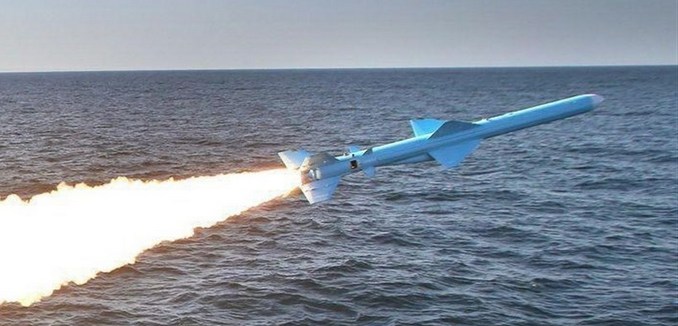
The Ghadr (or Qadr) missile, according to Iranian military officials “can be launched from mobile platforms or silos in different positions and can escape missile defense shields due to their radar-evading capability,” according to accounts appearing in Iran’s state-controlled media. Israel is within the range of the missile when launched from Iranian territory.

“Thirty-nine years in, the Islamic Revolution has little to show for its decades in power other than growing the country’s asymmetric military capabilities in order to continue their export of the revolution,” Behnam Ben Taleblu, an expert on Iran with the Foundation for Defense of Democracies, said. “The Islamic Republic has considerably grown the country’s missile and rocket arsenal, both through production and procurement.”

Taleblu also told the Washington Free Beacon, “The Ghadr can strike Israel when fired from Iranian territory, and in March 2016, was flight-tested while bearing genocidal slogans against the state of Israel.” He was referring to a test launch of a missile that had the phrase “Israel must be wiped off the Earth,” written on it in Hebrew.

UN Security Council Resolution 2231 formalized the 2015 nuclear deal with Iran, “calls upon Iran not to undertake any activity related to ballistic missiles designed to be capable of delivering nuclear weapons, including launches using such ballistic missile technology.”

In December of last year, both France and Germany reiterated their opposition to Iran’s continued ballistic missile development and called on the Islamic Republic to give up “its hegemonic temptations.”

France and Germany joined the United States and the United Kingdom in August 2017 in sending a letter to UN Secretary General António Guterres, charging that Iran’s launch of a satellite violated resolution 2231.

President Donald Trump, in October 2017, said that he would not certify Iran’s compliance with the nuclear deal and demanded that four aspects of the deal be fixed or he would no longer waive the sanctions that were lifted as part of the accord. Trump has demanded that: new negotiations eliminate the sunset provisions of the deal that allow Iran to develop an industrial scale uranium enrichment program by the deal’s end, prohibit Iran from developing ballistic missiles, ensure “anytime, anywhere” inspections so that Iran will have to allow inspectors into its military sites, and target Iran for sanctions for its human rights violations and support for terror.

Although Iran insists that its ballistic missile program is purely defensive, in November 2017 Hossein Salami, the lieutenant commander of Iran’s Islamic Revolutionary Guard Corps (IRGC), threatened that if Europeans insisted on negotiating over Iran’s missile program, Iran would increase the range of the missiles to reach Europe.

Iran has tested ballistic missiles capable of reaching Israel and reportedly used a Star of David as a target for one of its ballistic missile tests.

A UN report last week found that Iran had supplied ballistic missiles to Houthi rebels in Yemen. This would be a violation of Resolution 2231, which also prohibits Iran from transferring weapons—both conventional weapons and ballistic missiles—to other countries.


Up to 200 Russian advisers killed in last week’s clash with US forces in Syria 

February 13, 2018

Source: Up to 200 Russian advisers killed in last week’s clash with US forces in Syria – DEBKAfile

 In the first military clash between US and Russian forces in Syria, more than 200 Russian “mercenaries” are reported killed, scores more injured. 


US military sources first  reported that 100 Russian “advisers” were killed and dozens injured in a US attack on Syrian and allied pro-Iranian forces on Feb. 8. By  Tuesday, Feb. 13, those figures had doubled. Moscow has not confirmed the incident or the casualties, which would be five times more than Russian official losses since it entered the war in 2015. President Vladimir Putin’s spokesman, Dmitry Peskov, declined to comment, saying the Kremlin only tracks data on the country’s armed forces. According to one Russian officer, the death toll continues to rise after scores of Russian wounded were flown to hospitals in Moscow and St. Petersburg.

DEBKAfile’s military sources reported exclusively on Feb. 9 that US special forces had struck Russian military engineers laying a floating bridge on the Euphrates River near Deir ez-Zour for Syrian army, Hizballah and other pro-Iranian forces to cross to the east bank. That engagement unfolded when US forces posted in eastern Syria repelled a Syrian-pro-Iranian attack led by T-72 and T-55 tanks on a base held by American and US-backed Syrian Democratic Forces east of the Euphrates River near the oil town of Tabiye.

The strike force was fighting under the command of Iranian Revolutionary Guards officers. It included members of the Afghan Shiite militia imported by Tehran, pro-Assad troops of the Syrian National Defense Forces, local Arab tribesmen and Russian mercenaries. Those mercenaries were provided by Wagner, a Russian private military contractor, which supplies ground forces to fight for Assad alongside the pro-Iranian and Russian combatants.

Against that fighting strength, the Americans used F-22 Raptors, F-15 Strike Eagles, Air Force AC-130 gunships, Marine artillery and Army Apache attack helicopters, as well as Special Operations forces, which stopped the multiple assault in its tracks.

Damascus warns Israel of ‘more surprises’ in Syria

February 13, 2018
Syrian government official warns Israel of ‘more surprises’ being in store in the wake of the downing of the F-16 jet that attacked Iranian positions in the country Saturday; ‘God willing they will see more surprises whenever they try to attack Syria,’ the assistant foreign minister said.
https://www.ynetnews.com/articles/0,7340,L-5111825,00.html

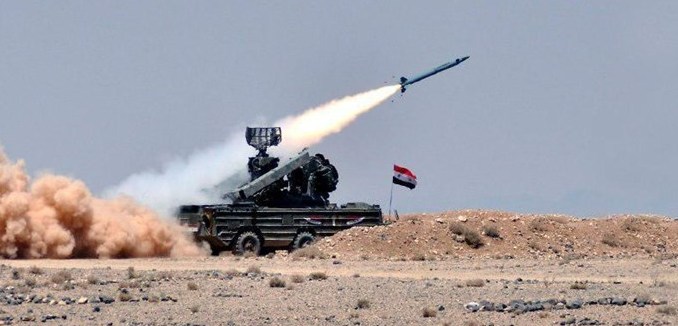
The Syrian government said on Tuesday that Israel would face “more surprises” in future attacks on Syria’s territory, after Syrian air defenses shot down an Israeli F-16 jet during the fiercest flare-up between the old foes in 36 years.

Syrian anti-aircraft fire downed the F-16 as it returned from a retaliatory bombing raid on Iran-backed positions in Syria after the incursion of an Iranian drone into Israeli airspace early on Saturday. Both Iran and Russia are supporting President Bashar Assad in Syria’s near seven-year civil war.”Have full confidence the aggressor will be greatly surprised because it thought this war—this war of attrition Syria has been exposed to for years—had made it incapable of confronting attacks,” assistant foreign minister Ayman Sussan said.

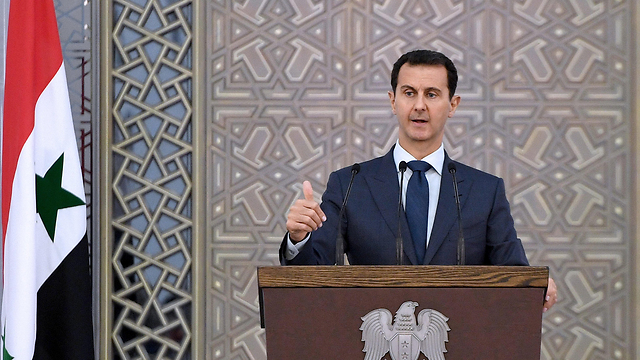
An official in Bashar al-Assad's regime said Syria had 'more surprises' in store for Israel (Photo: EPA)

An official in Bashar al-Assad’s regime said Syria had ‘more surprises’ in store for Israel (Photo: EPA)

“God willing they will see more surprises whenever they try to attack Syria,” Sussan said during a Damascus news conference.The downed F-16 was the first warplane Israel has lost to enemy fire since its 1982 Lebanon war. Its two-man crew survived, with injuries, after bailing out of the stricken jet.

Israel retaliated by destroying around half of Syria’s anti-aircraft batteries, according to an initial assessment shared with Reuters by an Israeli official who requested anonymity.

Prime Minister Benjamin Netanyahu said on Sunday that Israeli forces would press ahead with Syria operations in Syria, where it has launched scores of sorties against suspected arms transfers to Iranian-sponsored Lebanese Hezbollah terrorists.In Kiryat Shmona on Tuesday, Defense Minister Avigdor Lieberman told reporters, “There are no limitations (on military operations), and nor do we accept any limitations … We will respond to every provocation.”

“We will continue to defend our vital security and other interests. And I would like to paraphrase the well-known saying: ‘This is not the time to bark, this is the time to bite.'”

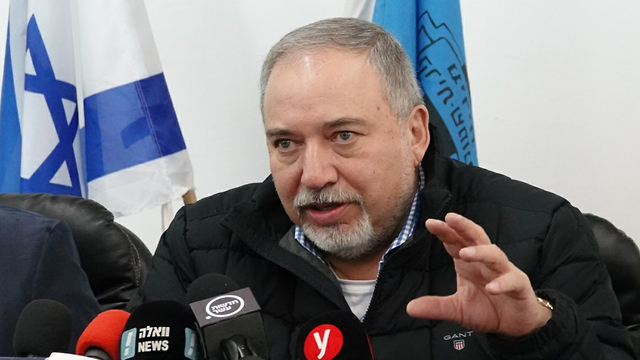
Defense Minister Lieberman said, 'Now is the time to bite' (Photo: Effi Sharir)

Defense Minister Lieberman said, ‘Now is the time to bite’ (Photo: Effi Sharir)

Tehran’s involvement in Syria, including the deployment of Iran-backed forces near the Golan Heights, has alarmed Israel. It has also has accused Iran of building precision-guided missile factories for Hezbollah in Lebanon.

Syria and Hezbollah celebrated the F-16 shoot-down as a blow to Israeli military superiority. Israel’s Army Radio said on Tuesday that investigators believed pilot error—rather than Syrian capabilities—were mainly at fault for the F-16’s failure to evade what was probably an aged SA-5 missile.

Saturday’s incident stirred up further questions in Israel about the effectiveness of a coordination mechanism set up with Russia, which has also been reinforcing and arming Assad’s army.

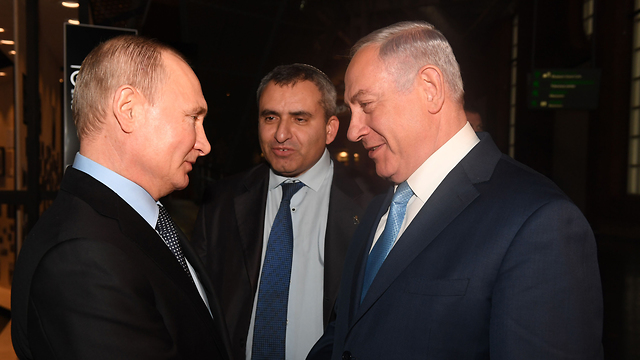
Russian President Vladimir Putin responded to the flare-up by urging Prime Minister Netanyahu to avoid escalation in Syria. Moscow said on Monday it did not have information to support Israel’s allegation about an Iranian military presence in the site bombed for launching the drone.

Minister Elkin (center) was present at the meeting between Russian President Putin (L) and PM Netanyahu (Photo: Kobi Gideon/GPO)

Minister Elkin (center) was present at the meeting between Russian President Putin (L) and PM Netanyahu (Photo: Kobi Gideon/GPO)

Ze’ev Elkin, a Russian-speaking Israeli cabinet minister who serves as Netanyahu’s interpreter in the talks with Putin, defended the coordination mechanism on Tuesday as granting Israel “freedom of action in the skies above Lebanon and Syria.”

“I don’t think the Russians ever pledged that they would take military action against the Iranians and the Syrians for us,” Elkin told Israel Radio.

“We are going one-on-one against the Syrians. We don’t need assistance from the Russians. We know how to deal with Syrian anti-aircraft fire, as everyone ultimately saw.”