The Defense Department has awarded a $6.56 billion contract to the Boeing Company to oversee another expansion of the missile defense base at Fort Greely in Alaska. (Photo/KUAC/
OAN Newsroom UPDATED 8:34 AM PT — Tues. February 20, 2018
The Pentagon is expected to release a major review on ballistic missile defense in the coming weeks.
$12.9 billion is requested for ICBM defense in the Pentagon’s 2019 budget proposal.
The White House budget proposal says more funding will go toward the capability and capacity for the U.S. to detect, defeat, and defend against North Korea.
The budget includes over nine billion dollars for the Missile Defense Agency.
It also requests billions more for interceptor missiles, an additional missile field in Alaska, and an increase in deployed interceptors by 2023.
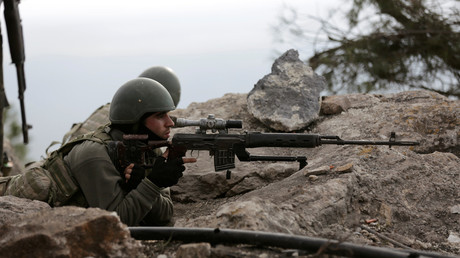
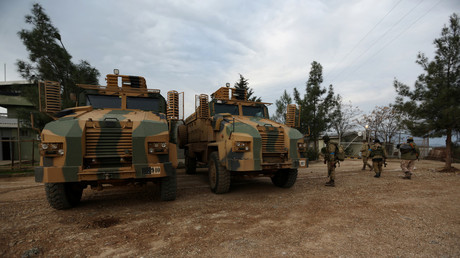
Turkish troops will encircle the Kurdish-held Syrian city of Afrin “in the coming days,” effectively starting its siege, President Recep Tayyip Erdogan told ruling party MPs, local media reported.
Speaking to members of the ruling Justice and Development Party’s (AKP) on Tuesday, Erdogan said the city center of Afrin will soon be besieged by advancing Turkish troops and allied Syrian militias, according to Hurriyet.
“Preparations in the field take some time. In the coming days, we will lay siege to Afrin city; it’s very important that everywhere we go should remain secure,” Erdogan said, as cited by Hurriyet. He added: “Thanks to the siege, the YPG will have no room for bargaining with the Syrian regime.”
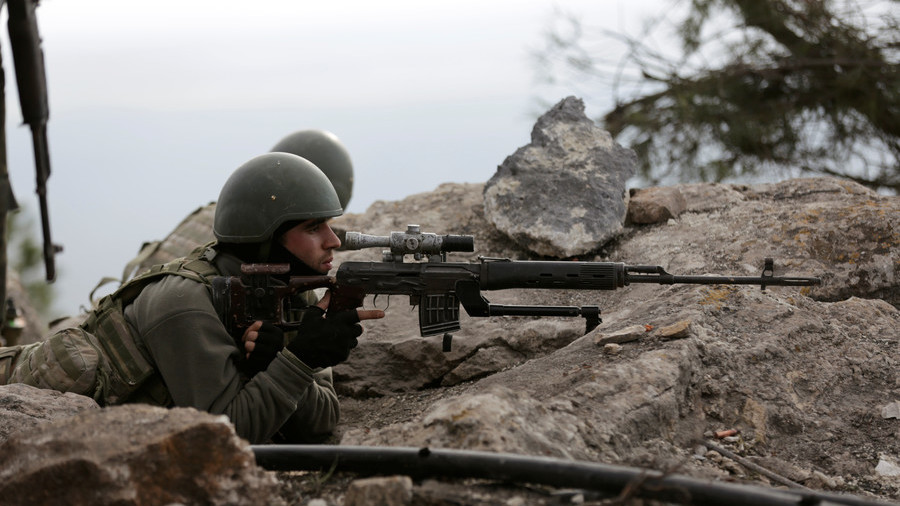
Erdogan’s statement comes as Turkish troops are advancing towards Afrin, “liberating” village after village. The offensive, codenamed Operation Olive Branch, was launched in January this year with the stated goal of driving the Kurdish YPG militia group – deemed a terrorist organization in Turkey – out of the area.
On Tuesday morning, the Turkish military said the troops had “neutralized” 74 Kurdish and Islamic State (IS, formerly ISIS) fighters, increasing the number of slain militants to 1,715.
“The ground operation, supported by air- and ground-based fire support assets, continues successfully as planned,” it added.
Earlier this week, media reports emerged suggesting an agreement has been reached between the local Kurdish administration and Damascus, under which Syrian pro-government forces would be allowed to enter the area. On Monday, Syrian media reported that government troops would arrive in Afrin “within hours.”
However, no official confirmation of the news has been announced, with Kurdish officials denying that such an agreement exists. “There is no agreement; there is only a call from us for the Syrian army to come in and protect the borders,” YPG spokesman Nouri Mahmoud told Reuters by phone on Monday.
Ankara has threatened to confront Syrian forces if they come to the aid of the Kurds, and also dismissed reports on the Kurdish-Syrian deal.
“If the regime enters [Afrin] to clear out the YPG, then there is no problem,” Turkish Foreign Minister Mevlut Cavusoglu said on Monday, as cited by state news agency Anadolu. However, he added: “If they are entering [Afrin] to provide protection to the YPG, then no one can stop Turkey or Turkish soldiers.”
Meanwhile, experts say Syrian leader Bashar Assad and his government are now playing a key role in stabilizing the situation in and around Afrin. “It is ironic because both the Kurds and the Turks at different times stated their absolute condemnation of the Syrian government and unwillingness to deal with President Assad or his government,” Danny Makki, Syria commentator, told RT.
Now both regional actors are looking at Assad as “some sort of peacemaker,” Makki said. While Turkey, which is losing soldiers and armor, is desperate to end the fighting, the Kurds would prefer to do a deal with Damascus rather than make one with the Turks “on very weak terms,” he suggested.
“The US and Israeli leaders don’t know Iran and don’t understand the power of resistance and therefore, they continuously face defeat.”
Any attacks carried out against Iran will result in the destruction of Tel Aviv, Mohsen Rezaei, secretary of Iran’s Expediency Council, warned Israel on Monday, according to the Fars News Agency.
Quoted by Iran’s semi-official government news site, Rezaei, in response to Netanyahu’s comments at the Munich Security Conference, asserted that “If they [Israel] carry out the slightest unwise move against Iran, we will level Tel Aviv to the ground and will not give any opportunity to Netanyahu to flee.”
“The US and Israeli leaders don’t know Iran and don’t understand the power of resistance and therefore, they continuously face defeat,” he was quoted as saying in an interview with Lebanese Hezbollah-affiliated Al Manar News.
“Today, the situation of the US and Israel indicate their fear of the Zionist regime’s collapse and the US decline,” he added in the interview.
Israel came in direct conflict with Iran on February 10, when an IAF attack helicopter shot down an Iranian operated drone, and later took out its command center in Syria.
According to the Iranian Mehr News Agency, Rezaei also highlighted that, while it is true that Iran supports what it calls the “Resistance Front” which stretches from Tehran to Gaza, the regime does not interfere in the Palestinian Territories and Lebanon but merely offers advisory help.
He added that Iran never wants to dominate the countries in the region, it wants them to stand on their own feet. {LOL – LS}
Rezaei’s pointed comments came in response to Netanyahu’s speech at the Munich Security Conference on Sunday where the Israeli prime minister warned Iran, “not to test Israel’s resolve.”
Netanyahu said at the conference, which was attended by Iranian Foreign Minister Javad Zarif, that Israel “will act not just against Iran’s proxies that are attacking us, but against Iran itself.”
Commenting on the Islamic Republic’s influence in region, Netanyahu emphasized that through nefarious moves in Yemen, Iraq, Syria, Lebanon and Gaza, Iran is trying to change the status quo. If they do change the status quo, he said, the rule he will follow is one established by the early Zionists when dealing with problems: “They said nip things in the bud, stop them before they get big. That’s basically what our policy is.”
Zarif, who addressed the conference later in the day, dismissed Netanyahu’s presentation as a “cartoonish circus, which does not even deserve a response.”
“We have stated many times that we won’t accept the statements that Israel, as a Zionist state, should be destroyed and wiped off the map.”
Russian Foreign Minister Sergei Lavrov attends a meeting in Moscow, Russia. (photo credit: SERGEI KARPUKHIN/REUTERS)
Russian Foreign Minister Sergey Lavrov chastised Iran on Monday for calling for Israel’s destruction during a panel discussion in Moscow where Iran’s Foreign Minister Javad Zarif was sitting with him on the dais.
“We have stated many times that we won’t accept the statements that Israel, as a Zionist state, should be destroyed and wiped off the map. I believe this is an absolutely wrong way to advance one’s own interests,” Lavrov said in Moscow at the Valdai International Discussion Club conference entitled “Russia in the Middle East: Playing on All Fields.”
The two-day conference brought together heads of think-tanks throughout the Middle East, from Libya to Iran, including Dore Gold, head of the Jerusalem Center of Public Affairs, and Amos Yadlin, who heads the Institute for National Security Studies in Tel Aviv.
Gold, a former director-general of the foreign ministry, was in the audience for Lavrov’s statement, and deemed it – being said in the presence of Zarif – as very significant, “because it is blatant criticism by the foreign minister of Russia of their Iranian ally.”
Asked how Zarif responded, Gold said the Iranian diplomat just smiled, adding that, “he is very good at smiling.”
“By the same token” Lavrov continued, “we oppose attempts to view any regional problem through the prism of fighting Iran.”
According to Lavrov, the US position on issues such as Syria, Yemen, and “even the latest developments around the Palestinian issue – including Washington’s announcement of its decision to recognize Jerusalem as the Israeli capital – are largely motivated by this anti-Iranian stance.”
Zarif, in his comments, referred to last week’s incident on the northern border where the incursion of an Iranian drone led Israel to shoot it down and attack Syrian and Iranian installations inside Syria. An Israeli F16 was shot down during those attacks.
“Israel has violated Syrian sovereignty. So for the first time in 36 years, Syrian defense forces managed to bring down an Israeli plane. Is this a catastrophe? Is this a strategic complication, or is the fact that Israel violated the airspace of a sovereign state a strategic catastrophe?” Zarif asked.
He continued: “Israel has to put a stop to its aggression. Don’t look for excuses, such as drones. We need to stop this aggression, and if anyone takes such an action against another country, it is possible to react.”
On Sunday at the Munich Security Conference, which Zarif also attended, Prime Minister Benjamin Netanyahu displayed a piece of the downed drone and confirmed that Iran has been denying that it sent the unmanned aerial vehicle.
“Well, here’s a piece of that Iranian drone, or what’s left of it after we shot it down,” Netanyahu said. “I brought it here so you can see for yourself. Mr. Zarif, do you recognize this? You should – it’s yours.”
Israel has successfully tested it’s newest Arrow-3 missile in it’s Arrow Missile Defense System:
FOX NEWS – Israel successfully tested its new Arrow missile defense system Monday, the Defense Ministry announced in a tweet, the accomplishment capping a program that’s seen a series of delays and cancellations.
The test was carried out in cooperation with the United States’ Missile Defense Agency.
“A short while ago, the Defense Ministry and American MDA carried out a planned flight test of its Arrow weapons system, with an Arrow 3 interceptor,” the Defense Ministry tweeted. “The Arrow 3 interceptor was launched and carried out its mission.”
The test came after several aborted attempts in recent months. In January, an exercise was called off because of a communication glitch that resulted in a data transfer problem. In December, a test was canceled after safety concerns arose when the Anchor-type target missile — which was fired from a jet — experienced a malfunction.
“The experiment we conducted today was very complex,” Boaz Levy, Deputy CEO of Israel Aerospace Industries and manager of its Systems, Missiles & Space Group, said in a statement. “In the experiment, the interceptor simulated a full military scenario and the rocket did the route in full. And, if it had a real target, would have hit it. We are very pleased with the result.”
Israel Aerospace Industries worked together with Boeing to develop the Arrow-3.
Moshe Patel, the director of Israel’s Missile Defense Organization, said in a statement that a more advanced test is scheduled in Alaska later this year.
“The Arrow-3 is designed for long-range threats, as well as unconventional threats,” said Patel, appearing to hint at Iran’s ballistic capabilities. “We are aiming for 100 percent success rate.”
Sweet! It’s awesome to see Israel successful in testing its defense systems in order to protect itself against ballistic missile threats from Iran.
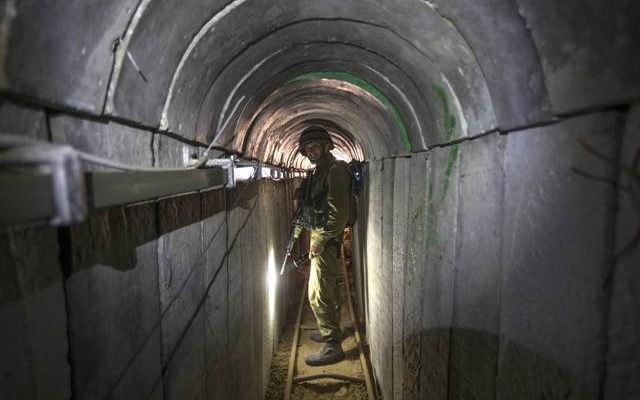
As the Israeli Air Force pounds Hamas targets for the second time in 48 hours in reaction to a rocket attack, Defense Minister Liberman confirmed that Israel destroyed a fifth Hamas tunnel.
By: Batya Jerenberg, World Israel News
Hours after a rocket landed in open territory in Israel after being shot from the Gaza Strip Sunday night, Israel hit back with several airstrikes, including hitting what the IDF called “underground infrastructure.” The euphemism was clear to those used to reading between the lines of military-speak, but Defense Minister Avigdor Liberman openly called it what it was later in the day.
“Last night, we destroyed a terror tunnel near Kerem Shalom,” he said Monday at the weekly meeting of his Yisrael Beytenu faction in the Knesset.
No other details about the target were forthcoming.
This was the second day in a row that a terror tunnel was struck. On Sunday, the IDF confirmed that 18 Hamas targets were hit overnight Saturday following the wounding of four Israeli soldiers by explosive devices hidden at the Gaza Strip’s border fence earlier that day. According to Palestinian reports, Israeli jets fired around 10 missiles at a Hamas tunnel located in an agricultural area east of Rafah.
This is by now the fifth time in recent months that Israel has destroyed such an underground passageway emanating from the Hamas-ruled territory. In October, the IDF used explosives to blow up an attack tunnel belonging to the Palestinian Islamic Jihad group, killing 14 terrorists, including two senior commanders. In December, using unspecified means, the army demolished a kilometer-long Hamas tunnel that began in Khan Younis and extended hundreds of meters into Israel. And just last month, the military destroyed a Hamas tunnel that crossed into Israel under the Kerem Shalom Crossing, through which hundreds of trucks bring goods into Gaza every day.
Over the past year, the army has been constructing an underground barrier around the Gaza Strip that is meant to block attempts to dig into Israel. The discovery of existing tunnels has been credited to a combination of unspecified cutting-edge technology and intelligence work
The Russian foreign minister stressed today that Moscow does not support the Iranian calls for Israel’s destruction. “We have stated many times that we won’t accept the statements that Israel, as a Zionist state, should be destroyed and wiped off the map,” the top diplomat said, as quoted by TASS.
Russian President Vladimir Putin and Iranian President Hassan Rouhani Photo Credit: http://www.kremlin.ru
Russian Foreign Minister Sergey Lavrov issued a rare rebuke of Tehran on Monday as he sat next to his Iranian counterpart. Speaking at the opening of the Valdai International Discussion Club’s conference in Moscow, Lavrov slammed Iran’s calls for Israel’s destruction.
“We have stated many times that we won’t accept the statements that Israel, as a Zionist state, should be destroyed and wiped off the map. I believe this is an absolutely wrong way to advance one’s own interests,” Lavrov said, as quoted by Russia’s TASS News Agency.
“By the same token, we oppose attempts to view any regional problem through the prism of fighting Iran,” he stressed. “This is happening in Syria, Yemen and even the latest developments around the Palestinian issue, including Washington’s announcement of its decision to recognize Jerusalem as the Israeli capital, are largely motivated by this anti-Iranian stance.”
Yesterday evening, Iranian Foreign Minister Mohammad Javad Zarif responded to a warning that Israeli Prime Minister Benjamin Netanyahu issued at the Munich Security Conference earlier that day. “Israel will not allow the regime to put a noose of terror around our neck,” Netanyahu said. “We will act if necessary not just against Iran’s proxies but against Iran itself.”
“Well, if they try to exercise that threat, they will see the response,” Zarif told NBC’s Bill Neely in an interview.
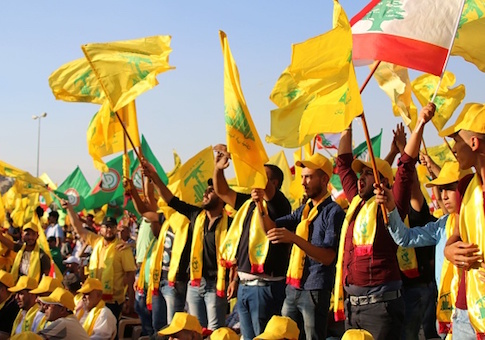
A top Trump administration official this week said the United States see a role for the Iranian-backed terror organization Hezbollah in political discussions about the future of Lebanon, a decision that is raising concerns about internal divisions inside the Trump administration, according to recent statements and sources close to the administration who spoke to the Washington Free Beacon.
Secretary of State Rex Tillerson, in remarks during a trip through the Middle East this week, said the United States recognizes Hezbollah is part of the political process in Lebanon as global leaders gather to discuss the Middle Eastern country’s future.
Despite the terrorist group’s unhelpful influence, Tillerson said “we also have to acknowledge the reality that they also are part of the political process in Lebanon.”
Tillerson’s remarks raised eyebrows in Washington, D.C., where some foreign policy officials questioned how the United States would hold diplomatic discussions with Hezbollah as the Trump administration also works to dismantle the group and crush its financial networks.
The comments starkly contradict efforts by the U.S. Treasury Department, which declared earlier this month that Hezbollah has no legitimate role to play in governance of Lebanon or other Arab countries Iran is seeking to destabilize.
Some officials remain concerned that treating Hezbollah as a legitimate actor in Lebanon—where it has amassed thousands of Iranian-built missiles on Israel’s northern border—will provide legitimacy to the terror group and make it even more difficult for the Trump administration to target it with sanctions.
Speaking in Jordan on Wednesday, ahead of his travel to Beirut, Tillerson told reporters that Hezbollah must be part of any political process discussing Lebanon’s future following the resignation of the country’s prime minister, who disclosed upon his resignation that Hezbollah has assumed de facto control of the nation.
“We support a free, democratic Lebanon free of influence of others, and we know that Lebanese Hezbollah is influenced by Iran,” Tillerson said. “This is influence that we think is unhelpful in Lebanon’s long-term future.”
However, “we also have to acknowledge the reality that they also are part of the political process in Lebanon,” Tillerson said. “I think Lebanon is taking positive steps with their law on disassociation that was passed last year to send a signal as to their view that they do not want to see any of Lebanese Hezbollah involved in foreign conflicts and have asked that they bring all of their people back from the conflict in Yemen.”
Though Tillerson subsequently gave a speech that seemed to walk back his previous comments, his initial remarks drew criticism, where some foreign policy analysts accused him of boosting and legitimizing Hezbollah’s role.
Asked on Thursday afternoon to clarify Tillerson’s remarks, a State Department official told the Free Beacon that while Hezbollah must be part of the political process regarding Lebanon’s future, the administration still considers it a terrorist organization.
“No, absolutely not,” a State Department officials said in response to questions about whether the administration sees a future for Hezbollah in Lebanon. “As the secretary said this morning in his press avail with Prime Minister Hariri in Beirut, ‘The United States has considered Hezbollah a terrorist organization for more than two decades.'”
The latest comments by Tillerson could signal internal disagreement in the Trump administration about how to deal with Hezbollah in Lebanon. As the State Department seeks to bring it into the political process, the Treasury Department has amped up efforts to sanction the terror group and dismantle its financial networks.
“Hezbollah is a terrorist organization responsible for the death of hundreds of Americans, “Secretary of the Treasury Steven Mnuchin said in a statement earlier this month announcing tough new sanctions on Hezbollah.
“It is also Iran’s primary proxy used to undermine legitimate Arab governments across the Middle East. The administration is determined to expose and disrupt Hezbollah’s networks, including those across the Middle East and West Africa, used to fund their illicit operations,” Mnuchin said. “The Treasury Department will continue to sever Hezbollah from the international financial system, and we will be relentless in identifying, exposing, and dismantling Hezbollah’s financial support networks globally.”
Asked about the State Department’s clarification, an Iran policy expert who has worked closely with the Trump administration on the issue said it shows signs that the administration is divided about how to approach the problem.
“The sad truth is the Trump administration doesn’t have a coherent policy on Lebanon. The president knows what he wants, which is to aggressively roll Iran back. There are parts of the administration where people seem committed to carrying out his policy, like Treasury’s sanctions division, which has been trying to sanction Hezbollah into the stone age,” according to the expert.
“But then you’ve got the State Department, which seems committed to maintaining a role for Hezbollah, and therefore Iran, in Lebanon. It’s from top to bottom. Even our ambassador in Beirut is an Obama holdover who sends along manufactured cables and papers about how Hezbollah is part of Lebanon’s political process. They’re barely even trying to hide it.”
Clifford May, founder and president of the Foundation for Defense of Democracies, said there should be no ambiguity in U.S. policy towards Hezbollah, an armed terror group responsible for the deaths of Americans.
“Secretary Tillerson’s initial statement was, at best, ambiguous. His subsequent clarification was not,” May said. “Hezbollah is a terrorist organization responsible for the slaughter of hundreds of Americans. It is the obedient agent of the Islamic Republic of Iran.”
“There is no separation between its military and political wings—they are attached to the same bird,” May said. “Hezbollah’s armed forces are dominant in the country—the Lebanese Armed Forces are no match—and they answer to Tehran. I expect Secretary Tillerson understands all that and will, sooner rather than later, act on that understanding.”
A Treasury Department spokesman declined to comment on the matter.
Turkish forces are seen at Mount Barsaya in northeast of Afrin, January 28, 2018 / Khalil Ashawi / Reuters
On the back of reports that Syrian pro-government forces are to enter Afrin, Ankara said “no one can stop” its soldiers if “the regime” comes to help Kurdish militias, but added that Syrians fighting them will be “no problem.”
Turkish troops will respond to Syrian pro-government forces entering the northwest Afrin province depending on their objective, Turkey’s Foreign Minister Mevlut Cavusoglu said on Monday after meeting his Jordanian counterpart Ayman Safadi in Amman.
“If the regime enters [Afrin] to clear out the YPG, then there is no problem,” Cavusoglu said, as cited by state news agency Anadolu. However, he added: “If they are entering [Afrin] to provide protection to the YPG, then no one can stop Turkey or Turkish soldiers.”
The minister’s remarks follow media reports indicating that pro-government Syrian forces are expected to enter Afrin in a matter of hours. Earlier on Monday, Syria’s news agency SANA reported the troops are preparing to move into the province to support the locals “facing aggression” from Turkey.
Earlier, adviser to the Kurdish administration Badran Jia Kurd said a deal has been reached to allow Syrian forces into the embattled area. “When it comes to the political and administrative matters in the region, it will be agreed upon with Damascus in the later stages through direct negotiations and discussions,” he told Reuters. On the official level, the Syrian government did not confirm that an agreement had been reached, and the Kurdish militia confirmed only that a request had been made for Syrian forces to protect Afrin. Turkey launched Operation Olive Branch in January this year, with the stated goal of securing its borders against Syria’s YPG Kurdish militia, whom Ankara considers terrorists. Later, Turkish leader Recep Tayyip Erdogan said the operation may spread beyond Afrin, going further into Syria’s Idlib province. In early October, Turkish military forces were deployed to the province to monitor one of four de-escalation zones located there. The proposal to establish the zones — brokered by Russia, Turkey and Iran — was finalized in September last year at a round of Syrian peace talks in Astana.
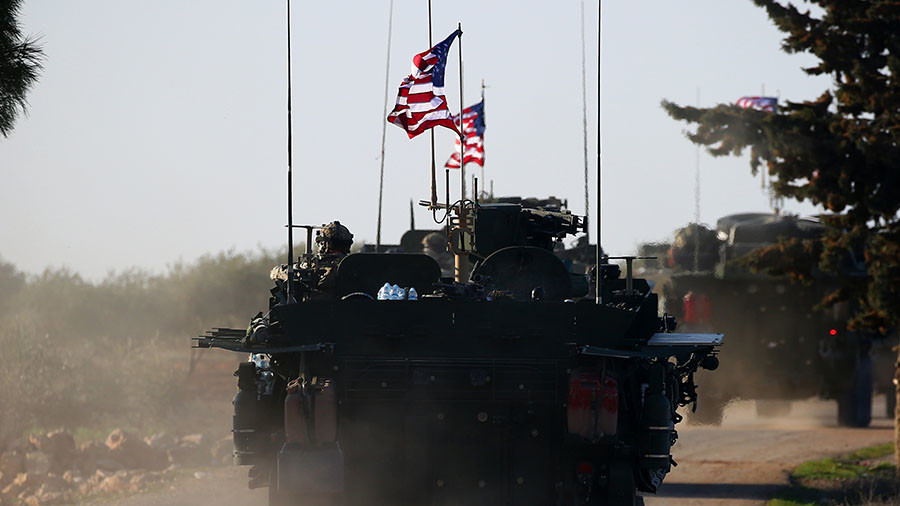
US troops must immediately shut down their zone of control in southern Syria in the area of Al-Tanf, Russian Foreign Minister Sergey Lavrov suggested when asked what should be done to help the Syrian peace settlement.
Lavrov was referring to an area on Syria’s border with Jordan and Iraq, which the US declared to be under its protection last year. Among other things, it contains the Rukban refugee camp. The facility is apparently used by radical militants, including members of UN-designated terrorist group best known by its former name Al-Nusra Front, to recover and raid other parts of Syria, Lavrov said at the Valdai Club conference on the Middle East in Moscow. The US is turning a blind eye to such abuses of its protection, he added.
“Inside the Al-Tanf zone, which the Americans unilaterally declared under their protection, and inside the refugee camp jihadists are regularly reported to recover strength. On several occasions they conducted raids from there into other territory of the Syrian Arab Republic. This zone must be shut down immediately,” the Russian minister said.
“Our colleagues from the UN for some reason are hesitant to say that humanitarian convoys cannot get into this US-controlled area because the US would not guarantee their safety,” Lavrov added. “Instead they focus attention on the humanitarian situation in Idlib or Eastern Ghouta.”
The minister added Russia has mounting evidence that the US has no intention to oppose this jihadist group in earnest.
The response came after a question from the think tank International Crisis Group about what “Russia could do more” in Syria to prevent an escalation of violence there, particularly between Iran and Israel. Lavrov said the question should be “what the US could refrain from doing” in Syria and that the answer was “stop playing dangerous games” and cease trying to partition the nation.
The Americans “in the territories they patronize east of the Euphrates River and all the way to the state border with Iraq create governing bodies which are designed by intention to have no links with Damascus,” he pointed out.
Lavrov also commented on the situation in the southwestern part of Syria on the border with Jordan and Israel – which was designated as a “de-escalation zone” by Syria, Russia, Turkey and Iran – and Israel’s interests in Syria. Israel accuses Iran of using proxy forces to seize control of parts of southern Syria, including those along the border, and has threatened to use military force to reverse the situation.
“We negotiated the creation of this zone with Jordan and the US and it’s not a secret that our Israeli colleagues were informed about what we discussed,” he said. “Now to implement everything we had agreed on we have to focus on one particular article, which said all parties to the agreement would work to make sure that no non-Syrian forces were present inside and near this de-escalation zone.”
The Russian diplomat added that the US carving out the Al-Tanf area was the exact opposite – a unilateral move that no other party agreed to.
The dispute between Israel and Iran, Lavrov said, certainly complicated the situation in Syria, and Moscow believes both parties need to take steps to defuse it. For instance, Iran’s statements that Israel was a Zionist entity that needs to be destroyed are perceived as absolutely unacceptable in Russia. But neither does Russia see as constructive Israel’s policy of turning every problem in the region into a vehicle for opposing Iran, he said.
“This is what we see in Syria, this is what we see in Yemen, and even the latest developments around the Palestinian issue, including Washington’s decision to recognize Jerusalem as Israel’s exclusive capital, are to a large extent caused by the very same anti-Iranian bias,” Lavrov explained. “Both attitudes pose a risk of further damaging the situation in the region, which is already very pitiful.”
The Russian minister suggested that Israel and Iran should try to address their differences – including the latest flare-up involving an Iranian drone destroyed by Israel after reportedly violating the airspace of the Jewish state – by taking them to the UN for proper resolution. “Otherwise we will be rolling down the slope to a situation in which every incident is simply blamed on the other party and used to justify military action.”








 anneinpt
 artaxes
 danmillerinpanama
 davidking1530
 Peter Hofman
 Joseph Wouk
 Peter
Peter Louisiana Steve
 WarSclerotic
Recent Comments