Archive for February 2018

Military strategist: ‘Great strategic clash between Israel and Iran on horizon’ 

February 11, 2018

Source: Military strategist: ‘Great strategic clash between Israel and Iran on horizon’ – Israel National News

‘First time Israel attacked Iranian targets in Syria, no other air force in world capable of reaching such achievement within two hours.’

Contact Editor

Mordechai Sones, 11/02/18 17:25
Display featuring missiles and portrait of Iran's Supreme Leader Ayatollah Ali Khamenei

Display featuring missiles and portrait of Iran’s Supreme Leader Ayatollah Ali Khamenei

Reuters

Institute for National Security Studies head Maj. Gen. (res.) Amos Yadlin today reacted Sunday on 103FM to the escalation this weekend between Israel and Iranian forces stationed in Syria, which he argued constituted a major change the change in the Islamic republic’s behavior toward Israel.

“Iran has acted in the past through proxies like Hezbollah, but has never fired directly into Israeli territory. Israel now responded by attacking Iranian targets directly, while it has so far attacked only arms shipments. This is a major escalation, and a great strategic clash is on the horizon.”

When asked why Iran chose to act now, Yadlin replied: “The Iranians are displeased with the freedom of action Israel has on Syrian soil, and therefore wanted to show Israel that it’s capable of hitting Israeli territory. This was an operational trial launching of anti-aircraft missiles and they may have hoped Israel wouldn’t notice it.”

“An Iranian drone was inserted into Israeli territory and shot down. Israel chose to attack the center that operated the drone, and as a result an Israeli F-16 was hit. After the plane was downed, Israel decided to respond extensively, attack Syrian targets, and leave Damascus’ air defense exposed along with about five Iranian targets.”

“This is the first time Israel has attacked Iranian targets on Syrian soil after an Iranian drone entered Israeli territory. There is no air force in the world capable of reaching such an achievement within two hours.”

“Russia and Iran are trying to save Assad’s regime,” Yadlin said, “they understand today that the only one that can undermine Assad’s regime is Israel, which is capable of damaging all his elements of power. This regime has killed half-a-million people, expelled 10 million people from their homes, and therefore I predicted that if Assad wins, he’ll bring us Iran and Russia into Syria. Unfortunately, that’s exactly what happened. I won’t shed a tear if Assad’s regime expires.”

The radio interviewer, Ayala Hasson, commented: “I’m shocked by what Assad is doing in his country, and I expected the world to get up and do something about it.”

Yadlin responded say, “Indeed, the use of chlorine and chemical weapons against civilians is very cruel, but the rocket and missile attacks in his country killed far more; the Syrians fire them at markets, schools, and hospitals indiscriminately.”

On the Russian’s position after Israel’s action, he said: “We have not harmed Russian targets and we will be very careful not to harm them in the future. On the other hand, we can’t allow the Russian presence to give immunity to the Iranians on the ground. The Russians are not our enemies, but their interests are not necessarily in consonance with ours. The Russians are trying to stabilize Syria, and any military action, like the one that took place at the week’s end, is contrary to their interests. The Russians have an impressive ability to maintain good relations with all sides, they play a very smart game diplomatically and try to promote their interests. We must make sure not to clash with those interests, and on the other hand the Russians must not be allowed to limit our activity against our enemies.”

On American support for the Israeli attack, he said: “The Americans have no interest in getting involved in Syria. They came there just to eliminate ISIS. The only reason they remain in the country is to protect their allies who helped them locate the ISIS people in the field from the Shiite militias. The support of the United States is important to us, but we can’t expect anyone else to do the work for us.”

On Israeli policy in Syria he stressed: “Israel faces a difficult dilemma, whether to act preventively or to wait for war. The Israeli cabinet needs to sit down and examine whether the precision missiles in Syria justify preventive actions that could drag us into war. According to statements made by the Prime Minister and the Defense Minister, I understand that this is indeed the cabinet’s policy, and that each case has its own merits.”

In conclusion, the reservist general related to rumors that he intends to enter politics: “I served the State of Israel for 40 years in the IDF. In 2015, I agreed to serve as a professional candidate in order to strengthen Herzog and Livni’s Zionist Union party. I didn’t want to go to the Knesset because I thought my ability to influence as head of the Institute for National Security Studies was greater than being a Knesset Member. Politics is not an obsession for me and I’m not connected to any party, and so far we don’t know when the next elections will be.”

Israel must take action

February 11, 2018

Source: Israel must take action – Israel Hayom

The most notable aspect of Saturday’s events in Syria and Israel’s north is that they were initiated by Iran. Early that morning, Iran sent a drone toward Israeli territory. Israel observed the drone until it reached a point where it could be intercepted, inside Israeli territory.

But there is also the possibility that Israel fell into a premeditated trap. As a result of the drone’s launch, Israeli fighter jets took to the air and something very grave transpired: An F-16 jet was shot down deep inside Israeli territory over the Beit Netofa Valley. Nothing like has ever happened before. Was this an ambush? Aerial warfare experts think this could very well be the case.

Beyond the Iranian aggression, this was the first time Israel paid a price for its actions inside Syria, which have been aimed at stopping the transfer of weapons to Hezbollah and thwarting Iran’s military establishment there. We also saw that when the Iranians initiate an operation, and it is more than just a stray mortar shell, it does not have to result in war. Several of the anti-aircraft missiles fired at our aircraft landed inside Israel.

Another thing we saw was the diplomatic activity, the warnings relayed to Russian President Vladmir Putin, the severe threats from Israeli ministers as well as Israel’s successful and prolonged military activity, none of which really served to deter the Iranians. In fact, the opposite might be true. It could be that the Israeli assertions, voiced in the highest of octaves, were the reason they decided to make it clear they are not deterred by Israel’s threats. Russia’s audacious response, which spoke of Syrian sovereignty while ignoring Israeli sovereignty, makes it seem as if Putin is not troubled by the possibility of a nice little war between Israel and Iran.

Although Israel took out anti-aircraft missile systems and a few Iranian targets deep inside Syria, as well as bases where there is a Russian military presence, it did not ultimately touch Hezbollah. Those targets still exist inside Lebanon. If Iran’s conduct over the weekend is any indication, one can safely assume that a solution to the precision missile manufacturing plants on Lebanese soil will not be achieved through diplomatic channels. That is, of course, where things are headed.

Up until Saturday, there was a sense that Israeli activity had entered a type of routine. One could at times forget the significance of the Israeli assessment, which held that Israel could not allow the creation of a new front in Syria. This is the statement that for the past two years could be heard from senior IDF officials and members of the political echelon. On Saturday, the meaning of this decision sunk in. Sometimes it is not the enemy but the Israeli public that needs to internalize Israel’s intentions.

Ultimately, the good relationship and understandings between Prime Minister Benjamin Netanyahu and Russian President Vladmir Putin only help to alleviate a situation that has worsened considerably on Israel’s northern front. Because it was only after Russia’s military establishment in Syria two years ago that the Iranians were able to gradually consolidate their grip on the country. These developments have fundamentally worsened Israel’s strategic situation. As predicted in September 2015, the Israeli Air Force’s freedom of action was reduced with the entry into Syria of the Russians and their advanced anti-aircraft missiles.

Strikes on anti-aircraft missile batteries have become nothing short of an integrated intelligence operation. In many cases, such actions involve more military components than just the plane and the control tower. The combination of the attempt to create an additional front against Israel on the Golan Heights together with Hezbollah’s precision missile capabilities demand Israel take action to eradicate these threats.

In the past two years, Israel has repeatedly stated it would not allow the creation of a second front against it in Syria. On Saturday, the significance of this decision finally sank in.

Freed from shroud of ‘foreign reports,’ Israel-Iran fight steps out from shadows

February 11, 2018

Today, 3:25 pm

https://www.timesofisrael.com/israel-iran-fight-once-waged-according-to-foreign-reports-enters-limelight/

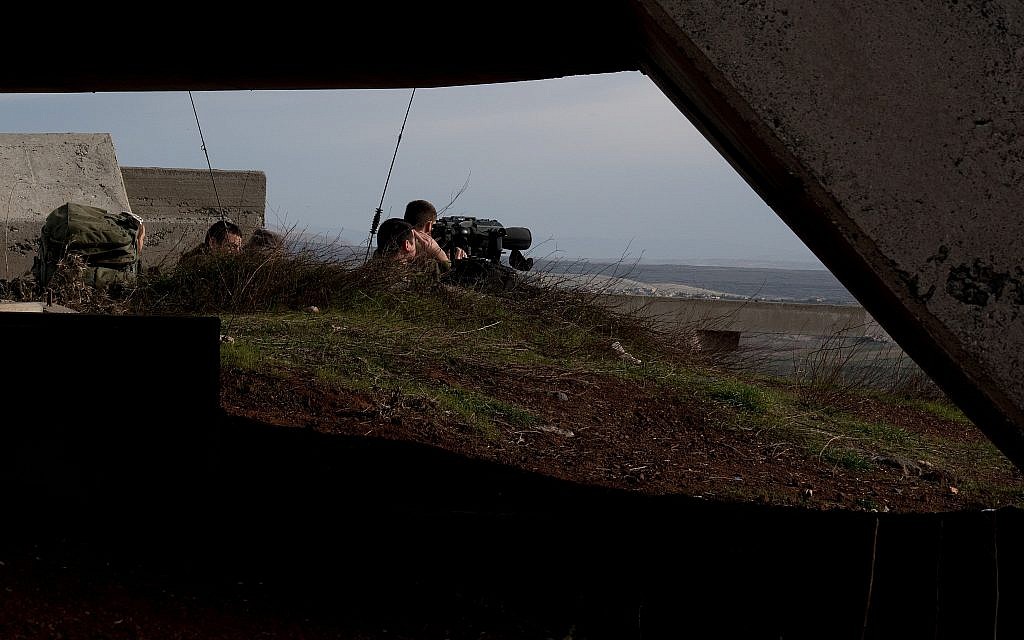
Israeli soldiers survey the border with Syria from a military post in the Golan Heights, following a series of aerial clashes with Syrian and Iranian forces in Syria, on February 10, 2018. (Flash90)

On Thursday, the International Crisis Group think tank and advocacy firm warned in a new comprehensive report that Israel and Iran (plus its proxies) were barreling toward open conflict in Syria.

Those prescient warnings came true — in part, at least — throughout Saturday morning, beginning shortly before 4:30 a.m., with the violation of Israeli airspace by a drone that the Israeli military says was piloted by an Iranian operator from an airfield that Tehran had taken control of months before, with Syrian permission.

Israeli jets conducted reprisal raids in Syria, during which one of the F-16 fighter planes was apparently hit by shrapnel from an exploding anti-aircraft missile and crashed in northern Israel, in what appears to be the first downing of an Israeli plane since 1982.

The aircraft’s pilots bailed out; one of them was seriously injured.
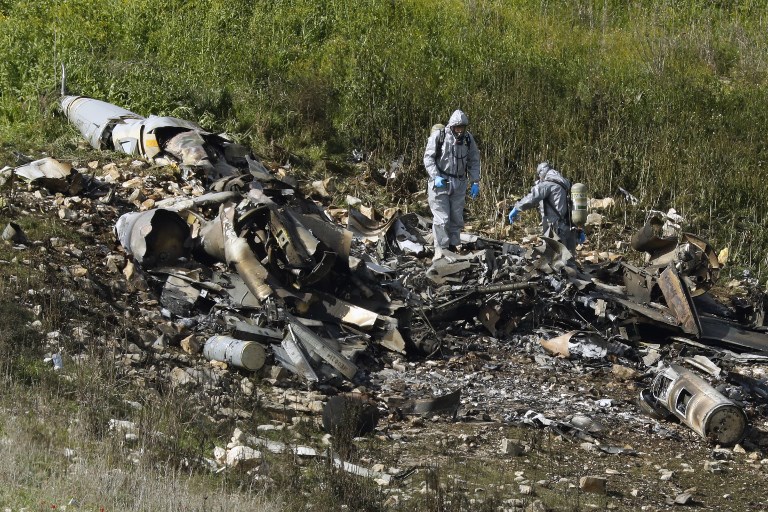
A picture taken in the northern Israeli Jezreel Valley on February 10, 2018, shows the remains of an Israel F-16 that crashed after coming under fire by Syrian air defenses during attacks against ‘Iranian targets’ in the war-torn country. (AFP PHOTO / Jack GUEZ)

Air force jets then completed a second set of retaliatory strikes. In the two rounds, the Israeli military said, its aircraft targeted several Syrian air defense systems as well as four Iranian positions in the country.

This was the first time Israel publicly acknowledged conducting airstrikes against Iranian-held locations in Syria, though not the first time it had done so, according to foreign reports.

IDF Chief of Staff Gadi Eisenkot (L) attends a briefing with Prime Minister Benjamin Netanyahu and Defense Minister Avigdor Liberman (R) in response to the escalation of tensions along the northern border on February 10, 2018. (Ariel Harmoni/Defense Ministry)

In the aftermath of the Saturday morning clash, Israeli, Syrian and Iranian politicians released tough, threatening statements aimed at one another. The United States backed Israel’s right to self-defense. Russia called for calm on all sides, but singled out Israel for violating Syrian sovereignty with its strikes, while conspicuously ignoring the Iranian drone’s airspace violation.

The aerial exchange thrust what had previously been a long-simmering but largely quiet conflict into the international spotlight and raised concerns that this bout will be the first of many clashes — and, in the nightmare scenario, the start of a full-fledged war across Syria, Lebanon and northern Israel.

I don’t think it’s the last time we’ll see such an event, but for the time being both sides will restrain their responses

However, the prevailing belief among Israeli defense analysts is that Saturday’s events were not the prelude to open war, but the beginning of an extended period of increased tension, which is liable to see additional clashes.

“I don’t think it’s the last time we’ll see such an event, but for the time being both sides will restrain their responses,” Sima Shine, a career defense official and current senior researcher at Tel Aviv’s Institute for National Security Studies think tank, told reporters on Sunday.

She added, during the phone briefing organized by the Media Central group, that escalation is in neither side’s best interest.

Amos Yadlin, a former fighter pilot and Military Intelligence chief, described Saturday as the “most significant day of fighting” in what Israel describes as its “campaign between wars,” often referred to in Hebrew by its acronym, Mabam.

“Despite the containment of the incident, the campaign is expected to continue,” Yadlin said.

In its report, released two days before Saturday’s flareup, the Crisis Group laid out how this campaign between Israel and the Iran-Syria-Hezbollah axis has developed and how it can be prevented from escalating further.

The organization tracks the current tensions to the Syrian regime’s battlefield victories over the past two and a half years, which it has achieved in large part due to support from the Russian military, which has provided significant air power since September 2015.

These have opened the Iran-led axis to shift toward preparing for a future conflict with Israel.

Only Moscow is in a position to mediate a bolstering of the deescalation agreement. Unless it does, the rules of the Syrian game are likely to be worked out through attack and response, with risk of escalation

According to the think tank, Russia is also the only entity able to prevent such a bloody war, having emerged from the Syrian civil war as the region’s sole remaining superpower after the United States dramatically scaled back its involvement in the conflict.

“Only Moscow is in a position to mediate a bolstering of the deescalation agreement. Unless it does, the rules of the Syrian game are likely to be worked out through attack and response, with risk of escalation,” according to the report.

In this photo released by an official website of the office of the Iranian Presidency, Iran’s President Hassan Rouhani, right, shakes hands with Russian President Vladimir Putin during their meeting at the Saadabad Palace in Tehran, Iran, Wednesday, Nov. 1, 2017. (Iranian Presidency Office via AP)

The group outlines three main issues that need to be addressed: the presence of Iranian and Shiite forces near the Israeli Golan Heights; the construction of Iranian military infrastructure in Syria; and ensuring any clashes that do take place remain confined to Syria.

The Crisis Group has also been working directly with Russia to try to persuade it to accept the role of mediator between Israel, Hezbollah, Iran and Syria.

“And we are seeing some traction with Russian officials,” Ofer Zalzberg, a senior Jerusalem-based analyst for the group and one of the report’s authors, told The Times of Israel last Wednesday ahead of the document’s publication.

The recipe for disaster

As Syrian dictator Bashar Assad vanquishes the remaining pockets of resistance in the country, the Israeli concern is that his allies — Iran, Hezbollah and Iran-backed Shiite militias — will be freed to focus on establishing positions along the Israeli border from which to antagonize the Jewish state, as well as permanent naval and air bases to bring in more advanced weaponry and conduct attacks.

Israel has designated these issues to be “red lines,” which it will not allow to be violated, and has said it will take military action if they are.

In its report, the Crisis Group warned that if the Iranian axis presses on with these efforts and Israel retaliates in kind, there is significant potential for escalation or even a large-scale war that could destabilize the entire region.

Israeli security forces inspect damage to a house after a Katyusha rocket attack by Hezbollah from southern Lebanon in the northern Israeli town of Nahariya, July 15, 2006. (Pierre Terdjman / Flash90)

The military assessments of what a war between Israel and Hezbollah would look like are chilling: Hezbollah launching over 1,000 rockets and missiles at Israeli cities and strategic sites each day, along with attempted infiltrations of Israeli communities along the Lebanese border. Israel conducting wave after wave of airstrikes against Hezbollah infrastructure, which the terrorist group has embedded deep inside civilian areas, ensuring significant noncombatant deaths, as well as large-scale IDF ground force maneuvers in southern Lebanon.

Zalzberg said a major part of the problem is that there are no established “rules of the game” between Israel and Iranian proxies in Syria, as there are in Lebanon, where Israel has been fighting Hezbollah off-and-on for decades.

That means the “rules” will be sorted out through back-and-forth, tit-for-tat clashes like Saturday’s. But this is a perilous path, fraught with opportunities for miscalculation and resulting in unintended casualties on both sides.

For instance, Israeli officials often refer to the “proverbial kindergarten” — the type of target that if hit, even accidentally, would prompt Israeli citizens to demand harsh and swift reprisals. As Iran and Hezbollah lack civilian targets in Syria, their equivalent might be a case of significant casualties from an Israeli airstrike, which would forced them to retaliate.

This is a current concern, following Saturday’s exchange, as the Syrian Observatory for Human Rights, a watchdog group, reported that at least six pro-regime fighters — including both Syrians and foreign nationals — were killed in Israel’s strikes and that “the death toll is expected to rise because there are some people in critical situation.”

Zalzberg added the potential for escalation in Syria is driven higher by the fact that different sides do not have a clear grasp of one another’s goals and viewpoints, citing a year’s worth of interviews by the Crisis Group with officials in Jerusalem, Tehran, Beirut, Amman, Moscow and Washington.

The report and its authors argue that it is ultimately in Russia’s best interest to avoid an all-out war between Israel and the Lebanon-based, Iran-backed Hezbollah, which would have the potential to completely destabilize the region.

Unlike in the 2006 Second Lebanon War between Israel and Hezbollah when the fighting was primarily limited to northern Israel and southern Lebanon, the view of both Israeli and Hezbollah officials is that the next conflict between the two groups would also include fighting in Syria.

Israeli artillery howitzers fire on Hezbollah targets at the Israeli-Lebanese border on July 18, 2006. (Olivier Fitoussi/Flash90)

“A massive campaign by Israel will do enormous damage to [Damascus and its backers’] achievements, perhaps even destabilizing the regime itself,” the report noted.

According to Zalzberg, this is not a desirable situation for Russia, as Moscow would like to see Assad regain near-total control over Syria.

The analyst noted that this is at odds with Iran, which wants to see Assad in power, but does not necessarily want to see him becoming too powerful, preferring instead to have Syria controlled by a coalition, similar to Lebanon, so that its Shiite militias could play a more significant role in the country.

Russia and only Russia

Moscow’s active support for Assad and his other main supporters, Iran and Hezbollah, has left Israeli officials decidedly wary of their Russian counterparts.

The Crisis Group report quotes an unnamed Israeli Foreign Ministry official as saying of the Russians, “It’s hard to trust them. They tell us they are not selling weapons to Hezbollah, but we know for a fact that they do. Their policies are cynical. They are not an enticing mediator.”

Russian President Vladimir Putin, left, shakes hands with Israeli Prime Minister Benjamin Netanyahu during an event marking International Holocaust Victims Remembrance Day at the Jewish Museum and Tolerance Center in Moscow, January 29, 2018. (Vasily MAXIMOV/AFP)

Yet there is an understanding among some in Israel that, while not enticing, Russia is the only mediator that has significant leverage over Iran and Hezbollah.

Israel has already had to maintain a close, if uneasy, relationship with Moscow due to its involvement in the region.

After Turkey shot down a Russian fighter jets that had invaded its airspace, Moscow installed an S-400 missile defense system in Syria. With the system, one of the world’s most advanced anti-aircraft batteries, Russia can monitor the overwhelming majority of Israel’s active airspace, including Israeli military flights.

Or, as one Israeli official told the Crisis Group, “A fly can’t buzz above Syria without Russian consent nowadays.”

This came as a shocking blow to the Israeli Air Force, which had, until then, enjoyed aerial superiority in the region, and required Jerusalem and Moscow to set up a hotline to prevent any potential conflicts between the two militaries.

Israel has also worked diplomatically with Russia to secure a buffer zone around the southwestern Syrian border, in which Hezbollah and other Iran-backed Shiite militias would not be allowed to maintain a presence.

In this photo released on Friday, Dec. 29, 2017 by the Syrian official news agency SANA, Syrian government forces stand next to a bus which is waiting to evacuate Syrian rebels and their families from Beit Jinn village, in the southern province of Daraa, Syria. (SANA via AP)

The border area has naturally been of significant concern for Israel, which is loath to see Hezbollah set up military positions along the Golan Heights to join the significant infrastructure it has already put in place in southern Lebanon.

Last month, the Syrian military, with some assistance from Shiite militias, regained control over the area of Beit Jinn, or Beit Jann, which is located just 13 kilometers (8 miles) from Israel’s Mount Hermon ski resort.

Though it is currently focused on retaking the area of Idlib in northwestern Syria, this coalition is likely to soon focus its attention on the Quneitra and Daraa regions, near the Israeli border.

Though Israel secured its buffer zone for that area this summer, the Crisis Group report notes that it would be relatively easy for these groups to get around the restriction, “for instance by integrating the fighters into the Syrian army or simply having them don its uniforms.”

The advocacy group argues that before the Syria-Iran-Hezbollah axis moves toward the southwest, Russia should work to negotiate an agreement between it and Israel.

There is still time for Russia to try to broker a set of understandings to prevent a confrontation, protecting both its investment in the regime and Syrian, Israeli and Lebanese lives

The Crisis Group notes that Israel’s insistence that Iranian and Iran-backed troops stay out of southern Syria will be the most difficult to negotiate, as Hezbollah and the Shiite militias would not be inclined to accept it and could easily cheat by disguising themselves as Syrians.

However, the authors say this could be resolved by getting Russia to agree to prevent Iran from setting up the types of infrastructure most concerning to Israel, like a seaport through which the Islamic Republic could carry out attacks against Israeli natural gas fields, an airport to transport weapons to Hezbollah, or a factory for the production of precise missiles.

“There is still time for Russia to try to broker a set of understandings to prevent a confrontation, protecting both its investment in the regime and Syrian, Israeli and Lebanese lives,” the Crisis Group wrote.

Preparing for war in the north, Israel boosts air defenses 

February 11, 2018

Source: Preparing for war in the north, Israel boosts air defenses – Arab-Israeli Conflict – Jerusalem Post

BY ANNA AHRONHEIM
 FEBRUARY 11, 2018 11:41
Some 20 Syrian air defense missiles were fired towards Israeli jets during missions over Syria.
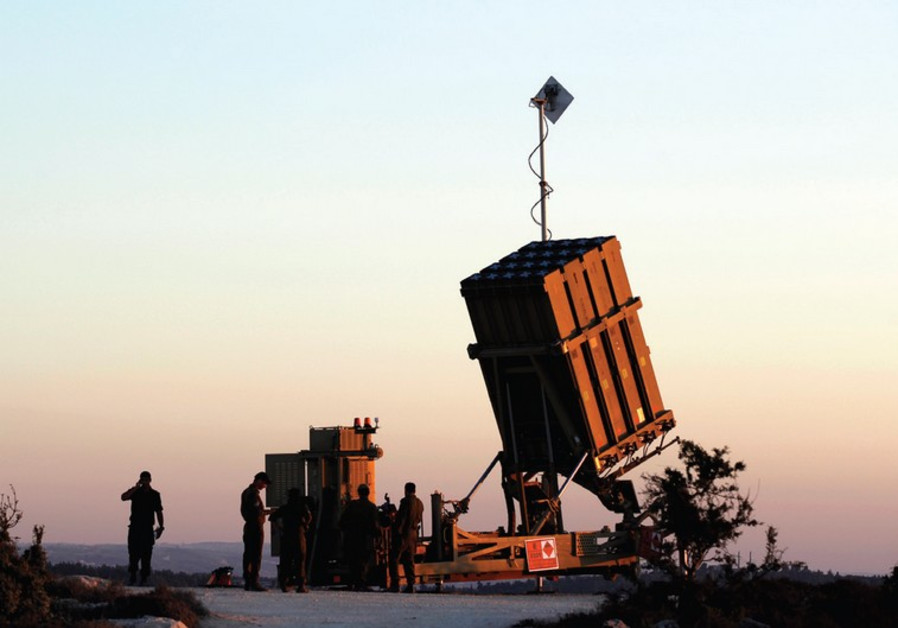
iron dome

 Soldiers stand next to an Iron Dome battery.. (photo credit: REUTERS)

While the Israeli army refused to comment on the reports, witnesses reported seeing a convoy of missile defense batteries heading north near the Israeli-Arab city of Baqa el-Garbiyeh. Other witnesses posted photos of several trucks carrying the batteries on central highways in northern Israel.

Israel’s air defenses currently include the Iron Dome, designed to shoot down short-range rockets; the Arrow system, which intercepts ballistic missiles outside of the Earth’s atmosphere; and the David’s Sling missile defense system, which is designed to intercept tactical ballistic missiles, medium-to-long-range rockets and cruise missiles fired at ranges between 40 to 300 km.

Israel also has Patriot missile batteries stationed in the north of the country and have used them to intercept drones infiltrating into Israeli airspace from Syria. In September, an Iranian-built unmanned aerial vehicle breached the “Bravo line” that marks the Syrian demilitarized zone and was intercepted by an Israeli Patriot anti-ballistic missile launched from a station near the northern city of Safed.

The first use of Arrow occurred in April, when the system was launched to intercept a three surface-to-air missiles Syrian regime air defense fired toward IAF jets.

On Saturday, an Iranian drone, which took off from Syria’s T4 airbase in northern Homs province, flew through Jordanian territory before it infiltrated into Israel. It flew for about a minute and a half in the northern Jordan Valley before it was shot down by a helicopter flown by Lt. Col. “L.”, commander of the 113 squadron.

“The squadron was sent to protect the country’s skies,” L. said. “We identified the aircraft as an Iranian drone, and when it crossed the border, we shot it down into Israeli territory. The squadron is ready and prepared for any task it is given.”

IAF chief of air staff Brigadier General Tomer Bar, the second in command of Israel’s Air Force, said the drone was an advanced model with a low signature that Israel had never intercepted before. It is currently being studied by the IDF.

In retaliation for the incursion, eight Israeli jets took off to strike the drone’s launch site. During the operation, Syrian regime forces fired around 20 anti-aircraft missiles at Israeli jets. The pilots of one of the planes ejected themselves when they recognized that one of the missiles had locked onto their jet.

According to the IDF, Iran and the Quds Force of the Revolutionary Guards have been operating at the T4 base “for a long time, backed by Syrian army forces and with the approval of the Syrian regime.”

“Iran has been using the base in recent months for the purpose of transferring weaponry to be used against Israel,” read a statement by the IDF Spokesperson’s Unit. “These actions by Iran at the base are ostensibly carried out under the guise of supporting the fighting against the global Islamic jihad forces, but the actions carried out in the past 24 hours prove that its real concern is direct violent action against Israel.”

“In the Iranian action, all the Israeli warnings against Iranian consolidation in Syria were realized. The attack was initiated and Israel was forced to respond first to the threat in its territory and then to the hostile elements operating from the Syrian territory opposite it.”

Iran’s Saegheh drone in Syria – a worry for US as well as Israel 

February 11, 2018

Source: Iran’s Saegheh drone in Syria – a worry for US as well as Israel – DEBKAfile

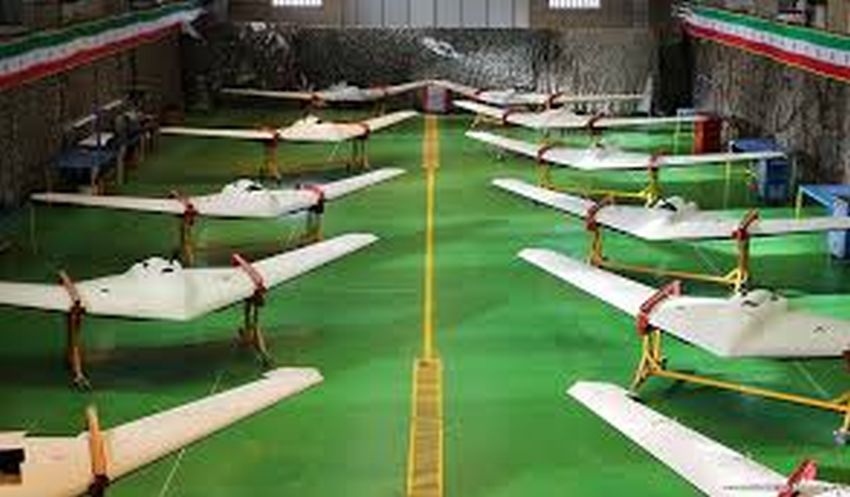
Iran’s Saegheh is no ordinary UAV; it is the Iranian Revolutionary Guards’ prize drone for assault and intelligence gathering. It made its debut outside Iran on Saturday, Feb. 10 when it slipped into Israeli airspace, first circling east into Jordan.
Until then, the Saegheh (Storm) was not generally known to have reached the Syrian warfront. After it was brought down almost intact by an Israeli Apache helicopter, Israel Air Force jets bombed the drone’s command vehicle deep in central Syria, at the T-4 base near Palmyra, which is shared by Iran and the Russian air force. The speed of this counter-punch confirmed that Israeli intelligence had tracked the drone from the moment it took to the air from T-4 and was on standby to snag it.

The price tag for the operation was paid by the IAF F-16’s exposure to Syrian air defense fire. The two pilots flew the crippled plane back over northern Israel, before ejecting for a parachute landing. One is recovering in hospital from a serious injury; the second was slightly hurt.

The infiltrator drone was discovered to have been part of a whole fleet of advanced armed Saegheh UAVs housed at the T-4 base. The second wave of Israeli air strikes against 12 Syrian and Iranian targets decimated this fleet. Most importantly, the drone intrusion and its sequel exposed the incident to have been no one-off,  but part of a calculated Iranian plot against Israel at the highest level, that was coordinated in advance with the Russian air force, which shares the use of T-4, and the Syrian air defense systems, which operate under Russian command. It is equally important to note that Iran brought its Saegheh UAV’s to Syria with Moscow’s consent.
This may be accounted for by the drone’s unique provenance.
In a long and arduous process of reverse engineering, Iran’s munitions industry copied some of the components of the CIA’s most secret stealth drone, the RQ-170 Sentinel, after it was intercepted and captured over Iran in December 2011. The American drone, armed and capable of detecting clandestine nuclear tests, is rated the finest UAV of its kind in operation. Tehran claimed it had intercepted the Sentinel’s overflight by taking control of the American surveillance satellite communications which navigated the drone’s course. This was vehemently denied by Washington. At the time, DEBKAfile’s intelligence sources revealed that the those responsible for the feat of bringing the secret American drone down intact were not Iranian but Chinese cyber experts.

The Russians were keen on getting a look at the wonders of the American drone, but the Iranians refused to give them access. Eight years later, they go their chance in Syria. Iran is finally confirmed as having gained possession of the an American RQ-170, by the evidence of the Iranian drone captured by Israel. But, meanwhile, Iran, by deploying a fleet of Saegheh drones in Syria, armed with missiles, has not only ramped up its threat to Israel, but also raised a tough regional challenge to America. If one of these drones can be used against Israel, why not against American forces in the Middle East or Saudi Arabia? The Revolutionary Guards dep chief Brig. Gen. Hossein Salami made no bones about this on Saturday, when he declared that Iran had the military power “to destroy all American bases in the region.”

The Iranian stealth drone’s trajectory through Jordan on Saturday was revealing. It flew from Palmyra along Syria’s eastern frontier with Iraq undetected by American military surveillance. When it came over the US-Jordanian garrison of Al Tanf in the Syrian-Iraqi-Jordanian border triangle, it turned right to northern Jordan and then crossed the border to fly over Beit Shean. Ninety seconds later, Israeli Apaches conducted their interception – but not before the “Storm” had triggered the first direct military skirmish between Israel and Iran.
Iran lost a valuable armed drone, but it was in the air long enough to gather plenty of information on the American, Jordanian and Israeli air defense and radar systems on the Syrian, Jordanian and Iraqi borders, as well as reporting on their anti-air missiles’ operational capabilities. The IDF announced Sunday the boosting of its air defense systems in the North.

Analysis: The open war with Iran has begun 

February 11, 2018

Source: Analysis: The open war with Iran has begun – Middle East – Jerusalem Post

BY YAAKOV KATZ
 FEBRUARY 11, 2018 00:05
The “Shadow War” between Israel and Iran has been going on for years, bringing us closer and closer to today’s events and what is to come.
The open war with Iran has begun

 SECURITY PERSONNEL examine the remains of an Israel Air Force F-16 fighter plane near Kibbutz Harduf on February 10, 2018. (Ronen Zvulun/Reuters). (photo credit: RONEN ZVULUN/REUTERS)

On Monday, Hezbollah will mark the 10th anniversary of the death of Imad Mughniyeh, its legendary and ruthless military commander, whose absence, according to Israeli intelligence, is felt still today.

Mughniyeh – the mastermind of the bombing of the US Marine barracks in Beirut (1983) as well as the attacks against the Israeli Embassy (1992) and the Jewish community center (1994) in Buenos Aires – was killed in Damascus on February 12, 2008, just after he finished a meeting with some of his Iranian patrons. The Mossad reportedly planted a bomb in the spare tire on the back of his Mitsubishi jeep.

The assassination of Mughniyeh as well as countless other operations and targeted killings attributed to Israel have been going on for years as part of the “Shadow War” between Israel and Iran and the proxies it funds and operates throughout the Middle East.

For the most part, until now, this war has been fought behind the scenes. Who needs to know, knows, and while some details occasionally make their way to the public domain, most do not.

What happened in northern Israel on Saturday is the beginning of the overt and direct war between Israel and Iran. The infiltration and interception of an Iranian drone over Israel, the downing of an Israeli F-16 and Israel’s retaliatory strikes against Syrian and Iranian targets that followed, are apparently just the opening scenes of a potentially wider conflict that could erupt if Iran continues trying to fortify its presence in the new Syria.

This was long in the making. Years ago, the Iranians came to the rescue of Bashar Assad in Syria and, together with Russia, ensured his survival. The problem is that they haven’t left. On the contrary – even though Assad is today in control of the majority of Syria, Iran is staying put and trying to establish an even greater presence within the country. On Saturday, we saw how determined it is to do just that.

It is too early to tell what lesson Iran has learned from the clash on Saturday. On the one hand, it succeeded in infiltrating a drone into Israel, even though it was ultimately intercepted. Its ally Syria succeeded in shooting down an Israeli fighter jet. On the other hand, Israel carried out its most widespread bombings in Syria since it destroyed almost all of Syria’s air defenses in 1982.
Israel’s retaliation was important for two reasons – it needed to neutralize the Syrian batteries that were used to down the F-16, but also to exact a price from Iran by bombing the control center used to operate the drone as well as other Iranian targets in Syria – the nature of which we will likely learn over the coming days.

The question will be whether Israel succeeded in boosting its deterrence. That depends on what Iran decides to do next. Will it keep on building its presence in Syria? Will it attempt another violation of Israel’s sovereignty down the road?

While the downing of a fighter jet is a heavy blow to Israeli morale, it was not totally unexpected and needs to be viewed through the wider context of what has been going on for the last five years. Israel has carried out more than 100 strikes in Syria, and in war there are always wins and losses. The fact that a plane hasn’t been shot down until now is the real story and speaks volumes of the IAF’s superior capabilities.

Finally, Israel needs to be concerned by Russia’s response to the events on Saturday. In Moscow, the Foreign Ministry issued a statement calling for restraint and for all sides to “respect the sovereignty and territorial integrity of Syria.”

On the surface, it seems like Russia is taking Iran and Syria’s side and not Israel’s, despite Prime Minister Benjamin Netanyahu’s best efforts to win over Vladimir Putin and his countless meetings with the Russian president. Beyond the ministry statement’s rhetorical significance, it could have practical consequences if Russia decides to deny Israel operational freedom over Syria in the future.

Israel will have to tread carefully and will not have a lot of choice but to accept Moscow’s directives. While Russia has allowed Iran to establish a presence in Syria it has – until now – prevented it from setting up large bases or a presence right along the border with Israel on the Golan Heights.

That could all still happen – and will depend on what Russia’s interests will be when it comes to the future of Syria and the wider Middle East.

US support for Kurds in Iraq and Syria unaffected by tensions with Turkey

February 11, 2018

Source: US support for Kurds in Iraq and Syria unaffected by tensions with Turkey

{While we’re making a huge investment in the Kurds, Turkey prolongs the battle against ISIS. – LS}

The Pentagon is continuing to support Kurdish forces in Iraq and Syria, a government audit revealed this week, even as the fight against the Islamic State (IS) winds down and the United States faces growing pressure from allies and foes alike to back down.

The latest quarterly Lead Inspector General (IG) report for the US-led mission in Iraq and Syria confirms that the Donald Trump administration continues to supply weapons and equipment to the Kurdish People’s Protection Units (YPG), part of the Syrian Democratic Forces (SDF). The Defense Department considers the YPG to be the most capable in-country US partner for the mission, but NATO ally Turkey views YPG fighters as terrorists.

For the fiscal year that started Oct. 1, the Pentagon asked for $500 million to supply Syrian forces, including YPG-led units, with vehicles, mortars, anti-tank missiles and machine guns, up from $430 million requested in fiscal 2017. Deliveries began in May 2017, prompting the ire of Turkish President Recep Tayyip Erdogan.

The IG report indicates that US support has kept up, despite pledges from US officials to draw down support amid increasing friction with both the Turks and Bashar al-Assad’s regime. A large battle outside SDF headquarters this week led to the deaths of more than 100 pro-Assad fighters who fired dozens of tank rounds at the Deir ez-Zor province compound, prompting the US-backed force to respond in self-defense, according to the Pentagon.

“SDF said that there had been no change in their relationship with the United States and that changes to weapons deliveries were a consequence of their victories against [the Islamic State],” said the report, prepared for Congress by inspectors general from the Pentagon, State Department and the US Agency for International Development. “Syrian Kurdish officials reiterated their interest in having American engagement in Syria continue, and warned that a reduction in US support could allow [IS] to regain strength.”

Yet as YPG and other fighters have strayed away from the US-backed mission against IS, the Pentagon has cautioned that it will cut off support for units that leave the front lines. More and more Kurdish fighters and their allies have been heading toward Afrin, a Kurdish-held area that has been under attack from the Turkish military since Jan. 20. Last weekend, the 2,000-member Syriac Military Council, a Christian group, opted to leave the SDF to join the fight in Afrin.

“Any forces that decide to move to Afrin will not receive continued coalition support,” a spokesman told Al-Monitor.

The mounting tensions come as the Defense Department says it has trained 12,500 vetted Syrian opposition fighters since the beginning of the anti-IS campaign in 2015, including 11,000 members of the SDF.

“Wherever possible, our advisers monitor the use of the weapons and supplies we give the Kurdish elements of the SDF, ensuring use only against [IS],” Pentagon spokesman Eric Pahon told Al-Monitor. “Any alleged misuse or diversion of US support is taken seriously and may lead to the possible curtailment of support, if verified.”

Meanwhile, the Pentagon trained nearly 2,000 more Iraqi Kurdish peshmerga forces over the past three months even as stipends to Kurdish Regional Guard Brigades ended after a yearlong agreement to fund the fighters expired in July. The Pentagon has requested $365 million this fiscal year to pay for the Kurdish force if a new deal can be ironed out.

In late October, Iraqi Prime Minister Haider al-Abadi said Baghdad would soon begin paying peshmerga salaries. But Abadi has still not delivered on that promise, the IG report says, as Iraqi security forces moved into disputed areas after the Kurds voted for independence in September.

Most peshmerga forces withdrew to protect their semi-autonomous territory in northeastern Iraq after Baghdad kicked them out with the help of Iranian-backed militias. Some units, however, stayed behind to fight IS, which now has fewer than 1,000 adherents fighting for small pockets of territory, including Tuz Khormato near the oil-rich city of Kirkuk.

Caroline Glick: Syria – The War Everyone Must Fight and No One Can Win

February 11, 2018

by CAROLINE GLICK10 Feb 2018 Via Breitbart

Source: Caroline Glick: Syria – The War Everyone Must Fight and No One Can Win

{Total quagmire. – LS}

Saturday morning’s violent clashes along the Israeli-Syria border between Israel on the one hand and Iran and Syrian regime forces on the other occurred against the backdrop of multiplying acts of war and violence among a seemingly endless roster of combatants.

To understand the significance and implications of the clashes – which saw Israel destroy an Iranian drone that penetrated its airspace and destroy the drone base in Syria from which the drone was deployed, and the downing of an Israeli F-16 by a massive barrage of Syrian anti-aircraft missiles – it is necessary to understand the basic logic of violence in Syria.

There are a dozen or so actors fighting in Syria. The US is fighting in coalition with the Kurdish dominated Syrian Democratic Forces. The Kurdish YPG militia is part of the SDF. Political representatives tied to the YPG have denied it, but the YPG is widely considered to be allied with the Turkish PKK group, which is listed as a terrorist group by the State Department and the Turkish government.

Russia is fighting with Iran, the Syrian-regime forces, Hezbollah and Iranian-organized Shiite militias that include fighters from Pakistan, Afghanistan, and Iraq.

Russia also sometimes acts indirectly with Israel against its coalition partners. On the basis of understandings that Israeli Prime Minister Benjamin Netanyahu has reached with Russian President Vladimir Putin, Russian forces in Syria do not interfere with Israeli air strikes against Iranian, Hezbollah and Syrian-regime targets which directly threaten Israel’s strategic interests.

The Turks are fighting largely independently. Sometimes they are supported by the U.S., sometimes they are supported by the Russians.

Turkey belatedly joined the anti-ISIS coalition led by the U.S. But the Turks’ main target in Syria is the Kurdish forces. Three weeks ago, the Turks launched yet another campaign against the Kurds in Syria. Their current operation is focused on the Afrin province controlled by YPG. But Turkey is also threatening Manbij, where US special forces are deployed in support of the SDF.

Non-ISIS rebel forces are being destroyed systematically by regime forces in Idlib province and in the Damascus suburban area known as Eastern Ghouta. According to a New York Times‘ summary of recent violence in Syria, regime forces have reportedly killed four hundred people, including a hundred children in Eastern Ghouta since December. Since the start of 2018, the Syrian regime reportedly carried out three chlorine gas attack against civilians in Ghouta.

As the New York Times noted, Ghouta was the site of the regime’s 2013 sarin gas attack which killed 1,400 people including 400 children. Then-president Barack Obama had said a year earlier that such an attack would be a red line that would provoke US action against the regime. Obama’s refusal to attack regime forces after the sarin gas attack empowered Russia, which deployed forces to Syria for the first time since the end of the Cold War in 2015.

Finally, there are ISIS forces. ISIS continues to control territory along the Syrian border with Iraq and pockets of territory in the vicinity of Deir Ezzor and Palmyra. Perhaps more importantly, ISIS forces from areas seized by coalition forces have melted away and are viewed as responsible for a spate of bombings in Damascus and elsewhere in recent months and weeks.

Over the past several weeks, numerous articles have appeared analyzing the recent rise in violence in Syria. The main question is: why is the violence continuing? The prevailing sense in the West had been that, following ISIS’s loss of most of the territory it had held, the war had wound down. The U.S. and its allies had made their peace with Syrian President Bashar Assad’s survival and with Russia’s newfound role as powerbroker on the one hand. And, on the other hand, the Russians and their Iranian, Syrian, and Hezbollah allies had made their peace with Kurdish control over large swathes of former Syrian territory and their alliance with the U.S.

Israel, the U.S., and Turkey were seen as actors with specific issues which could be remedied with intermittent tactical strikes that wouldn’t challenge the overall post-civil war order.

This assessment was false because there is nothing tactical or limited about any of the parties’ interests and concerns relating to Syria.

Consider the Turks and the U.S. The Turks oppose Syrian Kurdish control over territory along the border with Turkey because they view it as a strategic threat to Turkey. Turkey’s Afrin offensive – which Ankara envisions as the first stage of a broader offensive which will include Manbij – also has implications that far exceed the borders of Syria or the wider Middle East.

Russia is supporting the Turkish anti-Kurdish offensive for reasons that have nothing to do with Syria and everything to do with Russia’s strategic rivalry for great power status with the US.

By supporting Turkey’s anti-Kurdish offensive, Russia is placing NATO member Turkey in direct confrontation with the US. If the US stands with the Kurds and Turkey fails to back down, then the likelihood that American and Turkish forces will fight one another in battle grows to near certainty. If this happens, Turkish membership in NATO will effectively end.

On the other hand, if the US doesn’t stand with the Syrian Kurds, the U.S. will lose its residual credibility as an ally in the region. The stakes in Syria are critical in light of the U.S.’s failure to defend its Iraqi Kurdish allies last October, when the US-trained Iraqi military wrested control over the oil-rich Kirkuk province from the Kurdish regional government in Erbil.

For the US then, Syria is a moment of truth. It can stand with its allies on the ground and so assure its long-term ability to work with allies in the Middle East and beyond. Or it can betray its allies on the ground and preserve the idea of its strategic alliance with Turkey, even though, on the ground, that alliance no longer exists.

This then brings us to Israel, and Saturday morning’s violent clashes with Iran.

Although Bashar Assad still holds the title President of Syria, to all intents and purposes, he is an Iranian puppet. His forces take their orders from Iran and Hezbollah. He has no independent power to make decisions about anything in Syria.

Israel has eyed this development with great and growing concern over the years. Iran’s assertion of control over Syria has massive implications for Israel’s national security. And, over the years, Israel has set and enforced specific red lines in Syria designed to prevent Iran’s effective control over Assad’s regime from passing specific limits. Israel’s red lines include blocking Iran from transferring precision-guided missiles, other advanced weapons systems and non-conventional weapons to Hezbollah in Lebanon through Syria territory including the Damascus airport. Israel’s red lines also include blocking Iran from setting up permanent bases in Syria. To enforce these and other red lines, over the years Israel has conducted repeated air attacks against targets in Syria.

Immediately after Putin first deployed his forces to Syria in 2015, Netanyahu flew to Russia to coordinate Israel’s air operations with him and prevent direct confrontations between Israeli and Russian forces. Since their first meeting, Netanyahu has flown to Russia on ten subsequent occasions to develop a working relationship with Putin with the aim of weakening his strategic commitment to Iranian power in the region and cultivating his perception of shared strategic interests with Israel in Syria and beyond.

Netanyahu’s last meeting with Putin was on January 29. In media briefings before and after their meeting, Netanyahu said that he spoke to Putin about three issues. First, due to Israel’s success in blocking Iran from transferring precision-guided missiles to Hezbollah in Lebanon through Syria, Iran is now building missile factories for Hezbollah inside of Lebanon. Netanyahu pledged to destroy those factories.

In his words, “Lebanon is becoming a factory for precision-guided missiles that threaten Israel. These missiles pose a grave threat to Israel, and we cannot accept this threat.”

Second, Netanyahu warned Putin that Israel will not accept Iranian military entrenchment in Syria through the construction of permanent bases, among other things. Netanyahuexplained, “The question is: Does Iran entrench itself in Syria, or will this process be stopped. If it doesn’t stop by itself, we will stop it.”

Third, Netanyahu spoke to Putin about improving Obama’s nuclear deal with the Iranian regime.

Russia is both a resource and a threat to Israel. It is a resource because Russia is capable of constraining Iran and Hezbollah. Israel treated Russia as a resource Saturday, when in the wake of its violent confrontations with Iran, which included Israel’s Air Force’s first combat loss of an F-16 since the 1980s, Israel turned to the Russians with an urgent request for them to restrain the Iranians.

Russia is a threat to Israel because it is Iran’s coalition partner. Until Russia deployed its forces to Syria, it appeared that the regime and its Iranian overlords were losing the war, or at least unable to win it. After Russia began providing air support for their ground operations, the tide of the war reversed in their favor.

At any rate, Israel is in no position to persuade Russia to abandon Syria. Russia’s presence in the region limits Israel’s actions but also guarantees that Israel will continue to act, because its vital interests will continue to come under threat and intermittent attack.

In all, the situation in Syria is and will remain unstable and exceedingly violent for the foreseeable future. Syria is not only a local battlefield where various Syrian factions vie for control over separate areas of the country – although it remains such a local battlefield.

Statement by PM Netanyahu on Today’s Events 

February 10, 2018


‘We are at war’: Turkish helicopter ‘downed’ amid Afrin operation, 2 soldiers dead

February 10, 2018
https://www.rt.com/news/418412-turkish-helicopter-downed-operation/
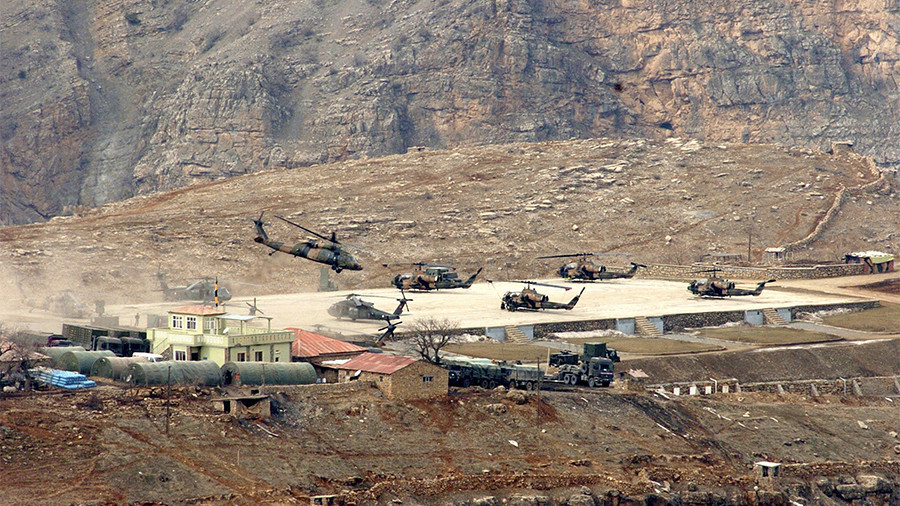
FILE PHOTO: A Turkish military helicopter takes of from a military base near Cukurca © Reuters
A Turkish military chopper was downed amid the country’s Olive Branch operation in northern Syria, President Recep Tayyip Erdogan said. Two soldiers were killed in the incident.

“One of our helicopters was downed just recently,” Erdogan said as he spoke to a member of the ruling Justice and Development Party (AKP) in Istanbul. “These things will happen, we are in a war,” the president said, adding that even though Turkey “might lose a helicopter,” the perpetrators of the attack will “pay a heavy price.”

Read more

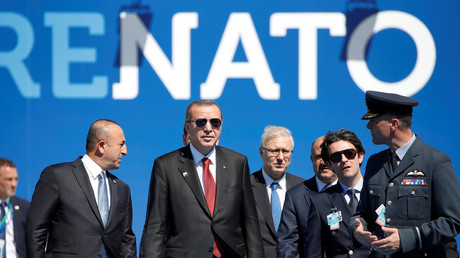
Turkish President Recep Tayyip Erdogan arrives to NATO Summit in Brussels, Belgium, May 25, 2017. © Christian Hartmann

The president also said the Turkish Armed Forces “destroyed many missile depots” of the Kurdish militias they are battling in the Afrin region.Turkish Prime Minister Binali Yildirim later told journalists that two soldiers were killed in the crash. However, he said that the cause of the incident is still unclear.

“We don’t have exact evidence or document to determine that it went down with any outside interference,” Yildirim told reporters on Saturday, as cited by AP. A representative of the Kurdish militias said that the chopper was shot down by Kurdish fighters over an area located northwest of Afrin, as reported by AP.

The Turkish Armed Forces also confirmed the incident and the deaths, saying that the helicopter had “crashed.” It is also unclear where the incident took place. Yildirim said that it occurred in Syria’s northern Afrin province. However, Anadolu Agency earlier reported that the helicopter crashed in the southern Turkish province of Hatay.

The Turkish General Staff also said on Saturday that the armed forces “destroyed” 36 targets and “neutralized” 79 militants in the airstrikes carried out in the Afrin region overnight.The Turkish Operation Olive Branch in the Afrin region in northern Syria entered its fourth week on Saturday. The campaign followed Ankara’s promises to “strangle” the new Border Security Force (BSF) in Syria.

Read more

Turkish army tanks gather close to the Syrian border on January 21, 2018 at Hassa, in Hatay province © Bulent Kilic

Earlier in January, the US-led coalition announced that it would help create the 30,000-strong BSF, half of which would be made up of the Kurdish Syrian Democratic Forces (SDF) alliance. Ankara was angered by the fact that the main force behind the SDF is the Kurdish People’s Protection units (YPG), linked to the Kurdistan Workers’ Party (PKK). The latter is designated as a terrorist group by Turkey.

Erdogan has recently stated that once the Afrin operation is over, Turkey’s next target could be Idlib.“We want our Syrian brothers and sisters to return to their land, and now we want to do the same in Idlib what we have done in Afrin,” he said on Thursday.

As the operation in northern Syria continues, Turkey, a NATO member since 1952, now seems to be straining the patience of its allies. During the first week of the campaign, Germany froze all decisions on supplying weapons to Ankara, including upgrades to the German-made Leopard tanks currently used by Turkey.

Earlier this week, the French president and foreign minister warned Ankara against the invasion and accused it of “adding war to war” – albeit in interviews, not official statements. Ankara’s operation in Afrin has also caused serious tensions with its major ally, the US. Washington later said it would cease providing military aid to the Kurds. The US’ arming of the Kurdish Forces – especially the YPG – has been repeatedly slammed by Turkey.