Archive for December 27, 2017

State Dept Denies Request By US Ambassador Friedman, Says ‘Occupation’ Still Exists

December 27, 2017

State Dept Denies Request By US Ambassador Friedman, Says ‘Occupation’ Still Exists, Jewish PressHana Levi Julian, December 27, 2017

US Ambassador to Israel David Friedman speaks during the 16th anniversary memorial ceremony for the victims of 9/11 attacks in a memorial monument in the Jerusalem Hills on September 11, 2017.

Because there is pressure “from above” involved in the issue, however, Friedman and those with whom there is a disagreement have agreed to review the matter, according to the report, leaving the final decision up to U.S. President Donald Trump.

**********************************

Israel’s Kan public broadcaster reported Tuesday that the U.S. State Department has refused to comply with Ambassador to Israel David Friedman’s request that official documents no longer use the term “occupation” in its references to Israel.

Friedman, an attorney, explained (as he has a number of times in the past) that United Nations Resolution 242 was deliberately written at the time in such a way as to reflect that the areas in which Jewish communities were built were always intended to remain with Israel.

Because there is pressure “from above” involved in the issue, however, Friedman and those with whom there is a disagreement have agreed to review the matter, according to the report, leaving the final decision up to U.S. President Donald Trump.

How to Defund the U.N.

December 27, 2017

How to Defund the U.N., Gatestone InstituteJohn R. Bolton, December 27, 2017

(Back in June of 1950, when North Korea with Stalin’s help and encouragement invaded South Korea, The UN General Secretary telephoned President Truman to say that he regarded the North Korean invasion an assault on the UN. Fortunately, Russia was boycotting the UN to protest its refusal to seat China. Various UN members provided troops to support the UN Command. It was a very different UN back then, the likes of which we are unlikely ever to see again. — DM)

Turtle Bay has been impervious to reform largely because most U.N. budgets are financed through effectively mandatory contributions. Under this system, calculated by a “capacity to pay” formula, each U.N. member is assigned a fixed percentage of each agency’s budget to contribute. The highest assessment is 22%, paid by the U.S. This far exceeds other major economies, whose contribution levels are based on prevailing exchange rates rather than purchasing power parity. China’s assessment is just under 8%.

Why does the U.S. tolerate this? It is either consistently outvoted when setting the budgets that determine contributions or has joined the “consensus” to avoid the appearance of losing. Yet dodging embarrassing votes means acquiescing to increasingly high expenditures.

The U.S. should reject this international taxation regime and move instead to voluntary contributions. This means paying only for what the country wants — and expecting to get what it pays for. Agencies failing to deliver will see their budgets cut, modestly or substantially. Perhaps America will depart some organizations entirely. This is a performance incentive the current assessment-taxation system simply does not provide.

**********************************

As an assistant secretary of state in the George H.W. Bush administration, I worked vigorously to repeal a hateful United Nations General Assembly resolution equating Zionism with racism. Foreign diplomats frequently told me the effort was unnecessary. My Soviet counterpart, for example, said Resolution 3379 was only a piece of paper gathering dust on a shelf. Why stir up old controversies years after its 1975 adoption?

We ignored the foreign objections and persisted because that abominable resolution cast a stain of illegitimacy and anti-Semitism on the U.N. It paid off. On Dec. 16, 1991, the General Assembly rescinded the offensive language.

Now, a quarter-century later, the U.N. has come close to repeating Resolution 3379’s original sin. Last week the U.N. showed its true colors with a 128-9 vote condemning President Trump’s recognition of Jerusalem as Israel’s capital.

This seemingly lopsided outcome obscured a significant victory and major opportunity for the president. Thirty-five countries abstained, and 21 didn’t vote at all. Days earlier the Security Council had endorsed similar language, 14-1, defeated only by the U.S. veto. The margin narrowed significantly once Mr. Trump threatened to penalize countries that voted against the U.S. This demonstrated once again that America is heard much more clearly at the U.N. when it puts its money where its mouth is. (In related news, Guatemala announced Sunday it will move its embassy to Jerusalem, a good example for others.)

While imposing financial repercussions on individual governments is entirely legitimate, the White House should also reconsider how Washington funds the U.N. more broadly. Should the U.S. forthrightly withdraw from some U.N. bodies (as we have from UNESCO and as Israel announced its intention to do on Friday)? Should others be partially or totally defunded? What should the government do with surplus money if it does withhold funds?

Despite decades of U.N. “reform” efforts, little or nothing in its culture or effectiveness has changed. Instead, despite providing the body with a disproportionate share of its funding, the U.S. is subjected to autos-da-fé on a regular basis. The only consolation, at least to date, is that this global virtue-signaling has not yet included burning the U.S. ambassador at the stake.

Turtle Bay has been impervious to reform largely because most U.N. budgets are financed through effectively mandatory contributions. Under this system, calculated by a “capacity to pay” formula, each U.N. member is assigned a fixed percentage of each agency’s budget to contribute. The highest assessment is 22%, paid by the U.S. This far exceeds other major economies, whose contribution levels are based on prevailing exchange rates rather than purchasing power parity. China’s assessment is just under 8%.

Why does the U.S. tolerate this? It is either consistently outvoted when setting the budgets that determine contributions or has joined the “consensus” to avoid the appearance of losing. Yet dodging embarrassing votes means acquiescing to increasingly high expenditures.

The U.S. should reject this international taxation regime and move instead to voluntary contributions. This means paying only for what the country wants — and expecting to get what it pays for. Agencies failing to deliver will see their budgets cut, modestly or substantially. Perhaps America will depart some organizations entirely. This is a performance incentive the current assessment-taxation system simply does not provide.

Start with the U.N. Human Rights Council. Though notorious for its anti-Israel bias, the organization has never hesitated to abuse America. How many know that earlier this year the U.N. dispatched a special rapporteur to investigate poverty in the U.S.? American taxpayers effectively paid a progressive professor to lecture them about how evil their country is.

The U.N.’s five regional economic and social councils, which have no concrete accomplishments, don’t deserve American funding either. If nations believe these regional organizations are worthwhile — a distinctly dubious proposition — they are entirely free to fund them. Why America is assessed to support them is incomprehensible.

Next come vast swaths of U.N. bureaucracy. Most of these budgets could be slashed with little or no real-world impact. Start with the Office for Disarmament Affairs. The U.N. Development Program is another example. Significant savings could be realized by reducing other U.N. offices that are little more than self-licking ice cream cones, including many dealing with “Palestinian” questions. The U.N. Relief and Works Agency for Palestine Refugees (UNRWA) could be consolidated into the U.N. High Commissioner for Refugees.

Many U.N. specialized and technical agencies do important work, adhere to their mandates and abjure international politics. A few examples: the International Atomic Energy Agency, the Food and Agriculture Organization and the World Health Organization. They shouldn’t be shuttered, but they also deserve closer scrutiny.

Some will argue incorrectly that unilaterally moving to voluntary contributions violates the U.N. Charter. In construing treaties, like contracts, parties are absolved from performance when others violate their commitments. Defenders of the assessed-contribution model would doubtless not enjoy estimating how often the charter has been violated since 1945.

If the U.S. moved first, Japan and some European Union countries might well follow America’s lead. Elites love the U.N., but they would have a tough time explaining to voters why they are not insisting their contributions be used effectively, as America has. Apart from risking the loss of a meaningless General Assembly vote — the Security Council vote and veto being written into the Charter itself — the U.S. has nothing substantial to lose.

Thus could Mr. Trump revolutionize the U.N. system. The swamp in Turtle Bay might be drained much more quickly than the one in Washington.

Pictured: John Bolton, then U.S. Ambassador to the United Nations, addresses the UN Security Council on October 14, 2006 in New York City. (Photo by Stephen Chernin/Getty Images)

John R. Bolton, former U.S. Ambassador to the United Nations, is Chairman of Gatestone Institute, a senior fellow at the American Enterprise Institute, and author of “Surrender Is Not an Option: Defending America at the United Nations and Abroad”.

This article first appeared in The Wall Street Journal and is reprinted here with the kind permission of the author.

Hamas: Iran Has Pledged ‘All Capabilities’ To Help Us Fight Israel

December 27, 2017

Hamas: Iran Has Pledged ‘All Capabilities’ To Help Us Fight Israel, Breitbart, December 26, 2017

AP Photo/ Khalil Hamra

The director of Israel’s Shin Bet security agency on Sunday told a select group of Israeli ministers and lawmakers that the Gaza-based group is being careful to avoid a full conflagration with Israel along the Gaza border, but was actively trying to sow chaos in the West Bank.

The security service’s chief Nadav Argaman said Hamas was preparing for a takeover of the West Bank, and added that the group’s efforts are dangerous especially in light of the political weakness of Palestinian Authority President Mahmoud Abbas.

******************************************

TEL AVIV — A top Hamas official said Monday that a senior Iranian official gave him his word that all of Iran’s military might would be available to help the Gaza-based group fight Israel and take over Jerusalem, according to a report in the Times of Israel.

“All our of capabilities and potential are at your disposal in the battle for the defense of Jerusalem,” Yahya Sinwar quoted the commander of Iran’s Islamic Revolutionary Guards Corps’ elite Quds Force Qassem Soleimani as telling him over the phone.

Sinwar’s comments were carried by pro-Iranian Lebanese news outlet al-Mayadeen.

Soleimani, according to the report, told Sinwar that “Iran, the Revolutionary Guards and Quds Force stand with all they have with our people in order to defend Jerusalem so that Jerusalem will endure as the capital of the state of Palestine.”

Since U.S. President Donald Trump recognized Jerusalem as Israel’s capital, Hamas has been trying to inflame the Palestinian street and issued calls for “days of rage” and a third intifada.

There have been riots near the Old City of Jerusalem after Friday morning prayers, but Israeli security forces have so far succeeded in quelling them with few casualties.

The director of Israel’s Shin Bet security agency on Sunday told a select group of Israeli ministers and lawmakers that the Gaza-based group is being careful to avoid a full conflagration with Israel along the Gaza border, but was actively trying to sow chaos in the West Bank.

The security service’s chief Nadav Argaman said Hamas was preparing for a takeover of the West Bank, and added that the group’s efforts are dangerous especially in light of the political weakness of Palestinian Authority President Mahmoud Abbas.

No friend of Israel

December 27, 2017

No friend of Israel, Israel Hayom, Eldad Beck, December 27, 2017

(Might the substantial and increasing Islamisation of “multicultural” Germany be a factor in German hostility to Israel? — DM)

The time has come to reveal the true face of Germany, a country that wages a relentless struggle against Israel in both EU and U.N. institutions at the same time that it claims Israel’s existence and security are integral to its national interests. Germany is Europe’s single largest donor to the Palestinian Authority, but it has never once thought to demand the Palestinians do something for peace in return for all the money it provides, like put an end to the violence and the anti-Semitic incitement. While this should be obvious given Germany’s history, it seems it is not so crystal clear to Berlin. Germany prefers to put pressure on Israel only, by funding radical organizations that slander the Jewish state around the world.

*************************************

Around two weeks ago, and mere days after U.S. President Donald Trump’s recognition of Jerusalem as Israel’s capital, one of the most popular tourist attractions in Berlin was opened at the Jewish Museum. Spanning over 1,000 square feet, the “Welcome to Jerusalem” exhibit is huge and includes hundreds of displays and exhibits.

One would have expected this type of exhibit at such an important Jewish museum to emphasize Jerusalem’s unique character as the holiest city in Judaism and also possibly focus a bit on the historical narrative of Zionism and the State of Israel. Such an exhibit could also have presented, in a balanced manner of course, the different religions that coexist in the city in spite of the ongoing conflict. But regrettably, the exhibit does nothing of the sort, but rather serves to strengthen the theory of Muslim-Arab-Palestinian ownership of the city, mainly through a biased presentation of the Arab-Israeli conflict.

A historical documentary about the conflict, one of the exhibit’s highlights, portrays Jews as domineering invaders. It notes the massacres and terrorist acts committed by Jewish paramilitary organizations while completely ignoring those same acts when they were carried out by Arab organizations at the behest of Jerusalem Mufti Haj Amin al-Husseini; completely ignores the Arab revolt of the 1930s and Husseini’s collaboration with the Nazis; presents a fairly long segment from an interview with late Palestinian leader Yasser Arafat from the early years of his leadership, in which the then-PLO chief explains that the Palestinians have no choice but to take up arms; and repeats the theory according to which the 1995 assassination of Prime Minister Yitzhak Rabin is what led to the disintegration of the peace process, as well as the proven lie that then-Opposition Leader Ariel Sharon’s 2000 visit to the Temple Mount sparked the Second Intifada. In short, according to the Jewish Museum in Berlin, the Jews are bad while the Arabs are victims.

Could one have really expected a different approach from a Jewish museum that, as part of its permanent exhibits, presents Israel as part of the “Diaspora” of German Jewry along with images of left-wing German Jews protesting against Israel? One of the curators of the Jerusalem exhibit is Cilly Kugelmann, a former vice director of the Jewish Museum whose post-Zionist views helped turn the museum into a center of activity for those who negate Israel’s existence. It is important to note that the Jewish Museum does not have ties with the local Jewish community and is financed by public funds, meaning the German establishment could influence the content on display and use the museum to relay a message. In fact, that is exactly what it is doing: The Jewish Museum serves the German establishment in its conscious struggle against Israel under the guise of a supposedly Jewish body.

Trump’s recognition of Jerusalem as Israel’s capital served to reveal Germany’s hypocrisy as far as concerns its ties with the Jewish state: Last week, Germany voted in favor of a U.N. resolution submitted by Turkey and Yemen that called U.S. recognition of Jerusalem as Israel’s capital “null and void.” Germany, along with the other great nations of the European Union, betrayed its alliance with the United States and Israel in order to align with the world’s most unsavory regimes in negating the Jewish state’s right to determine that its capital is in Jerusalem, the most sacred city to Jews.

The time has come to reveal the true face of Germany, a country that wages a relentless struggle against Israel in both EU and U.N. institutions at the same time that it claims Israel’s existence and security are integral to its national interests. Germany is Europe’s single largest donor to the Palestinian Authority, but it has never once thought to demand the Palestinians do something for peace in return for all the money it provides, like put an end to the violence and the anti-Semitic incitement. While this should be obvious given Germany’s history, it seems it is not so crystal clear to Berlin. Germany prefers to put pressure on Israel only, by funding radical organizations that slander the Jewish state around the world.

Unfortunately, Germany is no friend of Israel. That is at least as long as its current policies remain in place.

North Korean Soldier Had ‘Anthrax Antibodies,’ Raising Concerns Over Pyongyang’s Biological Weapons Plans

December 27, 2017

North Korean Soldier Had ‘Anthrax Antibodies,’ Raising Concerns Over Pyongyang’s Biological Weapons Plans, Newsweek,  , December 27, 2017

According to 2015 documents from the South Korean Defense Ministry, North Korea possesses 13 types of bacteria and viruses that cause disease, known as pathogens. These include anthrax, botulism, cholera, Korean hemorrhagic fever, plague, smallpox, typhoid fever, yellow fever, dysentery, brucellosis, staph, typhus fever, and alimentary toxic aleukia.

Seoul estimated Pyongyang could “cultivate and weaponize [the pathogens] within 10 days,” and would prioritize anthrax, because it is highly deadly, and smallpox, because it is highly contagious—and its soldiers are thought to be vaccinated against it.

******************************************

Anthrax antibodies were found in the blood of a North Korean soldier who defected to the South, intelligence sources told Seoul’s media, increasing concerns about the country’s biological weapons production.

The unidentified intelligence official who spoke to South Korea’s Channel A network did not specify which soldier it was referring to; at least four North Korean soldiers have defected in the past seven months. “Anthrax antibodies have been found in the North Korean defector who has escaped this year,” the official was quoted as saying in the news report, which aired Tuesday.

North Korea is thought to be vaccinating top officials against anthrax, while the defectors held lower ranks. Seoul’s intelligence agency is investigating what kind of vaccines stockpiles has the country developed, the report said.

Senior defense analyst Shin Jong Woo of the Korea Defense Security Forum (KODEF) told Channel A the vaccine is likely to have been given to soldiers who handle the bacteria for military purposes, as unconfirmed reports last week indicated Pyongyang was looking to load anthrax on its intercontinental ballistic missiles (ICBMs).

Anthrax can infect human beings through either ingestion, inhalation or skin exposure and it affects the normal functioning of the body’s immune system cells. While ingestion or skin exposure to anthrax can sometimes be treated, inhalation is highly fatal, with a mortality rate of at least 80 percent, according to the FDA.

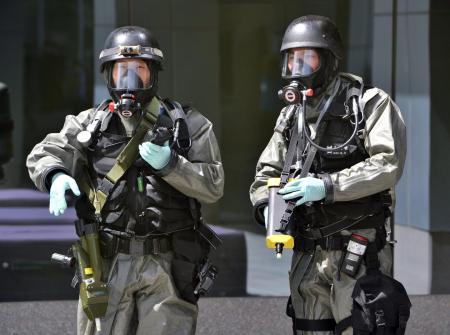
South Korean military biochemical warfare soldiers take part in an anti-terror drill in Seoul on May 3, 2011. A North Korean defector was found to have anthrax antibodies in his blood, an intelligence source told South Korean media. JUNG YEON-JE/AFP/GETTY IMAGES

Despite concerns about North Korea’s biological weapons production, Seoul’s soldiers are not vaccinated against deadly bacteria, unlike U.S. troops deployed on the peninsula, for whom smallpox and anthrax vaccinations have been compulsory for more than a decade. The two countries regularly hold military training exercises to practice their response to possible biological or chemical attacks.

On Monday, Seoul confirmed it had imported 350 doses of anthrax vaccines this year, which are meant to be stocked for treatment rather than vaccination.

“We purchased the vaccines, not to prevent but to treat the disease, in case of biological terror attacks,” presidential spokesperson Park Soo-hyun said, as quoted in the Korea Herald . He added that the Korea Centers for Disease Control and Prevention have acquired anthrax vaccines for 1,000 patients for the same purpose.

While North Korea has never publicly acknowledged the development of biological weapons, its leader Kim Jong Un visited Pyongyang’s Biological Technology Research Institute in June 2015.

According to Melissa Hanham, research associate at the James Martin Center for Nonproliferation Studies, the facility was not being used as a biological weapons facility at the time—but it could serve that purpose, as she wrote in analysis published on 38 North, a website dedicated to monitoring North Korea.

According to 2015 documents from the South Korean Defense Ministry, North Korea possesses 13 types of bacteria and viruses that cause disease, known as pathogens. These include anthrax, botulism, cholera, Korean hemorrhagic fever, plague, smallpox, typhoid fever, yellow fever, dysentery, brucellosis, staph, typhus fever, and alimentary toxic aleukia.

Seoul estimated Pyongyang could “cultivate and weaponize [the pathogens] within 10 days,” and would prioritize anthrax, because it is highly deadly, and smallpox, because it is highly contagious—and its soldiers are thought to be vaccinated against it.

New Western Wall train station to be named after Trump 

December 27, 2017

Source: New Western Wall train station to be named after Trump – Israel News – Jerusalem Post

BY UDI SHAHAM, JPOST.COM STAFF
 DECEMBER 27, 2017 10:00
“The Western Wall is the holiest place for the Jewish people, and I decided to call the train station that leads to it after President Trump.”

“The Western Wall is the holiest place for the Jewish people, and I decided to call the train station that leads to it after President Trump following his historic and brave decision to recognize Jerusalem as the capital of the State of Israel,” said Katz

Trump’s recognition of Jerusalem as the capital of Israel on December 6 led to almost unanimous support from across the Israeli political spectrum but sparked waves of protests across the world.

US President Donald Trump delivers remarks recognizing Jerusalem as the capital of Israel at the White House in Washington, US December 6, 2017. (Reuters)

US President Donald Trump delivers remarks recognizing Jerusalem as the capital of Israel at the White House in Washington, US December 6, 2017. (Reuters)

Yedioth Aharonot reported that Katz approved the construction plans for the train, which will include a three kilometer tunnel from the “Umma” (Nation) station at the entrance to the city to the Kardo in the Jewish Quarter, only a short distance from the Western Wall.

Katz said he sees this project of extending the length of the railway from Tel Aviv to Jerusalem as the most important national project, and ordered officials in the Transportation Ministry to define it as a top priority mission.

The high-speed Tel Aviv-Jerusalem railway has been under construction since 2001 and will complement the existing, slower railway that already operates between the two cities. The project has been marked by numerous setbacks and delays.

In May, Trump became the first sitting US president to visit the Western Wall when he visited the site during a tour of several Middle East countries.

Updated: Mordechai Kedar destroys Muslim claims to Jerusalem on Al-Jazeera TV – full video with English subtitles

December 27, 2017

When posted the video of Mordechai Kedar speaking on Al-Jazeera TV, I only had a subtitled version of a 2 minute segment. I noted that I didn’t have the full video with English subtitles and that I would update if I found it.

Reader Gideon Kantorovich very kindly sent me the video of the full interview (10 minutes) complete with English subtitles, which I hereby post below.

Enjoy Mordechai Kedar’s wit and his deep knowledge of Islam and Arab culture: