Archive for December 11, 2017

President Trump: The Courage to Act

December 11, 2017

President Trump: The Courage to Act, Gatestone InstituteDouglas Murray, December 11, 2017

The reaction around the world in recent days has been a reminder of the one central truth of the whole conflict. Those who cannot accept that Jerusalem is the capital of the State of Israel tend to be exactly the same as those who cannot accept the State of Israel.

Trump comes out of the whole situation well — taking on a promise that his three predecessors made, but on which only he had the courage to act. Those who have most forcibly criticised him, on the other hand, have shown something weak, as well as ugly, about themselves.

President Trump’s announcement on the status of Jerusalem last week was both historic and commendable. Historic because it is the first time that an American president has not just acknowledged that the Israeli capital is Jerusalem but decided to act on that acknowledgement. Commendable for breaking a deceitful trend and accepting what will remain the reality on the ground in every imaginable future scenario. As many people have pointed out in recent days, there is not one prospective peace deal between the Israelis and the Palestinians in which Tel Aviv becomes the capital of the Jewish state.

Yet, the Palestinian leadership, much of the mainstream media, academia and the global diplomatic community take another view. They believe that the American president should have continued with the fairy tale and should never have said “That the United States recognises Jerusalem as the capital of the State of Israel and that the United States Embassy to Israel will be relocated to Jerusalem as soon as practicable.” They claim that this is not a simple recognition of reality and not simply the American President granting the State of Israel the same right every other nation on the planet has — which is to have their capital where they like. Such forces claim that this is a “provocative” move. Amply demonstrating the illogic of this position, the first thing the Turkish Sultan Recep Tayyip Erdogan did after the American president made his announcement was to threaten a suspension of Turkish relations with Israel.

The reaction around the world in recent days has been a reminder of the one central truth of the whole conflict. Those who cannot accept that Jerusalem is the capital of the State of Israel tend to be exactly the same as those who cannot accept the State of Israel. Consider the expert whom the BBC’s flagship current affairs programme Newsnight chose to bring on to receive soft-ball questions on this issue. Dr. Ghada Karmi, from the Institute of Arab and Islamic Studies at the University of Exeter, a notorious opponent of Israel, was inevitably given the sort of respectful interview style that Newsnight presenters generally reserve for when they are interviewing Madonna or some other mega-star they cannot believe their luck at having gotten to speak with.

Here is what Ghada Karm had to say — with no meaningful challenge from the programme’s presenter, Emily Maitlis.

Ghada Karmi: We know that Donald Trump is not a free agent. He is surrounded by pro-Israel advisors, pro-Israel officials.

Emily Maitlis (BBC): To be fair the American stance towards Israel has not differed particularly from one President to another.

Karmi: No, because it’s always been dictated by Israeli interests.

Maitlis (BBC): So what are you saying – that he cannot broker peace or America cannot broker peace in the region.

Karmi: No – of course not. He can’t. He’s compromised. He is surrounded by pro-Israel propagandists, people who want Israel’s interests above any other and he cannot operate as a free agent even if he had the wit to do it…. Why it is so dangerous is because you know one of the first things that might happen — and watch for this — is that Israel will be emboldened to take over the Islamic holy places. It’s had its eye on the Aqsa mosque for a long time.

To the surprise of absolutely nobody, when Maitlis then turned to interview the Israeli ambassador to the UK, she adopted a different tone.

Ambassador Mark Regev was not given these sorts of soft-ball questions. If he had claimed that the Palestinians were planning to bulldoze the Western Wall, it seems unlikely he would have been allowed to say it uncontested. He was in fact treated throughout as though he were simply some well-known variety of idiot or liar, who had no concept of the “offence” (a favourite threat term) that this move by the American President would cause Palestinians.

Ghada Karmi was not challenged on the claim that the Israelis were about to take over any and all Islamic holy places (to do what?), but Ambassador Regev’s suggestion that the State of Israel already has its Parliament, Supreme Court and every wing of government in Jerusalem, and that Jerusalem might just be Israel’s capital, was treated as though it were the most inflammatory nonsense the BBC had ever heard.

Most disappointing was the response of the British Prime Minister, Theresa May. Goaded on by the deeply anti-Israel (not to mention anti-Semitism-harbouring) Labour party leader Jeremy Corbyn, May, for the second time in a fortnight, chose to berate the President of Britain’s closest ally. Captured by the logic of the UK’s Foreign Office, May announced:

“We disagree with the US decision to move its embassy to Jerusalem and recognise Jerusalem as the Israeli capital before a final status agreement.

“We believe it is unhelpful in terms of prospects for peace in the region. The British Embassy to Israel is based in Tel Aviv and we have no plans to move it.

“Our position on the status of Jerusalem is clear and long-standing: it should be determined in a negotiated settlement between the Israelis and the Palestinians, and Jerusalem should ultimately be the shared capital of the Israeli and Palestinian states.

“In line with relevant Security Council Resolutions, we regard East Jerusalem as part of the Occupied Palestinian Territories.”
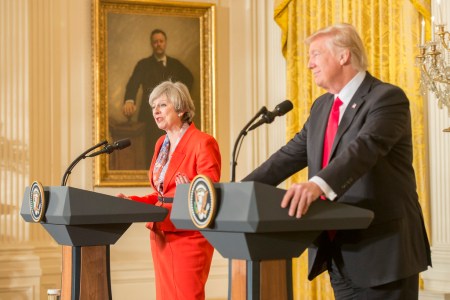
Following President Trump’s historic and commendable announcement on the status of Jerusalem last week, Britain’s Prime Minister Theresa May chose to berate Trump. Pictured: PM May, on January 27, 2017 addresses the media in Washington, DC alongside President Trump. (Image source: 10 Downing St./Flickr)

There is something which the entire world ought to recognise about the British government’s attitude towards “occupied territory”, which is that the august entity in Whitehall still believes that land in northern Israel should be returned to Syria’s Bashar al-Assad. Even now, the greatest minds of the Foreign Office in London advocate that Assad has not had enough territory to immiserate and destroy in recent years. Who knows, perhaps President Assad could have killed more than a half a million people in his country’s civil war if he could only have got an extra sliver of land?

Perhaps May feels the pressure of the Foreign Office status quo. Or perhaps she feels the pressure of Jeremy Corbyn’s band of anti-Semites at her back. Or — who knows — perhaps she worries about the millions of British Muslims from South Asia who can occasionally be whipped up into believing that the prime responsibility of Muslims worldwide is to rage about Middle Eastern politics — only of course if Jews are involved (otherwise they remain placid). Certainly that appeared to be on the national broadcaster’s mind, with the BBC choosing to go straight to the Muslim-dominated city of Bradford to ask South Asian Muslims there what they thought about Jerusalem.

There have been reactions around the world to US President’s historic announcement. Trump comes out of the whole situation well — taking on a promise that his three predecessors made, but on which only he had the courage to act. Those who have most forcibly criticised him, on the other hand, have shown something weak, as well as ugly, about themselves: When the facts on the ground were staring them in the face, they chose instead to bow to domestic fantasies of their own creation.

Douglas Murray, British author, commentator and public affairs analyst, is based in London, England. His latest book, an international best-seller, is “The Strange Death of Europe: Immigration, Identity, Islam.”
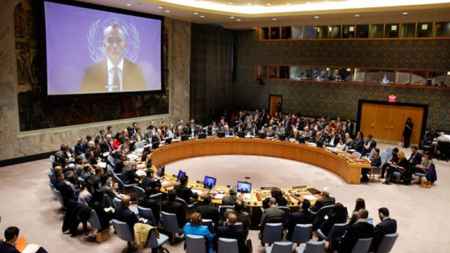
 

UN Security Council Bashes Trump’s Jerusalem Decision

December 11, 2017

UN Security Council Bashes Trump’s Jerusalem Decision, FrontPage MagazineJoseph Klein, December 11, 2017

(Please see also, Defiant Haley chides fuming Security Council members: ‘Change is hard. — DM)

Whichever provisions of Resolution 2334 are legally binding on Israel and all other UN member states, President Trump’s December 6th decision does not have any bearing on the sensitive issue of Israeli settlements or on Israel’s claims to sovereignty over “East Jerusalem.” Thus, invoking this infamous anti-Israeli resolution in the context of President Trump’s decision is a red herring.

“Over many years,” Ambassador Haley said in her remarks to the Security Council, the United Nations has been one of the world’s “foremost centers of hostility towards Israel.”  The Security Council became a kangaroo court on Friday, turning a perverted version of “international law” against the Trump administration for its just defense of the Jewish state of Israel and Israel’s right to choose its own capital as every other member state has the right to do.

********************************

On December 6th, President Trump announced his decision to officially recognize Jerusalem as the capital of Israel and to instruct the State Department to begin the process of relocating the U.S. Embassy from Tel Aviv to Jerusalem. Two days later, at a special meeting of the United Nations Security Council, the other 14 members of the Council, including U.S. allies such as France, the United Kingdom and Italy, ganged up on the United States to condemn President Trump’s decision. Allies and adversaries of the U.S., one after the other, claimed that President Trump’s decision had defied international consensus on how to achieve a viable two-state solution, violated international law and risked destabilizing the region as well as imperiling the peace process. Bolivia’s ambassador was the most strident, demanding that the Security Council take action against President Trump’s decision if it wanted to avoid becoming “an occupied territory.

To add insult to injury, the UN ambassadors from five member states of the European Union – the United Kingdom, France, Italy, Sweden and Germany – further criticized President Trump’s decision in a joint statement they read following the adjournment of the Security Council meeting. They claimed the decision “is not in line with Security Council resolutions and is unhelpful in terms of prospects for peace in the region.”

U.S. Ambassador to the UN, Nikki Haley, stood her ground in her remarks to the Security Council. She chastised those “countries that lack any credibility when it comes to treating both Israelis and Palestinians fairly.” All President Trump had done, she explained, was to formally acknowledge the reality that for nearly 70 years “the city of Jerusalem has been the capital of the State of Israel, despite many attempts by others to deny that reality. Jerusalem is the home of Israel’s parliament, president, prime minister, Supreme Court, and many of its ministries. It is simple common sense that foreign embassies be located there.”

President Trump’s change in American policy to reflect this reality does not mean that the United States has taken a position on the specific boundaries or borders within Jerusalem as a whole. “The specific dimensions of sovereignty over Jerusalem are still to be decided by the Israelis and the Palestinians in negotiations,” Ambassador Haley said.

Notably, President Trump’s announcement specifically called for maintaining the status quo at the holy sites in the Old City of Jerusalem. There is not even the slightest hint that the U.S. would be moving its embassy to the Old City or to any part of “East Jerusalem.” However, the critics of President Trump’s decision refuse to allow for the possibility of a U.S. embassy located anywhere at all in the entire city of Jerusalem – even in what is now referred to as “West Jerusalem,” which is an undisputed section of Jerusalem.

“Israel, like all nations, has the right to determine its capital city,” Ambassador Haley said. “In virtually every country in the world, U.S. embassies are located in the host country’s capital city. Israel should be no different.”

The principal objections to President Trump’s decision are that it sets back the chances for a peaceful resolution of the Israeli-Palestinian conflict based on the two-state solution, it is apt to destabilize and trigger violence in the region and beyond, and it violates international law.

The first two objections can be given short shrift. For seventy years, there has been no peace because the Palestinians have consistently pursued an absolutist policy rejecting the idea of a Jewish state living side by side with an Arab state. The Palestinians and their Arab state neighbors rejected the partition recommended in UN General Assembly Resolution 181 in 1947. The Palestinians did not declare an independent state of their own when they had the chance. They embarked instead on a campaign of violence. Hamas, Palestinian President Abbas’s coalition partner, still calls for Israel’s destruction. Abbas, who has incited sectarian violence and rewards terrorists, spurned a peace offer from Israel in 2008 that would have resulted in Israel’s withdrawal from virtually all of the West Bank and the relinquishment of Israeli control of Jerusalem’s Old City in favor of placing it under international control. Abbas has refused to this day to agree to direct unconditional negotiations with Israel, a position which long preceded President Trump’s decision.

As for the violence that critics of President Trump’s decision seek to lay at his feet, violence has indeed erupted, not only in the Middle East but elsewhere including Europe. However, President Trump’s decision is being used as a pretext for such behavior that Palestinians and Islamists throughout the world have displayed time and again. We have seen excuses for violence ranging from cartoons and an obscure anti-Muslim video to the installation of metal detectors at the Temple Mount (despite the presence of metal detectors at mosques in other countries). Foreign policy and national security decisions cannot be held hostage to mob rule. Giving in to threats of a violent reaction will only encourage the increased use of such threats to thwart other controversial decisions.

Turning to the objection to President Trump’s decision based on “international law,” the critics have claimed that his declaration recognizing Jerusalem as Israel’s capital and decision to move the U.S. embassy from Tel Aviv to Jerusalem violate a whole host of UN General Assembly and Security Council resolutions. Sovereignty over Jerusalem, they have argued, is a “final status” issue to be negotiated between the parties themselves. They have argued this position while also holding on to the characterization of “East Jerusalem” as part of the “Occupied Palestinian Territories” in the various UN resolutions they cite. In short, the Israel bashers have no problem exploiting UN resolutions to pre-determine the final status of “East Jerusalem,” which contains the holy sites of Judaism, Christianity and Islam, as belonging to the Palestinians.

Moreover, the UN resolutions that the critics of President Trump’s decision rely upon to support their objections on “legal” grounds do little to help their case. As a matter of international law, there is nothing in the United Nations Charter that grants the General Assembly any power that would render its resolutions, declarations, or recommendations legally binding or enforceable. In any case, the Palestinians and their Arab state neighbors, including Jordan, which illegally seized and annexed the Old City of Jerusalem in 1948, completely rejected the original UN two-state partition resolution, Resolution 181. Their attempt to invoke that resolution or subsequent General Assembly resolutions now to rationalize their position on international law grounds is specious at best.

President Trump’s critics also point for support of their position to UN Security Council resolutions stating that East Jerusalem is part of the “Occupied Palestinian Territories,” declaring Israel’s settlements in East Jerusalem to be illegal, concluding that Israel’s assertion of sovereignty over a unified Jerusalem is null and void, and calling upon member states to withdraw their embassies from the Holy City of Jerusalem.  These resolutions were not explicitly adopted in the exercise of the Security Council’s Chapter VII enforcement powers, which is significant in determining whether they are legally binding unless they are expressly framed as “decisions” of the Council or, at the very least, use such words as “demand” in the applicable provisions. Words and phrases such as “calls upon,” “urges,” “reaffirms,” “underlines,” and “stresses” are deemed insufficient by legal experts in the field to reflect an intention on the part of the Security Council to create a legally binding obligation on any of the member states of the UN.

Many of the ambassadors speaking at Friday’s Security Council meeting invoked Security Council Resolution 478 as a principal basis for declaring President Trump’s decision to be in violation of international law. However, Resolution 478 used the word “decides” only in the context of refusing to recognize Israel’s “Basic Law” declaring Israeli sovereignty over the “Holy City of Jerusalem” and “such other actions by Israel that, as a result of this law, seek to alter the character and status of Jerusalem.” Resolution 478 then “calls upon” (not demands) the member states “to accept this decision,” which means it is up to each member state to agree or not. Moreover, Resolution 478 only “calls upon” the member states “that have established diplomatic missions at Jerusalem to withdraw such missions from the Holy City.” Again, this does not constitute a legally binding obligation. Moreover, it would not appear to apply explicitly to the western sector of Jerusalem, outside of the Old City where the holy sites of Judaism, Christianity and Islam are located.

President Trump’s decision in no way is inconsistent with Resolution 478. To the contrary, as discussed above, President Trump specifically called for maintaining the status quo at the holy sites in Jerusalem and left it to Israel and the Palestinians to negotiate the final status of the boundary lines within Jerusalem as a whole. President Trump’s announcement of the intent to relocate the U.S. embassy to Jerusalem, particularly if relocated outside of the boundaries of the Old City as it most certainly will be, would not be enjoined by Resolution 478’s express provisions, which are not legally binding in any event. Moreover, it is way too premature to consider the legality of such a move since it is likely to take three years or more to occur.

The critics also have referred to Security Council Resolution 2334, passed at the end of last year after the Obama administration decided to abstain rather than exercise its veto power. Resolution 2334 principally addresses Israeli settlements in the occupied territories, which, as in previous resolutions, are said to include “East Jerusalem.” It states that “the establishment by Israel of settlements in the Palestinian territory occupied since 1967, including East Jerusalem, has no legal validity and constitutes a flagrant violation under international law.” Although most of the resolution’s operative paragraphs use non-binding words and phrases such as “calls upon,” the resolution does once refer to the Security Council’s “demand that Israel immediately and completely cease all settlement activities in the occupied Palestinian territory, including East Jerusalem, and that it fully respect all of its legal obligations in this regard.” (Emphasis added)

Whichever provisions of Resolution 2334 are legally binding on Israel and all other UN member states, President Trump’s December 6th decision does not have any bearing on the sensitive issue of Israeli settlements or on Israel’s claims to sovereignty over “East Jerusalem.” Thus, invoking this infamous anti-Israeli resolution in the context of President Trump’s decision is a red herring.

“Over many years,” Ambassador Haley said in her remarks to the Security Council, the United Nations has been one of the world’s “foremost centers of hostility towards Israel.”  The Security Council became a kangaroo court on Friday, turning a perverted version of “international law” against the Trump administration for its just defense of the Jewish state of Israel and Israel’s right to choose its own capital as every other member state has the right to do.

US must include “sovereignty” in Jerusalem Embassy Relocation Act.

December 11, 2017

US must include “sovereignty” in Jerusalem Embassy Relocation Act., Israel National News, David Bedein, December 10, 2017

(Please see also, U.S. Still Won’t List Jerusalem as Israel’s Capital on Official Docs, Passports, Maps. — DM)

The time is opportune to amend the US Embassy Relocation Act, so as to clarify the permanent legal status of Israel in Jerusalem to be in tune with what President Trump said when declaring Jerusalem the official capital of Israel.

The real challenge will be whether the U.S. will do so.

Such a policy change remains much more significant than the move of the U.S. embassy.

**********************************

President Trump did Israel a favor when he delayed the US embassy move to Jerusalem.  

Current wording of the US Embassy Relocation Act would move the embassy to Jerusalem, yet deprive Israel of sovereignty in Jerusalem. 

The U.S. Embassy Relocation Act does not officially recognize Jerusalem as part of Israel. The wording of Jerusalem Embassy and Recognition Act in 1995, as passed into law, reads as follows:

(1) Jerusalem should remain an undivided city in which the rights of every ethnic and religious group are protected.

(2) Jerusalem should be recognized as the capital of Israel.

As a journalist, I cover ed events in the US capitol when Congress passed the “US Embassy Jerusalem and Recognition Act” in October 1995

There was speculation at the time that the US would abandon its policy from 1948 that all of Jerusalem must be a “corpus separatum”– an international zone apart from Israel.

Yet the final wording of the US Embassy Jerusalem and Recognition Act removed references to Jerusalem as part of Israel and gave no assurance that Jerusalem would remain the exclusive capital of Israel.

Instead, the US Embassy Relocation Act reinforced two archaic rules of US policy which date from 1948: Not to recognize Jerusalem as part of Israel, and to define Jerusalem as an “international zone”.

The assassination of the UN envoy to Jerusalem in September 1948 suspended negotiations over the status of Jerusalem. However, nothing canceled these US policies.

The implications of the Jerusalem Embassy and Recognition Act are not lost on American citizens whose children were born in Jerusalem and whose children’s U.S. passports said “Jerusalem”, with no country listed, as their place of birth. For that reason, American citizens in Jerusalem initiated a class action lawsuit which reached the U.S. Supreme Court last year, with a demand to stamp Jerusalem, Israel on their passports.

The family of Ben Blutstein, an American student murdered by a terror bomb in July 2002 while having lunch in the Frank Sinatra cafeteria at the Hebrew University, still cannot get the US State Department to allow his US death certificate to read “Jerusalem, Israel.”

Spokespeople of the US State Department made it clear that under current law, even if the US embassy moves to Jerusalem, US birth and death certificates will still be stamped ” Jerusalem”, with no country.

If the US embassy moves to Jerusalem under current law, that would establish a “de jure” precedent that the embassy could move – yet with no Israel sovereignty in Jerusalem.

If the US still does not recognize Jerusalem as part of Israel, the next time Israel objects to an Arab education curriculum in Jerusalem, and the next time Israel objects to a given policy at the  Temple Mount , the US can repeat the mantra  that “Jerusalem does not belong to you.”

Why, then, the vocal Arab resentment and the overwhelming Jewish enthusiasm over the Jerusalem Embassy and Recognition Act?
​​
It is doubtful whether either side has read the wording of the legislation.

The time is opportune to amend the US Embassy Relocation Act, so as to clarify the permanent legal status of Israel in Jerusalem to be in tune with what President Trump said when declaring Jerusalem the official capital of Israel..

The real challenge will be whether the U.S. will do so.

Such a policy change remains much more significant than the move of the U.S. embassy.

5 Thoughts On The Furor Over The White House’s Hanukkah Party

December 11, 2017

5 Thoughts On The Furor Over The White House’s Hanukkah Party, The Federalist, December 11, 2017

(Please see also, Trump Attacked for Not Inviting Anti-Israel Activists to Hanukkah Party. — DM)

The media is so addicted to outrage that they’ve now set Hanukkah ablaze. The Jewish Festival of Lights, which begins the evening of December 12 this year, was celebrated last Thursday night at the White House. Because it was Donald Trump’s first Hanukkah party, we’re supposed to be inflamed by the White House’s supposed hostility to American Jewry.

Beyond the timing of the event, the media was offended that only 300 guests attended, not including many of their political allies on the Hill and elsewhere (e.g., J Street). They also didn’t like the decor. As a Jew watching all of this from home, I had some thoughts on the Hanukkah hullabaloo.

1. Define ‘Hanukkah Decorations’

Hanukkah has been elevated to Christmas-like importance so American Jewish children don’t feel left out in December. But Hanukkah isn’t Christmas. So I was confused by the pool reporter noting “there are no visible Hanukkah decorations or menorah in the East Room, but there are four large Christmas trees.” Yes, you could say there’s irony in celebrating a holiday about resisting assimilation while surrounded by Christmas trees.

However, what Hanukkah decorations was the pooler expecting? I honestly don’t know, because celebrating the Festival of Lights is about lighting candles (which Newsweek reports the Kushner children did), singing “Maoz Tzur” (which Elite Daily reports attendees did) and eating fried foods like potato pancakes (which The New York Times reports were on-hand).

2. The Guest List Isn’t Scandalous

Multiple articles trumpeted how shocking it is that congressional Jewish Democrats weren’t invited. But can we really be surprised? First, it’s not scandalous. Just because President Obama did things a certain way doesn’t mean everyone will, or should. As Tevi Troy, former Jewish liaison under President George W. Bush (who started the annual Hanukkah party tradition), told McClatchy, members of Congress typically weren’t invited to the White House Hanukkah party during Bush’s tenure.

Second, Jewish Democrats have been incredibly outspoken about #Resistance this past year, as is their right. But was the president supposed to invite Hillary ally Debbie Wasserman Schultz and others so they could turn their “regrets” into some sort of public performance art? Tennessee’s Rep. Steve Cohen tweeted: “Congressional Democrats Left Out of White House Hanukkah Party Honored not to have been invited and will work to see I’m not invited next year and the next and the next but in ’21!” Florida’s Rep. Lois Frankel remarked, “‘Let me just say this, not to be a hypocrite, I wouldn’t be going to any party at the White House with him.’” Exactly.

I’m all in favor of finding more common ground in politics, but that’s not where things are right now. If I were hosting the party, I’d say it wasn’t worth the drama, and I’d advise the president to work on building bridges one-on-one behind the scenes instead.

3. Descriptors Should Have Meaning

If you insist on referring to J Street as “pro-Israel,” as The New York Times does, describing them as “a progressive pro-Israel group that strongly backed Mr. Obama and the nuclear deal he forged with Iran — which was detested by many conservative Jews,” I reserve the right to take all your observations and analysis with a large grain of salt. J Street is progressive, yes, but pro-Israel no.

4. Get the Terminology Right

If you’re writing about a Jewish holiday event, please get the terminology right. Newsweek reports, “During the celebration, Trump’s Jewish grandchildren, the children of Ivanka Trump and her husband, Kushner, lit a menorah.” Numerous other outlets used the same incorrect terminology. A menorah is a candelabra with space for seven candles. It’s what was used in the Temple in Jerusalem in the Hanukkah story. To commemorate the miracle of one day’s oil lasting for eight nights, Jews now light a hanukkiah, or a candelabra with space for nine candles.

5. Thursday Night Was Historic

You wouldn’t know it from tweets, like this from CBS’ Mark Knoller, which focused on the party’s timing — and yes, it was random, just like President Obama’s not-on-Hanukkah party in 2011 — but Thursday night’s event was also historic. The president’s Jewish grandchildren were on hand to light candles. When was the last time that ever happened? Never.

So even if the president’s not “your guy,” it’s okay to feel pride while watching as Jewish traditions are passed “from generation to generation.” How do you like them apples, Antiochus?

And to all who will be celebrating this week, Chag Chanukah Sameach!

Melissa Langsam Braunstein, a former U.S. Department of State speechwriter, is an independent writer in Washington DC and a senior contributor to The Federalist. Her work has appeared in The New York Times, National Review Online, and RealClearPolitics, among others. She has appeared on EWTN and WMAL. Melissa shares all of her writing on her website and tweets as @slowhoneybee.

Lieberman: World is interested in our anti-tunnel technology

December 11, 2017

Source: Ynetnews News – Lieberman: World is interested in our anti-tunnel technology

Defense minister says many countries are interested in innovative Israeli tunnel eradication technology, but Israel ‘not yet ready to share our methods in combating terror.’
 The world is expressing interest in Israeli technology that targets underground tunnels, Minister of Defense Avigdor Lieberman said Sunday

“Many are interested in this technology but (for now), we are focusing our efforts on the threat in the south,” Lieberman told Yedioth Ahronoth.

“The most important thing is our security, and we are not yet ready to share our methods in combating terror. Additional research and technological updates are still necessary,” he added.

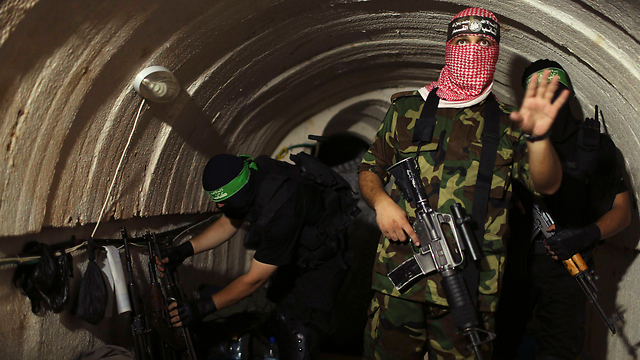
Hamas fighters inside a terror tunnel in Gaza (Photo: Reuters)

Hamas fighters inside a terror tunnel in Gaza (Photo: Reuters)

Behind the military’s ability to detect and neutralize two terror tunnels dug under Israeli territory over the last month and a half stands an original Israeli innovation developed by the Israel Military Industries and Elbit Systems.

The system involves a series of sensors and complex algorithms that analyze the gathered data and enable precise detection of tunnels. The system’s precision is still being improved since the IDF began using it on the Gaza border; it has yet to reach peak efficiency.

Before arriving at the current system, the Ministry of Defense tested all existing technologies that were proven to be able to detect tunnels, including seismographic sensors that detect the minor tremors in the ground that are caused by digging; miniature microphones that detect the sound of digging; radar and other types of sensors.

Like the Iron Dome that was developed rapidly over two years, the tunnel detection system has also been developing rapidly. According to foreign sources, the Ministry of Defense spent more than $60 million over the last five years on its development.

After it was cleared for publication Sunday that the IDF discovered and destroyed yet another cross border tunnel, Lieberman said, “The terror tunnels crossing into Israel and hurting our sovereignty are a threat we cannot accept, and we will invest any resource to foil it. Thanks to a joint effort of the IDF, Defense Ministry and defense industries, we have reached new technological capabilities in fighting tunnel terrorism. I sincerely hope within the next few months the threat posed by tunnels to residents living on the Gaza border will become a thing of the past.”

In a statement issued Sunday morning, Hamas’ military wing warned that “the enemy will pay for the aggression and crimes against our people. The enemy must be afraid and know that it will pay the price of breaking the rules of the conflict with the Gaza resistance.

“The coming days will make it clear to the enemy how wrong it was in estimating the resistance’s willpower. The enemy’s leaders and its decision makers must understand the extent of their foolish management of the battle against the resistance. We promise them that we will make them bite their fingers in regret over their misjudgments regarding the resistance’s silence and the way they are waging the battle.”

Has Iran given cruise missiles to Hizballah as well as Yemen’s Houthis?

December 11, 2017

Source: Has Iran given cruise missiles to Hizballah as well as Yemen’s Houthis? – DEBKAfile

 The maiden operational launch of Iran’s Soumar Kh-55 cruise missile was apparently entrusted to Yemen’s Houthis against a UAE target. Has it been given to Hizballah, another Iranian proxy?

Yemen’s Houthi rebels last week showed on their TV channel video footage of Iran’s most highly advanced Soumar.Kh-55 cruise missile, which can carry a nuclear warhead.  They claimed to have fired it at the unfinished Abu Dhabi power plant on Dec.3. The United Arab Emirates refuted this claim, saying that any missile reaching their air space would have been intercepted by advanced Emirati air defenses.
But would it? DEBKAfile’s military sources point out that neither Saudi Arabia nor UAE have air defense systems that are up to challenging this advanced Iranian cruise missile. With a maximum range of up to 3,000km, this reportedly re-engineered Russian KH-55 cruise missile, which could reach Israel from Iran, flew 600km on its test voyage in 2015 and can be launched from ships, aircraft and submarines.

Six examples of the Russian original were smuggled to Iran through Ukraine in 2001. It was never established whether they came with or without their nuclear warheads, but the intelligence presumption was that the vendors (most likely Ukrainian officers in charge of the stores) handed over the technical manuals for mounting them on the missiles. In April 2015, by which time this embarrassing affair had been brushed out of sight, six world powers signed a nuclear deal with Iran. No one bothered to mention the half a dozen nuclear-capable cruise missiles already reposing quietly in Iran’s arsenal.
But shortly after that deal was in the bag, the Iranian defense minister at the time announced he had just inaugurated what he called “the Soumar production line.”

Two years later, in January 2017, the re-engineered missile had its first field test. While US and Israeli officials appeared impervious, the German Die Welt newspaper reported that the Iranian Soumar had hit its target 600km away.  On Dec. 3, the Soumar conducted its first real operation. It was the Houthi strike against the UAE nuclear plant under construction at al Barakah in Abu Dhabi. It took place in the full sight of US and Middle East intelligence surveillance.  DEBKAfile’s military and intelligence sources report that the Iranian variety of the Soumar has a range of 2,500km and speed of 860km/h. It flies at very low altitudes to escape detection. Very little is known about its guidance system.
Images appearing on social media – one of which is attached to this report – showed sections of the Iran-made Soumar/Kh-55 missile on the ground at the Al-Jawf governorate of northern Yemen near the Saudi border, attesting to the fact that it was launched from there, but apparently failed to cruise towards its UAE target and exploded shortly after takeoff.

For Israeli, this episode is important as an indicator that Iran is ready to hand over to its Yemeni proxy its most highly advanced nuclear-capable hardware, for the sake of the war it is waging against Saudi Arabia and its Gulf ally. The question now is whether Tehran has also gifted this weapon to another of its proxies, the Lebanese Hizballah. Of relevance is the fact that Hizballah and Iranian officers and missile experts are physically present in Yemen alongside the Houthi insurgents and very likely attended the Soumar’s maiden launch against the UAE. At all events, Hizballah officers are obviously using the Yemen war to gain valuable experience in the use of cruise missiles, just as they have used the Syrian war to acquire important experience in large-scale combat operations and support for Russian air strikes.

Worth noting is a telling comment by the deputy commander of Iran’s Revolutionary Guards Brig. Gen Hossein Salami on Nov. 25. Discussing Iran’s ballistic missiles, Salami said that Iran was not limiting their range “due to lack of technology…We are following a strategic doctrine.” He then added: “So far we have not felt that Europe is a threat. But if Europe wants to turn into a threat, we will increase the range of our missiles.”  This was an indirect admission that Iran possesses ballistic missiles with a range of more than 2,000km which are capable of reaching Europe.


