Archive for October 17, 2017

Archaeology confirms historical writings

October 17, 2017

Archaeology confirms historical writings, Israel Hayom, Nadav Shragai, October 17, 2017

Over the past 50 years, Israel has had to avoid archaeological excavations at the heart of the Temple Mount because of pressure from Muslims and due to various political and religious constraints. As a result, archaeologists have had to shift their interest to adjacent areas.

The gamut of discoveries unearthed through their efforts – mainly near the western and southern walls – is impressive. These discoveries provide evidence of the Jewish ties to the Temple Mount and its surroundings – despite the incessant efforts by Muslims to negate those ties – as well as evidence from other periods, including when it was under Muslim rule.

On Sunday, eight stone courses of the Western Wall that had been buried under an 8-meter (26-foot) layer of earth were revealed by the Israel Antiquities Authority in the area just north of the Western Wall Plaza. A few years ago, at the southern end of the wall, excavators found what are believed to be the wall’s foundations. Thanks to the latest discovery, we now have an amazing compilation of evidence about the structure.

The discoveries announced on Sunday, especially the small theater-like structure from the Roman period, are unique. But most importantly, they provide archaeological evidence for historical documents that describe such structures at this very place.

This is not the first time archaeologists have been able to confirm descriptions provided by historical documents of the area. In fact, many findings on the site have done so. This was the case when archaeologists found what is known as the Trumpeting Place inscription near the southern end of the wall. The inscription confirmed what Jewish sages had written about the way the priests announced the onset of Shabbat during the Second Temple period, through a series of trumpet blows.

Findings along the path of the ancient drainage tunnel from the Siloam Pool to the Western Wall confirmed what the Roman historian Josephus Flavius wrote about how the Romans gouged holes in the tunnel with their spears. Even the cooking utensils used by the last Judean fighters who hid from the Romans in the city were found in the tunnel.

The theater-like structure announced on Sunday fooled some experts at first. They had initially speculated that it was the chamber where the religious assembly known as the Sanhedrin convened, and historical documents suggest that the body did, in fact, meet in the area. Finding the Sanhedrin chamber would be a great contribution to the effort to give archaeological backing to the historical timeline of Jerusalem.

Despite the appropriate excitement from Sunday’s discovery, we must remember that everything found near the Western Wall – whether ritual baths, coins, or clay fragments – attests above all to the centrality of the Temple Mount in Jewish history.

We must never forget this. The Western Wall became a replacement for the Temple and came to be seen as holy through rabbinical teachings, halachic rulings and the collective Jewish psyche. It is a symbol of the yearning for what once stood atop the holy basin.

We must avoid belittling the holiness of the wall, as some – who seek to bolster the Jewish presence on the Temple Mount – do occasionally. We must also keep in mind that the most important archaeological evidence is beyond the wall, where the Temple once existed.
Kerry on Edge as Legacy Crumbles

October 17, 2017

Kerry on Edge as Legacy Crumbles, FrontPage MagazineJoseph Klein, October 17, 2017

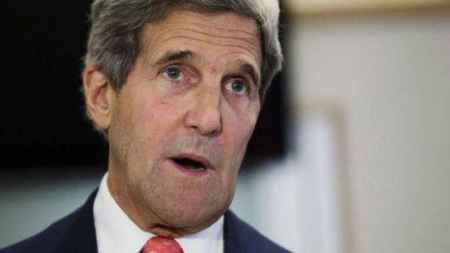
Former Secretary of State John Kerry wasted no time condemning President Trump’s decision not to recertify, and to possibly withdraw from, the disastrous nuclear deal with Iran that Kerry negotiated on behalf of his boss Barack Obama. President Trump insisted on significant improvements to the Joint Plan of Comprehensive Action (JCPOA), as the deal is formally known. The JCPOA’s fundamental flaws that President Trump wants fixed include Iran’s ability to block unfettered international inspections, the wiggle room that Iran is exploiting to continue developing and testing ballistic missiles capable of delivering nuclear weapons, and the sunset clause on nuclear enrichment that would provide Iran a clear path to becoming a nuclear armed state after the current restrictions are lifted. Obama and Kerry had promised that these issues would be dealt with satisfactorily before agreeing to the final terms of the JCPOA. Instead they caved to Iranian pressure in order to get the deal done.

Now that President Trump is trying to clean up the mess Obama and Kerry left him, Kerry has the gall to label President Trump’s decision a “reckless abandonment of facts in favor of ego and ideology” and to accuse the Trump administration of “lying to the American people.” It was the Obama administration that recklessly abandoned the facts in pressing ahead with the deal. The Obama administration lied to the American people, abandoning its own promises to ensure that the deal contained ironclad protections. Moreover, all that President Trump has done so far is to return the JCPOA to Congress for review. Had Obama followed the Constitution and submitted the JCPOA to the Senate as a treaty in the first place, the JCPOA in its present form almost certainly would not have been approved. Congress should now have the opportunity to revisit the JCPOA to determine whether the protections that the Obama administration promised are working as advertised. Congress should also consider whether time limits on Iran’s commitments continue to make sense in light of what we are now experiencing with Iran’s nuclear technology collaborator, North Korea. It bought time to turn into a full-fledged nuclear power under our noses.

Kerry had promised that the Iranian regime would be prohibited from testing ballistic missiles. This turned out to be a lie. After the JCPOA was finalized, with no such prohibition included, Iran continued to test such missiles. The Obama administration’s response was that the missiles had become a separate issue, to be dealt with under a new United Nations Security Council resolution endorsing the JCPOA.  The new resolution replaced clear prohibitions imposed on Iran’s ballistic missile program with a weak declaration in an annex that simply “calls upon” Iran not to undertake any activity such as development and test launches related to ballistic missiles designed to be capable of delivering nuclear weapons for eight years.

Iran has tested several ballistic missiles during the last two years, including two Qadr H missiles with the phrase “Israel must be wiped out” emblazoned on the sides. The commander of Iran’s Army, Major General Ataollah Salehi, had told reporters just a month before the launch of those missiles that Iran was “neither paying any attention to the resolutions against Iran, nor implementing them. This is not a breach of the JCPOA.”

Russian Ambassador to the United Nations Vitaly Churkin, spurning requests from Obama administration officials to impose sanctions against Iran under the Security Council resolution, asserted that the Iranian missile test did not violate the resolution. “A call is different from a ban so legally you cannot violate a call, you can comply with a call or you can ignore the call, but you cannot violate a call,” the Russian ambassador said. In short, the JCPOA did not cover the missile tests and the replacement UN Security Council resolution that did mention the missiles is toothless.

Deputy National Security Advisor Ben Rhodes told CNN, during an interview aired on April 6, 2015,  that under the deal’s terms then still being negotiated, “you will have anywhere, anytime, 24/7 access as it relates to the nuclear facilities that Iran has.” Rhodes claimed that “if we see a site that we need to inspect on a military facility, we can get access to that site and inspect it. So if it’s a suspicious site that we believe is related to its nuclear efforts, we can get access and inspect that site through the IAEA.” This was another lie. After the JCPOA was finalized in July 2015, Rhodes shamelessly denied that anytime, anywhere inspections were ever considered as part of the negotiations. “We never sought in this negotiation the capacity for so-called anytime, anywhere,” Rhodes said on July 14, 2015.

The JCPOA’s supporters, including Kerry, have made much of the fact that the International Atomic Energy Agency (IAEA) has on several occasions verified Iran’s compliance with its commitments under the JCPOA, keeping its stock of low-enriched uranium below the limit set forth in the JCPOA and not pursuing further construction of the Arak reactor. Iran was found to have slightly exceeded the limit on its stock of heavy water, but has remedied the problem to the IAEA’s satisfaction. IAEA chief Yukiya Amano reiterated in a statement he issued on October 9th that Iran has remained in compliance with its JCPOA commitments.

The problem, as any clear-eyed observer of the process recognizes, is that the IAEA relies on Iran for self-inspection of certain sites that the regime does not want the IAEA to inspect freely on its own. IAEA inspectors have avoided examining military sites it knows exists and has no reliable way of tracking undeclared sites. The IAEA’s explanation for not visiting any of Iran’s known military sites is that it had “no reason to ask” for access. Evidently, the IAEA is supposed to block out the fact that Iran had conducted tests relevant to nuclear bomb detonations at a military site before the JCPOA’s finalization in 2015. The IAEA should just pretend that such tests could not possibly happen again.

“Nobody is allowed to visit Iran’s military sites,” said Iran’s Head of Strategic Research Center at the Expediency Council and adviser to Supreme Leader Ayatollah Khamenei, Ali Akbar Velayati. Intimidation works. The IAEA knows not to ask.

As to the JCPOA’s sunset provisions, the Obama administration lied about that too. Kerry claimed on September 2, 2015 that the JCPOA “never sunsets. There’s no sunset in this agreement.”

This month Kerry has resorted to parsing words. He claims the phrase ‘sunset provisions’ is a “misnomer,” before then defending the JCPOA’s time limits. “We were comfortable because the cap on Iran’s low-enriched uranium stockpile remains in place until 2030,” Kerry wrote in an article published in the Washington Post late last month. In other words, let’s just kick the can down the road and hope for a more reasonable Iranian regime in 13 years that would agree to extend the time limits. In the meantime, Kerry advises us not to worry. Kerry declared, “15 or 25 years from now, we still have the same military options we have today.”

John Kerry has obviously learned nothing from the North Korean fiasco, which resulted from years of phony agreements with the rogue regime and so-called “strategic patience.” The United States clearly does not have the same military options today to deal with a nuclear armed North Korea as it did 23 years ago when former President Bill Clinton decided not to use military force to stamp out North Korea’s nuclear program at its inception. Instead, Clinton started us down the primrose path of naïve diplomacy with a duplicitous regime that now is on the verge of being able to strike the U.S. mainland with nuclear warheads delivered by intercontinental ballistic missiles. It is precisely because North Korea’s actions over the last 23 years have proven that making concessions to a rogue regime in order to obtain denuclearization commitments is so dangerous that President Trump does not want to make the same mistake with Iran.

America’s European allies are also upset with President Trump for refusing to recertify the deal and threatening to pull out if certain conditions are not met. British Prime Minister Theresa May, French President Emmanuel Macron and German Chancellor Angela Merkel issued a joint statement last Friday praising the JCPOA and its implementation. They said that the nuclear deal with Iran was “the culmination of 13 years of diplomacy and was a major step towards ensuring that Iran’s nuclear programme is not diverted for military purposes. Therefore, we encourage the US Administration and Congress to consider the implications to the security of the US and its allies before taking any steps that might undermine the JCPOA, such as re-imposing sanctions on Iran lifted under the agreement.”

Perhaps these European leaders should remember their own history. Appeasement through phony deals with a rogue dictatorship does not work, as proven by the infamous Munich Pact signed by British and French Prime Ministers Neville Chamberlain and Edouard Daladier with German Chancellor Adolf Hitler seventy-nine years ago.

UN Accused of ‘Blackmailing’ Israeli Telecomm Company to Cut Services to Jews

October 17, 2017

BY:

Source: UN Accused of ‘Blackmailing’ Israeli Telecomm Company to Cut Services to Jews

The United Nations Human Rights Council is pressuring a major Israeli telecommunications company to cease operations in disputed areas of the Jewish state or face a potential designation as a human rights abuser, according to a copy of communications sent by the Human Rights Council that is being viewed as an attempt to blackmail international corporations into boycotting the Jewish state.

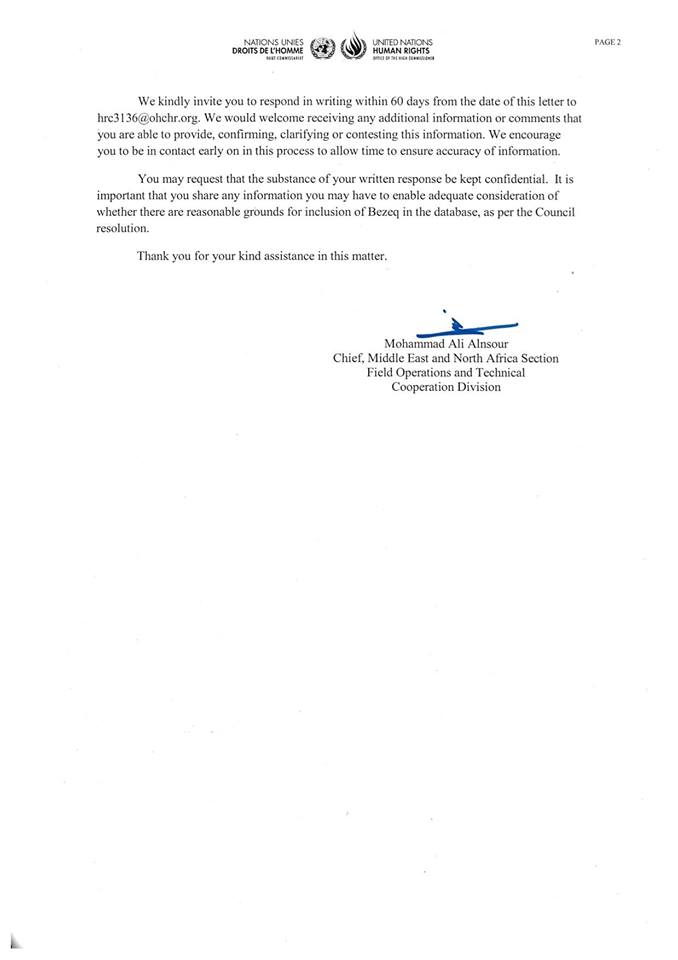
The UNHRC recently sent a letter to the CEO of Bezeq, a major Israeli telecoms firm, accusing it of promoting settlement activity in Israel and of providing cellular services to areas that the Council believes are Palestinian territory.

The UNHRC’s effort to create a database of companies working in and with Israel is being viewed by pro-Israel leaders as an effort to intimidate Israeli and Western businesses as part of the Boycott, Divestment, and Sanctions movement, or BDS, a global effort that has been described by the United States and others as anti-Semitic in nature. Bezeq is among a number of companies, including those in America, who have received such letters from the UNHRC.

A senior U.S. official familiar with the situation said the Trump administration opposes the UNHRC database and views it as part of a larger effort to isolate the Jewish state and use the United Nations to bully international corporations.

The UNHRC has long been accused of harboring an anti-Israel bias and recently elected a number of prominent global human rights abusers to take a seat at the council, including nations such as the Democratic Republic of Congo, Afghanistan, Angola, and Qatar, all of which have been accused of violating their citizens’ human rights.

The UNHRC’s effort to create a database of corporations that it claims support Israeli settlement growth and the abuse of Palestinian human rights has been described by some pro-Israel voices as a blackmail effort meant to undermine the Jewish state’s international standing.

The UNHRC sent a letter to Bezeq in late September accusing it of “supporting the maintenance and existence of settlements, as well as the “use of nature resources, in particular water and land, for business purposes,” according to a copy of that letter that first circulated on Facebook.

The UNHRC threatens to add Bezeq to its database of companies operating in what it claims are Israeli settlements and the occupied Palestinian territories.

“Bezeq owns approximately 40 real estate properties in the West Bank used for telecommunications infrastructure, and operates antennas throughout the West Bank,” the UNHRC wrote in its letter.”

“Bezeq provides landline, cellular, internet, and cable TV services to residents of settlements in the West Bank,” according to the UNHRC, which considers this activity a violation of its accords.

A spokesperson for the U.S. Mission to the UN criticized the creation of the database, telling the Washington Free Beacon the United States will not participate in such an effort.

“We have made clear our opposition regarding the creation of a database of businesses operating in Israeli settlements in the occupied territories, and we have not participated and will not participate in its creation or contribute to its content,” the official said.

Anne Bayefsky, a prominent pro-Israel activist and head of Human Rights Voices, a watchdog group that monitors anti-Israel bias at the UN, told the Free Beacon the letter to Bezeq represents an effort by the international body to promote BDS efforts against Israel.

“The UN High Commissioner for Human Rights, Jordanian Prince Zeid Al Hussein, acting in cahoots with the UN Human Rights Council, has been blackmailing companies around the world as part of a UN BDS campaign directed at Israel,” Bayefsky said.

Similar letters have been sent to companies across the globe, threatening them with inclusion into this anti-Israel database.

“Until now, the UN High Commissioners Office has been sending around secret letters both to companies and to states, threatening them with inclusion in a database of offenders that the UN plans to release by the end of the year,” Bayefsky said. “The database is to include companies that ‘directly or indirectly’ are connected to Israeli settlements. It is nothing short of an assault on the economic welfare of the state of Israel, period.”

As many as 30 American companies are believed to have received similar letters, according to Bayefsky, who urged the Trump administration to take greater action to counter the campaign.

“American shareholders and businesses, and the communities that depend on them, have no idea whether the State Department has been in touch with these companies and given them immediate and appropriate advice about how to handle this dangerous UN affront,” Bayefsky said. “The fact is that the high commissioner and the Council have no legal basis whatsoever in writing these letters or demanding any response to the Council’s anti-Israel resolutions that in turn have no legal status. Moreover, American companies that write back to the high commissioner may well violate American law, especially given numerous states that have adopted anti-BDS legislation.”

“The silence from American officials has been deafening and totally inexcusable,” Bayefsky said. “Blackmail is not defeated by playing by the blackmailers rules.”

Representatives from Bezeq and the UNHRC did not immediately respond to Free Beacon requests for comment on the matter.

After Syria strike, PM says, ‘We will hit anyone who hits us’

October 17, 2017

Source: After Syria strike, PM says, ‘We will hit anyone who hits us’ – Israel Hayom

Hours after Israeli jets bombed a Syrian anti-aircraft battery in response to missile fire at Israeli aircraft over Lebanon on Monday, Prime Minister Benjamin Netanyahu issued a brief video statement saying Israel would not be deterred and that the Syrian attempt to target Israeli aircraft was “unacceptable.”

After IAF strikes anti-aircraft battery, Syria warns of ‘dangerous consequences’ 

October 17, 2017

Source: After IAF strikes anti-aircraft battery, Syria warns of ‘dangerous consequences’ | The Times of Israel

Syrian military claims it fired at Israeli jets that penetrated its airspace, but IDF maintains they were over Lebanon

The Syrian military on Monday threatened Israel with “dangerous consequences” for the airstrikes it has carried out in the country, after Israeli Air Force jets bombed an anti-aircraft battery near Damascus earlier in the day.

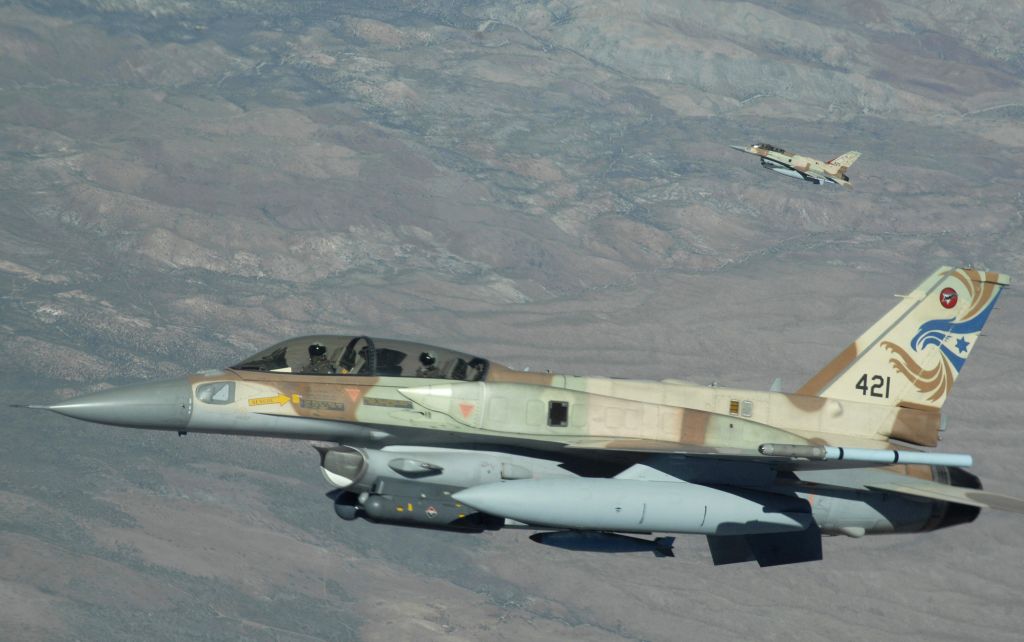
On Monday morning, the Syrian air defense battery fired an interceptor missile at Israeli reconnaissance planes. In response, a second IAF sortie, reportedly made up of F-16 fighter jets, attacked the SA-5 missile defense system that launched the interceptor, some 50 kilometers (31 miles) east of the Syrian capital.

In a statement published in official state media, the Syrian military warned Israel of “dangerous consequences for its repeated attempts of aggression.”

The Syrian military claimed the IAF aircraft entered its airspace, prompting the anti-aircraft attack. But IDF spokesperson Lt. Col. Jonathan Conricus said, both initially and in response to the Syrian assertion, that the reconnaissance planes “were in the skies over Lebanon, and not in Syria.”

According to the Syrians, the planes were flying near the Lebanese city of Baalbek, which is located near the Syrian border, approximately 50 kilometers (31 miles) north of Damascus.

The IDF would not confirm where the reconnaissance aircraft were flying when they were targeted.

Conricus said the reconnaissance planes were not struck by the interceptor missile, but the Syrian military claimed one Israeli plane was “directly hit” and “forced to flee.”

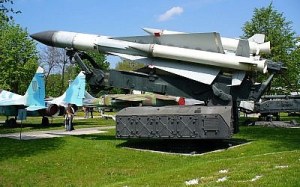
An SA-5 interceptor missile on display at the Ukrainian Air Force Museum. (George Chernilevsky/Wikimedia/CC BY-SA 3.0)

In response to the anti-aircraft missile, the IAF sent out a second sortie, which targeted the anti-aircraft system and “incapacitated” the offending SA-5 battery, the IDF said.

The SA-5, also known as the S-200, is a Russian-designed anti-aircraft system that has been in use since the late 1960s.

According to the Syrian statement, the anti-aircraft battery targeted the Israeli planes at 8:51 a.m., and the IAF retaliated approximately three hours later — which basically matched the timeline described by the Israeli military.

The Syrian military said the Israeli strike caused “material damage” to the battery, but did not report any casualties.

The exchange of fire was out of the ordinary for a number of reasons, notably that the Syrian military launched its interceptor missile not in response to an Israeli airstrike but to a more mundane reconnaissance mission, and that the IDF did not retaliate immediately but waited several hours before bombing the Syrian battery.

Analysts ascribed the former to Syrian dictator Bashar Assad’s battlefield successes, which may have prompted him to take a more aggressive approach toward Israel.

The delay in Israeli response, meanwhile, was seen as coming from the impending visit of Russian Defense Minister Sergei Shoigu, who is due to arrive in Israel on Monday afternoon.

The Russian military is allied with Assad and operates extensively in the war-torn country, and so an airstrike against Syrian forces hours before Shoigu lands in Tel Aviv would likely require a more serious consideration and approval process.

According to Conricus, the Russians were notified of the Israeli airstrike on the SA-5 battery “in real-time.”

The spokesperson said that when Shoigu arrives in Tel Aviv, “he will get a full briefing on the matter.”

Conricus acknowledged the sensitivity of the timing of the incident and the potential for it to cause tension during Shoigu’s visit, but said the military was “confident it won’t influence anything else.”

“This was obviously not a preplanned event,” he added.

In order to avoid unwanted clashes with the Russian troops in Syria, Jerusalem and Moscow have maintained a communication system over the past two years.

Israeli officials do not typically discuss the full extent of the coordination between the two militaries, but stress that the IDF does not seek Russian permission before carrying out airstrikes in Syria.

In general, Israel’s operation in Syria consist of bombing sites that are used to develop, store and transport advanced weaponry to the Iran-backed Hezbollah terrorist group. There have also been cases of the IAF responding when mortar shells and rockets “spillover” into Israel from the fighting in Syria.

Conricus said that while the army will continue to defend itself, it was not looking to “destablize” the situation with Syria.

“Preserving the relative stability is a common interest,” the lieutenant colonel said.

According to Conricus, this was the first time that Israeli aircraft were targeted by Syrian anti-aircraft missiles over Lebanese airspace since the start of the Syrian civil war. However, it was not the first time that IAF jets had been attacked by an SA-5 system.

In March, Assad’s military fired multiple interceptor missiles from an SA-5 system at Israeli jets flying over Jordan on their way back from a bombing run in Syria. The IAF jets were unharmed, but one Syrian missile seemed to be on a trajectory that took it toward an Israeli community and so it was shot down by the Arrow 2 air defense system, in the first reported use of the system.

However, in that case, Israel did not respond to the anti-aircraft attack on the IAF jets with a retaliatory airstrike on the SA-5 battery that launched it.

Arab media reports Israel hit targets in Sinai after rocket attack

October 17, 2017

Source: Arab media reports Israel hit targets in Sinai after rocket attack | The Times of Israel

Qatari newspaper, citing ‘tribal sources,’ says strike followed Egyptian targeting of Islamic State in the area

Illustrative: An Israel Air Force F-16 takes off. (Ofer Zidon/Flash90)

Tribal sources in the Sinai Peninsula said Israeli planes attacked targets in the Egyptian territory a short time after rockets were fired into Israel, the Hebrew language Ynet website reported Tuesday citing the Qatar-based Al-Araby Al-Jadeed media outlet.

The alleged attacks were in the area of Rafah and Sheikh Zweid in northern Sinai, and came shortly after the firing of two rockets on Sunday night that landed in the Eshkol region of Israel causing no damage or injuries. The Islamic State group took responsibility for the attacks on Monday.

There was no other source for the claims and Al-Araby Al-Jadeed said that the alleged IAF attack came after an airstrike by the Egyptian air force against the IS presence in the area, Ynet reported. Israel has not indicated or confirmed that it had responded to the rocket attack in any way.

IS often claims that Israel is assisting its opponents or directly targeting its forces in Syria.

The IS announcement that it had fired the two rockets was made by the Amaq News Agency, which is affiliated with the terror group.

IS claimed that during clashes with Egyptian forces, “Jewish” aircraft were assisting Egypt’s security forces and that it fired rockets at the Eshkol region in Israel in retaliation.

The two rockets struck areas inside the southern Eshkol region, an area that abuts both the Gaza Strip and the Sinai Peninsula, the IDF said at the time.

A military spokesperson said one of the missiles had been located in an open field near the communities of Magen and Ein Habesor, but that soldiers and police were still looking for the second.

The Sinai-based offshoot of Islamic State has been waging a bloody war with Egyptian forces for years and has also occasionally directed its attacks at Israel, launching rockets at nearby Jewish communities and in one case at the southern city of Eilat.

On Sunday, members of the terrorist group carried out multiple attacks on six Egyptian checkpoints near the border, killing at least six soldiers and injuring dozens more.

Egyptian officials said the near-simultaneous attacks took place at and around the town of Sheikh Zweid, with dozens of fighters using heavy machine guns and mortars. Apache helicopter gunships were called in to repel the attackers, said the officials.

An army statement said 24 of the attackers were killed and two SUVs they used were destroyed. The area was being combed by army troops in pursuit of the gunmen.

Last Thursday, six Egyptian policemen were killed in an attack in the northern Sinai region.

Occasionally, the terrorist group also launches rocket attacks at Israeli targets, in what many analysts believe to be shows of strength and attempts to score propaganda points.

In April, one rocket struck a greenhouse in the community of Yuval in the Eshkol region, slightly damaging the structure, but causing no injuries.

Another rocket was launched at Israel by the terrorist group in May, but it struck an open field.

The Associated Press contributed to this report