PM Netanyahu statement via YouTube, October 13, 2017
PM Netanyahu statement via YouTube, October 13, 2017
Initial Thoughts on Trump’s Iran Speech: Do All Roads Lead to a Pull-out?, Power Line,
If we take Trump’s speech at face value, it seems to me that all roads lead to terminating the deal. If Congress doesn’t act, Trump says he will terminate the deal.
**********************
President Trump has just given an address that outlines how he plans to proceed against Iran. The two main points are: (1) he will impose new sanctions to punish Iran’s Revolutionary Guard and (2) he will not certify the Iran nuclear deal.
The refusal to certify means that Congress has 60 days to act. Trump is asking it to adopt legislation, apparently already formulated, that would remedy the flaws in the Iran deal.
This legislation would become the basis for attempting, if possible with the help of our allies, to renegotiate (in effect) key terms of the deal with Iran. In the negotiations we would, among other things, try to improve the inspection regime and eliminate the sunset provisions (the ones that allow Iran eventually develop nukes).
Crucially, it seems to me on first analysis, Trump said that if Congress doesn’t act along these lines in 60 days, he will “terminate” the deal. The president thus attempts to light a fire under a Congress which, absent his threat, almost certainly would not act. He also attempts to light a fire under our allies who seemingly have no real desire to renegotiate with Iran.
If we take Trump’s speech at face value, it seems to me that all roads lead to terminating the deal. If Congress doesn’t act, Trump says he will terminate the deal.
If Congress acts, it can’t rewrite the deal. All it can do is formulate demands that, if not met by Iran, will result in termination, assuming Trump follows the hard line he took today.
If faced with congressional action and presidential resolve, Iran might agree to certain minor fixes to the deal. But it’s difficult for me to imagine the regime agreeing, for example, to drop the sunset clause.
Only a restoration of the crippling sanctions once in place would have any hope of achieving this result. But that hope would be faint. In any event, it’s unlikely that we could ever rally our allies to impose the truly crippling sanctions that former president Obama lifted.
If my preliminary analysis is correct, then Trump has taken the first step towards pulling the U.S. out of the Iran deal. He has done more, in other words, than just “splitting the baby” — i.e, satisfying hawks by decertifying and satisfying moderates by not pulling out of the deal or enlisting Congress for that purpose. If we take the speech at face value, we are on the road to pulling out.
The “compromise,” is that we are doing so in a measured way — one that is less easy for Democrats and U.S. allies persuasively to denounce. Trump is enlisting their aid by asking them to participate in a process that, in theory, could improve the deal to the point where the U.S. would stay in it.
In practice, the likelihood of substantially improving the deal seems slight. However, it is reasonable for Trump to give it a try, and reasonable for Democrats and our allies to participate in the effort.
I’ll conclude by saying that Trump’s speech was outstanding. In 20 minutes or so, he laid out the history of Iran’s evil-doing; excoriated the Iran deal Obama agreed to; and laid out his course of action going forward.
Will the administration follow that course or will key members persuade Trump to employ off-ramps? It’s difficult to say, or even to guess who the key members of the administration will be down the road. I’m inclined, though, to think that Trump will follow the course he laid out so solemnly today.
These observations are preliminary ones. I’m sure we’ll have more to say upon further reflection.
Trump designates Iran Revolutionary Guard Corps as a terrorist group, calls for more sanctions, Washington Examiner, Joel Gehrke, October 13, 2017
(Iran considers designation of the IRGC as a terrorist group as tantamount to a declaration of war. — DM)
As Trump spoke from the White House, the Treasury Department announced it was designating the IRGC as a terrorist entity under a White House Executive Order. That announcement said the group provides “support to a number of terrorist groups, including Hizballah and Hamas, as well as to the Taliban.”
**************************
The Trump administration on Friday designated Iran’s Islamic Revolutionary Guard Corps as a terrorist organization, a move that President Trump followed up with by calling for tougher sanctions against the organization.
“I am authorizing the Treasury Department to further sanction the entire Islamic Revolutionary Guard Corps for its support for terrorism and to apply sanctions to its officials, agents, and affiliates,” Trump said in a White House speech.
“I urge our allies to join us in taking strong actions to curb Iran’s continued dangerous and destabilizing behavior,” Trump added.
“The IRGC has played a central role to Iran becoming the world’s foremost state sponsor of terror,” Treasury Secretary Steven Mnuchin said Friday. “We urge the private sector to recognize that the IRGC permeates much of the Iranian economy, and those who transact with IRGC-controlled companies do so at great risk.”
As Trump spoke from the White House, the Treasury Department announced it was designating the IRGC as a terrorist entity under a White House Executive Order. That announcement said the group provides “support to a number of terrorist groups, including Hizballah and Hamas, as well as to the Taliban.”
Congress Seeks Deadline on Iran Accepting Tougher Nuclear Deal Standards, Washington Free Beacon, Adam Kredo, October 13, 2017

Rep. Peter Roskam / Getty Images
Roskam’s legislation would mandate that Iran permit unfettered, unannounced, and indefinite access to all of Iran’s contested nuclear sites, including military spots that have been completely off-access to international nuclear inspectors.
Iran opposes such proposals, claiming that its military sites will never been opened to the international community.
*************************************
Congress is set to consider new legislation that would require Iran to accept tough new conditions on the landmark nuclear deal or face a rash of harsh new economic sanctions aimed at thwarting the Islamic Republic’s continued nuclear buildup, according to a draft of new legislation exclusively viewed by the Washington Free Beacon.
On the heels of President Donald Trump’s announcement that he will decertify Iranian compliance with the nuclear agreement, top GOP lawmakers are already working on legislation that would compliment the White House’s announcement and move forward with efforts to harshly penalize Tehran if it does not accept rigid new standards on its nuclear activities within the next six months, according to a copy of draft legislation circulating in the House of Representatives.
The new legislation, spearheaded by Rep. Peter Roskam (R., Ill.), would reimpose all economic sanctions lifted by the former Obama administration as part of the nuclear agreement if Iran refuses to comply with tough new standards restricting its ballistic missile program, arms buildup, and failure to permit access to a range of military sites suspected of engaging in nuclear work.
The legislation also would effectively kill provisions of the nuclear agreement known as sunset clauses. These are portions of the deal that would rollback restrictions on Iran’s advanced nuclear research and weapons buildup within the next five to six years.
Trump, as well as allies in Congress, maintains the original nuclear accord contains several key flaws that permit Iran to cheat on the deal and receive sweetheart bonuses—such as sanctions relief and other assets—despite evidence of multiple violations of the agreement.
Sources who spoke to the Free Beacon about the effort to tighten the deal said that many in Congress would be willing to reimpose all key sanctions on Iran if it does not agree to abide by the stricter enforcement regulations.
“The days of appeasing the Mullah’s every wish and sitting back and watching as the terrorist state goes nuclear are over,” said one senior congressional official intimately familiar with the new proposal. “Congress overwhelmingly opposed Obama’s disastrous deal with Iran. Now’s the time to assert our constitutional responsibility to defend our nation and use all tools of U.S. power to permanently prevent an nuclear armed Iran.”
This new legislation is similar to the policy approach advocated by senior Trump administration officials, such as Secretary of State Rex Tillerson, who told reporters late Thursday the administration is looking to create a parallel nuclear deal that gives Congress a larger role in ensuring Iranian compliance.
These would include “trigger points that are specific to the nuclear program itself, but also deals with things like their ballistic missile program,” according to Tillerson.
Roskam’s new legislation, called the JCPOA Improvement Act of 2017, seeks to do precisely this.
In addition to banning Iran from developing, testing, and operating ballistic missile technology—which was never addressed in the original nuclear agreement – the new legislation would impose even stricter regulations on the amount of nuclear enrichment Iran can legally engage in.
It also would stop Iran from installing advanced nuclear centrifuges that can enrich uranium, the key component in a nuclear weapon, much faster than older versions of this equipment. Under the original nuclear agreement, known as the Joint Comprehensive Plan of Action, or JCPOA, Iran would have been granted the right to operate advanced centrifuges within the next several years.
Congress also is seeking to address Iran’s development of heavy water nuclear reactors that provide a secondary pathway to a nuclear weapon via the use of plutonium, a by-product of such equipment, according to the draft legislation and sources who spoke to the Free Beacon.
The Obama administration had worked to ensure that, under the agreement, Iran retained its right to operate such reactors, despite opposition in Congress and elsewhere. Iran has already inked several deals with Russia to assist in the construction of new light and heavy water reactors, though this new legislation could complicate that matter.
Another key portion of the original agreement that has been vehemently criticized by Trump and congressional allies surrounds caveats that give Iran more than a month before consenting to inspections of its nuclear sites.
Roskam’s legislation would mandate that Iran permit unfettered, unannounced, and indefinite access to all of Iran’s contested nuclear sites, including military spots that have been completely off-access to international nuclear inspectors.
Iran opposes such proposals, claiming that its military sites will never been opened to the international community.
If Iran does not agree to the new restrictions proposed in the legislation, Congress has the ability to reimpose all sanctions that were lifted as part of the original accord. This represents a major new tool for Congress as it works to thwart Iran’s continued military endeavors across the Middle East and its pursuit of advanced new weaponry.
Under the new legislation, any future attempt to rescind these new restrictions would be subject to a vote in the United Nations Security Council, according to the bill.
President Donald J. Trump’s New Strategy on Iran, Whitehouse.gov, October 13, 2017
“It is time for the entire world to join us in demanding that Iran’s government end its pursuit of death and destruction.” – President Donald J. Trump
President Donald J. Trump, in consultation with his national security team, has approved a new strategy for Iran. It is the culmination of nine months of deliberation with Congress and our allies on how to best protect American security.
Core Elements of the President’s New Iran Strategy
• The United States’ new Iran strategy focuses on neutralizing the Government of Iran’s destabilizing influence and constraining its aggression, particularly its support for terrorism and militants.
• We will revitalize our traditional alliances and regional partnerships as bulwarks against Iranian subversion and restore a more stable balance of power in the region.
• We will work to deny the Iranian regime – and especially the Islamic Revolutionary Guard Corps (IRGC) – funding for its malign activities, and oppose IRGC activities that extort the wealth of the Iranian people.
• We will counter threats to the United States and our allies from ballistic missiles and other asymmetric weapons.
• We will rally the international community to condemn the IRGC’s gross violations of human rights and its unjust detention of American citizens and other foreigners on specious charges.
• Most importantly, we will deny the Iranian regime all paths to a nuclear weapon.
The Nature of the Iranian Regime under Supreme Leader Khamenei
• For 28 years, Ali Khamenei has been Iran’s Supreme Leader. Before that, he held the office of President for 8 years. In that time, he has shaped the Iranian regime in his image.
• Khamenei and the IRGC have pursued a steady policy of spreading a revolutionary ideology aimed at undermining the international system and many states by force and subversion. His main enemy and rallying point has been and continues to be the United States of America, which he calls the Great Satan.
• Under Khamenei, Iran exports violence, destabilizes its neighbors, and sponsors terrorism abroad. Within Iran, under Khamenei’s rule the Iranian government has oppressed its people, abusing their rights, restricting their access to the internet and the outside world, rigging elections, shooting student protesters in the street, and imprisoning political reformers like Mir Hussein Musavi and Mehdi Karroubi.
The Threats from the Iranian Regime
• The reckless behavior of the Iranian regime, and the IRGC in particular, poses one of the most dangerous threats to the interests of the United States and to regional stability.
• The Iranian regime has taken advantage of regional conflicts and instability to aggressively expand its regional influence and threaten its neighbors with little domestic or international cost for its actions.
• This occurred most recently following the emergence of the Islamic State of Iraq and Syria (ISIS) from the vacuum created by the Obama administration’s ill-considered withdrawal from the region.
• The full range of the Iranian regime’s malign activities extends well beyond the nuclear threat it poses, including:
o Ballistic missile development and proliferation;
o Material and financial support for terrorism and extremism;
o Support for the Assad regime’s atrocities against the Syrian people;
o Unrelenting hostility to Israel;
o Consistently threatening freedom of navigation, especially in the strategically vital Persian Gulf;
o Cyber-attacks against the United States, Israel, and America’s other allies and partners in the Middle East;
o Grievous human rights abuses; and
o Arbitrary detention of foreigners, including United States citizens, on specious charges and without due process.
The Need for a Comprehensive Strategy
• The previous Administration’s myopic focus on Iran’s nuclear program to the exclusion of the regime’s many other malign activities allowed Iran’s influence in the region to reach a high-water mark.
• Over the last decade and a half, United States policy has also consistently prioritized the immediate threat of Sunni extremist organizations over the longer-term threat of Iranian-backed militancy.
• In doing so, the United States has neglected Iran’s steady expansion of proxy forces and terrorist networks aimed at keeping its neighbors weak and unstable in hopes of dominating the greater Middle East. Recently, the Iranian regime has accelerated the seeding of these networks with increasingly destructive weapons as they try to establish a bridge from Iran to Lebanon and Syria.
• The Trump Administration will not repeat these mistakes.
• The Trump Administration’s Iran policy will address the totality of these threats from and malign activities by the Government of Iran and will seek to bring about a change in the Iranian’s regime’s behavior.
• The Trump Administration will accomplish these objectives through a strategy that neutralizes and counters Iranian threats, particularly those posed by the IRGC.
Countering the IRGC
• Supreme Leader Khamenei’s primary tool and weapon in remaking Iran into a rogue state has been the hardline elements of the IRGC.
• The IRGC’s stated purpose is to subvert the international order. The IRGC’s power and influence have grown over time, even as it has remained unaccountable to the Iranian people, answering only to Khamenei. It is hard to find a conflict or a suffering people in the Middle East that the IRGC’s tentacles do not touch.
• Unaccountable to Iran’s elected leaders or its people, the IRGC has tried to gain control over large portions of Iran’s economy and choke off competition, all the while working to weaken and undermine Iran’s neighbors and perpetuate the chaos and instability in which it thrives.
• The IRGC has armed Bashar al Assad and guided his butchering of his own people in Syria and has cynically condoned his use of chemical weapons.
• The IRGC has sought to undermine the fight against ISIS with the influence of militant groups in Iraq under the IRGC’s control.
In Yemen, the IRGC has attempted to use the Houthis as puppets to hide Iran’s role in using sophisticated missiles and explosive boats to attack innocent civilians in Saudi Arabia and the United Arab Emirates, as well as to restrict freedom of navigation in the Red Sea.
• The IRGC has even threatened terrorist attacks right here at home. Senior IRGC commanders plotted the murder of Saudi Arabia’s Ambassador to the United States, Adel Jubeir, on American soil in 2011. But for exceptional work by our law enforcement and intelligence officers to detect and disrupt this egregious act, the IRGC would have conducted this terrorist attack and assassination in our own capital and would have killed not only a Saudi Arabian diplomat, but a host of other innocent bystanders at a popular restaurant in Washington, D.C.
• The IRGC, which repeatedly displays reckless hostility and disregard for the laws and norms that underpin the international order, threatens all nations and the global economy.
• Our partners in the international community agree with us that the IRGC’s reckless behavior threatens international peace and security. They agree that the IRGC is fanning sectarianism and perpetuating regional conflict. They agree that the IRGC is engaged in corrupt economic practices that exploit the Iranian people and suppress internal dissent, human rights, and Iran’s economic prosperity.
• For all these reasons, we want to work with our partners to constrain this dangerous organization, for the benefit of international peace and security, regional stability, and the Iranian people.
The Iranian Nuclear Program and the Joint Comprehensive Plan of Action
• The Iranian regime’s activities severely undercut whatever positive contributions to “regional and international peace and security” the Joint Comprehensive Plan of Action (JCPOA) sought to achieve.
• Even with regard to JCPOA itself, the Iranian regime has displayed a disturbing pattern of behavior, seeking to exploit loopholes and test the international community’s resolve.
• Iranian military leaders have stated publicly that they will refuse to allow International Atomic Energy Agency (IAEA) inspections of their military sites. These statements fly in the face of Iran’s commitments under JCPOA and the Additional Protocol. Not long ago these same organizations hid nuclear facilities on military sites.
• This behavior cannot be tolerated; the deal must be strictly enforced, and the IAEA must fully utilize its inspection authorities.
Put Iran back on the defensive, Israel Hayom, Amnon Lord, October 13, 2017
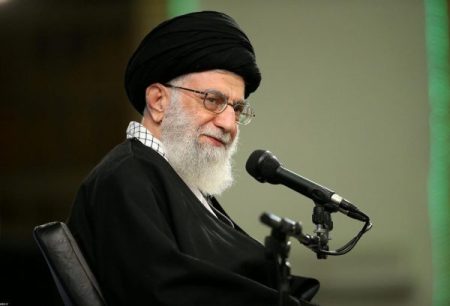 Iran’s Supreme Leader Ayatollah Ali Khamenei | Photo: Reuters
A recent interview with Brig. Gen. (ret.) Uzi Eilam, former director of the Atomic Energy Commission at the Prime Minister’s Office, has all but slipped under everyone’s radar.
During the interview, Eilam let it slip that in early 2015, when the fight against the nuclear deal with Iran was in full gear, he traveled to Washington to lobby support for the deal among Democratic senators and congressmen. Recently, we also learned that former National Security Adviser Uzi Arad and former Israeli Consul General in New York Alon Pinkas are part of a campaign by the left-wing Jewish lobby group J Street, which purports to be pro-Israel, to preserve the deal.
If the 2015 deal is so good, why is Prime Minister Benjamin Netanyahu so eager to amend it? And why did he so vehemently oppose it to begin with? If the deal is solid, why do the moderate Sunni states such as Egypt and Saudi Arabia oppose it? Why is U.S. President Donald Trump against it? Does the Israeli public really have to trust the judgment of former defense and diplomatic officials?
The truth is that it is quite bewildering that experts continue to insist on sticking to the deal when, two years in, the results are clear: Iran has massively infiltrated Syria and a new threat to Israel has emerged from the north. Those who supported the agreement apparently failed to fully understand its implications, or they knowingly covered up then-President Barack Obama’s rapprochement attempts with Iran at Israel’s expense.
Meanwhile, the Iranians have successfully taken over not only Damascus and Beirut, but also Iraq, Yemen and the Bab el Mandab Strait, a strategic waterway between Yemen on the Arabian Peninsula and Djibouti and Eritrea in the Horn of Africa. A senior intelligence official told me a month ago that there was a clear link between the approval of the nuclear agreement in July 2015 and the Russian invasion of Syria two months later. If anything, there is no doubt that Obama’s policy and the nuclear agreement paved the way for an Iranian-Russian takeover of the war-torn country.
The Israeli media all but ignored Obama’s moves over Iran. The Israeli and American intelligence agencies conducted effective warfare to sabotage the secret networks through which Iran built its nuclear program, but Obama vetoed these efforts, effectively terminating cyber warfare against Iran and lending international legitimacy to the Islamic republic’s nuclearization effort – efforts by a nation that has openly and repeatedly announced its clear intention to annihilate the State of Israel.
Above all, the nuclear agreement lifted the economic sanctions the international community had imposed on Iran. These sanctions, imposed due to American and Israeli pressure, had pushed into a corner, isolated it and placed it under constant international pressure. Obama freed Iran from this yoke and all but launched a campaign that delegitimized Israel, its government and its leader. Yet all of it was covered up by senior Israeli security officials and the Israeli media.
If Trump makes good on his threat and decertifies the nuclear deal, it will be the first step toward rectifying the situation and putting Iran back on the defensive. This would benefit Israel by pushing back the threat of an armed conflict on the northern border.
At this time, the effort to change the 2015 agreement in a way that prevents Iran from pursuing nuclear armament within eight years should be clear to the intelligence and security sages who are so supportive of the deal. North Korea barreled through two nuclear agreements negotiated by Wendy Sherman, the chief American negotiator with Iran, and emerged as a menacing nuclear threat.
Between the cabinet and the battlefield
The meeting between Netanyahu and Russian President Vladimir Putin in August, the massive military exercise in the northern sector in early September, the strike on a chemical weapons facility near Damascus last month, and defense officials’ publicly-voiced concerns about Iran’s military entrenchment in Syria, all made various pundits catch a whiff of napalm in the morning. But contrary to the perceived rise in security tensions in recent weeks, the IDF believes that chances of a flare-up on the Lebanese-Syrian front are waning.
One can argue about the scope of the strategic impact the Russian-Iranian alliance has on Israel. American analysts, who understood early on where Obama was heading with respect to Iran, believe the Russian-Iranian axis is very bad news for the United States as well as for Israel.
But the IDF has a different assessment, at least for the foreseeable future, according to which the Russian presence in Syria is deferring a potential conflict. Moreover, the Iranian presence in Syria appears less menacing when Revolutionary Guard soldiers are replaced by random Shiite militias.
The military says its multi-year work plan continues to evolve according to the dynamic map of threats from the north and it rejects claims that it is leading the IDF down the wrong path. According to a report by the Foreign Affairs and Defense Committee’s Subcommittee on the Defense Doctrine, which is an important intellectual venture led by Yesh Atid MK Ofer Shelah, the preparatory work done by the IDF to compose the multi-year work plan and its implementation so far are indeed impressive.
Nevertheless, even the apparently flattering report alludes to the fact that 11 years after the Second Lebanon War, the ground forces have yet to fully stabilize, while the Israeli Air Force has undergone a tremendous process of reinforcement. This is the military arm decision-makers continue to rely on, in conjunction with the IDF’s special forces, at the moment of truth.
Still, a critical review of the report reveals a serious problem that has not been resolved in Israel’s political reality: the interface between the political leadership and the IDF. The report criticizes the political echelon, saying it fails to provide the military with clear, written instructions and objectives. This makes it difficult for the military to adapt, outline its operational plans and build its strength.
Committees and cabinet meetings will not bring salvation. The IDF’s senior echelon must consider the fact that cabinet ministers cannot serve as a collective commander of the IDF’s operations in wartime. The cabinet was designed to supervise military moves, and while it can be called upon to decide on various operational alternatives before and during a conflict, it is up to military commanders to assume operational responsibility. The desire by lawmakers who see themselves as military experts to be involved to the point of making the military’s decisions for it is very unhealthy.
But there is one thing that can be expected from the political echelon: a decision on the strategic concept with respect to Hezbollah. Is Lebanese infrastructure a legitimate target in a potential future war, or is the IDF required to surgically deal only with Hezbollah elements? The answer to this question is not as simple as the hawks in the government would have the public believe.
Repeal and Replace In Farsi, Washington Free Beacon, Matthew Continetti, October 13, 2017
(Are the media playing games with their headlines as usual or are their reports accurate? Here’s a link to the principal Times of Israel article cited, Netanyahu at odds with security team over Iran deal. — DM)
President Donald Trump is flanked by GOP senators to discuss health care / Getty Images
[T]he headlines preceding today’s remarks have been almost entirely shaped by the deal’s supporters, by the echo chamber that promoted and distorted the aims and conditions of the agreement to begin with. These were but some of the stories in Thursday’s edition of the Times of Israel: “Barak urges Trump not to decertify Iran nuke deal,” “Netanyahu at odds with security team over Iran deal,” “With Trump set to decertify Iran deal, experts tell Congress to stick to accord,” “Jewish Democrats who opposed Iran nuke deal now urge Trump to keep it.” You have to look hard for a piece detailing Iranian noncompliance, explaining the process of decertification and its relation to the overarching agreement, or quoting defenders of the president and his policy.
****************************************
President Trump is expected to announce today that he cannot certify Iran’s compliance with the terms of the agreement over its nuclear program that it entered into with the United States and five other nations in 2015. The president’s decision, according to the Iran Nuclear Agreement Review Act of 2015, will commence a 60-day expedited legislative process during which the Republican-controlled Congress may re-impose sanctions against the Islamic theocracy for its intransigence and belligerence. Sanctions, I might add, that should never have been lifted in the first place.
What is striking is that, with the exception of Senator Tom Cotton of Arkansas, none of the Republicans and Democrats who opposed the nuclear deal two years ago with such vehemence have gone out of their way to prepare the ground and make the national security case for the president’s decision.
Now, the Democrats I can understand. They are just playing to type. To say a kind word for Trump’s attempt to improve the deal would violate the secular commandment to resist his very being. The Republican silence, by contrast, is far more maddening.
This is the party that invited Bibi Netanyahu to criticize the deal in an address to a joint session of Congress. This is the party whose 2016 platform reads, “A Republican president will not be bound by” the deal and “We must retain all options in dealing with a situation that gravely threatens our security, our interests, and the survival of our friends.” This is the party that nominated and elected a president who said his “number one priority is to dismantle the disastrous deal with Iran.”
Yet the headlines preceding today’s remarks have been almost entirely shaped by the deal’s supporters, by the echo chamber that promoted and distorted the aims and conditions of the agreement to begin with. These were but some of the stories in Thursday’s edition of the Times of Israel: “Barak urges Trump not to decertify Iran nuke deal,” “Netanyahu at odds with security team over Iran deal,” “With Trump set to decertify Iran deal, experts tell Congress to stick to accord,” “Jewish Democrats who opposed Iran nuke deal now urge Trump to keep it.” You have to look hard for a piece detailing Iranian noncompliance, explaining the process of decertification and its relation to the overarching agreement, or quoting defenders of the president and his policy.
And the reason you have to look hard is that there are few elected Republicans who are taking the lead on this issue. Internal division, uncertainty, and personal rivalry may once again prevent the congressional GOP from achieving the aims it has stated loudly and proudly for years. The parallels to the attempted repeal and replacement of Obamacare are startling and, for this conservative, disturbing. “This is health care for us,” Ben Rhodes said of the Iran deal back in 2014. It would be both a diplomatic and a political disaster if the Republicans flopped as badly while trying to undo the central achievement of Barack Obama’s second term as they had while trying to undo the central achievement of his first.
Iranian noncompliance is a no-brainer. Look at the number of advanced centrifuges Iran is currently operating, its repeated violation of limits on its heavy water stocks, its underground efforts to obtain nuclear- and missile-related technologies. Look at the IAEA’s acknowledgment in September that it has difficulty verifying compliance with Section T of the Joint Comprehensive Plan of Action, which forbids “activities which could contribute to the development of a nuclear explosive device.”
And look at the Swiss cheese inspections regime. How can the president in good conscience certify compliance when no Americans are involved in the inspections, when inspections are limited to “declared” nuclear sites, when the Iranians have 24 days to prepare for IAEA inspections of other locations, when inspectors are forbidden from examining military bases? We have no idea what is going on in such places, much less in the places we do not know about. Remember: We didn’t know about the installations at Natanz and Arak until 2002 and the one at Fordow until 2009.
Of course a serious agreement would allow access to military locations. The apologies for Iranian stubbornness on this point are absurd. “For many Iranians—including those who support the nuclear deal—keeping inspectors out of military facilities is a point of national pride,” write Shashank Bengali and Ramin Mostaghim of the Los Angeles Times. Funny that national pride is okay as long as it’s Iran we’re talking about. Bengali and Mostaghim quote a “newspaper employee” in Tehran, Susan Saderi, who says, “It’s our country, and any country’s defense systems should be off limits to international inspections.”
No offense, Ms. Saderi, but you know whose defense systems are not off limits to international inspections?
Ok, the PLA probably didn’t allow General Dunford to count ammo stocks in Shenyang. But the point stands. The arms control treaties we signed with the Soviet Union permitted American inspectors to visit military locations. That was the whole point of trust but verify. President Obama may have trusted the Iranians—but then President Obama trusted Harvey Weinstein to oversee his daughter’s post-high school internship earlier this year. Why should Donald Trump play the patsy?
“If the political branches, [work] on a bipartisan basis on the parts of the deal we all know are flawed,” Cotton said earlier this month, “we will have the strong and unified front between Democrats and Republicans, and between Congress and the president, that the Iran deal never enjoyed. That unity will help the president forge a unified position with our allies—not only the United Kingdom, France, and Germany, but also Israel and our Arab allies. Then it will be Russia and China who must choose between a stronger deal and being isolated and in league with the ayatollahs.”
Are Republicans prepared to close ranks in a “strong and unified front” to remove the sunset clauses from the Iran deal, impose further limits on Iranian centrifuges, include Americans on IAEA inspection teams that have access to Iranian military bases, and constrain Iranian missile development? Or will they prove as disunited, feckless, spiteful, and incompetent as they did during the repeal and replace debacle?
I’m not sure I want to know the answer.
White House unveils ‘new strategy’ for Iran ahead of nuclear deal announcement, Washington Examiner, Sarah Westwood, October 13, 2017
Trump is expected to apply particular pressure to the IRGC, which has been accused of human rights abuses. The IRGC’s activities, like many other Iranian offenses, did not fall under the provisions laid out by the Obama administration in the nuclear agreement.
**********************************
The Trump administration announced a “new strategy” for dealing with Iran that involves cracking down on aggressions that fall outside of the “myopic” nuclear agreement, the White House said Friday ahead of Trump’s announcement of his plan for the deal.
That strategy will focus on Iran’s ballistic missile testing, destabilizing activities throughout the region in countries like Yemen and Syria, and the violence of the Islamic Revolutionary Guard Corps, an arm of the Iranian military, the administration said.
“The Trump administration’s Iran policy will address the totality of these threats from and malign activities by the Government of Iran and will seek to bring about a change in the Iranian’s regime’s behavior,” the White House said Friday.
The plan runs the risk of antagonizing Iran to the point at which it could decide to declare the nuclear agreement has been violated. But Trump said Iran’s destabilizing activities need to be checked.
“It is time for the entire world to join us in demanding that Iran’s government end its pursuit of death and destruction,” Trump said in a statement announcing the plan.
Trump is expected to apply particular pressure to the IRGC, which has been accused of human rights abuses. The IRGC’s activities, like many other Iranian offenses, did not fall under the provisions laid out by the Obama administration in the nuclear agreement.
“We will work to deny the Iranian regime — and especially the Islamic Revolutionary Guard Corps (IRGC) — funding for its malign activities, and oppose IRGC activities that extort the wealth of the Iranian people,” the White House said. “We will rally the international community to condemn the IRGC’s gross violations of human rights and its unjust detention of American citizens and other foreigners on specious charges.”
“Most importantly, we will deny the Iranian regime all paths to a nuclear weapon,” it added.
Trump is expected to decline to certify the Iran nuclear deal during a speech on Friday, although he is not expected to scrap the deal altogether.
The president has previously described the agreement as an “embarrassment” to the U.S. and the “worst deal ever negotiated.”




 anneinpt
 artaxes
 danmillerinpanama
 davidking1530
 Peter Hofman
 Joseph Wouk
 Peter
Peter Louisiana Steve
 WarSclerotic
Recent Comments